INTRODUCTION
Outdoor-based egg production (e.g. organic and free-range) is a growing industry in many European countries, including Denmark (Windhorst, Reference Windhorst2005; Anonymous, 2015; Wall et al. Reference Wall, Jeremiasson, Jeremiasson, Odelros, Eriksson and Jansson2016). In Denmark, as of 2014, the annual table egg production is 60·9 million kg of which organic and free-range productions share 20·1 and 5·6%, respectively (Anonymous, 2015). Within the European Union (EU), both systems require laying hens to have outdoor access to promote natural behaviours and increase animal welfare (Anonymous, 1999, 2008). Unfortunately, outdoor-based production systems are characterized by high infection levels with the ascarid parasites, Ascaridia galli and Heterakis spp. (Permin et al. Reference Permin, Bisgaard, Frandsen, Pearman, Kold and Nansen1999; Jansson et al. Reference Jansson, Nyman, Vågsholm, Christensson, Göransson, Fossum and Höglund2010; Kaufmann et al. Reference Kaufmann, Daş, Sohnrey and Gauly2011; Bestman and Wagenaar, Reference Bestman and Wagenaar2014; Thapa et al. Reference Thapa, Hinrichsen, Brenninkmeyer, Gunnarsson, Heerkens, Verwer, Niebuhr, Willett, Grilli, Thamsborg, Sørensen and Mejer2015a). This is problematic as they can impair the health of chickens (Ikeme, Reference Ikeme1971; Schwarz et al. Reference Schwarz, Gauly, Abel, Daş, Humburg, Rohn, Breves and Rautenschlein2011a, Reference Schwarz, Gauly, Abel, Daş, Humburg, Weiss, Breves and Rautenschleinb), thus causing production losses (Skallerup et al. Reference Skallerup, Luna, Johansen and Kyvsgaard2005; Phiri et al. Reference Phiri, Phiri, Ziela, Chota, Masuku and Monrad2007) and welfare problems (Gauly et al. Reference Gauly, Duss and Erhardt2007; Hinrichsen et al. Reference Hinrichsen, Riber and Labouriau2016). Furthermore, ascarids can act as vectors for dissemination of other pathogens such as Salmonella enterica (Chadfield et al. Reference Chadfield, Permin, Nansen and Bisgaard2001) and Histomonas meleagridis (McDougald, Reference McDougald2005).
Both A. galli and Heterakis spp. have a direct life-cycle maintained by a fecal–oral route of transmission (Ackert, Reference Ackert1931; Madsen, Reference Madsen1962). Their eggs are morphologically similar with a thick shell consisting of three to four layers (Christenson et al. Reference Christenson, Earle, Butler and Creel1942; Lee and Lešťan, Reference Lee and Lešťan1971; Wharton, Reference Wharton1980) that help to increase the survival of the enclosed embryo or larva in the environment (Jasoski, Reference Jasoski1954; Wharton, Reference Wharton1980). In the outdoor environment, eggs cannot be easily removed and there is a high risk of accumulation of eggs in pastures over time thus acting as a continued source of infection to newly placed hens.
There are no effective ways to control pasture contamination, except from spelling (resting) the areas until eggs die off by natural mortality over time. Currently, the only effective option to control ascarid infections is use of synthetic anthelmintics, but overuse of anthelmintics may over time select for anthelmintic resistance as seen for other nematode parasites (Sutherland and Leathwick, Reference Sutherland and Leathwick2011). Helminth infections in organic systems in general might be reduced by improved management practices such as pasture rotation (Thamsborg et al. Reference Thamsborg, Roepstorff and Larsen1999). To allow vegetation to grow back and to reduce nutrient deposition and leaching, Danish regulations state that each henhouse must have more than one pasture (free-range area) and that the pasture must be kept free of hens for at least 60 consecutive days per year or 120 days every second year during the growing season (Anonymous, 2012; Hermansen et al. Reference Hermansen, Munkholm, Bruus, Eriksen, Poulsen, Kronvang, Bak, Dalgaard, Kristensen, Rasmussen, Adamsen, Hansen, Brüsch, Thorling, Magid, Rasmussen and Jensen2015). Overall, pasture rotation schemes in Denmark are less than 1 year (Thapa et al. Reference Thapa, Hinrichsen, Brenninkmeyer, Gunnarsson, Heerkens, Verwer, Niebuhr, Willett, Grilli, Thamsborg, Sørensen and Mejer2015a) and bird flocks receive no targeted parasite control.
The effectiveness/duration of pasture rotation is partly determined by the longevity of the parasite eggs in the pasture, but comprehensive data are lacking. Some qualitative studies have indicated that chicken ascarid eggs can survive for up to 4·4 years in the soil (Farr, Reference Farr1956, Reference Farr1961; Velichkin and Merkulov, Reference Velichkin and Merkulov1970). On-farm, most ascarid eggs deposited on soil surfaces are expected to die off quickly due to abiotic factors such as desiccation (Tarbiat et al. Reference Tarbiat, Jansson and Höglund2015) and UV-light (Dubinský, Reference Dubinský1969). However, eggs protected in the soil may survive long term (Ackert and Cauthen, Reference Ackert and Cauthen1931), but this has not yet been evaluated quantitatively. The present study therefore aimed to quantify over time the relative development and recovery of chicken ascarid eggs that had been buried in pasture soil during spring and winter.
MATERIALS AND METHODS
Experimental design
Unembryonated chicken ascarid eggs were mixed with soil (approximately 1300 eggs g−1 soil), placed inside sealed nylon bags and were buried at 7 cm depth in the soil of pasture plots on April 15, 2014 (spring, n = 72) and December 1, 2014 (winter, n = 72). Further, eight randomly selected bags per season were used to determine pre-burial egg recovery [i.e. 0 week post-burial (wpb)]. At six to seven time points from 5 to 104 wpb, eight random bags were removed from each plot and the soil analysed for numbers and development stages of eggs.
Origin and isolation of ascarid eggs
The parasite status of a Danish organic layer farm (flock size 3000 hens) was first examined through post-mortem worm counts for 15 randomly selected hens. This revealed an A. galli flock prevalence of 93% and a mean ± s.e. worm burden of 83 ± 18. The prevalence and worm burden for Heterakis spp. were 100% and 23 ± 8, respectively. Fresh fecal samples were collected from the ground inside and outside the henhouse. Any obvious caecal feces (pulpy and brownish) (Lapage, Reference Lapage1956) were excluded to increase the likelihood of recovering mainly A. galli eggs. Only the top part of the fecal material was collected to avoid contamination with eggs from the soil. The fecal material was homogenized in tap water and sieved sequentially through 500, 212, 90, 71 and 38 µm sieves (from top to bottom). The material retained in the 38 µm sieve was transferred to 50 mL centrifuge tubes, to which tap water was added to a total volume of 50 mL and centrifuged (253 g, 7 min). The top 45 mL of the supernatant was discarded and the sediment was re-suspended in flotation fluid (500 g glucose monohydrate per L saturated NaCl solution, specific gravity of 1·27 g per mL) to a total volume of 45 mL and centrifuged (253 g, 7 min). Supernatants containing the unembryonated ascarid eggs were transferred to a 38 µm sieve, rinsed thoroughly using sterile water and collected in tubes. For each season, egg embryonation percentage (spring, 87% and winter, 93%) was determined by incubating a subsample in 0·1 N H2SO4 (25 °C, 15 days). The egg suspensions were stored at 5 °C for 4–5 days before mixing them with soil.
Preparation of soil and nylon bags
A loamy fine sandy soil was collected for both burials (spring and winter depositions) from an open parasite-egg-free field. The soil was sieved through a sieve (3 mm) to remove stones and homogenized thoroughly. The moisture content of the soil (spring, 18%; winter, 14%) was estimated as weight loss of 5 g soil after drying (105 °C, 24 h). For each season, 750 g soil was spread evenly in each of ten stainless-steel trays (size 29 × 22 cm2) and spiked with 45 mL of unembryonated ascarid egg suspension (approximately 23·2 eggs µL−1) and 5 mL deionized water. The soil was mixed thoroughly with a spatula to help obtain a uniform distribution of eggs in the soil. Considering 800 g as the total weight of soil–egg mixture per tray, the soil egg concentration was calculated to be 1305 eggs g−1 wet soil for each deposition. To express egg concentration in relation to soil dry weight, the mean ± s.e. moisture content of the soil–egg mixture (22·0 ± 0·1 and 19·6 ± 0·5% in the spring and winter, respectively) was determined by drying two 5 g subsamples (105 °C, 24 h). This gave a theoretical concentration of 1673 and 1623 eggs g−1 dry soil at preparation in the spring and winter, respectively. Ninety g of the soil–egg mixture was transferred to each of 80 nylon bags. The bags (9 × 9 cm2) had been pre-prepared from a 25 µm mesh nylon cloth (Sintab Produkt AB, Sweden) and partially sealed by melting the edges over a flame. Once the bags were filled with soil, they were fully sealed without heating the soil and eggs inside. The bags were stored overnight (inside plastic bags to prevent moisture loss) at 5 °C before burial.
Experimental plots and burial of nylon bags
Two plots (each 1 × 7 m2) were established 1 m apart on a pasture in Tåstrup, Denmark (55°40′38·6″N, 12°17′39·5″E), one on April 15, 2014 and the other on December 1, 2014. The vegetation was removed and the soil was loosened to a depth of 15 cm and any large clumps of soil were broken up. For each season, three rows were outlined approximately 30 cm apart. The soil within each bag was distributed uniformly to a thickness of approximately 2 cm and the bags (n = 72) were buried at 7 cm depth and 15 cm apart from the adjacent bags. The soil around the bags was gently compressed and the position of each bag was marked. Prior to sampling, the vegetation along with any deep roots was removed using a brush-cutter and trowel. After the spring burial, weeding was done with a trowel at 5, 12, 23, 52, 64, 71 and 104 wpb, and after the winter burial, this was done 31, 38 and 71 wpb. Weeding was less frequent for the winter burial as the experimental period encompassed more cold periods when plant growth was slow.
Isolation of eggs from soil
At 7–8 time points (0, 5, 12, 23, 38, 52 and 71 wpb for both seasons, plus 104 wpb for spring), eight random bags were examined. If any bag was found to be torn or damaged, then it was discarded and a new intact bag was retrieved. Overall, bags were found at depths varying from 6 to 10 cm. The bags were opened in the laboratory and the contents were homogenized with a spatula. From each bag, three representative subsamples of 10 g (subsample A), 5 g (subsample B) and 10 g (subsample C) were taken to estimate the numbers and developmental stages of eggs, dry weight of soil and viability of eggs that were not fully embryonated, respectively.
Soil subsample A was divided equally in two 50 mL centrifuge tubes (5 g soil per tube) and the ascarid eggs were isolated from the soil using a variation of the method described by Larsen and Roepstorff (Reference Larsen and Roepstorff1999). NaOH (0·5 m) was added to each tube to a total volume of 50 mL, the tube manually shaken and then stored at 5 °C for 16 h. The top 40 mL of the supernatant (NaOH) was discarded after centrifugation (253 g, 7 min). The sediment was re-suspended in flotation fluid to 50 mL, and the tubes were centrifuged (253 g, 7 min). The entire supernatant from both tubes was poured into a beaker, and the process (re-suspension, centrifugation and collection of supernatants) was repeated twice more. The combined supernatants were washed sequentially through 212 and 20 µm sieves using tap water. Material retained on the 20 µm sieve was transferred to a 50 mL tube and tap water was added to a total volume of 50 mL. The tube was centrifuged (253 g, 7 min) and the top 45 mL of the supernatant was discarded. The residue was transferred to a 15 mL centrifuge tube to which tap water was added to a total volume of 15 mL. The tube was centrifuged (253 g, 7 min) and the top 12 mL of the supernatant was removed. H2SO4 (0·1 N, pH 1) was added to the residue to yield a total volume of 10 mL. The tube was shaken gently 30 times and a 20% subsample was transferred to a 15 mL tube to which tap water was added to a total volume of 15 mL and centrifuged (253 g, 7 min). The supernatant was removed leaving 0·7 mL residue. Three mL flotation fluid was added to the tube and the contents were mixed and transferred to McMaster slides. The tube was rinsed with 2 mL of flotation fluid, which was also transferred to McMaster slides. All eggs inside and outside the grid were counted and their developmental stage determined using a transmission light microscope (100× magnification). The dry weight of soil at each sampling week was estimated by drying subsample B (105 °C, 24 h). The number of eggs recovered from each sample was then expressed per g dry soil.
Categorization of egg development
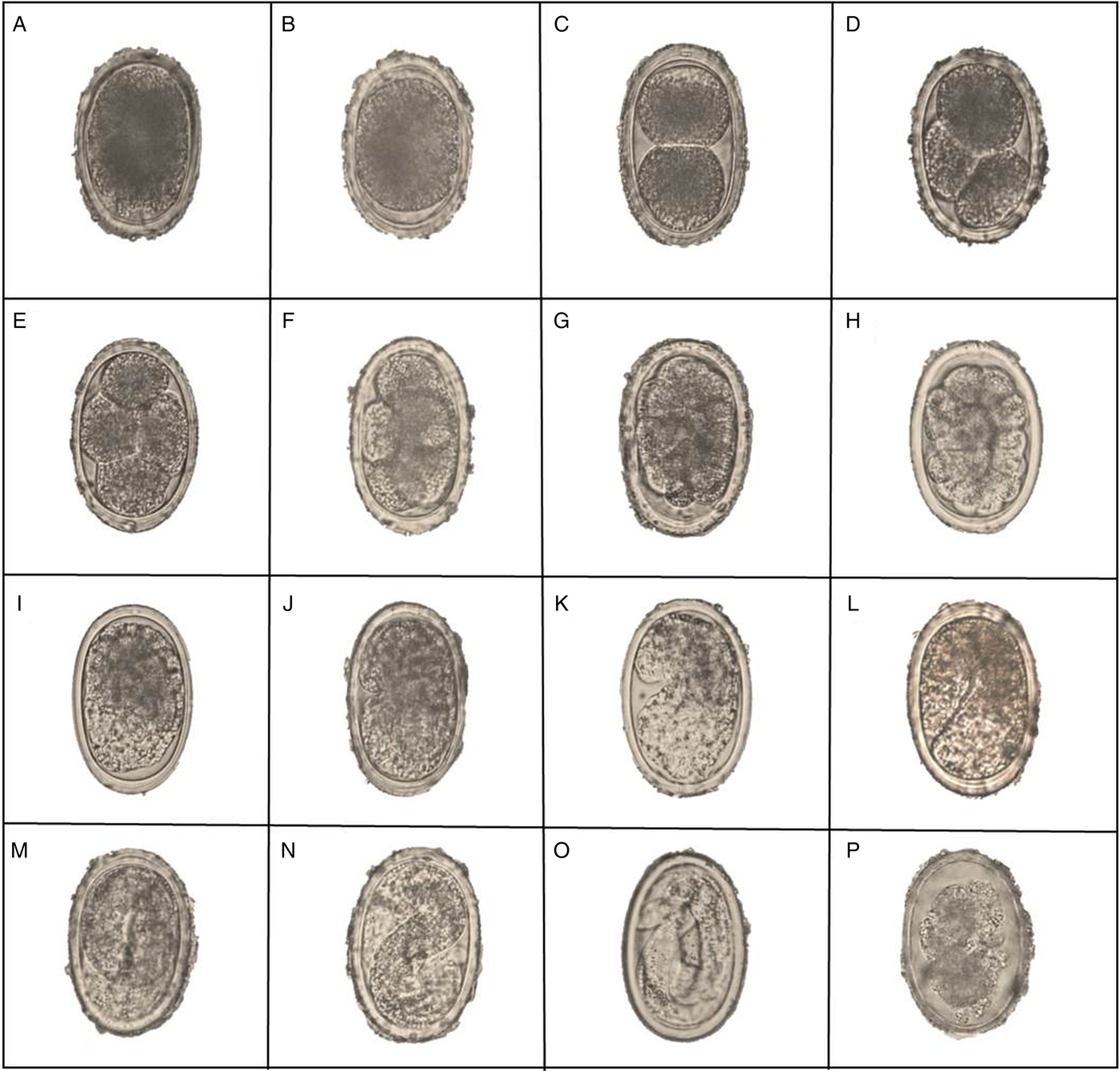
The categorization of egg development stage was based on an egg-development chart (Fig. 1) developed for this study by embryonating chicken ascarid eggs (isolated from feces from the same farm and stored at 5 °C for 2 days) at 22 °C in H2SO4 buffer (0·1 N, pH 1) for 26 days. The chart was prepared based on the development stages of the first 20–25 eggs detected in a subsample. The eggs were examined days 0–7, 9–16, 18–19, 21–23 and 26 post-incubation. At any given time point there was some variation, but the majority of the eggs were at the same stage of development as represented in Fig. 1. The eggs recovered from the soil were categorized into one of the following four categories: (a) Unembryonated (Fig. 1A) or single celled eggs (Fig. 1B); (b) eggs with a pre-larval embryo, i.e. two-celled (Fig. 1C) to gastrula (kidney-shaped embryo) (Fig. 1K); (c) partially to fully larvated eggs (Fig. 1L–O); and (d) degenerated eggs (vacuolated or degenerated contents) (Fig. 1P).
Chicken ascarid eggs at different stages of development when embryonated at 22 °C. (A) Fresh egg (day 0). (B) One-celled embryo (day 1). (C) Two-celled embryo (day 1). (D) Three-celled embryo (day 2). (E) Embryo with four large cells (day 2). (F) Four to 6-celled embryo (day 3). (G) Morula (day 4). (H) Blastula with large cells (days 5–6). (I) Blastula with small cells (days 6–7). (J) Pre-gastrula (days 8–9). (K) Gastrula (days 9–10). (L) Primitive larva (day 11). (M) Thick larva (days 14–16). (N) Elongated yet thick larva (days 18–19). (O) Slender larva (days 21–26). (P) Degenerated egg.

Laboratory embryonation of eggs to estimate viability
Ascarid eggs from soil subsample C were isolated using the same protocol as described earlier for subsample A. After isolation, the eggs were transferred to a 50 mL tube containing 30 mL H2SO4 (0·1 N, pH 1) and incubated at 25 °C for 15 days. The tubes were opened on day 7 for approximately 1 min to aerate the eggs. A subsample of the egg suspension was transferred to a Sedgewick Rafter slide (Pyser-SGI Limited, The UK) and the first 200 eggs were examined by transmission microscopy (100× magnification) and categorized as larvated or non-larvated.
Soil temperature and precipitation
The soil temperature was monitored every 2 h from April 15, 2014 until February 10, 2016 by a data logger (Testo 175-H2®) buried 7 cm below the soil surface between the spring and winter plots. Unfortunately, the soil temperature data from February 11, 2016 to April 16, 2016 could not be retrieved from the data logger. The total weekly precipitation was obtained from a nearby national weather station (The Danish Meteorological Institute, Høje Tåstrup Station) located 3·5 km from the pasture plots.
Calculations and statistical analysis
For each sampling week (0–104 wpb), eight bags were examined to determine the number of eggs per g dry soil. For both seasons, the egg concentration per g dry soil was log-transformed to obtain normality of the model residuals and approximate homogeneity of residual variance. The effect of sampling time on the log-transformed egg concentration was tested separately for each season using a one-way analysis of variance (ANOVA) under a linear model (R software version 3.3·2, The R Foundation for Statistical Computing Platform, 2016). If overall significant, post-hoc comparisons between different sampling weeks were examined with Tukey's adjustment (glht function, MULTCOMP package). All statistical analyses were carried out at the 5% level of significance.
It was expected that a considerable number of eggs would adhere to the trays and spatulas while preparing the soil–egg mixture (i.e. before placing egg–soil mixture to bags). Therefore, the actual number of eggs present in the soil after sealing the nylon bags was estimated at 0 wpb (i.e. pre-burial egg recovery) and used as a covariate in the statistical analysis and a baseline to compare the relative reduction in recovery of eggs when the bags were later removed from the pasture (5–104 wpb). For each season, the egg recovery rate (%) at 0 wpb was calculated with reference to the theoretical egg concentration at preparation (i.e. 1673 and 1623 eggs g−1 dry soil in the spring and winter, respectively).
RESULTS
Weather data
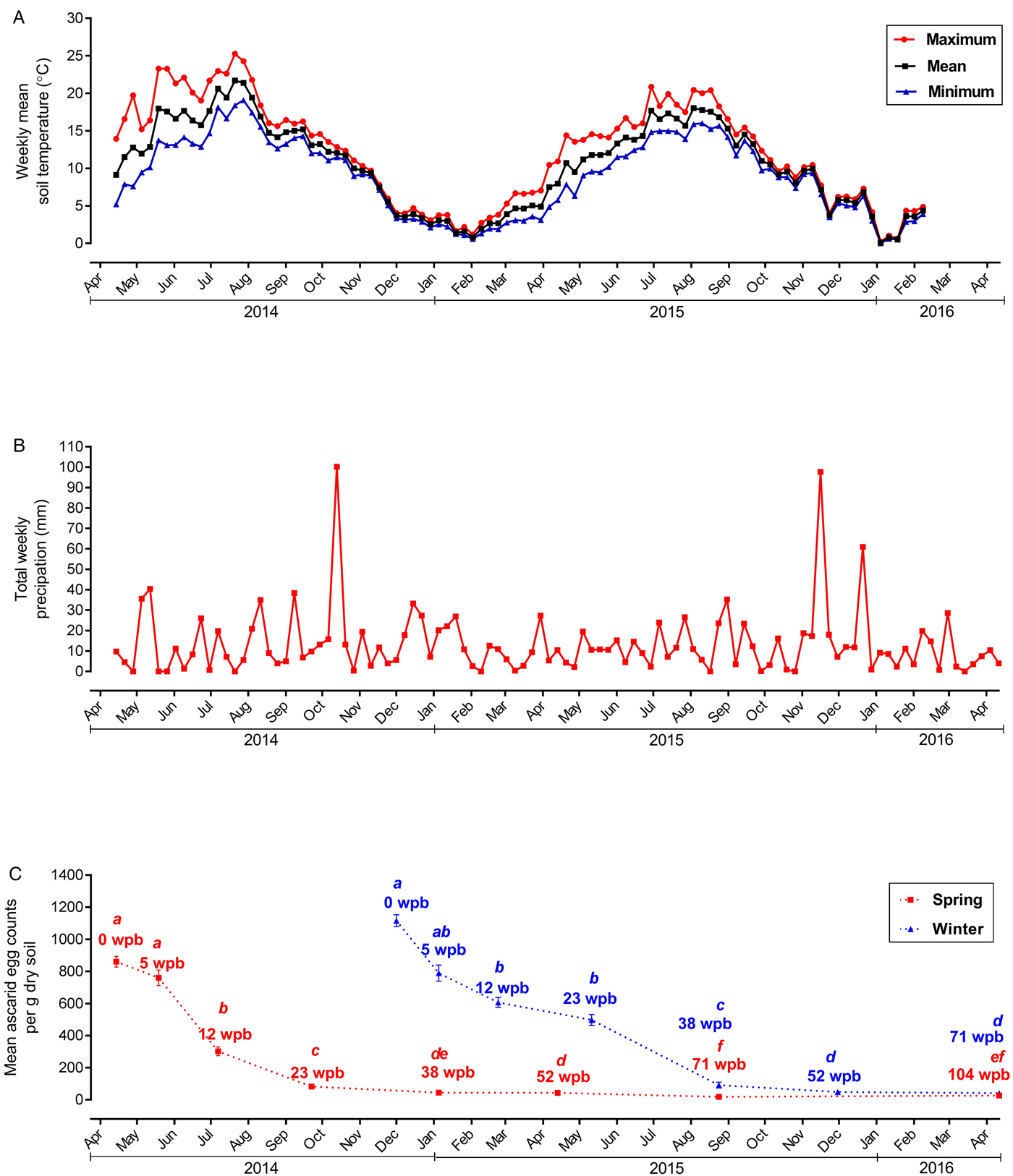
In Denmark, seasons are categorized as spring (March–May), summer (June–August), autumn (September–November) and winter (December–February). From April 15, 2014 until February 10, 2016 the weekly minimum, mean and maximum soil temperature at 7 cm depth ranged between 0–19, 0–22 and 0–25 °C, respectively (Fig. 2A). Overall, the difference between the weekly minimum and maximum temperatures from mid-April to mid-August varied by 5–12 °C, while those from mid-August to mid-April varied by a maximum of only 4 °C. The summer in 2014 was dry and warm. The absolute soil temperatures in 2014 (April–December), 2015 (January–December) and 2016 (January–February) ranged from 1 to 27, 0 to 24 and 0 to 6 °C, respectively. During the entire study, the soil temperatures never dropped below 0 °C at 7 cm depth even though air temperatures recorded 14·4 km south of the plots (The Danish Meteorological Institute, Roskilde Airport Station) decreased below 0 °C several times between December and February (data not shown). The fluctuations in weekly soil temperature throughout the year were thus relatively lower compared with the air temperature showing that the soil temperature was relatively more stable than the air temperature.
(A) Weekly minimum, mean and maximum soil temperatures at 7 cm depth between the spring and winter plots. (B) Weekly total precipitation recorded 3·5 km from the pasture plots (The Danish Meteorological Institute). (C) Mean number (±s.e.) of chicken ascarid eggs per g dry soil recovered 0–104 wpb from nylon bags (n = 8) buried in April 2014 (spring) and December 2014 (winter). The first day of each month is represented by a tick on the X-axis. Different italicized letters indicate significant differences between the sampling weeks (Tukey, P < 0·05) within the same season.
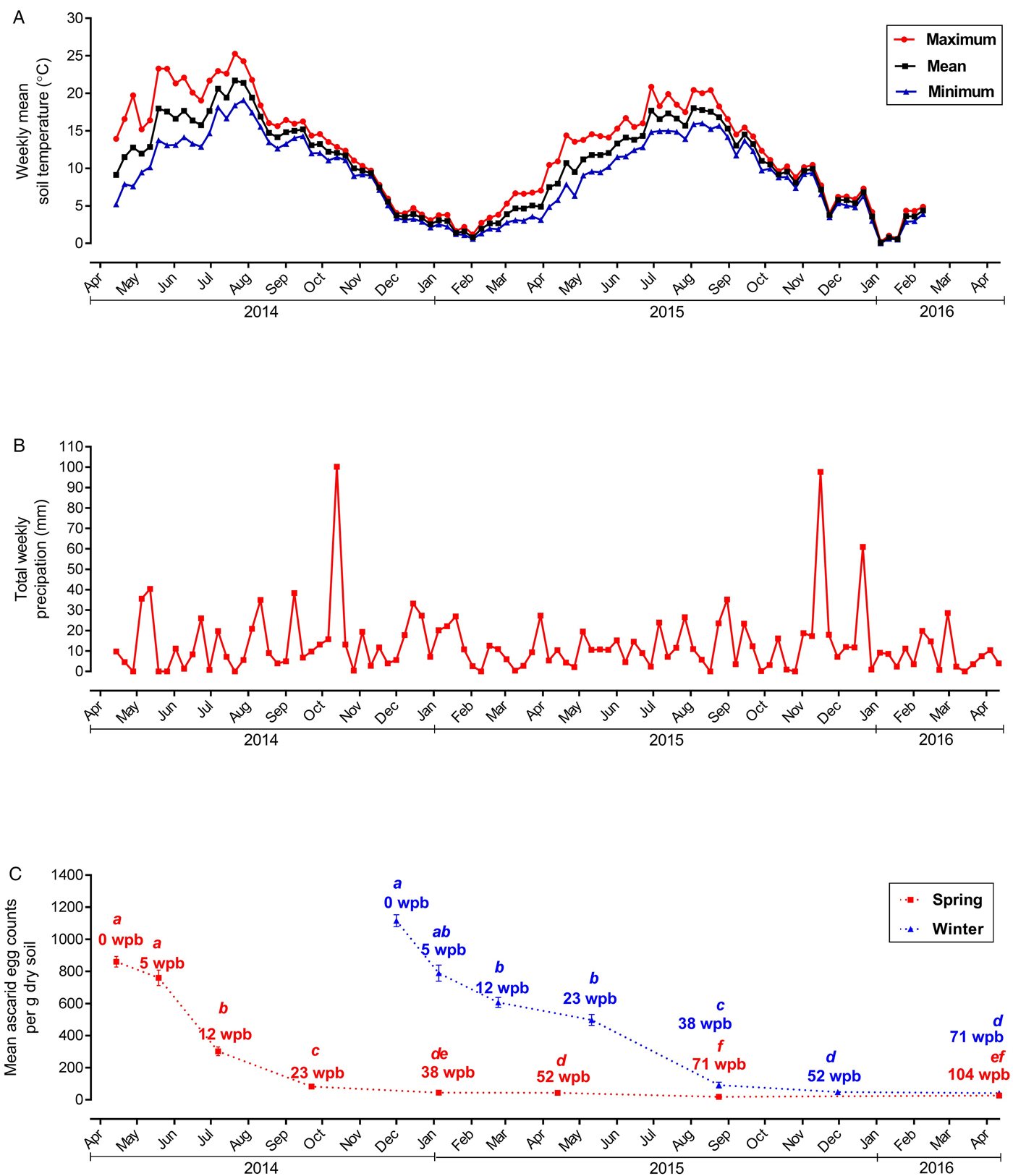
The weekly precipitation during the entire study period ranged between 0·0 and 100·2 mm with a mean of 13·5 mm (Fig. 2B). The summer in 2014 (specifically June and July) was considerably drier and warmer compared with the average Danish summers, whereas the summer in 2015 was similar (data not shown).
Survival and development of eggs
Spring deposition
The mean number of eggs recovered per g dry soil from 0 to 104 wpb is shown in Fig. 2C. Of the original number of eggs added to soil (i.e. 1673 eggs g−1 dry soil) at preparation, the mean ± s.e. egg recovery from the nylon bags (n = 8) at 0 wpb was 860 ± 34 eggs g−1 dry soil [i.e. 51 ± 2·0% (mean ± s.e.) recovery]. Using the 0 wpb recovery as a baseline, the mean recovery at 5, 12, 23, 38, 52, 71 and 104 wpb was reduced by 12, 65, 90, 95, 95, 98 and 97%, respectively. This substantial change meant that sampling time had an overall significant effect on the egg recovery (F 7, 56 =176·53, P < 0·0001). A large proportion of eggs disappeared from 5 to 12 wpb (P < 0·001) (Fig. 2C). From 12 to 23 wpb, there was a second large significant reduction (P < 0·001) in egg recovery. Overall, egg recovery was reasonably stable from 38 wpb until the end of the study although there were statistical differences between some sampling weeks (Fig. 2C).
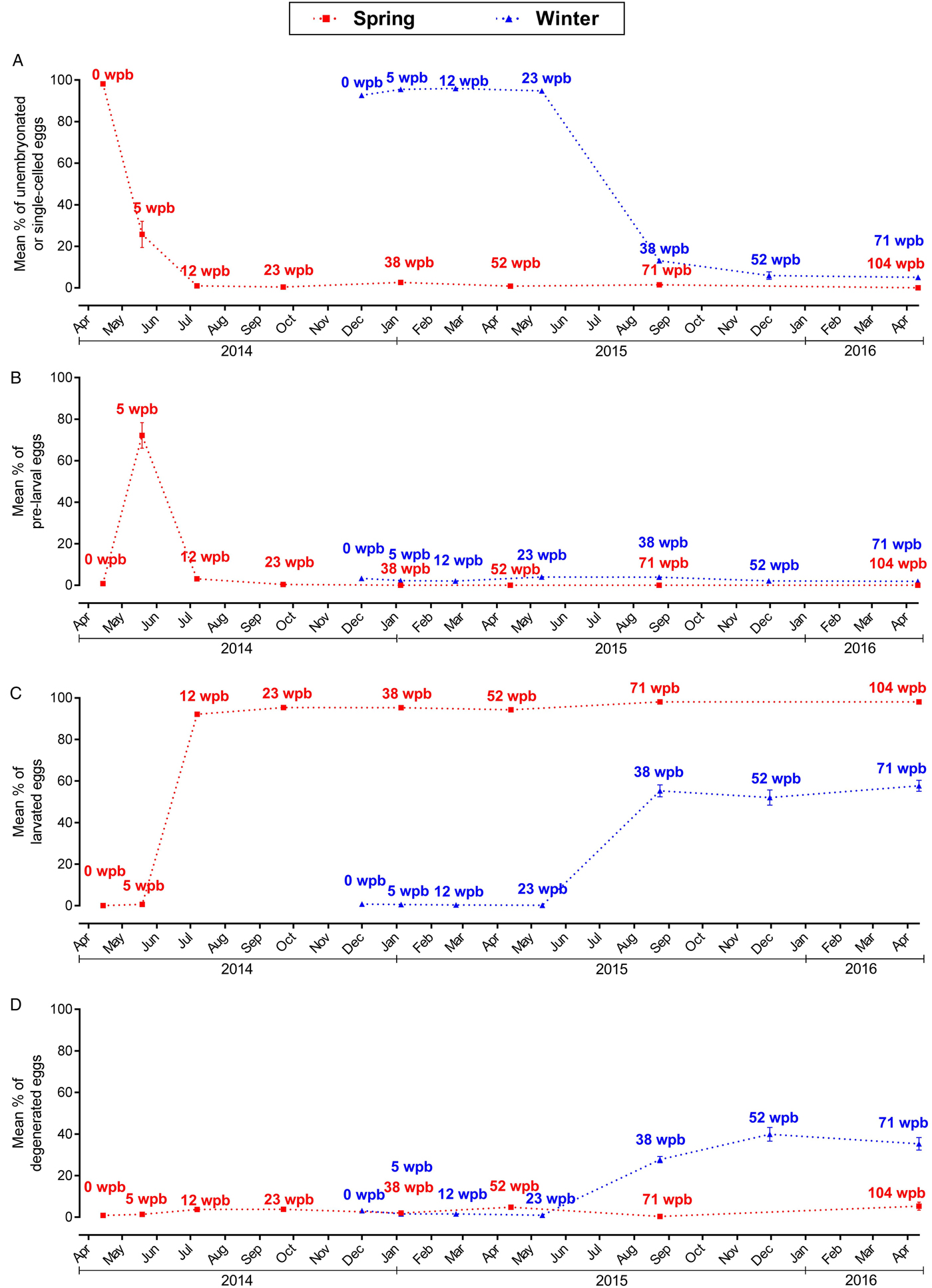
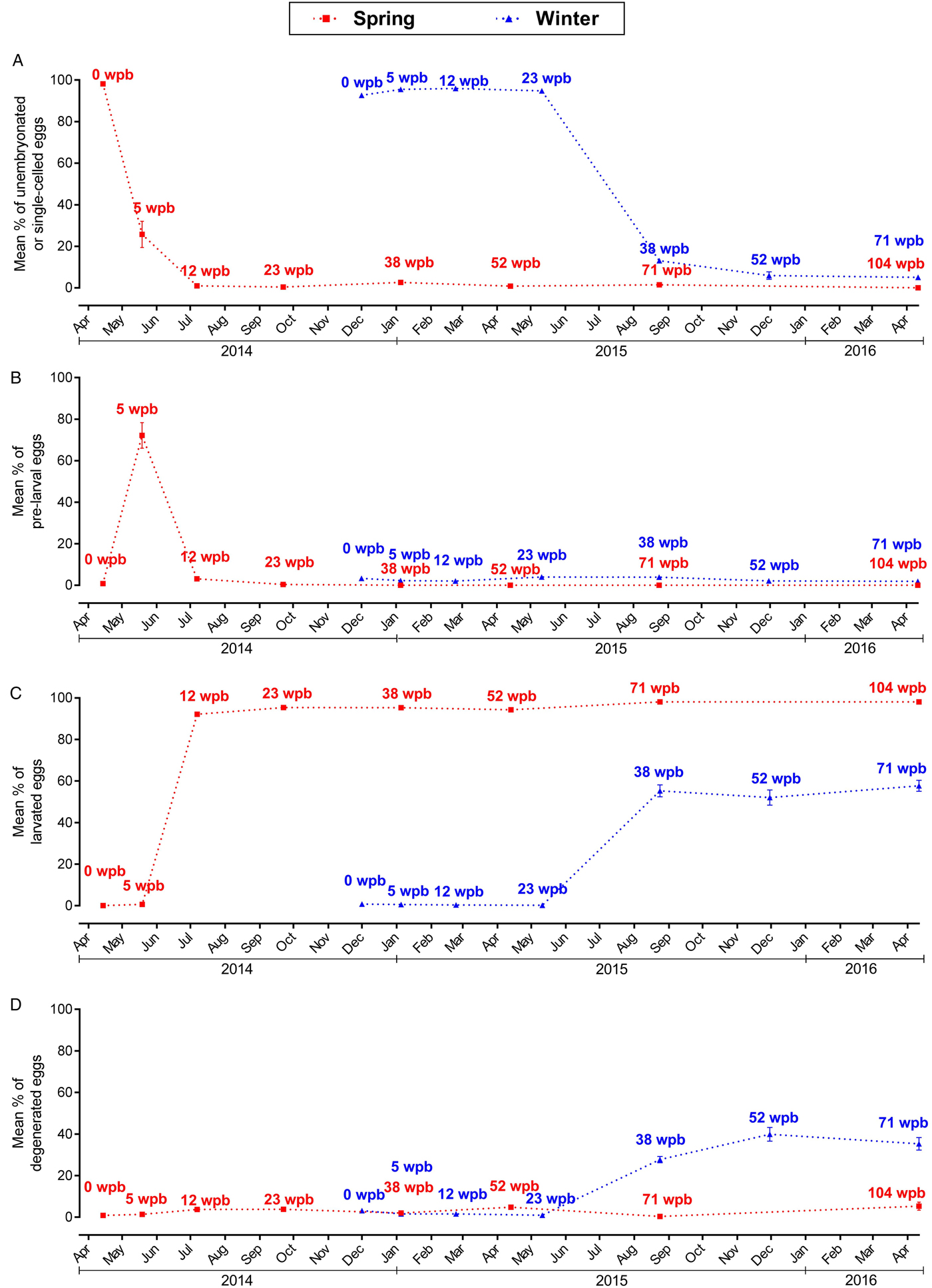
The distribution of different development stages of eggs recovered from the soil is shown in Fig. 3. Until 5 wpb (late-May 2014), the majority of the eggs still had only pre-larval stage embryos (Fig. 3A and B), primarily 2–8 cell stages, corresponding to the period when the weekly mean soil temperature was between 15 and 18 °C (Fig. 2A). However, upon in vitro embryonation to test viability of the recovered eggs, the mean ± s.e. proportion of larvated eggs at 0 and 5 wpb was 86 ± 1 and 83 ± 2%, respectively, indicating that most of the eggs were still fully viable by 5 wpb. From 5 to 12 wpb, the period when the mean soil temperature was 16–21 °C (Fig. 2A), 92% of the eggs were fully developed (Fig. 3C) and in vitro embryonation did not increase the proportion of larvated eggs. From 12 to 104 wpb, the proportion of larvated eggs varied between 94 and 98% (Fig. 3C). Throughout the study, most of the larvated eggs had retained their original colour and the larvae were seen to have the same level of intestinal food granules as in the freshly embryonated eggs (Elliott, Reference Elliott1954) (Fig. 1O). The proportion of recovered degenerated eggs was below 5% throughout the study (Fig. 3D).
Mean proportions (±s.e.) of chicken ascarid eggs that were (A) unembryonated or single-celled, (B) pre-larval, (C) larvated or (D) degenerated. Nylon bags containing unembryonated eggs in soil were buried at 7 cm depth in April 2014 (spring) and December 2014 (winter). Bags (n = 8) were recovered and the eggs examined 0–104 wpb. The first day of each month is represented by a tick on the X-axis.
Winter deposition
The mean number of eggs recovered per g dry soil from 0 to 71 wpb is shown in Fig. 2C. The mean ± s.e. egg recovery from the nylon bags at 0 wpb was 1116 ± 37 eggs g−1 dry soil (69 ± 2·1% (mean ± s.e.) of the added eggs) which was higher than for the spring. With reference to 0 wpb, the mean recovery at 5, 12, 23, 38, 52 and 71 wpb was reduced by 29, 46, 55, 92, 96 and 96%, respectively. The sampling time thus again had a significant effect on the egg recovery (F 6, 49 = 124·75, P < 0·0001). The overall drop in recovery until 23 wpb was slower when compared with the spring (Fig. 2C). From 23 to 38 wpb, there was a sharp reduction (P < 0·001) where after the recovery was fairly stable (Fig. 2C).
Until 23 wpb (mid-May 2015), >92% of the recovered eggs were still found to be unembryonated or single-celled (Fig. 3A), corresponding to the fact that the weekly mean soil temperature had remained below 15 °C up to that time point (Fig. 2A). Following in vitro embryonation, the mean ± s.e. proportion of larvated eggs at 0, 5, 12, 23 and 38 wpb was 92 ± 1, 92 ± 1, 87 ± 1, 75 ± 1 and 52 ± 2%, respectively, showing that the viability of eggs buried in the winter was reduced slowly over time. Development appeared to take place in pasture mainly between 23 (mid-May) and 38 wpb (late-August) as hardly any pre-larval eggs were detected at any sampling point (Fig. 3B and C) and by 38 wpb all viable eggs had become fully larvated (Fig. 3C). Of the total recovered eggs, the proportion of recovered degenerated eggs had increased considerably after 23 wpb and remained relatively high (28–40%) for the last three sampling time points (Fig. 3D). As for the spring, the larvae in most of the eggs recovered at the end of the study appeared to have same level of reserved food granules as in freshly embryonated eggs.
DISCUSSION
We have for the first time reported quantitative data on outdoor development and survival of chicken ascarid eggs based on recovery of eggs buried in pasture soil. We have thus shown that a small proportion (2–3%) of ascarid eggs (fully embryonated) can remain viable for at least up to 2 years when buried in pasture soil.
Very little is known about the survival rate of chicken ascarid eggs in pasture soil (Ackert and Cauthen, Reference Ackert and Cauthen1931; Levine, Reference Levine1937). Velichkin and Merkulov (Reference Velichkin and Merkulov1970) found that ascarid eggs deposited outdoors could remain infective to chickens for 2·5–3·0 years, but they did not quantify egg survival. Farr (Reference Farr1961) found that eggs of Ascaridia spp. and Heterakis gallinarum deposited outdoors can remain infective to turkeys for up to 3·1 and 4·4 years, respectively, but this study also did not examine the egg concentration in the soil and worm burdens in necropsied birds. Furthermore, the study did not determine the ascarid at the species level, though it is presumed to have been A. dissimilis because A. galli and A. dissimilis are highly host-specific (Kates and Colglazier, Reference Kates and Colglazier1970; Pankavich et al. Reference Pankavich, Emro, Poeschel and Richard1974). In contrast, our study is based on quantitative recovery of chicken ascarid eggs over time. In the current study, 2–3% of the deposited eggs, which appeared to be viable (based on morphology), could be recovered for at least 1·4–2·0 years, which is similar for the pig nematodes Ascaris suum and Trichuris suis under Danish climatic conditions (Kraglund, Reference Kraglund1999; Larsen and Roepstorff, Reference Larsen and Roepstorff1999). The fully larvated eggs were expected to be infective based on the observation of apparently intact shells and larvae possessing similar levels of intestinal food granules [e.g. fat globules (Elliott, Reference Elliott1954)] as in infective eggs (authors' personal observation). However, the most reliable method to monitor infectivity of eggs is to infect chickens because fully developed eggs may not necessarily be infective (Geenen et al. Reference Geenen, Bresciani, Boes, Pedersen, Eriksen, Fagerholm and Nansen1999).
It is not well understood why only a small proportion of eggs seem to survive long-term, but we believe that survival depends on microclimatic conditions precisely where a given egg is localized. We know that abiotic (e.g. temperature, humidity, etc.) (Tarbiat et al. Reference Tarbiat, Jansson and Höglund2015) and biotic factors (e.g. microfungi) can influence the survival of chicken ascarid eggs (Thapa et al. Reference Thapa, Meyling, Katakam, Thamsborg and Mejer2015b). Compared with the eggs buried in the spring, the recovery of eggs buried in the winter decreased more slowly, but the prolonged delay in onset of embryonation during colder months seemed to reduce the viability of eggs. Overall, more eggs disappeared during summer than during winter. This may be attributed to differences in egg batch, but in vitro embryonation rate was not substantially different between the spring (87%) and winter (93%) batches. We therefore expect that batch had less impact on egg survival and development than the season of deposition. Similar seasonal differences in egg mortality under field conditions have been documented for thick-shelled eggs of A. suum and T. suis in Denmark (Larsen and Roepstorff, Reference Larsen and Roepstorff1999). We also found a seasonal difference in the recovery of degenerated eggs. The physical evidence of degenerated eggs was easier to detect when eggs were buried in the winter compared with the spring, indicating a more severe degradation of eggs in summer than in winter. It is the authors' personal experience that dead eggs with intact shells are possible to detect using our flotation method, whereas many dead eggs that have lost shell integrity (e.g. after exposure to disinfectant such as p-Chloro-m-cresol) do not float and are thus unrecoverable with our method.
It has been shown that in vitro embryonation in aqueous suspension at temperatures above 33 °C can severely affect the viability of eggs (Reid, Reference Reid1960; Tarbiat et al. Reference Tarbiat, Jansson and Höglund2015). In our study, the absolute maximum soil temperature was 27 °C which occurred for 1–2 days on two occasions in the summer (July 2014). This in combination with low precipitation (i.e. desiccation) may have had a high impact on egg mortality during the summer as seen for A. suum and T. suis eggs (Gaasenbeek and Borgsteede, Reference Gaasenbeek and Borgsteede1998; Larsen and Roepstorff, Reference Larsen and Roepstorff1999). This is because the rate of water loss from eggs under dry conditions increases as an exponential function of temperature (Wharton, Reference Wharton1979, Reference Wharton1980). Further, larvae within eggs respond to high environmental temperatures by an increased metabolic rate, which depletes the intestinal food reserves (Elliott, Reference Elliott1954). Other abiotic factors such as UV light (Dubinský, Reference Dubinský1969; Brownell and Nelson, Reference Brownell and Nelson2006) and fecal ammonia (Katakam et al. Reference Katakam, Mejer, Dalsgaard, Kyvsgaard and Thamsborg2014) are also known to have a negative impact on parasite eggs. However, these factors were eliminated in our study as it was chosen to model the survival potential of ascarid eggs transferred into the soil and away from detrimental surface conditions.
Most of the eggs excreted on pasture will be on top of the soil, but their population can diminish faster compared with eggs incorporated into the soil (Ackert and Cauthen, Reference Ackert and Cauthen1931). As shown for other nematodes e.g. Parascaris equorum (Ihler, Reference Ihler1995) and T. suis (Burden and Hammet, Reference Burden and Hammet1979), a considerable number of chicken ascarid eggs are expected to be disseminated into the soil due to rainwater (Burden and Hammet, Reference Burden and Hammet1979; Storey and Phillips, Reference Storey and Phillips1985), earthworms (Kraglund et al. Reference Kraglund, Grønvold, Roepstorff and Rawat1998) and foraging by hens where the eggs are to be more protected against desiccation and direct sunlight. Our data were obtained from a single geographical location and it is likely that the development pattern and survival of ascarid eggs may vary according to regional differences in soil-type, vegetation and weather conditions (Kraglund, Reference Kraglund1999; Larsen and Roepstorff, Reference Larsen and Roepstorff1999; Williams et al. Reference Williams, Pepper and Gerba2012). Long-term survival of eggs may also depend on farm-management factors such as ploughing and frequency of pasture rotation.
Soil biotic factors and their interaction with abiotic factors may also have had a negative impact on the survival of eggs, and this could be more pronounced during the warmer months. Laboratory experiments have shown a substantially higher in vitro mortality of chicken ascarid eggs in non-sterilized soil than in sterilized soil (Thapa et al. Reference Thapa, Mejer, Thamsborg, Jensen and Meyling2015c). This may be due to soil microbiota, including egg-degrading microfungi such as Pochonia chlamydosporia and Purpureocillium lilacinum (Thapa et al. Reference Thapa, Meyling, Katakam, Thamsborg and Mejer2015b, Reference Thapa, Mejer, Thamsborg, Jensen and Meylingc). In addition, soil bacteria can degrade eggs of plant-parasitic and soil nematodes (Chen et al. Reference Chen, Moore, Yuen, Kobayashi and Caswell-Chen2006; Padgham and Sikora, Reference Padgham and Sikora2007). However, we do not know if there is an antagonistic effect of bacteria on ascarid eggs even though their basic egg shell structure is similar to that of ascarids (Wharton, Reference Wharton1980; Khan et al. Reference Khan, Williams and Nevalainen2004; Stein and Golden, Reference Stein and Golden2015). Some soil animals could theoretically also have an impact on the survival of nematode eggs but we have found no studies on this.
Very little is known about how long chicken ascarid eggs may take to fully develop to infectivity under outdoor conditions. Development of parasite eggs outdoors is often predicted on the basis of laboratory embryonation of eggs at constant temperature and humidity. This underestimates the influence of natural fluctuations as seen in our study. It has been shown for H. gallinarum eggs that development time is significantly shorter when eggs are embryonated at fluctuating temperatures between 12 and 22 °C compared with a constant mean 15 °C (Saunders et al. Reference Saunders, Tompkins and Hudson2000). We found that eggs deposited in pastures between early winter and mid-spring are likely to arrest their development until the weather becomes warmer the following summer. Pasture contamination with infective eggs therefore appears to peak mainly during summer and autumn as shown for A. suum (Kraglund, Reference Kraglund1999; Katakam et al. Reference Katakam, Thamsborg, Dalsgaard, Kyvsgaard and Mejer2016).
Overall, the method modified after Larsen and Roepstorff (Reference Larsen and Roepstorff1999) allowed us to re-isolate only 51–69% of the eggs from the soil in the bags. We may have lost about 10–30% eggs at preparation (e.g. mixing eggs with soil in trays) as the original method was shown to have a recovery of approximately 80% eggs from soil (Larsen and Roepstorff, Reference Larsen and Roepstorff1999). Though allowing us to detect eggs to monitor their development, the nylon bag assay has the limitation that it reduces the influence of dispersal and predation by larger soil fauna (accidental or intentional) thus overestimating the ability of the eggs to persist and survive in the specific area where they were buried. For unknown reasons, we found a relatively lower mean pre-burial recovery rate for the spring burial compared with the winter burial. This may again have reflected differences in egg batch quality, but as embryonation rates were similar it is also possible that there may have been subtle differences in method execution between the two seasons.
In conclusion, the initial development and survival patterns of chicken ascarid eggs buried in pasture soil may vary depending on the season of deposition. Most eggs deposited in pasture soil seem to disappear within a few months after the deposition, especially during warmer months but a small proportion of eggs may remain viable and infective for at least 2 years.
ACKNOWLEDGEMENT
The authors gratefully thank Anne M. L. Dam for preparing nylon bags.
FINANCIAL SUPPORT
The current study and the PhD fellowship of ST were financed by the Graduate School of Health and Medical Sciences, University of Copenhagen, Denmark.
CONFLICT OF INTEREST
The authors declare that there are no conflicts of interest.