Undernutrition is common in children with congenitally malformed hearts. Total daily energy expenditure is high as a result of an increase in cardiopulmonary work.Reference Barton, Hindmarsh, Scrimgeour, Rennie and Preece1, Reference Van der Kuip, Hoos, Forget, Westerterp, Gemke and de Meer2 Paradoxically, nutrient intake is reduced due to excessive fatigue during oral feeding and iatrogenic restriction of fluids. Delayed gastric emptying,Reference Cavell3 gastroesophageal reflux,Reference Forchielli, McColl, Walker and Lo4 and associated gastrointestinal malformations like cleft lip or palate, tracheoesophageal fistula, oesophageal atresia, malrotation, and diaphragmatic hernia may limit intake of nutrients.Reference Rosentahl5 In addition, losses of nutrients due to subclinical steatorrhoea and protein losing eneteropathy are seen in a proportion of patients with congenital cardiac disease, the latter especially in patients who undergo a Fontan procedure, or have severe right-sided congestive cardiac failure.Reference Sondheimer and Hamilton6
Growth, and the improved nutritional state, of children with congenital cardiac disease can be achieved by the provision of sufficient calories.Reference Schwarz, Gewitz and See7, Reference Unger, DeKleermaeker, Gidding and Christoffel8 This is usually achieved by nasogastric feeding. Percutaneous endoscopic gastrostomy, however, is now becoming a standard practice in both adult and paediatric settings in overcoming feeding-related problems with a variety of indications. The technique eliminates problems encountered with nasogastric feeding, such as inadvertent and spontaneous extubation, distress with repeated re-insertion, exacerbation of gastro-oesophageal reflux, and most importantly, the inhibition of oro-pharyngeal coordination and feeding development. Successful nutritional support via percutaneous endoscopic gastrostomy has been demonstrated in children with neurodisability,Reference McGrath, Splaingard, Alba, Kaufman and Glicklick9, Reference Sullivan, Juszczak and Bachlet10 cystic fibrosis,Reference Richter, Meier, Steppberger, Knorrek and Lietz11, Reference Williams, Ashworth, McAlweenie, Poole, Hodson and Westaby12 neonatal pulmonary disease,Reference Guimber, Michaud, Storme, Deschildre, Turck and Gottrand13 Crohn’s disease,Reference Cosgrove and Jenkins14 oncological conditions,Reference Skolin, Hernell, Larsson, Wahlgren and Wahlin15 metabolic disease, and genetic, chromosomal, and degenerative diseases.Reference Casswall, Backstrom and Henstrom16 In addition to improving the nutrition and growth of children with cerebral palsy,Reference Craig, Carr and Cass17 its use has been shown significantly to reduce the time of feeding, and ease administration of drugs.Reference Tawfik, Dickson, Clarke and Thomas18 Improvements in social functioning, mental, general health perception and quality of life of those providing care have been demonstrated in prospective studies of cohorts.Reference Sullivan, Juszczak and Bachlet19
The nutritional state of unwell children is a common cause of anxiety for parents, and feeding times can be stressful.Reference Sloper and Turner20 The impact of feeding via percutaneous endoscopic gastrostomy is positive, with many parents reporting a high level of satisfaction, and wishing that the intervention had taken place earlier.Reference Avitsland, Kristensen, Emblem, Veenstra, Mala and Bjørnland21
Nutritional support provided via percutaneous endoscopic gastrostomy is increasing in children with cardiac conditions. Between 2002 and 2006, we inserted 384 percutaneous endoscopic gastrostomies in our centre, 115 of them in children with congenitally malformed hearts, the median age at insertion being 0.39 years. Atrioventricular septal defects in children with Down’s syndrome were the predominant indications, in around one-fifth, followed by isolated ventricular septal defect, in just under one-fifth. The age at insertion was not significantly different between children with cyanotic and acyanotic disease. We have previously reported our experience in 37 children with congenital cardiac disease, demonstrating improvements in the standard deviation score for body weight for those with both cyanotic and acyanotic states.Reference Ciotti, Holzer, Pozzi and Dalzell22
Appropriate counseling and education about the reversibility of the gastrostomy, better quality of life for the patients, for those providing care, and importantly the perceptions of those providing care, are crucial in supporting decisions about recommending the technique. With the latter issue in mind, we have studied the perceptions of those looking after children with congenitally malformed hearts in whom we had used percutaneous endoscopic gastrostomy for nutritional support.
Methods
We requested those providing care for children with congenitally malformed hearts who had undergone percutaneous endoscopic gastrostomy to complete a 27 point semi-structured questionnaire regarding their perceptions on the utility of the technique in supporting feeding. The questions related to the feeding problems, the duration and ease of feeding, the administration of medications, the happiness of the child, and time for self, siblings, and support.
In the absence of a validated questionnaire, we adapted the questionnaire used for a similar study used to ascertain the views of those providing care for severely disabled children fed by gastrostomy.Reference Tawfik, Dickson, Clarke and Thomas18
The decision to use percutaneous endoscopic gastrostomy in these patients was taken following a multidisciplinary assessment in the cardiac feeding clinic. The team comprised a gastroenterologist, cardiologist, speech and language therapist, dietician and a specialty liaison nurse. Undernutrition in infants with congenitally malformed hearts due to fatigue on feeding, iatrogenic fluid restriction, increased metabolic expenditure due to cardiac failure, risk of aspiration and aversion to oral feeding are the usual indications for referral to the cardiac feeding clinic.
The survey was approved by the clinical audit department of the Alder Hey Children’s NHS Foundation Trust (Yr 2007). Microsoft Access was used for database creation and Graph Pad Instat (GraphPad Software, CA, and USA) was used for statistical analysis. Non-parametric tests of significance – Wilcoxon matched pairs signed ranks test was used to calculate perceived differences in feeding duration and frequency of feeding prior to and after percutaneous endoscopic gastrostomy insertion. Improvements in preoperative problems and measures of the effect of the procedure were tested using a one-tailed binomial test against improvement and deterioration or no improvement.
Results
The questionnaire was completed by 38 persons providing care for children with congenitally malformed hearts. Of the children, 10 were exclusively dependent on the feeds provided via the gastrostomy, while 28 received additional oral feeds. In 8 children, feeding was continuous, fed by a pump while the rest were bolus fed. In 13 instances, the children received a mixed diet, while 22 of the 38 subjects required antireflux medications. In Table 1, we show the parental perceptions of the problems relating to feeding, these not being exclusive, since some children had a combination of issues, prior to and after provision of percutaneous endoscopic gastrostomy.
Effect of percutaneous endoscopic gastrostomy on preoperative symptoms.

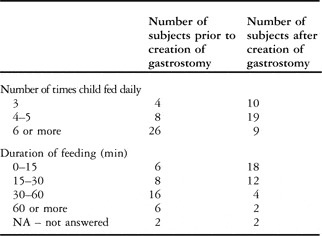
The time taken to feed the children was significantly reduced after the procedure (Table 2), from 30 to 60 minutes per feed before to 15 minutes after (p = 0.0006). The frequency of feeding was reduced from 6 times a day to 4 to 5 times a day; p = 0.0004 (Wilcoxon matched pairs signed ranks test).
Effect of percutaneous endoscopic gastrostomy on patterns of feeding.

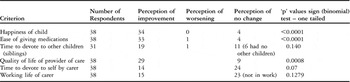
In Table 3, we summarise the parental perceptions on how the technique impacted on the life of their children, and on their own life.
Impact of percutaneous endoscopic gastrostomy on the child and the providers of care.

Of those providing care, 8 preferred the technique, as it helped them avoid the difficulty of managing nasogastric tubes. On the other hand, pain, infection around the stoma, chance of entanglement, inadvertent removal, and difficulty with bath times were all mentioned as difficulties experienced by those caring for the children with the gastrostomy tubes. Of the 38 respondents, 15 (40%) wished the operation had been performed earlier, but the remaining 22 considered it had been done at the appropriate time. Only 1 parent considered that their child should not have needed a percutaneous endoscopic gastrostomy.
Discussion
To the best of our knowledge, ours is the first survey of the perceptions of those providing care for children with congenitally malformed hearts in whom support for feeding has been provided by percutaneous endoscopic gastrostomy. We recorded high rates of satisfaction. Those providing care perceived significant reductions in pre-procedural symptoms along with the time required and frequency of feeding, and noted enhanced happiness in their children after the procedure. All the parents bar one considered that the decision to proceed with percutaneous endoscopic gastrostomy was the correct for nutritional support, with two-fifths stating that they wished the procedure had been performed earlier. A trend towards greater time to care for themselves and other children was also perceived, although this did not not reach statistical significance.
The results from our study correlate well with findings from Norway21 reporting high rates of parental satisfaction following percutaneous insertion of an endoscopic gastrostomy in a group of children with heterogenous indications. In their experience, again 97% of those providing care reported that the procedure had a positive influence on the condition of their children, and 98% would have chosen the technique again given the same situation. Our survey is different, in that we have studied only children with feeding problems related to congenital cardiac disease. Most children with cardiac disease do not require indefinite feeding support, in contrast to children with neurodisability. Growth is often compromised, nonetheless, if attention is not given to nutritional support. Following cardiac surgery, many children can be weaned off nutritional support, and the gastrostomies can be permanently removed. Keeping nasogastric tubes in place for several months is cumbersome, distressing, courts an increased risk of aspiration, and inhibits oromotor development. The percutaneous tubes used for endoscopic gastrostomy have the advantage of providing a secure route for feeding. Enhanced growth has already been reported following feeding children with congenital cardiac disease in this fashion.Reference Hofner, Behrens, Koch, Singer and Hofbeck23 These authors noted initial parental reservations, but subsequently acceptance was good. Parents find it difficult to consider feeding as an important issue in comparison to the underlying congenital cardiac disease. In addition, the desire for any parent is to feed their child naturally, and reaching the decision to accept supplemental nutritional support is not easy. Nasogastric tube feeding is a short term option, with disadvantages as previously highlighted.
We have demonstrated high satisfaction in those providing care following multidisciplinary assessment, and a concensus decision to proceed to placement of the gastrostomy. The results of our survey, hopefully, will now serve as a valuable resource in counselling those providing care for children with congenitally malformed hearts when the decision to proceed to percutaneous endoscopic gastrostomy as a means of medium or long-term nutritional support is envisaged.
Acknowledgements
We express sincere appreciation for the involvement of Ms Lisa Martin, dietician at Alder Hey Hospital, during the course of this study.