Since 2005, an increasing number of healthcare facilities have considered influenza immunization of healthcare personnel (HCP) a mandatory condition of employment, which has positively influenced immunization rates.Reference Black, Yue and Ball1,2 The concept of requiring influenza immunization as a condition of HCP employment has now been endorsed by a number of professional societies and quality organizations, including every major US infectious diseases and infection prevention organization.3 With the success of mandatory HCP influenza immunization programs, the call for expansion of mandates to cover all immunizations recommended by the CDC for HCP has also occurred.Reference Wicker and Poland4-6 The positive impact of mandatory HCP influenza immunization programs has been described frequently; however, reports of the impact of all-encompassing mandatory HCP immunization programs are sparse.
Successful use of such programs to increase immunization rates and pathogen immunity among HCP often are developed in the setting of very robust infrastructure. At Vanderbilt University Medical Center (VUMC), work focused on increasing HCP immunity and immunization rates began several decades ago. In 1992, an immunization policy that covered measles, mumps, rubella, varicella and hepatitis B was implemented. Influenza immunization of HCP was strongly encouraged but was not included in this policy. Over the subsequent years, interventions were introduced to improve HCP immunization compliance, including performance reporting for managers and tying faculty credentialing and annual staff pay increases to compliance requirements. These interventions resulted in increased compliance, yet rates remained below desired goals.
For the 2014–2015 influenza season, VUMC launched a system-wide initiative focused on professional accountability aimed to achieve and sustain high HCP influenza immunization rates, starting with heightened scrutiny of vaccine exemptions. For the 2015–2016 season, this effort expanded to all immunizations required for HCP along with added consequences for noncompliance. Here, we provide details of this enhanced mandatory immunization program and its impact.
Methods
Setting
The VUMC is a health system in Nashville, Tennessee, that includes adult, pediatric, and psychiatric hospitals, on-campus outpatient clinics and an extensive network of outpatient care sites throughout Middle Tennessee. In 2018, VUMC directly employed 20,352 HCP (including 2,960 faculty physicians).
Baseline program
Since 1992, the VUMC HCP immunization program has required that all HCP document protection (ie, immunization or proof of immunity) against measles, mumps, rubella, and varicella and that all HCP with risk for exposure to bloodborne pathogens document immunization, proof of immunity, or formal written declination of vaccine for hepatitis B. Seasonal influenza vaccine, while strongly encouraged, did not fall under this policy. The policy outlined the clinical requirements for each pathogen, including accepted evidence of immunity; however, consequences for noncompliance were delineated in operational protocols rather than within the policy. Despite this policy, compliance remained low, in part due to variability in accountability.
Over the subsequent years, interventions were introduced to improve compliance. Specific individual-level immunization compliance provided through an online portal that was updated daily, and these data were made available to managers upon request. Compliance became a requirement at the time of annual performance evaluations. Initially, performance was manually entered into the performance evaluation system by the supervisor, but by 2014 this process was automated. Staff would not receive annual pay increases if they were not current with all occupational health requirements. Attending physicians, house staff, research faculty and temporary staff were not tracked in the performance evaluation system, so alternative methods of assuring compliance were utilized. In 2007, immunization compliance became a requirement for credentialing. House staff compliance was monitored and enforced by the Graduate Medical Education office. Faculty compliance status was electronically shared with the faculty training compliance system.
Individual HCP could check their compliance status by logging into a secure online portal created in 2009. Starting in 2013, HCP who were noncompliant or were in danger of becoming noncompliant within 30 days received monthly e-mail reminders of their current status, services needed, and methods to access services to become or remain compliant. These interventions resulted in increased compliance for all of the targeted immunizations, yet rates remained below desired goals.
Although not included in these interventions, work to increase influenza immunization rates started in the early 2000s. Widespread access to free-of-charge vaccine had been part of the program since inception, and efforts to broaden access included on-site roaming immunization stations and a train-the-trainer program to allow local champions to vaccinate colleagues in the workplace. A large-scale mass immunization event, dubbed Flulapalooza, was developed in 2011 in conjunction with emergency preparedness planning to vaccinate a large population rapidly.7,Reference Swift, Aliyu and Byrne8 Formal declinations of influenza immunization started in 2007 (via online form), but these were used to inform educational campaigns and were not for compliance purposes. For the 2013–2014 influenza season, influenza immunization was added to the policy with the requirement that HCP either get immunized or submit a formal exemption request, but there were no explicit consequences for noncompliance.
Despite these efforts, VUMC’s HCP influenza immunization rate for the 2013–2014 season was 80%, ranking 58th of 110 acute-care hospitals in Tennessee.9 During the same period, a large outbreak of measles in California began,Reference Zipprich, Winter and Hacker10 illustrating the risk of transmission of measles from unvaccinated adults and children. Prompted by these factors, an enhanced mandatory HCP immunization program was developed.
Launch of the enhanced program
Implementation was carried out in phases: (1) planning and readiness assessment, (2) program launch targeting influenza immunization, and (3) a broader program of active accountability encompassing all vaccines required under VUMC policy. The program was implemented over 2 fiscal years using influenza immunization as the pilot immunization to ensure awareness of the enhanced program and to identify and ameliorate barriers to achieving high immunization rates. The following section describes the key elements implemented for the initial launch during the 2014–2015 influenza season:
-
1. Readiness assessment and planning. Prior to initiating the initiative and to increase the probability of success, the oversight team used a project bundle to direct preparation, as described previously.Reference Hickson, Moore, Pichert and Benegas11 Consisting of 9 elements subdivided into 3 sections (ie, learning system, people, and organizational readiness),Reference Hickson, Moore, Pichert and Benegas11 the project bundle focused planners in addressing the following: defining the problem, establishing project champions and leadership commitment, ensuring project alignment with the organization’s mission, and defining performance and measurement objectives.
-
2. Policy development. For the initial year of the program, only influenza immunization was targeted. Exemptions for medical contraindications (with the signed attestation of a licensed practitioner) and for religious or personal beliefs were allowed via a formal exemption request that detailed the rationale for exemption. The deadline for immunization or receipt of an approved exemption was December 1 of each year. No additional precautions (eg, masking) were required for unimmunized HCP for the first year of the program, and no additional consequences for noncompliance were imposed. The planned expansion of the program for year 2 to include more vaccines and heightened consequences for noncompliance was publicized to prepare VUMC HCP for the policy changes and to allow for thoughtful dialogue regarding concerns about the planned program.
-
3. Formalized exemption review process. To ensure a standardized, thoughtful approach to exemption requests, an Exemption Review Committee was created, with representation from Employee and Labor Relations, Occupational Health, Human Resources, Office of Legal Affairs, Infectious Diseases, Infection Prevention, and Quality and Patient Safety. The Committee reviewed all requests, and reviewers were blinded to the identities of employees requesting exemption. The process incorporated an initial review, appeal, and second appeal process to ensure respect for all sincerely held religious or spiritual beliefs and review of potential medical contraindications. Based upon feedback, a physician with expertise in allergy was added to the medical exemption review group starting in its second year.
-
4. Project champion identification. The Chief Medical Officer, Executive Chief Nursing Officer, and Chief Financial Officer were the program champions; they promoted the importance of the program and its impact on HCP and patient safety. These individuals were selected due to their influence, willingness to address any issues in a professional manner, and emphasis on the united goal of reducing harm.
-
5. Incorporation into institutional quality goals. VUMC executive leadership set an influenza immunization rate goal of 90% and a policy compliance (immunization or approved exemption) of 100% for the first year of the program.
-
6. Data management and feedback. A user-friendly weekly compliance and immunization report was developed for distribution to leadership, managers, and supervisors, allowing for centralized monitoring of their direct reports’ compliance. To protect employee privacy, only compliance status was displayed at the individual level, with aggregate vaccination rates displayed at the department level.
-
7. Consequences for noncompliance. For the first year, consequences for noncompliance did not include adverse employment actions. Specifically, managers and supervisors were requested to have 1:1 conversations with noncompliant team members to educate them, to encourage individual accountability, and to inform them that enhanced consequences were anticipated for subsequent years.
Expanded immunization requirements and accountability phase (year 2)
In anticipation of the 2015–2016 influenza season, VUMC leadership (in conjunction with an endorsement by the Board of Directors) approved the following policy requirements:
-
1. Broader vaccine inclusions. For the second year, compliance with measles, mumps, rubella, varicella, and hepatitis B policy requirements were added. Consideration was given to adding acellular pertussis (Tdap) as a required immunization. Because this had not been part of prior policies, Tdap was not included for year 2 due to concerns of increasing logistics on top of those added with the addition of 5 new infectious disease conditions.
-
2. Stricter consequences for noncompliant HCP. VUMC staff members who were noncompliant with the policy requirements after December 1 were placed on unpaid leave. If the HCP was noncompliant due to influenza, he or she was allowed to return to work at the end of influenza season or once influenza immunization was documented, whichever occurred first. If the HCP was noncompliant for the other vaccines, only immunization, evidence of immunity, an approved exemption, or a signed formal declination (for hepatitis B only) would allow the HCP to return to work. VUMC faculty and house staff (clinical and nonclinical) who were noncompliant with the policy requirements after December 1 lost access to all systems that required a VUMC-provided login and password. This included VUMC e-mail, grant submission platforms, the electronic medical record, and regulatory programs (eg, the institutional review board). If the HCP was noncompliant due to influenza, access was restored at the end of influenza season or once influenza immunization or receipt of an approved exemption was documented, whichever occurred first. If noncompliant for the other vaccine-preventable diseases, only compliance with policy requirements would restore the access to the VUMC systems.
-
3. Masking requirement. HCP with approved exemptions from influenza immunization were required to wear a surgical mask while in patient care and common areas during the influenza season.
Assessment of policy impact
An analysis of the impact of the enhanced mandatory program was undertaken. We compared immunization rates in relation to the program implementation date and assessed any adverse effects of the policy in terms of the number of HCP who sustained consequences for noncompliance. Annual compliance and immunization rates were examined. For influenza, immunization rates were described using a standardized denominator across all seasons that included every employee who worked at least 1 day during the period that influenza vaccine was available (ie, the current requirement for public reporting of this outcome).12 To assess secondary impacts of the policy, the HCP tuberculosis (TB) testing compliance rate (both on initial hiring and annual retesting), which was not included in the mandatory program, was also examined.
Statistical analysis
Comparison of immunization coverage was performed between the period prior to the program launch (ie, the 2013–2014 influenza season for influenza and January 2014 for the other immunizations) and the most recent reporting periods (2017–2018 influenza season and January 2017) using a 2-sample test of proportions with Stata version 13 software (StataCorp, College Station, TX).
Results
Impact on HCP Immunization Compliance
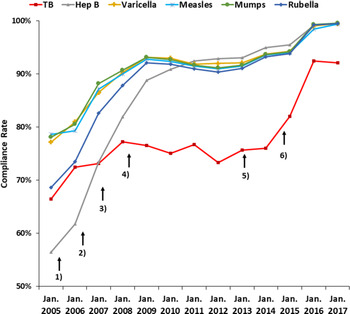
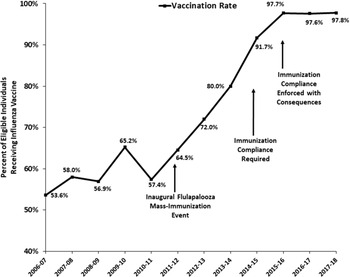
Prior to the launch of the mandatory program, immunization compliance rates had steadily increased to between 91% and 93% for measles, mumps, rubella, hepatitis B, and varicella; however, these rates plateaued from January 2010 to January 2013 (Figs. 1 and 2). Influenza immunization rates, however, increased from 54% during the 2006–2007 season to 80% in 2013–2014. Following the institution of the mandatory program, vaccination compliance rates significantly increased to >99% for all vaccines except influenza, which reached 97.8% (P < .0001 for comparisons of rates to those from the year prior to the mandate).
Immunization/Immunity Compliance among Vanderbilt University Medical Center (VUMC) healthcare personnel (HCP), 2005–2017. Interventions: (1) online compliance reports to managers, (2) compliance required for staff annual pay increase (supervisor enters manually), (3) compliance required for faculty credentialing, (4) compliance required for staff annual pay increase (automated), (5) automated e-mail reminders, and (6) enhanced policy. Note. TB, tuberculosis screening; Hep B = hepatitis B.

Seasonal influenza immunization rates, Vanderbilt University Medical Center (VUMC) healthcare personnel (HCP), the 2006–2007 through 2017–2018 influenza seasons. The numerator includes all VUMC employees receiving that season’s vaccine, not limited to patient caregivers. For the 2009–2010 season, immunization with the monovalent H1N1 vaccine is not included.

Impact on TB screening compliance
While not included as part of the mandatory program, TB screening compliance also significantly increased in conjunction with the mandate (Fig. 1). Annual TB testing compliance remained between 73% and 77% between January 2007 and January 2014. After the mandatory program launched, compliance rose to 82.0% in 2015, to 92.5% in 2016, and to 92.1% in 2017 (P < .0001) compared to 2014.
Exemptions
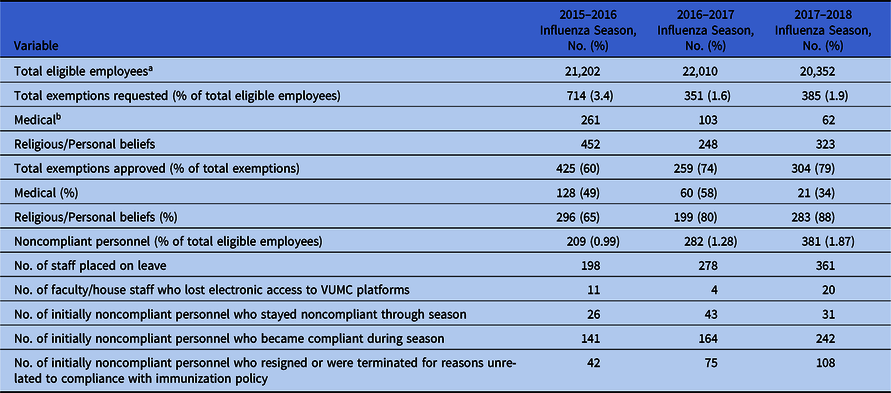
Following the institution of the consequences for noncompliance in 2015, the percentage of HCP who submitted exemption requests equaled 3.4% of the total population covered by the influenza requirements (Table 1). In the next 2 years, that figure dropped to 1.6%–1.9%. This decrease was not unexpected. After the first year, medical exemptions where allowed to carryover each year unless they were due to temporary medical conditions. The proportion of exemptions that were approved increased over the 3 years, particularly those that were religious or personal belief exemptions.
Immunization Policy Exemption Requests and Approvals, by Type, and Noncompliant Personnel Outcomes, Influenza Season 2015–2016 to 2017–2018

Note. VUMC, Vanderbilt University Medical Center; HCP, healthcare personnel.
a Uses the cohort of HCP that were included in the influenza required population.
b If approved, medical exemption requests did not require annual resubmission, while religious/person belief exemption requests had to be submitted annually.
Noncompliant HCP
For the first 3 years of the program, a small number of faculty and staff were noncompliant by the required deadline each season, with a significant increase in the proportion who were noncompliant year after year (P < .005 for all comparisons) (Table 1). Many individuals (~70%) became compliant within 2 weeks. No individual was terminated specifically due to noncompliance with the immunization policy.
Discussion
The move to mandate influenza immunization of HCP has garnered attention over the past decade, and immunization rates have climbed in response to a growing number of healthcare facilities adopting mandatory/condition of employment policies.Reference Black, Yue and Ball1 When examining other vaccines recommended for HCP, immunization rates remain below levels that will adequately protect HCP and patients from nosocomial acquisition.Reference Williams, Lu and O’Halloran13,Reference O’Halloran, Lu and Meyer14 The success of mandatory influenza immunization programs coupled with these low immunization rates for other vaccines have prompted calls to broaden mandatory programs to cover all immunizations recommended for HCP.Reference Wicker and Poland4-6 We report the positive impact of a robust mandatory HCP immunization program that included most of the recommended immunizations for HCP. Importantly, even though TB testing compliance was not held to the same accountability process, this compliance hit a record high in the second year of the mandatory immunization program, suggesting a strong positive secondary impact.
Extensive efforts were undertaken prior to the mandatory program to improve HCP compliance with immunization and immunity against the various pathogens. The VUMC has had a very engaged and supported immunization and occupational health program with committed team members since its inception. Access to immunization was markedly broadened, making it easy for HCP to receive the recommended immunizations. A carefully designed and comprehensive occupational health information system permitted reliable and customized reports of compliance and vaccination and immunity rates to support targeted campaigns and provide timely feedback. The policy requirements prior to the enhanced program importantly set out expectations for compliance. On paper, the immunization policy prior to 2014 read as a required policy; however, with no supporting performance expectations (eg, inclusion on institutional quality goals) or accountability for noncompliance, immunization and compliance rates, while improved, remained lower than desired targets. These rates changed with the enhanced policy, and several key drivers led to the gains noted. First, using the project bundle to assess institutional readiness for a change in policy and accountability helped identify and address potential barriers to implementation prior to program development. Identifying key operational champions helped engage key stakeholders, and concerns were discussed as they emerged. Taking a phased-in approach over several years, focusing first on influenza immunization allowed for thoughtful approaches to logistic issues around reporting, exemption review, and expectation setting based on the institution’s core values and commitment to professionalism. Formalizing the exemption review process also allowed for a multidisciplinary perspective on the various requests while helping ensure consistency with the assessments. Offering a thorough appeal process for those HCP who may have disagreed with the committee’s initial decision also engendered a culture of respect and professionalism. Finally, allowing phased-in consequences for noncompliance in the first year while preparing the workforce for more substantial consequences the second year provided time to communicate these expectations, to generate thoughtful dialogue on the change, and to reduce the discontent that can follow rapid implementation.
Although successful, the program has some unique aspects that may influence its generalizability. Unlike some other mandatory programs, compliance was not made an explicit condition of employment. However, the consequences for noncompliance (unpaid leave, loss of access to VUMC systems) effectively made noncompliant HCP unable to perform their jobs as expected (eg, physicians were unable to schedule clinical time, submit research grants, or utilize e-mail). Most of the physicians who practice at VUMC are directly employed by the medical center, effectively eliminating the challenges noted with credentialed clinicians who are not directly employed by the facility.Reference Babcock, Gemeinhart, Jones, Dunagan and Woeltje15 Finally, the impact noted was almost certainly affected by institutional culture and dynamics. Thus, these results may not be generalizable to other settings, particularly without a strong leadership commitment (up to the level of the board of directors) or programs designed to instill professional accountability.Reference Talbot, Johnson and Fergus16
In conclusion, HCP immunization coverage is an essential and important patient and HCP safety issue, and expansion of a mandatory immunization program to include more than just influenza immunization helps reduce the risk of healthcare-associated infections. A comprehensive program coupled with mandatory expectations can increase immunization compliance and may have additional influence on other outcomes, such as TB testing compliance.
Acknowledgments
We are indebted to all VUMC faculty and staff for their participation in the immunization program, especially for their enthusiasm and professionalism. We specifically acknowledge Dr. Wright Pinson for his unwavering support of the VUMC program.
Financial support
This study was supported by institutional funds.
Conflicts of interest
T.R.T. reports that his spouse has received research funding on vaccine studies from Sanofi Pasteur, Sequiris, and Medimmune. All other authors report no conflicts of interest relevant to this article.