

INTRODUCTION
The proposition that business should operate in the interests of society, over and above its own maximisation of commercial objectives, has become increasingly prominent in recent decades. This shift in the perception of business conduct has led to calls in the literature for greater attention to the relationship between institutions and corporate responsibility (Arya & Zhang, Reference Arya and Zhang2009; Wijen, Reference Wijen2014). This paper focuses on the interconnections between certified management standards (CMS) and socially responsible business conduct. CMS are institutions that play a significant role internalising consideration of corporate social responsibility (CSR) within aspects of business strategy (Cannon, Reference Cannon2012). Many CMS address issues related to the implementation of CSR, albeit to a different degree and often indirectly. Despite their significance and a general agreement that CMS are important as governance mechanisms for firms’ conduct, there are conflicting views on their effectiveness and role in promoting a socially responsible behaviour on the part of businesses. Whilst many theorists claim they are essential (Hodgson & Cicmil, Reference Hodgson and Cicmil2007; Schaefer, Reference Schaefer2007), others are sceptical about their usefulness (Aravind & Christmann, Reference Aravind and Christmann2011; Behnam & MacLean, Reference Behnam and MacLean2011).
Three factors contribute to this absence of consensus in the literature. The first is that, thus far, extensive scholarly interest in firms’ motives to subscribe to CMS and in the degree of commitment that they show towards CMS requirements (Agan, Acar, & Borodin, Reference Agan, Acar and Borodin2013; Allur, Heras-Saizarbitoria, & Casadesús, Reference Allur, Heras-Saizarbitoria and Casadesús2014; Heras-Saizarbitoria, Reference Heras-Saizarbitoria2011; Potoski & Prakash, Reference Potoski and Prakash2013; Singh, Jain, & Sharma, Reference Singh, Jain and Sharma2015; Zailani, Eltayeb, Hsu, & Tan, Reference Zailani, Eltayeb, Hsu and Tan2012) has not produced a majority view on which factors influence conformity to CMS and whether CMS improve CSR performance (Aravind & Christmann, Reference Aravind and Christmann2011; Heras-Saizarbitoria & Boiral, Reference Heras-Saizarbitoria and Boiral2013a). There is, as a result, an acknowledged research gap regarding the true potential of CMS to promote CSR (Rasche, Reference Rasche2010).
The second factor concerns the somewhat static nature of CMS analysis, given that it often assumes an intact regulatory environment, within which the values of social communities prescribe appropriate business behaviour (Palazzo & Scherer, Reference Palazzo and Scherer2006). In fact, although standards might promote stability and “sameness” among organisations, they represent, in reality, a dynamic phenomenon and thus research design needs to take this into account (Brunsson, Rasche, & Seidl, Reference Brunsson, Rasche and Seidl2012).
The third factor is that scholarship relating to the impact of CMS upon promoting responsible business conduct draws its material predominantly from the examination of large firms, and particularly multinational corporations (Russo & Perrini, Reference Russo and Perrini2010). The relative paucity of research evaluating the impact of CMS upon small and medium enterprises (SMEs) is a shortfall that requires urgent attention (Vázquez-Carrasco & López-Pérez, Reference Vázquez-Carrasco and López-Pérez2013; von Weltzien Høivik & Shankar, Reference von Weltzien Høivik and Shankar2011) given their economic significance within developed nations.
In light of these limitations, this paper contributes to the literature both empirically and theoretically. Empirically, first, by introducing new firm level data; second, by investigating firms that have adopted a bundle of standards rather than a single standard; third, by presenting a dynamic rather than a static view of standards through comparison of earlier and later adopters of CMS; fourth, by focusing on SMEs instead of large companies; and, fifth, by investigating a less explored institutional context, namely Greece. Theoretically, the paper contributes to both the CSR and CMS streams of literature by examining the extent to which the conclusions drawn from the existing literature, based disproportionately upon the behaviour of large firms, are relevant in the case of SMEs subscribing to multiple CMS. The paper’s results challenge studies that highlight the difference in attitudes to, and practices of, CSR between SMEs and large companies (Ciliberti, Pontrandolfo, & Scozzi, Reference Ciliberti, Pontrandolfo, Scozzi and Wankel2008; Enderle, Reference Enderle2004; Jamali, Zanhour, & Keshishian, Reference Jamali, Zanhour and Keshishian2009; Perrini, Reference Perrini2006; Preuss & Perschke, Reference Preuss and Perschke2010; Russo & Perrini, Reference Russo and Perrini2010; Sweeney, Reference Sweeney2007). The paper suggests that, depending on the context, SMEs tend to react in a similar fashion to larger enterprises given that they are influenced by an essentially similar set of institutional and economic motives.
Utilising regression analysis of primary (survey) data, this paper examines the motivations of SME respondents related to the adoption of CMS and their commitment to the implementation of the full range of standard provisions. In particular, the paper seeks to determine whether dissimilarities persist between earlier and later adopters of CMS. If the existence of dissimilarities in motives and implementation is confirmed, this may be used as ground for making conclusions about the role of these standards as an institution that promotes CSR performance in an SME context and as an instrument of self-regulation in general. In fact, using the example of the impact of CMS on CSR, the paper demonstrates that process based self-regulation, not supported by strict sanctions, loses its edge as the numbers of adopters increase. Our results suggest that SMEs responding to coercive and mimetic pressures for the adoption of CMS are associated with a lower probability of substantial implementation of all CMS requirements. By contrast, SMEs that react to normative motives and pursue internal efficiency gains, following the implementation of CMS, are more likely to integrate CSR consistently within their business operations. The former type of behaviour is found to be characteristic of later adopters while the latter is more typical of earlier adopters.
The paper’s conceptual framework draws on institutional and business strategy theories. Institutional theory has established that there is a meaningful difference between earlier and later adopters of a business practice, as these two groups face dissimilar pressures from the institutional environment and may adopt the same practice for different reasons. Earlier adopters are assumed to be driven mostly by the technical advantages that such practice offers and, for this reason, they are expected to apply it substantially in the sense that they will fully commit to its requirements. In turn, later adopters are more inclined to adopt a practice for legitimacy purposes and, as a result, they are expected to apply this practice symbolically, meaning that they will not genuinely attempt to conform to the requirements of the practice (Tolbert & Zucker, Reference Tolbert and Zucker1983). As for business strategy and competitive strategy theory in particular, this paper relies on the literature demonstrating that the adoption of CMS might be driven by internal efficiency factors such as cost savings and greater productivity (Bansal & Bogner, Reference Bansal and Bogner2002; Lannelongue, Gonzalez-Benito, & Gonzalez-Benito, Reference Lannelongue, Gonzalez-Benito and Gonzalez-Benito2013). By drawing on these two literatures, we seek to consider in our research both external and internal factors that may affect the effectiveness of CMS in triggering socially responsible business conduct in SMEs.
The empirical data has been collected through a primary survey of ISO 9001, ISO 14001 and OHSAS 18001 certified SMEs operating in Greece, thereby recognising the large-scale expansion of management standards across European Union member states, whilst expanding the literature beyond its current concentration upon the US, China and a narrow range of larger European economies. The rest of the paper is organized as follows: section two, after discussing the salient features of CMS, introduces the research hypotheses and, in doing so, provides commentary on previous research; section three describes the empirical methodology and section four presents the results; section five discusses the paper’s findings while the final section provides the main conclusions, implications and highlights directions for future research.
THEORETICAL APPROACH
2.1. Certified management standards
Certified Management Standards (CMS) are formal, technical documents, issued mainly under the auspices of international organizations, such as the International Organisation for Standardization (ISO), that establish criteria, methods, processes and practices intended to help firms improve their internal organisation and operational efficiency. CMS serve as frameworks that assist firms in developing their own management practices. They are the product of a wide multi-stage consultation process in which various groups of stakeholders are involved, including business experts, consumer associations, Non-Governmental Organisations (NGOs), academics, governmental authorities and, in some cases, testing laboratories. The fact that CMS are developed by expert groups grants them a certain status in the eyes of both practitioners and the public, as an instrument of legitimisation (Terlaak, Reference Terlaak2007a). Because of public perceptions of certified management standards as tokens of respectability and legitimacy, they have acquired significant symbolic value, i.e., value related to the image they project rather than to the advantages of proper application that businesses are keen to exploit. Along with practical benefits, the symbolic value of CMS has facilitated their proliferation and wide acceptance as a form of self-regulation.
CMS share several common characteristics. First, they are process rather than performance standards. They require firms to develop and apply a particular management system. The implementation of the system is subject to regular audits during which the management system and its components are thoroughly examined and compared with the standard’s requirements by external auditors. Second, most CMS are applicable to all organizations irrespective of size or industry. Third, in contrast to statutory regulations, these standards promote a voluntary approach to CSR implementation; since their adoption is not mandatory and there is no central authority to impose them, monitor their execution or sanction violations.
2.2 Certifiable management standards and corporate social responsibility
CMS have been developed in response to a growing demand for the establishment of managerial norms that would have a wider public acceptance and recognition, in an attempt to provide common criteria for the evaluation of corporate activities and the facilitation of managerial practices (Claessens & Yurtoglu, Reference Claessens and Yurtoglu2012). Most standards reflect the seven fundamental CSR principles set by the ISO: accountability, transparency, ethical behaviour, respect of stakeholders’ interests, respect for the rule of law, respect for international norms of behaviour and respect for human rights (ISO, 2010). As a result, the implementation of these standards directs businesses towards operating in a socially responsible way (Jiang & Bansal, Reference Jiang and Bansal2003). Accordingly, CMS are often described in the literature as an effective means of applying CSR practices and are promoted as organizational models that help firms to boost their legitimacy and credibility with stakeholders (Mueller, dos Santos, & Seuring, Reference Mueller, dos Santos and Seuring2009). Indeed, in many corporations they have become a significant element of the CSR effort (Schaefer, Reference Schaefer2007).
CMS have, additionally, been widely identified in the literature as a key foundation of a global governance mechanism for corporate social behaviour and self-regulation (Delmas & Montes-Sancho, Reference Delmas and Montes-Sancho2011; Jamali, Reference Jamali2010). They have enabled the formation and reproduction of shared meanings and understandings, thereby creating a kind of a “common language” of CSR that can be understood by different categories of stakeholders (Brunsson, Jacobsson, & Associates, Reference Brunsson and Jacobsson2005). CMS have been strongly favoured by the European Commission because they have been instrumental in developing a common perception of acceptable corporate behaviour, and thus have facilitated the formulation and application of relevant common policies in all European Union member states (European Commission, 2003).
Amongst those CMS that assist companies in applying CSR practices three have proved particularly popular, namely ISO 9001, ISO 14001 and OHSAS 18001. They account for the vast majority of all certifications worldwide (BSI, 2013; ISO, 2014). Of these, ISO 9001 is the most adopted CMS in the world, being implemented by over 1.1 million companies and organizations in over 170 countries (ISO, 2014). This standard assists organisations in implementing a quality management system and its role as a CSR related tool, as is the case with many CMS, may not be explicit at first glance. In fact, it deals, inter alia, with such important aspects of CSR as consumer/employee protection and has been extensively used as a means of introducing CSR into many countries (Tencati, Russo, & Quaglia, Reference Tencati, Russo and Quaglia2008). Such major organizations as the Organisation for Economic Co-operation and Development (OECD), the European Commission and the United States Council for International Business have included it in their lists of the most well-known CSR initiatives (European Commission, 2003; OECD, 2009; USCIB, 2013). In addition, ISO 14001 and OHSAS 18001 encourage CSR behaviour by supporting process requirements related to environmental protection and health and safety in the workplace (Aravind & Christmann, Reference Aravind and Christmann2011).
It is these three popular standards that this paper uses in its analysis. They are considered as a group on the basis that CMS may complement one another and are, therefore, neither exclusive of, nor competing with, each other (Delmas & Montes-Sancho, Reference Delmas and Montes-Sancho2011). As Rasche (Reference Rasche2009) points out, although CMS might deal with different subject matters, they should be used, at least for analysis purposes, as a joint category as they all aim at holding firms accountable for their operations and decisions.
ISO 9001, ISO 14001 and OHSAS 18001 mandate that certified firms develop policies on quality, environment, together with health and safety. They must state explicitly their objectives and responsibilities towards their stakeholders and, in addition, explain how their operations ensure stakeholder satisfaction (Biazzo & Bernardi, Reference Biazzo and Bernardi2003). These standards insist upon openness, from participating organisations, about those decisions and activities that affect society, together with their communication in a clear, accurate, timely, honest and complete manner (ISO, 2009). To achieve this, the standards stipulate certain procedures, such as internal and external audits and management reviews, which assist companies in avoiding questionable practices and promote transparent and credible operations (Arya & Salk, Reference Arya and Salk2006; Castka & Balzarova, Reference Castka and Balzarova2007). While complementing one another, each of these standards has a specific CSR related focus. For example, ISO 9001 ensures that companies do not practice price gouging, make misleading advertising claims or sell ineffective, unreliable and unsafe products. Similarly, ISO 14001 contributes towards protecting the rights of local communities through the application of pollution control measures. Finally, OHSAS 18001 ensures safer and healthier workplaces, alongside avoidance of negligent practices that may threaten employee integrity. Furthermore, the three standards indirectly deal with respect for human rights by advancing fundamental principles and rights at work, including forbidding the employment of children, use of forced/ compulsory labour, promoting education and training in the workplace and preventing discrimination at work (Göbbels & Jonker, Reference Göbbels and Jonker2003).
Individually and collectively, these three standards provide firms with valuable guidance on how to engage in CSR related practices. They set clear requirements related to various aspects of CSR and define processes for firms to follow to satisfy these requirements. Overall, they assist businesses in creating a meaningful CSR agenda by supplying the needed directions for monitoring their activities and constantly improving their CSR performance. Externally, these standards set communication procedures between the company and its stakeholders, allowing the latter insights into how the firm meets their expectations and demands.
2.3. Conceptual framework and hypotheses building
Establishing organisational motives for implementing CMS helps to unveil the true strength of commitment of businesses to this CSR tool (Zailani, Eltayeb, Hsu, & Tan, Reference Zailani, Eltayeb, Hsu and Tan2012). The institutional approach has been widely used as a conceptual framework for understanding the motives and implementation of CSR related practices (Aravind & Christmann, Reference Aravind and Christmann2011; Campbell, Reference Campbell2007; Delmas & Montes-Sancho, Reference Delmas and Montes-Sancho2011; Marano & Kostova, Reference Marano and Kostova2015). Institutions embody norms and values prevalent in societies and define the current perception of what is legitimate (Scott, Reference Scott2001). Institutional embeddedness theory investigates the interconnections between an organisation and its institutional environment. It argues that organizations that adhere to institutional prescriptions of appropriate conduct, obtain rewards that include greater legitimacy, status and enhanced access to resources (Baum & Oliver, Reference Baum and Oliver1992).
To reap these benefits, organisations have to make their adherence explicit. Subscribing to CMS provides such an opportunity due to their dual nature. Whilst being technical documents designed to help firms to adopt best practices in management (Heras-Saizarbitoria & Boiral, Reference Heras-Saizarbitoria and Boiral2013a), they are also created or endorsed by authoritative international establishments and are intended to reflect the interests of broad categories of stakeholders. Therefore, CMS act as an embodiment of socially acceptable managerial norms directing businesses towards operating in a socially responsible way (Jiang & Bansal, Reference Jiang and Bansal2003). Significantly, this duality of purpose creates conditions for a duality of application as these standards may be adopted predominantly for signalling purposes (Terlaak, Reference Terlaak2007b) when firms seek to exploit their symbolic value to send a compliance message to stakeholders or, instead, substantially for gaining chiefly the operational benefits associated with the application of the standards.
The two facets of CMS imply that the choice between symbolic and substantial implementation depends on the interplay of forces representing institutional isomorphism and the competitive marketplace. In respect to the former, DiMaggio and Powell (Reference DiMaggio and Powell1983), in their widely quoted article, propose that there are three categories of institutional pressure, namely coercive, normative and mimetic, that direct organizations towards isomorphism or homogeneity. A firm may be coerced to adopt CMS by pressure from stakeholders, such as requirements imposed upon the supply chain by larger companies (Heras-Saizarbitoria & Boiral, Reference Heras-Saizarbitoria and Boiral2013a). Normative forces refer to societal expectations towards organizations to behave in accordance with societal norms, beliefs and values (Schaefer, Reference Schaefer2007). In this context, SMEs might adopt CMS, for example, as a statement of integrating corporate responsibility into their business strategy (Cannon, Reference Cannon2012). Finally, mimetic pressures refer to symbols, cultural rules and frameworks that are taken-for-granted, i.e. their connection to social norms, values and beliefs is not questioned (Hoffman, Reference Hoffman1999). Indeed, the wide acceptance of CMS by the EU, many national governments and NGOs may increasingly turn these standards into tokens of respectability, thereby leaving SMEs little choice but to get on the bandwagon.
Isomorphic institutional pressures do not, however, necessarily result in homogeneous implementation of CMS. Critics of the institutional isomorphism approach draw attention to internal drivers as factors mitigating external institutional influences. They maintain that firms do not simply passively react to such pressures but are instead dynamic and active, and their response to external forces depends on the firms’ own resources and capacities (Allur, Heras-Saizarbitoria, & Casadesús, Reference Allur, Heras-Saizarbitoria and Casadesús2014; Boiral & Henri, Reference Boiral and Henri2012; Castka & Prajogo, Reference Castka and Prajogo2013; Guoyou, Saixing, Xiaodong, & Chiming, Reference Guoyou, Saixing, Xiaodong and Chiming2012; Nair & Prajogo, Reference Nair and Prajogo2009). Firms may be attracted to CMS because of the internal benefits they produce in the form of a better use of available capacities, reduced cost, enhanced efficiency and productivity, and product quality improvement (Boiral & Amara, Reference Boiral and Amara2009; Neumayer & Perkins, Reference Neumayer and Perkins2005). The implication is that firms are likely to fully conform to the CMS requirements only when there are performance improvements to be gained from these standards (Salomone, Reference Salomone2008).
Summarising the view of scholars, it is apparent that Jamali (Reference Jamali2010) made a valid comment when she concluded that, from a managerial perspective, the motives and implementation of CMS reflect “trade-offs between legitimacy and efficiency, between dependence and independence, between discretion and constraint” (Jamali, Reference Jamali2010: 635). It may appear that a logical conclusion from this observation is that every case of the adoption of a voluntary standard is individual and specific to circumstances. In reality, the literature argues that the adoption motivation, and the degree of the implementation of standards, can be expected to reliably differentiate between earlier and later adopters (Delmas & Montes-Sancho, Reference Delmas and Montes-Sancho2007). Earlier adopters have been found to be driven mostly by the competitive advantages that a new practice has to offer; e.g., the degree to which the change improves the firm’s financial and operational performance. For that reason, earlier adopters are inclined, it is argued, to commit fully to the practice’s requirements and in this sense would implement it substantially (Montiel & Husted, Reference Montiel and Husted2009). By contrast, later adopters are more disposed to mimic the environment with the objective of embracing a practice as a means to maintain or increase legitimacy and, as a result, they are likely to apply this practice symbolically, implying that they would not genuinely attempt to integrate the requirements of the standard in their own operation (Naveh, Marcus, & Hyoung Koo, Reference Naveh, Marcus and Hyoung Koo2004).
The paper, therefore, tests whether this dichotomy between earlier and later adopters holds for small and medium-sized firms with respect to CSR related CMS. It also investigates whether these two groups of adopters differ in how they react to institutional pressures and economic considerations (the motives of increasing internal efficiency) when choosing to subscribe to a bundle of standards. To achieve these objectives the paper examines five hypotheses that describe the motivation and behaviour of earlier and later adopters.
2.3.1 Coercive motives
Existing studies suggest that the most influential external factors that force companies to adopt CMS are linked to customer and peer pressures and market requirements (Corbett, Reference Corbett2006; Potoski & Prakash, Reference Potoski and Prakash2004). It has been found that firm size matters as far as time of adoption and motives for adoption of CMS are concerned (Rivera, De Leon, & Koerber, Reference Rivera, De Leon and Koerber2006). Large firms are more visible to external stakeholders and thus are more compelled to adopt CMS in early phases (Guller, Guillen, & Macpherson, Reference Guller, Guillen and Macpherson2002; Mori & Welch, Reference Mori and Welch2008). In addition, larger organisations are more likely to be earlier adopters because they have the resources required to invest in identifying and implementing opportunities stemming from the adoption of management standards (Mori & Welch, Reference Mori and Welch2008). Large firms not only implement CMS first, but also may play an active role in their diffusion through requiring their suppliers to adopt CMS (Montiel & Husted, Reference Montiel and Husted2009). With time, the pressures exerted by this group of earlier adopters transform CMS into a quasi-formal market requirement. Because SMEs have limited resources, they tend to adopt new managerial practices, such as CMS, either when they are certain that these are beneficial to them or when they are forced to do so by changes in the market environment. In the case of CMS, the literature singles out the pressure from larger companies as a major incentive for adoption (Baumann-Pauly, Wickert, Spence, & Scherer, Reference Baumann-Pauly, Wickert, Spence and Scherer2013). When SMEs and large firms are linked within a supply chain, the pressure to subscribe to CMS may either derive from mandated requirements, imposed upon suppliers, or through more subtle means of information dissemination and the sharing of best practice (Lewis & Cassells, Reference Lewis and Cassells2010). Either way, SMEs end up adopting management standards or engaging other CSR related tools in order to maintain their competitive position within the chain (Cote, Booth, & Louis, Reference Cote, Booth and Louis2006). Given the essentially reactive nature of this behaviour on the part of SMEs, it is plausible that this kind of pressure will have a more significant influence upon later rather than earlier adopters. This leads to the following hypothesis:
Hypothesis 1: The later the time of CMS adoption by SMEs, the greater the influence of adopters’ perceptions of coercive motives on CMS implementation.
2.3.2 Normative motives
Normative motives are fundamentally of moral origin and embolden ethical and responsible behaviours regardless of the outcomes (Hemingway & Maclagan, Reference Hemingway and Maclagan2004). They make another group of influential drivers behind the adoption of CMS by SMEs. The European Network for SME Research (ENSR) Enterprise Survey 2001, for instance, indicates that a substantial section of European SMEs adopt CMS because “it is the right thing to do,” with the importance of ethical reasons increasing as the size of the firm gets smaller (European Communities, 2002). In SMEs, normative motives are particularly strong in the case of CSR related activities (Mandl & Dorr, Reference Mandl and Dorr2007). In the literature, the focus of SMEs on moral values and norms is attributed to two circumstances. The first is the fundamental role of the entrepreneur’s beliefs and value system in shaping SMEs strategy (Perrini & Minoja, Reference Perrini and Minoja2008). The second is the fact that, because SMEs are largely local in their area of operation, their survival depends to a great extent on good relationships with their stakeholders, and in particular, the local community. Accordingly, the maintenance of a good reputation becomes central to small businesses’ success, encouraging SMEs to abide by ethical norms and to get involved in CSR as important prerequisites for gaining trust and respectability (Ciliberti, Pontrandolfo, & Scozzi, Reference Ciliberti, Pontrandolfo, Scozzi and Wankel2008; Murillo & Lozano, Reference Murillo and Lozano2006; Russo & Perrini, Reference Russo and Perrini2010). This may have important consequences in terms of the timing of the adoption of CMS, as some SMEs may seek competitive advantages by being proactive in respect of finding opportunities to raise their social profile (Aguilera, Rupp, Williams, & Ganapathi, Reference Aguilera, Rupp, Williams and Ganapathi2007). Consequently, it may be assumed that these are likely to choose to be early adopters of CMS. Thus, we hypothesise that:
Hypothesis 2: The earlier the time of CMS adoption by SMEs, the greater the influence of adopters’ perceptions of normative motives on CMS implementation.
2.3.3. Mimetic motives
Mimetic isomorphism occurs when certain organisational practices become “normatively sanctioned” (DiMaggio, & Powell, Reference DiMaggio and Powell1983), i.e., when they are adopted by firms-trendsetters, get wide societal backing and gain the reputation of “best practice.” Displaying isomorphism with other firms allows SMEs to obtain legitimacy benefits and lower the costs of acquiring vital resources (Hillebrand, Nijholt, & Nijssen, Reference Hillebrand, Nijholt and Nijssen2011). CMS are ideal candidates for mimetic isomorphism as the institutional environment in the Western economies has consistently promoted CMS adoption (Delmas & Montes-Sancho, Reference Delmas and Montes-Sancho2011). However, it necessarily takes time for a practice to achieve a status that makes managers recognise that imitation is worthwhile or even inevitable. Hence:
Hypothesis 3: The later the time of CMS adoption by SMEs, the greater the influence of adopters’ perceptions of mimetic motives on CMS implementation.
2.3.4. Internal efficiency motives
Firms are not deterministically governed by their institutional environment (Hillebrand, Nijholt, & Nijssen, Reference Hillebrand, Nijholt and Nijssen2011). The argument that CMS adoption may be driven by efficiency considerations is well developed in the literature in respect to large firms. Less has been said about SMEs, although it has been suggested that cost reduction and profit maximization motives are significant (Battisti & Perry, Reference Battisti and Perry2011). In regard of large firms, there is an established view that earlier adopters of voluntary standards are more likely to be motivated by the perceived intrinsic benefits of a practice. This assumption can be expanded to form the fourth hypothesis:
Hypothesis 4: The earlier the time of CMS adoption by SMEs, the greater the influence of adopters’ perceptions of internal efficiency motives on CMS implementation.
2.3.5. Commitment to CMS
There is a suggestion that the years of implementation of a practice positively influence a firm’s commitment to that practice (Delmas & Montes-Sancho, Reference Delmas and Montes-Sancho2007). To the extent that this is accurate, it may be expected that those SMEs that adopted CMS earlier should demonstrate their commitment through more complete implementation of CMS requirements. In turn, those SMEs that adopted CMS at later stages might not commit as fully to the standards’ requirements and implement them symbolically. Hence, it is hypothesised that:
Hypothesis 5: The earlier the time of CMS adoption by SMEs, the greater the possibility for SMEs to fully commit to the CMS requirements.
METHOD
3.1. Sample
The sample was drawn from ISO 9001, ISO 14001 and OHSAS 18001 certified companies operating in the county of Attica, the most significant economic region of Greece, which accounts for half national GDP. Choosing a geographically limited sampling frame has the advantage of guaranteeing that all companies sampled share the similar cultural and institutional context. Thus, all firms contained within the sample are likely to face similar levels of scrutiny insofar as they conform to the same social and environmental demands (Long & Driscoll, Reference Long and Driscoll2008).
Due to the absence of any official database of certified companies in Greece, data were collected through ICAP, QualityNet.grFootnote 1 and consultations with officials working for Greek certification bodies. The respondents were requested to confine their responses to only the period when all three CMS were operational within their firm. To ensure a high quality of responses, the key informant method was used. The survey was directed at managers responsible for the implementation of CMS, in line with previous studies (Aravind & Christmann, Reference Aravind and Christmann2011; Christmann & Taylor, Reference Christmann and Taylor2006). A total population of 828 certified SMEs were identified. The questionnaire was emailed to a subsample of 489 SMEs that had all three certifications. The questionnaire was compiled in English and translated into Greek, and from Greek back into English, with the help of bilingual native speakers, to ensure the authenticity of translation. The survey was pilot tested and the final version of the survey was distributed via both hard copy and web-based formats. To improve the response rate, the survey was followed by two reminders. Responses were anonymised to reduce the probability of biased answers. To ensure the validity of responses, the survey addressed predecessor information on questions regarding motivations to adopt CMS in prior yearsFootnote 2. In total, 178 valid questionnaires were returned, securing a response rate of 36.4%. This is above a typical response rate of large-scale mail survey (Dillman, Reference Dillman2000) and, moreover, it compares favourably to other similar studies (Heras-Saizarbitoria & Boiral, Reference Heras-Saizarbitoria and Boiral2013b; Jamali, Reference Jamali2010; Singh, Reference Singh, Jain and Sharma2015).
To evaluate the representativeness of the mailing sample, the non-response bias was estimated by comparing an early tranche of survey participants and a latter tranche. This method is widely used (Luo, Liu, & Xue, Reference Luo, Liu and Xue2009) and based on the assumption that late respondents of the survey (those who replied after the second reminder) are very similar to non-respondents, given that they would have fallen into that category had not the second reminder been mailed. Early versus late respondents of the survey were compared along the variables used in hypotheses testing. T-tests showed no significant differences suggesting sample representativeness and indicating that the survey’s sample does not suffer from non-response bias (Heavey, Simsek, Roche, & Kelly, Reference Heavey, Simsek, Roche and Kelly2009). The reliability of the self-reported data was assessed by randomly conducting follow-up telephone surveys with ten companies, chosen from the survey sample, with no deviation from previous responses identified.
Of the sample of 178 SMEs, the largest segment of respondents (38.5%) operate in the service sector, including financial, insurance and real estate, followed by wholesale and retail trade (33%) and manufacturing activities (28.5%)Footnote 3.
3.2. Variables
Later adopters will, by definition, implement CMS for a shorter period of time than earlier adopters. Hence, the dependent variable in this paper is Years of CMS implementation Footnote 4 (YoICMS) whereby the firm has been implementing the bundle of the three CSR related standards, namely ISO 9001, ISO 14001 and OHSAS 18001.
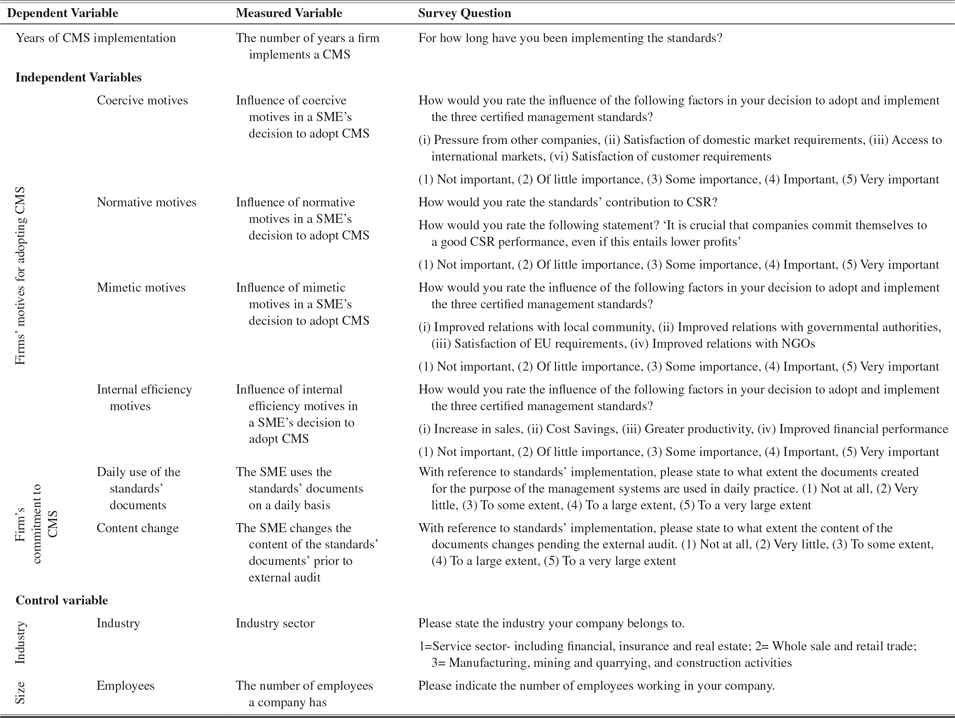
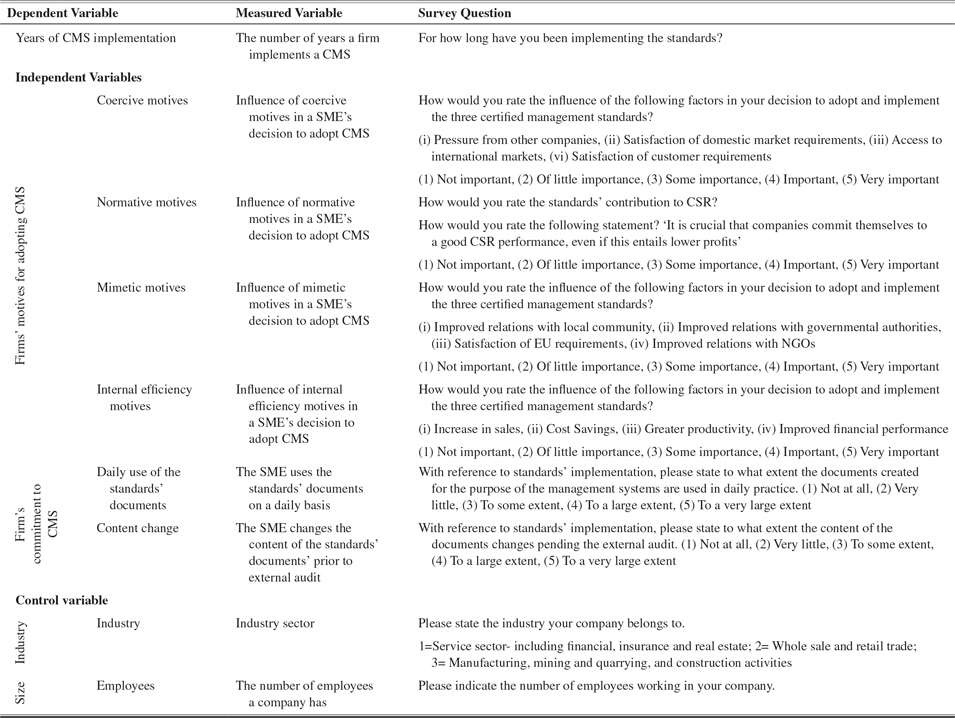
The independent variables refer to SMEs motives and SMEs commitment to the CMS requirements. SMEs motives incorporate the fourteen drivers most widely quoted in the literature as motives for CMS adoption (Bansal & Hunter, Reference Bansal and Hunter2003; Boiral, Reference Boiral2007; Castka & Balzarova, Reference Castka and Balzarova2007; Delmas & Montes-Sancho, Reference Delmas and Montes-Sancho2011; Gonzalez-Benito & Gonzalez-Benito, Reference Gonzalez-Benito and Gonzalez-Benito2005; King, Lenox, & Terlaak, Reference King, Lenox and Terlaak2005; Simpson, Power, & Klassen, Reference Simpson, Power and Klassen2012; Singh, Jain, & Sharma, Reference Singh, Jain and Sharma2015). Respondents were asked to rate the influence of each driver on their decision to subscribe to a CMS on a five point Likert scale (1=not important, 5=very important). The fourteen variables were collapsed into four factors after conducting factor analysis (see Appendix). The reliability of each factor was assessed using Cronbach’s alpha; as shown below, all factors had α>0.7, thus indicating an adequate level of reliability of the survey items (Bagozzi, Youjae, & Phillips, Reference Bagozzi, Youjae and Phillips1991; Nunnally, Reference Nunnally1978):
• Influence of coercive motives: influence of customers’ requirements; domestic market requirements; access to international markets; pressure from other companies (α = 0.809).
• Influence of normative motives: contribution of CMS to CSR; importance of CSR performance (α = 0.786).
• Influence of mimetic motives: influence of governmental authorities; NGOs; EU; local community (α = 0.833).
• Influence of internal efficiency motives: influence of greater productivity; cost savings; financial performance; sales’ increase (α = 0.848).
In order to capture the extent of commitment by SMEs to the substantial implementation of the three standards, the study adopted the methodology employed by Christmann and Taylor (Reference Christmann and Taylor2006) and Naveh and Marcus (Reference Naveh and Marcus2004). This involved asking managers: (a) to specify the degree to which SMEs use the CMS documents in their everyday activities (1=not at all, 5=to a large extent), measured by the variable daily use of the standards’ documents; and, (b) if they change the content of the documents on the verge of external audits (reverse score) (1=not at all, 5=to a large extent), captured by the variable content change of the standard’s documents. The rationale behind this latter variable is that those SMEs which apply the standards systematically are likely to make changes as required by their daily operation, whilst SMEs that adopt the standards for symbolic reasons are likely to only update documentation at the last minute to pass the annual certification audits. SMEs commitment was measured as the average of these two items. A low score indicates low commitment to CMS implementation (symbolic implementation) while a high score indicates high commitment to CMS implementation (substantial implementation). A Cronbach Alpha of 0.701 shows good reliability of the measure.
Sector affiliation is used as a control variable in response to suggestions expressed in the literature (King, Lenox, & Terlaak, Reference King, Lenox and Terlaak2005) that CMS may have more relevance to manufacturing firms than to those in other sectors, thus implying that the latter may be predisposed to the symbolic implementation of the standards. Size is also added as a control variable to address evidence from previous research indicating that SMEs might have problems in implementing CMS due to lack of resources (King & Lenox, Reference King and Lenox2000). To control for firm size, the logarithmFootnote 5 of the number of employees was used. Table 1 summarizes the measures used in the analysis.
Measures used in the analysis
ANALYSIS AND RESULTS
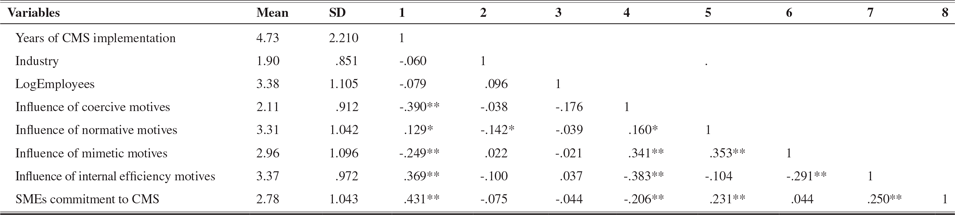
Multiple regression is used in order to predict the relationship between a continuous dependent variable (Years of CMS implementation) and several independent variables (Coercive motives, Normative motives, Mimetic motives, Internal efficiency motives, SMEs commitment), while controlling for two independent variables (Industry and Size). To ensure that the collected data are appropriate for multiple regression analysis, both normality and multicollinearity of the predictor variables were considered. To assess normality, the skewness of each measure was identified. It was established that all values fell within the acceptable range for skewness of between -1 and +1 (Hair, Anderson, Tathman, & Black, Reference Hair, Anderson, Tathman and Black1998). Regarding multicollinearity, no inter-factor correlation was found to be above 0.70, indicating that multicollinearity did not seriously affect the results (Table 2). To diminish potential multicollinearity threats, the tolerance and Variance Inflation Factor (VIF) values of each individual predictor were examined. Their values ranged between 1.01 to 1.35, which are well below the accepted level of 10.0 (Hair, Anderson, Tathman, & Black, Reference Hair, Anderson, Tathman and Black1998), thereby denoting the absence of multicollinearity.
Descriptive statistics and correlation analysis (n= 178)

** Correlation is significant at the 0.01 level (two tailed).
* Correlation is significant at the 0.05 level (two tailed).
The reliance upon self-reported data, derived from managers’ responses, raises the question of common method variance (CMV). The potential presence of CMV was tested through the use of Harman’s single factor test (Podsakoff, Lee, MacKenzie, & Podsakoff, Reference Podsakoff, Lee, MacKenzie and Podsakoff2003). If CMV is present, a single factor emerges from the factor analysis or one general factor accounts for the majority of the variance in the variables. The test yielded four factors with Eigenvalues greater than 1.0 and indicated that the first factor accounted only for a minority of variance (19.8%). This signifies that CMV is not of great concern in the data (Pérez-Nordtvedt, Kedia, Datta, & Rasheed, Reference Pérez-Nordtvedt, Kedia, Datta and Rasheed2008).
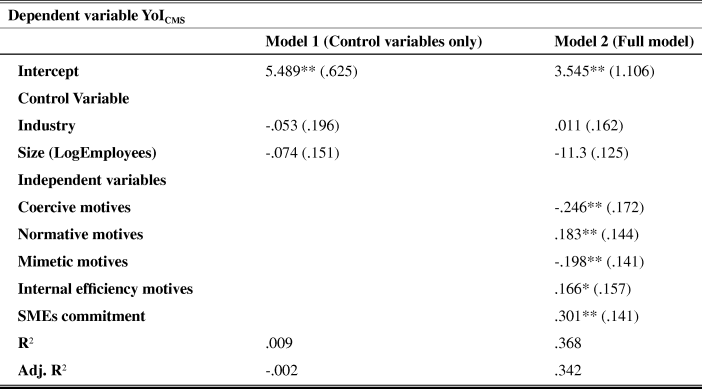
Table 3 presents the results of the regression analysis. In order to separate the effects of the control and the independent variables, a baseline model was first estimated which included only the control variables Industry and Size. Their inclusion in the equation generated an overall non-significant model, F (2,175) = .793, p = .454, indicating that industry affiliation and size did not have any effect on the dependent variable Years of CMS implementation (YoI CMS). By contrast, when SMEs motives and SMEs commitment were introduced into the equation, this produced an overall significant model, F (5,170) = 14.166, p < .001. The results of the regression indicated that five predictors explained 34.2% of the variance of YoI CMS (R2 = .368, Adj. R2 =.342). This is a typical effect size common in business studies (Cohen, Reference Cohen1988). Within our model the adoption motives with the most significant impact on YoI CMS are Coercive motives (b = -.246), followed by Mimetic motives (b = -.198), Normative motives (b = .183) and Internal efficiency motives (b = .166).
Regression results (N=178)
Standard errors are in parentheses
* p<0.05;
** p<0.01
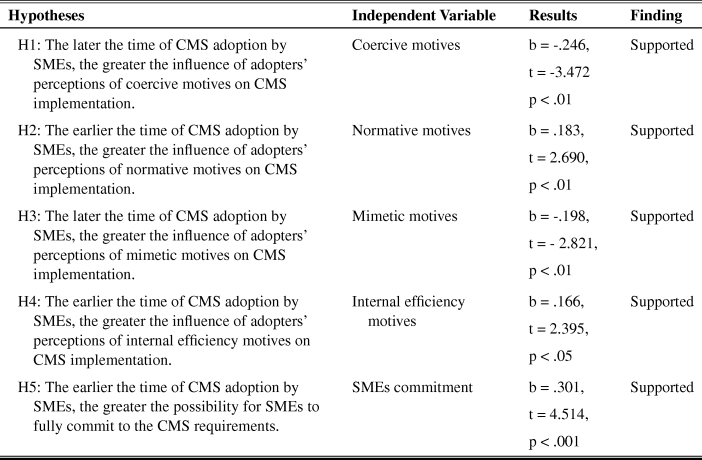
The findings of the econometric analysis provide evidence consistent with all five hypotheses formulated in this paper (see Table 4). More precisely, an inspection of the coefficients of the independent variables reveals that Coercive motives (b = -.246, t = -3.472, p < .01) as well as Mimetic motives (b = -.198, t = - 2.821, p < .01) are negatively related to YoI CMS. This implies that later adopters might be more susceptible to these motives than earlier adopters. In turn, the coefficients of Normative motives (b = .183, t = 2.690, p < .01) and Internal efficiency motives (b = .166, t = 2.395, p < .05) indicate a positive relationship between these motives and YoI CMS. This suggests that earlier adopters might show more concern for normative and internal efficiency motives. Finally, SMEs commitment (b = .301, t = 4.514, p < .001) shows a positive relationship between this variable and YoI CMS, thus indicating that greater commitment to the implementation of the requirements of CMS appears to characterise earlier rather than later adopters. Hence, the results of this analysis suggest that earlier adopters of CMS are more likely to implement the standards substantially in comparison to the later adopters.
Summary of the hypotheses and results
DISCUSSION
The extant literature on the relationship between CSR and CMS in terms of motivation and implementation has a tendency to concentrate on larger firms and investigate the application of individual standards separately. Consequently, this paper offers a different perspective by analysing the behaviour of small and medium-sized firms that have subscribed to a bundle of CSR related CMS. This is an advance (Boiral, Reference Boiral2011; Rasche, Reference Rasche2009) on those studies which tend to consider the application of just one standard in isolation (Boiral & Henri, Reference Boiral and Henri2012; Castka & Prajogo, Reference Castka and Prajogo2013; Heras-Saizarbitoria & Boiral, Reference Heras-Saizarbitoria and Boiral2013b; Iatridis and Kesidou, Reference Iatridis and Kesidou2016; Lannelongue, Gonzalez-Benito, & Gonzalez-Benito, Reference Lannelongue, Gonzalez-Benito and Gonzalez-Benito2013; Zailani, Eltayeb, Hsu, & Tan, Reference Zailani, Eltayeb, Hsu and Tan2012). By shifting the focus towards firms which subscribe to multiple CSR related standards, we put in the limelight the behaviour of an important category of SMEs that demonstrate a more systematic, and possibly a more advanced, approach to managing their corporate responsibilities.
Regression analysis corroborates the theoretical arguments that underpin this research, demonstrating the overall validity of established views on the drivers behind the adoption of CMS. This is not an insignificant finding considering that there is a strong stream in the literature that suggests that attitudes to, and practices of, CSR in SMEs are appreciably different from those developed in large companies (Ciliberti, Pontrandolfo, & Scozzi, Reference Ciliberti, Pontrandolfo, Scozzi and Wankel2008; Enderle, Reference Enderle2004; Jamali, Zanhour, & Keshishian, Reference Jamali, Zanhour and Keshishian2009; Perrini, Reference Perrini2006; Preuss & Perschke, Reference Preuss and Perschke2010; Russo & Perrini, Reference Russo and Perrini2010; Sweeney, Reference Sweeney2007). One important aspect of the debate is the role of formal tools such as social and ethical standards when applied in SMEs. These tools, it is argued, are developed with large firms in mind and therefore their implementation pattern in smaller firms may be different (Baumann-Pauly, Wickert, Spence, & Scherer, Reference Baumann-Pauly, Wickert, Spence and Scherer2013; Enderle, Reference Enderle2004; Spence, Jeurissen, & Rutherfoord, Reference Spence, Jeurissen and Rutherfoord2000). Our research demonstrates that, in fundamental respects, SMEs tend to react to CSR related CMS in a similar manner to larger firms, and are guided by similar institutional and economic motives, as is evident from the comparison of the behaviour of earlier and later adopters.
Our analysis indicates that the personal beliefs and values of the people running SMEs, who are usually also the owners, are particularly weighty drivers of CSR activities (Grayson, Reference Grayson2004; Lepoutre & Heene, Reference Lepoutre and Heene2006; Vyakarnam, Bailey, Myers, & Burnett, Reference Vyakarnam, Bailey, Myers and Burnett1997). Hence, it may be conjectured that owners-managers with strong normative views on social responsibility of business are more likely to be found among earlier adopters of the standards. This conclusion is supported by Arya and Zhang (Reference Arya and Zhang2009), who argued that larger firms with ethical motivations tend to be first movers in the adoption of CSR related practices. Our data indicates that this might be the case for SMEs as well. At the same time, our results are in a dissonance with the view expressed by Cordano, Marshall, and Silverman (Reference Cordano, Marshall and Silverman2010) who argued that, in an SME context, normative pressures tend to increase with time. Our findings suggest that, with the passage of time, in the case of CMS, normative pressures lose significance and SMEs tend to adopt CSR related practices increasingly due to coercive and mimetic pressures.
Incorporating a time dimension into the analysis has allowed us to make a contribution to the literature on the comparative influence of the motives that drive SMEs to subscribe to CSR related standards. This literature usually assumes a static approach that does not account for changes that may occur over a period of time (e.g. Heras-Saizarbitoria, Arana, & Molina-Azorín, Reference Heras-Saizarbitoria, Arana and Molina-Azorín2011; Heras-Saizarbitoria & Boiral, Reference Heras-Saizarbitoria and Boiral2013b; Heras-Saizarbitoria, Reference Heras-Saizarbitoria2011; Singh, Jain, & Sharma, Reference Singh, Jain and Sharma2015). Our results suggest that, in the case of SMEs, the balance of power between motives shifts from normative and internal efficiency motives for earlier adopters to coercive and mimetic motives for later adopters.
A notable result is the finding that industry characteristics have no significant influence on a firm’s behaviour towards CSR related CMS. This counters the conclusion often drawn in the literature that sector affiliation influences the degree of commitment to CMS requirements displayed by larger firms (Boiral, Reference Boiral2003). That SMEs behave differently may be a consequence of the difference in size, as the environmental and other impacts of individual small units of production are less noticeable than those produced by large firms, although the cumulative impact should be significant considering that in Europe alone SMEs amount to 99% of all firms (Spence, Jeurissen, & Rutherfoord, Reference Spence, Jeurissen and Rutherfoord2000).
In line with previous studies (Corbett, Reference Corbett2006; Delmas & Montes-Sancho, Reference Delmas and Montes-Sancho2007), this paper reveals a significant difference in the behaviour of earlier and later adopters. The latter have been found to be less committed to CMS requirements. By contrast, earlier adopters of CMS exhibit behaviour that implies a more substantial integration of standards in their operations. These results show that, although SMEs adopting CMS are forced to share common practices, this does not necessarily lead to the internalisation of corporate responsibility into business strategy. These findings are in line with a burgeoning stream of research that focuses on large companies, and which challenges the assumption that there is a linear relationship between institutions like CMS and socially responsible business conduct (Allur, Heras-Saizarbitoria, & Casadesús, Reference Allur, Heras-Saizarbitoria and Casadesús2014; Heras-Saizarbitoria & Boiral, Reference Heras-Saizarbitoria and Boiral2013b; Nair & Prajogo, Reference Nair and Prajogo2009; Perez-Batres, Doh, Miller, & Pisani, Reference Perez-Batres, Doh, Miller and Pisani2012). We found that, equally in an SME context, the implementation of CMS varies, leading to dissimilar levels of CSR embeddedness into business strategy.
For economies such as Greece, in which the vast majority of CMS participants are later adopters (ISO, 2014), the finding that this category of CMS adopters tends to apply the standards symbolically is significant. It indicates that the majority of SMEs seek to employ CMS standards in a manner that allows them to reconcile the traditional business model with limited social and environmental performance. In other words, they prefer to stick to the “business as usual” scenario and do not make serious attempts to use CMS as a means of advancing their social and environmental performance.
Finally, given that CSR practices, including CMS, are voluntary and based on self-regulation, the results outlined in this paper cast doubt upon the proposition that socially responsible business practices can be best implemented through self-regulatory tools (Lenox & Nash, Reference Lenox and Nash2003; Levy & Kaplan, Reference Levy, Kaplan, Crane, McWilliams, Matten, Moon and Siegel2008). The paper, therefore, offers support to research that adopts a more sceptical approach towards the role of self-regulation as a driver of corporate responsible practices (Locke, Rissing, & Pal, Reference Locke, Rissing and Pal2013; Toffel, Short, & Ouellet, Reference Toffel, Short and Ouellet2013) and towards the effectiveness of self-regulation in general. The revealed distinction between earlier and later adopters suggests that, at some point in time, any form of process based self-regulation, not supported by sanctions, may be expected to enter a stage whereby participation becomes a passive act, decoupled from implementation, thus drastically reducing its effectiveness.
CONCLUSIONS AND DIRECTIONS FOR FUTURE RESEARCH
Apart from its theoretical contribution, the paper’s results have implications for policy-makers and practitioners. Regarding the use of self-regulatory approaches to encourage CSR, it has been shown that these tools may not be as effective as their supporters may suggest. Accordingly, regulators should consider playing a more active role in stimulating and encouraging CSR. Given the apparent reluctance of Western states to enforce regulation intended to promote CSR, and the constraints imposed by a globalized business environment (Bauman, Reference Bauman2007), one possible solution would be for governments to collaborate with industry associations and work towards improving existing self-regulatory tools. The authors agree with Campbell (Reference Campbell2007) that this may help governments to share the costs related with the application of CSR practices, whilst establishing strict monitoring and sanction mechanisms to ensure that such practices do not become subject to adverse selection.
The paper’s results have additional implications for those managers who use CMS as a criterion of selecting their business partners. It has been demonstrated that certification per se is not sufficient to establish the CSR credentials of the firm. Instead, information concerning the actual implementation of the standard would provide a superior benchmark for selection.
There are a number of limitations to this study pointing towards possible avenues for future research. First, testing the study’s propositions in the context of a single country minimized influences exerted by the environment constant, but weakened the wider applicability of the results. Due to cultural influences on organizations and, by extension, on CMS implementation, an interesting development of this study could be a cross-country research, analysing institutional and cultural influences on why and how businesses adopt CSR practices such as CMS. This would assist in testing further the robustness of the current theoretical predictions and investigate whether firms’ motives for adopting CMS and the way in which firms apply these standards vary in different cultural contexts.
Second, in line with previous literature (Christmann & Taylor, Reference Christmann and Taylor2006; Oskarsson & von Malmborg, Reference Oskarsson and von Malmborg2005), this paper assumed that because the structure, the implementation process and the audit requirements of ISO 9001, ISO 14001 and OHSAS 18001 are similar, firms were likely to exhibit similar patterns of behaviour when implementing all of these standards. Nonetheless, it would prove an interesting extension of this study to investigate whether this is, indeed, the case.
Furthermore, another potential avenue for future research could be to include in the analysis of earlier and later adopters of CMS any decertification trends found between these two groups. Although such trends do not appear to be significant at the moment, as suggested by the latest ISO survey, it would be interesting nonetheless to investigate the causes of decertification and their possible effect on the behaviour of SMEs.
Finally, the measures used in this paper are not exhaustive. They allowed valuable insights in the evaluation of corporate attitudes towards CMS, but it would be wrong to pretend that they have fully captured the various facets of the motivations of firms relating to the adoption of such standards and how firms choose to implement them. Future studies could contribute by introducing additional measures to further test the robustness of current CSR theory.
The analysis contained within this paper reinforces the view that the adoption of CMS by SMEs is driven by coercive and mimetic motives rather than by normative or internal efficiency motives. Moreover, the paper’s findings indicate that, in contrast to earlier adopters, later adopters of CMS might not be so much interested in managerial effectiveness as in seeking to extract benefits of a different kind, for example, to enhance their own reputation. This evidence suggests that, in Greece, CMS have not diffused among companies so much because of their potential to assist firms in applying CSR related practices, but mostly due to market and peer pressures. These results are significant in emphasizing the fact that in the domain of CSR, ostensibly so exposed to public scrutiny, market stimuli are still a prime force behind the firm’s decision to subscribe to CMS.
ACKNOWLEDGEMENTS
The authors would like to thank Business Ethics Quarterly associate editor Jerry Goodstein and the three anonymous reviewers for their insightful comments on earlier versions of the manuscript.
Appendix: Factor loadings for pressures relating to years of CMS implementation