Introduction
Health behaviours such as exercise, sleep, diet and alcohol use are important modifiable contributors to the global burden of disease – such as diabetes, heart disease and cancer (Khaw et al., Reference Khaw, Wareham, Bingham, Welch, Luben and Day2008). Furthermore, health behaviours have been linked to mental health and wellbeing, with studies demonstrating that those with mental health problems are more likely to engage in unhealthy behaviours (Jane-Llopis & Matytsina, Reference Jane-Llopis and Matytsina2006; Lasser et al., Reference Lasser, Boyd, Woolhandler, Himmelstein, McCormick and Bor2000; Stranges, Samaraweera, Taggart, Kandala, & Stewart-Brown, Reference Stranges, Samaraweera, Taggart, Kandala and Stewart-Brown2014). The COVID-19 pandemic and associated lockdown and home confinement is likely to have had an impact on health behaviours as this new way of life may have led to changes in exercise regimes, dietary and sleeping patterns, and alcohol and tobacco use (Ammar et al., Reference Ammar, Brach, Trabelsi, Chtourou, Boukhris, Masmoudi and Hoekelmann2020; Biddle, Edwards, Gray, & Sollis, Reference Biddle, Edwards, Gray and Sollis2020; Cellini, Canale, Mioni, & Costa, Reference Cellini, Canale, Mioni and Costa2020; Deschasaux-Tanguy et al., Reference Deschasaux-Tanguy, Druesne-Pecollo, Esseddik, de Edelenyi, Alles, Andreeva and Egnell2021; Di Renzo et al., Reference Di Renzo, Gualtieri, Pivari, Soldati, Attina, Cinelli and De Lorenzo2020; Duffy, Reference Duffy2020; Wardell et al., Reference Wardell, Kempe, Rapinda, Single, Bilevicius, Frohlich and Keough2020). Previous research has highlighted socio-demographic inequalities in changes in health behaviours during the pandemic (Bann et al., Reference Bann, Villadsen, Maddock, Hughes, Ploubidis, Silverwood and Patalay2020; Biddle et al., Reference Biddle, Edwards, Gray and Sollis2020; Deschasaux-Tanguy et al., Reference Deschasaux-Tanguy, Druesne-Pecollo, Esseddik, de Edelenyi, Alles, Andreeva and Egnell2021; Giustino et al., Reference Giustino, Parroco, Gennaro, Musumeci, Palma and Battaglia2020; Koopmann, Georgiadou, Kiefer, & Hillemacher, Reference Koopmann, Georgiadou, Kiefer and Hillemacher2020). However, such behaviours may also differ as a result of individual-level health factors, such as mental health status (Stanton et al., Reference Stanton, To, Khalesi, Williams, Alley, Thwaite and Vandelanotte2020), these links may in turn lead to a worsening of subsequent mental and physical health outcomes.
It is conceivable that those with poor mental health may be especially susceptible to detrimental lifestyle changes during the pandemic. Existing studies have examined inequalities in health behaviours based on mental health. These are largely cross-sectional in nature, and have suggested that poor mental health is detrimental to some health behaviours during the pandemic (Cellini et al., Reference Cellini, Canale, Mioni and Costa2020; Cheval et al., Reference Cheval, Sivaramakrishnan, Maltagliati, Fessler, Forestier, Sarrazin and Boisgontier2020; Deschasaux-Tanguy et al., Reference Deschasaux-Tanguy, Druesne-Pecollo, Esseddik, de Edelenyi, Alles, Andreeva and Egnell2021; Stanton et al., Reference Stanton, To, Khalesi, Williams, Alley, Thwaite and Vandelanotte2020; Xiao, Zhang, Kong, Li, & Yang, Reference Xiao, Zhang, Kong, Li and Yang2020). However, previous studies have been limited in terms of sample representativeness and none have used a UK sample. Moreover, previous studies have been limited to examining mental health concurrent with the pandemic rather than considering mental health status prior to this event.
The current study addresses this gap by examining mental health prior to the pandemic as a predictor of health behaviour immediately before and at two timepoints during the pandemic. This enables comparisons of associations during the height of the first UK lockdown (May 2020) and later in the pandemic when some restrictions had eased (September 2020). We were thus able to investigate if the pandemic led to a widening of such inequalities in health behaviours by mental health status. We used data from four nationally representative UK cohort studies, representing different age groups (19–20, 30–31, 50 and 62 years). Measures of mental health were also obtained during the pandemic and examined in relation to health behaviours. Since the magnitude of association and its change across the course of the pandemic may differ by age and sex, we formally tested for heterogeneity by cohort and sex (Alati et al., Reference Alati, Kinner, Najman, Fowler, Watt and Green2004; Gibson, Reference Gibson2012).
Methods
Sample
Data are from four UK longitudinal cohort studies. The National Child Development Study (NCDS) is the oldest cohort, following the lives of an initial 17 415 people born in 1958 (Power & Elliott, Reference Power and Elliott2006). The 1970 British Cohort Study (BCS70) is based on initially 17 196 cohort members born in 1970 (Elliott & Shepherd, Reference Elliott and Shepherd2006). The Next Steps cohort is born in 1989 starting with 15 770 cohort members (Calderwood & Sanchez, Reference Calderwood and Sanchez2016). Finally, the youngest cohort, the Millennium Cohort Study (MCS), began with an original sample of 18 818 born in 2001 (Joshi & Fitzsimons, Reference Joshi and Fitzsimons2016). In this paper, we refer to these cohorts according to the year participants were born, so 1958c, 1970c, 1989c and 2001c. The cohorts have been followed up at regular intervals from birth, with exception of the 1989 cohort which was recruited at age 14. Measures and assessments have been broad, spanning across the domains of health, mental health, socioeconomics and demographics. All cohorts were emailed an online questionnaire during the height of the COVID-19 pandemic lockdown in May 2020, and again in September 2020 when some restrictions had eased. The COVID-19 survey was issued to a sample of nearly 39 000 across the four cohorts for whom an email address was held and who had not attritted permanently from their respective cohort study. Around 14 000 responded to the first survey in May that captured various aspects of their lives during the pandemic, including health behaviours. Analyses in the current study are based on 10 666 participants who provided valid responses to questions on health behaviours before and during the pandemic in the May survey and again in the September survey. Further information on the COVID-19 survey is available elsewhere (Brown et al., Reference Brown, Goodman, Peters, Ploubidis, Aida, Silverwood and Smith2020). The cohorts each provided data from their respective survey sweeps prior to the pandemic. For the Next Steps cohort, this was using an online survey; and for all other cohorts, data collection was face-to-face interviews with mental health measures administered via a self-completed questionnaire.
Measures
Health behaviours
Four aspects of health behaviour outcomes were measured (alcohol, diet, exercise and sleep). In the first survey in May 2020, participants reported their behaviours in the month before the Coronavirus outbreak and their current behaviours, and the second survey in September 2020 again asked about current behaviours. For each health behaviour, binary measures were constructed distinguishing healthy and risky behaviour using recommended guidelines. We used this dichotomised approach in main analyses (and original scales in supplemental analyses) to aid presentation given the large number of comparisons drawn and to account for likely non-linear effects of health behaviours on other health outcomes (e.g. both low and high sleep may adversely affect health). Alcohol consumption was measured in terms of frequency (frequency from never to four or more times a week) and volume (number of drinks per typical day when drinking). Both measures were categorical rather than continuous (see online Supplementary Table S1). From these measures, a measure of risky drinking was constructed using current UK guidelines recommending no more than 14 units a week (National Health Service, 2018b), and less than six units in a session (National Health Service, 2019a). Because our survey asked about drinks (which tend to contain more than one unit), our thresholds were adjusted to up to 12 drinks weekly and less than five drinks per session. Diet was ascertained in number of portions of fresh fruit and vegetables consumed in a typical day, from which a binary measure was created using the ‘five a day’ recommendation as a cut-off (National Health Service, 2018a). Physical activity was measured as number of days per week doing exercise for at least 30 min that raises the heart rate and causes sweating; a binary measure was constructed with a cut-off point of less than 5 days a week falling short of the recommended 150 min a week (National Health Service, 2019b). Finally, sleep was reported as average hours per night, which was dichotomised into a variable distinguishing recommended sleep levels (7–9 h) v. atypical sleep (<7 or >9) (Hirshkowitz et al., Reference Hirshkowitz, Whiton, Albert, Alessi, Bruni, DonCarlos and Kheirandish-Gozal2015).
Mental health
Multiple psychological health measures were used: (1) psychological distress (measured using different scales in each cohort, both prospectively before COVID-19 and during the first lockdown) and (2) anxiety and depression symptoms (ascertained during lockdown in May using the same scale across the cohorts). Each has complementary advantages – the former in mapping hypothesised temporal directions using well-characterised measures used longitudinally in each cohort and the latter in terms of improving comparability for testing cohort differences in association; thus both were used separately in analyses.
Psychological distress prior to the pandemic was measured using different scales in each cohort. In the 2001c, this was at age 17 (2 years prior) using the Kessler (K6) (Kessler et al., Reference Kessler, Barker, Colpe, Epstein, Gfroerer, Hiripi and Zaslavsky2003), a six-item measure ranging 0–24, with scores of 13 and above considered in the clinical range, α = 0.86. In the 1989c, the assessment was at age 25 (5 years prior), using the General Health Questionnaire (GHQ-12) (Goldberg & Williams, Reference Goldberg and Williams1988), ranging from 0 to 12, with clinical level of 4 and above, α = 0.85. In the 1970c, the assessment was at age 46 (4 years prior), and in the 1958c at age 50 (12 years prior), both using the nine-item Malaise (Rutter, Tizard, & Whitmore, Reference Rutter, Tizard and Whitmore1970), ranging from 0 to 9 with scores of 4 or above considered in the clinical range, α = 0.76. These cohort-specific measures were administered also in the COVID-19 survey in May and are referred to in this study as current psychological distress. High psychological distress in the current study is the established clinical cut-off for each of these respective measures.
Anxiety/depression was assessed in the COVID-19 survey in May as another current measure of mental health and this was the same across all cohorts. Depressive symptoms were measured using two items from the Patient Health Questionnaire (PHQ-2), range 0–6, and scores of 3 and above are indicative of high depressive symptoms (Kroenke, Spitzer, & Williams, Reference Kroenke, Spitzer and Williams2003). Anxiety symptoms were assessed by two items from the General Anxiety Disorder scale (GAD-2), range 0–6, with scores of 3 and above considered high levels of anxiety symptoms (Kroenke, Spitzer, Williams, Monahan, & Lowe, Reference Kroenke, Spitzer, Williams, Monahan and Lowe2007). These scales were combined into one single measure of anxiety/depression, range 0–12, and high levels of symptoms were set to 6 or above, a threshold that was guided by the distribution of cut-offs for the two subscales, α = 0.88.
Covariates
Since education may influence both mental health and health behaviours (Huijts et al., Reference Huijts, Gkiouleka, Reibling, Thomson, Eikemo and Bambra2017; Yu & Williams, Reference Yu, Williams, Aneshensel and Phelan1999), it was included as a potential confounder. Cohort members’ level of education was classified using the National Vocational Qualifications (NVQ) level system, ranging from NVQ1 to NVQ5, with an additional category for those without any qualifications. For the youngest cohort, parental educational level was used as many were still in training or education. Gender was also included as a confounder, using sex at baseline in the 1989c and sex at birth in all other cohorts.
Analyses
All statistical analyses were carried out using Stata version 16 (StataCorp, 2019). We examined how prior mental health (psychological distress) and mental health during the lockdown in May (psychological distress, and anxiety/depression) were associated with health behaviour at three timepoints: the month before the Coronavirus outbreak, during the lockdown in May and in September when restrictions had eased. Descriptive statistics and unadjusted associations between mental health and health behaviour used clinical cut-offs (binary measures) of mental health. In logistic regression models, adjusting for gender and for educational level of cohort members, ridit scores of mental health were used to estimate inequalities in each behaviour, to maximise statistical power and avoid information loss. Ridit (relative to an identified distribution) scores (Bross, Reference Bross1958) were calculated based on the continuous mental health measures using the wridit Stata command. When used in regression models, ridit is referred to as the slope index of inequality and provides a single estimate of the total magnitude of association (inequality between those with the highest scores, compared to those with the lowest scores), while accounting for differences in the distribution of participants within each cohort (World Health Organization, 2017). Where the prevalence of the outcome differs across time, comparing results on the relative scale can impair comparisons of risk factor–outcome associations (e.g. identical odds ratios can reflect different associations on the absolute scale) (King, Harper, & Young, Reference King, Harper and Young2012). As such, absolute risk differences in health behaviour outcomes by mental health were obtained using the margins command in Stata following logistic regression. Effect estimates show the difference in risk for each outcome comparing those with the highest compared with least mental health symptoms. Because interpretation of within-person change scores can be problematic (Tennant, Arnold, Ellison, & Gilthorpe, Reference Tennant, Arnold, Ellison and Gilthorpe2021), main analyses examined associations between mental health and health behaviours at each timepoint; however, change score analyses are provided as additional analyses. Regression analyses were carried out by cohort and results were meta-analysed to formally assess heterogeneity using the I 2 statistic and obtain pooled estimates of association. Models examining cohort estimates controlled for gender and education. In the models examining gender differences, educational level and cohort were controlled for.
In all analyses, bias due to non-response to the survey was adjusted for by using weights (Brown et al., Reference Brown, Goodman, Peters, Ploubidis, Aida, Silverwood and Smith2020). We also accounted for the stratified survey designs of the 1990c and 2001c in all analyses.
Results
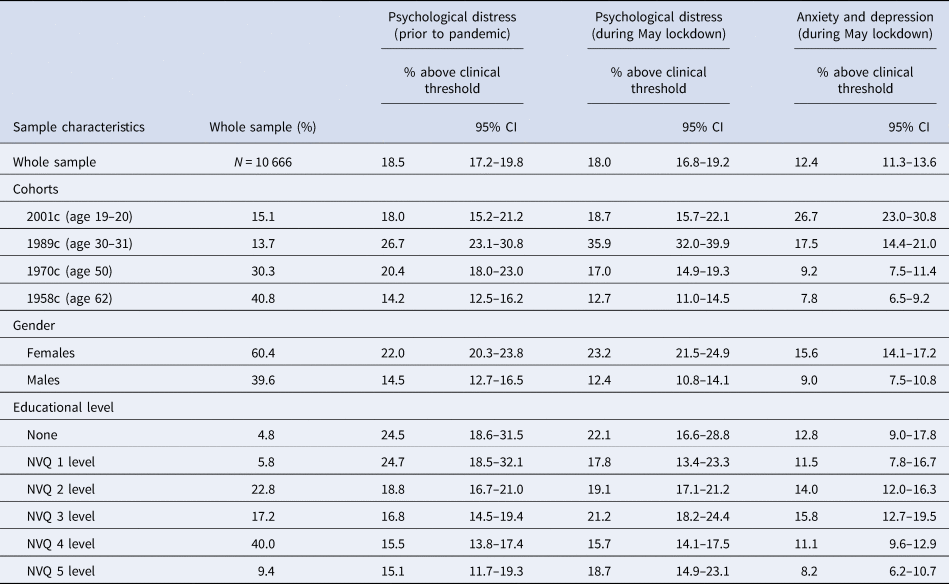
Sample characteristics of the 10 666 participants are shown in Table 1. The oldest cohort 1958c (NCDS) accounted for 41% of the sample, 1970c (BCS) 30%, 1989c (NS) 14% and the youngest 2001c (MCS) 15%. Females made up 60%, and around 50% were educated to degree level or above (NVQ 4 and 5). Also shown in Table 1 are sample characteristics by mental health status. For current anxiety/depression, in which the same questions were asked across all cohorts, symptoms were considerably more prevalent in younger cohorts [e.g. 26.7% (CI 23.0–30.8) in 2001c, and 17.5% (CI 14.4–21.0) in 1989c, compared with 9.2% (CI 7.5–11.4) in 1970c and 7.8% (6.5–9.2) in 1958c]. Similar patterns were found for both prior and current psychological distress (using cohort-specific measures).
Sample characteristics by mental health

Psychological distress prior to pandemic was measured in the 2001c at age 17, in the 1989c at age 25, in the 1970c at age 46 and in the 1958c at age 50.
Estimates of mental health are weighted to account for survey non-response. % above clinical threshold are based on scale-specific cut-offs used for each measure that indicate probable clinical diagnosis.
Mental health and sleep
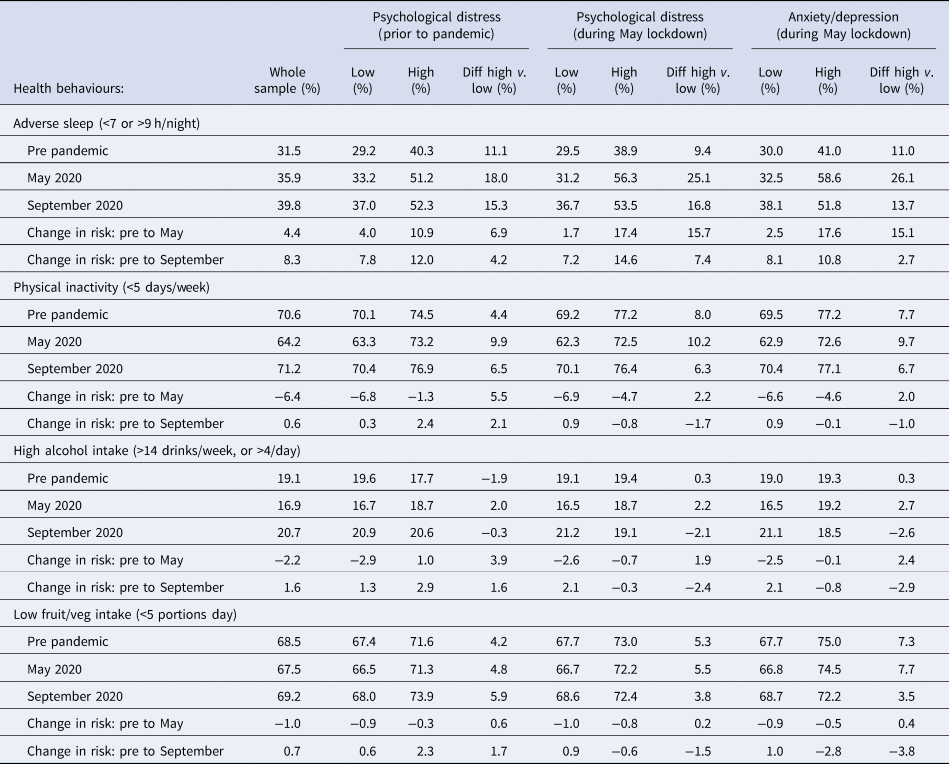
Table 2 shows that across the sample overall, 31.5% reported adverse sleep duration prior to the pandemic, and this increased to 35.9% during the May lockdown, and increased further to 39.8% in September. Across all periods – pre-pandemic, in May and September – all measures of worse mental health were associated with adverse sleep (Table 2 and Fig. 1 for binary mental health measures). The size of these inequalities appeared to be lowest pre-lockdown, and highest during the pandemic in May and September.
Health behaviour outcomes before and during the COVID-19 pandemic by mental health status. Note: High levels of mental health symptoms are those above clinical cut-offs for each scale (see Methods).

Health behaviours (before the pandemic and during May and September 2020) by mental health status

Estimates are weighted to account for survey non-response. High psychological distress levels of symptoms are those above the clinical cut-off for the respective scales.
The cohort-pooled risk differences for adverse sleep – in the highest compared with lowest levels of prior psychological distress – were 21.2% (95% CI 16.2–26.2) before lockdown, 25.5% (20.0–30.3) in May and 28.2% (21.2–35.2) in September (Fig. 2a). There was little evidence for systematic differences by cohort (I 2 < 44% in each timepoint). Findings were similar for current anxiety/depression (Fig. 2b) and current psychological distress (online Supplementary Fig. S1), with effect sizes slightly weaker in September compared with May, and more pronounced cohort differences, with the 1990c having the largest effect size in the height of the lockdown in May, yet no association prior to the pandemic.
Results of logistic regressions showing differences in health behaviour risk (before COVID-19 pandemic, during May 2020 lockdown and in September 2020) between participants with highest and lowest levels of mental health problems: meta-analysis of four cohort studies. (a) Psychological distress (prior to pandemic, cohort-specific mental health measures). (b) Anxiety and depression (during May lockdown, same mental health measure across cohorts). Note: Estimates show the risk difference on the percentage scale between those with the highest v. lowest mental health problems (ridit scores), and are weighted to account for survey non-response and survey design in 2001c and 1990c. Sex and educational level are controlled for.

Mental health and exercise
As shown in Table 2, prior to the pandemic, 70.6% of the total sample were physically inactive; during the lockdown in May, this declined to 64.2%; and in September, it reverted to 71.2%. Those with mental health problems (across all measures) were at greater risk of insufficient exercise before the pandemic, with inequalities increasing during the lockdown in May, and narrowing again in September (Table 2, Fig. 1).
Comparing those with the highest to those with the lowest level of prior psychological distress (Fig. 2a), cohort-pooled risk differences for insufficient exercise were 8.5% (95% CI 3.7–13.5) prior to the pandemic, rising to 10.8% (95% CI 3.3–18.2) in May and 10.8% (95% CI −1.8 to 23.4) in September. In September, cross-cohort heterogeneity was highest (I 2 = 85%) and inequalities were especially large in the youngest 2001c cohort. Results for current mental health show a similar increase in inequalities from prior to the pandemic to the lockdown in May (Fig. 2b; online Supplementary Fig. S1), although in September they revert to below pre-pandemic levels, and broadly there is little difference between cohorts across timepoints.
Mental health and alcohol consumption
In total, 19.1% reported high-risk drinking prior to the pandemic, declining to 16.9% during the lockdown in May, and then increasing to 20.7% in September. While associations between prior mental health and alcohol intake were largely null (Table 2, Fig. 1), for current mental health, there was some evidence of inequality. For anxiety/depression, the risk difference was 5.4% (95% CI 1.3–9.4) prior to the pandemic, rising to 10.2% (95% CI 6.3–14.1) in May and reverting to 6.4% (95% CI 1.5–11.3) in September (Fig. 2b). A similar pattern was seen for current psychological distress (online Supplementary Fig. S1).
Results were largely similar across cohorts for all measures of mental health and timepoints. The only exception was for current psychological distress for which inequalities were especially large in the 2001c in May.
Mental health and fruit and vegetable intake
As for diet (Table 2), 68.5% of the sample overall reported consuming less than five a day portions of fruit and veg before the pandemic, decreasing to 67.5% during the May lockdown and increasing to 69.2% in September. As seen in Table 2 and Fig. 1, across all binary mental health measures, those with high distress were at greater risk of not achieving the five a day recommendation at all three timepoints.
Cohort-pooled risk differences in consuming less than five a day, comparing those with the highest level of prior psychological distress to those with the lowest (Fig. 2a), were 9.0% (95% CI 4.1–14.0) prior to the pandemic, and very similar in May (9.1%, 95% CI 4.2–14.0) and in September (8.3%, 95% CI 3.4–13.2). For current mental health, we see an increase in inequalities from before to during the pandemic in May that then revert to pre-pandemic levels in September (Fig. 2b; online Supplementary Fig. S1).
In term of cohort differences, for prior psychological distress, results were similar across the cohorts at the three timepoints, whereas for current mental health, cohorts differed before the pandemic, with inequalities greatest in the oldest 1958c cohort.
Additional and sensitivity analyses
The main findings in terms of inequalities in health behaviours based on mental health based were similar in males and females, with few exceptions (online Supplementary Fig. S2). Inequalities in sleep based on current mental health were greater for females than males in May. Males with a low level of prior mental health symptoms were at higher risk of excessive drinking before the pandemic, but for females there was no association.
Main findings using ridit scores also did not differ when analysing mental health as either z-scores (online Supplementary Fig.S3) or binary variables (online Supplementary Fig. S4). The original (non-binary) health behaviour measures by mental health status can be seen in online Supplementary Table S1 and Fig. S5 shows results of main regression models using these original health behaviour measures. These are largely consistent with results using binary outcomes. Online Supplementary Fig. S6 are analyses that examine change in health behaviour risks between pre-COVID and May and September, respectively, which corroborate the main findings by showing an increase in inequalities based on mental health in May which then reverts pre-pandemic levels in September.
Discussion
Main findings
The present study examined the association of mental health with sleep, exercise, alcohol and diet prior to and at two timepoints during the COVID-19 pandemic, using data from four UK cohort studies. For the sample overall, from before the pandemic to the full lockdown in May, there were positive improvements in exercise, diet and alcohol, but a deterioration in sleep. In September when many restrictions had eased, levels had reverted to pre-pandemic levels for most health behaviours, except for sleep for which the risk of atypical sleep had increased further.
Poor mental health was related to adverse health behaviours; especially in relation to sleep, but also exercise, and fruit and vegetable consumption, whereas for alcohol consumption the difference was small. The associations between poor mental health and health behaviour risks tended to be larger in May during the full lockdown, with 11 out of 12 effect estimates larger in May than pre-pandemic. These lockdown effects were larger for concurrently measured mental health compared to pre-pandemic measures of mental health. In September when restrictions had lessened, most health behavioural inequalities had restored to pre-pandemic levels, with 10 of 12 associations smaller in September than May. A notable exception to this general pattern of restoration was sleep, for which inequalities remained elevated into September for all measures of mental health.
Comparison with other studies and explanations of findings
Our findings resonate well with previous research showing that poor mental health is associated with less ‘healthy’ behaviours (Jane-Llopis & Matytsina, Reference Jane-Llopis and Matytsina2006; Lasser et al., Reference Lasser, Boyd, Woolhandler, Himmelstein, McCormick and Bor2000; Stranges et al., Reference Stranges, Samaraweera, Taggart, Kandala and Stewart-Brown2014). Moreover, there is significant consistency between recent COVID-19 studies conducted in other countries that have examined mental health in relation to health behaviours, showing that common mental health problems such as depression and anxiety are risk factors for unfavourable changes in health behaviours during the pandemic (Cellini et al., Reference Cellini, Canale, Mioni and Costa2020; Cheval et al., Reference Cheval, Sivaramakrishnan, Maltagliati, Fessler, Forestier, Sarrazin and Boisgontier2020; Deschasaux-Tanguy et al., Reference Deschasaux-Tanguy, Druesne-Pecollo, Esseddik, de Edelenyi, Alles, Andreeva and Egnell2021; Stanton et al., Reference Stanton, To, Khalesi, Williams, Alley, Thwaite and Vandelanotte2020; Xiao et al., Reference Xiao, Zhang, Kong, Li and Yang2020). We build on such evidence by using longitudinal nationally representative cohort data, using multiple validated mental health scales measured both prior to and during the pandemic, and also examining multiple health behavioural outcomes.
As in the current examination, an existing study has found that sleep in particular had deteriorated during the pandemic for those with higher levels of mental health problems (Stanton et al., Reference Stanton, To, Khalesi, Williams, Alley, Thwaite and Vandelanotte2020). Sleep is regarded as fundamental to the operation of our central nervous system and therefore linked with a large range of mental health disorders, and the relationship is highly reciprocal with mental health problems in turn being highly detrimental to sleep (Alvaro, Roberts, & Harris, Reference Alvaro, Roberts and Harris2013; Harvey, Murray, Chandler, & Soehner, Reference Harvey, Murray, Chandler and Soehner2011). This strong and cyclical relationship may explain why the sleep inequalities based on mental health had not returned to more normal pre-pandemic levels as seen for the other health behaviours. Moreover, sleep has a very direct or instant effect on emotional regulation (Gruber & Cassoff, Reference Gruber and Cassoff2014). In a recent review, it was proposed that the strongest pathway of the bidirectional relationship between sleep and mental health is sleep as a causal factor for the occurrence of psychiatric problems (Freeman, Sheaves, Waite, Harvey, & Harrison, Reference Freeman, Sheaves, Waite, Harvey and Harrison2020).
The association between mental and various other health behaviours is also likely to be reciprocal. Positive changes to health behaviours such as targeted in interventions have shown improvements in mental health following the adoption of a healthier diet (Parletta et al., Reference Parletta, Zarnowiecki, Cho, Wilson, Bogomolova, Villani and O'Dea2019), reduced alcohol consumption (Charlet & Heinz, Reference Charlet and Heinz2017) and increased physical activity (Atlantis, Chow, Kirby, & Singh, Reference Atlantis, Chow, Kirby and Singh2004). Conversely, the influence of mental health on subsequent health-related behaviours may be the main driving mechanism for the observed higher risk of morbidity and premature mortality amongst those with mental health problems (Lawrence & Coghlan, Reference Lawrence and Coghlan2002; Ploubidis, Batty, Patalay, Bann, & Goodman, Reference Ploubidis, Batty, Patalay, Bann and Goodman2021; Reilly et al., Reference Reilly, Olier, Planner, Doran, Reeves, Ashcroft and Kontopantelis2015). For example, psychological distress can lead to self-medicating with alcohol (Phillips & Johnson, Reference Phillips and Johnson2001; Turner, Mota, Bolton, & Sareen, Reference Turner, Mota, Bolton and Sareen2018), comfort eating (Gibson, Reference Gibson2012), and it can be a motivational barrier to taking exercise (Firth et al., Reference Firth, Rosenbaum, Stubbs, Gorczynski, Yung and Vancampfort2016).
Mental health-related differences in health behaviours may have widened during the pandemic reflecting the additional volitional efforts required to undertake such health behaviours during a lockdown; common mental health problems may lead to multiple barriers to undertaking such behaviours (e.g. feeling tired, loss of enjoyment in activities). Another explanation may be a worsening of mental health symptoms (Henderson et al., Reference Henderson, Fitzsimons, Ploubidis, Richards and Patalay2020; Niedzwiedz et al., Reference Niedzwiedz, Green, Benzeval, Campbell, Craig, Demou and Whitley2021), and thereby a worsening of health behaviours. Such worsening may be explained by multiple factors such as financial insecurity and changes to support mechanisms particularly affecting those with preceding mental health problems. Further research and examination will be needed to illuminate such pathways.
Strengths and limitations
Our study benefits from a large sample of participants from four UK cohort studies, spanning from ages 19 to 62. Because these cohorts have been followed longitudinally prior to the pandemic, it was possible to examine previous measures of mental health and not just mental health concurrent with the pandemic. It is, to our knowledge, the first study to provide evidence on the effect of the pandemic on widening health behaviour inequalities based on mental health in the UK.
Limitations include the relatively low response rates. As in many other COVID-19 surveys, fieldwork was planned and carried out rapidly. The online format used is likely to have contributed to the low response rates also observed in other comparable national studies (Niedzwiedz et al., Reference Niedzwiedz, Green, Benzeval, Campbell, Craig, Demou and Whitley2021). While non-response weights (developed using individual and demographic data from previous sweeps) were used in analyses, we cannot fully exclude the possibility of there being unobserved predictors of missing data influencing our results. In addition, attrition occurred between COVID sweeps; while those retained in analyses were broadly similar to the initial survey (online Supplementary Table S2), it could feasibly either lead to upward or downward bias in our estimates of association. Another limitation in relation to the data collection format is that this differs between the online COVID-19 survey and the surveys prior to the pandemic, which are mainly face-to-face interviews with self-completed mental health questionnaires. Such modal differences could have affected the measures and therefore the results of the study.
Although the recall period for pre-pandemic health behaviours was short, recall bias may have affected these measures. Those with mental health problems may be especially affected by such recall bias, potentially biasing associations – for example, leading to overestimation of association if those with mental health problems underestimated reported physical activity. Further, limited aspects of each health behaviours were used which do not include the full spectrum of these behaviours’ impact on health. Exercise was captured in only 30 min bouts and does not capture less intensive physical activities, or sedentary behaviours; fruit and vegetable intake is only one component of diet; and sleep is limited to sleep duration and not quality of sleep; finally, it is challenging to accurately capture alcohol consumption since units may differ by drink. There is inherent uncertainty in the classification of such behaviours as ‘high risk’ using binary scores, potentially leading to misclassification; however, our findings were similar when using the non-binary response scales (online Supplementary Fig. S4).
Regarding mental health, prior and current psychological distress measures were not the same across cohorts, and the timing of their measurement prior to the pandemic varied across cohorts, meaning that any cohort differences could be due to a difference in measures and timing. Although the very similar results between different measures and the same measure of current mental health are encouraging and suggest little impact of how mental health is measured. However, particular caution is warranted in interpreting the association between mental health during the pandemic health behaviours prior to this, as these may be particularly influenced by reverse causality. These measures were included as triangulation of the main results that use prior mental health measures but which varied widely between cohorts in terms of timing of assessments as discussed above. As in all studies examining potential effects of the COVID-19 lockdown, we cannot distinguish whether differences found are due to different lockdowns or other time-varying factors such as seasonal change. Further, if such factors influenced mental health differentially, this may account for changes in inequalities in health behaviour risks between timepoints. In addition, as in all such observation studies, we cannot exclude the possibility of other unmeasured confounding factors which could explain our results, nor the possible influence of residual confounding (e.g. since education alone may imperfectly capture all dimensions of socioeconomic position).
Conclusion
This study highlights the sizable inequalities in multiple health behaviours attributable to mental ill-health and shows how the COVID-19 lockdown may have further amplified these inequalities. This may have long-lasting effects on subsequent mental and physical health outcomes.
Supplementary material
The supplementary material for this article can be found at https://doi.org/10.1017/S0033291721004657
Data
The data used are available from the UK Data Archive: https://www.data-archive.ac.uk.
Acknowledgements
We thank the Survey, Data and Administrative teams at the Centre for Longitudinal Studies and Unit for Lifelong Health and Ageing, UCL, for enabling the rapid COVID-19 data collection to take place. We also thank Professors Rachel Cooper, Mark Hamer and Dr Jane Maddock for helpful discussions during the COVID-19 questionnaire design period.
Financial support
PP and DB are supported in this work by funding from the UKRI via the Economic and Social Research Council (grant number ES/V012789/1). DB is supported by the Economic and Social Research Council (grant number ES/M001660/1) and Medical Research Council (MR/V002147/1). DB and AV are supported by The Academy of Medical Sciences/Wellcome Trust (‘Springboard Health of the Public in 2040’ award: HOP001/1025).
Conflict of interest
None.
Ethical standards
The authors assert that all procedures contributing to this work comply with the ethical standards of the relevant national and institutional committees on human experimentation and with the Helsinki Declaration of 1975, as revised in 2008.