Introduction
Preventing elder abuse is a political priority (House of Commons Health Committee, 2004). It predicts institutionalization and hospitalization (Dong and Simon, Reference Dong and Simon2013; Dong et al., Reference Dong, Chen, Chang and Simon2013). People with dementia are particularly vulnerable and frequently abused (Cooper et al., Reference Cooper, Selwood and Livingston2008b). In recent studies, a third of family carers reported acting in a way that met definitions of significant psychological or physical abuse (Cooper et al., Reference Cooper, Selwood and Livingston2008b; Reference Cooper, Selwood, Blanchard, Walker, Blizard and Livingston2009), although they are often unaware their behaviors would be thus defined. In two longitudinal studies, abusive behavior reported by dementia family carers increased over a year, and was predicted by anxiety and depressive symptoms (Rush Smith et al., Reference Rush Smith, Williamson, Miller and Schulz2005; Cooper et al., Reference Cooper, Blanchard, Selwood, Walker and Livingston2010a).
As people with dementia are most often abused and this is most frequently by their carer, they are a very important group to target. A recent non-randomized study found that intervening with professional carers reduced abusive behavior (Hsieh et al., Reference Hsieh, Wang, Yen and Liu2009), but no interventions are known to reduce abuse by family carers (Ploeg et al., Reference Ploeg, Hutchinson, MacMillan and Bolan2009).
The START study, a randomized controlled trial (RCT) of a manualized psychological intervention for dementia family carers reduced carer anxiety and depression (Knapp et al., Reference Knapp2013; Livingston et al., Reference Livingston2013; Reference Livingston, Barber, Rapaport, Knapp and Griffin2014a; Reference Livingston2014b) We have previously reported that abusive behavior reported did not differ between carers in intervention and control groups in the whole trial population (Livingston et al., Reference Livingston, Barber, Rapaport, Knapp and Griffin2014a). This original analysis, however, did not exclude family carers for people who moved to care homes during the trial, after which point the family carers were unlikely to report abusive behavior as they were no longer providing day-to-day care. This paper is the first analysis of an RCT with the outcome of abuse towards people with dementia while they were living in their own homes; and the first to report levels of abuse over two years. We tested our hypothesis that the START intervention reduced reported abusive behavior towards people with dementia living at home, compared with TAU alone.
Methods
Study design
START was a parallel-group, powered to show the intervention was superior to TAU on the primary outcome, single-blind, RCT, recruiting participants 2:1 to intervention: TAUto allow for therapist clustering, at four UK sites. Methods are described in detail elsewhere (Knapp et al., Reference Knapp2013; Livingston et al., Reference Livingston2013). This trial is registered: ISCTRN 70017938.
Participants and setting
Inclusion criteria: Eligible participants were self-identified family carers providing support at least weekly to people with a clinical dementia diagnosis, living in their own homes. The patients had been referred to the clinical team in the previous year. Exclusion criteria: Carers who were unable to give informed consent to the trial, or who were already in a trial of carer support or lived over 1.5 hours from the researchers’ base. We recruited from 04/11/2009 to 08/06/2011 from three mental health trusts and a tertiary neurology clinic in South-East England. We obtained written ethics approval for the study from East London and the City Research Ethics Committee 1 for the trial (ID: 09\H0703\84) and Research and Development permission from the local trusts. All participants gave written informed consent.
Procedures
Randomization was stratified by center using random permuted blocks via an online computer-generated randomization system from an independent Clinical Trials Unit. Assessors were blinded to randomization status, but study participants knew their allocation. We developed the eight-session START manual-based individual coping intervention for dementia family carers from the American “Coping with Caregiving” programme (Gallagher-Thompson et al., Reference Gallagher-Thompson2002). We trained and supervised non-clinically trained psychology graduates to deliver it. We devised a fidelity checklist for each session by considering the most important components of the session and then scored the session fidelity from 1, “not at all,” to 5, “very” focused. This was completed from an audio-recording by a therapist who did not deliver the intervention. Therapists recorded one therapy session per participant selected at random by the trial manager. Sessions were usually in participants’ homes, unless they preferred the team's office. The graduate therapists were encouraged to be empathic, adhere to the manual, and work collaboratively with carers rather than giving solutions or advice. Therapists and carers identified difficulties and implemented strategies to manage them, including: relaxation, behavioral management, communication strategies, identifying, and changing unhelpful thoughts, positive reframing, accessing emotional support, future planning, and increasing pleasant events. The carers were asked to practice the manual and relaxation compact discs between sessions. In the final session, carers and therapists developed a maintenance plan of useful strategies. There are more details of the treatment in the full report (Livingston et al., Reference Livingston, Barber, Rapaport, Knapp and Griffin2014a). Although carers are given information about dementia (not necessarily systematically) and told about services, none of the other features of the intervention are part of TAU.
TAU within the trusts involved in the trial was based on NICE guidelines (National Institute for Clinical Excellence and Social Care Institute for Excellence (NICE/SCIE), 2006). TAU consisted of assessment, diagnosis and information-giving, risk assessment and management, drug treatment, cognitive stimulation therapy, practical support, and treatment of neuropsychiatric and cognitive symptoms.
Outcomes
The full assessment methods have been reported elsewhere (Livingston et al., Reference Livingston2013). Carers were interviewed at baseline, short term (4 and 8 months) and long term (12 and 24 months) after randomization. They completed the MCTS each time. This is a self-completed measure of potentially abusive behavior by carers towards the care recipient which has been validated and used previously with family carers of people with dementia (Beach et al., Reference Beach, Schulz, Williamson, Miller, Weiner and Lance2005; Cooper et al., Reference Cooper, Manela, Katona and Livingston2008a). Ten behaviors ranging from shouting, to threatening to shaking, or slapping, are scored as to whether, during the previous three months, they occurred never (0), almost never (1), sometimes (2), most of the time (3), or all of the time (4) and item-scores are summed. Where participants scored ≥2 on any item, this is classified as significant abuse, so the researcher discussed the behavior with a supervising clinician. If concerns were raised, a plan was made with one of the lead investigators about how to manage the risk. If it was judged that the person with dementia was at risk, permission was asked and given to inform the clinical team so that the carer and patient could have appropriate help. No one was lost to the study as a result of this process.
Statistical analysis
The study was powered for the primary outcome, carer mood. Participant allocation was unequal to allow for therapist clustering in the intervention arm. MCTS was a secondary outcome and our analyses were exploratory but predetermined and signaled in the main report (Livingston et al., Reference Livingston, Barber, Rapaport, Knapp and Griffin2014a). We describe the numbers and percentage of those engaging in possibly abusive behavior by allocation group and time. Analyses were intention to treat. We censored data at the assessment before any care home admission, as care home staff would then be providing personal and day-to-day care. We explored MCTS score differences between groups (binary outcomes and continuous). We used random effects models allowing for repeated measures adjusted for baseline MCTS, center, time, group, patient age, and sex to consider differences in potentially abusive behavior between randomized groups on binary outcomes only as the continuous data were very skewed. The analysis used multi-level modeling so uses data where there is some follow up data. In models that took account of outcome data at all time points, we were able to include 213 in the analysis although not all had completed data up to 24 months.
We used sensitivity analysis which also adjusted for baseline imbalances (carer work, carer education, patient education, relationship with carer, lives with carer) and which showed very similar results. Additionally, sensitivity analyses adjusting for these and baseline demographic/clinical predictors of missing showed similar results.
Results
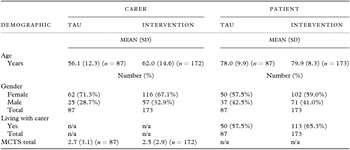
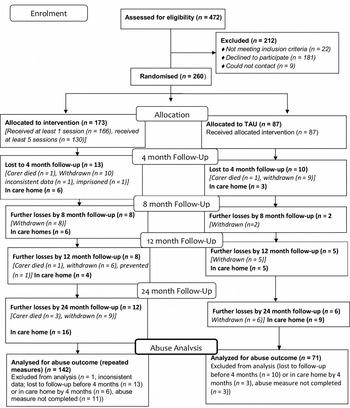
260/450 (58%) eligible carers consented. The remainder refused to participate or were uncontactable. The known personal details of those who consented and those who did not were compared and shows that the study sample had good external validity (Livingston et al., Reference Livingston2013) 173 (66.5%) participants were randomized to the intervention group and 87 to TAU. Data from 213 (82%) of carers recruited were included in our analyses (as these had at least one follow up measurement of abusive behavior) and 173 (67%) remained in the study for two years. 17 TAU group and 32 intervention group carer recipients were admitted to care homes over the study and their data were censored (see Figure 1 for consort diagram). Baseline characteristics are shown in Table 1. Table 2 describes the numbers and percentage of those engaging in possibly abusive behavior by allocation group and time.
Demographic characteristics and abuse score of sample

MCTS harmful behavior (at least one item > = 2)

Consort diagram.

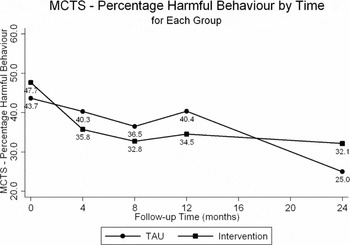
There was no significant difference in the proportion with MCTS score ≥2 (Figure 3) between randomization groups over two years in regression models, controlling for baseline MCTS score, centee, and time (n = 213, Odds Ratio (OR) 0.59, 95% Confidence Interval (CI) 0.27–1.28, p = 0.18), or when differentiating between short and long term follow-ups (n = 213, OR 0.54, 95% CI 0.23–1.28 p = 0.16 and OR 0.67, 95% CI 0.25–1.80, p = 0.43 respectively); or after additionally controlling for patient age and gender (n = 213, (OR 0.65, 95% CI 0.31–1.36, p = 0.25). When we compared the final model to globally test the significance of time within the model by re-fitting the model excluding time, the p-value (for the effect of time) is 0.460.
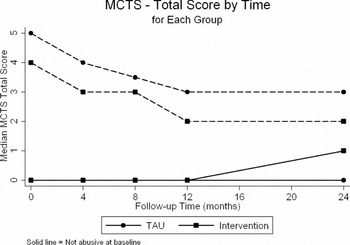
Figures 2 and 3 show the median MCTS score and the percentage reporting significant abuse over time. Among participants who reported some abuse at baseline, median abuse scores decreased over the two years by two MCTS score points in both control and intervention groups. There were also very similar decreases in the proportions reporting significant abuse in the two groups.
Median MCTS total score at each follow-up by group and whether any abuse was reported at baseline.

Modified Conflict Tactic Scale (MCTS) significant abuse (≥2) at baseline and each follow-up and whether any abuse was reported by group.

Discussion
This is the first RCT with abusive behavior towards people with dementia as an outcome. Nearly half of the participants reported significantly abusive behavior at baseline and the START intervention did not decrease this compared to TAU. The parallel decrease in median abuse scores suggest that the lack of effect was not due to lack of power but was a true finding.
Carers who are anxious or depressed report more abusive behavior towards care recipients (Rush Smith et al., Reference Rush Smith, Williamson, Miller and Schulz2005; Cooper et al., Reference Cooper, Blanchard, Selwood, Walker and Livingston2010a). In two previous naturalistic longitudinal studies, caregiver-reported abusive behaviors increased over a year (Cooper et al., Reference Cooper, Blanchard, Selwood, Walker and Livingston2010a; Smith et al., Reference Smith, Williamson, Miller and Schulz2011). Carers in the first study were identified through National Health Service secondary care providers in the United Kingdom and therefore would be expected to be recipients of treatment as usual. Those in the second group were found from more disparate sources and only some will have received healthcare. Given that abusive behavior has been associated with neuropsychiatric symptoms (Cooper et al., Reference Cooper, Selwood, Blanchard, Walker, Blizard and Livingston2010b), which increase with dementia severity, it is perhaps surprising that abusive behavior did not similarly increase in this, the longest prospective study of dementia carer abusive behavior to date. We intervened when the carer was acting in a significantly abusive way. Our intervention was to discuss with the carer how this behavior was problematic and probably indicated that they needed more support. We would then tell the clinical teams of the problem and they decided how to proceed. They did not release clinical details of their actions to the research team. The discussion about the abusive behavior and the need for support might explain why abuse did not increase, as the threshold for intervening was probably lower than in the previous studies. Potentially, where it did not, it may have dissuaded carers who were still acting abusively from reporting this again. Alternatively, naming behaviors as abusive through completing the baseline measure might have led some carers to seek solutions to difficulties provoking these behaviors.
This is the first study to consider outcomes for carers based on whether they reported behaving abusively at baseline. A quarter of carers still reported significant abuse after two years, but those not acting abusively at baseline did not become abusive. START decreased anxiety and depression and increased quality of life in family carers. We thus uncoupled the abusive behavior and carer anxiety and depression. An effective evidence-based intervention to reduce abuse is urgently needed and should target carers reporting abusive behavior as a priority rather than as a preventative intervention. Follow-up compared favorably with other longitudinal studies and our models allowed analyses of 82% of study participants, but data was missing for a third of carers by 24 months, and those who withdrew from the study might have been more or less likely to be acting abusively.
Our findings that abusive behavior reported by carers in our study did not, as in previous longitudinal studies, increase over time suggest that talking about abusive behavior and offering support may help carers accept rather than act on negative feelings within caring relationships. Additionally, a future abuse prevention intervention might usefully focus on encouraging professionals to talk about abusive behavior and offer support to reduce abusive behavior to those who report it. Our study highlights the challenges of designing an RCT with abuse as an outcome, as there may be an ethical need to intervene to try to reduce abuse reported in the control group.
Conflict of interest
None.
Description of authors’ roles
All authors developed the analysis plan and MG carried out the analyses; CC drafted the paper and all authors revised it for important intellectual content and agreed the final version. GL was chief investigator of the START trial.
Acknowledgments
With thanks to the National Institute for Health Research HTA programme for funding the START trial (08/14/06).