Introduction
The classic work of J. K. Gibson-Graham begins from the premise that economies are more diverse than most scholars realize. Labelling an economy as ‘capitalist’, they argue, masks the huge diversity of economic processes—from housework to slave labour, from gift giving to wage labour, from state redistribution to non-profit businesses, from self-employment to gambling—that take place in even the most ‘capitalist’ of countries.Footnote 1 Mayfair Yang has been one of the few scholars to apply this perspective to China. In 2000 she argued that the economy in late twentieth-century Wenzhou, Zhejiang province, was a hybrid of a lineage-based ritual economy and an entrepreneurial petty capitalist economy.Footnote 2 But well before she applied Gibson-Graham's scheme and, indeed, even before The End of Capitalism (as we Knew it) was first published in 1996, Yang was writing of the diverse forms of economy that characterized China during the 1970s and 1980s. She saw three distinct types of economic process: the state redistributive economy, the interpersonal gift economy (which she called the art of guanxi, 关系), and the grey market or quasi-capitalist market economy.Footnote 3 Each of these economic processes had its own forms of morality and its own dynamics of power, and each could be used by well-placed individuals to resist forms of power emanating from one of the other types of economy. The three types of economy could be seen as both independent and overlapping. On the one hand, the forms of morality (that is, the explicit or implicit rules that label some forms of exchange improper) that were attached to the different modes of economy could directly contradict one another. In most circumstances, for example, it would not be proper to apply the rules of grey market commodity exchange when giving a gift; people who violated the rules could easily suffer some form of social sanction. On the other hand, the items exchanged, especially when they involved cash, easily moved from one form of economy to another. Individuals were often involved in all three types of economy at once and found ways of bending the rules to act simultaneously in all three realms. Market traders, for example, could claim to give their customers a ‘gift’ of a particularly high-quality example of the commodity they were selling; state cadres could frame the impersonal distribution of housing benefits as a ‘gift’ that was to be reciprocated with performances of political loyalty to the state, monetary transfers to the cadre himself, or both.
The fact of economic processes that are simultaneously distinct and overlapping is not limited to China. As anthropologists and sociologists of money have often pointed out, although money is the most fungible of objects (or symbols), humans consistently fathom ways of dividing it into different types to be used for different purposes: rent money, drinking money, lottery money, money for the grandchildren, and so on. This is as true of modern money as it was of the so-called traditional, special purpose currencies like cowrie shells in New Guinea.Footnote 4 It is also as true in the formal economic realms of state taxation and business accountancy as it is in the informal economics of street peddlers. Despite the relative universality of typing money, we suggest that in contemporary China the extent of differing moral modes of economic exchange and the processes of creative rule interpretation that allow the bridging of one mode of exchange to another is especially large and politically significant. As well as being the material of our own argument, we present the following detailed ethnography as a basis for future comparative studies that may help to test this proposal.
The diversity and fungibility of economic moralities in China today are driven in part by the legal ambiguity under which much economic activity takes place. There are activities that are technically illegal but widely accepted by government authorities as well as those that are technically legal but actively discouraged. Considerable local variation emerges as cadres in various localities interpret and apply the rules differently. The constantly shifting lines between the legal and the illegal, the tolerated and the not tolerated, make economic actors adept at framing their activities in diverse ways, as well as saying one thing while doing another. In addition, in so far as laws governing accountancy, banking, and taxation separate money into differing legal categories, legal ambiguity facilitates shifting money from one category to another. It also facilitates the conversion of one sort of capital in the Bourdieuian sense to other sorts of capital. This multiplicity of economic processes and moralities, and the modes of shifting among them, make the ethnographic examination of economic activities particularly revealing. In this article we examine two socioeconomic realms where diverse modes of economic interaction intersect: urban funerals and ‘face funds’—typically village-level welfare funds founded by local entrepreneurs for both investment and charitable purposes.Footnote 5 Kipnis did the ethnographic research on funerals and Cliff examined the face funds. We highlight both the diversity of modes of interaction—that is, the diversity of the formal and informal rules, or institutions, that characterize the various forms of economy—and how social actors exploit the legal ambiguities that surround these institutions.Footnote 6 Echoing Parry and Bloch, our overall approach is to move from explaining the ‘meanings of money’ in various situations to explaining the meanings of ‘whole transactional systems’.Footnote 7 By comparing the social and political institutions surrounding funerals and non-state welfare provision, we aim to determine what distinguishes and conceptually unites these systems.
While other case studies could be used, we find it striking that across these two very different social contexts—one in urban China and one in rural China—three similar forms of socioeconomic grouping emerge. These are the household, defined here as a group which pools economic resources and shares a common budget; the extended family, potentially including distant relatives, friends, and fictive kin relations; and the overarching political nation, including those participating in markets regulated by the People's Republic of China (PRC). Three forms of capital in the Bourdieuian sense map onto these three forms of economic grouping. In pooling a budget, households are held together by actual economic capital—money. Extended families are held together by social capital, a form of trust extant in long-term social relations. The larger political regime is held together by political loyalty to the Chinese Communist Party. Political capital—necessary to do business and to secure favourable conditions in which to conduct business—is gained by actively bolstering the legitimacy of Party rule, such as by declaring loyalty to the Party and by promoting local social stability and economic growth. Here we invoke Bourdieuian notions of different forms of capital not to add analytic rigour to the definitions of the terms themselves, but as a heuristic device to indicate both that there are multiple fields of power, which operate in differing but overlapping ways, and that actors often convert one form of capital into another.
We argue that both funeral observances and the rituals and exchanges associated with non-state welfare funds are ultimately concerned with sustaining and affirming the legitimacy of a particular social order.Footnote 8 In China, this social order is characterized by centralized authority in nested hierarchies from the national level (centralized authoritarian government) to the domestic level (patrilineal descent and authority). Yet the persistence of hierarchical structures in Chinese society in no way implies a smooth and unruffled continuity: within this reproduction and legitimation of hierarchy there is also contestation. Our point, in line with scholars writing on topics as diverse as popular protestFootnote 9 and Chinese patriliny,Footnote 10 is that contestation is carried out within existing structures and institutions by individuals and groups that are themselves products—in terms of desire, aspiration, and social mores—of those structures and institutions. Hence contestation itself becomes a powerful legitimizing force for the overall social order. Delineating the flows of money ethnographically highlights the processes by which social structures are reconstituted.
The rest of the article begins with a section analysing funerary economies and finishes with a section on face funds. In each section we describe different forms of economic activity, the role of households, extended families, and state actors in the activities; the different forms of capital and moral principles involved; and the role of legal ambiguity in enabling the activity. In the section on funerals, we place a greater emphasis on delineating the differing forms of economic activity, while in the discussion on welfare funds we emphasize how actors move among different forms of economic activity, converting one form of capital into another as well as one ‘type’ of money into another. In both cases our overall purpose is to highlight the dynamic of simultaneously differentiating forms of money, economic activity, and capital from one another, and then crossing over the divides by converting one form into another.
Urban funerals
As Caroline Schuster points out in the Paraguayan context, funerals are often moments for both a settling of accounts (for the dead person) and an opening of new accounts for the living.Footnote 11 In contemporary urban China this settling and opening of accounts takes place across (at least) five different forms of economic interaction and three (or more) planes of legal ambiguity. The five modes of economic exchange are: the inter-household gift economy; the intra-familial inheritance economy; the state redistributive economy; the small-scale informal market economy; and the large-scale, formal market economy. The three planes of legal ambiguity are those of: ritual activities involving gods, ghosts, ancestors, or other ‘religious’ or ‘superstitious’ actors that could be labelled illegal religious activities; the ambiguity of gifts given between households where the household receiving the gift could include a cadre or a business leader and the gift could be labelled as a bribe; and the ambiguity of small-scale businesses which neither obtain state licences nor pay taxes. Because funerals are such complex economic affairs, we illustrate the five modes of exchange with data from different funerals. Kipnis could not simultaneously follow all five processes for a single case. While the five modes of economic exchange proceed under differing moral codes, the moralities they involve map roughly onto, or draw from, the three forms of capital and three forms of socioeconomic grouping described above.
Inter-household gift economy
Funerals across China involve gift giving. In Nanjing, where Kipnis carried out most of his research, the family of the deceased would usually allow three (or sometimes five) days between death and the farewell meeting (gaobiehui, 告 别 会, the main ritual in the funerary sequence). Friends, relatives, and close associates were notified, while the body was stored at the state-run crematorium/funeral home. A home altar (lingtang, 灵 堂) was set up with a picture of the deceased, a large, printed character (奠, dian, meaning offerings to the deceased), and tables with offerings placed in the living room of the deceased's home. Friends, neighbours, and relatives would drop by, give the family an envelope filled with cash, sometimes also flower wreaths with calligraphy expressing their respect for the deceased and their relation to them (such as: ‘Magnificent Uncle (father's younger brother) last forever, your nephew, Kean’ (shushu daren qiangu, zhi'er Kean, 叔叔大人千古,侄儿柯安), bow or kowtow in front of the altar, and receive a return bow or kowtow from a representative of the deceased's household. The household receiving the gift would designate someone to keep track of all of the gifts, writing down the amount given and the name of the person who gave the money. Most, if not all, of the people who gave money would be invited to the post-funerary banquet, which in Nanjing was usually held at lunchtime on the same day as the farewell meeting, after the cinerary casket was buried.Footnote 12 At the banquet, all of the attending households would also receive a simple return gift (huili, 回 礼), usually containing soap and a washcloth so that the recipients could wash off the bad luck (huiqi, 晦气) that going to places like crematoriums and cemeteries could attract.
One household showed Kipnis the gift registrar from their 80-year-old father's funeral in 2015. Thirty-five people gave slightly more than 25,000 yuan (roughly US$3,900) in gift money. The father had three brothers and sisters who had a total of seven children. The brothers and sisters themselves each lived with one of their children, so there were seven gift-giving households from the father's side of the family, each of whom gave between 1,000 and 2,000 yuan. The surviving mother had one sister who was still alive and five nieces and nephews, making a total of five more households who also gave between 1,000 and 2,000 yuan each. The deceased had three children—a son and two daughters—and a total of 20 households comprising relatives of the children's spouses as well as a few close friends gave between 100 and 500 yuan each. Finally, three neighbours who had been friends of the father gave 100–200 yuan each. The total amount given at this funeral was similar to other middle-class urban families Kipnis heard about, but did not come close to the amount given at the funeral of an important government official (at least before the crackdown instituted by Xi Jinping on giving gifts to cadres at the funerals of their parents).Footnote 13 Gift-giving relationships imply an indebtedness that can encourage corruption, but it is not only powerful cadres and anti-corruption agencies who worry about the implications of indebtedness. The household of the 80-year-old father also refused one gift. An associate of one of this household's sons-in-law attempted to give the deceased's wife a gift of 3,000 yuan (larger than any other) three days after the funeral. He was not particularly close to the family and had not been invited to the funeral but wanted to deepen his business relationship with the son-in-law. The mother declined the gift, saying the funeral had already passed. She told Kipnis that the families were not close enough to know of each other's funerals and that the morality of exchange demanded that they would have to return a larger gift in the future, but they would not know when this might be. Without the ability to reciprocate, the gift would become a burden, an unrepayable debt, hanging over the head of the son-in-law. This example demonstrates that the legal ambiguity regarding the line between gifts and bribes reflects a serious moral problem: how to separate economic relations based on moral ideologies of fairness that require all to be treated equally from social relationships in which economic obligations for some people are greater than those for others.
The logic of inter-household giving at urban funerals closely resembles that already depicted in the literature on gift giving in China,Footnote 14 but a few points warrant reiterating. First, as the mother's comment indicates, gift giving involves a logic of continual inflation. If one of the households that gave a gift at this funeral were to hold a funeral in the future, then the mother's household would be obliged to give an amount larger than the amount they received at her husband's funeral. To return the same amount would cancel the indebtedness between the households and thus end the relationship. Second, none of the households who might inherit something from the deceased (the mother, the three children, and various grandchildren) could give a gift at this funeral. They were the direct mourners and thus constituted the group of gift receivers at this funeral. Third, the practice of giving gifts draws economic boundaries around households. Gifts are understood as coming from a household. In no case do different members of a household give two separate gifts. Though the receiving unit could be seen as comprising several households, the key members of those households were originally all part of the deceased's household, which is why they could inherit. Households form and break up over time, but while they are intact, they have strong economic boundaries. The three forms of economic grouping become visible in these transactions. The households are defined by the sharing of money (actual economic capital), while money given from one household to another generates social bonds and social capital for the giving household. The exchange of the gifts also defines the second social unit mentioned in the introduction—that of the extended family defined by debts of social capital. The example of the refused gift shows how the morality of maintaining relationships of indebtedness through gift exchange can be manipulated to influence wider forms of economic exchange. The mother feared that the social capital gained by the man who wanted to give 3,000 yuan would one day require her son to give him a form of economic benefit that was even more valuable.
Finally, there was some tension in the family over how to divide the gift money. The daughter-in-law said that since her relatives had given the most, her household should receive a larger portion of the gift money. In the end they divided the money (along with the pension pay-out) equally in four portions—one for the mother (as a one-person household) and one each for the households of the three children. But the conflict here was the opening salvo in a war that was to erupt over inheritance issues. The daughter-in-law took arguments from the realm of inheritance and tried to apply them to the logic of gift exchange.
Intra-familial inheritance
Issues of inheritance loom large in China's cities. Several factors exacerbate tensions. First, the generation of people now passing away in urban areas typically had their children in the 1950s, 1960s, and 1970s, before the birth planning policy was implemented; they often have three or more children. Second, contemporary elderly Chinese urbanites worked in an era when work-unit employment was the norm. Most, even if they were factory workers, own apartments and receive pensions, and thus have significant assets to leave to their children. Third, the 1990s, 2000s, and 2010s have been a time of a rapid increase in urban real-estate costs. The value of apartments has increased much more rapidly than incomes, and even the small, dingy apartments of former factory workers can be worth a fortune, especially in relation to the income levels of their children. For many urban families, the value of property to be inherited is many times larger than the annual incomes of the heirs. In addition, many elderly people in China do not want to think about the fact that their children may be preparing to fight over their inheritance. They avoid the issue by not making a will. Finally, the moral logics around inheritance (but perhaps not so much the legal logics in this case) can be contradictory and ambiguous. Many sons and daughters-in-law argue for a patrilineal logic of inheritance. Daughters tend to suggest that inheritances should be split evenly among all the children of the deceased and the law generally agrees with them. Finally, many people feel that inheritance should depend on the quality of the relationship between parents and their children, and the amount of physical and emotional care, and financial support a particular child gives to the parents in their old age. The courts also consider this support in their rulings.Footnote 15
Kipnis learned of many conflicts that ended up in the courts. A man who ran a small business arranging funerals in Nanjing told him:
It seems that more than half of the funerals I do involve siblings quarrelling over the inheritance. They will try to keep the hostilities under control for the three days between the death and the funeral itself, as quarrelling at the funeral is inauspicious. But some cannot even keep their tempers in check for that long. I know many families in which the siblings no longer speak to one another.
In one case, a couple who were former factory workers passed away at the same time in a car accident. They owned a 90 square metre apartment in a former work-unit housing complex that was centrally located near downtown Nanjing not far from parks and a subway stop. Though not fancy, it was estimated that the apartment was worth well over 2 million yuan. In addition, the family received a pension payout of over 200,000 yuan. The couple had two sons and a daughter. All were married; the sons had one child each but the daughter was childless. The mother had been ill before the car accident and the daughter had provided most of the care. None of the children had attended university and all worked in the service sector earning between 2,000 and 4,000 yuan per month. The sons claimed that the daughter should not receive any inheritance as she was childless, while they were continuing the family line. The daughter claimed a share because she had spent considerable time caring for her mother. The case went to court which ruled that the inheritance should be split evenly. When Kipnis finished his research the sons were appealing the case and the siblings only communicated through their lawyers.
In this case, differing moral logics of inheritance conflicted with one another. In particular, the logics of continuing the family line (which are often patrilineal, but not in this case as the daughter was childless) conflict with logics of reciprocity which dictate that those giving care to the elderly should receive an inheritance. In rural China both today and in the past, formal practices of dividing the household (fenjia, 分 家) usually kept such conflicts under control.Footnote 16 But in contemporary urban China, traditional ways of dividing the household are largely lost and conflicts often end up in the courts. The existence of these disputes shows the importance of economic capital in the constitution and reproduction of households. The fact that strict patrilineal logics of inheritance are being successfully challenged by daughters on the basis of their care work—such challenges would not have been entertained in a relatively recent past—is evidence of the changing moral and economic structures of the basic unit in Chinese society (the household), with implications that extend upwards through the social order. Nevertheless, the claims of sons are not, either socio-morally or legally, dismissed outright: patriarchal assumptions persist and remain important organizing principles of the PRC's society and political system.Footnote 17 Moreover, patrilineal arguments about the morality of sons deserving more than daughters would not be appropriate in the context of the inter-household gift economy, showing how differing economies are structured by differing moral logics.
The state redistributive economy
As the above mention of the 200,000 yuan pension payout implies, the state or, more precisely, municipal governments play a big role in governing death. In Nanjing the economic governance of death flows through two channels. First, the Civil Affairs Bureau (Minzhengju, 民政局) regulates the state-run crematorium/funeral home (binyiguan, 殡 仪 馆) as well as the urban graveyards. It forces these institutions to keep prices artificially low for its most basic services (while allowing them to profit from everything else), regulates the types of rituals that can proceed at these places (recently banning firecrackers that are used to scare away ghosts, for example), and provides free basic funeral services for impoverished households without pensions. Second, work units, or the government units that have taken over their pension burdens if they no longer exist, provide pension payouts and additional services to the families of dead people who originally worked at their unit. Under 2016 regulations, upon the death of a pensioner, the families of the deceased receive a payout equivalent to 24 monthly pension payments. Pensions vary greatly in Nanjing and can be as low as 1,000 yuan per month or more than 10,000 yuan for high-ranking cadres. Because pensions have increased regularly over the years, people who retired long ago often receive higher pensions than those who retired more recently. Factory workers who retired at the age of 50 in the 1980s are now often in receipt of pensions of 3,000–4,000 yuan per month. The politics of pension reform is a fraught area, but most cities in China pay out retirees for life at state-regulated levels rather than giving workers Individual Retirement Accounts. Pension levels have been the cause of protests in many cities and relatively high pensions are often seen as a way of ‘maintaining social stability’ (weiwen, 维 稳). Some people suspect that the pension payouts themselves are a strategy for buying political peace.Footnote 18 They encourage people to report the deaths of their aged parents (in the past there were rumours of people continuing to collect pensions while storing their dead parents at home in refrigerated caskets) and give families an immediate payout at a time when they are facing funeral expenses and may be feeling strong emotions that could turn against the state. In addition to the pension payout, certain work units provide other benefits at the time of death, such as transportation to the funeral, small cash gifts to the family from a representative who is sent to visit the home altar, and help with arranging the funeral. The families of high-ranking cadres receive even more benefits upon the death of the cadre. As Martin Whyte details, during the Maoist era, most urban funerals were arranged by work units.Footnote 19 In contemporary urban China, the role of the work unit has diminished for most people but is still crucial for state employees.
Two forms of moral logic inform the state redistributive economy in relation to death. First, as with all forms of state benefit, bureaucratic logic demands the pigeonholing of people into different categories to determine what sorts of benefits they should receive. Bureaucratic morality requires this to be done fairly and accurately. Such an explicit logic of fairness relates to state-level economic activities and the ways in which state actors attempt to distinguish their activities from those of non-state actors. But a second logic of reciprocity also emerges. Families should express gratitude towards the state and its bureaucratic workers for the payouts by not using funerals as an excuse for an outpouring of anti-state emotion. In this sense, the pension payout is a way for the state to transform economic capital into political capital and reproduce the loyalties that link households to wider structures across society. Access to state payouts also helps define those who receive the payouts as citizens of a particular municipal area in China and, by extension, as citizens of the PRC itself—the third significant social unit mentioned in the introduction.
Small-scale informal economies
Funerals can involve many small-scale businesses. There are vendors who sell flowers, spirit money, and other items for burning from carts on the street in front of cemeteries and funeral parlours, religious practitioners who offer services such as chanting sutras for the dead, musicians who play dirges in funeral processions, and, most importantly, ‘one-stop dragon’ (yitiao long, 一条龙) entrepreneurs, who arrange the entire funeral process from start to finish. Almost every community (shequ, 社 区) in Nanjing will have a one-stop dragon entrepreneur. Other one-stop dragons open small shopfronts near the major hospitals. Most families will employ such individuals when faced with a death in the family. One-stop dragons help customers to obtain death certificates and carry out all the paperwork required after a death: they contact the state-run funeral parlour and arrange the transport and storage of the body, the room for the farewell meeting, and the time for the cremation. They will contact graveyards and buy a plot if the family does not have one, and arrange a burial ceremony at the graveyard and for the attendance of any religious practitioners which the family would like to be involved at any point in the process. Their services include setting up a home altar in the house and a banquet after the funeral, and advising the family on a wide range of ritual avoidances and procedures. In Nanjing, these businesses typically price three days of service at about 1,000 yuan, which is well under cost. However, they require the customers to purchase cinerary caskets (guhuihe, 骨灰盒), longevity clothes (shou yi, 寿衣) in which to dress the deceased, and sometimes packets of return gifts from them. They make their profit by selling these items.
While some such businesses have shopfronts which display cinerary caskets and longevity clothes, others just have a phone number and business cards. Many do not bother obtaining business licences, and even those with licences and shopfronts only pay taxes on those rare transactions when a customer demands a receipt. Though the busiest of these businesses can arrange close to a hundred funerals a year, and often require two people to help with a single funeral—one to accompany a representative from the family when visiting various government offices, the funeral parlour, and graveyards, while the other stays with the rest of the family and directs activities at the home altar—they rarely formally employ anyone. Anyone who ‘works’ at such an establishment does so as an independent contractor and the business does not provide them with insurance or pensions payments.Footnote 20 The businesses also pay a cut to those who refer customers (often nurses at the hospitals) and sometimes receive kickbacks if they direct customers to particular graveyards. Most of their informal employees are relatives and all transactions are in cash. Of the 12 such entrepreneurs Kipnis interviewed, all came from rural areas near the cities where they worked.
In one case, a woman approached a one-stop dragon shopfront near a hospital. Her mother had just passed away, one Tuesday in the early afternoon. She had learned about the business from the nurse who had provided night care for her mother. After a brief negotiation, the woman agreed to pay 900 yuan for three days of service, purchased a 1,000 yuan longevity clothes set, spent 800 yuan for 20 return gift packs, and agreed to buy a cinerary casket (which ranged from 1,500 yuan to 10,000 yuan), but she wanted consult with her family about which one to buy. The entrepreneur then took his son-in-law with him to accompany the woman to her home. After they arrived at the woman's apartment, they met her husband and child. The entrepreneur then went with the woman's husband to drive to various offices to make arrangements and obtain certificates. He accompanied the husband for two hours that afternoon and six hours on the following day. After some direction from the entrepreneur, the woman made a list of people to be notified and began contacting them. The entrepreneur's son-in-law stayed at the home to set up the home altar and to write calligraphy for visitors who came with flower wreaths. The son-in-law spent six hours in the home on Tuesday and 12 hours on Wednesday. The farewell ceremony, cremation, burial, and banquet took place on Thursday (the third day) and the entrepreneur accompanied the family for the entire morning (from 5am until the banquet at noon). The son-in-law convinced the family to purchase a 2,800 yuan cinerary casket. In all, the family paid the entrepreneur 5,500 yuan in cash.Footnote 21 The wholesale cost of the items sold was about 1,200 yuan. The entrepreneur gave a 500 yuan kickback to the referring nurse and 1,000 yuan to his son-in-law (500 of which was commission on the cinerary casket). He also drove his own car to some of the offices, paid for some small items used in setting up the home altar, and had expenses related to renting his shopfront, but he estimated that he made 2,000 yuan on the funeral.
Two moral logics inform the process. The first is that of immediate cash payment for all services with a short time frame around each transaction. Opposite to the logic of the gift economy, the norm here involves clearing all debts as soon as possible. In terms of forms of capital, there is no attempt to create social capital by maintaining relations of indebtedness. Trust is possible because payments come quickly.Footnote 22 The second is one of kinship. The entrepreneur hired his son-in-law and often used idioms of kinship—or at least friendship—when addressing the other people with whom he did business. Two types of social units and two forms of capital can be observed here. The first are households which give and receive payments in economic transactions. The second are forms of (fictive and real) extended family which establish the trust or social capital that enable economic transactions to take place with minimal reference to the state. Though the entrepreneur's relationship with his son-in-law was clearly ongoing, the use of fictive kin terms among the other actors only allowed for those transactions in which a service was performed on one day and payment was received a day or two later. Formal, state-related economic processes were avoided at every turn, in part because most of the businesses are technically illegal. They thrive in a legally ambiguous environment in which the municipal government desires a dynamic economy and high levels of employment, but also wants all businesses to register with it.
Formal state-regulated business economies
There are three types of formal enterprises involved in the funeral industry. The first are the local state-run funeral homes/crematoriums, usually run by the municipal civil affairs bureaus. Second are the cemeteries, more often privatized but always run by large corporations approved by the bureaus. Third are one or two large insurance companies that are attempting to establish nationwide markets in funerary insurance and pre-paid funerals.Footnote 23 All of these types of businesses either formally hire their employees or go through officially regulated employment agencies which pay the insurance fees of their employees. Though some of the employees are given incentives to sell the most expensive services, most of their income derives from their regular salary. The prices these companies charge for their products and services are fixed, and are usually publicly displayed. They issue receipts after customers make payments and pay tax regularly, though they also occasionally pay cash kickbacks to one-stop dragon entrepreneurs to steer business to them. Despite, or, in fact because of, their official nature, contradictions between these business's state affiliation and their customer orientation shape their economic interactions with customers. The graveyards and the insurance agencies require long-term economic trust from their customers, as they buy graves for 20–30 year periods (with options to extend) and can pre-pay for funerals or funerary insurance decades before the funeral is carried out. When presenting themselves to their customers, these companies emphasize their size and state affiliations to suggest that they will be around for the long haul. The funeral homes/crematoriums are run by the state and many of their prices and services are directly shaped by state regulations. But because funerary ritual often involves activities that could be construed as religious or superstitious, all of these companies must walk the fine line between providing funerals according to state aesthetics and shaping funerals according to customer desire. In addition, because the state subsidizes cremations and basic services for the poor, the funeral homes distinguish pricing strategies for services in a way that can make their pricing seem irrational. For example, in Nanjing in 2016 the cost of renting a small room to hold a farewell meeting was only 100 yuan an hour (a simple meeting would take less than an hour). But the price to decorate the room appropriately with flower wreaths started at 3,000 yuan and could go as high as 50,000 yuan.
The contradictions regarding ‘superstitious’ activities are even sharper. Funeral homes have rules about the types of ritual, religious, and ‘superstitious’ activities they will allow, drawing lines that can seem arbitrary. Graveyards commonly provide burial services during which their master of ceremonies may refer to various ghosts, gods, and ancestors as well as Buddhist notions of heaven and hell, and even ideas from Western astrology. The master of ceremonies may also make reference to practices that are said to bring good luck to the deceased's decedents. Cemeteries also often employ geomancy masters to help people choose gravesites. However, they still ban certain activities when required to do so, such as setting off firecrackers (used to scare away ghosts) or even, at some graveyards, burning spirit money. In addition, some cemeteries go to great lengths to bury Party and national martyrs, with special sections reserved for them. Elaborate memorials are devised and the cemeteries are opened to the public to offer lessons on the glorious history of the Party to tourists and visiting groups of schoolchildren. Such actions both curry favour with Party officials and demonstrate to customers their relations with the Party-state. Some customers will pay a premium to be buried (or bury loved ones) at a cemetery that is also home to Party heroes.
In short, these formal enterprises blend two political-economic moral logics. For their economic stakeholders (stock owners in the private corporations and those employees who share in the profits of the state-run funeral homes), they must do whatever it takes to make a profit—charging as high a price as the market will bear and providing whatever services customers demand. But they must also politically support the Communist Party, regularly performing their loyalty and enacting any policies the Party-state demands. At times, these enterprises find ways of seamlessly blending the two missions, as when graveyards build memorials for Party and martyrs, whose presence then attracts high-end customers to purchase plots. But in other instances, the two imperatives contradict one another and compromises are reached. The relationship between the two types of logic is often seen as a type of reciprocity: the companies perform loyalty to the Party and the Party gives the companies the regulatory space to be profitable. As many scholars have noted, large capitalists in China almost always forge alliances with the Party.Footnote 24 In these examples, the social entity of the Party (with its claims to represent the nation as a whole) and the political capital of those who can build a relationship with the Party-state loom large. Yet the moral logics of these processes differ from those of the technically illegal small-scale business described in the last section.
Face funds and welfare entrepreneurs
Welfare entrepreneurs simultaneously operate two types of enterprise: a for-profit company and a non-state welfare fund (minjian cishan jijinhui, 民间慈善基金会).Footnote 25 The companies manufacture or trade physical goods (furniture, electronics, and steel products) and are usually family owned and run by the entrepreneur himself (all of the welfare entrepreneurs Cliff encountered were men). In a few cases, the entrepreneurs are employed as senior managers in much larger companies started by one of their relatives or fellow villagers. Either way, their income is paid by the company and the company's success is their success. All of them regularly deal with large sums of physical cash, reducing the traceability of their transactions.
The non-state welfare funds aim to generate profit to pay welfare benefits to fellow villagers who are seen as needy or deserving—for example, the aged, the poor, the sick, and students. In contrast to the privately owned companies, the funds are collective ventures run by the leading entrepreneurs in a given village. Welfare entrepreneurs both run private companies and play leading roles in the collective welfare funds.
In the villages of Huagang township, Shandong province, where Cliff conducted his research,Footnote 26 welfare entrepreneurs operated across four closely inter-related economic realms. Each of these economies had different rules (explicit or implicit) for the use of money. Related to these economic realms, entrepreneurs commonly spoke of four different types of money: welfare fund money (which they insist ‘belongs to all of the villagers’, collectively), enterprise money (that spent on their businesses), household money (nominally under the control of their wives), and pocket money (used for entertainment activities with people potentially involved in either their businesses or the welfare funds, including Cliff). From the analytic perspective of Bourdieuian types of capital, at least three different forms of capital were involved. These were political/moral capital (the wider reputation of a given entrepreneur, political official, or company as legitimate and a positive moral influence); social capital (relationships with other actors who could be relied on in times of trouble and from whom favours could be expected); and actual monetary capital. In their economic lives, welfare entrepreneurs actively managed the conversion of one type of capital to another, in part by reclassifying money from one type to another. As in the case of funerals, the three types of capital help to define three basic types of social groups: households (which share economic capital), the extended or fictive family (which is tied together by social capital), and state-designated leaders or units (whose legitimacy requires political capital).
In this section of the article, we focus on instances when welfare entrepreneurs and other actors transform one type of capital into another or retype one kind of money into another. Rather than distinguishing between the different types of economy we examine the fungibility of money and the ambiguity among differing sorts of economic morality. As in the case of funerals, legal ambiguity contributes to the fungibility of types of money and moral codes. In contrast to Mayfair Yang's application of Gibson-Graham,Footnote 27 we emphasize the compatibility of the various types of economy and capital, and how they support and reproduce incumbent political hierarchies and structures.
Historical comparison within China itself (an in-depth investigation of which is beyond the scope of this article) suggests that the welfare fund economy and the money ‘type’ that comes with it fills a space created by the demise of rural collective institutions from the socialist and immediate post-socialist periods.Footnote 28 Rotating credit associations have played a central role in rural finance, and social and political life more generally, in China in the reform era,Footnote 29 as well as before the establishment of the PRC and in overseas Chinese communities.Footnote 30 Economic capital may be used to develop social and political capital, and social and political capital can contribute to the goal of increasing profits. In the cases at hand, although contradictions between the differing forms of economy emerge, welfare entrepreneurs actively endeavour to smooth these out.Footnote 31
Face funds’ accumulative models
In the Huagang area, non-state welfare funds have been steadily multiplying. Surrounding Huagang town, funds began spreading from 2012: there were six when Cliff first visited in 2014, nine in 2015, and upwards of 12 in the region by 2016. In September 2017, a township-level Civil Affairs official confirmed the existence of ‘over 20’ funds in the township.
Each fund varies in specifics, but they share important commonalities. All of the Huagang funds solicit donations from the village population and lend the accrued capital (fund principal) at a rate of interest to local village entrepreneurs. Most villagers donate at least something, and the richer an individual is, the more they tend to donate. The funds make profits by operating a credit-bidding association (biaohui, 标 会) or underground bank. Only interest received is used to pay benefits, so the fund's capitalization is either stable or growing: they use the phrase ‘spend interest, don't spend principal’.
Significant variations also exist in what the initiators call the fund ‘model’ (moshi, 模). For example, Fund G simply takes donations to pay benefits. Fund B is a fully fledged underground bank that takes and pays interest on savings deposits from local villagers, as well as donations. Fund F takes only interest-free fixed-term loans from entrepreneurs, no donations, and nothing from the broader village population. These different fund models have implications for participation, profits, benefits, and dividends; for the types of ambiguity generated and the extent of legal transgression; and for the typing and retyping of money. However, as public, charitable organizations, they all have explicit rules relating to the spending of money and operate transparently at the local level or, at least, do a very good job of performing transparency and of recruiting people who are not directly involved with the funds to legitimize them and their operations. The fund managers do not spend the fund principal on daily operational costs or meeting-banquets (these tend to be absorbed by their own companies), and if they arrange for public festivities during annual donation drives, they personally make additional donations to cover the costs.
Participation, profits, benefits, and dividends
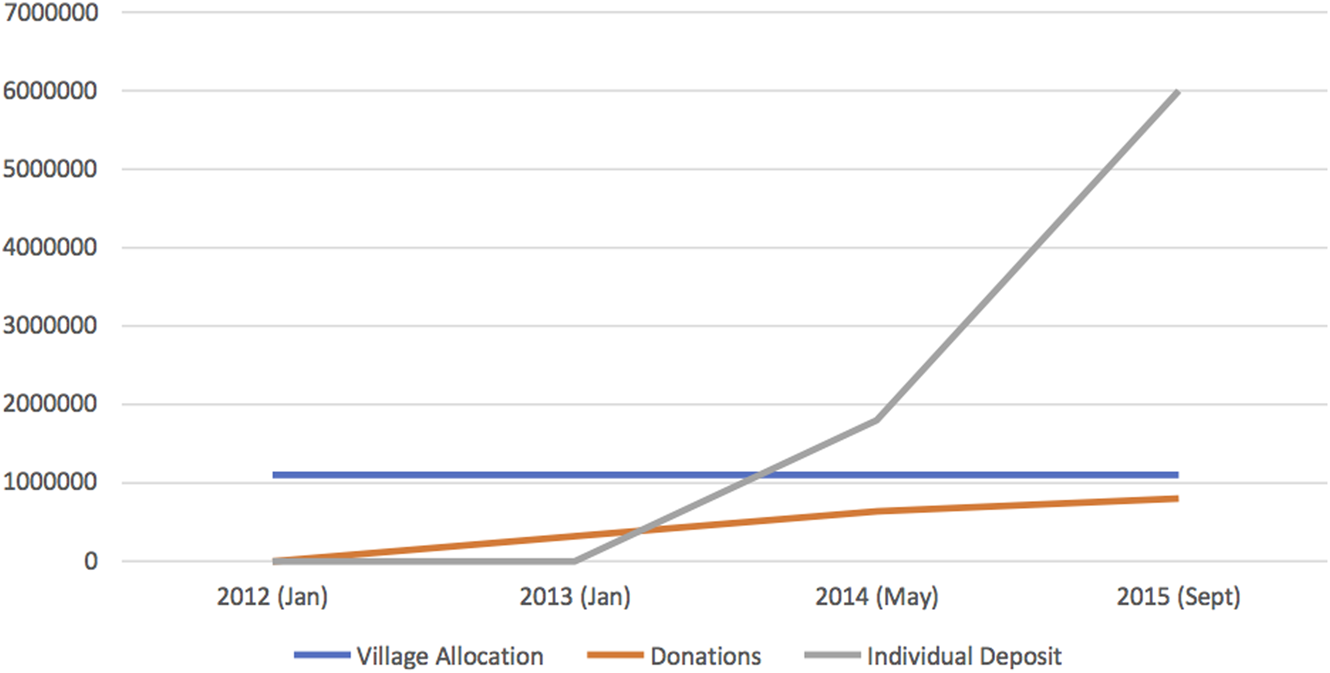
Funds range in size from 350,000 yuan to 8 million yuan (US$ 50,000 to US$ 1.2 million dollars) for villages of approximately 1,000 people. Like most funds in the region, Fund B built its initial principal with donations, as well as a one-off allocation from the village committee. However, since 2014, Fund B's principal has been composed mainly of interest-bearing deposits from local villagers. The fund offers deposit rates that are above those paid by banks; in 2015, this rate was about 5 per cent per annum. Like a bank, the fund lends out money to local entrepreneurs at a far higher rate of interest—12 per cent per annum in 2015. The fund reaps the money generated by the difference between these rates, that is, 7 per cent per annum.
Decent savings deposit rates proved very popular with the local villagers. Deposits totalled 1.6 million yuan in the first 16 months of operation, then climbed steeply to 6 million yuan 16 months later. Due primarily to the introduction of the ‘individual deposits’ innovation, Fund B is over three times larger than the next biggest fund.
The funds operate to get money out of the household and into circulation in the informal economy, producing both money and social and political capital in the process. By being fed into Fund B's productive cycle as deposits, the ‘stagnant capital’ saved by the penny-pinching villagers is mobilized while remaining intimately connected to the village. The fund avoids both the low interest rates of the formal (state) investment channels for cash (banks) and the visibility associated with investment in such channels. As well as the much higher rate of interest paid by the funds to the villager-depositors, the funds also pay a moral dividend: villagers who deposit into the fund know that their money is earning approximately 7 per cent in welfare benefits. In 2015, Fund B (see Figure 1) collected interest payments of 675,000 yuan (US$ 105,000) and gave out monthly pension payments of 400 yuan to each person over 90 years old, 300 yuan to people aged 80–89, 200 yuan to people aged 70–79, and 100 yuan to people aged 65–69.Footnote 32 The moral logic behind this structure reflects one principle of filial piety in rural China: the older you are, the more deserving you are of respect and special treatment. It also involves the application of transparent, explicit rules for fund outlays. This transparency makes the same sorts of moral claims made by state bureaucrats, perhaps indexing the place of these funds in generating political capital. If the production of political capital for the fund donors is roughly proportional to the benefits given out by the fund, then Fund B generated quite a lot.
The origins of Fund B's money (yuan/time). Source: Reproduced from Cliff, ‘Face Funds’.

Though depositors may be pleased to be associated with the fund's moral endeavours, the majority of the political capital generated by the fund accrues to local government officials and the elite entrepreneurs who run the funds. The political logic of these endeavours is as follows: aged care is a primary, if not the primary, focus of state efforts to encourage societal involvement in welfare service provision. Moreover, state-generated ‘public good advertisements’ (gongyi guanggao, 公益广告) throughout the 2010s asserted the moral imperative of filial piety, and in 2012, the National People's Congress of the PRC instituted the Law on Protection of the Rights and Interests of the Elderly, setting out what the people's representatives deemed to be the appropriate measures and practices of looking after one's parents.Footnote 33 By augmenting China's insufficient rural welfare system, the funds help ‘maintain social stability’—an important criterion in the promotion of political cadres to higher posts. The focus on aged care symbolically reinforces central state discourse and, by extension, the Party's right to set moral, economic, and political priorities. And by providing operating capital to local small-scale entrepreneurs (who find it difficult to get state bank loans), the funds also help drive local economic activity, especially tax revenue and local GDP growth, another important criterion in the evaluation of local cadres. For local government officials, the political and moral capital generated by the funds may bring promotion and economic rewards. In turn, the welfare entrepreneurs who run these funds gain social capital with local government officials for making the latter look good. The entrepreneurs may use this capital to secure advantages for their businesses. They also enhance their reputations in the local communities, which would presumably serve them well if the labour and land-use practices of their factories run into opposition from other community members, and certainly enables good business relationships to develop with their local economic elite peers. However, Cliff's interviews and observations suggest that this capital is most important to them as a form of moral legitimacy. It may thus be considered as both social and political capital, suggesting that economic leadership takes on political functions in contemporary China, if not everywhere.
Productive ambiguity and institutional transformation
In official terms, most of these funds are ‘not legal’ (bu hefa, 不合法). Until China's ‘Charity Law’ came into effect in September 2016,Footnote 34 Chinese regulations stated that donated money must not be used to make money, even if the profits went to charity. Donation-taking organizations must register with the Civil Affairs Bureau, while profit-making organizations have to register with the Industrial and Commercial Bureau (Gongshangju, 工商局). Authorization to take interest-bearing deposits and make interest-bearing loans requires registration with the China Banking Regulatory Commission (Yinjianhui, 银 监 会). Registration with one bureau precludes registering with another. If organizations were to strictly abide by the regulations restricting the use of donated money, the funds would have been unable to operate as self-sustaining informal lenders; they could have been nothing more than a village charity (where a one yuan donation can yield a maximum of one yuan in benefits, even if the organization runs at zero cost).
The legal environment described meant that only one fund in Huagang had chosen to register by September 2016; most fund managers said they had no plans to register and quite a few explicitly ruled out the possibility. Even one full year after the Charity Law legalized profit-making by non-state organizations for specifically charitable purposes, only three more funds in Huagang had completed the registration process. Nevertheless, for years beforehand, local government officials at the township, county, and city levels had been aware of the funds’ existence and seemed to cautiously approve of even the unregistered ones. Notwithstanding the slight to official authority implied by these funds’ refusal to register, tacit official approval is consistent with a pragmatic strain in Chinese politics as practised at the local level. As long as they restrict themselves from organizing across the geographic boundary lines of local governments, many technically illegal organizations are allowed to exist.
Keeping it small and not registering sustains a productive ambiguity around the funds. Key is the ambiguity over the funds’ very existence: they have not registered and therefore have not formally done anything to let officialdom know of their existence. This allows local officials to turn a blind eye until such time as they choose to intervene, usually for political reasons.Footnote 35
Legal ambiguity helps to avoid confrontations between policy and practice. Although fund registration would increase the potential benefits for local officials (they can more easily claim political credit with their superiors for the positive effects of the funds), the potential risks are also increased. Moreover, local officials can reap at least some of the political and moral benefits of such social service provision—a lower likelihood of social unrest and a high level of local economic development—without the funds being registered.Footnote 36 Policy grey areas allow for the creative interpretation of the rules, and apparent contradictions in policy allow for selective adherence to regulations. Many Chinese people—especially industrial entrepreneurs, NGO leaders, and others engaged in setting up something new—are habituated to pushing legal and regulatory boundaries. A business owner and long-time friend of Cliff said simply: ‘Everyone in China is a criminal. You can't live without breaking rules. If you didn't break rules, you would just be trampled down and die.’
In China, it is not uncommon for rules transgression to precede a change in those rules, whether de facto or de jure, to fit the practice.Footnote 37 In Huagang, for example, most of the land on which the factories are situated was zoned agricultural when they were built. Today, most factory owners still do not possess a formal land-use certificate, but there is no way that land will return to agricultural use—it is too valuable as factory land providing tax revenue. The fact that a rule remains broken also provides a potential source of leverage for local government over the factory owners.
Huagang county-level officials denied any knowledge of the funds in May 2014, but by September 2015, they were ready to cautiously admit knowing of them (or at least some of them). The turning point was the registration of Fund G in July 2015. Top leaders from the township and county formally attended a late August ceremony celebrating this registration. The still-extant regulations governing the use of donated money had been conveniently overlooked. A higher (municipal-level) leader attended in an unofficial capacity but did not appear in the fund's publicly displayed photographs commemorating the event. The municipal leader's widely known but unrecorded attendance conveyed the city mayor's informal approval of the fund's activities—and thereby sent a strong message to lower-level officials to get on with supporting such activities—but distanced the municipal government from any future negative consequences. By September 2016, when the Charity Law enabled registration without a significant change of form, local political circles were abuzz with talk of such funds and how they might be able to assist with social service provision and (just as crucially) local economic development. China's legal ambiguity starts at the top of its structures. High-level officials desire the flexibility to change their minds about the legality of various activities. Consequently, lower-level officials fear being labelled ‘illegal’ by their superiors and prefer to maintain a state of plausible deniability regarding the activities they permit.
Labelling money
By the time Cliff first visited Huagang in May 2014, five villages (A–E) had set up funds, and entrepreneurs and ordinary villagers alike had donated generously to them. Leading entrepreneurs from other furniture-producing villages in the area had also begun mobilizing to set up a fund, in what was probably an attempt to stay morally abreast of their kin and businesses in Villages A–E. But it was not always easy. The flamboyant entrepreneur Huang Manxiao, president of Fund F, described how he and the other two initiators of the fund had worked around the problem of donor reluctance.
At first, the fund's initiators found it difficult to persuade other entrepreneurs from Village F to donate money. The three people proposing the fund first put forward a fixed sum, donation-based model which involved about five entrepreneurs donating 10,000 yuan each. But some did not did not want to give as much as that. The organizers then reduced the sum to 5,000 yuan and attempted to increase the number of donors, but this still did not result in enough donations. Eventually, the initiators gave up asking for donations, and instead gave a different label to the money they were requesting, calling them ‘interest-free loans’ of 10,000 yuan. By personally calling on each of the entrepreneurs in the village and holding a group meeting, the organizers got 29 people to participate, resulting in an initial fund principal of 290,000 yuan. The loan was for a fixed period of three years, after which time lenders could request the return of their money. Despite labelling the money as a ‘loan’, Huang Manxiao was confident that none of the lenders would ask for their money back. He told Cliff that once donors had gained the moral capital associated with supporting a welfare fund—‘face’, he called it—they would be unwilling to let it go and ‘the fund would only grow’. (He has been right so far: 18 months later, the fund had grown from 290,000 yuan to almost 400,000 yuan.) In effect, the money issued as a fixed-term zero-interest loan would become a periodically extended zero-interest loan. The longer the loan was extended, the more it would resemble a donation. In this case the money was relabelled without being retyped in practice.
Huang Manxiao proceeded to argue that the interest-free loans model also had great utility in reconciling the local money-typing rules of the domestic realm with investment aspirations in the face funds and business ventures. Some Village F entrepreneurs claimed that it was their wives, not themselves, who opposed donating to the fund. Huang Manxiao explained:
If your wife disagrees, what can you do? You can only take it out of your own pocket money [smiles wickedly]. But then, when it comes to posting the names of the donors, how can you be included? Your wife will certainly know. [She will ask you]: ‘Where did the money come from?’ Right?
With this model [he produces a piece of paper explaining the structure], you show your wife and ask for money—‘No problems, I will get it back in three years.’ And your wife will be very happy! Moreover, when that list of donors is made public, lo, there is your name, included!! How's that? Your family gets face and it is still your money. So good!
In this example, we learn of another, non-official way of typing money. The claim that ‘the wife will not let me donate money’ has rhetorical value because women are socially permitted, even expected, to be stingy (xiaoqi, 小 气), whereas men are expected to be generous and benevolent (dafang, 大方). This relates to a gendered division of labour wherein women are expected to take care of the internal (nei, 内) aspects of the household while men are responsible for its external face (wai, 外). Although this is neither a universal nor a strict division, it has the righteous status of Confucian tradition: as the saying goes ‘men are in charge of the outside, women in charge of the inside’ (nan zhu wai, nü zhu nei, 男主外女主内).Footnote 38 In terms of the types of capital and social groupings discussed at the beginning of the article, this arrangement puts the wife in charge of the household and its economic capital, and the husband in charge of the social and political capital related to the extended family and nation.
The power of the wife to demand that money is retained by the household rests upon the typing of the husband's income into three basic categories as regards ownership and control. First, if the male entrepreneur has his own factory or business, a significant proportion of his gross income is needed as operating and investment capital for his business enterprise. This is part of the external domain and money spent here by the husband is primarily his business. From the wife's point of view, all of the male entrepreneur's remaining income automatically accrues to the internal domain of the household, which is under her control. Under these rules, the male entrepreneur has no explicit right to keep a significant cache of cash for himself. In practice, however, he has pocket money (koudai limian de qian, 口袋里面的钱) which is income that is not declared to his wife. In most cases, most of the time, wives know about the hidden pocket money, but ignore it. The male entrepreneur's hidden-but-known-about discretionary income is spent in ways that leaves little trace, such as in karaoke parlours (huisuo, 会 所). This pocket money can be likened to the proceeds of illicit business, which must not manifest in a tangible asset that can be used by the authorities as proof of ill-gotten gains or undeclared tax.
As with the logic of gift giving/receiving at funerals, the types of money here relate to the economic boundaries around households, who has the authority to cross them, and under what circumstances. In the example of gift giving at funerals discussed above, it was the oldest woman of the household (the deceased man's wife) who had the authority to decline the inappropriate gift at his funeral. But in that example, the senior man was deceased. In the context of the rural businesses discussed here, it is men who have the authority to operate across the boundaries of households and who can transport or transfer money across them. As we saw above, in the examples from Huagang, several types of money (and corresponding moralities of exchange) exist. These are: household money (to be closely managed for the purposes of social reproduction); gift money (to be directly reciprocated according to the inflationary laws of propriety); pocket money (used to purchase social capital in a similar way to gift money, but more on an individual-to-individual basis with peers and government officials, and morally tainted, even if widely tolerated as simply ‘what men do’); and fund/charity money (not to be directly reciprocated, but rather compensated with political capital, and with social capital across the entire village). On the one hand, money and goods are ‘typed’ according to pre-existing social boundaries, and, on the other, these transfers and transformations of money, moral standing, and political resources across household boundaries themselves serve to reaffirm, and even sometimes reshape, such boundaries.
Producing social capital in the ritual economy
Pocket money—spent on entertaining guests, whether potential buyers, political leaders, or local peers—produces social capital for the spending entrepreneur, and this social capital is an equally important factor in producing material wealth. Many scholars and practitioners have noted that karaoke is a homosocial act that strengthens ties (guanxi, 关) between men.Footnote 39Huisuo expenditure similarly transforms monetary capital into social capital. Money is wasted (spent in an ostentatious display of hospitality) as a social investment. As P. Steven Sangren points out, ‘consumption is production in one of its valences … and must be understood with reference to social production as a whole’.Footnote 40 Huang Manxiao explained that:
You can tell a person's character by the way they receive a guest. If a buyer comes here, we take him out, treat him well (food, drink, karaoke), spend time with him, and provide him with a place to stay. That's the way you show your personal quality. First you demonstrate your social graces, then you talk business—what could possibly be impossible? (xian zuo nide renpin, hou qu zuo shi—nar you bukeneng? 先做你的人品, 后去做事—哪儿有不可能?)
In practical terms, as the buyer has already accepted the factory-owners’ hospitality, he is at a disadvantage in negotiations. He could simply walk out if he does not get the price he wants, but both parties would know that he remains in debt to the factory owner. The tendency is for the seller/host to get a better price than if they did not personalize the transaction.
By engaging in ritual expenditure, the entrepreneurs are not undermining capitalist logics of efficiency and resource-maximization, they are simply deploying resources effectively for the context in which they produce. The notion that waste is alien to contemporary capitalism and capitalist production has already been subject to plenty of critique and we will not labour the point here. More important is to note that the moral rules around spending pocket money differ from those surrounding money spent in the household and on enterprise (where frugality is encouraged), especially with money in the face funds (which must be transparent and guided by explicit rules).
Pocket money to fund money to enterprise money
Local networks of trust and respect, with fund managers occupying a central position, characterize the moral-economic structure of grassroots governance in these relatively well-off Chinese villages. These networks, which are effectively constituted of extended kin, connect downwards to the household and upwards to state authorities and the political nation. In a sense they could be said to help reconstitute the entire social order, even if they are technically illegal. Of course, they also have the potential to fail miserably, which is part of the reason why they are illegal. State operators will claim them while they thrive, but reserve space to disown them should they fail.
The funds are said to ‘belong’ to the villagers. Financial dividends in the form of interest payments flow to the villagers: welfare benefits go to the aged and needy, and deposit interest to the depositors. Few, if any, senior citizens or poor families in fund-operating villages depend upon the funds’ disbursements for their survival. This is not because the formal state pensions or social insurance payouts are sufficient—rural pension payouts are roughly one-third of the state-determined rural poverty line,Footnote 41 and large-ticket medical costs are only partly covered by the state. Rather, sufficient and reasonably well-paid employment opportunities for locals (because of all the small factories run by their kin) result in a low level of out-migration, and inter-generational support ensures that most villagers’ survival needs are met. The exceptions are those without close family, and this is where the funds’ payments and distributions of goods really do make a difference. In these cases, the extended kin group partly compensates for the inadequacy of material support from the household (and the state). Such charitable acts, witnessed by all villagers, most of whom also participate by donating, and also by state agents, produce a great deal of moral capital. Villages, and especially village elites, compete to establish the largest and most generous funds and propagate their own version of the fund model in other villages.
Factory-owning donors also reap financial benefits by having access to reasonably priced loan capital—12 per cent roughly matches that charged by state banks, which is considered cheap. Donors are the only people who can borrow money from the fund, since demand for capital at 12 per cent is greater than the funds can supply. The largest borrowers are the big, successful enterprises of the village, which have a relatively high capacity to repay the loan and typically donate more. The village's small enterprises with growth potential are targeted for smaller loan amounts. In other words, the funds have an economic developmental function that parallels, and may even be as important as, their welfare function. When borrowed by village entrepreneurs, the fund money operates as enterprise capital, producing more fund money (interest paid to the fund) and, if the business is successful, profits for the enterprise and, ultimately, the household (and the individual entrepreneur's pocket).
The initiators and managers of, and largest donors to, a given fund gain the largest moral dividend (the most political capital) from the fund, but also expose themselves to the risks of the fund's failure. Fund initiators need a very good reputation in the village and the support of the village's two leaders to be able to mobilize other people to donate, since people are naturally suspicious of such schemes. The two leaders of a village are the Party branch secretary and village head; these are not formal governmental positions, but they must be approved by the township and they do have their salaries paid by the state. The necessity of having connections to the village leaders parallels the funeral homes’ emphasis on their connection with the state, and therefore their dependability.
Fund managers are also the ultimate guarantors of the funds’ donated monies. The funds’ operating capital is kept deliberately low in order to maximize interest income for the fund, but, while outgoing loans are made for a fixed period, individual deposits can be withdrawn at short notice.Footnote 42 This means that the funds may, with little warning, face a shortage of operating capital. A fund manager said, ‘If many depositors want to withdraw their money at once, then we take the money out of our own pocket. The same applies if a borrower defaults on a loan. The fund belongs to all the villagers—we only manage it.’ By committing to use their own enterprise or household money to make up any shortages in operating capital, the fund leaders accrue even greater political capital.
Social capital in the form of mutual trust among the village's economic and political elite is the single most important condition for the establishment of these non-state welfare funds. And, in a cyclical process mirroring (economic) capital accumulation, fund managers accrue moral dividends (political capital) by virtue of their position at the head of the most well-respected (and financially empowered) pan-village organization. It is increasingly common for fund organizers and major donors to stand for and be elected as the village leaders.
Leadership positions in the richer villages tend to be held by a person who is a successful factory owner himself—a social and economic peer of the fund initiators and a major donor to the fund. In contrast, none of the township- and county-level officials that I met run successful private enterprises. Thus, acting in their capacities as both fictive kinsmen and as non-kin representatives of national political authority, these village leaders engage in the transfer and transformation of various forms of capital across the state–private, national–village, and formal–informal boundaries. As with the inter-household boundary, this reaffirms those boundaries in the process.
Conclusion
Face funds are redistributive but also accumulative, part of ritual but not excessive or exuberant, technically illegal (if unregistered), but materially supportive of statist goals. In Huagang, welfare entrepreneurs mesh the resurgent moral logics of kinship and redistribution with both state logic and capitalist logic. All three logics get their way—at least at present. Kinship ties are strengthened through collective activity and mutual assistance. Inter-village or inter-lineage competitive giving and competitive innovation are sustained. The local state authorities have their most important and pressing material needs met: social support is provided without reducing state coffers and local economic development is stimulated. The funds also remedy problems created by state constraints: low bank deposit rates and the difficulty that small and medium-sized private enterprises encounter in obtaining state bank loans. Holding all of this together, face funds integrate and trade on pre-socialist moral, political, and economic structures that have once again become overt structural mainstays of the Chinese state—filial piety, patrilineal authority, and (yes) also capitalism. Thus prompted by state regulation and incapacity, the household unit is linked to the fictive kin unit and thence to the impersonal national economy through exchanges of money, sales of manufactured products, and contemporary-styled acts of ritual propriety.
The same could be said of the different forms of monetary and capital exchange at funerals. Various moral, political, and economic logics contend but also compromise with one another. Disruptions and discontent with specific transactions occur even as the system as a whole continues to function. The heightened emotions involved with both death and the distribution of money present state actors with great dangers and great opportunities in terms of ideological alignment and political control. At the same time, under the conditions of uncertainty over legal process and access to the rights of citizenship that prevail in contemporary China, even materially small gestures by Chinese state actors can yield a disproportionate return of political capital. So, keeping the cost of basic services of funeral parlours low helps to avoid resentment being directed towards the state. One-stop dragons also provide their basic services below cost, consciously or unconsciously mirroring the practice of formal state-linked businesses. All of the funeral service providers—state, private, and semi-private; formal and informal—need to be economically accessible for even poor people while also making money for themselves. The operators must switch smoothly between formal business negotiations with their customers and performance of the affective labour expected of them by those very customers. It is in large part by typing and de-typing money, performing ritual exchange, and transforming various types of capital across the boundaries of social units that these contradictory aims are realized.
However, potential conflicts loom. In Huagang, moral-economic leadership by local elites could be seen as a threat to formal state authority. Tightened cash flows in times of economic decline could lead to accusations of corruption, to wives attempting to restrict their husband's pocket money, or, more generally speaking, to the judgemental application of moral rules governing one type of money to other domains of monetary manipulation. In short, as with funerals, the multiple economic realms associated with face funds have the potential to contradict one another, either if the participants do not make efforts to gloss over the contradictions or if wider political and economic circumstances force the contradictions to become explicit. Legal ambiguity helps state and economic leaders to juggle the pressures by fudging the rules, but this flexibility has its limits. And this ambiguity could exacerbate conflict if an economic downturn were to end the contemporary era of ‘social stability’.
The ethnographic exploration of the multiple economic principles that intersect in a given economic domain shine a powerful lens on the dynamics of social change and contention. They enable deeper understandings of socioeconomic cleavages in a given society as well as the sorts of labour that goes into glossing over those cleavages. In China, at least during this century, various forms of legal ambiguity provide both the means and incentives to prevent the contradictions from rupturing the normal social order. Whether that will continue to be the case as the Chinese state seeks to shift certain social welfare responsibilities onto individuals and social groups, and the economy overall continues to slow, remains to be seen.