Surgical site infections (SSIs) account for >20% of all healthcare-associated infections.Reference Magill, Edwards and Bamberg 1 They are the most common reason for unplanned readmissions and a major indication for revision surgery after arthroplasty procedures.Reference Merkow, Ju and Chung 2 Because the number of arthroplasty procedures is expected to increase in the coming years, SSIs following hip and knee arthroplasty will continue to burden healthcare systems.Reference Kurtz, Ong, Lau, Mowat and Halpern 3
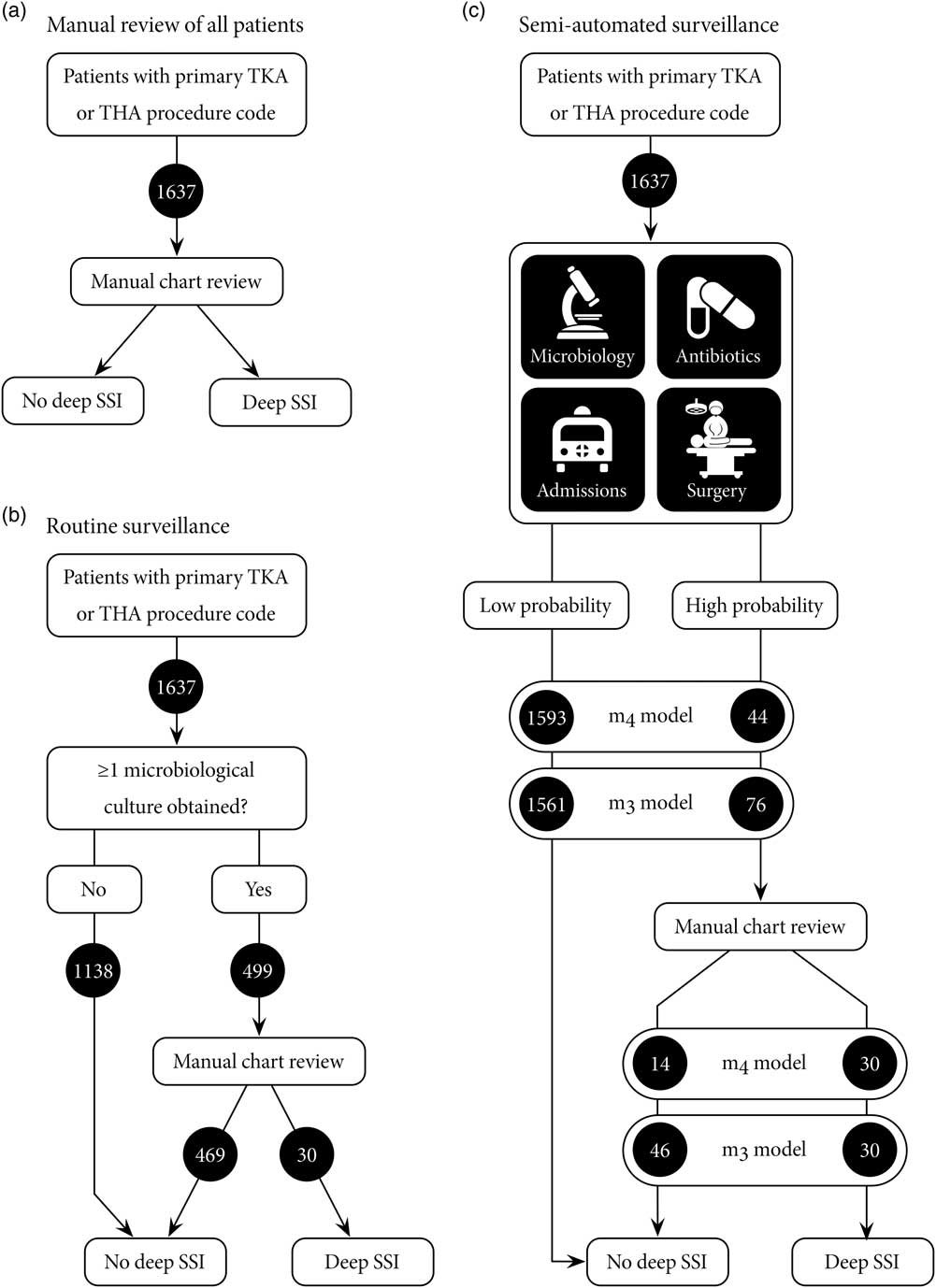
Accurate and timely identification of SSIs through surveillance is essential for targeted implementation and monitoring of preventive interventions. Traditionally, surveillance comprises manual chart review by an infection control practitioner of all patients who underwent a surgical procedure (Figure 1a). However, chart review is time-consuming and prone to subjective interpretation. To reduce workload, hospitals may have adopted a case-finding strategy, such as limiting chart review to patients for whom a microbiological culture has been obtained (Figure 1b). Importantly, variability in case-finding strategies and differences in surveillance methods among hospitals may impair comparability, even in the presence of standardized SSI definitions. This variation is particularly problematic in light of increasing public reporting requirements. 4 The high workload and lack of standardization prompt the development of novel and improved surveillance strategies.
Schematic overview of the different surgical site infection (SSI) surveillance strategies. Numbers in the circles represent the number of patients in this study. (a) Ideally, infection control practitioners should manually assess the medical records of all patients who underwent primary total hip or knee arthroplasty. (b) For efficiency reasons, current surveillance is limited to those patients with at least 1 relevant microbiological culture obtained. (c) With the proposed semiautomated surveillance method, based on 4 diagnostic categories, the number of medical charts to assess can be substantially reduced.

The availability of clinical data warehouses that store data from electronic health records offers the opportunity to automatically and systematically select patients with a high probability of infection for chart review (Figure 1c). This study presents a semiautomated surveillance model that relies on routine care data to retrospectively discriminate between patients with a low and high probability of having developed a deep SSI after primary total hip arthroplasty (THA) or total knee arthroplasty (TKA).
METHODS
Study Population
This retrospective cohort study included all primary THA or TKA procedures in patients aged ≥18 years from 2004 through 2010 and from 2012 through 2014 at University Medical Center Utrecht, a tertiary-care hospital in the Netherlands. Revision procedures were excluded because these are omitted from routine surveillance. 5
Reference Standard
A deep SSI within 90 days of surgery detected by routine surveillance was considered the reference standard. Routine surveillance consisted of chart review by an infection control practitioner using nationally accepted definitions for patients with at least 1 relevant microbiological culture obtained (Figure 1b). 5 Patients without a relevant culture were assumed not to have a deep SSI. Because chart review preceded the development of the model, infection control practitioners were blinded to the outcome of the automated risk stratification.
Model Development
Data elements that could indicate a possible deep SSI were extracted from our local clinical data warehouse for a period of 120 days after surgery. We extracted both clinical and administrative data on microbiological cultures, prescribed antibiotics, admission and discharge dates, surgical procedures, outpatient visits, and discharge codes. Among patients with a second primary THA or TKA procedure within the selected time period, data collection for the first procedure was censored on the day of the second procedure. This study received a waiver of informed consent from the institutional review board.
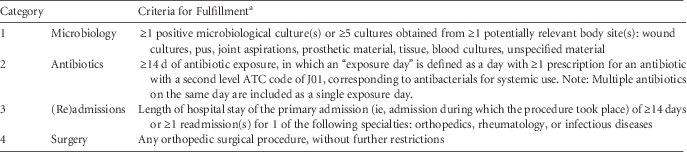
Logistic regression identified predictors that were most strongly associated with a deep SSI. These predictors were dichotomized and categorized into 4 main diagnostic categories: (1) microbiology, (2) antibiotics, (3) (re)admissions, and (4) surgery. To discriminate between patients with a low and high probability of a deep SSI, we developed multiple classification models (Figure 1c) with various degrees of stringency, depending on the required number of diagnostic categories fulfilled.
For the purposes of semiautomated surveillance, we considered sensitivity and positive predictive value (PPV) to be the most important characteristics because any false-positive cases will be corrected during subsequent chart review, whereas false-negatives remain unnoticed. The impact of the different models on workload was calculated as the percentage of medical charts to assess compared with both manual review of all patients (Figure 1a) and routine surveillance (Figure 1b). All analyses were performed using SPSS Statistics version 21 (IBM, Armonk, NY).
RESULTS
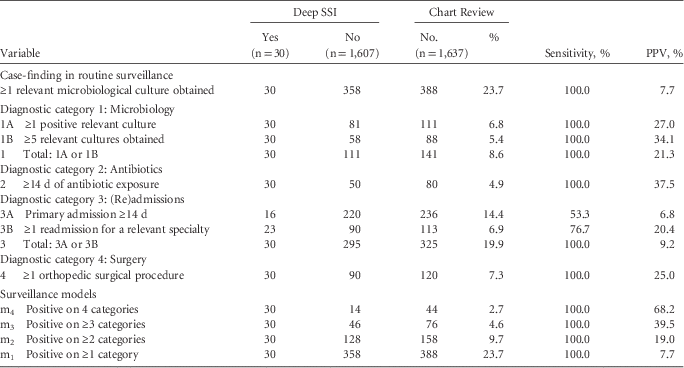
This study included 1,637 primary arthroplasty procedures (684 TKA and 953 THA) in 1,402 patients (36.7% male; median age, 66 years [interquartile range, 56–74 years]). Routine surveillance identified 30 deep SSIs (1.8%). The PPV of at least 1 relevant microbiological culture obtained (ie, the case-finding method used in routine surveillance) was 7.7% (Table 1).
Performance of Individual Predictors, Diagnostic Categories, and ModelsFootnote a

NOTE. SSI, surgical site infection; PPV, positive predictive value.
a All predictors were analyzed for a period of 120 days after the primary procedure (Appendix 1 for details). The surveillance models include 4 main diagnostic categories (1–4), of which 2 are further subdivided (A and B). Only 1 subcategory needs to be fulfilled for the main diagnostic category to turn out positive. The proposed models are designated as mi, in which i represents the minimum number of main diagnostic categories a patient needs to fulfill to be selected for chart review.
The final model comprised 4 diagnostic categories (Appendix 1). Each category showed a sensitivity of 100% and a PPV ranging from 9.2% for (re)admissions to 37.5% for antibiotics (Table 1). The model that requires a patient to score positive on all categories (m4) showed a sensitivity of 100.0% (95% CI, 88.4%–100.0%) and a PPV of 68.2% (95% CI, 52.4%–81.4%). Thus, 44 charts required manual assessment, corresponding to 2.7% of all charts and 11.3% of the 388 charts selected by “culture taken” prescreening used in routine surveillance. The PPV decreased to 39.5% (95% CI, 28.4%–51.4%) for the less stringent m3 model, requiring the manual assessment of 76 charts (ie, 4.6% of all charts and 19.6% of the charts assessed in routine surveillance).
DISCUSSION
In this study, semiautomated surveillance to identify patients with a high probability of a deep SSI substantially reduced the workload of subsequent chart review while maintaining 100% sensitivity. Although the value of automated SSI surveillance using routine care data has been demonstrated previously,Reference Perdiz, Yokoe, Furtado and Medeiros 6 – Reference Van Mourik, Troelstra, Van Solinge, Moons and Bonten 8 many studies have relied on either a single predictor or very few data sources, which implies vulnerability to practice variations.
The strength of this model is the concurrent use of multiple clinical data sources to enhance the PPV and, hence, the efficiency of the model, thereby reducing the workload while simultaneously offering a safety net for SSIs that do not fulfill all criteria. As to err on the side of caution, we have chosen the less stringent model (m3) for use in clinical practice, even though the most stringent model did detect all deep SSIs. Future validation will determine the necessity of maintaining such a safety net.
Interestingly, current surveillance definitions do not require a microbiological culture to score an SSI. 5 Nonetheless, routine surveillance is often “culture driven” and will miss infections where microbiological evidence is lacking. The proposed model does detect patients without a positive culture (m4) or without any culture obtained (m3); hence, it may be less vulnerable to differences in diagnostic practice. Moreover, semiautomated surveillance may standardize case-finding by systematically identifying patients with a high probability of SSI, thereby improving comparability of SSI rates across hospitals.
Several limitations to our study should be noted. First, routine surveillance, the reference standard, may have missed some cases. Nevertheless, reanalysis of high-probability cases did not identify additional infections. Second, surveillance was limited to hospitalizations in the operating hospital, which may have led to an underestimation of the true SSI rate.Reference Yokoe, Avery, Platt and Huang 9 However, this applies to both semiautomated and routine surveillance. Moreover, lack of postdischarge surveillance is particularly a problem for superficial SSIs, which were not included as a study outcome.Reference Ming, Chen, Miller, Sexton and Anderson 10 Third, this was a single-center study, and interhospital differences in sampling habits may limit generalizability. Finally, some revision procedures were mistakenly coded as primary procedures. These misclassifications could not be corrected by automated surveillance because manual assessment to identify such errors is required.
In conclusion, semiautomated surveillance based on routine care data can reliably and efficiently identify patients that may have developed a deep SSI, and it holds promise as an improved surveillance method. Future validation should determine its robustness to clinical practice variations and its generalizability to other settings.
ACKNOWLEDGMENTS
The authors would like to thank D. ter Doest and H. E. M. Blok (data managers), H. C. Vogely (orthopedic surgeon) and the Department of Hospital Hygiene of University Medical Center Utrecht for their assistance in data collection and their clinical expertise.
Financial support: No financial support was provided relevant to this article.
Potential conflicts of interest: All authors report no conflicts of interest relevant to this article.
Criteria for Fulfillment of Diagnostic Categories in the Proposed Models