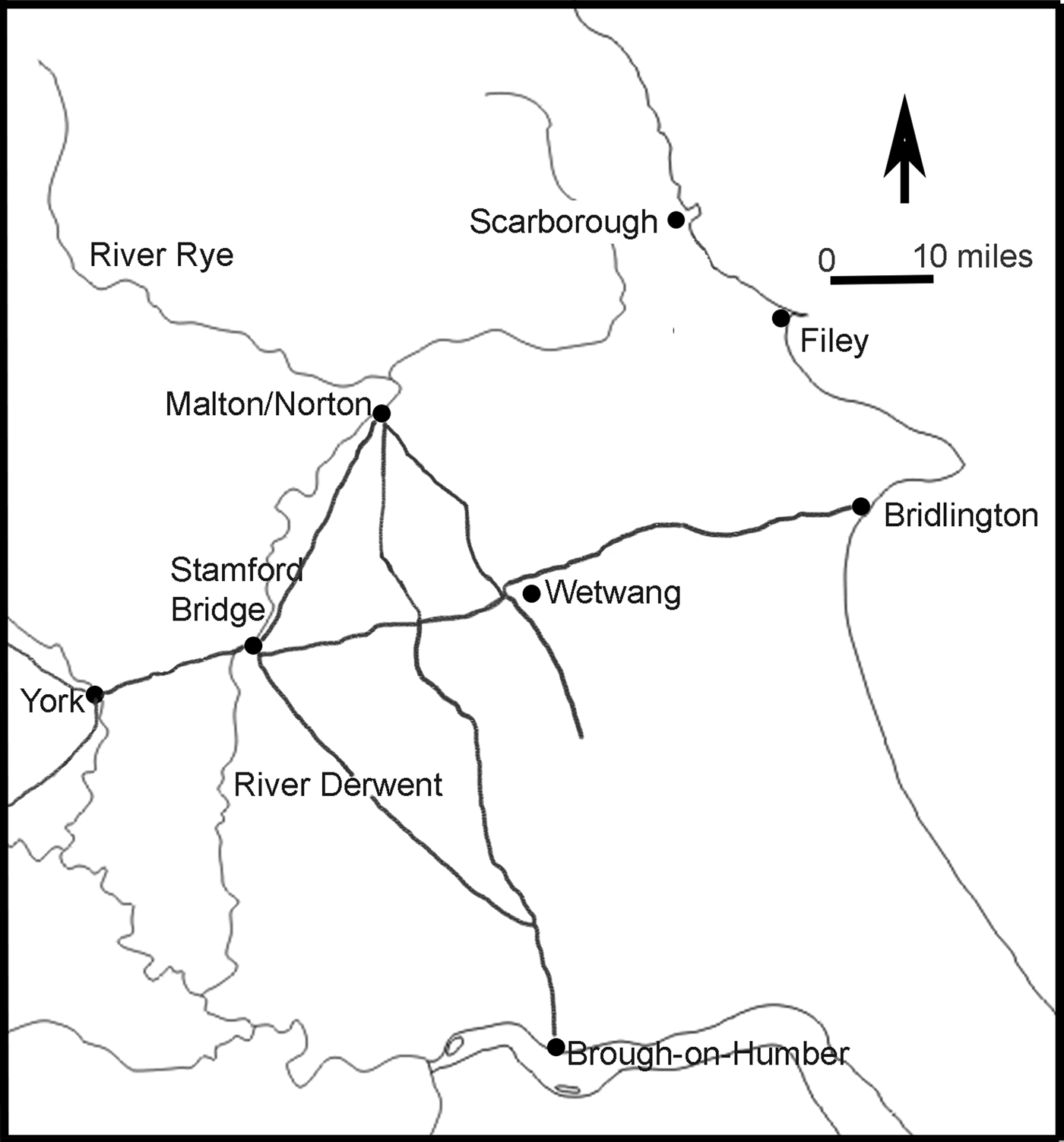
John Creighton explored this subject in depth in his paper ‘The place names of East Yorkshire in the Roman period’Footnote 100 which included discussion of the Roman-period name for Malton/Norton, which he concluded was Delgovicia rather than the traditional identification of Derventio.Footnote 101 This view has found general,Footnote 102 if not universal,Footnote 103 acceptance. That having been said, renewed debate has been engendered by Thomas Ikins writing in the English Place Name List.Footnote 104 While Ikins accepts the name Derventio should be applied to Stamford Bridge, as suggested by Creighton, he rejects the latter's equation of Malton/Norton with Delgovicia preferring an identification with WetwangFootnote 105 and proposes an alternative name for Malton/Norton (see below).
The occurrences of the name Derventio relevant to this consideration appear in Iter I of the Antonine ItineraryFootnote 106 and in the Notitia Dignitatum.Footnote 107 The Notitia records a place called Derventio as being garrisoned by the Supervenientes of Petuaria (Brough-on-Humber). Given the proximity of Brough-on-Humber and Malton it has been assumed that the Derventio of the Notitia was located in eastern Yorkshire and that, with the Derventio of Iter I, it should be identified with MaltonFootnote 108 because:
(1) the Antonine Itinerary records a Derventio somewhere in East Yorkshire;
(2) there is a Roman road from York to Malton (Margary Road 81a);
(3) Malton is on the river Derwent, the name of which derives from the British *dervā meaning ‘oak’, with the name meaning ‘river where oaks are common’ (or similar) and which is etymologically connected to Derventio;Footnote 109
(4) there is a fort at Malton with third- and fourth-century occupation;
(5) the unit of Supervenientes was originally raised at Petuaria, which is generally accepted as being Brough-on-Humber in East Yorkshire.
Places mentioned in the text.

The main difficulty with the traditional identification is that the Antonine Itinerary records Derventio as being 7 mille passum from York whereas Malton is 18.6 mille passum. In addition the Notitia’s Derventio forms part of a list of units in Cumbria, the Pennines and County Durham. Given that there is a second Derventio, also located on a river Derwent, at Papcastle near Cockermouth, it would seem a better fit for the Notitia entry as the Notitia lists Yorkshire sites separately. Therefore if the Notitia’s Derventio can be discounted, it would only leave the Antonine Itinerary entry for the Yorkshire Derventio. Creighton's disposing of Derventio as the Roman name for Malton was made easier as a result of the recognition of a major Roman-period site at Stamford Bridge which is 7 mille passum from York and is also located on the river Derwent.Footnote 110
Having equated Derventio with Stamford Bridge, Creighton persuasively argued that Malton should be identified as Delgovicia which the Itinerary locates 13 mille passum from Derventio,Footnote 111 coinciding with the distance from Stamford Bridge to Malton.
Ikins’ argument hinges on his belief that Praetorio, recorded in the Antonine Itinerary as 25 mille passum from Delgovicia, must equate with Brough-on-Humber, known as Petuaria in the Roman period, despite Creighton's entirely reasonable statement ‘that there is no direct evidence for this link’.Footnote 112 However, Brough is nearer 35 than 25 mille passum from Malton and to explain this Ikins suggests, as noted above, that Delgovicia should be equated with Wetwang — where there is no evidence for significant Roman-period occupation — and that an entry for Malton must have been lost from the Iter. To fill this claimed gap he proposes the name of Rigae for Malton based on Malton being the findspot of an altar dedicated to Mars Rigae,Footnote 113 probably a local deity whose name may have links to the river Rye which joins the Derwent at Malton, and the name of which could have British origins perhaps as Rīṷa or Reg-iā, or possibly incorporating rīa or rïjā.Footnote 114 Alternatively it is possible to read the dedication as possibly referring to ‘Mars the King’, or ‘Mars Rigas’, the latter readily explained by the well-known practice of synchretising Roman and native deities.
Not only does Ikins’ argument require the invention of a new place-name, but he is also constrained to introduce a right-angle turn in the route at Malton towards Wetwang and a further turn to the south at Wetwang to achieve his objective of Brough; in his view Praetorio as a corruption of Petuaria. He fails to consider the fact that Yorkshire extends eastwards from Malton towards the coast, which is roughly 25 mille passum away. Creighton argued that Praetorio might be either Scarborough or Filey,Footnote 115 both sites with known Roman-period occupation, but I would add to those suggestions the possibility that it could represent a Roman site near Bridlington which has been lost to the sea. The Rapid Coastal Zone Assessment project concluded that ‘coastline has been eroded in the past two millennia, and the location of a [Roman-period] port and related settlement are likely to lie 1–2 kms east of the present harbour’.Footnote 116 Not only could such a site have been the terminus of Roman road M811,Footnote 117 but it would also be the focus for a small group of villas and possible villas,Footnote 118 similar to the group around Malton.Footnote 119
The discussion above demonstrates that it is possible to securely locate the Derventio of Iter I within eastern Yorkshire and offer credible locations for the other Roman-period names under consideration without recourse to introducing mistakes by copyists, right-angle turns and missing lines. The mileages work and, given the now secure identification of Stamford Bridge as the East Yorkshire Derventio (which Ikins accepts), Creighton's identification of Delgovicia as Malton/Norton should stand, but with the additional possibility that the previously unlocated Praetorio was at or near Bridlington, probably off the existing coastline, and that the conjectured name of Rigae for Malton/Norton should be dismissed as a falsa.
ACKNOWLEDGEMENTS
I am grateful to Dr Steven Bassett for drawing my attention to Dr Ikins’ publication and for helpful comments on a draft text. Thanks are also due to Jill Wilson for preparing the accompanying figure.