Introduction
Chagas disease, caused by the parasitic protozoan Trypanosoma cruzi, is responsible for a larger disease burden in Latin America than all other vector-borne pathogens combined (WHO, 2004). It is estimated that in Guatemala two million people are at risk from Chagas disease and more than 2000 people become infected with T. cruzi every year (PAHO, 2005). Insect vectors, haematophagous reduviid bugs, comprise the main route for T. cruzi transmission accounting for more than 80% of new cases (PAHO, 2005). In Guatemala, prior to the initiation of the control programme, the main vectors were Rhodnius prolixus and Triatoma dimidiata (Ponce, Reference Ponce2007). Rhodnius prolixus was focalized in a well-defined region in eastern Guatemala, and was always found to be associated with human houses (WHO, 2002). Triatoma dimidiata, in contrast was more widely distributed and found in domestic, peridomestic and sylvatic environments (WHO, 2002). Consequently, different approaches were launched to control the two species; complete elimination of R. prolixus, and domiciliary control of T. dimidiata (<5% infestation rate). Elimination of T. dimidiata was not believed to be possible due to the risk of house re-invasion from extra-domiciliary populations with potential for subsequent reproduction inside houses. In addition to vector control measures, the Central American Initiative for Chagas Disease Control (IPCA) also ordered the screening of all blood donors (WHO, 2002). Extensive implementation of house spraying with residual insecticides in Guatemala, has placed the country ahead in the goal to eliminate R. prolixus (PAHO, 2006). Reports suggest that following the intensive vector control campaign in the last decade R. prolixus has been virtually eliminated (Petherick, Reference Petherick2010; King et al., Reference King, Cordon-Rosales, Cox, Davies and Kitron2011). Although, intradomestic infestations of T. dimidiata have been greatly reduced, there are persistent foci in several departments. In Guatemala, 39% of sampled T. dimidiata were infected with T. cruzi, and vectorial transmission has been demonstrated even when the insect is present at low infestation densities (Schofield & Dujardin, Reference Schofield and Dujardin1997; Monroy et al., Reference Monroy, Mejia, Rodas, Rosales, Horio and Tabaru1998a, Reference Monroy, Rodas, Mejia and Tabarub; PAHO, 2006). Consequently, it is now considered the most important vector of Chagas disease in Guatemala.
Triatoma dimidiata is native and widespread throughout the country in extradomestic habitats and so its elimination is virtually impossible. Sustained monitoring and cost-effective targeting of control will be necessary to maintain houses free of infestation. Entomological surveys, the current method used to monitor for domestic triatomines, are labour intensive and time consuming. Therefore, in countries where Chagas disease is endemic, entomological evaluations are targeted at communities that are believed to be at increased risk of triatomine infestation. Risk is evaluated by quantifying factors that influence the probability of domestic infestation with triatomine bugs e.g., houses possessing mud walls and palm roofs, the results of anecdotal surveys, suspected infestations or houses previously infested (Nakagawa et al., Reference Nakagawa, Hashimoto, Cordon-Rosales, Abraham Juarez, Trampe and Marroquin Marroquin2003; Campbell-Lendrum et al., Reference Campbell-Lendrum, Angulo, Esteban, Tarazona, Parra, Restrepo, Restrepo, Guhl, Pinto, Aguilera, Wilkinson and Davies2007; King et al., Reference King, Cordon-Rosales, Cox, Davies and Kitron2011). However, targeted sampling, using risk factors, was recently found to be less effective than random sampling at detecting villages with T. dimidiata prevalence above the 5% threshold (King et al., Reference King, Cordon-Rosales, Cox, Davies and Kitron2011). The failure of this method was believed to be due to the assumption of a similarity in risk factors across geographic space. However, T. dimidiata prevalence is patchy and appears to be dependent upon different risk factors and environmental variables in different areas (King et al., Reference King, Cordon-Rosales, Cox, Davies and Kitron2011). In addition, one of the risk factors used for targeting sampling was the presence of a palm roof, a characteristic that is highly correlated with R. prolixus infestation (Cordon-Rosales & Pennington, Reference Cordon-Rosales and Pennington2007), but T. dimidiata is rarely associated with palm roofing materials. Therefore, risk factors specific to T. dimidiata need to be identified to increase the effectiveness of control based on priority stratification of communities and houses. In domestic habitats, T. dimidiata are often found within cracks, in the floor or walls, concentrated around the sleeping areas (Zeledon et al., Reference Zeledon, Solano, Zuniga and Swartzwe1973; Schofield & Dujardin, Reference Schofield and Dujardin1997; Monroy et al., Reference Monroy, Mejia, Rodas, Rosales, Horio and Tabaru1998a, Reference Monroy, Rodas, Mejia and Tabarub; WHO, 2002). However, T. dimidiata exhibits a preference for peridomestic refuges, such as piles of roof tiles or firewood (Zeledon et al., Reference Zeledon, Solano, Zuniga and Swartzwe1973; Starr et al., Reference Starr, Rojas, Zeledon, Hird and Carpenter1991). Consequently, despite living outside the house, the insects are close enough to enter houses and feed on human hosts.
Differences between geographic regions, such as variation in vector distribution due to environmental factors, e.g., temperature, humidity and vegetation type, also have an effect on risk. For example, the risk of T. dimidiata infestation is elevated in certain life zones, in particular subtropical forests (Cordon-Rosales & Pennington, Reference Cordon-Rosales and Pennington2007). To stratify an area based on risk of triatomine infestation, locally important variables need to be established. Risk factors may vary spatially between regions due to variation in human behaviour, vector behaviour and ecology and environmental factors. Local knowledge can then be used to more effectively target houses for vector control and also to determine house characteristics that could be prioritized in house improvement programmes (Campbell-Lendrum et al., Reference Campbell-Lendrum, Angulo, Esteban, Tarazona, Parra, Restrepo, Restrepo, Guhl, Pinto, Aguilera, Wilkinson and Davies2007).
The present study aimed to identify factors associated with domestic infestation in Chiquimula, Guatemala, a department with high levels of triatomine infestation and infection with T. cruzi (Tabaru et al., Reference Tabaru, Monroy, Rodas and Mejia1999a, Reference Tabaru, Monroy, Rodas, Mejia and Rosalesb; Monroy et al., Reference Monroy, Rodas, Mejia, Rosales and Tabaru2003). More specifically, variables could be used to stratify houses for vector control and prioritize improvements in housing to reduce suitability for T. dimidiata infestation.
Materials and methods
Study sites
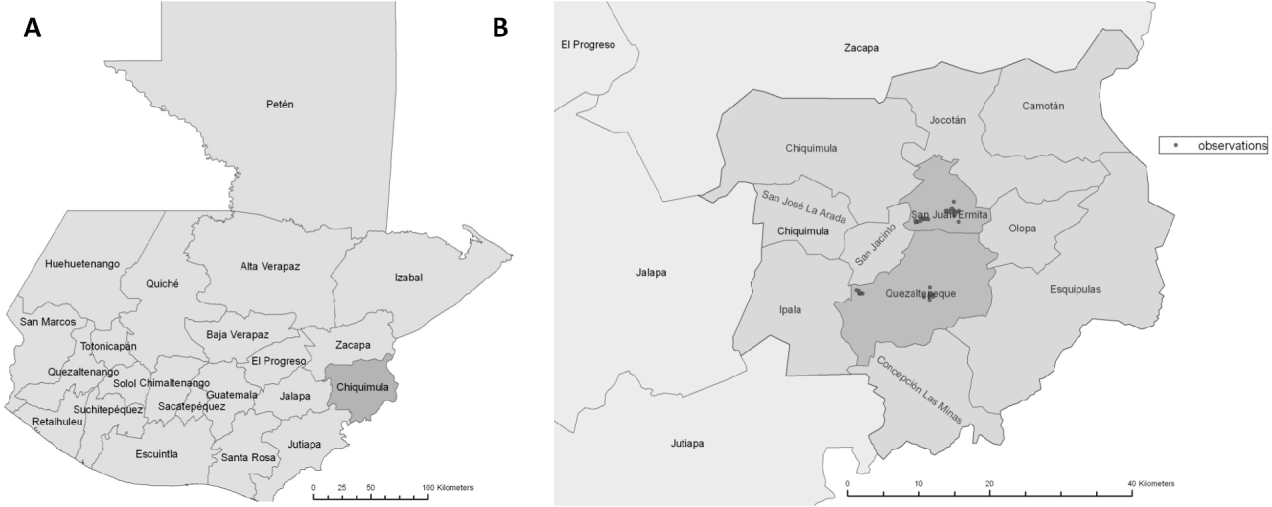
The survey was performed from June to August 2006 in the eastern highlands in the Chagas disease endemic department of Chiquimula, Guatemala (fig. 1). Chiquimula is at a latitude of 14°48′00″N and a longitude of 89°33′00″W, with an elevation of 420 m above sea level.
Maps of Guatemala, showing the department of Chiquimula (A) and the sampled municipalities in Chiquimula (B), San Juan Ermita and Quezaltepeque, with the sample houses marked by circles (black).

A total of 50 houses were sampled representing six communities from two municipalities. Chancó, Corral de Piedra, Río Arriba, Los Encuentros in San Juan Ermita (654 m.a.s.l), and Pedregalito and El Limón in Quezaltepeque (685 m.a.s.l.). The communities were chosen based on infestation data and intervention history collected by the Universidad del Valle de Guatemala. All study communities had baseline infestation rates greater than 15% and had no previous record of control intervention. Within each community, a probabilistic sample of houses was selected by systematically choosing every fifth house from a census map of the community, provided by the national vector control programme. The number of houses to be sampled per community was estimated using census data provided by the Guatemalan Ministry of Health (Ministerio de Salud Pública y Asistencia Social-MSPAS) with the following parameters: 30% estimated infestation level, 5% precision, 95% CI and 80% statistical power (Hashimoto et al., Reference Hashimoto, Cordon-Rosales, Trampe and Kawabata2006). Therefore, if the total number of houses was 0–30 then 50% were sampled, 33% for 31–59 houses and 10% for 60–100 houses.
Risk factors
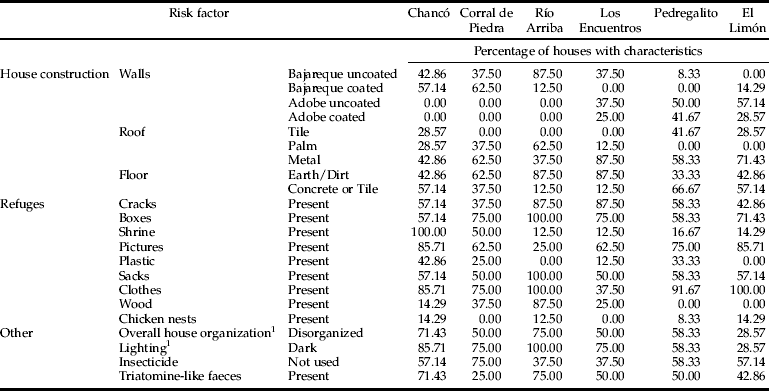
Householders were shown photographs and pinned specimens of R. prolixus and T. dimidiata and asked about triatomine activity using four questions; (1) Have you seen a triatomine bug in the last month?, (2) Was it inside or outside your house?, (3) Have you been bitten by a triatomine bug in the last month?, and (4) Have you sprayed insecticide to try and kill triatomine bugs or other insects? Information was recorded about the house structure and potential refuges in the domestic environment and these data formed the basis for the 17 risk-factor measures (table 1). With regard to the more subjective variables: organization and lighting, categories were assigned after visual inspection (E. Weeks). In ‘organized’ houses belongings were tidied away or intentionally positioned, whereas in ‘disorganized’ houses there was no obvious intentional positioning of belongings, with items such as food, clothing or firewood, on the floor providing potential triatomine refuges. Lighting was classified based on the presence of natural light during the day, sleeping areas with natural light entering through windows or doors were ‘light’ and those with no natural light were ‘dark’. Only natural light was considered as only two of the six communities had an electricity supply.
House characteristics by community in the municipalities of San Juan Ermita and Quezaltepeque, Chiquimula, Guatemala.
1 Categorized by visual inspection (interviewer). Organized=belongings tidied away or intentionally positioned. Disorganized=no obvious intentional positioning of belongings, with items such as food, clothing or firewood, on the floor providing potential triatomine refuges. Light=natural light in bedroom, Dark=no natural light in bed room.
A global positioning system (GPS) device was used to record the latitude, longitude and altitude of each sample house.
Triatomine detection methods
A combination of three detection methods was used during the study to identify properties infested with triatomines. These included a passive sensor box method and two active methods. Active methods were householder collection and manual inspection by trained personnel. All three methods were applied to each house. Sensor boxes were installed and householder collection pots were distributed at the beginning of the study. After three weeks the pots and boxes were collected and a manual inspection was completed. The sensor boxes were checked for any signs of triatomine infestation: faeces, eggs, exuviae, nymphs or adults. All triatomines collected were classified morphologically into species using identification keys (Lent & Wygodzinsky, Reference Lent and Wygodzinsky1979). Sensor boxes were of the Gomez Nunez design (Gomez Nunez, Reference Gomez Nunez1965), which were made of cardboard and measured 31×25×5 cm. On one side of the box, positioned in contact with the wall, there were 12 holes; each 2 cm in diameter. Inside each box, stiff brown paper sheet was folded and perforated with holes to form a lattice-like structure for the triatomines to rest on. Two sensor boxes were positioned in the principal bedroom, on the wall nearest the bed, one each at 50 and 150 cm. The householder collection pots were adapted 50 ml conical tubes; the lid of the tube was perforated to hold a piece of mesh in place for ventilation. Inside the tube was a piece of folded brown resting paper. Protective gloves were provided for use when catching triatomines and the use of the pot was demonstrated. A manual inspection of the domestic area was conducted for 15 min or 0.5 man hours using forceps and flashlights (Nakagawa et al., Reference Nakagawa, Hashimoto, Cordon-Rosales, Abraham Juarez, Trampe and Marroquin Marroquin2003). A 15 min search of any potential peridomestic refuges, e.g., wood piles, chicken coops, within the house boundaries (maximum distance 50 m) followed the intradomestic search. The distance constraint was set within 50 m or the change to farmland or sylvatic areas, whichever was met first.
Data analyses
Triatomine distribution was measured using four conventional entomological indices at the department, municipality and community level (WHO, 2002; Nakagawa et al., Reference Nakagawa, Juarez, Nakatsuji, Akiyama, Hernandez, Macal, Flores, Ortiz, Marroquin, Bamba and Wakai2005). The infestation, colonization and crowding index were defined as the proportion of houses that have T. dimidiata, that have immature stages and the number of triatomines per infested property, respectively. The infestation density was defined as the number of triatomines per sample house.
Risk factor analyses were performed in STATA (StataCorp, TX) using multivariate stepwise logistic regression with the dependant variable being houses found infested with T. dimidiata by any method. Independent variables, or risk factors, were interpreted as categorical variables. The maximal model included all variables with a z-test P value of less than 0.2 from the univariate analyses. Variables with a z-test P value of greater than 0.05 were removed in a stepwise method from the maximal model until only variables significant by the z-test remained. Finally, each variable that had been excluded was added back in to the model individually, to confirm that it added no explanatory power to the model. Variables with more than two categories were examined for association with the likelihood ratio (LR) test in STATA. In addition, a logistic regression was also performed to test the significance of geographical variables, i.e., altitude, latitude and longitude, over the presence of T. dimidiata infestation using GenStat (VSN International, U.K.).
Ethics
The study was reviewed and approval was granted by the Research Ethics Committee at the London School of Hygiene and Tropical Medicine, U.K. The first visit to each house began with an explanation of the study to gain verbal consent from the inhabitants.
Results
Infestation
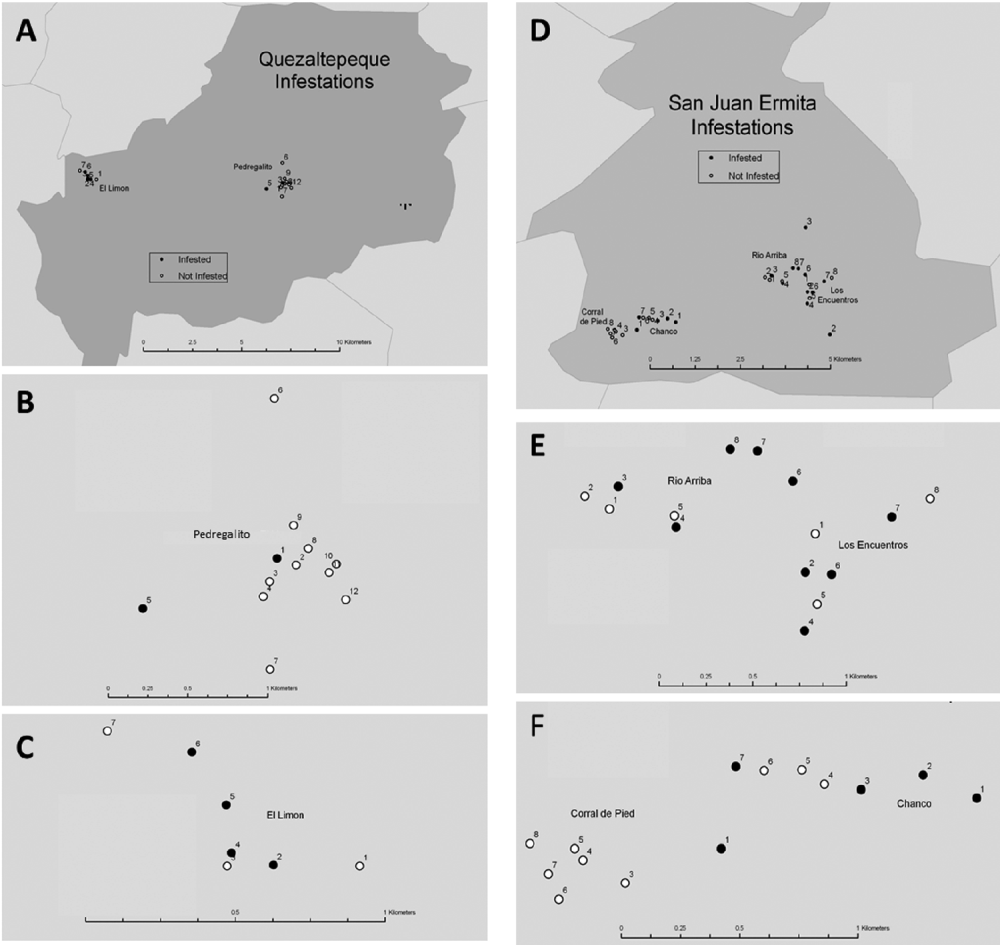
A total of 130 T. dimidiata and one Triatoma nitidia were collected. No samples of R. prolixus were collected by any of the methods. Of the T. dimidiata collected, 50 specimens were adults and 80 were nymphs (table 2). The single T. nitidia specimen, collected in Los Encuentros (San Juan Ermita), was a nymph; the house was not co-infested with T. dimidiata. In all houses where nymphs were found, adults were also collected (table 2; fig. 2). In Chiquimula the T. dimidiata infestation index was found to be 44% (22/50; 95% CI 30.3–58.6), with the two municipalities surveyed, San Juan Ermita and Quezaltepeque, having indices of 52% (16/31; 95% CI 33–70) and 32% (6/19; 95% CI 9–54), respectively. All surveyed communities had greater than 15% infestation with T. dimidiata. The average number of T. dimidiata collected per infested house in Chiquimula was 6 (±4.6 s.d.; crowding index) and the average number of T. dimidiata collected per sample house was 2.6 (±4.22 s.d.; infestation density). The infestation density and crowding indices by municipality were similar. The highest number of triatomines collected from one house was 17 specimens, consisting of six adults and 11 nymphs, in Chancó (San Juan Ermita).
Infestation maps for municipalities and communities in Chiquimula, Guatemala. Maps show the sampled properties (circles) in Quezaltepeque (A, B, C) and San Juan Ermita (D, E, F), infested properties have filled in circles (black).
Triatoma dimidiata captured by community.
Risk factor analyses
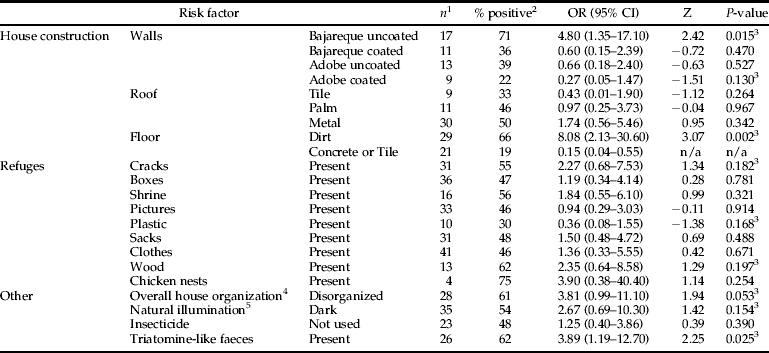
Risk factor analyses were performed to identify variables associated with T. dimidiata infestation (table 3; the single house positive for T. nitidia was excluded). The probability that a house was infested with T. dimidiata increased significantly with the presence of uncoated bajareque walls (P=0.015; OR 0.66, 95% CI 0.18–2.40) and dirt floors (P=0.002; OR 8.08, 95% CI 2.13–30.60). Furthermore, the presence of triatomine-like faeces on interior walls, was associated with an increase in infestation rate (16/26, 62% infested; P=0.025; OR 3.89, 95% CI 1.19–12.70). Although only 17 of the 50 houses sampled possessed uncoated bajareque walls, 71% (12/17) of these houses were infested with T. dimidiata. The largest odds ratio was associated with floor type, signifying a strong association of this variable with the probability of a house being infested by T. dimidiata. Of the houses with dirt floors, 66% (18/29) were infested with T. dimidiata.
Univariate analysis of house-level risk factors, effect on the probability that a house was found infested by T. dimidiata.
1 Number of houses out of 50 where the factor was present.
2 Percentage of houses with factors that were positive for T. dimidiata (house positive for T. nitidia excluded from the analysis).
3 Indicates inclusion in the maximal model.
4 Categorized by visual inspection (interviewer). Organized=belongings tidied away or intentionally positioned. Disorganized=no obvious intentional positioning of belongings, with items such as food, clothing or firewood, on the floor providing potential triatomine refuges.
5 Categorized by visual inspection (interviewer). Light=natural light in bedroom, Dark=no natural light in bed room.
The analysis produced a maximal model with nine risk factors (χ2=13.60; P=0.0587). The presence of uncoated bajareque walls, a dirt floor, cracks in the walls (P=0.182; OR=2.27, 95% CI=0.068–7.53), firewood (P=0.197; OR=2.35, 95% CI=0.64–8.58) and triatomine-like faeces increased the probability of an infestation. Disorganized (P=0.053; OR=3.81, 95% CI=0.99–11.10) and dark houses (P=0.154; OR=2.67, 95% CI=0.69–10.30) were also more likely to be infested with T. dimidiata. The presence of coated adobe walls (P=0.130; OR=0.272, 95% CI=0.050–1.47) and plastic on the walls (P=0.168; OR=0.356, 95% CI=0.082–1.55) decreased the likelihood that a house was found to be infested. Multivariate stepwise logistic regression analyses produced a minimal model where only the presence of a dirt floor remained significant (χ2=13.36; P=0.0013). In comparison with any other type of floor (concrete or tile), dirt floors increased the probability that a house was infested with T. dimidiata.
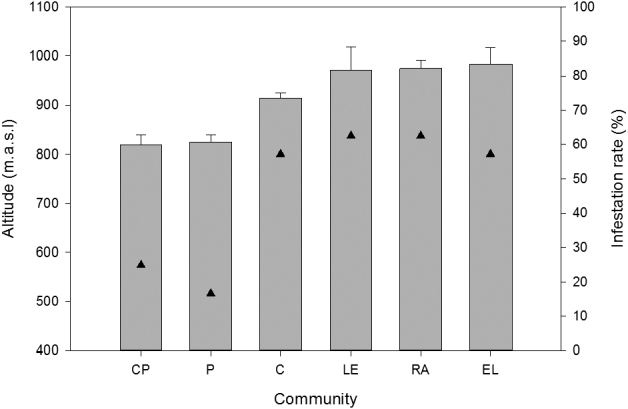
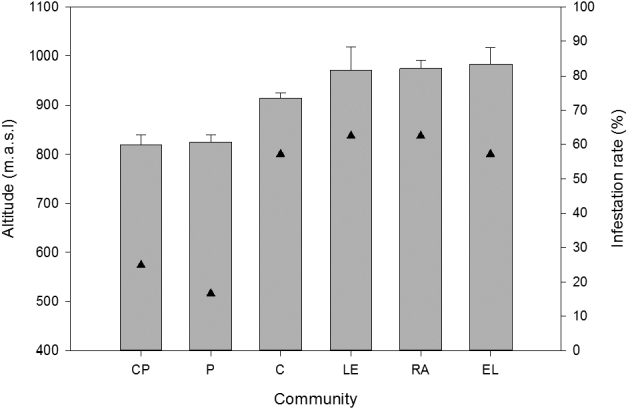
Analysis of the geographical variables by logistic regression revealed a significant linear relationship of altitude with the presence of T. dimidiata infestation (fig. 3; P=0.027; range 791–1101 m.a.s.l). Within this range, every 100 m increase in altitude resulted in an increase in the community infestation rate by 25%. No significant relationship was found between T. dimidiata infestation and the latitude (P=0.116) or longitude (P=0.675) of the sample houses.
Relationship between altitude and infestation rate (%) with T. dimidiata. Bars (grey) represent the arithmetric mean altitude in meters above sea level (m.a.s.l.; ±95% CI) of the sample houses within the six communities, CP=Corral de Piedra, P=Pedregalito, C=Chancó, LE=Los Encuentros, RA=Río Arriba and EL=El Limón. Triangles (black) represent the community infestation rate (%).
Discussion
Historically, Chiquimula was an area with a high level of domestic triatomine infestation (Tabaru et al., Reference Tabaru, Monroy, Rodas and Mejia1999a, Reference Tabaru, Monroy, Rodas, Mejia and Rosalesb). In a previous survey completed in 1999, more than 25% of houses within the department were infested with T. dimidiata or R. prolixus (Tabaru et al., Reference Tabaru, Monroy, Rodas and Mejia1999a, Reference Tabaru, Monroy, Rodas, Mejia and Rosalesb). All six of the study communities in the municipalities of San Juan Ermita and Quezaltepeque (Chiquimula, Guatemala) were infested with and colonized by triatomines. The majority of the triatomines collected were identified as T. dimidiata. Previous studies in Guatemala found that at a T. dimidiata infestation rate of approximately 25% (in the absence of other vectors) there was a 8.9% T. cruzi seropositivity among inhabitants (Paz-Bailey et al., Reference Paz-Bailey, Monroy, Rodas, Rosales, Tabaru, Davies and Lines2002). Our study indicated that in five of the six communities that were sampled the infestation rate was equal to or greater than this level. Chiquimula was, therefore, in urgent need of control of T. dimidiata.
The use of house characteristics to stratify communities based on risk is one method of targeting control on those houses that are most likely to be infested. In the current study, the presence of statistically significant associations between the probability of infestation by T. dimidiata and several anthropogenic characteristics has been demonstrated. The probability of infestation increased significantly with the presence of dirt floors, uncoated bajareque walls and triatomine-like faeces, risk factors that are consistent with previous studies and existing knowledge of triatomine ecology. Dirt floors are thought to provide refuge and the opportunity to use dirt for camouflage, a distinctive behaviour of T. dimidiata (Zeledon et al., Reference Zeledon, Zuniga and Swartzwelder1969). In a previous study in Guatemala, the majority of houses were found to have dirt floors thus limiting the power to detect a significant association; the results indicated no significant correlation (Cordon-Rosales & Pennington, Reference Cordon-Rosales and Pennington2007). In the communities visited in the present study, 21 out of 50 houses had modified concrete or tile floors so it was possible to study the association between floor type and the probability of infestation with T. dimidiata. A study in Jutiapa, Guatemala, found that intradomiciliary prevalence of T. dimidiata in villages was more likely to be above the 5% threshold in communities with a higher proportion of houses with dirt floors (King et al., Reference King, Cordon-Rosales, Cox, Davies and Kitron2011). Communities with a higher proportion of alternative floor types, e.g., tile, had a lower likelihood of village infestation (King et al., Reference King, Cordon-Rosales, Cox, Davies and Kitron2011). The results are consistent with studies conducted in other countries into the ecology of T. dimidiata. For example, in two studies in Costa Rica the species was found to have an association with dirt floors (Zeledon & Vargas, Reference Zeledon and Vargas1984; Starr et al., Reference Starr, Rojas, Zeledon, Hird and Carpenter1991). Although, Starr et al. (Reference Starr, Rojas, Zeledon, Hird and Carpenter1991) did not find a significant association between dirt floors and the risk of being infested with T. dimidiata, the factor was assumed to be important due to high odds ratios. Other studies have not detected the relationship with dirt floors. For example, a study in Colombia identified a reduction in triatomine infestation in general with the presence of other floor types, but the species specific analysis found no relationship of T. dimidiata infestation and floor type (Campbell-Lendrum et al., Reference Campbell-Lendrum, Angulo, Esteban, Tarazona, Parra, Restrepo, Restrepo, Guhl, Pinto, Aguilera, Wilkinson and Davies2007). Another study completed in Guatemala found no significant association between T. dimidiata infestation and floor type, the authors hypothesized that the result was due to the infestations being well established (Bustamante et al., Reference Bustamante, Monroy, Pineda, Rodas, Castro, Ayala, Quinones, Moguel and Trampe2009). The variation between studies completed in different areas highlights the need to understand the risk factors in each epidemiological setting before the factors are used to prioritize houses for control.
The other risk factors identified, including the presence of uncoated bajareque walls and triatomine-like faeces, are known indicators of potential triatomine infestation. T. dimidiata is known to live in cracks within walls (Zeledon et al., Reference Zeledon, Solano, Zuniga and Swartzwe1973; WHO, 2002), and previous studies also have recorded this association with unplastered walls (Monroy et al., Reference Monroy, Mejia, Rodas, Rosales, Horio and Tabaru1998a, Reference Monroy, Rodas, Mejia and Tabarub; Tabaru et al., Reference Tabaru, Monroy, Rodas and Mejia1999a, Reference Tabaru, Monroy, Rodas, Mejia and Rosalesb; Campbell-Lendrum et al., Reference Campbell-Lendrum, Angulo, Esteban, Tarazona, Parra, Restrepo, Restrepo, Guhl, Pinto, Aguilera, Wilkinson and Davies2007; Cordon-Rosales & Pennington Reference Cordon-Rosales and Pennington2007; Bustamante et al., Reference Bustamante, Monroy, Pineda, Rodas, Castro, Ayala, Quinones, Moguel and Trampe2009). As there are several wall dwelling species, the presence of uncoated bajareque walls or the absence of wall coating is likely to be a more general risk factor indicative of triatomines in general. Coated walls were found to protect against several other species of Triatominae including Triatoma infestans and Triatoma pallidipennis (Enger et al., Reference Enger, Ordonez, Wilson and Ramsey2004; Levy et al., Reference Levy, Bowman, Kawai, Waller, del Carpio, Benzaquen, Gilman and Bern2006). In contrast, dirt floors are likely to be a more specific risk factor for T. dimidiata infestation, as dirt camouflage is a behaviour specific to this species. Triatomine-like faeces on walls is often used as indirect evidence of triatomine presence during manual inspection and has been found to be a good indicator of domestic infestation for T. dimidiata and R. prolixus (Monroy et al., Reference Monroy, Mejia, Rodas, Rosales, Horio and Tabaru1998a, Reference Monroy, Rodas, Mejia and Tabarub). However, the identification of triatomine-like faeces is not as simple as recording the floor and wall type of a house and will involve a more invasive assessment of the property by an experienced technician.
Following further analysis, only the presence of a dirt floor was included in the minimal model, in this area of Guatemala, this factor alone is likely to be the most reliable indicator of T. dimidiata infestation risk. Consequently, we propose the use of the presence of dirt floors and uncoated bajareque walls as factors to stratify houses in Chiquimula, Guatemala based on for risk of T. dimidiata infestation. At the same time, it would be necessary to identify the resilient T. dimidiata infestation areas to ascertain focalized risk factors.
Coated adobe walls and the presence of plastic on the walls were also included in the maximal model for potentially decreasing the odds of infestation in this study. Coating walls would restrict access to cracks reducing potential refuges, and plastic on the walls may have a similar effect while also making thorough manual inspection more difficult. The use of plastic material on walls was associated with a low likelihood of infestation (30%), however, the number of houses with this modification was low (n=10). If the negative association with plastic is true, then plastic-coated walls could provide an innovative method of controlling T. dimidiata infestations, which may be enhanced by the use of insecticide impregnated plastics.
In addition to those factors that were found to significantly increase the probability of infestation in the present study, other variables in the maximal model could be used to modify the risk of T. dimidiata infestation, e.g., the presence of cracks in walls and wood piles, disorganization and poor natural illumination. Cracks in walls and wood piles are known refuges of T. dimidiata (Zeledon & Vargas, Reference Zeledon and Vargas1984; Dias & Schofield, Reference Dias and Schofield1999; WHO, 2002). While there was no significant association detected with any other house content factor in the present study, e.g., boxes, sacks; the majority of homes sampled had uncoated walls (56%) with cracks (60%), so there was no shortage of preferred T. dimidiata refuges available. A disorganized, poorly illuminated house could potentially have a greater number of refuges for triatomines and permit an extended period of activity for these nocturnal insects. Previous studies have recorded a negative association of T. dimidiata with interdomestic light intensity (Tabaru et al., Reference Tabaru, Monroy, Rodas and Mejia1999a, Reference Tabaru, Monroy, Rodas, Mejia and Rosalesb), and number of windows in the bedroom (Bustamante et al., Reference Bustamante, Monroy, Pineda, Rodas, Castro, Ayala, Quinones, Moguel and Trampe2009). Several studies have found an association with the presence of domestic animals and T. dimidiata and other Chagas disease vectors (Enger et al., Reference Enger, Ordonez, Wilson and Ramsey2004; Levy et al., Reference Levy, Bowman, Kawai, Waller, del Carpio, Benzaquen, Gilman and Bern2006; Bustamante et al., Reference Bustamante, Monroy, Pineda, Rodas, Castro, Ayala, Quinones, Moguel and Trampe2009). During the current study, few animals were observed within the sample properties. Only four of the 50 houses sampled had any evidence of animals living indoors, this was always in the form of indoor chicken nests and of these four properties three were infested with T. dimidiata.
While the identification of house-level risk factors for infestation would decrease the cost of control, the community would need to be visited at least once in order for these risk factors to be recorded. However, unlike entomological evaluation, this assessment could be done by a non-specialist or someone within the community. In addition, it would be desirable to test if remotely sensed environmental variables could help stratify the risk of triatomine infestation in large areas. In Guatemala, T. dimidiata can be found throughout a range, from sea level to 1600 m and has been found to be most prevalent between 800 and 1000 m.a.s.l. (Tabaru et al., Reference Tabaru, Monroy, Rodas and Mejia1999a, Reference Tabaru, Monroy, Rodas, Mejia and Rosalesb). Our study describes a relationship of increasing infestation with increasing altitude within this range in Chiquimula. However, the relationship may vary across the county so nationwide studies are needed to determine how altitude affects the infestation rate by department across the whole of Guatemala. Variation in infestation due to changes in altitude is unlikely to be independent of other environmental and climatic variables. Future work could incorporate such factors to identify zones of increased risk within the country. As environmental variables can be determined remotely, such a method for assessing risk would be probably more cost effective than surveys, enabling at risk houses to be predetermined without any field visits.
The identification of house-level risk factors may also be used to inform house improvement schemes of the factors most likely to reduce triatomine infestation. Home improvements have the potential to greatly reduce the risk of triatomine infestation by reducing the availability of refuges for resting and breeding. Campbell-Lendrum et al. (Reference Campbell-Lendrum, Angulo, Esteban, Tarazona, Parra, Restrepo, Restrepo, Guhl, Pinto, Aguilera, Wilkinson and Davies2007) predicted a 60% decrease in risk of infestation by triatomines associated with improvements in basic house structure. The model used assumed the complete renovation of all houses within a village through plastering of walls, cementing of dirt floors and replacement of natural roofing materials such as palm or thatch, with metal or tile (Campbell-Lendrum et al., Reference Campbell-Lendrum, Angulo, Esteban, Tarazona, Parra, Restrepo, Restrepo, Guhl, Pinto, Aguilera, Wilkinson and Davies2007). Costs associated with complete renovation would exceed spraying costs in the short term. For example, a study in Paraguay priced a renovation at US$600 and a round of insecticide fumigation at US$29 (Rojas de Arias et al., Reference Rojas de Arias, Ferro, Ferreira and Simancas1999). However, the results of house improvements are longer lasting and have other benefits due to the increased level of construction and hygiene. Owing to the costs associated with a complete house renovation it is important to prioritize changes in house structure based on locally important risk factors. For example, following the identification of uncoated walls as a risk factor for T. dimidiata infestation in Jutiapa, Guatemala (Bustamante et al., Reference Bustamante, Monroy, Pineda, Rodas, Castro, Ayala, Quinones, Moguel and Trampe2009), a trial house improvement scheme was established involving wall plastering with traditional materials and methods by inhabitants (Monroy et al., Reference Monroy, Bustamante, Pineda, Rodas, Castro, Ayala, Quinones and Moguel2009). The single improvement, costing just US$30 per house, reduced domestic triatomine infestation in all communities equal to a traditional spraying programme but with longer lasting effects (Monroy et al., Reference Monroy, Bustamante, Pineda, Rodas, Castro, Ayala, Quinones and Moguel2009).
The current study also found uncoated walls to increase the risk of T. dimidiata infestation, although the risk factor with the strongest association was found to be the presence of a dirt floor. A survey of school age children completed in Guatemala found a significant association with seropositivity for T. cruzi and floor type (Rizzo et al., Reference Rizzo, Arana, Diaz, Cordon-Rosales, Klein and Powell2003). Children living in a house with a modified floor had a lower seropositivity rate (3.9%), compared with those children living in houses with traditional dirt floors (6.5%) (Rizzo et al., Reference Rizzo, Arana, Diaz, Cordon-Rosales, Klein and Powell2003). Therefore, the modification of dirt floors could decrease T. cruzi transmission through long-term reduction in contact between the insect and the human host. Currently, 42% of houses in Chiquimula have a cement floor so it is a socially acceptable flooring material and would be feasible to implement providing costs were subsidized. The replacement of dirt floors with those made of concrete or tile could have an impact on the transmission of other diseases, for example, tungiasis caused by Tunga penetrans (sandflea). Unsurprisingly in areas where tungiasis occurs, there is an association with people that are heavily infested and those who live in houses with dirt floors (Muehlen et al., Reference Muehlen, Feldmeier, Wilcke, Winter and Heukelbach2006).
The presence of T. dimidiata in extradomiciliary populations is believed to be the main factor that will prevent elimination of the species within its natural range. Following treatment, peridomestic and sylvatic reservoirs of triatomines are able to recolonize houses (Schofield, Reference Schofield1994). As the first point of contact during invasion is likely to be the flooring material, the changing of floor construction, from dirt, that is preferred by this species, to a concrete or tile floor may prevent re-colonization of homes (Zeledon & Vargas, Reference Zeledon and Vargas1984).
This study is not without limitations. For example, one limitation of this study is the sample size. While guidelines were followed with regards to sampling for surveillance of triatomines in Guatemala, a total of 50 houses was relatively low for identification of risk factors. Despite this limitation, the study identified several factors that were statistically significant in their association with T. dimidiata infestation with clear biological relevance. Extending the study to more houses in communities across Guatemala could improve the power of the study and enable mapping of the risk factors across the country. Not all possible variables were considered in this study. However, the majority of those with a previously demonstrated association with T. dimidiata (e.g., uncoated walls) and R. prolixus (e.g., palm roof material), the main vectors in Guatemala, were investigated. Furthermore, two of the variables, organization and light, were highly subjective and classified by one person. Future studies could incorporate a standardization of the method or classification to reduce the effect of a personal bias. Finally, the study was completed several years ago, in 2006, since then there have been many changes in Guatemala. Particularly, the great progress in Chagas disease vector control in Guatemala with the first goal of the Central American Initiative, R. prolixus elimination, almost achieved. However, the study remains relevant and its findings important, as although a reduction in domestic infestation with T. dimidiata has been observed, in accordance with the second goal, there are areas in Guatemala that remain infested with T. dimidiata despite repeated treatment by residual insecticide spraying. Not only is surveillance essential to assess the impact of vector control and to target interventions but also epidemiological studies are needed to find alternative ways to further reduce infestation and prevent re-colonization from the surrounding environment.
In conclusion, we identified a high level of T. dimidiata colonization in Chiquimula. Efforts now need to be directed towards control of this species, especially as Guatemala was recently declared free of T. cruzi transmission by R. prolixus (Guhl et al., Reference Guhl, Pinto and Aguilera2009). Indeed during the current study no samples of R. prolixus were collected. Identification of factors associated with an increased risk of T. dimidiata infestation that could potentially be used to prioritize houses for monitoring and control efforts, could be highly beneficial on an economic basis. Previously in Guatemala, entomological surveys were based on risk factors obtained from Costa Rica (Starr et al., Reference Starr, Rojas, Zeledon, Hird and Carpenter1991). However, factors may vary between countries or even departments. The current study indicates that in Chiquimula, Guatemala, stratifying houses by floor and wall type would enable the targeting of control interventions to houses at increased risk of triatomine infestation. In addition, the implementation of a house improvement scheme involving the covering of dirt floors with concrete or tiles and walls with plaster could decrease triatomine infestation and reduce the risk of re-invasion through the removal of potential refuges.
Acknowledgements
This publication is dedicated to Professor Clive Davies, the inspiration and driving force behind this study. The authors would like to thank the field technicians Pedro Peralta and Alfonso Salam who worked on this project, for their invaluable skills and knowledge. To acknowledge Haroldo Monterroso and the Oficina de Control de Enfermedades Transmitidas por Vectores (Chiquimula) for their cooperation and for allowing their experienced technicians (Alvaro, Mario and Felipe) to work with us. In addition, we would like to thank Gabriel Jaime Parra Henao, Germán Aguilera Jaramillo, Maria Dora Feliciangeli and Mόnica Flórez Martínez for advice before and during the field work. Sincere thanks and admiration to Joel Irish for assistance with geographical data and mapping.