1. Introduction
The past few years have shown a stark increase in the demand for intelligent robots capable of performing complex tasks without any human intervention in almost every industry. The agriculture industry is not untouched by it. A lot of effort has been put into developing autonomous robots for harvesting crops, unmanned aerial vehicles and weed removal, spraying chemicals and more. It is worth paying attention to the structures designed for harvesting fruits [Reference Navas, Fernández, Sepúlveda, Armada and Gonzalez-de-Santos1, Reference Rodríguez, Moreno, Sánchez and Berenguel2]. There are developments aimed at collecting fruits, most of which are collected by damaging the fruit or tree trunk [Reference Torregrosa, Molina, Pérez, Ortí, Xamani and Ortiz3]. There are fruits that must be harvested by individually separating each fruit from the plant without causing damage. For this purpose, smart harvesting complexes with a recognition and feedback system are being developed, which are equipped with a manipulator and a gripping device, as described in ref. [Reference De-An, Jidong, Wei, Ying and Yu4]. The authors of one of the works [Reference Kaixiang, Kyle, Pengyu, Dickinson, Zhaojian and Renfu5] presented a robot that collects apples by tearing off and dropping the fruit on a special surface. This device takes a lot of time to transfer the apple to an area where it can be reset. A key element of the robotic fruit harvesting system is a gripping device. There is a large amount of research on gripping devices for harvesting fruits. A key feature of fruit harvesting grippers is the ability to separate the fruit without damaging it, which can be achieved by increasing the contact spot of the object with the gripper. In this case, the grasp can be carried out by compression and jamming, and the separation of the fetus by tearing, unscrewing, breaking and cutting. So in ref. [Reference Khort, Kutyrev, Smirnov and Pupin6], the authors propose a three-finger gripping device for harvesting apples, which has flexible fingers that are unable to squeeze the apple by damaging it, while the gripping force is sufficient to separate the fruit. There are promising studies aimed at creating soft gripping devices that do not have rigid elements capable of damaging fruits [Reference Wang, Kang, Zhou, Au, Wang and Chen7, Reference Chen, Li. Tao, Xie, Qingchun, Zhu and Zhao8]. These gripping devices work on the basis of pneumatics, which makes it possible to reduce the dimensions of the gripping device by moving the motors outside the manipulator. The main disadvantage of such devices is slow operation, which can be compensated by installing a flexible pipe. Another way to save the fetus is to control the force of pressing the fingers due to the installed force sensors as presented in ref. [Reference Mu, Cui, Liu, Cui, Fu and Gejima9]. The three-finger design of the gripper device works on the principle of tearing off, with one of the fingers being a force sensor. The gripping device is installed together with a flexible pipe, which significantly increases the velocity of fruit harvesting. Also in ref. [Reference Monta, Kondo and Ting10], a device is described that uses force sensors on the fingers. This allows you to determine the maximum compression force of the fruit for safe grip when separating from the plant. Another suitable solution is a gripper device based on particles [Reference Rodriguez, Moreno, Sanchez and Berenguel11] or based on granules [Reference Russo, Ceccarelli, Corves, Huesing, Lorenz, Cafolla and Carbone12, Reference Shiakolas, Koladiya and Kebrle13], which can press the target object into the granular mass, and then clamp by applying a vacuum. This gripper can press the target object into the granular mass and then clamp by applying vacuum. Grippers based on jamming materials can change the surface passively to adapt to complicated object shapes, which allows it to have universal gripping capability. The gripping force derives not only from the friction between the jamming material and the object but also a lot from the clamping force when the particles gather. The connection between the object and the gripper is rigid. The particle jamming structure also applies to multiple finger grippers [Reference Shoujie, Xianghui, Chongkun, Linqi, Xueqian and Liang14]. The disadvantage of a particle-based gripper is the significant time spent on transferring the grasped fruit to the basket, as well as a gripper of this type is not capable of capturing apples located at the top. For the gripper to work, gravity must affect the particles, and the fruit is pressed into the particles, which is impossible when harvesting fruits from bottom to top. The jamming efficiency of finger grips is lower; however, the energy consumption for creating a vacuum is higher than when turning and holding fingers, which has a significant role in mobile robotics.
In cases where a screw or worm gear is used to ensure finger movement, as in refs. [Reference Simon15, Reference Simpson16], the jamming force also allows you to securely hold the object. The disadvantage of this type of gripping device is the considerable time for separating and placing fruits in a basket. An important role in fruit harvesting is the way the fruit is separated from the plant. The most preferred method, most often, is cutting, since tearing leads to damage to the plant. A gripping device of this type requires more precise positioning and computing force to determine the correct cut point, which follows from the following work [Reference Steuer17] and is a disadvantage. A high-quality apple harvest implies the absence of a fruit stem on the harvested fruit. This is necessary to preserve the presentation, since when storing apples, the fruit stem damages neighboring fruits. The preferred method of harvesting apples is unscrewing and simultaneously tearing the fruit from the branch, in such a way as to exclude the remainder of the fruit stem. It is necessary to look for new ways to implement the most effective methods of fruit harvesting by developing new gripping devices.
Thus, the purpose of this work is to develop a new universal gripper device for robotic system, using the latest digital design tools, as well as multi-criteria optimization methods based on genetic algorithms.
This document is organized as follows: section 2 presents a robotic system for harvesting fruits, for which it is necessary to develop a gripper device, for which the requirements for the parameters and design of the gripper device are formulated, as well as the design scheme of the gripper device is proposed and described; section 3 presents a mathematical model of the gripper device; section 4 presents the dependencies of geometric parameters and the performance of the gripper device, as well as the optimization of these parameters; section 5 describes the creation of a three-dimensional dynamic simulation model of the gripper device, and also contains a comparison of the results of analytical calculation and the results of the simulation; section 6 describes the construction of a prototype of the gripper device, describes all the elements of the device and tests are carried out; section 7 formulates a conclusion about the work done.
2. Requirements and technical solution
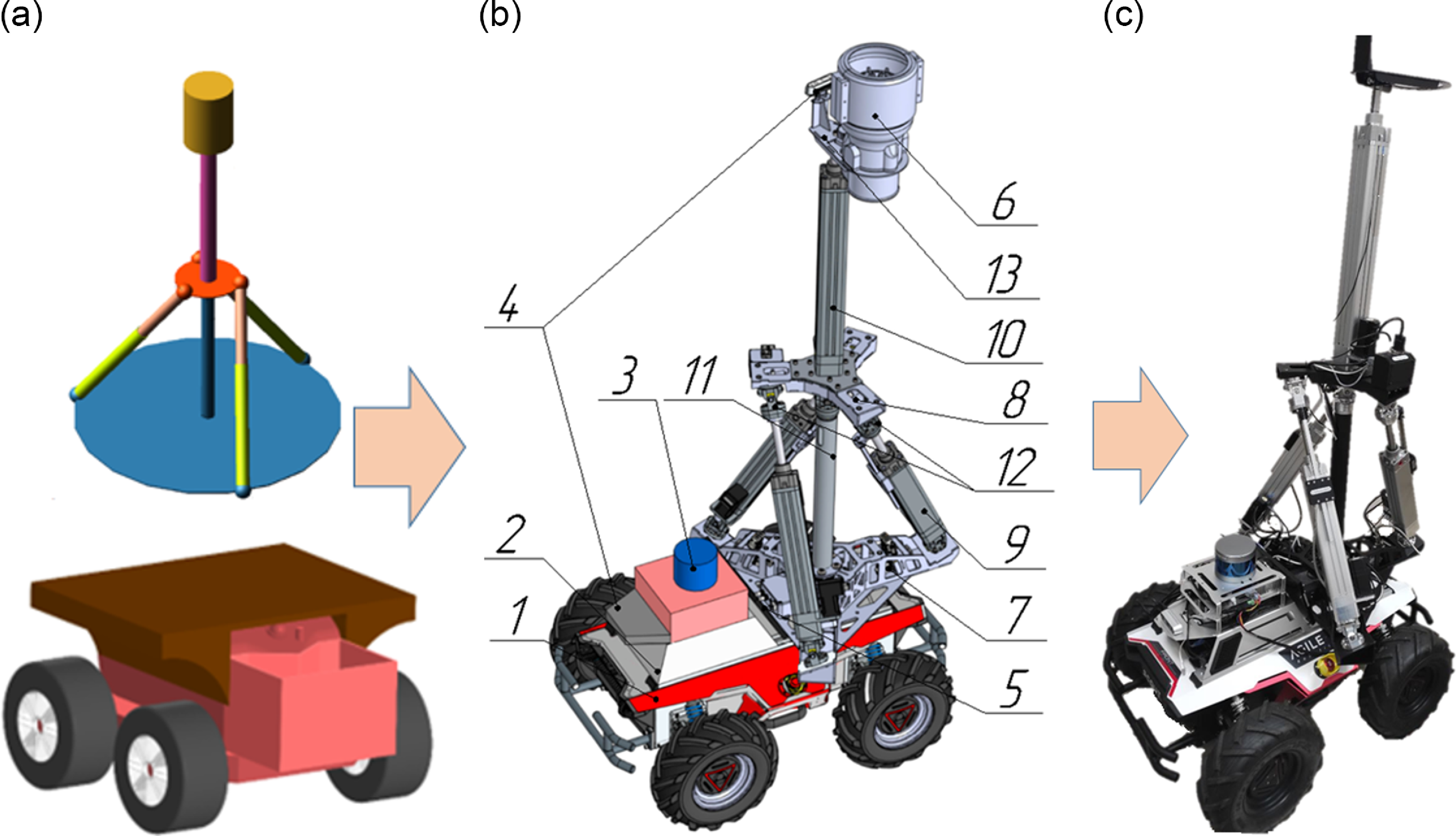
At the previous stages of the study, the authors proposed a new architecture of an autonomous robotic system (RS) for fruit harvesting, the scheme of which is shown in Figure 1a. The system consists of an unmanned ground robot and a grasp with a telescopic link, which are mounted on a robot parallel structure. The selected structure of the robot is characterized by high rigidity and load capacity, which will allow the positioning of the gripper device on a long telescopic link with sufficient accuracy. The height of the entire system reaches 2.2 m. The dimensions of the autonomous chassis are 1000 x 700 x 500 mm with a load capacity of up to 50 kg. The parameters of the parallel structure robot were calculated using multi-criteria optimization methods in previous work [Reference Malyshev, Rybak and Voloshkin18], and simulation modeling under dynamic conditions was also carried out using MSC Adams [19]. Based on the results obtained, an electronic digital robotic system model was built using the NX CAD/CAE design system, which consists of the following subassemblies (Figure 1b): SCOUT 2.0 chassis 1, industrial computer 2, LiDAR 3, RealSense D415 camera 4, HD display 5, gripper 6, lower base 7, upper base 8, electric cylinders 9, telescopic link 10, central stand 11, universal joint 12, flange 13.
Robotic fruit harvesting system: (a) – Device diagram; (b) – Digital twin; (c) – Prototype.

Let’s consider the algorithm of the RS action: the operator, controlling in manual mode, moves the robot along the rows of fruits that need to be harvested. Cross-country ability in difficult terrain is provided by large wheels and a robot suspension system prepared for it. The first movement of the robot takes place with the mapping mode enabled. A map of the area is being built and the robotic system remembers the route of movement. When the map is built, the operator can launch the RS along the built trajectory in offline mode. The robotic system moves along the trajectory until the fruit specified for recognition falls into the camera lens, which is well described in ref. [Reference Xuehui, Li. Haoxin, Chongyang, Tianci, Luxin and Yuanqiang20, Reference Dexiao, Jiayi, Qinghui and Li. Junqiu21]. As soon as the fruit is found, the robot takes a position to collect, after which the robot of a parallel structure with a telescopic link is activated. The manipulator is controlled automatically using the camera installed on it. As soon as the fruit enters the gripper, the drive is turned on and the fruit is separated. The fruit enters the gripper device, from where it enters the fruit container through a flexible pipe (not shown in the diagram). The tank can be installed both on the SCOUT 2.0 chassis and can be a trailer device with its own chassis. In accordance with the electronic digital model of the robotic system, a prototype was built (Figure 1c) without a gripper device and a flexible pipe, the development and construction of which will be considered in this work.
For the selected configuration of the robotic system, based on the literature review, the requirements for the developed gripper device for collecting fruits are formulated:
1. The method of separating the fetus from the plant is simultaneous twisting and tearing.
2. The gripper device must have a cavity for installing a flexible pipe for fast and continuous fruit harvesting.
3. The gripping device must not damage the fruit.
4. The device is aimed at spherical fruits such as apples, kiwis, oranges, etc.
5. The gripping device must be mounted on a mobile robot.
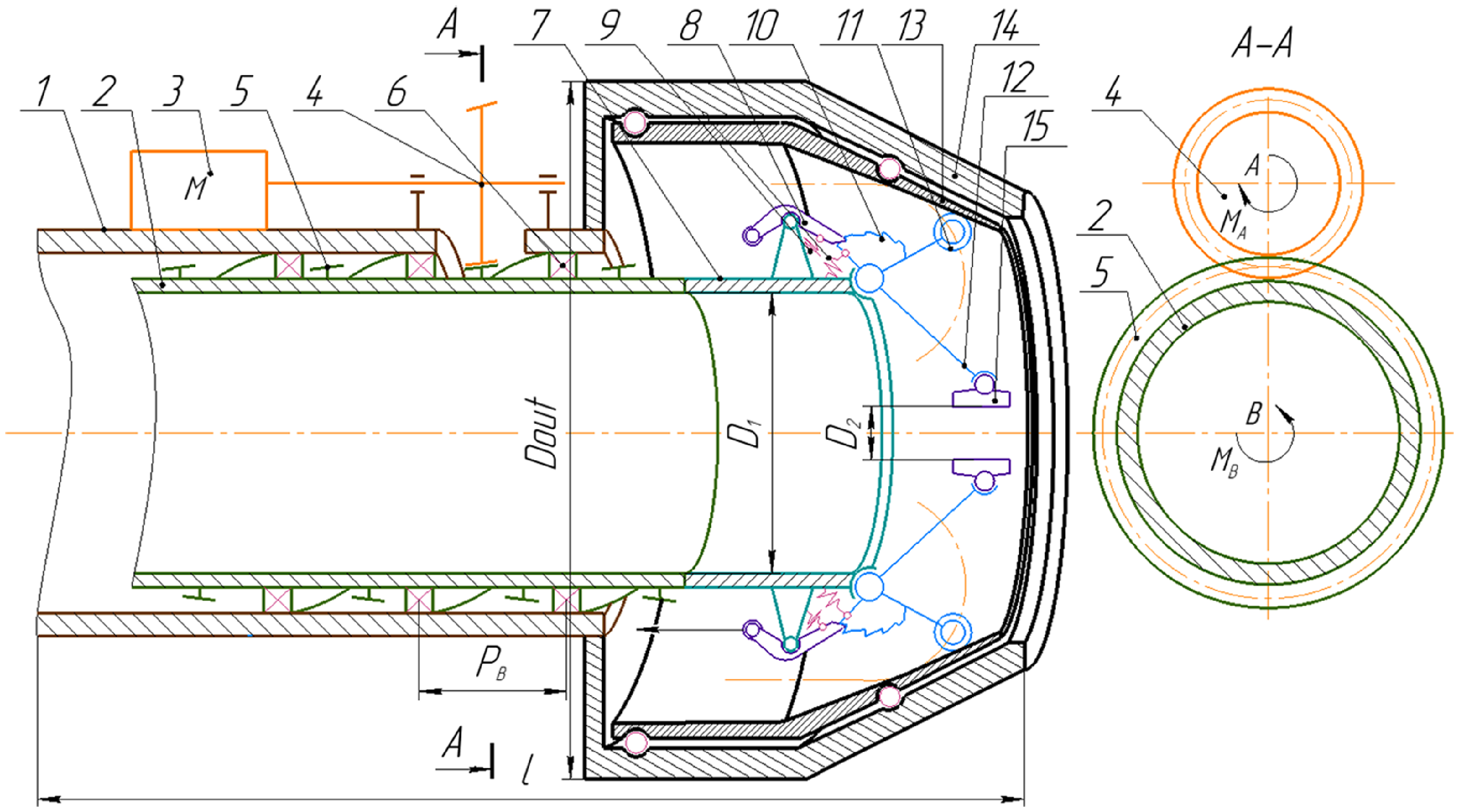
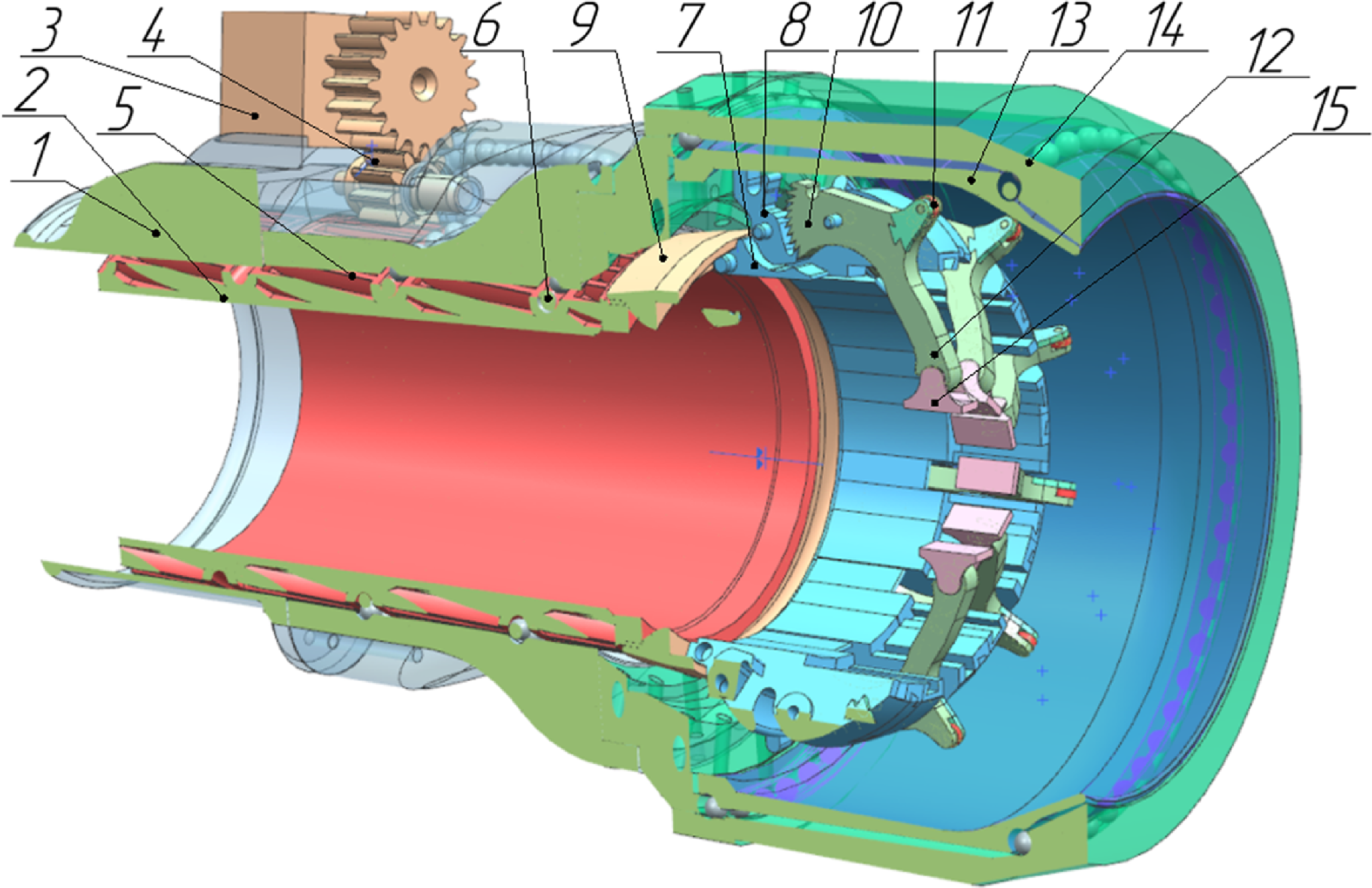
A new design of the gripping device is proposed for gripping without visible damage (Figure 2). The gripping device has advantages such as high velocity of the fruit separation and stacking process. This is achieved by the fact that the grip simultaneously tears off and unscrews the apple. Next, the fruit falls into the inner cavity of the gripper device, while the gripper device is able to grasp the next fruit.
The scheme of the gripper device.

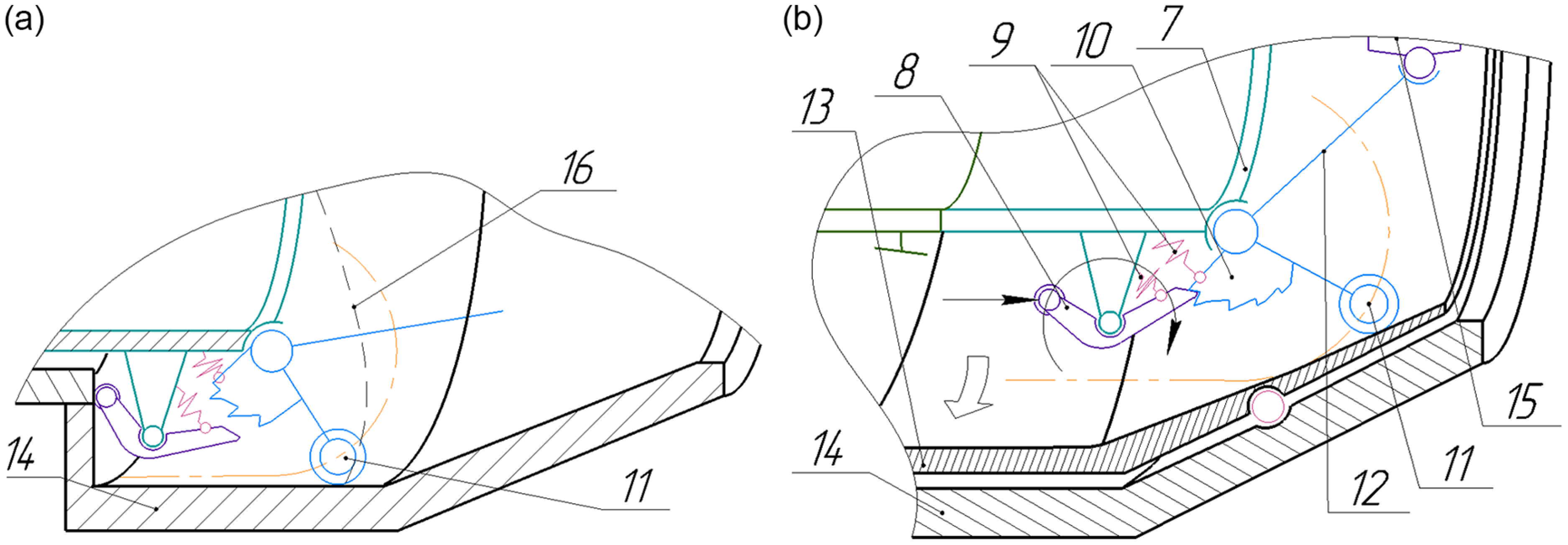
The gripping device consists of an outer pipe 1 and an inner pipe 2, which is screwed into the outer pipe 1. A stepper motor 3 is installed on the outer pipe 1, which rotates the inner pipe 2 by means of a gear transmission 4. The inner tube 2 on the outside has a toothed profile 5, made parallel to the spiral of the ball-screw transmission 6. At the end of the inner tube 2 there is a gripper housing 7, made of 10 segments. Each segment is a rotating pin 12 with a roller 11 fixed on it and a ratchet wheel 10. The counterclockwise rotation of the finger is blocked by a pawl 8, which is pressed against the wheel 10 by a spring 9. The compression of the fingers occurs due to the movement of the roller 11 along the inner surface of the cone holder 13, which rotates inside the cone 14. At the end of each finger, there is a soft sponge 15, which can rotate in a small range. The gripper device for collecting apples works as follows: the manipulator positions the gripper device so that the apple is inside the cone 14. The motor 3 rotates the gear wheel 4 and the inner tube 2 connected to it, which performs a rotational translational movement (unscrews). The fingers 12, supported by the roller 11 on the inner surface of the cone holder 13, are compressed. Unlike the previous work [Reference Voloshkin, Rybak, Malyshev, Carbone and Mohan22] (Figure 3a), where the roller is pressed against the cone 14 and moves along a complex helical trajectory 16, a cone holder 13 is added, which rotates together with the pipe 2, the gripper body 7 and the fingers 12, as a result of which the rollers 11 have a unidirectional trajectory, which significantly reduces the friction force (Figure 3b).
The scheme of operation of the finger of the gripper device: (a) – The scheme of rotation of the finger due to movement on the surface of the cone; the scheme of rotation of the finger due to movement on the surface of the cone holder.

The movement of the roller 11 along the conical surface ensures the closing of the fingers and fixation of the fruit. The fingers are fixed by a ratchet mechanism 8-10. The apple is separated by twisting the inner pipe 2 in the opposite direction into the outer pipe 1. When the initial position is reached, the pawl 8 rests against the housing 14, releasing the ratchet wheel 10, as a result, the fingers 12 unclench. This allows both harvesting in the classic way, by putting individual fruits in a basket, and harvesting fruits continuously through a soft tube.
3. Mathematical model
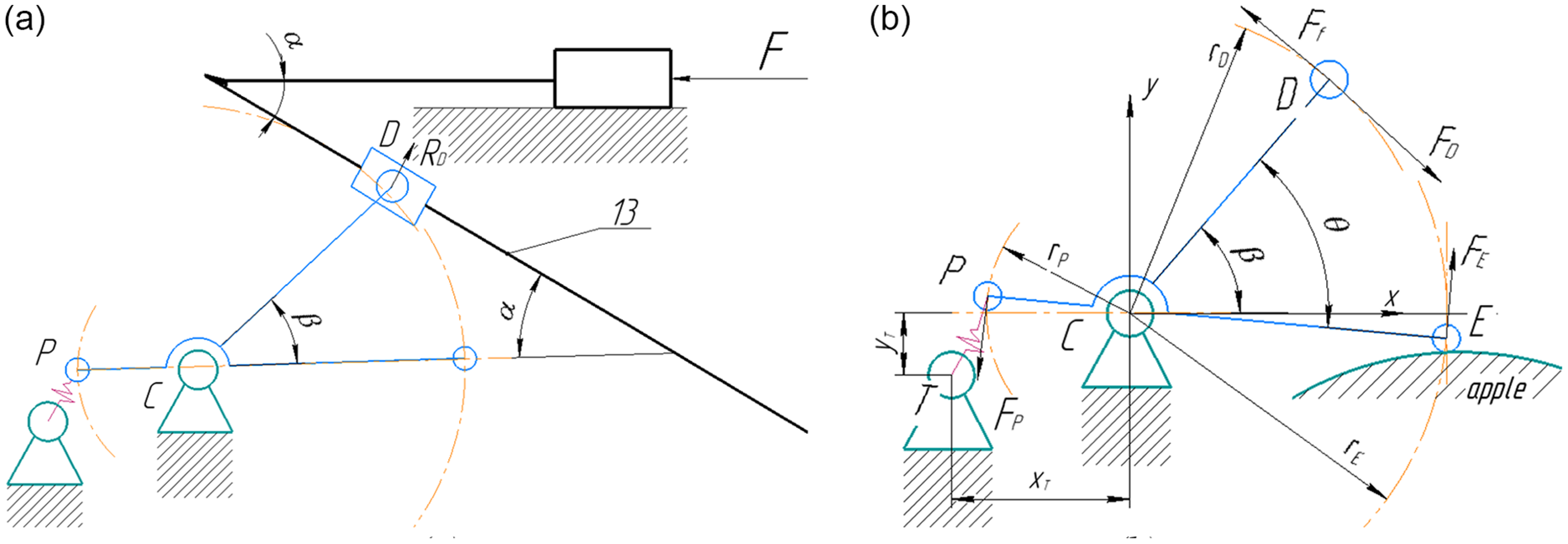
An important design step is to determine the compressive strength of the apple, as well as determine what torque is required for this. To determine these parameters, we will draw up a calculation scheme for the finger of the gripper device (Figure 4a).
Let’s imagine the finger compression mechanism as a planar circuit, where the force F is an external force. The force F is the resultant of the translational motion of the inner tube, which is applied to one finger. The rotation of the finger relative to the joint C is carried out due to the reaction of the conical surface of the cage, which occurs as a result of the action of force on the roller
 $R_{D}$
. Let’s consider a system in static equilibrium, while the spring is not loaded
 \begin{equation*} \sum \vec {F_{i}}=0, \end{equation*}
where
 $R_{D}$
is the reaction of the slider to the force F, which is determined by the formula
 \begin{equation} R_{D}=F\cos \left(90^{\circ}-\alpha -\beta \right), \end{equation}
where
 $\alpha$
is the angle of the cone relative to the axis, and
 $\beta$
is the angle of rotation of the lever.
Then the force
 $F_{D}$
, which turns the finger as a result of the action of force F, is determined by the following formula
 \begin{equation} F_{D}=F\cos \left(90^{\circ}-\alpha -\beta \right)\cdot \cos \left(\alpha +\beta \right)=F_{E}+F_{P}.\end{equation}
The gripper has a large number of fingers, which is why the insignificant friction force in one finger in total exerts a significant load on the engine, which was not taken into account in previous work, resulting in jamming. Let’s determine the friction force on the surface of the cage
 \begin{equation} F_{f}=fR_{D}\end{equation}
where
 $f$
is the coefficient of friction.
Let’s determine the compression force
 $F_{E}$
of the fruit (Figure 4b) by the formula
 \begin{equation} F_{E}=\frac{-F_{D}r_{D}+F_{P}r_{P}+F_{f}r_{D}}{r_{E}}, \end{equation}
where
 $r_{D}, r_{E}, r_{P}$
are the turning radii of the levers, and
 $F_{P}$
is the spring elasticity force of the lever. To begin with, let’s determine the force of the spring itself, given that the force vector of the spring will be directed perpendicular to the axis of the gripper device, then the expression will take the following form
 \begin{equation} F_{P}=-k\cdot \Delta x\cdot \cos \left(\theta -\beta \right)\end{equation}
where k is the coefficient of elasticity,
 $\Delta x$
is the difference between the initial and stretched position of the spring when turning the lever. Taking into account that T is the point of attachment of the spring, and in the joint C is the center of the coordinate system, then
 $F_{P}$
has the form
 \begin{equation} F_{P}=\left(-k\cdot \sqrt{\left(r_{P}\cos \left(\theta -\beta \right)+x_{T}\right)^{2}+\left(r_{P}\sin \left(\theta -\beta \right)-y_{T}\right)^{2}}\right)\cdot \cos \left(\theta -\beta \right)\frac{r_{P}}{r_{E}}\end{equation}
where
 $\theta$
is the angle between the finger and the roller of the gripper, and
 $x_{T}, y_{T}$
are the coordinates of the spring attachment point on the housing.
On the other hand, let’s define the relationship between the force F and the torque of the engine M
 \begin{equation} F=\frac{M2\pi z_{2}\eta }{P_{B}z_{1}n},\end{equation}
Therefore, taking into account the expression (1-7), we define the torque as
 \begin{equation} M=\frac{\frac{F_{E}r_{E}\,+\,F_{P}r_{P}\,+\,F_{f}r_{D}}{r_{D}\cos \left(90^{\circ}-\alpha -\beta \right)\,\cdot\, \cos \left(\alpha +\beta \right)}P_{B}z_{1}n}{2\pi z_{2}\eta },\end{equation}
where
 $\eta$
is the efficiency assumed for a ball-screw transmission equal to 0.88 [Reference Chin-Chung and Ruei-Syuan23]; n is the number of fingers of the gripper device;
 $P_{B}$
is the pitch of the screw surface;
 $z_{1},z_{2}$
are the number of teeth of the pipe 2 and the drive wheel 4, respectively. Taking into account the largest diameter of the apple, we determine the number of teeth
 $z_{1}$
on the surface of the inner tube 2 (Figure 2).
 \begin{equation} z_{1}=\frac{2,2m+D_{1}}{m},\end{equation}
where m is the gear unit, which must be minimized to obtain a smaller size of the gripper device. We accept the module
 $m=4$
, taking into account further manufacturing using 3D printing. Based on expression (8), the resulting value of
 $z_{1}$
will be the minimum for harvesting apples with a diameter of
 $D_{1}$
, thus choosing the nearest larger value of
 $z_{1}$
, taking into account the modulus m based on ISO 1328-1-2017, we get the optimal number of teeth
 $z_{1}=50$
. The highest gear ratio is
 $z_{2}/z_{1}$
in the case when
 $z_{2}$
takes the minimum value, based on the ISO 1328-1-2017 standard gear table,
 $z_{2}=10$
.
The smaller the pitch of the helical surface, the less torque is required; however, with the described arrangement, a gear engagement is located between the coils. When designing the layout of the memory made of plastic, the value
 $P_{B}=0,052$
m was assumed.
Next, we will consider the optimization of the design parameters of the memory, which will be used in the future for design.
4. Multi-criteria optimization of geometric parameters
The described gripper device can be used for any round-shaped fruit, however, due to significant differences in their size, peel, separation method and required separation force, different geometric parameters may be used. In the current work, we will consider the optimization of the parameters of the gripper device for harvesting apples. To determine the design parameters, we use multi-criteria optimization methods. To do this, we will find many solutions with different design parameters of the mechanism under given constraints. We will find from the whole set those that will have the minimum values: the torque M, the outer diameter of the housing
 $D_{out}$
and the length of the inner pipe l.
The optimization problem looks like this.
- Optimization criteria:
1. The torque of the motor tends to a minimum
 $\mathrm{M} \rightarrow min$
, expression (8) and (9) we obtain the dependence of the required torque on the motor shaft on the design parameters of the finger, to ensure the required compression force of the apple;
2. The outer diameter of the housing is
 $D_{out}\rightarrow min$
, which is determined by the following formula:
 \begin{equation} D_{out}=D_{1}+2r_{D}\sin \theta ;\end{equation}
3. The length of the pipe is
 $l\rightarrow min$
, which is determined by the following formula:
 \begin{equation} l=3P_{B}.\end{equation}
- Optimization parameters: the radius of fixing the spring on the finger
 $r_{P}$
, the length of the finger
 $r_{E}$
, the angle of the cone relative to the axis of the gripper
 $\alpha ^{\circ}$
and the stiffness of the spring unclenching the fingers
 $k$
.
- Optimization limitations: the radius of the extreme point of the finger should not exceed the radius of the largest apple
 $D_{1}=120$
mm, while it should be greater than the difference between the larger and smaller apple
 $D_{2}=40$
mm, then
 $\frac{D_{1}-D_{2}}{2}\lt r_{E}\lt \frac{D_{1}}{2}$
. The diameter of the smaller and larger apples is selected based on the varieties growing in the nearest gardens and may vary depending on the area. This inequality will eliminate the options when the fingers close together or in the opposite case, when the fingers do not reach the small diameter apple [Reference Seval24]. The diameters
 $D_{1}$
and
 $D_{2}$
are taken with a margin of 15%, to simplify the positioning of the gripping device. The angle between the finger CE and the lever CD is limited as
 $0\lt \theta \lt 90-\alpha$
; if the condition is not met, the force vector of the rotating roller will be zero, while
 $0^{\circ}\lt \alpha \lt 90^{\circ}$
. In this case, theta is equal to
 $\theta =\sin ^{-1} \frac{0.5\left(D_{1}-D_{2}\right)}{r_{E}}$
. We limit the lengths of the levers by the following inequality
 $0\lt r_{P}\lt r_{D}$
, since only the roller D must touch the surface of the cone, otherwise the mechanism will jam, while the length of the lever
 $r_{D}$
will be equal
 \begin{equation*} r_{D}=\frac{P_{B}}{\cot \alpha \sin \theta } \end{equation*}
The stiffness of the spring can take the values
 $k_{min}\lt k\lt \infty$
, where
 $k_{min}$
is the stiffness of the spring that ensures the rotation of the finger to its initial state. In this work, the value was assumed to be
 $k_{min}=2$
N/m, based on experimental data. The finger is rotated by the angle β, at which
 $0\leq \beta \leq \theta$
.
The choice of the compression force parameter of the fruit
 $F_{E}$
is based on the data given in refs. [Reference Wang, Kang, Zhou, Au, Wang and Chen7, Reference Junhua, Qin, Manoj, Huanyu and Jianfeng25, Reference Joseph, Abhisesh, Manoj, Changki and Q26], which presents studies on the force to separate an apple from a tree for five varieties. It is taken into account that the gripping force at the torque of separation of the apple from the tree branch varied from 2.4 to 57.6 N, according to which the gripping device should provide a gripping force of at least 57.6 N. Also in ref. [Reference Joseph, Abhisesh, Manoj, Changki and Q26], the value of the permissible surface pressure on the apple was obtained equal to 56.97 Pa, which will be used by us for the most effective modeling. Increasing the number of fingers reduces the pressure on a particular area of the apple since the required holding force will be distributed between n fingers. The initial position of the finger is when the PE lever is positioned parallel to the axis of the gripper device, in which the spring is completely relaxed. Then the coordinates of the spring attachment point
 $x_{T}=r_{P};\, y_{T}=0$
.
As optimization algorithms, we use evolutionary algorithms that are widely used to solve similar problems [Reference Steuer27, Reference Simon28]. One of the solutions is the “gamultiobj” module, which is included in the MATLAB software package, which allows using a genetic algorithm to solve the problem of multi-criteria optimization, including for shapes and surfaces, as shown in a number of studies [Reference Shiakolas, Koladiya and Kebrle29–Reference Duong and Cuong32]. The authors previously investigated two modifications of the multi-criteria optimization algorithm, one of which is based on the parallel gray wolf’s algorithm (MO-GWO), and the second on the parallel particle swarm optimization algorithm (MO-PSO) [Reference Rybak, Malyshev and Voloshkin33]. Each of the algorithms has its advantages, but the “gamultiobj” module is not inferior to any of them.
To reduce the number of criteria and thereby build a Pareto set more efficiently, we will perform the convolution of criteria 2 (maximum diameter
 $D_{out}$
) and 3 (maximum length of the device l) into one criterion, which is the volume V occupied by the gripper device.
 \begin{equation*} V=\frac{l\pi D_{out}^{2}}{4}, \end{equation*}
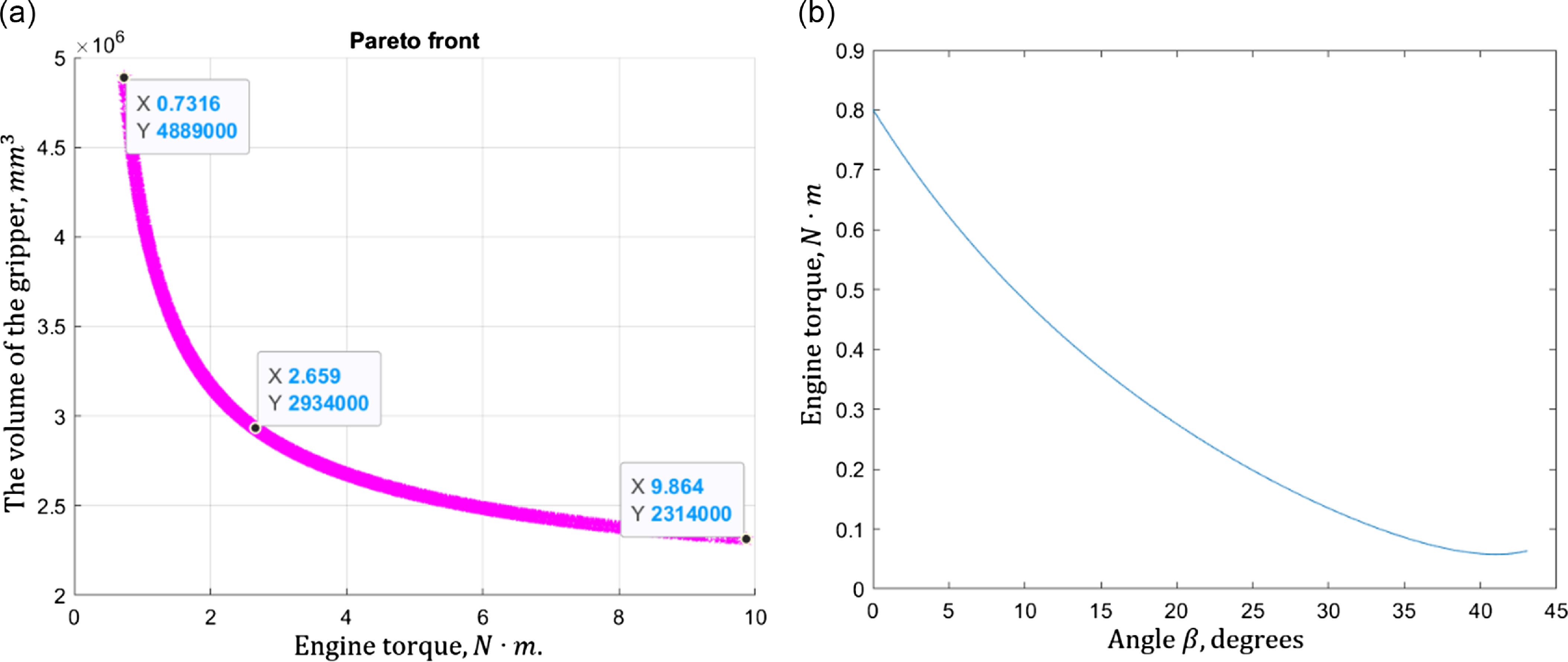
The calculation result is represented as a Pareto set (Figure 5a). The graph shows that the distribution of optimal values has many values both with a large torque and a compact gripping device and with a small torque and large dimensions. From the whole set, a value is selected at which the torque is as low as possible, and the volume remains within reasonable limits for manufacturing. As a result of optimization, the following parameters of the mechanism were obtained: the radius of fixing the spring on the finger
 $r_{P}=0.005$
m, the length of the finger
 $r_{E}=0.0587$
m, the angle of the cone relative to the axis of the gripper
 $\alpha =37.4^{\circ}$
, the spring stiffness
 $k=2.815\cdot 10^{4}.$
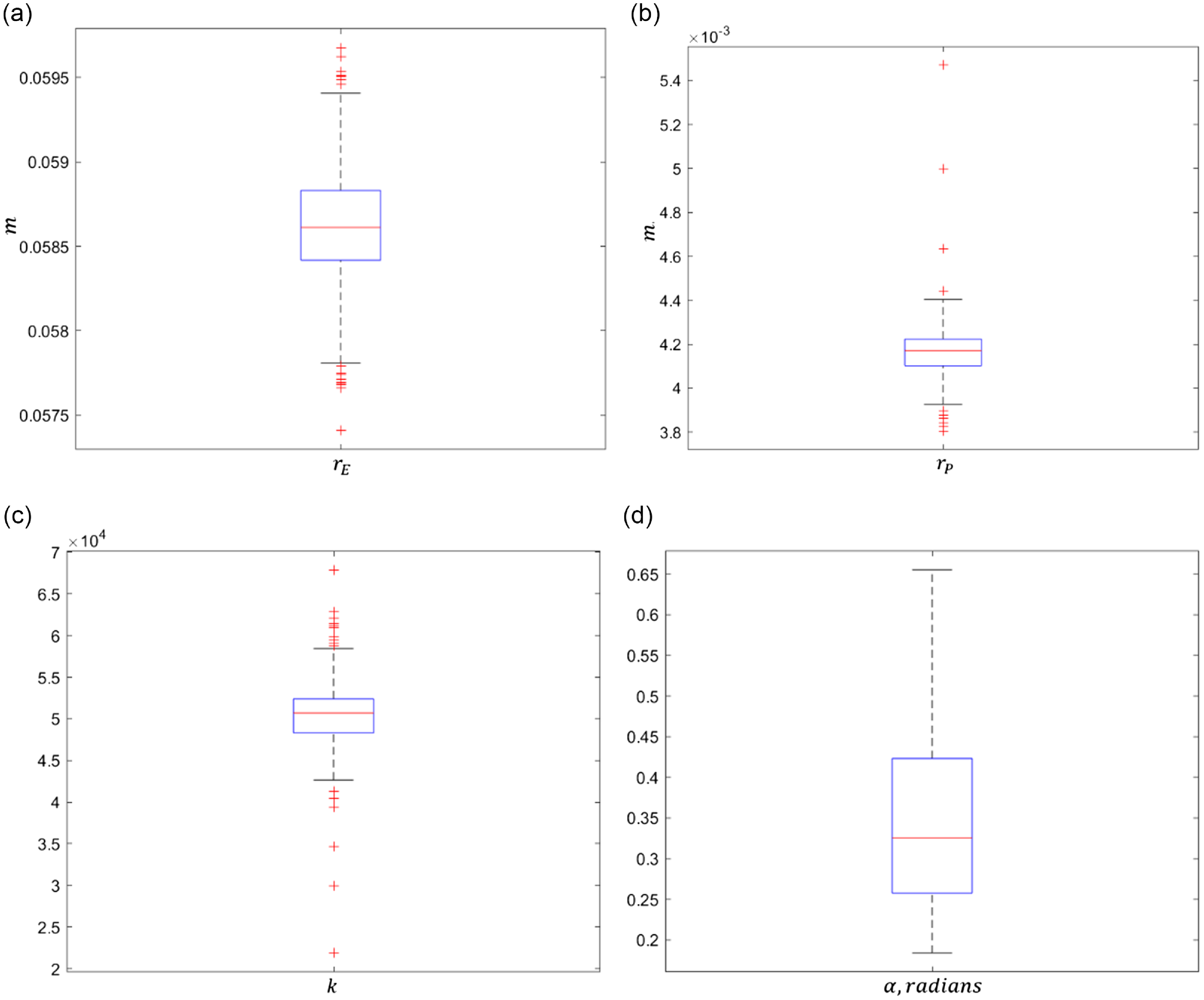
For the selected parameters of the mechanism, the required torque is calculated depending on the compression of the fingers (Figure 5b). Based on the graph, it follows that in the initial position, when the fingers are parallel to the pipe, the torque is significantly higher than when the fingers are compressed. This dependence is not linear and allows you to optimize the design. If we consider that most apples have a diameter of about 80-90 mm, then most often the gripper device will work within the flexion of the fingers from 10 to 30 degrees, with a minimum torque. The maximum required engine torque is 0.73 Nm. The distribution of optimization parameter values is shown in (Figure 6 a, b, c, d). As a result of optimization, some of the selected parameters fall outside the upper and lower quartiles, which indicates a small variability in the desired configuration of the mechanism.
Calculation scheme of the finger: (a) – Diagram of the interaction of the finger and the cone; (b) – Calculation scheme of the finger.

Optimization results: (a) - Is the Pareto set; (b) - Is the graph of the maximum torque of the engine depending on the rotation of the fingers.

Optimization results: (a) - fnger length; (b) - the distance to the spring attachment; (c )- spring stiffness; (d) - cone angle;.

5. Digital design and simulation
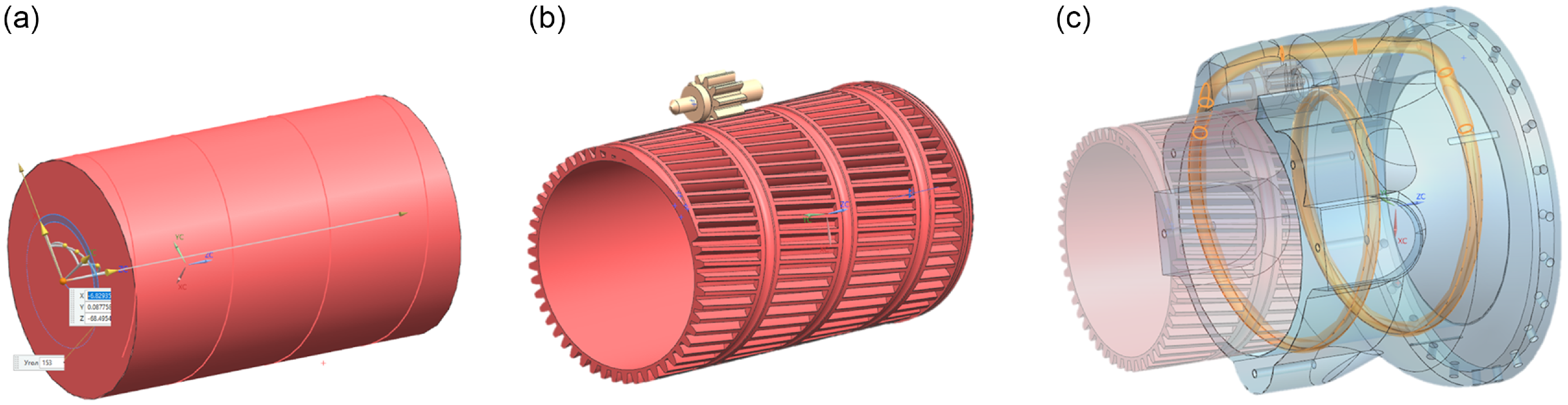
Based on the obtained optimization parameters, using the CAD/CAE NX system, we build a 3D model of the gripper device. The basic element of the construction is the inner tube, which combines a toothed and ball-screw torque transmission. To build it, we will create a cylinder with a diameter of 110 mm and build a helical line on its surface with a given pitch
 $P_{B}$
(Figure 7a). In accordance with the angle of inclination of the helical line, we build a toothed profile and an internal cavity, after which we create a groove along the trajectory of the helical surface. At the end of the inner pipe, add a thread for mounting the housing and build a drive gear, which is located at the same angle as the toothed profile of the pipe (Figure 7b). We build an external pipe, on the inside of which we create a closed helical surface with a step
 $P_{B}$
using a spline (Figure 7c). A closed helical surface is a spiral, the ends of which are connected by an external arc. In order to place the bearings inside during assembly, part of the gutter is detachable and is located on another part of the housing. In this way, it will be possible to assemble a ball-screw transmission, after which fix the bearing hole with another part of the housing.
Construction of the inner tube: a,b,c – stages.

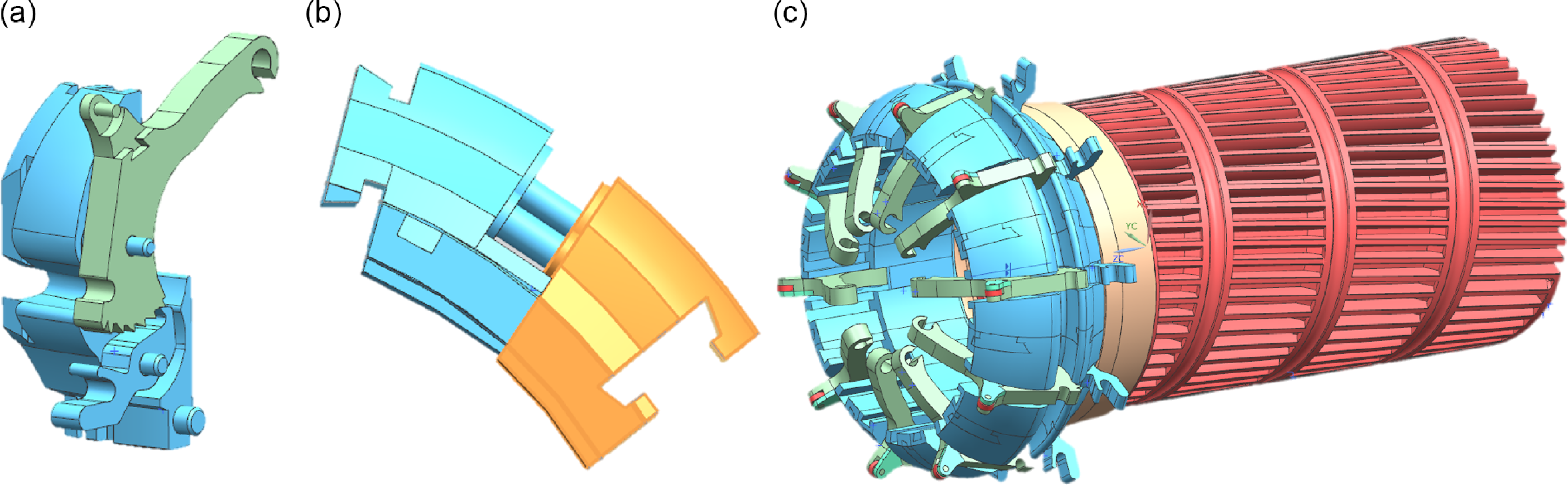
In order to increase the contact area, it was decided to use 10 fingers. Each of the fingers must have a ratchet mechanism so that the fingers are blocked when the pipe is twisted back. To do this, each finger is installed in the housing module (Figure 8a). The housing module consists of two parts, each of which is connected to the previous one like puzzles (Figure 8b). When all the elements are assembled into a common housing, they are connected to the inner pipe by means of a transition ring, which is necessary for reliable fixation (Figure 8c).
Construction of the gripper device: (a) – The finger mechanism; (b) – Two parts of the housing module; (c) – The housing assembly.

Figure 9 shows the final 3D model of the gripper device, which was built in accordance with the geometric parameters obtained during optimization.
The digital counterpart of the gripper device. (1 – outer tube 1; 2 – inner tube; 3 – stepper motor; 4 – gear transmission; 5 – gear profile, 6 – ball-screw transmission; 7 – gripper housing, pawl – 8; 9 – adapter tube; 10 – finger with ratchet wheel; 11 – roller; 12 – bearings; 13 – clip; 14 – cone; 15 – soft sponge).

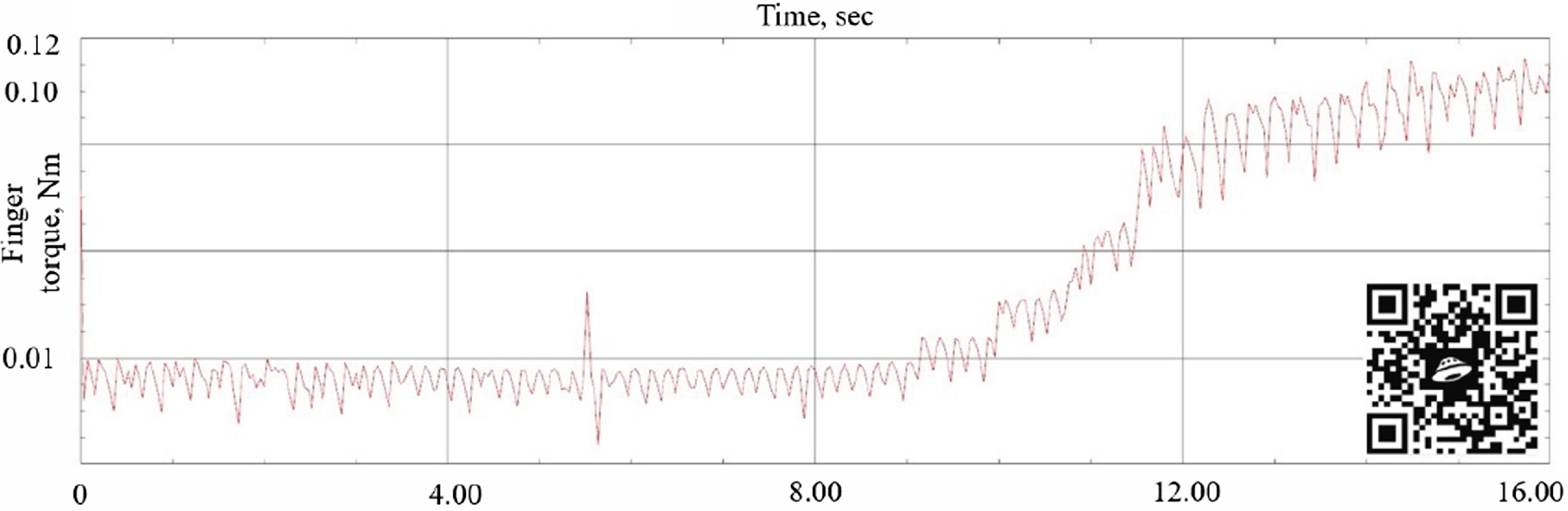
A simulation of the gripper device operation was carried out. The mechanical design of the proposed gripping device, which is used in simulation modeling, is shown in Figure 9. The simulation was developed using the NX CAD system. The coefficient of friction is 0.04. The modulus of elasticity is 2.1 × 10⁵ N/mm2. The material of all elements is assigned ABS plastic. The damping and stiffness of the contact surface are 10 Ns/mm and 10,000 N/mm, respectively. The gripper model has a starting position with the fingers pressed together. At the beginning of the simulation, the fingers unclench, as a result of which the finger rollers touch the surface of the cone. The imitation of the gripping device was carried out only to close the fingers. The duration of the simulation is 16 s. The closing of the fingers as a result of touching the surface of the cone begins from 10 s. The simulation results are shown in the graph (Figure 10). It follows from the graph that the maximum torque when turning one finger was 0.11 Nm at 16 s of movement, with a given engine torque of 0.73 Nm. The length of the fingers is 0.0445 m, which corresponds to a compression force of 2.47 N for one finger and 24.7 N for 10 fingers. The discrepancy between the results and the calculations in MATLAB was 3%, which is due to the action of inertia forces, as can be seen from the graph at the beginning of the movement.
Graph of the dependence of the finger torque on time.

In addition to the fact that the apple would not damage the gripping device, it is important not to damage it during transportation. After the apple is separated from the tree, it falls into a flexible pipe, through which it enters the storage container. In a position where the telescopic link is slightly extended, the flexible tube can have many bends, along which the apple descends smoothly without significantly accelerating. However, with the maximum extension of the telescopic link, the flexible tube straightens and the apple accelerates significantly. The impact force of an overclocked apple can be determined by a well-known formula
 $F_{a}=m^{*}(V_{2}-V_{1})/\Delta \mathrm{t}$
, where
 $V_{1}$
is the velocity at the beginning of the impact,
 $V_{2}$
is the velocity after impact,
 $\Delta \mathrm{t}$
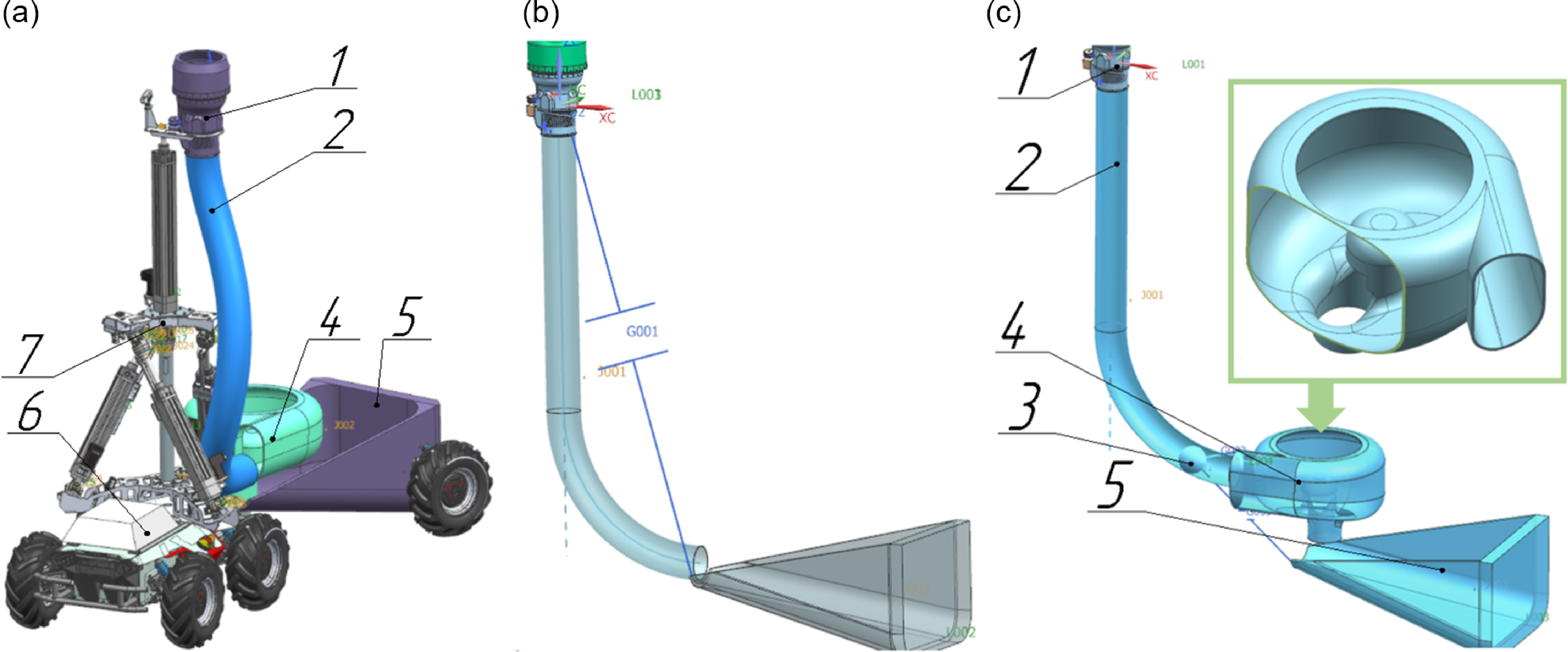
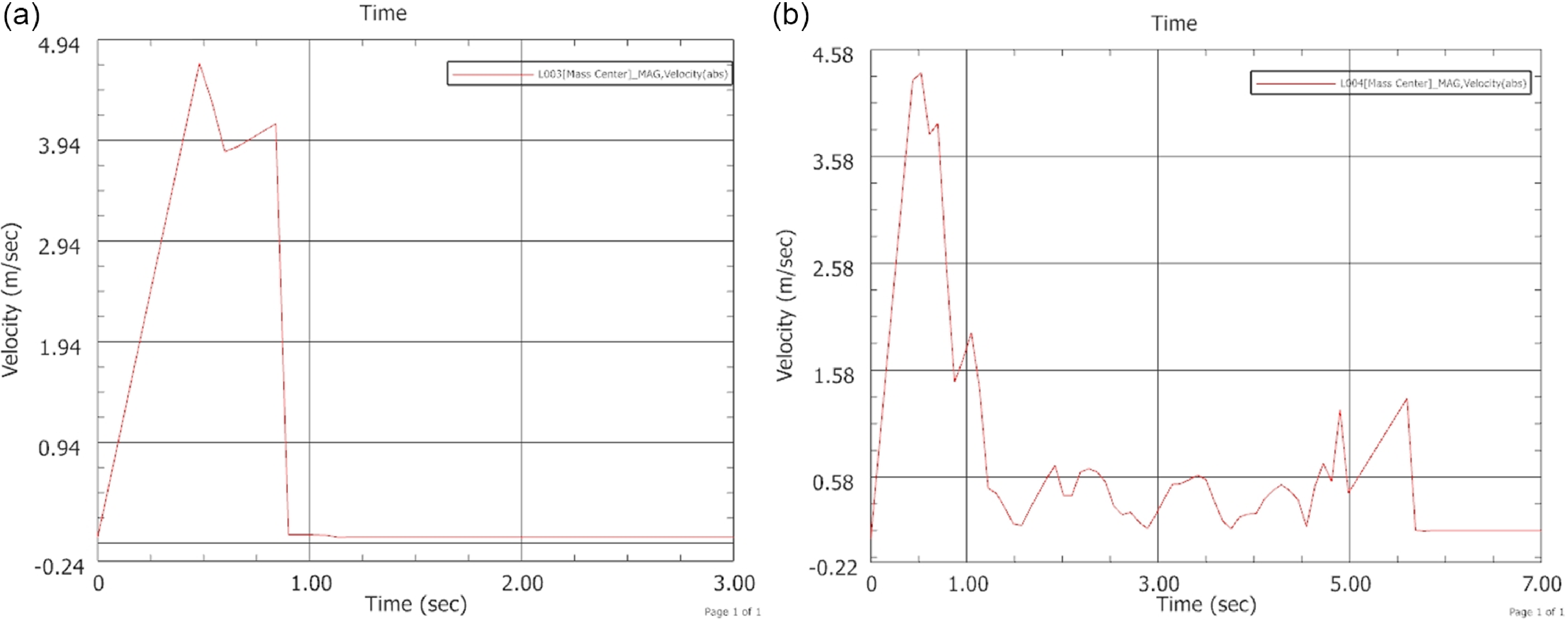
is the contact time in seconds. Note that the height of the telescopic link allows you to collect apples at a height of 2 m, and the fruit basket is mounted on an autonomous chassis with a height of about 0.5 m. Then the velocity of a free-falling apple determines the acceleration of free fall and the mass of the fruit. The contact velocity is a more difficult value to calculate and requires precise determination of the material to be contacted. To do this, it is important to know the amount of a certain substance that diffuses through a unit area in 1 s under the influence of a gradient of one unit. Depending on the ripeness of the apple and the ambient temperature, these values may vary. The simplest solution would be to experimentally estimate the contact time by using a high-speed camera. To do this, we throw the apple on the surface of the fruit basket and measure the time from contact to the rebound of the apple. The experimental values obtained are approximate to reality, however, it allowed us to obtain an average contact time value of about 0.05 s. The velocity of the apple after impact is assumed to be zero. At a velocity of 15 m /s, an apple weighing 240 g hits another apple lying in a basket with a force of about 70 N, which significantly exceeds the permissible surface pressure on the apple even with a significant contact area. This value can vary within different limits, as the condition of the impact itself will change; however, in most cases, the apple will be damaged. The force of the impact can be significantly reduced if the velocity is reduced or a direct impact is avoided. To do this, at the outlet of the pipe, we will build a surface of complex shape, which tangentially to the trajectory of the fruit will increase the contact time upon impact. To do this, at the outlet of the pipe, we will build a surface of complex shape, which will tangentially cause a hard impact and maintain the velocity V2. At the place where the apple stops, we will make a hole through which the apple will fall into the basket. The general view of the system is shown in (Figure 11a). To test the theory, a simulation of two cases of apple harvesting was performed, in which the apple 3 falls from a maximum height without resistance into a pipe 2 with a rectilinear section for acceleration. In the first case, the apple immediately enters the alleged fruit container 5 from the pipe (Figure 11b). In the second case, a snail device 4 is installed after the pipe, after which the apple enters the fruit container 5 (Figure 11c). The simulation did not consider aerodynamic resistance, but it did account for Coulomb friction between the contacting surfaces and the effects of gravitational acceleration. The results of the calculations are presented in Figures 12a and 12b.
Simulation: (a) – General view of the system; (b) – Apple falling through a pipe into a fruit collecting container; (c) - Apple falling through a pipe into a fruit collecting container through a “snail”, (1 – gripper, 2 – flexible pipe, 3 – fruit, 4 – “snail”, 5 – fruit container, 6 – autonomous mobile robot, 7 – parallel robot).

Simulation results. (a) Is a graph of the velocity of an apple falling through a pipe; (b) Is a graph of the velocity of an apple falling through a pipe and a “snail”.

In the first case of the simulation, the apple got into the fruit collection container at a velocity of 3.94 m/sec, in the second case, where the “snail” is installed, the apple got into the fruit collection container at a velocity of 1.01 m/sec., while the velocity of the apple at the exit of the “snail” was 0.2 m/sec. At such velocity, the snail will reduce the impact of the apple to values from 0.45 N to 4.5 N, which is significantly lower than the permissible surface pressure on the peel.
A significant role is played by the friction force, which ultimately allows the apple to stop. To enhance the friction effect, it is possible to make the snail soft, this will increase the contact spot, which will significantly reduce the stopping time. For the proper operation of such a system, it is important that the flexible tube is supplied in such a way that the apple does not hit the walls of the snail, but rolls relative to the surface.
6. Production and testing of an experimental sample
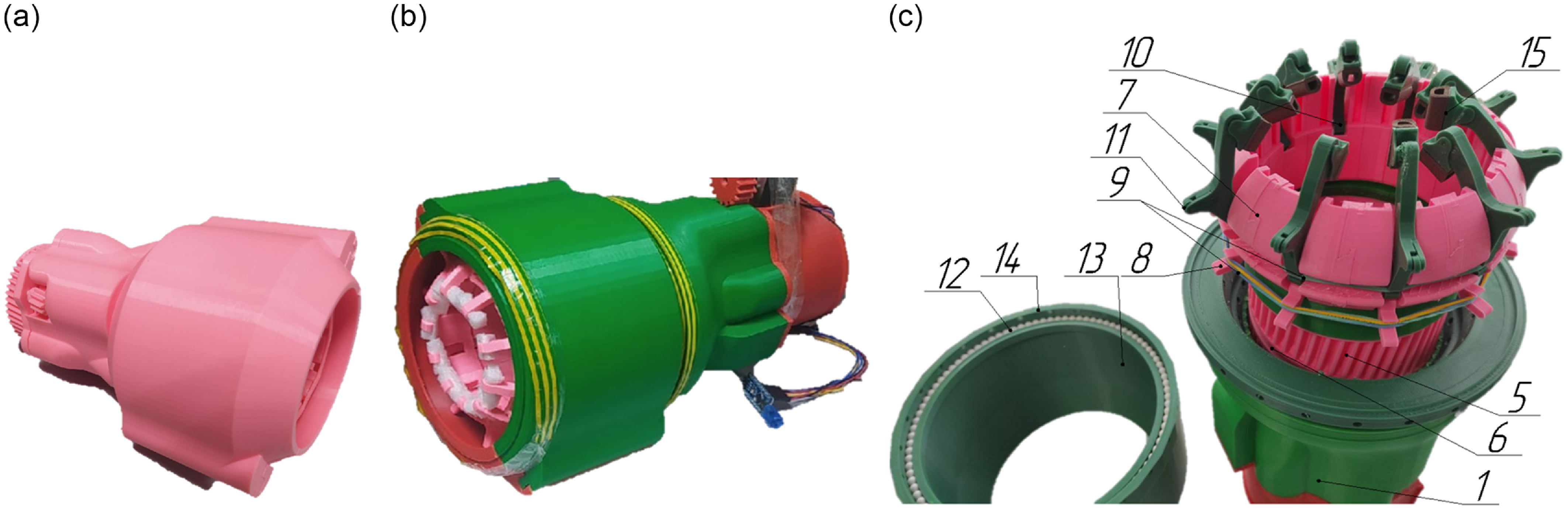
The details of the design of the gripper device were developed taking into account the manufacture using additive technologies. An STL model has been created for each of the parts, which is divided into layers for 3D printing using PolygonX software. Initially, a 1-scale gripper layout was developed:2. Disadvantages were identified on the 1:2 layouts: a casing is needed for the smooth movement of the inner pipe since jamming occurs as a result of small objects falling between the body and the inner pipe; The cone on the body is too narrow and does not allow the fingers to grab objects that did not get inside (Figure 13a). Taking into account the identified shortcomings, the first prototype was manufactured, which at the time of testing did not have an internal cage and had increased friction. At the same time, it was possible to test and prove the operability of this mechanism (Figure 13b). Taking into account the tests carried out, a third sample was made with an inner clip and rollers on the fingers (Figure 13c). Balls for bearings with a diameter of 6 mm were perfectly suited by Airsoft.
Prototypes of the gripper device; (a) – 1 : 2 layout; (b) – An prototype without a clip; (c) - An prototype with a clip (1 – outer tube; 2 – inner tube; 5 – toothed profile, 6 – ball-screw transmission; 7 - gripper housing; 8 – pawl; 9 – springs; 10 – finger with ratchet wheel; 11 – roller; 12 – bearings; 13 – clip; 14 – cone; 15 – soft sponge.).

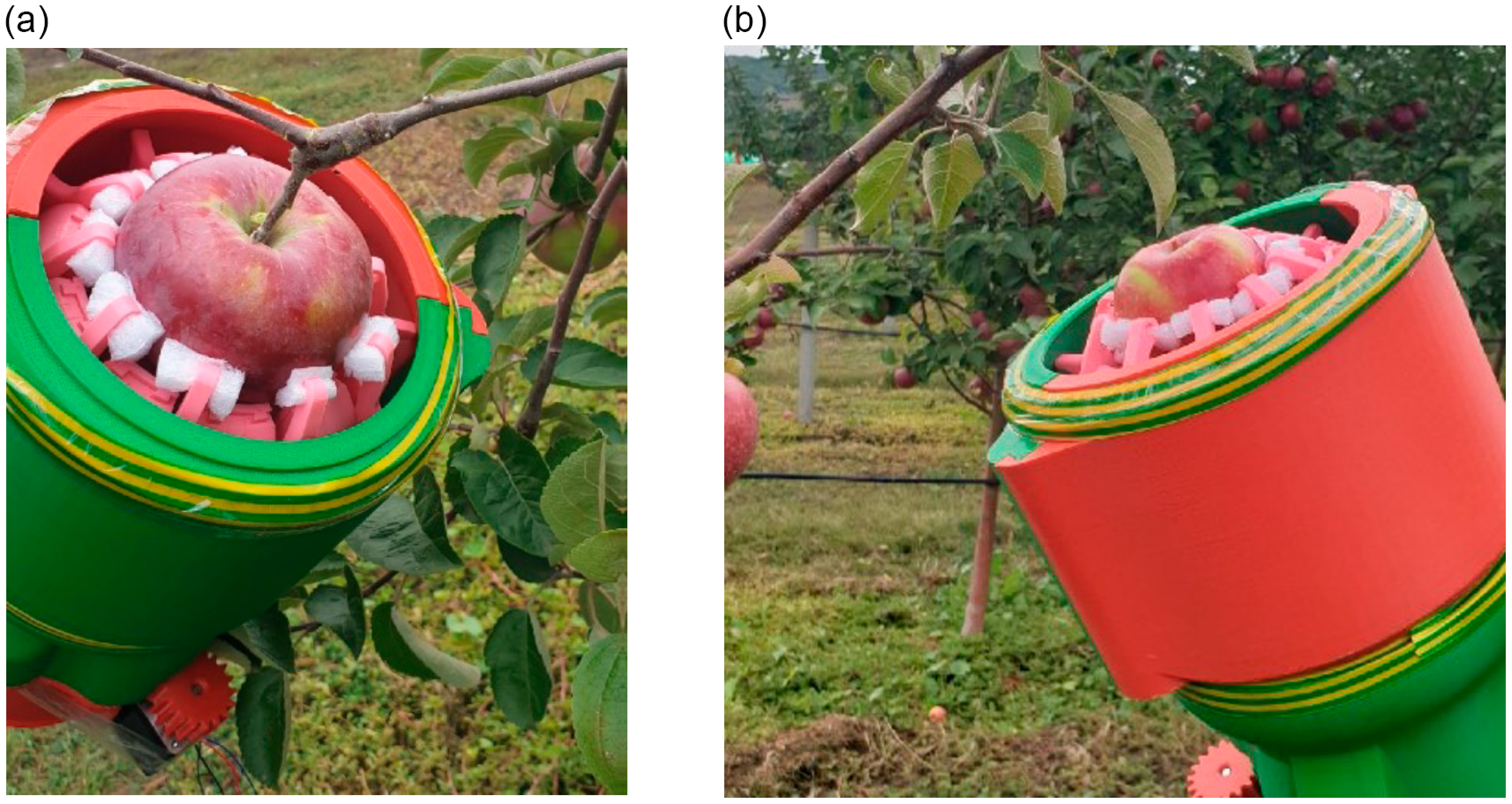
Tests were carried out in one of the nearest industrial gardens. The purpose of the test: to determine whether the grasp of sufficient force will occur to further separate the apple from the tree; whether the apple will be damaged; to check how the fruit behaves when separating from the tree when the grasp is located below the apple and above the apple; in which cases the grasp is not able to grasp. Apples of the largest and smallest diameters were selected for the experiment. Figure 14a, b shows the process of capturing an apple. The positioning of the gripper was performed manually, and the tearing process was performed automatically. Plastic fingers damage the apple with sharp edges, so soft sponges have been added. The material of the soft sponges must meet the requirements of the food industry. In this case, the apple is grasped by the middle of the fruit, if the middle has not been reached by positioning, the grasp does not occur and the apple slips out. This disadvantage can be attributed to a management problem. The separation of the fruit stem as a result of unscrewing occurs, however, there were also cases in which the fruit stem did not separate. The load when separating the apple at the time when the apple was already ripe turned out to be significantly lower than the estimated 24 N. When positioned from below, the apple gets inside the gripper device without visible difficulties, in cases of jamming, the apple falls into the cavity of the gripper device until the fingers are unclenched.
Grabbing an apple from below, (a) - Biggest diameter, (b) - Smallest diameter.

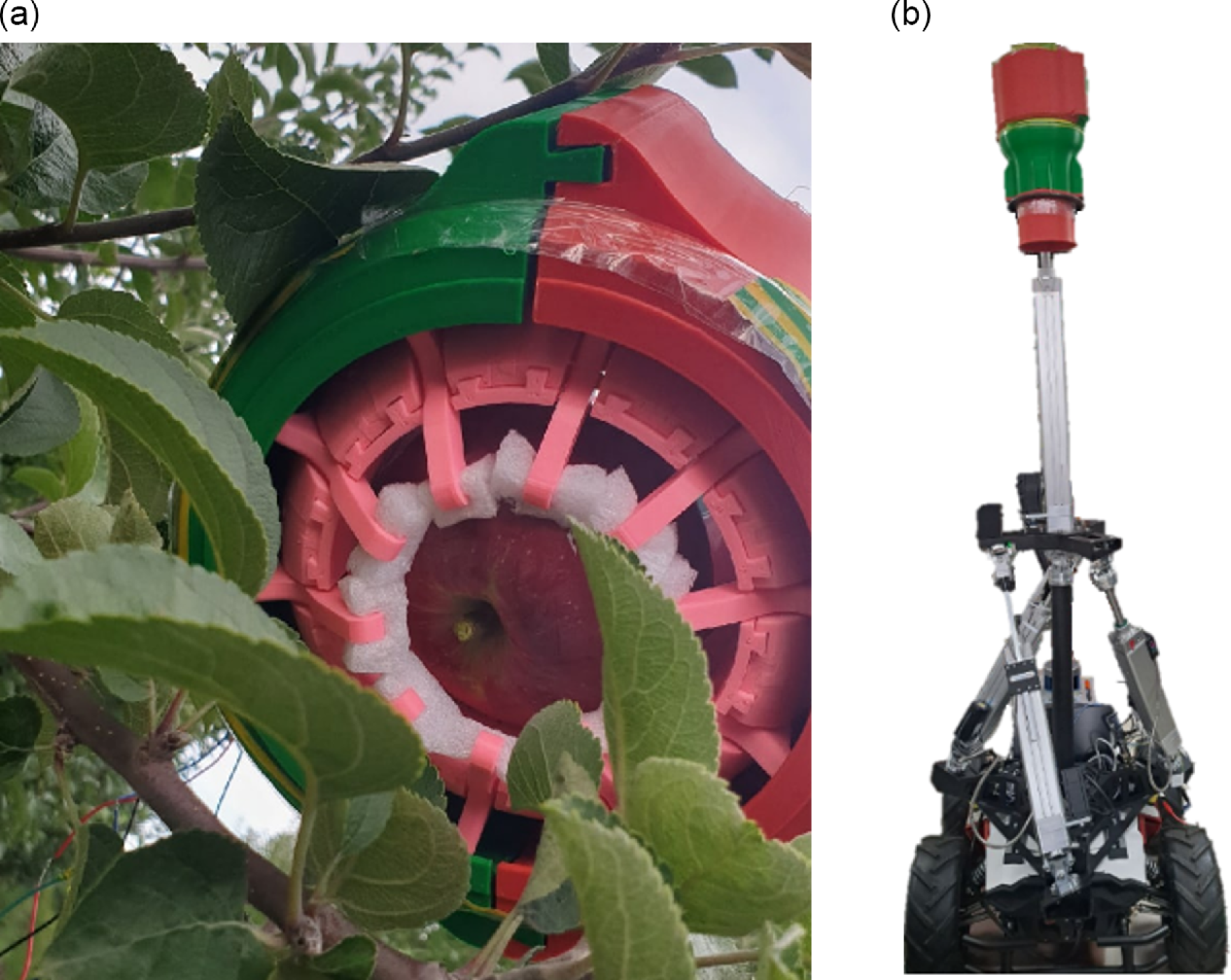
Figure 15a shows the apple harvesting, in the case when the gripper is positioned from above. The apple is harvested by jamming. In this case, the failure of the fetus into the grasp cavity does not occur. You have to lift the grip up, after which your fingers unclench and the apple falls into the cavity of the gripper device. At the same time, the time spent on laying the fruit is longer than with the described tipping of the gripper. This method of fruit harvesting was used as a test and is unsuitable for the chosen design of the robotic system, but can be useful in other configurations.
a) - Harvesting an apple from above, (b) - The position of the robotic system during harvesting from below.

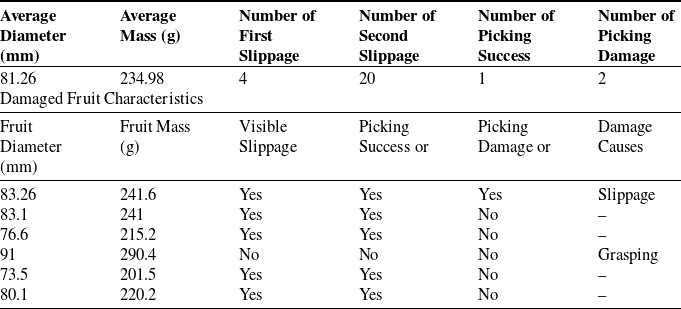
A comparative grip test was conducted to verify the effectiveness of a safe grip. Similar to the experiment described in ref. [Reference Chen, Li. Tao, Xie, Qingchun, Zhu and Zhao8], a total of 25 apple samples were selected in this experiment without visible damage, while the contact points were marked with a marker. The harvested apples were stored indoors at the same temperature for 7 days. It was analyzed how many fruits remained intact, how many were subjected to slippage during grasp and whether they were damaged at the same time. The data is listed in Table I.
Harvesting with a gripper.

After a seven-day wait, it was revealed that 5 apples were damaged. At the same time, one of them, with a diameter of 91 mm, had obvious damage. In a gripper with 10 fingers, slipping occurs only outside or inside the device. In this case, slipping inside is considered a positive result. When the jaws of the gripper device slipped out, one apple was damaged. Compared to the soft-finger gripper, the developed gripper shows a 12% higher number of damaged apples, but the collection rate is much higher. In order for the soft sponges not to damage the fruit when sliding off, a hinge joint was added, which rotates when the soft sponges slip off. This allows you to save the apple from the hard part of the fingers.
7. Conclusions
The developed gripper device is a good alternative to well-known devices. The ability to collect apples without spending time putting them in a basket makes a gripper device with a gear-screw surface drive promising. Separating an apple from a fruit stem by rotation and translational movement is inferior in efficiency only to cutting, which is not always possible to implement. The design parameters were calculated using multi-criteria optimization, as a result of which the preferred design parameters of the mechanism elements were determined in the form of a Pareto set. The pressure value on the apple
 $F_{E}=2.45$
N. Was selected. The engine torque was obtained equal to 0.73 Nm, as well as design parameters for this value: the radius of fastening the spring on the finger
 $r_{P}=0.005$
m, the length of the finger
 $r_{E}=0.0587$
m, the angle of the cone relative to the axis of the gripper
 $=37.4^{\circ}$
, the spring stiffness
 $k=2.815\cdot 10^{4}$
. A digital model of the gripper device was built using the NX CAD system. A simulation of the gripping device was carried out, in the first case, an imitation of finger compression at low velocity was performed, as a result of which a finger rotation torque of 0.11 Nm was obtained at a given engine torque of 0.734 Nm, which amounted to a discrepancy of the analytical calculation results of no more than 3%. In the second case, an imitation of an apple falling through a pipe into a fruit container occurred, the velocity of which was 3.94 m/sec. To reduce the velocity at the outlet of the pipe, a “snail” was installed, which allowed the velocity to be reduced to 0.2 m/sec at the peak, which is a safe indicator for an apple to fall.
The mathematical model includes parameters such as the force of pressure on the fruit, the largest and smallest diameters of the fruit, the required number of fingers and the speed of tearing-unscrewing the fruit from the tree. By changing the listed parameters, it is possible to adapt the gripper device to any fruit of a suitable geometric shape.
As a result, a mockup of a gripper device made of PLA and ABS plastic was built. Laboratory tests of the gripper have been carried out, the results of which confirm the operability of the gripper, but shortcomings have also been identified. So for smooth operation of the gripper device, it is necessary to achieve a smooth cone surface and high-quality engagement of the ratchet mechanism, which is not so easy to do when printing on a 3D printer. It was possible to eliminate these shortcomings by upgrading the cone, in which a rotating cage on bearings was installed. The paper considers a new design of a robotic system for harvesting fruits and a new gripping device for this system. It was possible to prove the operability of the proposed system, but there are still a number of problems that prevent it from showing high efficiency.
Author contributions
Conceptualization, L.R. and G.C.; methodology, S.M and A.V.; software, D.M.; validation, L.R. and G.C.; formal analysis, D.M.; investigation, A.V.; resources, E.G.; data curation, A.V.; writing – original draft preparation, A.V.; writing – review and editing, G.C. and L.R.; visualization, D.M.; supervision, L.R. and G.C.; project administration, G.C.; funding acquisition, L.R. and G.C. All authors have read and agreed to the published version of the manuscript
Financial support
Research funded by grant of the Russian Science Foundation No. 22-19-20153, https://rscf.ru/project/22-19-20153/ and the Government of the Belgorod Region, Agreement No. 4.
Competing interests
The authors declare no Competing interests exist.
Ethical approval
None.