Introduction
It has long been recognized that knowing the body mass of an animal can afford a wealth of information about its biology based on many noted correlations between body mass and physiological and ecological variables (e.g., Peters Reference Peters1983; Makarieva et al. Reference Makarieva, Gorshkov and Li2005). Consequently, more than a century of effort has focused on estimating the body masses of fossil taxa in hopes that they too can be interpreted within a biological context (Gregory Reference Gregory1905). Owing to the large sizes nonavian dinosaurs attained, estimation of their body masses has received a great deal of attention and a number of approaches have been attempted. These include the traditional building of physical scale models (Colbert Reference Colbert1962; Alexander Reference Alexander1985; Christiansen Reference Christiansen1998), extant-based scaling equations (Anderson et al. Reference Anderson, Hall-Martin and Russell1985; Campione and Evans Reference Campione and Evans2012; Campione et al. Reference Campione, Evans, Brown and Carrano2014), and three-dimensional virtual reconstructions (Henderson Reference Henderson1999; Hutchinson et al. Reference Hutchinson, Bates, Molnar, Allen and Makovicky2011; Sellers et al. Reference Sellers, Hepworth-Bell, Falkingham, Bates, Brassey, Egerton and Manning2012). In one study, Campione and Evans (Reference Campione and Evans2012) advocated the use of an equation based on the log-linear relationship between the combined circumferences of the humerus and femur and body mass in extant quadrupeds (originally proposed by Anderson et al. Reference Anderson, Hall-Martin and Russell1985). Following multiple statistical tests of this relationship, the authors were unable to recover differential scaling patterns among extant forms from different phylogenetic histories, gaits, and limb postures, suggesting that the circumference–body mass relationship could be extended to generate expected body-mass ranges for extinct quadrupeds, including nonavian dinosaurs. However, recent studies have reported lower body-mass estimates for some of the largest extinct forms, the sauropods (Sellers et al. Reference Sellers, Hepworth-Bell, Falkingham, Bates, Brassey, Egerton and Manning2012; Bates et al. Reference Bates, Falkingham, Macaulay, Brassey and Maidment2015). Although many of these body-mass estimates occur within the 95% prediction errors of the linear equation (Bates et al. Reference Bates, Falkingham, Macaulay, Brassey and Maidment2015), these lower estimates suggest that extrapolation of the linear relationship may lead to overestimation and imply that the relationship between the combined stylopodial circumferences and body mass is log-quadratic, rather than log-linear. Campione and Evans (Reference Campione and Evans2012) attempted to address such a possibility by testing for differential scaling patterns between larger and smaller taxa at various thresholds (i.e., 20, 50, and 100 kg), but they did not test whether a quadratic (or second-degree polynomial) model fits the log10 data better.
The first part of this study will explicitly test whether a quadratic model outperforms the previously published linear model through a series of model-fitting exercises. The second part will attempt to assess some of the concerns associated with extrapolation. Extrapolation will forever plague paleontologists interested in estimating body mass and any number of anatomical and biological characteristics (e.g., organ size [Franz et al. Reference Franz, Hummel, Kiensle, Kölle, Gunga and Clauss2009], metabolism [Pontzer et al. Reference Pontzer, Allen and Hutchinson2009]) of extinct animals that fall outside the size range of modern forms. However, I show here that, given the right data set, a sequential subsetting approach can be used to visualize the capacity of a model to extrapolate. This approach is applied here to both linear and quadratic models.
Materials and Methods
The data set used in this study is from Campione and Evans (Reference Campione and Evans2012). It includes a sample of 255 quadrupedal tetrapod species. The body masses, which range from approximately 50 g to 6500 kg, were collected from each individual specimen, prior to either death or skeletonization. Measurements were taken directly from the limbs. Only circumference measurements of the humerus and femur are used here; these were taken at the thinnest part of the diaphysis and to the nearest tenth of a millimeter with identical measuring tapes that were cut to various sizes depending on the size of the animal. If possible, both left and right sides were measured and averaged. The phylogenetic tree used to test for phylogenetic effects was compiled from a series of phylogenetic studies of mammals and reptiles (see Campione and Evans Reference Campione and Evans2012, and references therein) and is provided in the Supplementary Material. Following Campione and Evans (Reference Campione and Evans2012), both the amphibian and talpid (moles: Condylura cristata, Parascalops breweri) parts of the data set were removed prior to model fitting and subsetting exercises, resulting in a final sample size of 245. All measurements were log10 transformed prior to all analyses.
Model Fitting
Linear and quadratic models were fit, using both ordinary least squares and phylogenetic generalized least squares, onto the log10 combined stylopodial circumferences–body mass data set. The nonlinear nature of the data, if present, is established by a statistically significant second-degree coefficient. Beyond that, models were compared using coefficients of determination (R 2), mean percent prediction errors (PPEs), standard errors of the estimate, and, to a greater degree, Akaike information criteria for limited sample sizes (AICc) and associated Akaike weights.
Subsetting
Sensitivity to extrapolation was tested through a series of subsetting exercises in which predictor and predicted data sets were sequentially generated at various body-mass thresholds (determined by orders of magnitude). In this manner, a predictor set with body masses under a predetermined magnitude is used to estimate the masses of the predicted set above said magnitude. Accuracy is then measured using mean PPE. The thresholds range from three to six orders of magnitude at 0.01 intervals. In order to test extrapolation far beyond the predictor set, a second subsetting analysis was carried out in which the predictor set was used to estimate the masses of a predicted set with masses one or more orders of magnitude above the upper limit of the predictor set.
All analyses and graphics were carried out/generated in R, Version 3.2.2 (R Development Core Team 2015) with functions from xlsx 0.5.7, MASSTIMATE 1.2, qpcR 1.4-0, ape 3.3, Geiger 2.0.6, and nlme 3.1-122 (Paradis Reference Paradis2012; Adrian Reference Adrian2014; Andrej-Nikolai Reference Andrej-Nikolai2014; Campione et al. Reference Campione, Evans, Brown and Carrano2014; Pennell et al. Reference Pennell, Eastman, Slater, Brown, Uyeda, FitzJohn, Alfaro and Harmon2014; Pinheiro et al. Reference Pinheiro, Bates, DebRoy, Sarkar and Core Team2015). Quadratic equations for quadrupeds and bipeds are integrated into the MASSTIMATE 1.3 QE and cQE functions, respectively, using the argument ‘quadratic=’ (see Supplementary Material for full R script).
Results
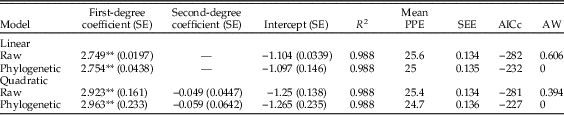
The addition of a second degree did not result in a statistically better fit to the circumference–body mass relationship presented by Campione and Evans (Reference Campione and Evans2012). As the second degree was not significant, the quadratic relationship can be considered statistically linear. It is, therefore, not surprising that both linear and quadratic models share virtually identical statistics (Table 1), with slightly better support for the linear model based on AICc. Whether linear or quadratic, a nonphylogenetic treatment of the analysis provides a much stronger fit than a phylogenetic generalized least-squares treatment, supporting the former’s use (Benson et al. Reference Benson, Campione, Carrano, Mannion, Sullivan, Upchurch and Evans2014).
Summary of results for the linear and quadratic models. SE, standard error; PPE, percent prediction error; SEE, standard error of the estimate; AICc, Akaike information criterion for limited sample size; AW, Akaike weight. *p<0.05; **p<0.01.

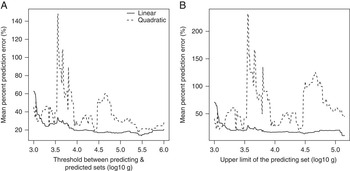
By subsetting the data set of Campione and Evans (Reference Campione and Evans2012), I tested the sensitivity of a predictor set to estimate beyond its range. This approach reveals, as expected, that the greater the range of the predictor set, the greater its ability to extrapolate (Fig. 1). However, results also show that a quadratic relationship is affected substantially by nuances in the predictor set, leading to unpredictable outcomes when extrapolating and high levels of error. Such is not the case when using a linear approach, which follows a more predictable pattern of decreasing mean PPE as the range of the predictor set is increased. Errors are higher when the predictor set is extrapolated to predict masses that are at least an order of magnitude above the predictors (Fig. 1B). These errors are very pronounced when using a quadratic approach, with certain mean PPEs exceeding 200%. Such error levels are never observed when using a linear approach. The linear approach, in both subsetting exercises, generated similar prediction errors when extrapolated.
Extrapolation potential of the linear and quadratic models. Values along the x-axis define the log10 body-mass upper limit of the predictor subset (A and B). The predicted subset comprises taxa with body masses above the upper limit of the predictor set (A) or greater than one order of magnitude above the upper limit (B).

Discussion
Obtaining the body mass of an extinct animal can offer insights to a wealth of biological data. However, despite more than 100 years of interest (particularly in dinosaurs; Gregory Reference Gregory1905), realizing such values remains contentious. Approaches for estimating body mass require assumptions to be made, either through the use of extant analogues (Anderson et al. Reference Anderson, Hall-Martin and Russell1985; Campione and Evans Reference Campione and Evans2012) or soft-tissue and whole-body density reconstructions (Colbert Reference Colbert1962; Henderson Reference Henderson1999; Gunga et al. Reference Gunga, Suthau, Bellmann, Stoinski, Friedrich, Trippel, Kirsch and Hellwich2008; Bates et al. Reference Bates, Manning, Hodgetts and Sellers2009, Reference Bates, Falkingham, Macaulay, Brassey and Maidment2015; Hutchinson et al. Reference Hutchinson, Bates, Molnar, Allen and Makovicky2011; Sellers et al. Reference Sellers, Hepworth-Bell, Falkingham, Bates, Brassey, Egerton and Manning2012), and these assumptions are particularly pronounced when estimating the masses of very large extinct forms, such as many sauropod dinosaurs, which likely had masses that exceeded (or far exceeded) those of known terrestrial vertebrates (O’Gorman and Hone Reference O’Gorman and Hone2012). Such cases unavoidably require extrapolation, which can be obvious or obscure. Obvious extrapolation is evident when applying extant-based scaling equations (e.g., Anderson et al. Reference Anderson, Hall-Martin and Russell1985) to taxa outside the extant size range. Although unavoidable in such cases, this is often a criticism of mass-predicting scaling equations (Hutchinson et al. Reference Hutchinson, Bates, Molnar, Allen and Makovicky2011; Sellers et al. Reference Sellers, Hepworth-Bell, Falkingham, Bates, Brassey, Egerton and Manning2012; Brassey and Sellers Reference Brassey and Sellers2014; Brassey et al. Reference Brassey, Maidment and Barrett2015). Obscure extrapolation, as the name suggests, is not always evident but relates to the paradigm that our ability to interpret the past is predicated on our empirical observations of the present (i.e., methodological uniformitarianism; Gould Reference Gould1965). Accordingly, all applications of mass-estimation methods to taxa outside the size scope of extant exemplars are extrapolations. The assumptions that go into reconstructing extinct large terrestrial taxa (e.g., sauropods) are unavoidably biased by our observations of living taxa. The amount of soft tissue added (whether arbitrarily or by some upscaling factor), the organ size, and the assumed body and/or tissue densities, must all be extrapolated from extant observations. Such is the general nature of historical sciences (Gould Reference Gould1965), and to do otherwise is untestable and unscientific.
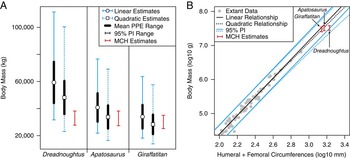
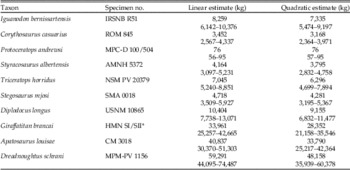
This study, however, deals with the obvious extrapolation of Campione and Evans’s (Reference Campione and Evans2012) log-linear, extant-based scaling equation between the combined humeral and femoral circumferences and body mass. In particular, the conclusions of a recent study by Bates et al. (Reference Bates, Falkingham, Macaulay, Brassey and Maidment2015) suggest that mass estimates based on the linear approach may overestimate masses when extrapolated, and the authors present instead a set of lower mass estimates for certain taxa (Apatosaurus, Brachiosaurus, and Dreadnoughtus) based on the minimum convex-hull (MCH) approach. Here, I tested the implicit expectation of Bates et al. (Reference Bates, Falkingham, Macaulay, Brassey and Maidment2015) that the log10 combined humeral and femoral circumferences–body mass relationship of Campione and Evans (Reference Campione and Evans2012) is nonlinear (i.e., quadratic). Although my results do not statistically support such a scenario (i.e., addition of a second-degree term to the linear function was not significant; Table 1), applying such a relationship has a substantial (albeit not significant) effect on the resultant mass estimates of large dinosaurs (>6000 kg; Table 2). Estimates based on the quadratic relationship are more consistent with the lower estimates recently obtained using MCH (Bates et al. Reference Bates, Falkingham, Macaulay, Brassey and Maidment2015) and are especially consistent with estimates for Apatosaurus and Giraffatitan (Fig. 2). For Dreadnoughtus, both the 21% and maximal models of Bates et al. (Reference Bates, Falkingham, Macaulay, Brassey and Maidment2015) occur within the 95% prediction intervals of the quadratic model. However, MCH estimates for Dreadnoughtus remain low relative to both scaling models, especially when compared with Apatosaurus and Giraffatitan (Fig. 2), and may necessitate ad hoc explanations as to why this individual overbuilt its limbs. Despite the fact that Campione and Evans (Reference Campione and Evans2012) found little to suggest that gait and limb posture affect stylopodial circumferences with respect to body mass, it is possible that shifts in these attributes and body plans in titanosaurs (Wilson and Carrano Reference Wilson and Carrano1999; Wilson Reference Wilson2002; Bates et al. Reference Bates, Mannion, Falkingham, Brusatte, Hutchinson, Otero, Sellers, Sullivan, Stevens and Allen2016) may have had an effect on stylopodial circumferences when dealing with animals of this size. However, more complete skeletons of large titanosaurs are needed to test this hypothesis. Alternatively, ontogeny (as acknowledged by Bates et al. Reference Bates, Falkingham, Macaulay, Brassey and Maidment2015) could explain the discrepancy between mass-estimation methodologies when applied to Dreadnoughtus. Lacovara et al. (Reference Lacovara, Lamanna, Ibiricu, Poole, Schroeter, Ullmann, Voegele, Boles, Carter, Fowler, Egerton, Moyer, Coughenour, Schein, Harris, Martínez and Novas2014) noted that, despite its large size, the lack of scapula–coracoid fusion, the lack of lines of arrested growth, and the extensive layer of fibrolamellar bone in the humerus (among other factors) in the holotype of Dreadnoughtus would suggest that it was not somatically mature at the time of death. If this is the case, then the scaling relationship of Campione and Evans (Reference Campione and Evans2012) should not be interpreted directly, as it assumes maturity. As shown by Brassey et al. (Reference Brassey, Maidment and Barrett2015), based on a very complete Stegosaurus specimen, when ontogenetic correction is applied through developmental mass extrapolation (Erickson and Tumanova Reference Erickson and Tumanova2000), estimates obtained through the combined circumferences–body mass scaling equation are consistent with MCH estimates. Under this interpretation, the heavier estimate presented by Lacovara et al. (Reference Lacovara, Lamanna, Ibiricu, Poole, Schroeter, Ullmann, Voegele, Boles, Carter, Fowler, Egerton, Moyer, Coughenour, Schein, Harris, Martínez and Novas2014) may have been inaccurate for the holotypic specimen, but it could be considered to provide an approximation of the adult mass for the species.
Comparison of body masses estimated for Dreadnoughtus, Apatosaurus, and Giraffatitan using linear and quadratic equations and the 21% and maximal models of Bates et al. (Reference Bates, Falkingham, Macaulay, Brassey and Maidment2015). Plot A compares mass estimates in non-log space, providing both mean PPE and 95% prediction intervals of the scaling models; plot B places the minimum convex-hull (MCH) mass estimates of the three dinosaurs onto the circumference mass log-log plot generated by the extant data set of Campione and Evans (Reference Campione and Evans2012).

Body-mass estimates of commonly cited nonavian quadrupedal dinosaurs obtained from the linear and quadratic models with ranges calculated from their respective mean percent prediction errors. Data are from Campione and Evans (Reference Campione and Evans2012), except for Apatosaurus (Benson et al. Reference Benson, Campione, Carrano, Mannion, Sullivan, Upchurch and Evans2014) and Dreadnoughtus (Lacovara et al. Reference Lacovara, Lamanna, Ibiricu, Poole, Schroeter, Ullmann, Voegele, Boles, Carter, Fowler, Egerton, Moyer, Coughenour, Schein, Harris, Martínez and Novas2014). Body masses estimated in this table are based on nonphylogenetically corrected equations, and the error range is based on the 25.6% and 25.4% mean prediction error obtained from the equations, respectively (see Table 1). *Composite specimen of HMN SI and HMN SII, as well as bones from other individuals (M. D’Emic personal communication 2016).

Interpretations aside, at this time, the overall consistencies between mass estimates obtained using the quadratic model and the MCH approach (Fig. 2) lend some support to the use of the quadratic equation, with the caveat that quadratic models are unpredictable when extrapolated (Fig. 1). Forthcoming research comparing mass-estimation techniques on a massive scale and testing the MCH approach in a phylogenetically and morphologically diverse suite of extant taxa should provide a better context for the general nature of upscaling factors (Sellers et al. Reference Sellers, Hepworth-Bell, Falkingham, Bates, Brassey, Egerton and Manning2012) and will shed light on the linear or quadratic nature of Anderson et al.’s (1985) seemingly universal scaling relationship between combined humeral and femoral circumferences and body mass in terrestrial tetrapods. At the moment, it would appear that a quadratic approach to Campione and Evans (Reference Campione and Evans2012) provides some constancy between recent reconstruction-based approaches and extant scaling methods when estimating the body mass of very large extinct terrestrial vertebrates (Fig. 2). One final point: when estimating the body masses of extinct animals, at no time should any mass estimate be presented or interpreted as a point estimate; statistical and (where possible) methodological errors should always be considered.
Acknowledgments
I thank Ryosuke Motani (University of California, Davis) for his thought-provoking questions that encouraged this study; Roger Benson (University of Oxford), David Evans (Royal Ontario Museum), and Kenneth Lacovara (Rowan University) for useful discussions; and Collin VanBuren (University of Cambridge) for useful comments on an earlier version of this paper. Special thanks to Michael D’Emic and an anonymous reviewer for their comments, which improved this article. I dedicate this study to my recent neonate Damián, who slept on me while I ran analyses.
Supplementary Material
Data available from the Dryad Digital Repository: http://dx.doi.org/10.5061/dryad.868mr