Introduction
Pest and disease issues represent constant challenges for strawberry (Fragaria × ananassa Duchesne ex Rozier; Rosaceae) producers. Among these, the cyclamen mite (Phytonemus pallidus Banks; Acari: Tarsonemidae) has been an increasing source of concern around the world in recent years (Fig. 1A). This major pest, sometimes known as the strawberry mite, is a phytophagous mite that feeds on young leaves before migrating to the flowers and fruits later in the season (Schaefers Reference Schaefers1963). Infested leaves become distorted, wrinkled, and stunted (Fig. 1C). Under severe infestation, plants become dwarfed with brown, brittle leaves (Alford Reference Alford2007). Fruits first turn brown under the sepals, then remain small and dry as infestation progresses (Jeppson et al. Reference Jeppson, Keifer and Baker1975; Hoy Reference Hoy2011), which leads to widespread fruit rejection and yield reduction (Fig. 1D).
Phytonemus pallidus and the damage they cause. A, Phytonemus pallidus female and eggs inside a young strawberry leaf; B, adult Neoseiulus cucumeris feeding on a female P. pallidus; C, severe damage caused by P. pallidus on a strawberry plant (cultivar Jewel); D, damage caused by P. pallidus on a strawberry fruit. Photographs by Stéphanie Patenaude.

Control of cyclamen mites is very difficult and rather complex. Because they are not easily visible, early detection is arduous, and they are often discovered only when symptoms appear. Cyclamen mites live inside young folded leaves and flower buds, which shield them from most control methods, including non-systemic acaricides (Zhang Reference Zhang2003; Fitzgerald et al. Reference Fitzgerald, Xu, Pepper, Easterbrook and Solomon2008; Hoy Reference Hoy2011). This species is mainly parthenogenetic, and females can lay an average of two eggs per day for a mean oviposition period of eight days (Easterbrook et al. Reference Easterbrook, Fitzgerald, Pinch, Tooley and Xu2003; Alford Reference Alford2007; Rostami et al. Reference Rostami, Maroufpoor, Sadeghi, Ghazi and Atlıhan2018). In addition, several generations overlap during the season, and adult females overwinter on site, deep in the crown of the plant (Jeppson et al. Reference Jeppson, Keifer and Baker1975; Alford Reference Alford2007). Consequently, infestations can become very problematic in multi-year strawberry production systems such as the matted row system, common in the province of Québec, Canada. Historically, producers have achieved effective control of this pest with endosulfan sprays (Schaefers Reference Schaefers1963; Stenseth and Nordby Reference Stenseth and Nordby1976; Labanowska Reference Labanowska1992). However, this acaricide has been withdrawn in many countries in recent years, due to its deleterious effects on the environment and human health. It is also banned in Canada as of 31 December 2016 (Gouvernement du Canada 2011). Since then, much research has aimed to identify other effective acaricides, but results among studies are variable and the acaricides studied only appear to provide partial control of this pest (Raudonis Reference Raudonis2006; Gobin and Bangels Reference Gobin and Bangels2008; Zalom et al. Reference Zalom, Thompson and Nicola2009; Fountain et al. Reference Fountain, Harris and Cross2010; Lafontaine et al. Reference Lafontaine, Tremblay, Bouchard and Martinez2011; Labanowska et al. Reference Labanowska, Piotrowski, Korzeniowski and Cuthbertson2015). Therefore, finding an alternative to chemical control is essential.
Biological control with predatory mites (Acari: Phytoseiidae) is a promising solution (Fig. 1B). In the last 20 years, many indigenous and introduced species have been studied as biological control agents against the cyclamen mite. The phytoseiid mite Neoseiulus cucumeris Oudemans (Acari: Phytoseiidae) is one of the predators most recommended against P. pallidus by biological control supply companies, and the most studied. Indeed, its effectiveness against this pest has been known for more than 60 years (Huffaker and Kennett Reference Huffaker and Kennett1953), and, despite great variability, has been demonstrated in many studies (Croft et al. Reference Croft, Pratt, Koskela and Kaufman1998; Easterbrook et al. Reference Easterbrook, Fitzgerald and Solomon2001; Berglund et al. Reference Berglund, Svensson and Nilsson2007; Petrova et al. Reference Petrova, Samsone, Jankevica, Cudare, Dimza, Eihe, Ikase, Lanauskas, Libiakova and Lopez2008; Svensson Reference Svensson2008; Tuovinen and Lindqvist Reference Tuovinen and Lindqvist2010). However, as N. cucumeris is known to be sensitive to cold temperatures (Gillespie and Ramey Reference Gillespie and Ramey1988; Jones et al. Reference Jones, Shipp, Scott-Dupree and Harris2005; Svensson Reference Svensson2008) and most studies originate from countries where this predatory mite often overwinters, its efficacy and survival under the Canadian climate remain unknown.
Previous experiments on the biological control of P. pallidus have mostly been performed under laboratory conditions or in protected crop production systems, such as greenhouses, and no field study has been performed in a commercial context in the temperate climate of Canada. Furthermore, studies on population dynamics of P. pallidus are scarce and were mostly performed under controlled conditions (Schaefers Reference Schaefers1963; Jeppson et al. Reference Jeppson, Keifer and Baker1975; Easterbrook et al. Reference Easterbrook, Fitzgerald, Pinch, Tooley and Xu2003; Rostami et al. Reference Rostami, Maroufpoor, Sadeghi, Ghazi and Atlıhan2018). Although they provide a good basis, they do not reflect the specific complexities of dynamics in the field. Thus, the objectives of this study were to monitor cyclamen mite population dynamics in the field for two consecutive years to better understand its phenology and evaluate the effectiveness of the predatory mite N. cucumeris to control P. pallidus under commercial strawberry field conditions.
Materials and methods
Both the phenology and the in-field biological control experiments were conducted on a commercial strawberry farm located in Sainte Foy (46°46′6.7″N, 71°23′56.5″W), Québec, Canada. They were performed in a June-bearing strawberry (cultivar Jewel) field planted in matted rows in the spring of 2015. In 2015, the plantation was in an establishment phase where daughter plants (runners) were allowed to establish in bare land to form a dense and intertwining bed. In 2016 and 2017, the field was in production. After each production year, the plantation has been renewed (renovation) by mowing the foliage to maintain the productivity of the plants. A straw mulch was also applied on the plants in late fall to protect them from frost injury, then removed the next spring. At the end of the 2017 production season, the field has been tilled by growers following the usual management of the matted row system.
Phenology of the cyclamen mite
Field set-up
To better understand P. pallidus in the field, three untreated plots were monitored in 2016 and 2017 on the strawberry farm in Sainte Foy. The field was renewed by mowing on 2 August 2016, and tilled on 10 July 2017, according to the usual crop management practices of the producer. Plots consisted of three rows (12 m2) of strawberry plants. Two HOBO data loggers (Onset, Bourne, Massachusetts, United States of America) were placed in the field to record temperature and humidity at the canopy level.
Sampling
Ten young folded trifoliate leaves were randomly sampled once a week from 14 June to 29 November 2016, and from the date of straw mulch removal (May 4) until the tilling of the field at the end of the harvest (July 10) in 2017. Leaves were placed individually in plastic bags and immediately stored in a cooler. In the laboratory, samples were kept at 4 °C until counting. Both sides of leaflets were examined under a stereomicroscope and held wide open in order to clearly see P. pallidus on leaf veins and in creases. For this descriptive analysis, the number of eggs, larvae, females, and males of P. pallidus were counted visually.
In-field biological control
Experimental set-up and treatments
Three treatments were compared: (1) introductions of N. cucumeris; (2) acaricide (abamectin, Agri-Mek SC, Syngenta Crop Protection Canada, Guelph, Ontario, Canada) applications, and (3) untreated control. Treatments were replicated six times in a randomised complete block design, for a total of 18 plots. The experimental unit was a 12-m2 plot, consisting of three rows of strawberry plants in the first year of production. To prevent plot contamination, a 20-m buffer zone was established on the perimeter of each plot. Temperature and humidity were recorded using a HOBO data logger placed at canopy level in two plots. The field was managed by the producer according to their usual practices. If insecticide treatment had to be applied in the field (e.g., against Lygus lineolaris (Palisot de Beauvois); Hemiptera: Miridae), all plots were covered with a waterproof plastic tarpaulin during spraying to prevent potential deleterious effects on phytoseiid mites.
Predator releases
Curative release rates of N. cucumeris (Koppert Biological Systems, Berkel en Rodenrijs, The Netherlands) were based on the recommendations of the biological control supplier. Introduction frequency and rates were adjusted as necessary, according to weekly counts. Thus, predators were introduced every one or two weeks from 21 June to 10 August 2016. In total, two releases of 500 N. cucumeris m−2 and four of 1000 N. cucumeris m−2 were carried out. Numbers of predators required per plot to achieve high curative rates were obtained by measuring the volume of the vermiculite mixture from the commercial containers. Because of the large quantities needed, the numbers of predators were estimates, rather than based on actual individual counts (Rhodes et al. Reference Rhodes, Liburd, Kelts, Rondon and Francis2006). Therefore, the volume of mixture per release was 124 or 248 mL (500 or 1000 N. cucumeris m−2) per plot. The viability of predatory mites was assessed prior to each release, by observing three representative samples of the bottle (after a gentle rotation) under a stereomicroscope for at least 10 minutes. Predatory mites were released in the field in the late afternoon for optimal conditions, within 24 hours after delivery by the supplier. The measured volume of the vermiculite mixture containing predatory mites was sprinkled on the foliage evenly within the plots.
Acaricide application
The acaricide treatment consisted of abamectin (Agri-Mek SC), sprayed after foliage mowing (2 August 2016) during post-harvest operations. This compound was selected because of its previously documented efficacy against P. pallidus and common use among Québec producers. Since abamectin has no effect on eggs (Labanowska et al. Reference Labanowska, Piotrowski, Korzeniowski and Cuthbertson2015), two applications were performed, on 9 August and 22 August 2016, at a rate of 225 mL of Agri-Mek SC/ha with the addition of 0.2% non-ionic adjuvant Agral (Syngenta Crop Protection Canada). Total spray volume (2000 L/ha) was applied by producers using a conventional mounted field sprayer equipped with a number 8010 spray nozzle regulated at a pressure of 413.7 kpa.
Sampling
A total of 10 young folded leaves per plot were randomly sampled every week from 21 June to 6 September 2016 and then every two weeks until 17 October. Leaves were stored and counted in the laboratory following the method described in the phenology section of the Materials and methods. Motile stages (female, male, larvae) and eggs of P. pallidus and phytoseiid mites were counted. Phytoseiid mites were collected with a fine brush and kept in a 70% ethanol solution until mounted on a microscope slide in polyvinyl alcohol mounting medium (BioQuip Products, Rancho Dominguez, California, United States of America) for taxonomic identification by the Laboratoire d’expertise et de diagnostic en phytoprotection (Quebec Ministry of Agriculture, Ville de Québec, Québec, Canada). When necessary, identification of phytoseiid specimens was validated by Dr. Frederic Beaulieu, acarologist at the Agriculture and Agri-Food Canada National Identification Service (Ottawa, Ontario, Canada). Not all phytoseiid mites counted could be identified, either because they could not be captured during the count, were too damaged to be mounted on a slide, or were impossible to identify (e.g., characteristic features not visible). Voucher specimens were deposited at the Laboratoire d’expertise et de diagnostic en phytoprotection (Quebec Ministry of Agriculture, Ville de Québec, Québec, Canada).
Second-year follow-up observations
In the fall of 2016, the plantations of half of the plots were destroyed by the producer due to plant disease. However, to observe change in treatments over time, the nine remaining plots (three repetitions of each treatment) were sampled weekly until 29 November 2016, and then from 4 May to 10 July 2017, using the method described above. As the aim of the follow-up observations was to monitor the treatment effect over time, no acaricide or predatory mite treatments were carried out in these plots in 2017.
Fruit yield could not be measured in 2016 but was assessed in 2017 on the nine remaining plots. Harvest area consisted of a 1−m2 subplot within each plot. Strawberries were harvested twice a week from 26 June to 10 July 2017. Fruits were classified as marketable or unmarketable. Unmarketable fruits were either smaller than 6 g or damaged by disease, pests, or abiotic factors. Fruits in each category were subsequently counted and weighed.
Statistical analysis
No statistical analyses were performed for the phenology of the cyclamen mite, as this part of the study was purely descriptive. For the part on biological control, we evaluated the treatment effect using two-way analysis of variance with repeated measures and fitted to the data using the MIXED procedure of SAS (SAS Institute, Cary, North Carolina, United States of America). In each model, the correlation structure that best fit the data was chosen based on the Akaike information criterion. Numbers of P. pallidus were square-root transformed to meet the normality assumptions, except for the 2016 experiment, for which the log transformation was used. No statistical t analysis could be performed on predatory mites due to the high proportion of zeros, despite trying with glmmADMB and Binomial model (glimmix) for zero-inflated data of R software (R Core Team 2013). Fruit yields (2017) were analysed with the same analysis of variance model, but on the raw data. Following a significant effect in any of the analysis of variance tables, the protected least significant difference method was used to identify pairs of treatments that showed differences. All analyses were performed at a significance level of 5% and all the least square means were reported on the scale of the raw data.
Results
Phenology of the cyclamen mite
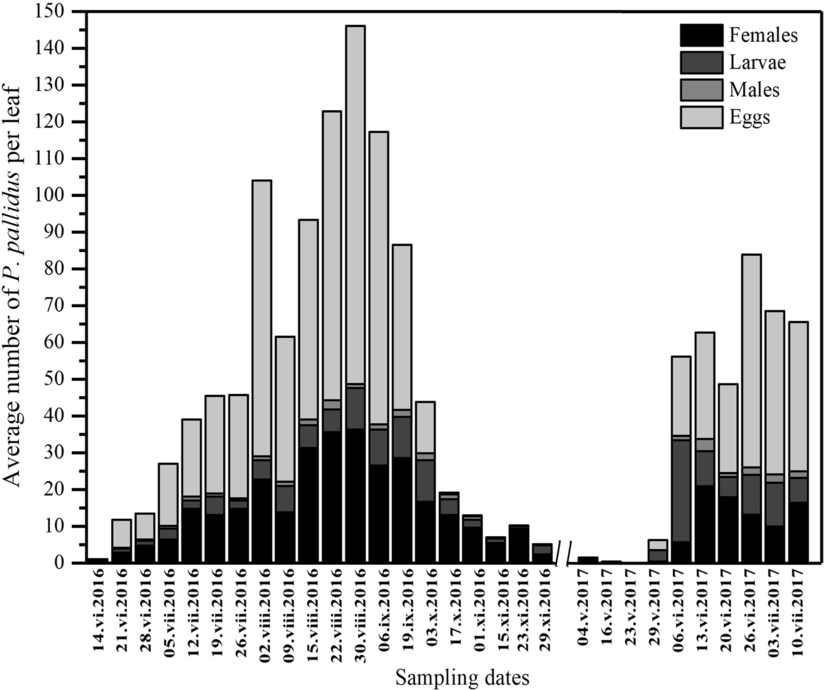
In 2016, sampling began on 14 June when strawberry plants were blooming. At that time, only very few P. pallidus were observed (Fig. 2). Over the following weeks, the population increased continually and peaked at the end of August, then started to decrease for all stages, especially the number of eggs. Field sampling stopped on 29 November, as strawberry plants were covered with ice and snow. However, active P. pallidus individuals (females and immatures) were still counted on this date.
Dynamics of Phytonemus pallidus females, larvae, males, and eggs per young strawberry leaf for 2016 and 2017 weekly sampling in untreated plots in Sainte-Foy (Québec, Canada).

In 2017, sampling began when the straw mulch was removed. From then until 29 May, few P. pallidus were detected, although high population levels had been documented in these plots during the previous season. At the beginning of June, the population increased rapidly then stayed relatively constant until the end of the observations. The overall population increased about a month earlier in 2017 compared to 2016. The female-male ratio was very high, with a two-year average of 93% females for 7% of males, ± 5%.
In-field biological control
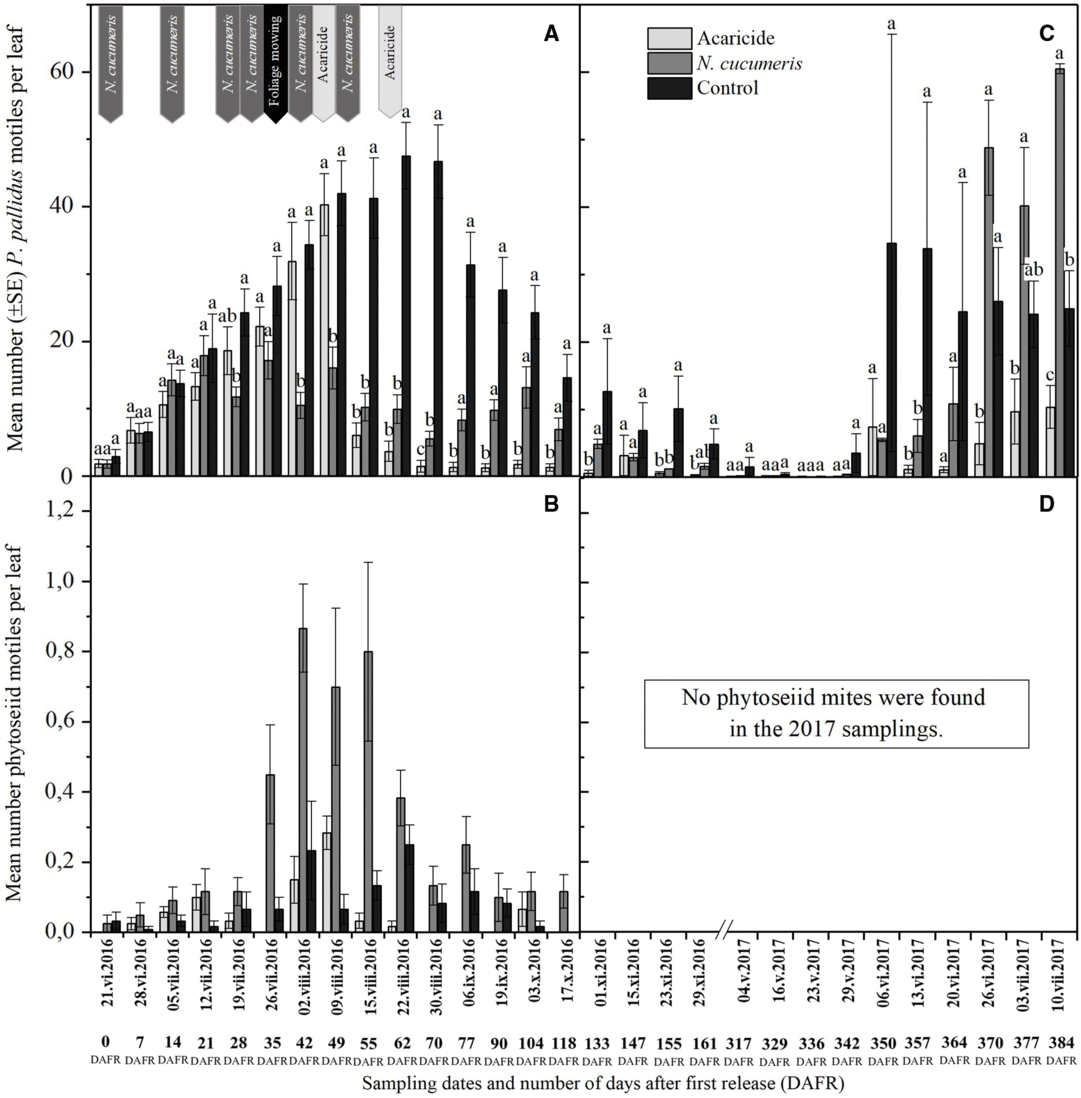
A total of six predator introductions were carried out from 21 June to 10 August (Fig. 3A). At the beginning of the season, that is, from mid-June to mid-July, N. cucumeris failed to cause a decrease in the P. pallidus populations despite two releases (Fig. 3A). Abnormally, cold nights (2.4 °C on 24 June 2016) at the end of June might have affected survival and efficacy of the first batch of predators introduced (Supplementary Fig. 1). The effects of this sensitivity to cold may have persisted for some time, as the phytoseiid population was still very low at the end of July, despite a third release. Thus, as of 19 July, introduction rates were doubled and carried out weekly instead of every other week. Afterwards, the number of cyclamen mites decreased in the N. cucumeris treatment and these plots became distinct from the control plots. The interaction treatment × period (sampling dates) was significant (F 28,210 = 5.34, P < 0.001) for P. pallidus motile forms (Fig. 3A). Following the first acaricide application on 9 August, the cyclamen mite densities in the acaricide and N. cucumeris treatment plots were comparable for two weeks, but different from the control (F 2,210 = 21.56, P < 0.001; Fig. 3A). Following the second acaricide application on 22 August, the P. pallidus densities in the acaricide treatment became significantly different from those in the two others treatments (F 2,210 = 14.67, P < 0.001) and this difference remained until the end of the experiment. At the end of the season, the number of motile forms began to decrease in the control treatment while those in the N. cucumeris treatment increased. Consequently, these two treatments did not differ.
Average numbers (± standard error) of Phytonemus pallidus motile forms (A, C) and phytoseiid mite motile forms (B, D) per young leaf for the acaricide, N. cucumeris, and control treatments on each sampling date for the in-field biological control experiment (A–B) and for the second-year follow-up observations of half of the plots (C–D). Dark grey arrows show N. cucumeris release dates (21 June and 5 July: 500 N. cucumeris m−2; 19 July, 26 July, 3 August, and 10 August: 1000 N. cucumeris m−2), light grey arrows, acaricide applications and black arrow, foliage mowing (renovation). No predatory mite release or acaricide application was carried out in 2017. Columns with the same letters are not significantly different (protected least significant difference test, P < 0.05). No statistical test could be performed on the phytoseiid mite dataset due to the high proportion of zeros.

The early season phytoseiid mite densities were low in the N. cucumeris treatment (Fig. 3B), even though predatory mites had already been released twice in these plots. The number of phytoseiid mites started to increase as of 26 July, but the density decreased rapidly as of 22 August until the end of the season. Few phytoseiid mites were found in other treatments during the experiment and consisted mainly of naturally occurring N. fallacis. After the first acaricide, no phytoseiid mite was found in this treatment until 3 October.
Second-year follow-up observations
To evaluate the residual effects of N. cucumeris the following year, nine plots were monitored in spring and summer 2017 (Fig. 3C). The interaction treatment × date was significant for the two years combined (F 58,174 = 4.72, P < 0.001).
In the spring of 2017, the number of P. pallidus motile forms was low and remained similar among treatments until 29 May. A week later, populations increased rapidly for all treatments. Between 20 and 26 June 2017, the number of P. pallidus exploded in the N. cucumeris treatment and even surpassed the control, becoming significantly different on 10 July (F 2,174 = 22.92, P < 0.001). Density in the acaricide treatment remained low from 15 August 2016 to 10 July 2017. On the last sampling date (10 July 2017), the acaricide treatment had the lowest number of motile forms per leaf, followed by the control and finally by N. cucumeris. No phytoseiid mites were found in the 2017 samplings (Fig. 3D).
Fruit yield
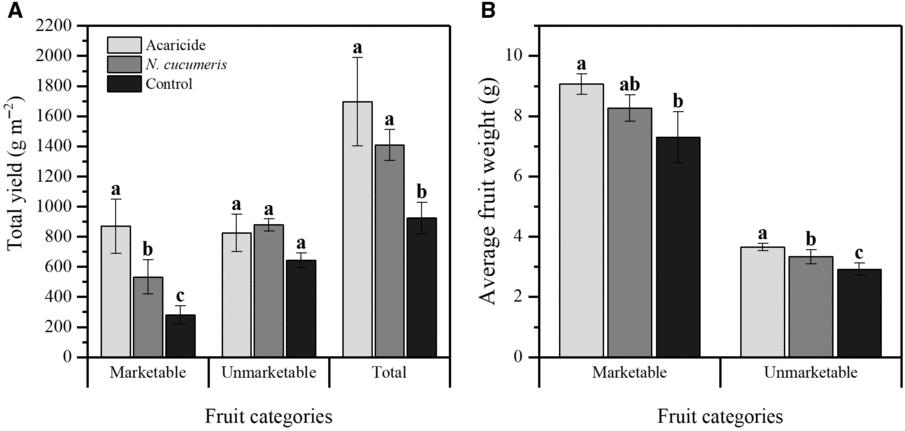
Fruit yield was measured only for the second year of the study (2017). Marketable yield was significantly different for all treatments (F 2,4 = 22.05, P = 0.007) and decreased in the following order: acaricide, N. cucumeris, and control (Fig. 4). The acaricide and N. cucumeris treatments produced similar total yields (t 4 = 1.8, P = 0.150), which were higher than that of the control (F 2,4 = 12.12, P = 0.020). Fruit size also differed among treatments (marketable: F 2,4 = 9.94, P = 0.028; unmarketable: F 2,4 = 19.16, P = 0.009). The average fruit weight for marketable strawberries was higher for the acaricide treatment than the control, whereas the N. cucumeris treatment was intermediate and not different from the two others.
Strawberry yield for the three treatments (Acaricide, N. cucumeris, and Control) at the second-year follow-up (2017) of the 2016 in-field biological control experiment. (A and B) Total yield (g m2) (± standard error) and average individual fruit weight (g) (± standard error) of marketable, unmarketable, and total strawberries. Columns with the same letters are not significantly different (protected least significant difference test, P < 0.05).

Discussion
This study represents the first report of cyclamen mite control by N. cucumeris in strawberry fields in eastern Canada. Our results highlight some of the challenges of using biocontrol agents under field conditions in northern countries. Indeed, despite its effectiveness against P. pallidus, some factors complicate the timing of N. cucumeris introductions and impact its performance in the field, thus compromising the potential for its use in a commercial context.
Phenology of Phytonemus pallidus in the field
We found, unlike any previous study, actively feeding mites until the end of November. This could represent a greater management challenge, for example, during a mild fall or under the microclimate of a floating row cover, a sheet of fabric laid over plants to extend the growing season or protect the plantation from frost. However, additional monitoring of strawberry fields located in various parts of Canada is needed to confirm whether this late occurrence is common or purely anecdotal.
Field monitoring of P. pallidus also allowed us to draw attention to the extent of the challenges of its detection early in the growing season. Although high densities of P. pallidus were present in the fall 2016, only small numbers were detected the following spring. However, the population outbreak that occurred within a week at the beginning of June 2017 suggests that reproduction started in the crown of the plant long before being detectable on young leaves. According to Jeppson et al. (Reference Jeppson, Keifer and Baker1975), females start laying eggs in mid-April in Canada. However, their migration from the crown seems to be gradual and unpredictable. Destructive sampling of the crown would be advisable in future research to better understand the early season behaviour of P. pallidus that complicates early detection and estimation in the field. As a result, determining the necessity of treatment and optimal timing represent quite a challenge for producers and agronomists. Moreover, when hidden in the crown, P. pallidus are, practically speaking, impossible for predators to reach. This characteristic is known to be a factor limiting the effectiveness of augmentative biocontrol (Collier and Van Steenwyk Reference Collier and Van Steenwyk2004).
To our knowledge, the first and only study to document P. pallidus population dynamics in first-year production strawberry fields was conducted by Schaefers (Reference Schaefers1963) in New York State, United States of America. However, comparisons are difficult, as observations were only performed once in that study. It is possible that another timing or pattern would occur under different temperature and humidity conditions (e.g., warmer fall). Lastly, our observations confirmed some well-known characteristics of P. pallidus, such as its high rate of reproduction and the large proportion of females, the two-year average of 93% females being similar to the 95% reported in the literature (Alford Reference Alford2007).
Neoseiulus cucumeris efficacy in the field
Previous studies in Europe and United States of America found that N. cucumeris could provide satisfactory control of P. pallidus with a single introduction (Croft et al. Reference Croft, Pratt, Koskela and Kaufman1998; Petrova et al. Reference Petrova, Cudare and Steinite2000; Easterbrook et al. Reference Easterbrook, Fitzgerald and Solomon2001; Tuovinen et al. Reference Tuovinen, Lindqvist, Kauppinen and Kivijarvi2009), but our study did not entirely corroborate these findings. Neoseiulus cucumeris did offer adequate control of P. pallidus in August, but was less effective at the beginning and at the end of the season.
The high sensitivity of N. cucumeris to cold temperatures may explain the poor performance of the predators at these times of the year. The few cold nights with temperatures near the freezing point after the first introduction in June could have affected their survival, as Gillespie and Ramey (Reference Gillespie and Ramey1988) showed that only 1.2% of non-acclimatedN. cucumeris survive at 2 °C. Thus, a sudden drop in temperature, such as a sub-zero night just after the introduction, may not leave them enough time to achieve cold hardening.
In addition, the short growing season and overall cold climate of the Ville de Québec area may not be suitable for N. cucumeris, resulting in suboptimal performance against P. pallidus in early and late season. Temperature is one of the most important factors impacting phytoseiid mite reproduction and development (Ghazy et al. Reference Ghazy, Osakabe, Negm, Schausberger, Gotoh and Amano2016). Indeed, a rise in temperature from 20 °C to 25 °C has led to better predation and oviposition rates of N. cucumeris, resulting in more effective control of Thysanoptera (Jones et al. Reference Jones, Shipp, Scott-Dupree and Harris2005). Unfortunately, temperatures above 25 °C rarely occur in the summer, and mainly in July–August, in the Ville de Quebec area. The weather might also affect P. pallidus and predatory mite development differently, resulting in a divergence in population size between the two species. Indeed, unfavourable environmental conditions during releases and inappropriate timing have been found to be among the most common ecological limits on augmentative biocontrol (Collier and Van Steenwyk Reference Collier and Van Steenwyk2004). A temporary lack of pollen in the field is another potential explanation for the lack of N. cucumeris activity early in the season. Indeed, Tuovinen and Lindqvist (Reference Tuovinen and Lindqvist2010) showed that N. cucumeris maintained good preventive control of P. pallidus but the number of predators dropped drastically a week after the end of the cattail pollen supply, although cyclamen mites were present.
No residual effects of the N. cucumeris treatment were noted after the overwintering period. Phytonemus pallidus density in the N. cucumeris treatment even surpassed the control treatment in June 2017. The absence of N. cucumeris in 2017 may be part of the explanation, as this predatory mite is not known to overwinter in Nordic countries (Svensson Reference Svensson2008). Accordingly, no predatory mite was found during sampling in 2017 (Fig. 3D). This difference can also be explained by the fact that strawberry plants in the control treatment were severely damaged by P. pallidus in the fall of 2016. Thus, poor plant regrowth in 2017 led to rapid deterioration of the leaves, which could no longer support high P. pallidus density; this in turn resulted in high natural mite mortality (Schaefers Reference Schaefers1963). In contrast, plants in the N. cucumeris treatment showed normal growth in the fall. Consequently, more leaves were available to support cyclamen mite growth in 2017.
Despite the absence of N. cucumeris in 2017, a treatment effect on fruit yield was detected in the second year following treatment. The N. cucumeris treatment provided 48% more marketable yield than the control plots. It is possible that a higher marketable yield could have been obtained if N. cucumeris introductions had also been performed in 2017. Indeed, Svensson (Reference Svensson2008) reported 88% more first-class fruits when treating severe infestation with N. cucumeris for two consecutive years. On this farm, yield loss was mainly caused by a decrease in fruit size and number, rather than direct aesthetic damage. Thus, a greater proportion of the yield loss might have been caused by pre-harvest damage, as Stenseth and Nordby (Reference Stenseth and Nordby1976) suggested that the reduction in fruit size resulted from a direct attack on flowers and pre-harvest weakening of plants by P. pallidus. However, these results must be interpreted cautiously since there were only three replications in 2017, and yield for 2016 was not available for comparison.
Our results point out the many challenges of in-field biocontrol. In addition to temperature, many other environmental stresses, such as humidity or ultraviolet radiation, can impact phytoseiid mite performance, and interaction can also occur between these stressors (Ghazy et al. Reference Ghazy, Osakabe, Negm, Schausberger, Gotoh and Amano2016). Contrary to greenhouses, fields are in a fluctuating environment and each year has its unique and unpredictable combination of temperature, humidity, and precipitation. Therefore, the efficacy of in-field biocontrol is difficult to predict. Moreover, early introduction, a key factor in P. pallidus biocontrol (Easterbrook et al. Reference Easterbrook, Fitzgerald and Solomon2001; Svensson Reference Svensson2008; Tuovinen et al. Reference Tuovinen, Lindqvist, Kauppinen and Kivijarvi2009), proves to be a challenge in regions under temperate climate such as Québec. Past studies have pointed out that introduction rates and frequency should be temperature-adapted to maintain the same level of efficacy (Jones et al. Reference Jones, Shipp, Scott-Dupree and Harris2005; Svensson Reference Svensson2008), but this strategy can become expensive and uneconomical for producers. Indeed, the high-rate, repetitive introductions that are required to obtain this level of control in our project turned out to be very expensive (over CAD $5000 per ha). Unfortunately, the indirect benefits of biocontrol, such as a reduced impact on the environment and human health, are rarely taken into account by growers to compensate for the higher costs (Collier and Van Steenwyk Reference Collier and Van Steenwyk2004).
Acknowledgements
We would like to thank our collaborators for their time and expertise: Thierry Chouffot, François Demers, Caroline Martineau, Olivier Samson-Robert, and Jacinthe Tremblay, as well as grower Laurent Fiset, for providing land and showing strong interest for the entire duration of the project. We are also very grateful to Mario Fréchette and Frédéric Beaulieu for their expertise in taxonomy; Gaétan Daigle and Awa Diop for their statistical assistance; Éric Lucas, Roselyne Labbé, and other anonymous readers for their constructive comments on previous versions of the manuscript; and Aurélie Boilard, Audrey Boivin, Catherine Bolduc, Clémence Landreau, and all members of the Fournier laboratory for their technical assistance. Finally, we are grateful to Koppert Canada for providing predatory mites free of charge.
This work was supported by Programme Prime-Vert (volet 4) en appui à la Stratégie Phytosanitaire québécoise en agriculture du Ministère de l’Agriculture, des Pêcheries et de l’Alimentation du Québec by grant ULAV-1-15-1746 to V.F. and a Natural Sciences and Engineering Research Council of Canada scholarship to S.P.
Supplementary material
To view supplementary material for this article, please visit https://doi.org/10.4039/tce.2019.75