Implications
Endophyte-infected tall fescue growing adjacent to alfalfa showed greater concentration of CP and alkaloids than endophyte-infected tall fescue growing away from alfalfa. Lambs preferred initially tall fescue growing near alfalfa over tall fescue growing away from alfalfa, but their preferences waned as the day progressed. Olfactory cues affected preference, but to a lesser extent than the nutrients and alkaloids in tall fescue. Thus, legumes growing by endophyte-infected tall fescue have some changes, which are beneficial (i.e. increases in the concentration of CP) and detrimental (i.e. increases in the concentration of alkaloids) for livestock. This study shows sheep can discriminate these changes and modify their feeding preferences accordingly.
Introduction
Approximately 90% of tall fescue (Lolium arundinaceum (Schreb.) Darbysh) pastures in the United States are infected with the endophyte fungus Neotyphodium coenophialum, which produces various ergopeptide alkaloids (Bacon and Siegel, Reference Bacon and Siegel1988). The symbiotic relationship between tall fescue and N. coenophialum has agronomic advantages, including broader adaptation to soil types and geographic areas (Burns and Chamblee, Reference Burns and Chamblee1979), greater tolerance of low management inputs and resistance to insects (Clay, Reference Clay1988; Popay et al., Reference Popay, Jensen and Cooper2005; Popay, Reference Popay2009). Yet, ergot alkaloids in tall fescue are toxic to grazing animals (Bacon et al., Reference Bacon, Porter, Robbins and Luttrell1977; Bacon and Siegel, Reference Bacon and Siegel1988); they reduce heat tolerance and predispose animals to heat stress, elevate rectal temperatures and respiration rates, and decrease prolactin in serum and/or blood (Aldrich et al., Reference Aldrich, Paterson, Tate and Kerley1993a). In addition, ergot alkaloids likely cause aversive post-ingestive effects (nausea) in livestock, as antiemetic drugs like metoclopramide – which attenuate nausea and food aversions (Provenza et al., Reference Provenza, Ortega-Reyes, Scott, Lynch and Burritt1994) – also increase intake of endophyte-infected tall fescue in sheep (Aldrich et al., Reference Aldrich, Rhodes, Miner, Kerley and Paterson1993b).
Herbivores have evolved a variety of interrelated mechanisms to cope with consumption of plant toxins, ranging from physiological (e.g. detoxification) to behavioral (e.g. avoidance, diet switching, regulation of intake below a toxic dose, altering the size and pattern of feeding bouts, consuming diverse and complementary diets, which enhance detoxification processes) (Estell, Reference Estell2010). For instance, toxin inactivation and elimination in mammalian herbivores requires additional inputs of energy and nutrients to sustain the increased metabolic demands imposed by detoxification processes (Illius and Jessop, Reference Illius and Jessop1995). In turn, an increased selection of foods high in protein increases the ability of ruminants to consume foods that contain toxins (Villalba et al., Reference Villalba, Provenza and Banner2002a). Thus, forage intake and livestock production can increase if endophyte-infected tall fescue is grown with other plant species, such as legumes that improve protein intake and minimize the negative post-ingestive effects of alkaloids. As a result, sheep and cattle graze more on tall fescue and reed canarygrass that contain alkaloids when they are first allowed to graze legumes like birdsfoot trefoil (Lyman et al., Reference Lyman, Provenza, Villalba and Wiedmeier2012; Owens et al., Reference Owens, Provenza, Wiedmeier and Villalba2012).
Understanding whether legumes as companion species alter intake of tall fescue, and whether such an effect is mediated by changes in the chemical composition of tall fescue growing under different conditions, has implications for designing grazing systems incorporating tall fescue. For example, sheep and cattle may prefer to graze endophyte-infected tall fescue growing adjacent to a legume, as the legume may improve the nutritional value of the grass through: (a) an additive effect which enhances grass digestibility (Van Soest, Reference Van Soest1994) and (b) the provision of nitrogen that aids in ergovaline detoxification. Livestock have been observed to prefer grazing endophyte-infected tall fescue plants growing by legumes on the same area (alfalfa or sainfoin; Villalba J.J., personal observations). However, tall fescue growing by a legume may have greater concentrations of alkaloids. Bacteria on the root nodules of legumes fix nitrogen and they may not only increase the nutritional value of nearby grasses, but the nitrogen they fix may provide a substrate to increase alkaloids in fescue (Arechavaleta et al., Reference Arechavaleta, Bacon, Plattner, Hoveland and Radcliffe1992, but see Rasmussen et al. Reference Rasmussen, Parsons, Bassett, Christensen, Hume, Johnson, Johnson, Simpson, Stacke, Voisey, Xue and Newman2007). According to the carbon–nutrient balance hypothesis (Bryant et al., Reference Bryant, Chapin and Klein1983), increased nitrogen availability can, simply by mass action, increase concentrations of nitrogen-based secondary compounds like alkaloids. More alkaloids could partly negate the benefits of legumes on forage intake and livestock production. Thus, animals may avoid tall fescue growing adjacent to a legume. Finally, scent cues in legumes may attract livestock to consume nearby grasses like tall fescue.
Food odors and tastes are cues that help ruminants anticipate the post-ingestive consequences of food, thus improving learning efficiency in complex feeding environments (Villalba and Provenza, Reference Villalba and Provenza2000; Favreau-Peigné et al., Reference Favreau-Peigné, Baumont and Ginane2013). In addition, legumes are digested faster and contain more nitrogen than grasses (Merchen and Bourquin, Reference Merchen and Bourquin1994), which explains why herbivores typically prefer legumes to grasses (Ginane and Dumont, Reference Ginane and Dumont2011). Thus, preference for tall fescue may be enhanced by the scent of a legume. However, the possibilities that nutrients, alkaloids and odors that influence food selection may not be mutually exclusive, as ruminants may concomitantly select diets that balance the intake of plant primary and secondary compounds (Provenza, Reference Provenza1996) and use olfactory cues to guide their foraging preferences (Elliott and Loudon, Reference Elliott and Loudon1987; Provenza et al., Reference Provenza, Kimball and Villalba2000).
To examine how sheep trade-off nutrient and alkaloid intake and explore the influence of scent on this process, we determined (1) the influence of nutritional composition (CP, minerals, fiber), (2) plant concentration of ergovaline and (3) scent of highly preferred legumes, like alfalfa or sainfoin, on preference by sheep for endophyte-infected tall fescue growing adjacent either alfalfa or endophyte-infected tall fescue.
Material and methods
Animals and housing
Sheep used in the study were 6-month-old Suffolk (n=5 in both experiments) or Rambouillet (n=5 in both experiments), of mixed sex (eight wethers and two ewes in Experiment 1; seven wethers and three ewes in Experiment 2), provided by a farm 16 km north of Lewiston, UT. Lambs had no previous experience in eating endophyte-infected tall fescue and they were of uniform BW (initial weight in Experiment 1: 31.3±0.9 kg (mean±s.e.); Experiment 2: 31.3±0.8 kg – weighed on 9 and 29 June 2010). Both experiments were conducted at the Utah State University pasture research facility in Lewiston, UT (41°56'N 111°52'W), according to procedures approved by the Utah State University Institutional Animal Care and Use Committee (approval number 1474).
Maximum, minimum and mean temperatures during the study were 25.1±1.4°C, 8.0±0.6°C and 16.3±0.9°C, and mean air humidity was 55.4±2.2% (Utah State University, Station data).
Lambs were placed in individual pens (1.5×2.5 m) at 1600 h on 9 June 2010. Sheep pens were located in a barn within the pasture research facility. At 0900 h on 10 and 11 June, the 10 lambs in Experiment 1 were offered freshly harvested orchardgrass (Dactylis glomerata; cultivar Latar) and alfalfa (Medicago sativa; cultivar Vernal) at the rate of 1.5 and 0.5 kg (fresh weight), respectively, in separate feeders, while the 10 lambs in Experiment 2 were offered 2 kg (fresh weight) of orchardgrass daily from 10 to 15 June, split evenly into separate feeders. Forage was harvested using a Swift flail harvester immediately before feeding (walk behind model, 762 mm cutting width). Lambs in Experiment 1 consumed most of the alfalfa offered on these days, so the fresh alfalfa offered was increased to 1 kg/animal from 12 to 14 June 2010. Alfalfa was offered to familiarize lambs with this legume. During this acclimatization period, refusals were weighed at 1600 h each day, and the feeders in which orchardgrass and alfalfa were offered were alternated daily in Experiment 1. On 15 June, alfalfa was removed from Experiment 1, and 1 kg freshly harvested orchardgrass was offered in each of two separate feeders. Across both experiments during the acclimatization phase, the lambs ate an average of 1730 g (860 g on a dry matter basis) of fresh orchardgrass between 0900 and 1600 h, although intake varied between 1420 and 2000 g (as-fed basis). Refusals of alfalfa (Experiment 1 acclimatization) were negligible. This level of intake informed the amount of freshly harvested forage offered throughout the experiments. Water was offered free choice during both experiments in 10 l buckets, and water intake for each lamb was recorded daily at 0800 h before refilling buckets. Evidence of diarrhea during the experiments (light, moderate or heavy) was recorded.
Forages
Two 0.08 ha (11×73.2 m) plots of endophyte-infected tall fescue (L. arundinaceum (Schreb.) Darbysh, cultivar Kentucky 31, known to contain elevated levels of ergovaline during the summer; Owens et al., Reference Owens, Provenza, Wiedmeier and Villalba2012) growing adjacent (by the longer side of the rectangular area) to alfalfa (M. sativa; cultivar Vernal) or sainfoin (Onobrychis viciifolia; cultivar Shoshone) were used for this study. Visually, tall fescue growing within ~1 m of alfalfa plots was greener and had greater biomass. Each morning before feeding, tall fescue was harvested adjacent to alfalfa (fescue–alfalfa; FA) and from the center of the plots (fescue-middle; FM), ~5 m from the adjacent legume plots. Approximately 0.2 m of the FA plots directly adjacent to alfalfa plots was not harvested to ensure alfalfa was not harvested with FA. The areas to be harvested were visually inspected before harvesting to ensure no unintended plant material was harvested.
Experiment 1
Preference for different fescue types
On 16 and 17 June 2010, 1.5 kg each of freshly harvested FA and FM were offered in separate feeders (total amount offered=3 kg) from 0900 to 1600 h. The amount was increased to 1.8 kg (total amount offered=3.6 kg) on 18 June 2010 and to 2.0 kg (total amount offered=4 kg) from 19 to 27 June 2010 to ensure that animals had ad libitum amounts of forage (at least 20% of the amount of forage initially offered). The feeders in which FA and FM were offered were alternated daily.
Preference for different fescue types+odor cues
On 28 and 29 June 2010, cages containing freshly harvested alfalfa from the alfalfa plot were added to the FA feeders, and cages containing freshly harvested FM were added to FM feeders. Cages (30.5×30.5×15.2 cm), which could be opened on one side, were constructed using wire mesh (0.5×0.5 cm). Laundry bags (30.5×15.2 cm) contained the forages were placed inside the cage and then attached to each feeder. The distance between the two feeders in the preference test was ~1.5 m. The feeders in which FA and FM were offered (2 kg each, from 0900 to 1600 h) were alternated daily, along with the cages, such that alfalfa scent was always associated with FA, and FM scent with FM.
Experiment 2
On 16 and 17 June 2010, 1.5 kg freshly harvested FM was offered in each of two separate feeders from 0900 to 1600 h (total amount offered=3 kg). This amount was increased to 1.8 kg on 18 June 2010 (total amount offered=3.6 kg) and to 2.0 kg from 19 to 27 June 2010 (total amount offered=4 kg) to ensure that animals had ad libitum amounts of forage (refusals of at least 20% of the amount of forage initially offered). Cages were filled with either freshly harvested alfalfa (n=10) or freshly harvested FM (n=10), and were placed in separate feeders to provide a choice of scent from 16 to 23 June 2010. The cages containing FM or alfalfa were alternated daily between feeders. Freshly harvested forage was placed inside laundry bags to ensure animals had only an olfactory cue – that is the cages containing FM or alfalfa looked identical, and there was no possibility the material inside the cages could be removed through the mesh. From 24 to 27 June 2010, FM inside cages was replaced with freshly harvested sainfoin, so sheep had the choice between FM with either alfalfa and sainfoin scent. Lambs had no prior experience with sainfoin. These cages were alternated daily between feeders. This experiment tested the influence of a cue from a novel legume (sainfoin), instead of a familiar one (alfalfa), on preference by lambs for tall fescue.
Feeding and sample collection
Before daily feeding, two subsamples were collected from each freshly harvested batch of FA and FM. One of these subsamples was split and the two samples weighed and dried overnight at 60°C before reweighing to determine dry matter. The dried subsamples were then stored in an airtight container until analysis for forage quality. The second subsample was sealed in an airtight plastic bag and frozen for later analysis of ergovaline content.
At 1000, 1200 and 1400 h on each day, the uneaten residue from each feeder was weighed and immediately returned to the feeder. Dry matter intakes of each fescue type within each of these periods were calculated using the dry matter content of the offered feed. At 1600 h each day, the uneaten residue from each feeder was weighed and discarded. A subsample was taken from each refusal and weighed before overnight drying at 60°C and reweighing to determine refusal dry matter. These subsamples were composited daily across refusal types (FA and FM) for chemical analyses. Daily dry matter intake of each fescue type was calculated as the difference between dry matter offered and refused. When daily dry matter intake for an animal was <200 g, data were excluded from analyses for that animal on that day, requiring the removal of a total of 11 daily records across four animals in Experiment 2.
Forage analyses
Dried herbage, both offered and refused, from 7 days of the experiment (approximately every 2nd day, chosen on the basis of expected temporal changes in quality or when a new plot was harvested) was ground through a Wiley mill with a 1-mm screen and analyzed for CP, ADF and NDF, and macrominerals (Ca, P, K and Mg) using NIRS (Association of Official Analytical Chemists, 1990). Frozen subsamples of herbage (corresponding to the same days samples were analyzed for nutritive value) were freeze-dried and ground through a 1-mm screen before analysis for ergovaline (Rottinghaus et al., Reference Rottinghaus, Garner, Cornell and Ellis1991).
Statistical analyses
Feed intake (dry matter basis/kg0.75, based on liveweight on 9 June) of each choice, and proportion of each choice selected in the total diet by lambs (intake of a single food/total food intake) were analyzed as a split-plot design, with types of fescue (FA and FM, or FA and FM with an odor cue) as the whole-plot factor, lamb as the random factor, and day and feeding period (0900 to 1000, 1000 to 1200, 1200 to 1400 and 1400 to 1600 h) were the repeated measures. All analyses were computed using a mixed-effects model (version 9.1 for windows; SAS Institute Inc., Cary, NC, USA). The variance–covariance structure used was the variance components, which yielded the lowest Bayesian information criterion. The model diagnostics included testing for a normal distribution of the error residuals and homogeneity of variance. Means (fixed factors and interaction means) were analyzed using pairwise differences of least squares means.
Paired t-tests were conducted to examine differences in forage quality and ergovaline content between FA and FM forages and between offered and refused forages.
Results
Forage quality and ergovaline content
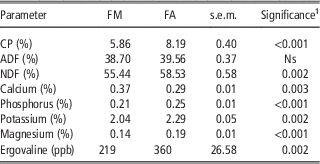
Tall fescue grown adjacent to alfalfa (FA) had greater concentrations of CP, NDF, phosphorus, potassium and magnesium than fescue grown in the middle of the plots (FM). Likewise, tall fescue grown adjacent to alfalfa had greater ergovaline content than tall fescue grown in the middle of plots. Calcium concentrations were greater in FM than in FA (P<0.05; Table 1).
Mean forage quality and ergovaline content for tall fescue harvested from the middle (FM) of plots or adjacent to alfalfa (FA)

FM=fescue-middle; FA=fescue–alfalfa.
1 Determined by a t-test.
Nutritional analysis of refusals yielded similar patterns, although only differences in NDF (58.6±0.6% v. 61.1±0.6%; P<0.05), Ca (0.31±0.01% v. 0.27±0.01%; P<0.01), P (0.20±0.01% v. 0.23±0.01%; P<0.001), K (2.03±0.04% v. 2.25±0.04%; P<0.001) and Mg (0.14±0.01% v. 0.17±0.01%; P<0.01) for FM and FA, respectively, were significant.
Liveweight and water intake
During Experiment 1, initial weight (9 June 2010) was 31.3±0.9 kg and final weight (29 June) was 32.9±2.1 kg. For Experiment 2, initial weight was 31.3±0.8 kg and final weight was 33.6±1.3 kg. Average daily water intake was 1.65±0.21 and 1.45±0.21 l/lamb per day for Experiments 1 and 2, respectively. Five animals were observed with diarrhea during Experiment 1.
Experiment 1
Intake and preference for different tall fescue types
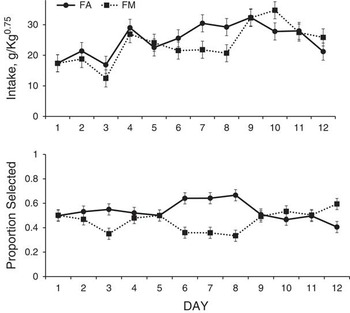
Averaged across days (day 1: 16 June; day 12: 27 June), daily intake of FA (25.2±1.8 g/kg0.75) did not differ from FM (23.7±1.8 g/kg0.75 ; P>0.05). However, intake differed among days (P<0.001), and there was an interaction between fescue type and day (P<0.05). Lambs consumed more FA than FM on days 7 and 8 and less FA than FM on day 10; they consumed similar amounts (P>0.05) of FA and FM on other days (Figure 1).
Experiment 1: daily intake of tall fescue grown adjacent to alfalfa (FA) and grown in the middle of fescue plots (FM), and daily proportions of FA and FM selected in the total diet by lambs. Values are means for 10 lambs; s.e. are represented by vertical bars. FA=fescue–alfalfa; FM=fescue-middle.

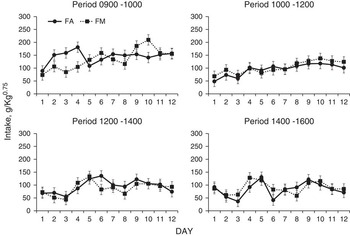
Intake during the 1st hour of offering tall fescue (0900 to 1000 h: 10.5±0.8 g/kg0.75) was greater (P<0.001) than intake during the three subsequent 2-h periods (1000 to 1200 h: 7.4±0.8 g/kg0.75; 1200 to 1400 h: 6.8±0.8 g/kg0.75; and 1400 to 1600 h: 6.6±0.8 g/kg0.75) and the feeding period×day interaction was significant (P<0.001). From 0900 to 1000 h, lambs consumed more FA than FM on days 2, 3 and 4 and less on day 10 (fescue type×day×period interaction; P<0.001; Figure 2). No other differences were detected for FA and FM across feeding periods (P>0.05).
Experiment 1: intake of tall fescue grown adjacent to alfalfa (FA) and grown in the middle of fescue plots (FM) by lambs from 0900 to 1000 h, from 1000 to 1200 h, from 1200 to 1400 h and from 1400 to 1600 h each day. Values are means for 10 lambs; s.e. are represented by vertical bars. FA=fescue–alfalfa; FM=fescue-middle.

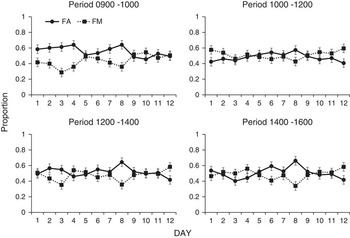
Overall, lambs selected a greater (P<0.05) proportion of FA (0.54±0.02) than FM (0.46±0.02). However, fescue type and day interacted (P<0.001) because lambs selected a greater proportion of FA than FM in their diets on days 3, 6, 7 and 8, a lower proportion on day 12 and did not differ (P>0.05) on other days (Figure 1).
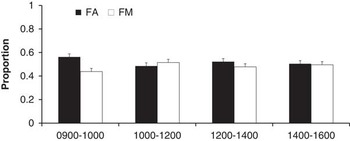
Consistent with the intake data, lambs preferred FA to FM during the 1st hour of feeding (0900 to 1000 h; P<0.05; Figure 3), owing to differences in preference occurring during days 1 to 4 and 7 to 8. The proportion of FA and FM selected differed by hour and day: 1000 to 1200 h (days 1, 8 and 12), 1200 to 1400 h (days 3 and 8) and 1400 to 1600 h (days 6, 8 and 12) (fescue type×day×period interaction; P<0.005; Figure 4).
Experiment 1: average proportion of diet selected as fescue grown adjacent to alfalfa (black bars) or in the middle of fescue plots (white bars) from 0900 to 1000 h, from 1000 to 1200 h, from 1200 to 1400 h and from 1400 to 1600 h during the study. Values are means for 10 lambs; s.e. are represented by vertical bars.

Experiment 1: proportion of tall fescue grown adjacent to alfalfa (FA) and grown in the middle of fescue plots (FM) selected by lambs from 0900 to 1000 h, from 1000 to 1200 h, from 1200 to 1400 h and from 1400 to 1600 h each day. Values are means for 10 lambs; s.e. are represented by vertical bars. FA=fescue–alfalfa; FM=fescue-middle.

Intake and preference for different fescue types with alfalfa or tall fescue scents
Averaged across days (28 and 29 June), intake of (33.1 v. 28.0±2.3 g/kg0.75) and preference for (0.5 v. 0.5±0.01) FA with an alfalfa odor cue did not differ from FM with a FM odor cue (P>0.05). No differences in forage intake or preference were detected on the 1st day of exposure (P>0.05), but on the 2nd day lambs consumed (35.2 v. 28.0±2.4 g/kg0.75) and preferred (0.54 v. 0.45±0.03) more FA with an alfalfa odor cue than FM with an FM odor cue (day; P<0.05; fescue type×day; P<0.05).
Intake during the 1st hour (0900 to 1000 h: 12.8±1.2 g/kg0.75) was greater (period effect; P<0.01) than intake for the subsequent 2-h periods (1000 to 1200 h: 9.9±1.2 g/kg0.75; 1200 to 1400 h: 8.3±1.2 g/kg0.75; and 1400 to 1600 h: 6.7±1.2 g/kg0.75). However, no interactions were detected between feeding period and odor cue or day (P>0.05).
Experiment 2
Intake and preference for tall fescue offered with alfalfa or tall fescue scents
Although total daily intake (from day 1 on 16 June to day 8 on 23 June) of FM was numerically greater when offered with alfalfa scent than when offered with FM scent (27.60±3.73 v. 22.2±3.73 g/kg0.75), the difference was not significant (P>0.05). The scent by day interaction was not significant (P>0.05), but intake differed between days (P<0.0001); intakes were greater on days 4, 5, 6 and 8 (31.1±2.9, 28.8±2.9, 27.5±2.9 and 27.2±3.2 g/kg0.75, respectively) than on days 1, 2, 3 and 7 (16.8±2.9, 22.3±3.0, 22.9±3.0 and 22.6±3.0 g/kg0.75, respectively).
Intake was greater during the 1st hour (9.5±0.6 g/kg0.75) and subsequent 2 h (1000 to 1200 h) of offering tall fescue (8.9±0.6 g/kg0.75) than during the last 2 h feeding periods (1200 to 1400 h: 6.7±0.6 g/kg0.75; 1400 to 1600 h: 6.4±0.6 g/kg0.75) (P<0.001), but no scent, scent×period or scent×period×day effects were detected (P>0.05); the day×period interaction was significant (P<0.0001).
Preference was greater for FM offered with alfalfa scent (0.58±0.08) than for FM offered with FM scent (0.38±0.08) (P<0.05). The day within scent interaction was significant (P<0.01); while preference was always greater for FM offered with alfalfa, the difference was only significant on days 4 and 8. There was no period, scent×period or scent×period×day interaction (P>0.05).
Intake and preference for tall fescue offered with alfalfa or sainfoin scents
Daily intake (from day 9 on 24 June to day 12 on 27 June) did not differ between fescue offered with alfalfa or sainfoin scents, nor was the interaction with day significant (P>0.05). The effect of day was significant (P<0.001); intake was greater on day 10 (36.0±2.7 g/kg0.75) than on day 12 (27.6±2.7 g/kg0.75), while intake on days 9 (33.7±2.7 g/kg0.75) and 11 (32.4±2.7 g/kg0.75) was intermediate.
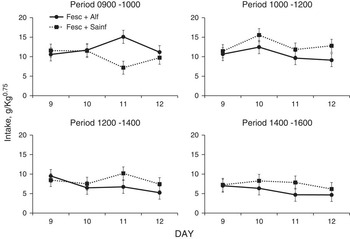
Intake differed between feeding periods (P<0.001) and there was a period×day interaction (P<0.001); intake was greater during the 1st hour of feeding (11.1±1.1 g/kg0.75) and during 1000 to 1200 h (11.7±1.1 g/kg0.75) than during later periods (1200 to 1400 h: 7.68±1.1 g/kg0.75; 1400 to 1600 h: 6.5±1.1 g/kg0.75). No scent×period interaction was detected (P>0.05), but there was scent×feeding period×day interaction (P<0.0001); intake of tall fescue offered with alfalfa scent was greater than intake of tall fescue offered with sainfoin scent in the first feeding period (0900 to 1000 h) for day 11, but the pattern reversed for subsequent feeding periods (Figure 5).
Experiment 2: intake of tall fescue grown in the middle of fescue plots offered with alfalfa (Fesc+Alf) or sainfoin (Fesc+Sain) in cages by lambs from 0900 to 1000 h, from 1000 to 1200 h, from 1200 to 1400 h and from 1400 to 1600 h each day. Values are means for 10 lambs; s.e. are represented by vertical bars.

Lambs preferred fescue offered with sainfoin scent (0.52±0.02) to fescue offered with alfalfa scent (0.48±0.02; P<0.02). No effects of day or period were detected (P>0.05) and there was no scent×day, scent×period or scent×day×period interaction (P>0.05).
Discussion
In our study, lambs faced a trade-off between eating nutrients and toxins from a choice of endophyte-infected tall fescue growing in close proximity or away from a legume and with or without the presence of scents from legumes. Results suggest lambs’ feeding behavior reflected the influence of all these chemical and sensorial forage attributes.
Preference and intake for different fescue types: influence of nutrients
Lambs in this study showed an overall preference for tall fescue growing by alfalfa, the forage with the greatest concentration of P, K, Mg and CP. Growing lambs are likely to seek forages high in CP, as concentration of CP in feeds influences foraging behavior (Kyriazakis and Oldham, Reference Kyriazakis and Oldham1993). Lambs fed diets low in protein prefer the flavor of low-quality foods previously paired with intra-ruminal infusions of nitrogen (urea, casein, gluten) (Villalba and Provenza, Reference Villalba and Provenza1997). Given pre-loads of energy (in starch) or nitrogen (in casein), lambs subsequently prefer flavors previously paired with nitrogen or energy, respectively, during the ensuing meals (Villalba and Provenza, Reference Villalba and Provenza1999). Lambs ingesting diets deficient in Ca and P also acquire preferences for supplements that provide these minerals (Villalba et al., Reference Vilallba, Provenza and Hall2008).Thus, sheep select balanced diets, and in the process, they recognize different internal states and associate the flavors of different foods with their post-ingestive effects (Provenza, Reference Provenza1996).
Preference and intake for different fescue types: influence of ergovaline
The carbon–nutrient balance hypothesis predicts an increase in allocation to nitrogen-based secondary metabolites when plants are subjected to nitrogen amendments (Bryant et al., Reference Bryant, Chapin and Klein1983). Consistent with this, nitrogen fertilization increases alkaloid levels in tall fescue (Arechavaleta et al., Reference Arechavaleta, Bacon, Plattner, Hoveland and Radcliffe1992). Bacteria on the root nodules of legumes fix nitrogen in soil and can provide the substrate to increase alkaloid concentrations in the grass. In our study, FA had greater concentrations of nitrogen and ergovaline than did FM, and preference by lambs for FA was likely being modulated by the greater ergovaline content of FA.
Lambs preferred FA to FM mainly during the 1st hour of feeding after which their preferences for FA waned relative to FM, suggesting that alkaloids influenced preference. Endophyte-infected tall fescue growing by alfalfa (FA) contained greater concentrations of ergovaline than FM. Ergovaline at concentrations of 500 to 800 ppb causes clinical disease in sheep (Hovermale and Craig, Reference Hovermale and Craig2001). Although ergovaline in FA was below these levels, sub-clinical concentrations of alkaloids in tall fescue cause measurable changes in livestock performance (Peters et al., Reference Peters, Grigsby, Aldrich, Paterson, Lipsey, Kerley and Garner1992), which affect foraging behavior and welfare of sheep (Catanese et al., Reference Catanese, Distel and Villalba2014).The five animals that regularly (on at least 5 days each) had diarrhea, all lost weight, and of these animals, four selected >60% of their diet as FA. Animals satiate on specific foods, a result of interactions among primary and secondary compounds (Provenza, Reference Provenza1996), and they typically show cyclic patterns of intake of plants that contain secondary compounds (Pfister et al., Reference Pfister, Provenza, Manners, Gardner and Ralphs1997). Although plant secondary compounds can act as diuretics (Dearing et al., Reference Dearing, Mangione and Karasov2001), lambs had water intake of 1.5 l/lamb per day, which are within the normal range for the amount of dry matter consumed by lambs (Squires, Reference Squires1988).
Lambs alter their grazing behavior when faced with ingesting plant secondary metabolite-containing foods and develop mild-to-strong aversions to foods high in these compounds (Provenza, Reference Provenza1996). Ergot alkaloids are small non-polar molecules, and thus the latency of experiencing the negative post-ingestive effects of these compounds by sheep is in the scale of minutes (Jaussaud et al., Reference Jaussaud, Durix, Videmann, Vigie and Bony1998). Thus, it is likely that lambs start to experience the consequences of consuming endophyte-infected tall fescue at the beginning of the first feeding period. However, the present study did not assess physiological parameters related to fescue toxicosis.
Given a choice between endophyte-infected and uninfected Festuca rubra, sheep avoided the infected variety (Hubbard, Reference Hubbard1995). Likewise, given a choice of a range of tall fescue plots with different levels of endophyte infection, cattle grazed preferentially on endophyte-free plots (van Santen, Reference van Santen1992). Lambs given a dose of ergotamine grazed tall fescue to a lesser extent than did undosed lambs (Villalba et al., Reference Villalba, Provenza, Clemensen, Larsen and Juhnke2011).
Food aversions are caused by stimulation of the emetic system (Provenza, Reference Provenza1996). Sheep given antiemetic drugs eat more endophyte-infected tall fescue than controls not given the drugs (Aldrich et al., Reference Aldrich, Rhodes, Miner, Kerley and Paterson1993b), likely because the antiemetic drugs block the actions of the emetic system. Thus, alkaloids likely caused transient food aversions, which reduced intake of tall fescue in our study.
The lack of differences in the ingestion of the two tall fescue types after 1 h of feeding may also reflect the restricted choice lambs were faced with at these times. As lambs had frequently preferred FA in the first feeding period (Figures 4 and 5), in the ensuing feeding periods they were left with a choice of consuming the FA from which the more attractive parts may have already been selected relative to FM.
Trade-off nutrients–ergovaline
Supplemental protein and rumen degradable carbohydrates enhance detoxification processes, allowing animals to eat foods high in secondary compounds (Vilallba et al., Reference Villalba, Provenza and Banner2002a; Villalba and Provenza, Reference Vilallba and Provenza2005). The nutritional costs of detoxification occur during a two-step process involving conjugation, often with nitrogenous compounds such as glycine or glucuronic acid, and excretion of detoxified products (Foley et al., Reference Foley, McLean and Cork1995; Illius and Jessop, Reference Illius and Jessop1995). Nitrogen is lost through increased ammonium excretion, which buffers high acid loads from compounds such as glucuronic acid (Foley et al., Reference Foley, McLean and Cork1995). When nutrient supply and energy intake is sufficient, animals can better withstand the acid loads associated with detoxifying secondary compounds (Illius and Jessop, Reference Illius and Jessop1995). Thus, greater nutrient supply from FA could aid in the detoxification of the greater concentrations of ergovaline present in this forage type.
Animals foraging on landscapes high in plant diversity face complex foraging decisions involving primary and secondary compounds (Provenza and Balph, Reference Provenza and Balph1990). A trade-off framework in which animals make decisions in relation to costs and benefits of adopting a particular behavior can be used to interpret ingestive behavior in complex environments (Hutchings et al., Reference Hutchings, Judge, Gordon, Athanasiadou and Kyriazakis2006). In our study, lambs faced a trade-off between ingesting a forage of greater concentration of CP and the need to limit intake of ergovaline. They may have attempted to increase their intake of the more nutritious FA, but there was a limit to how much FA they could eat given its greater content of alkaloids. Over time, the greater intake of FA than of FM waned and by the end of the experiment they ate greater amounts of FM. Thus, lambs modulated their preference for FA, the more nutritious forage relative to FM, the forage lower in alkaloids.
Preference values in this study were in the range of 0.4 to 0.6, which do not reveal clear-cut preferences in single choice tests (Goatcher and Church, Reference Goatcher and Church1970). However, temporal changes in preference – even when in the aforementioned range – are indicative of the impact of nutrients and toxins on food selection by herbivores (Villalba et al., Reference Villalba, Provenza and Bryant2002b). This is relevant in situations, like in this study, when differences in the nutrient profile of food alternatives were small or when the concentration of ergovaline in the forage was below toxic levels (Lyman et al., Reference Lyman, Provenza and Villalba2008; Bernard et al., Reference Bernard, Maughan and Villalba2013). Changes in preference suggest lambs in our study were able to discriminate between the two fescue types assayed and traded-off the concentration of nutrients and plant secondary compounds across time.
Preference and intake for different fescue types: influence of scent
Palatable plants attract herbivores to a patch, which increases the likelihood where they will eat unpalatable neighbors in the patch (Atsatt and O’Dowd, Reference Atsatt and O’Dowd1976). Pre-ingestive odor cues are beneficial for herbivores to identify the chemical composition of plants in a community (Provenza et al., Reference Provenza, Kimball and Villalba2000), as they can shorten foraging decision times (Augner and Bernays, Reference Augner and Bernays1998). For instance, cattle prefer tall fescue sprayed with juice extracted from highly palatable ryegrass (Scehovic et al., Reference Scehovic, Poisson and Gillet1985). In contrast, preference declines when ryegrass is sprayed with juice extracted from tall fescue (Scehovic et al., Reference Scehovic, Poisson and Gillet1985). However, these results cannot be attributed only to odor cues as animals could also consume the extracted material. When lambs could smell scents but not consume the source (e.g. foods inside a cage), they showed aversions to foods associated to negative scent cues (Provenza et al., Reference Provenza, Kimball and Villalba2000).
When offered either fescue grown adjacent to alfalfa or grown at a distance, lambs in Experiment 1 had greater intake of fescue grown adjacent to alfalfa during the initial feeding period (0900 to 1000 h) from the 2nd day after lambs were offered tall fescue for the first time. This observation suggests that scent affected preference for FA.
Sensory cues in tall fescue likely helped lambs to quickly select the alternative with greater concentration of nitrogen. Sheep generalize from familiar to unfamiliar foods based on familiar cues (Launchbaugh and Provenza, Reference Launchbaugh and Provenza1993; Villalba and Provenza, Reference Villalba and Provenza2000). The aroma of volatile compounds released by plants affects foraging behavior, and Mayland et al. (Reference Mayland, Flath and Shewmaker1997) identified several compounds emitted from fresh tall fescue cultivars that influence grazing preferences, including 6-methyl-5-hepten-2-one and acetic acid. Certain volatile compounds in tall fescue likely signaled a greater content of CP, which initially influenced lambs’ preferences. In addition, FA and FM visually differed in color (FA being darker) and sheep learn to discriminate between dark (high nitrogen) and light (low nitrogen) green grasses (Bazely and Ensor, Reference Bazely and Ensor1989). This initial selection was likely reinforced by the different post-ingestive effects of the different tall fescue types, which caused changes in their foraging behavior (Provenza, Reference Provenza1996).
When lambs could smell but could not consume the source of a palatable scent cue (alfalfa), they showed a moderate preference (days 4 and 8) for tall fescue associated with the odor of alfalfa. Sheep display strong preferences for patches of Calluna vulgaris fertilized with nitrogen relative to non-fertilized patches, despite no discernible difference in the morphology of fertilized and unfertilized areas (Duncan et al., Reference Duncan, Hartley and Iason1994), suggesting the presence of cues in fertilized plants, which signal a greater nutrient content. The taste elicited by the sodium salt of the amino acid l-glutamate (umami) helps animals detect sources of protein, and protein-deficient sheep naïve to the umami flavor develop preferences for umami-flavored foods (Bach et al., Reference Bach, Villalba and Ipharraguerre2012). Thus, this cue may be involved in signaling foods with high CP content like alfalfa.
When offered a choice of tall fescue associated with the scent of alfalfa or the scent of sainfoin, another palatable legume, lambs consumed more fescue when offered with the scent of alfalfa than sainfoin in the 1st hour after feeding on day 11 (Figure 5), but in subsequent feeding periods they consumed more fescue with sainfoin scent. This response might have been because of satiation to the smell of alfalfa, given that ruminants satiate to the flavor of feeds consumed too frequently or in excess (i.e. sensory-specific satiety; Provenza, Reference Provenza1996). Alternatively, lambs could have preferred the scent from another palatable legume like sainfoin, or could have selected the alternative, which was relatively more available after the first feeding period (tall fescue with sainfoin scent).
Conclusions
Lambs initially preferred endophyte-infected tall fescue grown by alfalfa to tall fescue grown in monoculture, but they decreased their preference for the former relative to the latter over time within and across days. Their initial preference was likely owing to the greater nutritive value of endophyte-infected tall fescue grown adjacent to alfalfa compared with endophyte-infected tall fescue grown in monoculture, while the decline in preference over time was likely owing to the greater alkaloid content of fescue grown adjacent to alfalfa. Future studies should investigate metabolic responses to the increased voluntary consumption of tall fescue grown adjacent to alfalfa to improve our understanding of how sheep manage toxin loads. Olfactory cues influenced preference for tall fescue, but to a lesser extent than the nutritional and toxicological attributes of the grass.
Acknowledgments
This research was supported by grants from the National Institute of Food and Agriculture (NIFA) USDA (Award 2009-35101-05360) and the Utah Agricultural Experiment Station. This paper is published with the approval of the Director, Utah Agricultural Experiment Station and Utah State University, as journal paper number 8587. M.A.F. was in receipt of a Special Studies Program Grant from Charles Sturt University. We acknowledge R. Stott for veterinary services, A. Clemensen for chemical analyses, and B. Maughan and D. Forester for technical support.