Congenital heart disease (CHD) is the most common congenital lesion with a prevalence of 9.2 per 1000 births.Reference van der Linde, Konings and Slager1 The improved treatment options developed over the past 50 years have resulted in a substantial expansion of the adult CHD patient population,Reference Marelli, Ionescu-Ittu, Mackie, Guo, Dendukuri and Kaouache2,Reference Marelli, Mackie, Ionescu-Ittu, Rahme and Pilote3 which is expected to grow further for at least three more decades.Reference Benziger, Stout, Zaragoza-Macias, Bertozzi-Villa and Flaxman4 The majority of these adult patients cannot be considered cured, as most lesions have a chronic course, even after repair. This has led to an annual 8.2–11.4% increase in outpatient cardiology visits.Reference Willems, Werbrouck, De Backer and Annemans5 Special care programmes have been developed to deal appropriately with these recurrent care needs.Reference Moons, Meijboom, Baumgartner, Trindade, Huyghe and Kaemmerer6 However, despite these efforts, and primarily due to an increase in the number of patients, the number of adult CHD hospitalisations has increased by 3.5–10.6% per year in recent decades.Reference Willems, Werbrouck, De Backer and Annemans5
The rise in healthcare demands may compromise future accessibility and affordability of care. Several expert opinion-based clinical guidelines have recommended the principle of subsidiarity – the provision of clinically appropriate care to the individual patient at the least complex level possible – in order to avoid saturation of special care programmes. Follow-up care can be stratified into three levels: (i) specialised care provided by adult CHD cardiologists, (ii) care shared between adult CHD cardiologists and local general cardiologists, and (iii) non-specialist care provided by local general cardiologists, with access to specialised care if needed.Reference Deanfield, Thaulow and Warnes7–Reference Baumgartner, Budts and Chessa9
In Belgium, a country with approximately 11 million inhabitants, adult CHD care is provided at four designated tertiary university hospitals.10 Compared to European standards (Moons et alReference Moons, Meijboom, Baumgartner, Trindade, Huyghe and Kaemmerer6 identified 70 European adult CHD centres), adult CHD care in Belgium is thus relatively well developed, with the number of adult CHD centres being close to the recommendation of Marelli et al – one specialised centre per two million inhabitants.Reference Marelli, Therrien, Mackie, Ionescu-Ittu and Pilote11 Specialised care in Belgium is also provided at specialised centre-affiliated satellite centres. Satellite centres are local hospitals with an outpatient clinic managed by an adult CHD cardiologist. Research into care gaps may give an indication of the proportion of patients receiving specialised care. A Belgian single-centre study reported that 86% of patients remained under follow-up at either a tertiary or satellite clinic after transfer from paediatric to adult careReference Goossens, Stephani and Hilderson12; this is a substantially higher percentage than reported in other countries.Reference Goossens, Stephani and Hilderson12–Reference Gurvitz, Valente and Broberg14 The specific structure of this adult CHD centre may differ from the structure of other Belgian tertiary adult CHD centres, and hence hinder the generalisation of the results to all Belgian centres.Reference Goossens, Stephani and Hilderson12
This qualitative study investigated the applicability of the organisational recommendations in the Belgian context. Our main aim was to obtain knowledge and views regarding the potential role of general cardiologists in the care of adult patients with a CHD. The study was embedded in a broader interview about the general organisation of adult CHD care.
Methods
Participants
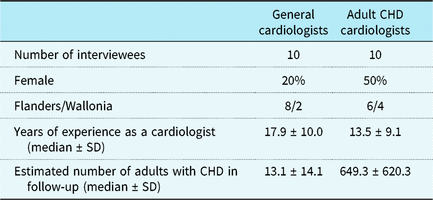
An electronic invitation to participate as an interviewee was sent to members of the Belgian Society of Cardiology on 20 June 2018. A saturation pointReference Holloway and Galvin15 was reached after 20 interviews. These were conducted between 3 July and 20 December 2018; half of the interviewees were adult CHD cardiologists, and half were general cardiologists. We define adult CHD cardiologists here as cardiologists with a specific interest in adult CHD care, working in a tertiary centre licensed for Cardiac Care Program C, or an associated satellite centre where outpatient visits take place. Cardiac Care Program C involves diagnosis, treatment, care, and revalidation of paediatric and adult patients with CHD.10 Four university hospitals in Belgium are licensed for Cardiac Care Program C. All other interviewees were categorised as general cardiologists. An overview of the participants can be found in Table 1. To ensure anonymity, only limited demographic data are provided, as Belgium is a small country with a small number of adult CHD cardiologists. Four, two, and four of the general cardiologists were working, respectively, in peripheral or secondary hospitals, private practice, and tertiary hospitals. Four and six of the adult CHD cardiologists were working, respectively, in satellite hospitals and tertiary hospitals.
Descriptive statistics

CHD = congenital heart disease.
Procedure
In preparation for the interview, the interviewees were asked to fill out a short questionnaire gauging their adult CHD experience and their knowledge of organisational recommendations, as described in adult CHD guidelines. This information was used as a starting point for the interview, which was conducted by the first author (R.W.). A flexible semi-structured interview guide was developed: after the first six interviews, the interview guide was modified to address relevant topics that had been raised. The questions were broad and open-ended in order to stimulate the natural flow of the interview. All questions were related to the interviewees’ opinions on:
(1) the role general cardiologists may have in the care of adult CHD patients; for example: Are general cardiologists sufficiently equipped and trained to follow up adult CHD patients? Do you see potential in certification? What is the best way to distribute or share adult CHD information? Should adult CHD be an integrated part of cardiology training?
(2) the organisation of adult CHD care; for example: Should adult CHD care become more (de)centralised? Should there be an official referral network in place? How can referral of patients be improved? What is the role of a dedicated nurse specialist?
The short questionnaire and interview guide can be found online (Supplementary Material 1).
Analysis
The data analysis software QRS NVivo 12 was used to code and analyse the semi-structured interviews.16 The following step-by-step thematic framework analysis was used to handle the data: (1) familiarisation with the data through data transcription, (2) open coding (free coding of raw data), (3) axial coding to major themes (although the interview guide determined the data framework to some extent, other data-driven (inductive) themes also emerged), (4) review of themes, and (5) interpretation of themes.Reference Braun and Clarke17
The first (R.W.) and second (M.d.H.) authors independently analysed all four interviews with general cardiologists working in a peripheral hospital. A few doubts were discussed, until a consensus on how to interpret the data was reached. Afterwards, the first author (R.W.) analysed all the remaining interviews.
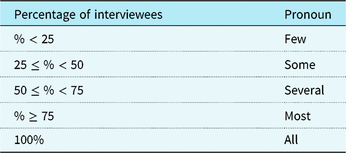
Qualitative data were reinforced by quantitative counts of the interviewees discussing a specific theme.Reference Sandelowski18 We called <25% of the cardiologists “a few”, and 100% of the cardiologists “all”, with “some”, “several”, and “most” reflecting percentages in-between (Table 2).
Percentages of interviewees discussing a subcategory and matching pronouns
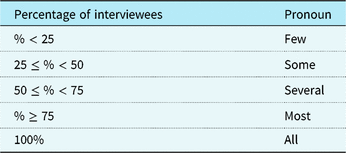
For example, if 6 out of 10 general cardiologists mentioned being in favour of certification, it is written in the result section as “several general cardiologists were in favour of certification”.
Ethical approval was obtained from Ghent University Hospital ethical committee (registration number B670201835149). The research project was endorsed by the Belgian Working Group on Adult Congenital Heart Disease and the Belgian Society for Cardiology.
Results
The general cardiologist: knowledge and role
Clinical look at adult CHD. General and adult CHD cardiologists differed in their opinions on adult CHD care. Most adult CHD cardiologists mentioned the sub-optimal referral of patients formerly followed up by general cardiologists. Several adult CHD cardiologists argued that only cardiologists with a special training should provide patient follow-up, as adult CHD patients have specific care needs. General cardiologists may be unaware of long-term complications, especially of those that occur in mild lesions.
I sometimes see patients who have been under follow-up for 15 years by a cardiologist with limited knowledge of adult CHD. After 15 years, we see the patient because his clinical status has deteriorated, which in fact we could have anticipated for a long time. (Adult CHD cardiologist 1)
An atrial septal defect may look simple, but it’s not, and “closed” does not mean “finished”. You still need to follow your patients from time to time. (Adult CHD cardiologist 6)
An atrial septal defect is nonsense. You shouldn’t concern yourself with it. (…) For me, it’s similar [following up on an atrial septal defect and acquired heart disease]. I have one patient with an atrial septal defect who had been operated on two years ago. I’ll see him again in two years, but then I’ll ask myself: should I see him again afterwards? (General cardiologist 6)
Only a few general cardiologists indicated they knew the adult CHD guidelines, while a few other general cardiologists were aware of the existence of them. Most general cardiologists, however, stated that they should not look after the most complex cases, while mild lesions (such as atrial septal defects) should not be a problem. Nevertheless, the following statement of a general cardiologist captures the sometimes broad range of lesions being followed up by general cardiologists:
I can imagine people [general cardiologists] reasoning about a complex lesion such as a double outlet right ventricle or a complex shunt that they’d rather not [deal with it]. However, there are many lesions that may not pose problems, such as a light Fallot, or mild to moderate pulmonary stenosis, or a ventricular septal defect. (General cardiologist 1)
Certification. Opinions on certification were mixed, as there are some hurdles involved. First, a definition of certification is needed: do you need a certification to follow up patients with an atrial septal defect? A few adult CHD cardiologists stated this should be integrated in general cardiology training. Second, there is currently no legal framework to make certification enforceable. A few of the general and some adult CHD cardiologists thus suggested interpreting such certifications as valorisations of the cardiologist’s expertise. Third, how could a certification be obtained, and who should hand it out? A few of the general and several adult CHD cardiologists mentioned the importance of practice and volume at a tertiary centre. Nevertheless, several general and adult CHD cardiologists advocated for the idea of certification, as it would show credibility to both patients and colleagues, and may create a stronger bond with the tertiary centre.
I think it should be possible that, in a couple of peripheral hospitals, some cardiologists have an interest [in adult CHD]. They could have a role as a gatekeeper, and so they could be recognized, without them being highly specialized. (…) They should have had extensive training for some period, in which they saw a range of pathologies, so they know if they can handle it themselves or if it’s too much for them. (General cardiologist 10)
Sharing of knowledge. The best way to share knowledge, according to several of the general cardiologists, is to spread practice-oriented information on a local level. They did acknowledge that this approach can be time-consuming. They thought that meetings specifically on adult CHD mainly attract doctors who are already interested in the topic. Moreover, little attention is given to adult CHD at general cardiology meetings.
On the other hand, some adult CHD cardiologists believed that meetings are effective in disseminating adult CHD knowledge. Some general cardiologists also mentioned webinars, although most were not very enthusiastic about this.
Currently, the number of adult CHD teaching hours during cardiology residency is limited. Whether residents (cardiologists in training) gain practical experience in the topic depends on their personal motivation. Most of the adult CHD cardiologists and some of the general cardiologists argued for a compulsory internship at a tertiary centre during training. This internship should be short (1–3 months) and aimed at becoming acquainted with the complexity. Motivated residents should be offered the opportunity of an in-depth specialisation year.
Views on the organisation of care
Decentralisation and shared care. The cardiologists were generally in favour of a geographically decentralised organisation of care. Several general and adult CHD cardiologists emphasised the importance of proximity of care: healthcare is a service to the patient. Furthermore, a few of the general and some of the adult CHD cardiologists argued that some adult CHD knowledge should be locally available, as acute care needs cannot be planned for. A few of the general and adult CHD cardiologists also stated that referral patterns would benefit from a decentralised organisation of care, which would also lead to a decrease in loss to follow-up.
I get the centralization idea: we want to concentrate all expertise to create high-volume hospitals with good results. However, I think it must be feasible to create one center per province to follow-up “B-pathologies” and to centralize the more complex cases. (General cardiologist 1)
Several adult CHD cardiologists argued that there is a need for geographically decentralised healthcare but that, as mentioned, only cardiologists with special adult CHD training should provide the follow-up. Indeed, several general and adult CHD cardiologists mentioned sufficient patient volume as a key to expertise. Some of the general and adult CHD cardiologists thus stated that complex lesions should always be managed in a centralised way. Additionally, a few of the general and some of the adult CHD cardiologists argued that the concept of proximity of care should be completely abandoned.
A lot of the data [patient data] is scattered. Everybody, especially in Belgium, is just doing something. (…) That’s a problem, it’s wrong. Many of these cardiologists had no training, they don’t have the knowhow, so they can’t provide proper care and follow-up. (Adult CHD cardiologist 3)
And we should stop the idea of proximity of care we have in Belgium, having access to everything within 10 kilometers. Belgians should realize that there are no other European countries like this. In Germany, you have to travel many kilometers to have access to care. (Adult CHD cardiologist 6)
Most of the general and adult CHD cardiologists mentioned that they were in favour of the shared care principle (cf. organisational level 2). Shared care can accommodate growing patient populations and improve communication between general and adult CHD cardiologists. A periodical consultation at the tertiary centre remains important due to medical progress. Some general cardiologists said that, in every middle-to-large hospital, a general cardiologist should be designated to deepen his or her adult CHD knowledge. This would correspond with the opinion of some adult CHD cardiologists that shared care is possible, but only with general cardiologists who have great knowledge of adult CHD and who work with sufficiently high volumes.
The mobile adult CHD cardiologist. Some of the general and several of the adult CHD cardiologists argued for tertiary adult CHD cardiologists to visit peripheral hospitals. Similarly, adult CHD cardiologists at peripheral hospitals should also frequent the tertiary hospital. These measures would be beneficial for the patient, would limit loss of expertise, would improve communication, and would distribute adult CHD knowledge. This strategy is already in place in Belgium to some extent, but is not yet common practice.
The role of a dedicated nurse specialist. Most adult CHD cardiologists acknowledge the dedicated nurse’s role in communication with patients. Adult CHD counselling takes time, due to the complexity of the medical issues and the need for discussion of non-medical issues, such as insurance, employment, desire for children, and sports, which can be addressed by a dedicated nurse specialist. They are also regarded as more approachable than doctors, and patients with questions can be directed more easily to them. Some general and adult CHD cardiologists also saw the dedicated nurse specialist as a point of contact for general cardiologists, while some others preferred direct doctor-to-doctor communication. Other tasks mentioned by a few of the cardiologists were research work, administrative support, and steering the care process.
My point of view is: it does not matter who gives me the information I need, as long as I get it. It does not make a difference and, if it is really necessary, you will get somebody [a doctor]. Those people [dedicated nurse specialists] will know the pathology better than the peripheral cardiologist. (…) I expect resistance from the peripheral cardiologists, but this can be overcome with good communication. (General cardiologist 3)
Some general and a few adult CHD cardiologists emphasised that the doctor still holds the final responsibility. Additionally, dedicated nurses might be too expensive if the government does not allocate a budget for them.
Referral patterns. Some of the cardiologists described how current referral patterns are primarily based on either the historical partnership between institutions or the personal history of the general cardiologist. The general cardiologist will refer patients more easily to the tertiary hospital where they had part of their training. Proximity to the tertiary hospital was only mentioned by a few of the adult CHD cardiologists. Legally required referral patterns were discussed: several of the general and most of the adult CHD cardiologists were negative about it. The most important concern was that it could damage the patient’s freedom of choice, which is pivotal. Some of the general and adult CHD cardiologists argued for a bottom-up approach in which cardiologists construct their own network on the basis of geography. Some of the general and a few of the adult CHD cardiologists were in favour of legally required referral patterns, but mentioned implementation problems, such as the legislation:
To make them [referral patterns] mandatory, yes, that should be possible! It might be feasible to implement a Danish healthcare model. But if you can still choose, things will be difficult. You have to make good agreements and you have to refer back. I’m not an opponent of the idea. (General cardiologist 3)
Some of the general and adult CHD cardiologists mentioned that general cardiologists sometimes lack knowledge of the congenital healthcare landscape, despite the small size of the community. For this reason, one adult CHD cardiologist suggested that there should be a webpage with the contact details of all the specialised hospitals and cardiologists.
Several of the general and some of the adult CHD cardiologists mentioned the idea of having more referrals back to the general cardiologist in order to facilitate referrals. However, referral back is subordinate to the accessibility of the tertiary centre, timely feedback, and good communication. Importantly, some general cardiologists indicated that they currently have better relations with the adult CHD clinic than with other tertiary specialisations. Most general cardiologists nevertheless stressed the need for improved feedback, especially in cases where there is no referral back. Several general cardiologists emphasised they have no special need to see the patient again, but that they just want to receive an update on the patient’s health status, as a personal bond was formed over the years. Several general cardiologists preferred verbal communication by telephone over letters, e-mail, or other technological means. Some general cardiologists thought the electronic communication will gain importance in the future if its user-friendliness improves. However, there is still room for some improvement as regards communication:
Any communication channel is good: telephone, e-mail, or letter. The more direct the communication, the better. (…) Do I do this [the most direct communication method] in practice? … no, I don’t. But if it is possible, it’s the best possibility. (Adult CHD cardiologist 9)
Definitely, we write him or her a letter to describe the situation, explain the problem, and at the end we offer some options. (…) But even if I want to write a letter every one of my patients, I mightn’t have all the addresses, or for some reason the letter doesn’t make it to the doctor. (…) So sometimes the system doesn’t work right. It isn’t us who don’t want to send these letters. (Adult CHD cardiologist 7)
Discussion
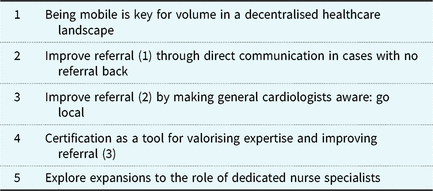
This qualitative study summarised the opinions of general and adult CHD cardiologists on the organisation of adult CHD care in Belgium, with a particular focus on the role of general cardiologists. In the discussion section, five recommendations are made to improve adult CHD care and are located in the international scientific context (Table 3).
Five points of recommendation
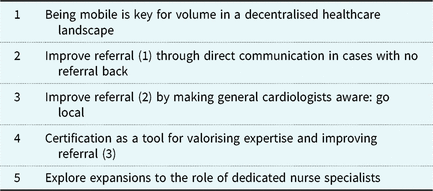
Being mobile is key for volume in a decentralised healthcare landscape
The major argument for centralising care is that it can generate enough volume to create expertise in a relatively small patient population (which is, nonetheless, growing).Reference Marelli, Ionescu-Ittu, Mackie, Guo, Dendukuri and Kaouache2, Reference Marelli, Mackie, Ionescu-Ittu, Rahme and Pilote3 Complex lesions are rare, at six patients per 10,000 people.Reference Marelli, Ionescu-Ittu, Mackie, Guo, Dendukuri and Kaouache2 Indeed, care at high-volume expertise centres has been associated with lower mortality rates in Canadian research, and this effect has mainly been found in patients with complex lesions.Reference Mylotte, Pilote and Ionescu-Ittu19 On the other hand, decentralised care was advocated by our interviewees because of the proximity of care. Regional access to care is a strength of the Belgian healthcare system,Reference Bjornberg20 and is one of the most important determinants of patient satisfaction worldwide.Reference Batbaatar, Dorjdagva, Luvsannyam, Savino and Amenta21
These, at first sight, opposing benefits are not in fact mutually exclusive. Interviewees suggested regional representation by a limited number of peripheral cardiologists with a sub-specialisation in adult CHD, though these would not necessarily have to possess the same level of expertise as the adult CHD cardiologists at the tertiary centre. Local provision of basic care can be enhanced by electronic communication with the tertiary centre; in order to provide enough volume to maintain high-level care, the peripheral adult CHD cardiologists should periodically carry out consultations at the tertiary centre. Similarly, tertiary cardiologists should periodically frequent peripheral centres to disseminate knowledge and improve communication.
Improve referral (1) through direct communication in cases with no referral back
The interviewees were critical of potential regulations on patient referral, both because of the patient’s freedom of choice and because such regulations would not be feasible in the current Belgian healthcare system. On the other hand, communication with and feedback for the referring cardiologist appeared to be key in improving future referral patterns, especially in cases with no referral back. General cardiologists preferred verbal communication by telephone or, where that was not possible, sending a letter, which is congruent with the literature.Reference Vermeir, Vandijck and Degroote22 Furthermore, the perception of communication regarding referrals differed between general and adult CHD cardiologists: adult CHD cardiologists assessed the quality of communication more positively. General cardiologists indicated that there are still some shortcomings, although communication with adult CHD cardiologists appeared to be better than with other tertiary specialties. This difference in the assessment of communication quality has also been reported extensively in general practitioner–specialist physician interactions.Reference O’Malley and Reschovsky23–Reference Vermeir, Vandijck and Degroote26 The literature on communication between general practitioners and specialists has also demonstrated the importance of optimal communication: good communication was significantly associated with several patient-related outcomes, such as continuity of care, patient safety, patient satisfaction, and the efficient use of resources.Reference Vermeir, Vandijck and Degroote22
Improve referral (2) by making general cardiologists aware: go local
There was a difference of opinion in terms of the types of lesion that general cardiologists can follow up on. General cardiologists were convinced that they are able to at least follow up on patients with mild lesions, but the extent to which they could care for patients with moderate lesions was unclear. Patients with complex lesions should be followed up by adult CHD cardiologists. Some adult CHD cardiologists believed that general cardiologists are (or should be) able to follow up on patients with mild lesions. On the other hand, other adult CHD cardiologists believed that even patients with mild lesions should be followed up only by cardiologists with an adult CHD sub-specialisation. Indeed, Cordina et alReference Cordina, Nasir Ahmad and Kotchetkova27 demonstrated an increased risk of adverse outcomes if adult CHD patients, regardless of lesion complexity, were followed up by general cardiologists rather than being under the care of cardiologists with a congenital sub-specialisation. The odds of a major event while under the care of a general cardiologist was 5.0.Reference Cordina, Nasir Ahmad and Kotchetkova27 It was striking that general cardiologists deviated significantly more from the guidelines than did adult CHD cardiologists.Reference Cordina, Nasir Ahmad and Kotchetkova27 Accordingly, our results indicated limited knowledge of the guidelines among general cardiologists. According to general cardiologists, awareness of the special treatment needed by adult CHD patients can best be disseminated on the local level. For example, membership of a local quality group of no more than 25 doctors is needed to hold a non-obligatory certification. Such a platform can be ideal.
Furthermore, the visibility of current adult CHD care facilities seemed to be sub-optimal. It is recommended that their visibility be enhanced, to enable more efficient communication and referral, which would be beneficial for the patient. Mylotte et alReference Mylotte, Pilote and Ionescu-Ittu19 reported lower mortality rates in adult CHD patients who were directly referred to specialised centres than among patients first referred to non-specialised centres.Reference Mylotte, Pilote and Ionescu-Ittu19
Certification as a tool for valorising expertise and improving referral (3)
The idea of certification was advocated by the majority of interviewees because of the credibility it demonstrates to patients and colleagues, and also because it could improve communication. However, several concerns were raised: uncertainty about the lesions covered by the certification, the absence of a formal procedure for obtaining it, and the absence of a legal framework to make it enforceable in Belgium. It is beyond the scope of this paper to answer all these questions, but it is suggested that the certification be interpreted as a valorisation of the cardiologist’s special knowledge and experience, in addition to the general cardiology practice. A fellowship at a tertiary centre to obtain the certification could establish an instant relationship. Adult CHD certification and training practices in other countriesReference Warnes, Bhatt, Daniels, Gillam and Stout28–32 may guide the developing certification process in Belgium. Moreover, Baumgartner et al described the appropriate level of training to become an adult CHD cardiologist.Reference Baumgartner, Budts and Chessa9 No such formal training has yet been established in Belgium. The German example illustrates how these certifications could possibly enhance the visibility of those adult CHD services that are available country-wide.33 However, there is still little scientific dataReference Fiorilli, Minges and Herrin34, Reference Norcini, Lipner and Kimball35 available on the impact of certification on patient-related outcomes, and conclusions are disputed.Reference King36
Additionally, knowledge of adult CHD should be improved in cardiology residents, as general cardiologists are the gatekeepers to cardiology. General cardiologists should be able to detect problems related to adult CHD and to refer the patient appropriately. For this reason, it is suggested that a short but mandatory internship be embedded in the curriculum so that future general cardiologists experience the challenges of adult CHD care. Moreover, a mandatory internship could be beneficial for patients choosing to remain with a general cardiologist. Establishing a shared scheme of care with an adult CHD cardiologist is pivotal in these cases.
Explore expansions to the role of dedicated nurse specialist
Adult CHD cardiologists considered dedicated nurse specialists to be complementary healthcare professionals who are approachable by patients. A dedicated nurse specialist is ideally placed to educate patients on issues such as health behaviour, employment, and sport, among other topics. There was, however, no consensus on the role that dedicated nurse specialists can play in communication with peripheral cardiologists. A dedicated nurse specialist could potentially be a contact point improving communication, but doctors may continue to prefer direct doctor-to-doctor contact. Indeed, an increasing number of specialised centres employ dedicated nurse specialists,Reference Moons, Meijboom, Baumgartner, Trindade, Huyghe and Kaemmerer6, Reference Moons, Engelfriet, Kaemmerer, Meijboom, Oechslin and Mulder37 whose jobs are mainly oriented towards patients (coordination, triage and physical examination, telephone consultation, and patient education)Reference Moons, Scholte op Reimer and De Geest38. The extent to which their role can be further developed is one of the research priorities determined by Goossens et al.Reference Goossens, Fleck, Canobbio, Harrison and Moons39 Another research priority is the impact of dedicated nurse specialists on patient-related outcomes in adult CHD,Reference Goossens, Fleck, Canobbio, Harrison and Moons39 as this is still unknown. However, research in (for instance) heart failure clinics has demonstrated fewer events, fewer admissions, and better self-care.Reference Stromberg, Martensson, Fridlund, Levin, Karlsson and Dahlstrom40
The observation that dedicated nurse specialists are too expensive in Belgium, because their cost is not reimbursed, may soon become outdated: during the course of the interviews, important steps were made to officially recognise dedicated nurse specialists, and it will become possible for them to carry out certain medical acts alongside regular nursing acts. Legal regulation may eventually lead to the reimbursement of nursing consultations.
Limitations and strengths
The main limitation of this study is that selection bias cannot be excluded. An electronic invitation to participate in the study was sent to all members of the Belgian Society of Cardiology, but not every Belgian cardiologist is a member of this, and only a minority answered our call. The opinions of general cardiologists who responded may thus not represent the opinions of all general cardiologists. Second, a high variability can be seen in the general cardiologists we interviewed: some were working in tertiary hospitals, others in peripheral hospitals or private practices. Their working circumstances might have led to differences in opinions. We did not analyse these potential differences due to the small size of the subgroups. For the same reason, we did not analyse potential differences in opinions between cardiologists located in Flanders and those located in Wallonia. The literature would surely benefit from future general cardiologist-oriented research exploring the differences between such subgroups and regions. Nevertheless, since little research has been published on the opinions and roles of general cardiologists in adult CHD care, we regarded the variability in general cardiologists as an asset to the study. Moreover, a major strength of this study is the richness of the data, which were obtained by interviewing both general and adult CHD cardiologists.
The interviewees’ answers and the recommendations are primarily applicable to Belgian healthcare organisation, known for its relatively well-developed adult CHD care. Nonetheless, adult CHD care in other countries may also benefit from some of our conclusions, as this is a young and dynamic medical discipline with certain shortcomings, such as a worldwide high loss to follow-up. The development of an adequate and patient-centred adult CHD care demands a multidimensional approach that defines the role of different healthcare professionals, improves communication channels, and sensitises healthcare professionals. Our recommendations may, therefore, also act to strengthen the further development of adult CHD care in other countries.
A multidimensional approach also characterises the role of two types of healthcare professionals not previously discussed, namely, paediatric cardiologists and general practitioners. First, the transition period from paediatric to adult care in adolescence is a critical phase for stemming the loss of patients.Reference Goossens, Stephani and Hilderson12 It is recommended to initiate a gradual transition process, with an overlapping period where both the paediatric and adult CHD cardiologists are present and working in close collaboration.Reference Deanfield, Thaulow and Warnes7 It is pivotal that the adult CHD cardiologist examines the patient at least once before the potential transition to a shared care program can take place.Reference Deanfield, Thaulow and Warnes7, Reference Baumgartner, Bonhoeffer and De Groot8 Second, the general practitioner is an accessible and coordinating healthcare professional who can maintain a holistic overview of the patient’s medical history in a sector or specialised healthcare. For adult CHD patients, it is important that care is coordinated with the adult CHD cardiologist. General practitioners should be aware of the patient’s clinical condition and functional status.Reference Sable, Foster and Uzark41 However, general practitioners should be discouraged from giving advice without gaining the expert opinion of an adult CHD cardiologist. It is therefore recommended to establish a close liaison.42
Conclusion
The growing adult CHD population requires the optimal organisation of care. This qualitative study examined the opinions of general and adult CHD cardiologists in the case of Belgium. The main finding was a discrepancy between the opinions of both groups of cardiologists on how to appropriately treat adult CHD patients. Sensitisation to improve the currently sub-optimal referral patterns seemed to be pivotal. Adult CHD knowledge dissemination to general cardiologists is best done on a local level. There also appears to be room for improvement in the communication patterns, especially when there is no referral back. The cardiologists’ opinions were divided on the importance of certification, and on how to define the role of dedicated nurse specialists.
Supplementary material
To view supplementary material for this article, please visit https://doi.org/10.1017/S1047951119002245
Acknowledgements
The authors wish to thank all the interviewees.
Financial support
This work was supported by a research grant from the Fonds voor Wetenschappelijk Onderzoek Vlaanderen (Research Foundation Flanders) (grant number G.0975.16N).
Conflicts of interest
Michèle de Hosson is a dedicated nurse specialist at Ghent University Hospital. Julie De Backer is an adult CHD cardiologist at Ghent University Hospital and a member of the Belgian Working Group on Adult Congenital Heart Disease.
Ethical Standards
The research does not involve human and /or animal experimentation.