Introduction
The worldwide prevalence of dementia exceeds 24 million and this is set to exceed 40 million by 2020 and 80 million by 2040 (Ferri et al., Reference Ferri2005). Dementia is a tragedy for those affected, their families and for society in general, imposing a significant economic burden on society (Jönsson et al., Reference Jönsson2006).
While there is no cure for most forms of dementia, early diagnosis has the potential to ameliorate stress, allows patients and families to prepare for the future, and enables the development of management plans (Ashford et al., Reference Ashford2007). For most patients in most countries, general practitioners (GPs) or primary care physicians are the first health professional that patients or their families contact if concerned about memory loss (Valcour et al., Reference Valcour, Masaki, Curb and Blanchette2000). Even so, the majority of cases of dementia remain undiagnosed in general practice (Brodaty et al., Reference Brodaty, Howarth, Mant and Kurrle1994). In response to GPs’ complaints about lack of suitable instruments and time to assess patients’ cognitive state (Valcour et al., Reference Valcour, Masaki, Curb and Blanchette2000), an instrument was designed specifically for primary care that was quick, efficient and had psychometric properties at least equivalent to the Mini-mental State Examination (MMSE) (Folstein et al., Reference Folstein, Folstein and McHugh1975), the most widely used screening tool for cognitive impairment. The General Practitioner Cognitive Assessment instrument (GPCOG) (Brodaty et al., Reference Brodaty2002) was developed for this purpose. Unlike most screening instruments, it combines cognitive testing and informant reports. Additionally, it takes only about four minutes to complete, is easy to learn how to use, requires no specific forms or equipment, has been successfully translated into a number of languages (http://www.gpcog.com.au/) and has diagnostic accuracy equivalent or better than the standard MMSE (Brodaty et al., Reference Brodaty, Low, Gibson and Burns2006).
The GPCOG was developed from three principal sources: the Cambridge Cognitive Examination (CAMCOG) (Roth et al., Reference Roth, Huppert, Mountjoy and Tym1988), the Psychogeriatric Assessment Scale (Jorm et al., Reference Jorm1995) and the Instrumental Activities of Daily Living Scale (Lawton and Brody, Reference Lawton and Brody1969). It consists of a cognitive section, based on nine items that deal with cognitive functions (score range: 0–9), and an informant section covering six functional items that are clinically relevant and related to pivotal activities of daily living (score range: 0–6). Higher scores indicate better functioning on both subscales. The GPCOG subscales were developed to allow a two-step testing procedure in order to maximize efficiency for GPs. In the first step, the patient's cognition is tested: a score of 9/9 indicates intact cognition and a score of < 5/9 indicates impaired cognitive performance. In both situations, the diagnosis is about 90% accurate, making the second step, informant questioning, unnecessary (Brodaty et al., Reference Brodaty2002). However, intermediate scores, i.e. 5–8/9, require an informant interview to clarify whether there is significant impairment. If the informant affirms that there has been no decline in four or more of the six questions, the patient is considered cognitively well, though repeat testing in six months is advised. For patients whose informant affirms lack of decline in three or fewer items (i.e. decline in four or more items), cognitive impairment is diagnosed.
Our aim was to evaluate the psychometric characteristics of the Italian version of the GPCOG (GPCOG-It), in particular as a screening tool capable of correctly identifying patients in need of further evaluation in memory clinics. While the novelty of this tool lies in the inclusion of informant and cognitive testing items, this can give rise to complex issues with respect to the sources of information and culture. For this reason, formal validation in Italian was deemed necessary.
Methods
Implementation of the GPCOG-It from the GPCOG
The translation of the items was undertaken with particular attention and care being given to rendering the original level of difficulty and the original functional sense and meaning in the Italian wording. The Italian version of the GPCOG fully respects the original format and scoring system.
The validity of the GPCOG-It was assessed against standard DSM-IV criteria for diagnosis of dementia as well as the Clinical Dementia Rating Scale (CDR) (Morris, Reference Morris1993). Both sets of criteria identify dementia and, moreover, CDR stage 0.5 also allows recognition of questionable dementia or an early transitional state compatible with mild cognitive impairment (Gauthier et al., Reference Gauthier2006).
Sample and setting
The Ethics Committee of the Faculty of Medicine at the University of Modena approved the research protocol. Written informed consent was obtained from each participant and a family member (as potential caregiver).
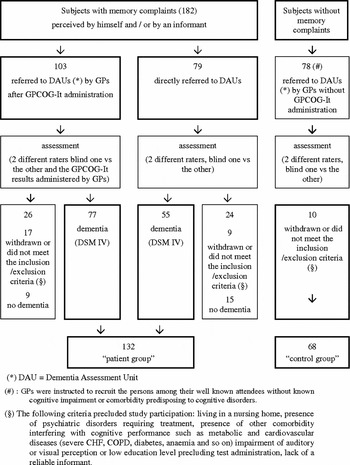
The research was conducted on a sample consisting of two groups: a “patient group” and a “control group”. For the “patient group”, 182 community-dwelling individuals complaining of memory impairment were recruited over a 6-month period: 103 were referred to the Dementia Assessment Units by GPs trained in administering the GPCOG-It in their daily practice activity, whereas 79 directly contacted Dementia Assessment Units seeking medical advice. Of these 182 patients, 132 met the inclusion criteria and completed the study (Figure 1). For the “control group”, 78 individuals were recruited by the GPs during daily practice activity from well-known attendees without any subjective memory complaints, after excluding those with known cognitive impairment or comorbidity predisposing to cognitive disorders such as metabolic and cardiovascular diseases. Of these, 68 individuals met the inclusion criteria and completed the study (Figure 1).
Flow diagram of the recruitment of the sample.

All study participants were required to be at least 55 years old, have an available informant and provide informed consent. The following criteria precluded study participation: living in a nursing home, presence of psychiatric disorders requiring treatment, presence of other comorbidity interfering with cognitive performance such as severe chronic heart failure, chronic obstructive pulmonary disease, diabetes, anemia, impairment of auditory or visual perception or low education level precluding test administration, and lack of a reliable informant. As we were interested in comparing the GPCOG-It and MMSE, we excluded 24 patients who were found not to have dementia: 15 who contacted the Dementia Assessment Units directly without a GP referral and nine who were seen by their GP and referred to Dementia Assessment Units. Informants, defined as persons who usually lived with the patient or met with her/him at least three times a week, were contacted directly or by phone.
The GPs comprised four males and three females, aged from 38 to 55 years. They were a convenience sample of GPs practicing within Italy's National Health System, recruited on a voluntary basis. Their characteristics with regard to age, gender, practice population and location (urban or rural) were similar and representative of Italian GPs. All had worked at least five years in general practice, with four having practiced for more than 20 years. The number of patients per practice varied from 800 (for the younger GPs) to 1500 (for the older GPs). The total number of practice-registered patients was 8,738.
The two Dementia Assessment Units (Unità di Valutazione Alzheimer – UVA) were located in a middle-sized industrial city (Modena = 300,000 inhabitants) and in a rural town (Cento, in the Province of Ferrara = 30,000 inhabitants). The Dementia Assessment Units were part of a nationwide program, labeled “Progetto Cronos” (http://www.alzheimer-cronos.org), implemented by the National Department of Health for the screening, diagnosis and treatment of Alzheimer's disease (AD). The staff employed at the Dementia Assessment Units comprised geriatricians or neurologists and psychologists, grouped in teams targeted to ensure diagnosis, follow-up, pharmacologic and non-pharmacologic treatment for patients and counseling for caregivers of patients with dementia. All the teams employed at the Units received common basic training to minimize inter-rater bias regarding evaluations and treatment plans; moreover, staff inter-rater reliability was periodically reviewed.
Measurements and instruments
All the subjects evaluated by the GPs were asked to make an appointment with the Dementia Assessment Unit, at least one month later. Patients and controls were assessed as follows in the Dementia Assessment Units:
(a) Cognitive domain: GPCOG-It (administered only to the subjects not previously tested by GPs), Mini-mental State Examination (MMSE) (Magni et al., Reference Magni, Binetti, Bianchetti, Rozzini and Trabucchi1996), Cambridge Cognitive Assessment (CAMCOG), the cognitive section of the Cambridge Examination for Mental Disorders of the Elderly – Revised (Giannelli et al., Reference Gianelli, Neri, DeVreese and Polleri2001), Alzheimer's Disease Assessment Scale – Cognitive subscale (ADAS-Cog) (Lucca et al., Reference Lucca, Tettamanti and Spagnoli1994)
(b) Affective domain: 15-item Geriatric Depression Scale (GDS) (Sheikh and Yesavage, Reference Sheikh, Yesavage and Brink1986)
(c) Clinical staging: The Clinical Dementia Rating score (Morris, Reference Morris1993), namely Total (CDR-T) and CDR Sum of Boxes, was applied by two geriatricians (one for each Unit) who were formally trained to apply the procedure as certified by United BioSource Corporation (http://www.unitedbiosource.com). The CDR is a 5-point scale used to characterize six domains of cognitive and functional performance applicable to AD and related dementias: memory, orientation, judgment and problem solving, community affairs, home and hobbies, and personal care. The necessary information to make each rating is obtained only through a semi-structured interview of the patient and a reliable informant or collateral source (e.g. family member) (http://alzheimer.wustl.edu/cdr/default.htm)
(d) Diagnoses of dementia: Diagnoses were made for patients who fulfilled DSM-IV criteria as judged by an expert geriatrician or neurologist blind to the GPCOG-It score based on a semi-structured interview of each outpatient and his/her informant, a physical examination and scores on Italian versions of the MMSE, CAMCOG and ADAS-Cog (Dementia Assessment Unit of Modena) and MMSE and ADAS-Cog (Dementia Assessment Unit of Cento). Two thresholds for diagnoses of dementia on the MMSE were used: (i) the standard score of less than 25, and (ii) a score less than 27, as approved by Italian law for free supply of cholinesterase inhibitors (“Progetto Cronos”). As one of the goals of “Progetto Cronos” was to detect the very early stage of dementia, the MMSE cut-off score was set at a higher level (26/27) in order to improve sensitivity with reliance on further assessments to increase specificity (O'Bryant et al., Reference O'Bryant2008). The CAMCOG cut-off score for diagnoses of dementia was <80 (range 0–105) while for ADAS-Cog the cut-off was >10 (range 0–70).
Validation
The GPCOG-It was validated in two ways: (i) against the gold standard of DSM-IV dementia diagnoses (absence / presence) and (ii) assessing the functional stage with the CDR-T (absence / four worsening stages of presence). Dementia on the CDR-T was categorized as absent (CDR-T = 0), questionable or very mild dementia (CDR-T = 0.5), mild (CDR-T = 1) and moderate (CDR-T ≥ 2).
In order to simplify analyses, the 62 mild and 16 moderate cases with dementia were combined, i.e. 78 cases with CDR-T ≥ 1. The GPCOG-It – total score and its cognitive and informant sections – were compared to MMSE 24/25 and 26/27 thresholds in diagnosing dementia.
Analyses
All analyses were carried out using statistical routines derived from the Statistical Package for Social Sciences (SPSS 13): (a) two-tailed t-tests and χ2 tests were used to compare the demographic and psychometric characteristics of the two groups at baseline; (b) Pearson's coefficient of correlation between demographic data and psychometric measures on one hand and the GPCOG-It cognitive section and the other validated cognitive indices on the other hand, were checked for possible significant relationships; (c) ANCOVA, MANCOVA and subsequent ANOVA or LSD post-hoc tests were carried out to test for possible differences with respect to diagnostic or staging criteria; (d) Receiver Operator Characteristic (ROC) curves were generated and areas under the curve (AUC) calculated for the GPCOG-It total score and sub-scores and MMSE to visualize differences in their sensitivity and specificity.
Results
Characteristics of the sample
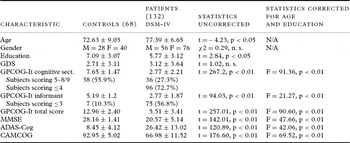
Of the 260 subjects recruited, a total of 200 completed the study (see Figure 1). These comprised 84 males and 116 females with a mean age of 76.1 years (SD 7.2 years; range 56–94 years). Elementary school was completed by 143 subjects (71.5%), middle school by 25 (12.5%) and secondary or university education by 32 (16.0%). Controls were younger and more educated than patients (respectively t = –4.23 and t = 2.84, p < 0.05 for both), whereas no significant difference was found with respect to depression scores and gender distribution (Table 1).
Comparison of demographics and cognitive test scores with DSM diagnosis of dementia (variable mean ± SD, unless otherwise stated)

DSM-IV = Diagnostic and Statistical Manual of Mental Disorders, 4th edn; GDS = Geriatric Depression Scale; GPCOG = General Practitioner Cognitive Assessment of Cognition; MMSE = Mini-mental State Examination; ADAS-Cog = Alzheimer Disease Assessment Scale – Cognitive subscale; CAMCOG = Cambridge Cognitive Assessment.
Comparison of cognitive test scores and DSM diagnosis of dementia
Scores on rating instruments of cognition were highly significantly different between the two groups, even when corrected for age and education (Table 1).
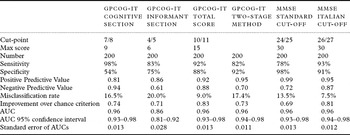
The sensitivity, specificity, positive predictive value (PPV), negative predictive value (NPV) of the GPCOG-It total, 2-stage, patient and informant sections and MMSE using both cut-points against DSM diagnoses of dementia are shown in Table 2. The different indices were reported with both the misclassification rates and the improvement over chance criterion (IOCC; range 0–1). The MMSE Italian cut-off and the GPCOG-It total showed the highest values of IOCC, very close to 1, corresponding to a perfect classification rate. The informant scale alone did not perform as well as the cognitive tests (Table 2).
Sensitivity, specificity, and area under the curve (AUC) for GPCOG-It cognitive and informant sections, GPCOG–It total score, GPCOG-It “two stage “ method and MMSE against DSM-IV dementia diagnosis

GPCOG = General Practitioner Cognitive Assessment of Cognition; MMSE = Mini-mental State Examination; AUC = area under the curve.
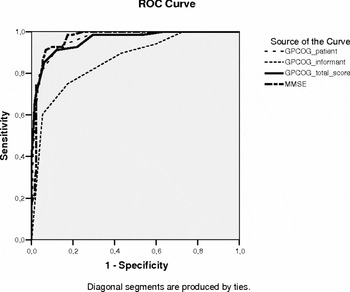
The ROC curves showed very similar slopes (Figure 2). The AUCs of the GPCOG-It total, two-stage and cognitive section and of the MMSE, standard and Italian cut-points, did not show any significant difference for any possible comparison when Z scores were applied corrected for Hanley and McNeil criteria (Hanley and McNeil, Reference Hanley and McNeil1982).
The Receiver Operating Characteristics (ROC) curves for the GPCOG-IT and MMSE.

Comparison of cognitive test scores and clinical staging (CDR)
Of the 132 patients referred to the Dementia Assessment Units who received DSM-IV diagnoses of dementia, 54 were rated as having very mild dementia on the CDR-T, and 78 mild-moderate dementia.
None of the 68 controls received DSM IV diagnoses of dementia but eight had CDR-T scores of 0.5 as some limited functional decline was noted despite normal neuropsychological assessment and no memory impairment as confirmed by the informants. Analyses were conducted with all 68 controls and repeated after reclassifying these eight subjects as CDR-T = 0.5 as they were considered a possible confound.
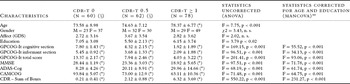
In order to examine the influence of severity of dementia on the performance of the cognitive tests applying an ANOVA, we compared those with CDR-T = 0, 0.5 and ≥1 performing a two-step analysis. At first, the 68 controls and 54 with very mild dementia (CDR-T = 0.5) original groups were considered and then the potentially confounding eight controls with CDR-T = 0.5 were moved into the very mild dementia group [i.e. CDR 0 (68 → 60 Ss.) to CDR 0.5 (54 → 62 Ss.)]. The difference between groups for all possible comparisons was tested by means of an LSD-post-hoc analysis, taking into account a 5% level of significance.
In the first step, each CDR-T group proved to differ significantly from the others with respect to the GPCOG-It indices, MMSE, ADAS and CAMCOG. These differences persisted even when corrected for age and education with a MANCOVA. The second step analyses, performed with the confounding factor moved from the CDR 0 group to CDR 0.5 (Table 3), showed the same pattern of results.
Comparison of demographics and cognitive test scores with clinical staging of dementia

(§) The CDR-T 0.5 group combines both the 54 patients affected from “very mild dementia” and the 8 “normal” cases reporting functional but not memory impairment according to the CDR-T scoring rules (http://alzheimer.wustl.edu/cdr/default.htm).
(*) LSD: p <0.005 for all possible comparisons.
**Lambda Wilk's = 0.85, F(14,182) = 31.62, p>0.001.
CDR-T = Clinical Dementia Rating – Total score; GDS = Geriatric Depression Scale; GPCOG = General Practitioner Cognitive Assessment of Cognition; MMSE = Mini-mental State Examination; ADAS-Cog = Alzheimer Disease Assessment Scale – Cognitive subscale; CAMCOG = Cambridge Cognitive Assessment.
Relations between GPCOG-It indices and psychometric and staging validated measures
The levels of correlation were computed between the three sections of GPCOG-It and cognitive and functional measures. The GPCOG-It total score was highly and significantly correlated with all the cognitive (Pearson's correlations: MMSE = 0.73, CAMCOG = 0.84, ADAS-Cog = −0.70) and functional measures (CDR-Sum of Boxes = −0.75). Also, the GPCOG-It subscales were highly and significantly correlated with all the cognitive (cognitive subscale: MMSE = 0.68, CAMCOG = 0.84, ADAS-Cog = −0.71; informant subscale: MMSE = 0.63, CAMCOG = 0.47, ADAS-Cog = −0.55) and functional measures (cognitive subscale = CDR-Sum of Boxes: −0.75; informant subscale = CDR-Sum of Boxes: −0.68).
Time for administration
The time required for completion of the GPCOG-It was significantly lower than for the other cognitive scales: GPCOG-It Cognitive = 2.97 ± 0.20 minutes; GPCOG-It Informant = 1.53 ± 0.22 minutes; GPCOG-It Total Score = 4.45 ± 0.42 minutes; MMSE = 8.9 ± 1.1 minutes; ADAS-COG = 18.4 ± 7.2 minutes.
Discussion
The data obtained in this study strongly indicate that the GPCOG-It maintains the original psychometric characteristics of the English-language version. The translation work has led to a culturally competent tool, able to provide data that may be compared to those in different cultural settings, such as English-speaking countries and other countries where GPCOG validated translations are available (http://www.gpcog.com.au). Like the original, the GPCOG-It proved to be a valid, efficient and rapid instrument for dementia screening. Moreover, the gain in the levels of both sensitivity and specificity obtained with the original GPCOG two-stage mechanism, was evident in the results of the Italian version as well.
The performance of the GPCOG-It was independent of the patient's gender and affect, and relatively independent of age and educational level. Indeed, the cognitive section score differentiated dementia diagnosis and stage when controlled for age and education. This characteristic makes the instrument relatively free from the pitfall of a higher educational level being able to mask the clinical expression of a higher degree of neurodegeneration (Garibotto et al., Reference Garibotto2008). In order to reduce misclassification rates, it has been proposed that scores adjusted for educational level be used for cognitive testing; such scores have been reported to perform worse than unadjusted ones by some (Teresi, Reference Teresi2007) but not others (Anderson et al., Reference Anderson, Sachdev, Brodaty, Trollor and Andrews2007). Among the strengths of the test, we emphasize that GPs require very little training to administer it. Moreover, the test is simple for testers to remember and repeat. The GPCOG-It requires only 3–5 minutes in an office or home setting where the printed form or just a pencil and paper can be used if other forms are unavailable. Further, the two-stage procedure (Denny et al., Reference Denny2000) optimizes accuracy and efficiency as needed in the screening process. We concede that, as participants in this study were chosen because of their status as having dementia symptoms and diagnoses or not, the psychometric properties of the instrument including PPV and PNV are likely to differ if tested on consecutive general practice attendees where the prevalence of dementia is lower.
The GPCOG is one of a number of brief screening tests for dementia (Lorentz et al., Reference Lorentz, Scanlan and Borson2002). Its uniqueness lies in its combination of both cognitive testing and informant reports as sources of information in one scale, its design specifically for primary care and its two-stage administration to enhance efficiency. The addition of informant data to cognitive testing has been reported to enhance accuracy of dementia screening by several authors (Mackinnon and Mulligan, Reference Mackinnon and Mulligan1998; Jorm, Reference Jorm2003; Kemp et al., Reference Kemp, Brodaty, Pond and Luscombe2002) though not by all (Knafelc et al., Reference Knafelc2003) and has the advantage of being race, gender and education neutral, unlike most performance-based screening tests. The GPCOG-It strategy is aligned with the two-stage mechanism recommended for screening in the way that it is based on two different sources of information: the patient and the informant.
The expertise of GPs in testing procedures may not be particularly high if we consider the figures of incidence and prevalence of dementia in Italy, together with the characteristics of the patients in the practice of an Italian GP. As the maximum number of patients in the practice of an Italian GP is set at 1500, the GP does not have occasion to diagnose many cases of dementia (prevalence: 28 cases – 1.8% of GP patients: females 57%, males 43%; incidence: 4–5 new diagnoses/year – males 1%; females: 1.3%) (De Ronchi et al., Reference De Ronchi2005). However, owing to their long relationships with patients and their families, GPs are in a favorable and unique position to collect information to provide an evaluation of a patient's cognitive and functional profile. This information is considered pivotal for both the diagnostic process and the analysis of treatment effects (Nygärd, Reference Nygärd2003). The GPCOG-It fully performs the information feature, making it very attractive as a psychometric tool for GP daily practice. Even though our data indicate similar diagnostic properties for the GPCOG-It total score when compared with MMSE, using either the standard or Italian cut-off score, the efficiency of the GPCOG-It makes it appealing for Italian GPs to use.
We conclude that the GPCOG-It is a suitable tool for GPs to use to screen for dementia. Our results are in accordance with a recent review (Milne et al., Reference Milne, Curverwell, Guss, Tuppen and Whelton2008) that found GPCOG to be one of the best tools among those proposed for screening for dementia in primary care. Regardless of the controversy about “case-finding” detection versus “cognitive screening of elderly outpatients” (Ashford et al., Reference Ashford2007), the simplicity and rapidity of GPCOG-It testing can improve the ability of GPs to evaluate their patients during their routine practice activity.
Conflict of interest
None.
Description of authors' roles
Alessandro Pirani, Henry Brodaty and Mirco Neri designed the study and wrote the paper. Alessandro Pirani and Mirco Neri supervised Emilio Martini, Davide Zaccherini and Francesca Neviani in collecting the data. Mirco Neri and Henry Brodaty developed the statistical design of the study, and Emilio Martini carried out the statistical analysis.
Acknowledgment
We thank the participating GPs, patients and informants.