




No CrossRef data available.
Article contents
The impact of irrelevant dimensional variation on rule-based category learning in patients with Parkinson's disease
Published online by Cambridge University Press: 26 August 2005
Abstract
This study examined the impact of irrelevant dimensional variation on rule-based category learning in patients with Parkinson's disease (PD), older controls (OC), and younger controls (YC). Participants were presented with 4-dimensional, binary-valued stimuli and were asked to categorize each into 1 of 2 categories. Category membership was based on the value of a single dimension. Four experimental conditions were administered in which there were zero, 1, 2, or 3 randomly varying irrelevant dimensions. Results indicated that patients with PD were impacted to a greater extent than both the OC and YC participants when the number of randomly varying irrelevant dimensions increased. These results suggest that the degree of working memory and selective attention requirements of a categorization task will impact whether PD patients are impaired in rule-based category learning, and help to clarify recent discrepancies in the literature. (JINS, 2005, 11, 503–513.)
Information
- Type
- Research Article
- Information
- Journal of the International Neuropsychological Society , Volume 11 , Issue 5 , September 2005 , pp. 503 - 513
- Copyright
- © 2005 The International Neuropsychological Society
INTRODUCTION
The ability to acquire new categories is a fundamental aspect of human cognition that has great implications for adapting to new environments. Recent research attempts to better understand the cognitive systems that are involved in learning to categorize, and one important theme that has emerged is the possibility of multiple category learning systems (Ashby & Maddox, 2005; Maddox & Ashby, 2004). One proposed category learning system that has received much attention is the hypothesis testing system, which is thought to be involved in the acquisition of highly salient and verbalizable rules that are often based on a single stimulus feature (e.g., blue items are in Category A and red items are in Category B; Ashby et al., 1998; Bruner et al., 1956; Garner, 1978; Smith et al., 1998). Category learning tasks with these structures are often referred to as rule-based tasks because a simple, verbalizable rule can be used to describe category membership.
Previous studies using rule-based tasks with non-neurological (or control) populations provide strong support for the existence of a hypothesis testing system and insights into the properties of this form of category learning (Ashby et al., 2002, 2003a; Maddox et al., 2003, 2004a, 2004b; Waldron & Ashby, 2001; for a review see Maddox & Ashby, 2004). For example, when controls are asked to perform a secondary, memory scanning task, performance on rule-based category learning tasks suffers (Maddox et al., 2004a). In addition, increasing the number of categories (and thus the number of decision rules to be learned) can also negatively impact the learning of rule-based category structures in controls (Maddox et al., 2004b). These studies suggest that working memory resources and/or selective attention processes are necessary for the learning of rule-based categories (see also Ashby et al., 1998; Waldron & Ashby, 2001).
From a neuroanatomical standpoint, there has also been recent evidence from functional imaging studies with controls that have attempted to identify the neurobiological substrates of the hypothesis testing system. For example, in a recent study, Filoteo et al. (in press) identified a network of brain regions including the dorsolateral frontal cortex, the parietal lobe, and the head of the caudate that was activated during the learning of rule-based categories. Similarly, other studies have also identified dorsolateral frontal and parietal activation on rule-based tasks in controls using both visual (Patalano et al., 2001; Vogels et al., 2002) and verbal material (Grossman et al., 2002). Given the proposed role of working memory and selective attention in rule-based category learning, it is not surprising that dorsolateral frontal and parietal activation has been identified when control participants learn rule-based tasks, particularly in light of the fact that these brain regions are often involved when individuals perform more traditional tasks of working memory (Collette & Van der Linden, 2002; Wager & Smith, 2003) or selective attention (Assad, 2003).
Other studies have examined rule-based category learning in patients with Parkinson's disease (PD), a neurodegenerative disorder that is known to impact striatal functioning (Gibb, 1992). Maddox and Filoteo (2001), for example, examined rule-based category learning in a group of nondemented PD patients. In their study, participants were presented with connected vertical and horizontal lines that varied trial-by-trial in length. Stimuli that had longer vertical lines than horizontal lines belonged to one category and stimuli that had longer horizontal lines than vertical lines belonged to the other category. This is a rule-based category learning task because the rule is easy to describe verbally. The results of the study indicated that PD patients learned the rule-based categories as quickly and to the same level as controls. Thus, this study provided initial evidence that the striatum is not involved in learning rule-based categories.
Although the study by Maddox and Filoteo (2001) suggested that PD does not impact rule-based category learning, not all studies have found this to be the case. In fact, Ashby et al. (2003b) found exactly the opposite result. In that study, participants were asked to categorize single cards that consisted of colored geometric figures on a colored background. Each stimulus varied from trial-to-trial along four binary-valued dimensions. In the rule-based condition, category membership was defined by the value on a single dimension (e.g., color of the stimuli). Interestingly, PD patients were impaired in learning the rule-based task in terms of the number of participants who were able to meet a specific learning criterion. Notice that the Ashby et al. task is very similar to the Wisconsin Card Sorting Test (WCST; Berg, 1948), a test on which PD patients have often been shown to be impaired (e.g., Gotham et al., 1988). Thus, taken together, these latter set of results suggest that PD patients are impaired when having to learn rule-based categories, a finding that is in contrast to that observed by Maddox and Filoteo (2001).
The main purpose of the present study was to explore possible reasons for these discrepant findings. In the study by Maddox and Filoteo (2001), the stimulus on each trial consisted of a horizontal line and a vertical line. The lengths of these lines varied across trials and correct categorization required attention to both dimensions—that is, there was no irrelevant dimensional variation. Under these conditions PD patients showed normal rule-based category learning. In contrast, in the Ashby et al. (2003b) study, one dimension of the stimulus was relevant, and three dimensions could vary randomly from trial to trial. Under these conditions, PD patients showed a deficit in rule-based category learning Thus, the PD deficit observed in Ashby et al., but not Maddox and Filoteo, might be due to differences in the number of dimensions that could vary in value from trial to trial (three dimensions in the study by Ashby et al. vs. zero dimensions in the study by Maddox & Filoteo).
To test this possibility in the present study, a group of nondemented PD patients and older control (OC) participants were administered a rule-based category learning task in which each stimulus was constructed from four binary-valued dimensions (see Figure 1) and the number of irrelevant dimensions varied systematically across four randomly administered conditions. In all conditions, one dimension was selected at random to be relevant, and the remaining three were irrelevant. Across the four conditions, there were zero, 1, 2, or 3 possible randomly varying irrelevant dimensions. For example, in the condition where there were zero varying irrelevant dimensions (Condition Zero), the only dimension that varied from trial to trial was the one relevant to the category membership. In contrast, in the condition where there were two possible irrelevant varying dimensions (Condition 2), the one dimension that was relevant to category membership varied from trial to trial, but in addition, two other dimensions that were not relevant to category membership could also vary from trial to trial. Thus, the selective attention and working memory requirements varied systematically across the four different conditions as a function of the number of varying irrelevant dimensions, thereby allowing us to evaluate whether this manipulation differentially impacted the rule-based category learning abilities of patients with PD. Importantly, however, the category learning requirements remained the same across all four conditions in that correct category learning always depended on learning to categorize each stimulus based on the value of a single dimension.

Single examples of stimuli from the six possible sets of stimuli.
In addition to examining the potential impact of this manipulation in PD patients, we also wanted to determine whether there were any age-related differences that might occur on this task. Age-related changes in working memory and selective attention have also been well documented in the literature (Bowles & Salthouse, 2003; Maddox et al., 1998; West, 1999), but to our knowledge no study has attempted to systematically determine whether increasing the requirements of these processes would differentially impact rule-based category learning in older versus younger adults. To examine this possibility, we also administered the task to a group of younger control (YC) participants and compared their results to those of the PD patients and OC participants. Based on our hypothesis that the working memory and/or selective attention requirements might account for the discrepancies observed between the study by Ashby et al. (2003b) and the study by Maddox and Filoteo (2001), we predicted that the rule-based category learning in PD patients would be impacted to a greater extent than OC participants by increasing the number of irrelevant varying dimensions. In addition, we also hypothesized that age would impact negatively the ability to learn rule-based categories when the number of varying dimensions increases.
METHODS
Research Participants
A total of 54 individuals participated in this study: 19 patients with PD (8 male and 11 female), 19 OC participants (7 male and 12 female), and 16 YC participants (7 male and 9 female). The patients were diagnosed by a board-certified neurologist based on the presence of two of the following symptoms: (1) resting tremor, (2) rigidity, or (3) bradykinesia. The patients had been diagnosed an average of 7.6 years (range = 1–26 years; SEM = 1.3) prior to their participation in this study. At the time of their participation, all patients were taking some form of dopaminergic medication. Using Hoehn and Yahr's (1967) rating scale, the mean motor impairment rating for the group was 1.7 (range = 0–3; SEM = 0.2). OC participants were recruited from the community and YC participants were undergraduates at the University of Texas who participated in the study as partial fulfillment of course requirements. Table 1 shows the mean age and years of education of all three groups, and the scores on the Dementia Rating Scale (DRS; Mattis, 1988) for the PD patients and OC participants. The three groups did not differ in gender distribution [χ2 = 0.2, df = 1.0, p > .05]. As expected, a one-way ANOVA indicated that the three groups differed in age [F(2,51) = 194.9, p < .001], and Tukey's HSD tests indicated that the age of the YC participants was lower than the age of the other two groups (p < .001 for both comparisons), but the age of the PD patients and OC participants did not differ. A one-way ANOVA also indicated that the three groups differed in years of education [F(2,51) = 11.3, p < .001], and Tukey's HSD tests revealed that the YC participants had less education than either the PD patients or the OC participants (p < .05 for both comparisons), but that the PD patients and OC participants did not differ. The PD and OC groups did not differ in their scores on the DRS (p > .05). Given that the DRS is a measure of global cognitive functioning, the lack of a difference between the two groups on this measure indicates that the patients were non-demented.
Demographic characteristics and Dementia Rating Scale Scores of the PD patients and controls

The PD patients and OC participants were also given a short battery of neuropsychological tests in order to better characterize their general cognitive functioning. These tests were selected because they evaluate cognitive domains that are often impaired in patients with PD. The battery consisted of the Wisconsin Card Sorting Test (WCST: Berg, 1948; Heaton et al., 1993), the California Verbal Learning Test–2 (CVLT–2; Delis et al., 2000), and the Judgment of Line Orientation Test (JLOT; Benton et al., 1978). The WCST is a measure of novel learning and set shifting that shares many of the same characteristics as the task used in the present study. In the WCST, the participant has to learn by trial and error a specific rule when matching cards of multiple dimensions (color, form, and number) to one of four key cards. Once the participant correctly classifies 10 cards in a row, the examiner changes the correct dimension to which the participant must sort (e.g., from color to form) without informing the participant. The participant must then use the trial-by-trial feedback in order to disengage from the previously correct dimension in order to change to the new relevant dimension. Indices from the WCST examined in the current study include the number of categories achieved within 128 trials (WCST–Cat), the number of perseverative errors (i.e., the number of times a participant made a classification response to a previously correct dimension; WCST–PE), and the number of set loss errors (i.e., the number of times a participant made at least five correct responses in a row but failed to achieve the criterion of 10 correct responses in a row; WCST–SL). The CVLT–2 is a measure of verbal learning and memory in which a 16 item word list is read to the participant who is asked to state back as many of the list items as possible on five different learning trials, short and long delay free-recall trials, and short and long cued recall conditions. The participant is also provided with a recognition condition in which they are presented with list and non-list items and asked to state whether the word presented was from the original list. The primary CVLT–2 indices examined in this study were the number of words recalled on the first learning trial (CVLT–2 Trial 1), the total number of words recalled on the five learning trials (CVLT2–Total), the total number of words recalled on the long delay free-recall trial (CVLT2–LDF), and the recognition discriminability index that is based on the number of times the participant correctly discriminated list items from non-list items during the recognition trial (CVLT2–Discr). The JLOT is a measure of visuospatial abilities in which the participant is presented two lines oriented at different angles on one page and 10 lines oriented at different angles on a second page. The participant is then asked to identify which two lines on the second page are in the same orientation as the two lines from the first page. The primary JLOT index examined in this study was the number of correct items out of 30.
The raw scores from the key indices of these tests are displayed in Table 1 for the PD patients and OC participants and were compared using t tests. Note that 2 OC participants were not given the tests due to time constraints on the day of their participation, and 1 PD patient was not given the CVLT–2 for the same reason. The results of these comparisons revealed differences only on the total words recalled on the CVLT–2 [CVLT–Total: t(33) = 2.2, p < .05], and on the delayed free recall trial of the CVLT–2 [CVLT–LDF: t(33) = 2.6, p < .05], but not on any of the other CVLT–2 indices or other tests.
Stimuli
Six different sets of stimuli were used that consisted of the following: castles, gardens, houses, rings, shapes, and planes/sharks. These names, however, were never used during the actual administration of the experiment. Examples of individual exemplars from each of the six sets are shown in Figure 1. For each set, four possible binary-valued dimensions could vary from trial to trial. These four dimensions and the binary values for each stimulus set were the following: castle stimuli: shape of foundation (diamond or square), location of ramparts (above walls or sunken into walls), number of rings surrounding castle (one or two), color of drawbridge (yellow or green); garden stimuli: texture of the ground (brown dirt or green grass), fountain material (gray cement or brown clay), placement of water and flowers (water inside circles or flowers inside circles), number of circular planters or water fountains (one or two); house stimuli: color of door (blue or red), lighting inside window (lights off or lights on), shape of roof (flat or triangular), nature of plants (shrub or tree); ring stimuli: placement of gold ring (vertical around front ring or tilted around back ring), material of large ring in background (ice or cloud), placement of red balls (outer periphery or central), natural element (water or fire); shape stimuli: color of bar (red or green), orientation of bar (horizontal or vertical), nature of blue shape (triangle or square), number of yellow circles (one or two); plane/shark stimuli: nature of the nose (shark or plane), nature of eyes or cockpit (shark or plane), nature of the main wings or side fins (shark or plane), nature of the back and tail fins (shark or plane).
Each stimulus was presented in colors that remained constant except for those dimensions that were relevant to the categorization task described above. Each stimulus was approximately 10 cm in height and from a viewing distance of approximately 60 cm subtended about 9.6° of visual angle.
General Procedure
Each individual participated in four experimental conditions (and thus saw only four out of the six possible stimulus sets) where one to four of the binary-valued dimensions varied from trial to trial. In Condition Zero, only the relevant dimension of the stimulus could vary from trial to trial, whereas all other stimulus dimensions were held constant at a randomly chosen fixed value. In Condition 1, both the relevant dimension and a second binary-valued dimension could vary from trial to trial, and all other dimensions were held constant. In Condition 2, the relevant dimension and two other binary-valued dimensions could vary from trial-to-trial and the fourth dimension was held constant, and in Condition 3, the relevant dimension and all three remaining binary-valued dimensions could vary from trial to trial. Given this constraint, participants could see two to 16 unique stimuli (depending on the condition), with half of those stimuli being assigned to Category 1 and the other half being assigned to Category 2. For each set of stimuli, the participant had to determine the appropriate dimension and the dimensional value that determined category membership. The relevant dimension remained the same throughout all trials within each of the conditions. To minimize the possibility that any observed group differences were due to order effects or the specific stimulus sets used in any of the four conditions, the selection and order of stimulus sets and the order of conditions was counter-balanced across participants using Latin squares. The same counter-balancing technique was used for all three groups. The relevant dimension for category membership was determined randomly for each participant.
At the beginning of the experiment, participants were told that they would be shown individual pictures and asked to categorize each as either belonging to Category 1 or Category 2 by pressing a specified key. They were also told that after they categorized the picture, they would receive feedback in the form of applause for correct responses and a buzzing sound for incorrect responses. The participants were also told that they would be guessing at first and that they should attempt to learn from their errors. Each trial began with the presentation of a picture which remained on the screen until the participant made a categorization response. Immediately following a response, correct or incorrect feedback was presented for 0.75 s while the stimulus remained on the screen, followed by a blank screen for 1.0 s, and then presentation of the next stimulus. Each condition continued until the participant made 10 correct categorization responses in a row, or until they reached a maximum of 200 trials. The participant was offered a short break after the completion of each condition and was then administered another condition.
RESULTS
Trials to Criterion
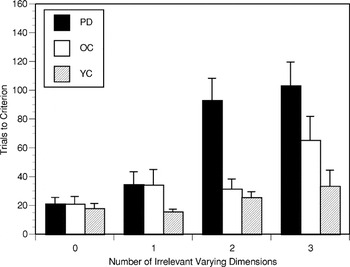
The mean trials to criterion (i.e., the number of trials it took to get 10 in a row correct) for the three groups in the four conditions are displayed in Figure 2. These data were analyzed using a group (PD vs. OC vs. YC) by condition (Conditions 0–3) mixed-design ANOVA. The results of this analysis revealed a significant main effect of group [F(2,51) = 8.0, p < .001], a significant main effect of condition [F(3,153) = 17.9, p < .001], and a significant Group × Condition interaction [F(6,153) = 4.9, p < .001]. To determine in which of the four conditions the groups differed, one-way ANOVAs were conducted separately for each condition. The results of the one-way ANOVAs were not significant in either Condition 0 (F < 1.0) or Condition 1 [F(2,51) = 1.5, p = .22], but they were significant in Condition 2 [F(2,51) = 13.8, p < .001] and in Condition 3 [F(2,51) = 5.0, p < .05]. Follow-up comparisons in Condition 2 using Tukey's HSD revealed that the PD patients had a significantly greater mean number of trials to criterion than either the OC participants or the YC participants (p < .001 for both comparisons), whereas the other two groups did not differ from each other. These results can be seen very readily in Figure 2. Follow-up comparisons in Condition 3 revealed that the PD patients had a greater mean trials-to-criterion than the YC participants (p < .01), but the PD patients did not differ from the OC participants, nor did the OC participants differ reliably from the YC participants.a
However, a direct comparison of the OC and YC participants using an independent t test revealed a trend towards OC participants taking more trials than the YC participants to learn the rule in Condition 3 [t(33) = 1.5, p = .13].

Mean trials-to-criterion for the PD patients and the OC and YC participants in the four conditions. (Error bars are standard error of the mean.)
To confirm this pattern of results, we also conducted one-way ANOVAs for the four conditions separately within each group. The effect of number of dimensions was significant for the PD patients [F(3,54) = 16.1, p < .001], and follow-up paired t-tests of adjacent conditions indicated that the only two conditions that differed within the PD patients were Conditions 1 and 2 [t(18) = 2.7, p < .01]. The effect of number of dimensions was also significant within the OC participants [F(3,54) = 5.0, p < .01], but in contrast to the PD patients, follow-up paired t tests of adjacent conditions indicated that the only two conditions that differed were Conditions 2 and 3 [t(18) = 2.3, p < .05]. For the YC participants, the effect of number of dimensions was not significant [F(3,45) = 1.7, p = .18].
Set Loss Errors
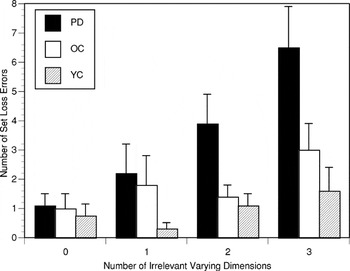
To further examine the nature of PD patients' rule-based category learning deficit, we examined set loss errors in each of the four conditions. A set loss error was defined as three correct responses in a row followed by an incorrect categorization.b
Note that this criterion is somewhat more liberal than is used in defining a set loss on the WCST in which 5 correct responses in a row are required. We chose a somewhat less stringent definition because, unlike in the WCST, the rule-based task we used did not allow for ambiguous responses. That is, because of the nature of the stimuli in the WCST, a participant could make a correct categorization response because a stimulus matched a category on two different dimensions (i.e., there are ambiguous responses in the WCST), and this was not the case in the task used in the present study. The lack of potential for ambiguous responses in the experimental task enabled an establishment of response set within fewer trials, thus, we felt it was appropriate to define set losses using three correct responses in a row. In addition, it should also be noted that the measure of set loss error could be overestimating the “true” number of set loss errors in that participants could be responding correctly based on chance during the run of three correct trials.

Mean total number of set loss errors for the PD patients and the OC and YC participants in the four conditions. (Error bars are standard error of the mean.)
As a follow-up to the overall set loss analysis, we also examined the nature of the set losses committed by those participants who made such errors. In so doing, we coded each set loss based on whether it occurred following a change in the target value (i.e., the value on the relevant dimension) versus when the target value remained the same. The former type of set loss is more like a perseverative motor response in that, despite the fact that the target changed values, the participant continued to make the same response when they should have switched responses. Hereafter, we will refer to this type of set loss as a repetitive set loss. In contrast, the latter type of set loss is more consistent with what is typically meant by the term “set loss” in that the participant spontaneously switched their categorization response despite the fact that the target value remained the same, so we will refer to this type of error as a disengage set loss.
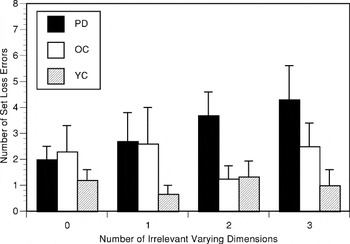
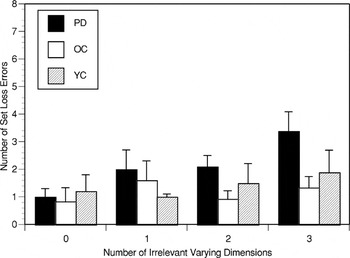
The mean number of repetitive set losses and disengage set losses for the three groups by condition are displayed in Figures 4 and 5, respectively. Separate one-way ANOVAs were conducted on the data in each condition since all participants did not contribute data to all four conditions (only individuals who committed at least one set loss were included in these analyses). Because of this, the analyses of these conditions are not entirely comparable given that different participants contributed data to the different conditions. The number of participants from each group that committed at least one set loss in the four conditions are the following: Condition Zero, PD = 7, OC = 6, YC = 5; Condition 1: PD = 9, OC = 8, YC = 3; Condition 2: PD = 13, OC = 12, YC = 6; Condition 3: PD = 16, OC = 13, and YC = 9.

Mean repetitive set loss errors in the four conditions for the PD patients and the OC and YC participants who committed at least one set loss. (Error bars are standard error of the mean.)

Mean disengage set loss errors in the four conditions for the PD patients and the OC and YC participants who committed at least one set loss. (Error bars are standard error of the mean.)
As can be seen in Figure 4, PD patients tended to commit more repetitive set losses than either of the two groups across the four conditions. The only significant difference among the three groups was in Condition 2 [F(2,28) = 3.9, p < .05] and Tukey's HSD contrasts indicated that the PD patients committed more repetitive set losses than the OC participants (p < .05). There was also somewhat of a trend for the groups to differ in Condition 3 [F(2,35) = 2.3, p = .12], but there were no differences in Conditions Zero and 1 (both Fs < 1.0). A further analysis of the data in Condition 2 was conducted in which we examined whether there were any differences between the PD patients and the OC participants in terms of the number of repetitive set losses that occurred when either one or two irrelevant dimensions varied across the set loss trials as well as the number of repetitive set losses that occurred when no irrelevant dimensions varied across the set loss trials. Note that this analysis was possible because despite the fact that up to two irrelevant dimensions could vary from trial to trial in Condition 2, there were some instances when none of the irrelevant dimensions varied and other instances when one or two dimensions varied. The mean number of repetitive set losses that occurred when there were at least one or two irrelevant dimensions varying was 3.2 (SEM = .9) for the PD patients and .83 (SEM = .3) for the OC participants, and this difference was significant [t(23) = 2.5, p < .05]. In contrast, the mean number of repetitive set losses that occurred when there were no irrelevant dimensions varying was .46 (SEM = .3) for the PD patients and .42 (SEM = .2) for the OC participants. The mean difference for these set loss errors between the two groups was not significantly different (t < 1.0). Thus, it appears that when there was greater distraction (i.e., when the irrelevant dimensions varied), PD patients were more likely than controls to commit a repetitive set loss.
In contrast, the differences in disengage set losses among the three groups were not dramatically different, as can be seen in Figure 5. One-way ANOVAs identified only trends in Condition 2 [F(2,28) = 2.3, p = .12], and Condition 3 [F(2,35) = 2.0, p = .15], but no reliable differences in Condition Zero and Condition 1 (both F's < 1.0).
Correlations of Rule-Based Category Learning
We also wanted to determine whether performance on the categorization task was associated with any of the disease characteristics of the PD patients and their performance on the neuropsychological tests, so we took a difference score between the trials-to-criterion in Condition 3 and the trials-to-criterion in Condition Zero and correlated this “distractor index” score with PD patients' Hoehn and Yahr ratings, length of their illness, and their neuropsychological test scores. The distractor index score was used in these analyses because it reflected the overall impact that the irrelevant varying dimensions could have on performance while taking into account baseline performance when there was only one varying dimension. Specifically, the greater distractor index scores reflected a greater impact of the varying irrelevant dimensions. The results of these correlations revealed a significant relationship between greater distractor index scores and greater Hoehn and Yahr ratings, reflecting poorer motor functioning [r(17) = 0.57, p < .05], whereas there was no association between this difference score and length of illness (p = 0.18). In terms of the neuropsychological tests, not surprisingly a greater distractor index score was associated with lower number of categories achieved on the WCST [r(17) = −.54, p < .05], and a higher number of perseverative errors [r(17) = .48, p < .05]. There was no reliable association between the categorization difference score and their number of set loss errors on the WCST or their scores on the JLOT. There was a trend towards an association between higher scores on the distractor index and lower scores on the DRS [r(17) = −.41, p = .08]. Interestingly, the distractor score was not associated with any of the indices from the CVLT–2 (all p's > .20).
DISCUSSION
The primary purpose of this study was to determine whether increasing the number of randomly varying irrelevant dimensions differentially impacted rule-based category learning in PD patients. The main finding was that, relative to the OC participants, PD patients displayed a sharper increase in trials to criterion as the number of irrelevant dimensions increased. Specifically, PD patients and OC participants did not differ when the number of randomly varying irrelevant dimensions was zero or 1, but the PD patients took over twice as many trials compared to the OC participants to learn the categories when there were two varying irrelevant dimensions (i.e., in Condition 2; see Figure 2). Interestingly, however, when there were three irrelevant varying dimensions, the PD patients and OC participants did not differ. In regard to the impact of age on rule-based category learning, although the follow-up contrasts between the OC and YC participants in the four conditions never revealed any significant differences, there was some evidence that age played an important role in determining whether irrelevant dimensional variation impacted rule-based category learning. Specifically, within-group comparisons indicated that the trials-to-criterion differed reliably across the four conditions in the OC participants but not the YC participants, suggesting that older adults were impacted by irrelevant dimensional variation whereas YC participants were not.
Taken together, these results indicate that both PD and age can contribute to changes in rule-based category learning when there are varying irrelevant dimensions, but that the threshold at which these contributions emerge is different for these two variables. That is, the impact of PD on rule-based category learning will emerge at a lower threshold (i.e., two varying irrelevant dimensions) than the impact of age, but as the number of irrelevant varying dimensions increases (up to three), the impact of age on rule-based category learning will also become apparent. These results suggest a graded impact of PD and age on how increasing the number of varying irrelevant dimensions can impact rule-based category learning, with the effects of PD on rule-based category learning occurring with fewer irrelevant varying dimensions as compared to the older controls.
The pattern of differences that emerged between the PD patients and OC participants helps to clarify some of the discrepant findings from past studies. Recall that Maddox and Filoteo (2001) and Ashby et al. (2003b) found opposite results. In the former study, PD patients were normal at learning rule-based categories, whereas in the latter study, PD patients were impaired. The results from the present study suggest that this discrepancy may be due to the number of irrelevant varying dimensions in the rule-based tasks. In the study by Maddox and Filoteo (2001), there were no irrelevant varying dimensions in the rule-based condition and PD patients were not impaired in learning, a finding that is consistent with the results from Condition 0 in the present study in which there were also no varying irrelevant dimensions and PD patients and OC participants did not differ in the number of trials it took to learn the rule. In the study by Ashby et al., in which there were three irrelevant varying dimensions, PD patients were impaired; a finding that is consistent with the results from Condition 2 in which PD patients took more trials to learn the categories than the OC participants. Note that although the number of irrelevant dimensions it took to identify an impairment in the PD patients differed in the present study and the study by Ashby et al. (2 vs. 3, respectively), the important point is that increasing the number of irrelevant varying dimensions increased the likelihood of a rule-based category learning impairment in patients with PD. The number of irrelevant varying dimensions it takes to elicit such impairment may be impacted by other variables, such as the general complexity of the stimuli.c
Interestingly, the majority of the stimuli used in this present study were more complex than those used in the study by Ashby et al. (2003b), in which the relevant dimensions were basic elements of a visual stimulus (e.g., shape, color, number of shapes). As such, it is possible that the more complex the stimuli, the fewer the number of varying irrelevant dimensions would be necessary to disrupt rule-based category learning in patients with PD.
Based on the present findings, it appears that both PD and normal aging can impact the extent to which the number of varying irrelevant dimensions affects rule-based category learning. Given that rule-based category learning is proposed to require both working memory and selective attention (Ashby et al., 1998; Smith & Sloman, 1994), it is likely that deficits in one or both of these processes accounted for the pattern of results we obtained. This is especially likely given that both PD and normal aging can impact these processes (Bowles & Salthouse, 2003; Bradley et al., 1989; Filoteo & Maddox, 1999; Maddox et al., 1996, 1998; Postle et al., 1997; West, 1999). However, it is difficult to determine exactly which of these two processes best accounts for how increasing the number of irrelevant varying dimensions can impact rule-based category learning in these populations. Nevertheless, an examination of the set loss errors offers some insight into this issue, particularly in regard to the differences between the PD patients and OC participants. Specifically, when participants committed a set loss error, PD patients were more likely than OC participants to make a repetitive set loss in Condition 2, the condition where there was the greatest difference between PD patients and OC participants in the mean number of trials to criterion. Furthermore, follow-up analyses indicated that the tendency for PD patients to commit such errors was more likely when there were at least one or two irrelevant dimensions that varied across the set loss trials in Condition 2, whereas this was not the case when none of the irrelevant dimensions varied. Given that a change in irrelevant dimensional values across consecutive trials likely results in greater distractibility, these results suggest that an impairment in selective attention may have played more of a role in the PD patients' deficit in learning the rule-based categories in Condition 2.
Regardless of whether selective attention or working memory deficits underlie PD patients' rule-based category learning deficit, it appears that an impairment in inhibition might ultimately account for the present findings. Specifically, varying the number of irrelevant dimensions likely impacted participants' ability to inhibit the processing of these dimensions, regardless of whether such inhibition occurred at a selective attention or working memory stage of processing. Inhibitory deficits have been described in PD patients in several previous studies (Filoteo & Maddox, 1999; Poliakoff et al., 2003; Praamstra & Plat, 2001), and models of normal striatal functioning often attribute inhibitory processes to these brain regions (Kropotov & Etlinger, 1999; Mink, 1996). Thus, a deficit in inhibitory processing could account for the results obtained in the present study.
As might be expected, PD patients' performance on the WCST in terms of number of categories achieved and number of perseverative errors was associated with their scores on the distractor index. These results suggest that the task in the present study and the WCST are measuring similar processes. This is not surprising given that the WCST is a rule-based task in that the rules that dictate category membership can be easily verbalized. That is, in much the same way as in the experimental task in the present study, participants performing the WCST simply have to recognize that they are to sort the cards based on a particular stimulus dimension. However, the fact that the PD patients and the controls in this study did not differ on any of the measures from the WCST, but did differ in Condition 2 of the experimental task, suggests that the experimental categorization task may be more sensitive to the cognitive changes associated with PD. Why this is the case remains to be seen, but it is possible that the working memory and/or selective attention demands in the experimental task are greater than those in the WCST (possibly due to stimulus complexity issues), and PD patients' purported deficits in these areas contributed more to impaired rule-based category learning in the experimental task than the WCST. Alternatively, it could be that the testing format of the experimental task resulted in greater impairment in the PD patients in that participants were given four different experimental conditions using four of six different stimulus sets. Future work could test either of these possibilities by examining rule-based category learning while systematically varying stimulus complexity and holding constant the number of irrelevant varying dimensions.
Another interesting correlation that was observed in the PD patients was between the scores on distractor index and the scores on the Hoehn and Yahr rating scale. Although this motor rating scale is a rather gross measure of motor functioning, PD patients with greater motor impairment required more trials to reach criterion when the number of varying irrelevant dimensions increased. These results suggest an association between the brain regions involved in the motor deficits observed in PD and those brain regions involved in rule-based category learning. This is an interesting finding given that PD tends to differentially impact subregions of the striatum with greater dysfunction occurring within the putamen as compared to the caudate (Broussolle et al., 1999; Leenders et al., 1990). Traditional models of striatal functioning have attributed motor functions more to the putamen, whereas cognitive functions (such as those necessary to perform the task in the present study) have been attributed more to the caudate (Alexander et al., 1986). Thus, the finding of an association between patients' level of motor impairment and their distractor index score is somewhat unexpected. However, it is also possible that this association simply reflects the overall level of pathology in these PD patients.
The finding that older adults were also impacted negatively by increasing irrelevant dimensional variation is consistent with the observed changes in striatal volume in normal aging (Gunning-Dixon et al., 1998; Jernigan et al., 1991). However, one must also consider the possibility that changes in prefrontal structures might also account for the age effects observed in this study given that this brain region also changes with age (Jernigan et al., 2001; Salat et al., 2001). This latter issue raises the interesting possibility that the behavioral impact of irrelevant dimensional variation in PD and normal aging is due to alterations in different underlying brain regions (i.e., striatal dysfunction in PD and normal age-related changes in the prefrontal cortex in the older adults), although the possibility of prefrontal dysfunction in PD patients must also be considered as contributing to the present findings.
Finally, although we did not examine the issue directly in the present study, our data also speak to the possibility of multiple category learning systems. Previous research indicates that PD patients can demonstrate deficits in learning both rule-based and information-integration category learning tasks. Information-integration category learning is thought to occur implicitly through a procedural learning system that relies on certain regions of the striatum (i.e., the tail of the caudate; Ashby et al., 1998). In two previous studies, we found that PD patients were differentially impaired relative to controls when asked to learn a complex, nonlinear rule that likely emphasized the information-integration category learning system (Filoteo et al., 2005; Maddox & Filoteo, 2001). The findings from the current study, however, also confirm that PD patients are impaired in learning rule-based categories, and that the deficits may be associated with the emphasis of working memory and/or selective attention demands as the number of irrelevant dimensions increases. Thus, taken in conjunction with previous studies, the present results suggest that PD patients may be impaired in both rule-based and information-integration category learning, but for entirely different reasons. That is, a rule-based category learning deficit in PD may be associated with impairments in selective attention and/or working memory, as stated above. In contrast, PD patients' information-integration category learning deficits appear to be due more to the complexity of the rule (i.e., whether it be linear or non-linear). The possibility of PD patients being impaired in both types of category learning tasks was proposed by Ashby et al. (1998) in their original conceptualization of these category learning systems. The results of the present study help to identify under what conditions a rule-based category learning deficit is likely to be observed in patients with PD.
ACKNOWLEDGMENTS
This research was supported in part by National Institute of Health Grant R01 NS41372 to J.V.F., National Institute of Health Grant R01 MH59196 to W.T.M., and a McDonnell-Pew Consortium Grant.
References
REFERENCES
Alexander, G.E.,
DeLong, M.R., &
Strick, P.L.
(1986).
Parallel organization of functionally segregated circuits linking
basal ganglia and cortex.
Annual Review of Neuroscience,
9,
357–381.CrossRefGoogle Scholar
Ashby, F.G.,
Alfonso-Reese, L.A.,
Turken, A.U., &
Waldron, E.M.
(1998).
A neuropsychological theory of multiple systems in category
learning.
Psychological Review,
105,
442–481.CrossRefGoogle Scholar
Ashby, F.G.,
Ell, S.W., &
Waldron, E.M.
(2003a).
Procedural learning in perceptual categorization.
Memory and Cognition,
31,
1114–1125.Google Scholar
Ashby, F.G. &
Maddox, W.T.
(2005).
Human category learning.
Annual Review of Psychology,
56,
149–178.CrossRefGoogle Scholar
Ashby, F.G.,
Maddox, W.T., &
Bohil, C.J.
(2002).
Observational versus feedback training in rule-based and
information-integration category learning.
Memory & Cognition,
30,
666–677.CrossRefGoogle Scholar
Ashby, F.G.,
Noble, S.,
Filoteo, J.V.,
Waldron, E., &
Ell, S.
(2003b).
Category learning deficits in Parkinson's disease.
Neuropsychology,
17,
115–124.Google Scholar
Assad, J.A.
(2003).
Neural coding of behavioral relevance in parietal cortex.
Current Opinions in Neurobiology,
13,
194–197.CrossRefGoogle Scholar
Benton, A.L.,
Varney, N.R., &
Hamsher, K.
(1978).
Visuospatial judgment: A clinical test.
Archives of Neurology,
35,
364–367.CrossRefGoogle Scholar
Berg, E.A.A.
(1948).
A simple objective test for measuring flexibility in
thinking.
Journal of General Psychology,
39,
15–22.CrossRefGoogle Scholar
Bowles, R.P. &
Salthouse, T.A.
(2003).
Assessing the age-related effects of proactive interference on
working memory tasks using the Rasch model.
Psychology and Aging,
18,
608–615.CrossRefGoogle Scholar
Bradley, V.A.,
Welch, J.L., &
Dick, D.J.
(1989).
Visuospatial working memory in Parkinson's disease.
Journal of Neurology, Neurosurgery, and Psychiatry,
52,
1228–1235.CrossRefGoogle Scholar
Broussolle, E.,
Centresangle, C.,
Landais, P.,
Garcia-Larrea, L.,
Pollak, P.,
Croisile, B.,
Hibert, O.,
Bonnefoi, F.,
Galy, G.,
Froment, J.C., &
Comar, D.
(1999).
The relation of putamen and caudate nucleus 18F-Dopa
uptake to motor and cognitive performances in Parkinson's
disease.
Journal of Neurological Sciences,
166,
141–151.CrossRefGoogle Scholar
Bruner, J.S.,
Goodnow, J.J., &
Austin, G.A.
(1956).
A study of thinking.
New York:
John Wiley & Sons, Inc.
Collette, F. &
Van der Linden, M.
(2002).
Brain imaging of the central executive component of working
memory.
Neuroscience and Biobehavioral Review,
26,
105–125.CrossRefGoogle Scholar
Delis, D.C.,
Kramer, J.H.,
Kaplan, E., &
Ober, B.A.
(2000).
California Verbal Learning Test–Second Edition, Adult Version
manual.
San Antonio, TX:
The Psychological Corporation.
Filoteo, J.V. &
Maddox, T.W.
(1999).
Quantitative modeling of visual attention processes in patients with
Parkinson's disease: Effects of stimulus integrality on selective
attention and dimensional integration.
Neuropsychology,
13,
206–222.CrossRefGoogle Scholar
Filoteo, J.V.,
Maddox, W.T.,
Salmon, D.P., &
Song, D.D.
(2005).
Information-integration category learning in patients with striatal
dysfunction.
Neuropsychology,
19,
212–222.CrossRefGoogle Scholar
Filoteo, J.V.,
Maddox, W.T.,
Simmons, A.N.,
Ing, A.D.,
Cagigas, X.E.,
Matthews, S., &
Paulus, M.P.
(in press).
Cortical and subcortical brain regions involved in rule-based
category learning.
NeuroReport.
Garner, W.R.
(1978).
Selective attention to attributes and to stimuli.
Journal of Experimental Psychology: General,
107,
287–308.CrossRefGoogle Scholar
Gibb, W.R.G.
(1992).
Neuropathology of Parkinson's disease and related
syndromes.
Neurologic Clinics,
10,
361–376.CrossRefGoogle Scholar
Gotham, A.M.,
Brown, R.G., &
Marsden, C.D.
(1988).
‘Frontal’ cognitive function in patients with
Parkinson's disease ‘on’ and ‘off’
levodopa.
Brain,
111,
299–321.CrossRefGoogle Scholar
Grossman, M.,
Smith, E.E.,
Koenig, P.,
Glosser, G.,
DeVita, C.,
Moore, P., &
McMillan, C.
(2002).
The neural basis for categorization in semantic memory.
Neuroimage,
17,
1549–1561.CrossRefGoogle Scholar
Gunning-Dixon, F.M.,
Head, D.,
McQuain, J.,
Acker, J.D., &
Raz, N.
(1998).
Differential aging of the human striatum: A prospective MR imaging
study.
American Journal of Neuroradiology,
19,
1501–1507.Google Scholar
Heaton, R.K.,
Chelune, G.J.,
Talley, J.L.,
Kay, G.G., &
Curtiss, G.
(1993).
Wisconsin Card Sorting Test manual.
Odessa, FL:
Psychological Assessment Resources, Inc.
Hoehn, M.M. &
Yahr, M.D.
(1967).
Parkinsonism: Onset, progression and mortality.
Neurology,
17,
427–442.CrossRefGoogle Scholar
Jernigan, T.L.,
Archibald, S.L.,
Berhow, M.T.,
Sowell, E.R.,
Foster, D.S., &
Hesselink, J.R.
(1991).
Cerebral structure on MRI. 1. Localization of age-related
changes.
Biological Psychiatry,
29,
55–67.Google Scholar
Jernigan, T.L.,
Archibald, S.L.,
Fennema-Notestine, C.,
Gamst, A.C.,
Stout, J.C.,
Bonner, J., &
Hesselink, J.R.
(2001).
Effects of age on tissues and regions of the cerebrum and
cerebellum.
Neurobiology of Aging,
22,
581–594.CrossRefGoogle Scholar
Kropotov, J.D. &
Etlinger, S.C.
(1999).
Selection of actions in the basal ganglia-thalamocortical circuits:
Review and model.
International Journal of Psychophysiology,
31,
197–217.CrossRefGoogle Scholar
Leenders, K.L.,
Salmon, E.P.,
Pippa, T.,
Perani, D.,
Brooks, D.J.,
Sager, H.,
Jones, T.,
Marsden, C.D., &
Frackowiak, R.S.J.
(1990).
The nigrostriatal dopaminergic system assessed in vivo by positron
emission tomography in healthy volunteer subjects and patients with
Parkinson's disease.
Archives of Neurology,
47,
1290–1298.CrossRefGoogle Scholar
Maddox, W.T. &
Ashby, F.G.
(2004).
Dissociating explicit and procedural-learning based systems of
perceptual category learning.
Behavioral Processes,
66,
309–332.CrossRefGoogle Scholar
Maddox, W.T.,
Ashby, F.G., &
Bohil, C.J.
(2003).
Delayed feedback effects on rule-based and information-integration
category learning.
Journal of Experimental Psychology: Learning, Memory, and
Cognition,
29,
650–662.Google Scholar
Maddox, W.T.,
Ashby, F.G.,
Ing, A.D., &
Pickering, A.D.
(2004a).
Disrupting feedback processing interferes with rule-based, but not
information-integration category learning.
Memory & Cognition,
32,
582–591.Google Scholar
Maddox, W.T. &
Filoteo, J.V.
(2001).
Striatal contribution to category learning: Quantitative modeling of
simple linear and complex non-linear rule learning in patients with
Parkinson's disease.
Journal of the International Neuropsychological Society,
7,
710–727.CrossRefGoogle Scholar
Maddox, W.T.,
Filoteo, J.V.,
Delis, D.C., &
Salmon, D.P.
(1996).
Visual selective attention deficits in patients with
Parkinson's disease: A quantitative model based approach.
Neuropsychology,
10,
197–218.CrossRefGoogle Scholar
Maddox, W.T.,
Filoteo, J.V.,
Hejl, K.D., &
Ing, A.D.
(2004b).
Category number impacts rule-based but not information-integration
category learning: Further evidence for dissociable category learning
systems.
Journal of Experimental Psychology: Learning, Memory, and
Cognition,
30,
227–235.Google Scholar
Maddox, W.T.,
Filoteo, J.V., &
Huntington, J.R.
(1998).
Effects of stimulus integrality on visual attention in older and
younger adults: A quantitative model-based analysis.
Psychology and Aging,
13,
472–485.CrossRefGoogle Scholar
Mattis, S.
(1988).
Dementia Rating Scale.
Odessa, FL:
Psychological Assessment Resources.
Mink, J.W.
(1996).
The basal ganglia: Focused selection and inhibition of competing
motor programs.
Progress in Neurobiology,
50,
381–425.CrossRefGoogle Scholar
Patalano, A.L.,
Smith, E.E.,
Jonides, J., &
Koeppe, R.A.
(2001).
PET evidence for multiple strategies of categorization.
Cognitive Affective and Behavioral Neuroscience,
1,
360–370.CrossRefGoogle Scholar
Poliakoff, E.,
O'Boyle, D.J.,
Moore, A.P.,
McGlone, F.P.,
Cody, F.W., &
Spence, C.
(2003).
Orienting of attention and Parkinson's disease: Tactile
inhibition of return and response inhibition.
Brain,
126,
2081–2092.CrossRefGoogle Scholar
Postle, B.R.,
Jonides, J.,
Smith, E.E.,
Corkin, S., &
Growdon, J.H.
(1997).
Spatial, but not object, delayed response is impaired in early
Parkinson's disease.
Neuropsychology,
11,
171–179.CrossRefGoogle Scholar
Praamstra, P. &
Plat, F.M.
(2001).
Failed suppression of direct visuomotor activation in
Parkinson's disease.
Journal of Cognitive Neuroscience,
13,
31–43.CrossRefGoogle Scholar
Salat, D.H.,
Kaye, J.A., &
Janowsky, J.S.
(2001).
Selective preservation and degeneration within the prefrontal cortex
in aging and Alzheimer disease.
Archives of Neurology,
58,
338–344.Google Scholar
Smith, E.E.,
Patalano, A.L., &
Jonides, J.
(1998).
Alternative strategies of categorization.
Cognition,
65,
167–196.CrossRefGoogle Scholar
Smith, E.E. &
Sloman, S.A.
(1994).
Similarity- versus rule-based categorization.
Memory and Cognition,
22,
377–386.CrossRefGoogle Scholar
Vogels, R.,
Sary, G.,
Dupont, P., &
Orban, G.A.
(2002).
Human brain regions involved in visual categorization.
Neuroimage,
16,
401–414.CrossRefGoogle Scholar
Wager, T.D. &
Smith, E.E.
(2003).
Neuroimaging studies of working memory: A meta-analysis.
Cognitive and Affective Behavioral Neuroscience,
3,
255–274.CrossRefGoogle Scholar
Waldron, E.M. &
Ashby, F.G.
(2001).
The effects of cocurrent task interference on category
learning.
Psychonomic Bulletin & Review,
8,
168–176.CrossRefGoogle Scholar
West, R.
(1999).
Visual distraction, working memory, and aging.
Memory and Cognition,
27,
1064–1072.CrossRefGoogle Scholar

Single examples of stimuli from the six possible sets of stimuli.

Demographic characteristics and Dementia Rating Scale Scores of the PD patients and controls
Mean trials-to-criterion for the PD patients and the OC and YC participants in the four conditions. (Error bars are standard error of the mean.)
Mean total number of set loss errors for the PD patients and the OC and YC participants in the four conditions. (Error bars are standard error of the mean.)
Mean repetitive set loss errors in the four conditions for the PD patients and the OC and YC participants who committed at least one set loss. (Error bars are standard error of the mean.)
Mean disengage set loss errors in the four conditions for the PD patients and the OC and YC participants who committed at least one set loss. (Error bars are standard error of the mean.)
 You have
Access
- 25
- Cited by