INTRODUCTION
Bryozoans are sessile colonial organisms, whose colonies grow by consecutive budding of zooids. Variability of zooidal sizes within a colony can be high. The size of newly forming zooids increases during early stages of astogeny (colony development). This part of the colony is referred to as the zone of astogenetic change (Boardman & Cheetham, Reference Boardman and Cheetham1969). Then the zone of astogenetic repetition is formed where zooidal size can vary, but there are no regular changes in connection with the generation number (Pachut et al., Reference Pachut, Cuffey and Anstey1991). The sizes of bryozoan zooids in the zone of astogenetic repetition can be affected by ambient temperatures (Harmelin, Reference Harmelin1997; O'Dea & Okamura, Reference O'Dea and Jackson1999; O'Dea & Jackson, Reference O'Dea and Jackson2002; Lombardi et al., Reference Lombardi, Cocito, Occhipinti-Ambrogi and Hiscock2006), abundance of feeding (Jebram, Reference Jebram1973, Reference Jebram and Rummert1978; Jebram & Rummert, Reference Jebram1978; Sebens, Reference Sebens1979; Okamura, Reference Okamura and Ross1987; O'Dea & Okamura, Reference O'Dea and Okamura1999), water salinity (O'Dea & Okamura, Reference O'Dea and Okamura1999), and hydrodynamic conditions (Partridge & Okamura, Reference Partridge and Okamura1999).
In the case of sessile colonial organisms the local conditions of their habitat strongly reflect the characteristics of the substratum on which they grow. The substratum shape and its rigidness generally define local hydrodynamics, which is significant for attachment of larva (Abelson, Reference Abelson1997; Lapointe & Bourget, Reference Lapointe and Bourget1999), and feeding of adult zooids (Grunbaum, Reference Grunbaum1995). Its suitability for settling larvae and successful growth of the colony is defined by physical and chemical properties of the surface (Buss, Reference Buss, Larwood and Rosen1979). Metabolites excreted by living substrata can affect the growth of colony as well (Manriquez & Cancino, Reference Manriquez and Cancino1996).
Many bryozoan species live on the substrata of a certain type (Seed & O'Connor, Reference Seed and O'Connor1981; Barnes & Clarke, Reference Barnes and Clarke1995; Manriquez & Cancino, Reference Manriquez and Cancino1996; Kuklinski et al., Reference Kuklinski, Gulliksen, Lønne and Weslawski2006) and size (Håkansson & Winston, Reference Håkansson, Winston, Nielsen and Larwood1985; Bishop, Reference Bishop1989), and even take a certain position on it (Stebbing, Reference Stebbing1972; Boaden et al., Reference Boaden, O'Connor and Seed1975; O'Connor et al., Reference O'Connor, Seed and Boaden1979; Bishop, Reference Bishop1988; Cadman & Ryland, Reference Cadman, Ryland, Gordon, Smith and Grant-Mackie1996). The choice of substratum and the position on it occurs during larval settlement (Abelson, Reference Abelson1997; Mariani, Reference Mariani2003). Differences in density of larvae settling on different parts of a substratum can depend on hydrodynamic conditions (Harvey & Bourget, Reference Harvey and Bourget1997) or chemical factors (Seed & O'Connor, Reference Seed and O'Connor1981; Harvey & Bourget, Reference Harvey and Bourget1997). Larvae survival is influenced by their sizes. Size of a larva also defines the size of ancestrula, as well as size of the colony, its fertility and ultimately sizes of the next generation of larvae eventually formed by it (Marshall & Keough, Reference Marshall and Keough2004a, Reference Marshall and Keoughb). Experiments with two bryozoan species showed that the size of settling larvae was higher at higher densities (Marshall & Keough, Reference Marshall and Keough2003). This may be due to large larvae being able to swim longer and have greater probabilities of finding optimal attachment substrata (Bennett & Marshall, Reference Bennett and Marshall2005).
Thus, substratum properties are important both during settlement, metamorphosis and life of a bryozoan colony. Therefore, it is reasonable to suggest that zooidal size in colonies of the same species living in different biotopes (e.g. on different substrata) can differ. The purpose of the current study was to determine the components of variation in zooidal size connected with colony habitat in common boreal cheilostome bryozoan Cribrilina annulata (Fabricius, 1780).
MATERIALS AND METHODS
Zone of astogenetic repetition is traditionally used to study the variability of zooidal sizes caused by external factors. Variations in zooidal size in this zone caused by astogeny, are considered to be casual (Boardman & Cheetham, Reference Boardman and Cheetham1969; Pachut et al., Reference Pachut, Cuffey and Anstey1991; O'Dea & Okamura, Reference O'Dea and Okamura2000). We intentionally worked with zooids from the ancestral zone (the zone of astogenetic change). It provides an opportunity to compare individual zooids forming during certain moments of astogeny and occupying definite positions in the colony. Thus the variability caused by astogenetic and environmental factors can be separately examined (Taylor & Furness, Reference Taylor and Furness1978). We used the encrusting species Cribrilina annulata because its early astogeny is well established. Cribrilina annulata lives on different substrata and has a wide geographical (coastal) distribution.
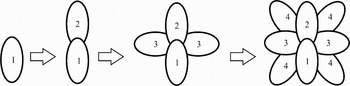
The early astogeny of C. annulata has been well studied (Powell, Reference Powell1967; Ostrovsky, Reference Ostrovsky1998; Nikulina, Reference Nikulina1999, Reference Nikulina2001; Yagunova, Reference Yagunova2002, Reference Yagunova2005). The first generation of zooids is an ancestrula, the second—one zooid, the third—two, and the fourth generation—four zooids (Figure 1). Deviations from such sequence of budding are rare.
The scheme showing a sequence of zooidal budding in the early asthogeny of Cribrilina annulata. 1, ancestrula; 2–4 sequential generations of zooids (from Yagunova, Reference Yagunova2005).

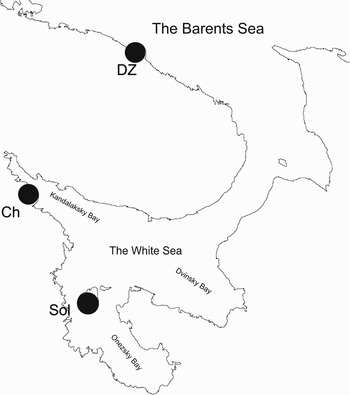
Colonies of C. annulata were collected during summer 2002 in three areas: Chupa Inlet (Kandalaksha Bay, White Sea), Solovetski archipelago (Onega Gulf, White Sea) and Dalnezelentskaya Inlet (East Murman Region, Barents Sea). These sites are denoted as Ch, Sol, DZ in Figure 2. Colonies growing on thalli of the red alga Odontalia dentata and on stones were collected at each of the three sites. Samples of this alga were collected from 5–15 m depth using grapnel and SCUBA-diving. Stones bound to rhizoids of red algae were collected in the White Sea area. In the Barents Sea stones were collected at extreme low water spring tide level. Cribrilina annulata was abundant on thalli of O. dentata in all three regions, and in the Barents Sea—on stones too. Colonies of this species were rare on stones in the White Sea area.
Map showing the collecting sites. DZ, Dalnezelentskaya Inlet (East Murman Region, Barents Sea); Ch, Chupa Inlet (Kandalaksha Bay, White Sea); Sol, Solovetski archipelago (Onega Bay, White Sea).

Only colonies of C. annulata without visible obstacles in their early development were considered. The length and width of completely formed zooids (with calcified distal walls) budded during early astogeny were measured in each colony using an ocular micrometer.
Collecting was repeated in 2006 in the Dalnezelenetskaya Inlet (Barents Sea). Young colonies of C. annulata on stones and algae O. dentata were digitally photographed. Photographs of colonies were cropped to obtain separate images of each zooid. These photographs of zooids were transformed into black-and-white binary format and examined with image analysis software. The program used defined the area of each image as the number of black pixels in each photograph. The boundary line of image was defined, then, after a smoothing procedure, the boundary of each zooid was plotted as a graph in polar coordinates. This allowed calculation of the zooidal length and width (maximal size in two perpendicular directions), and its perimeter. Representation of the zooids' contours in graphic form enabled to plot an image of an ‘average’ zooid by calculation of average sizes in all directions and to estimate averaging error.
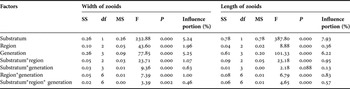
Analysis of variance (ANOVA) was used to compare the influence of the generation number, the collecting site and the substratum (colonies of year 2002) on the zooidal length and width, as well as to determine the astogenetic, geographical and habitat components of variability. To compare the extent of influence of the factors the portions of dispersion resulting from each factor were calculated. Comparison of ancestrula sizes from the two study substrata were repeated with specimens collected in 2006.
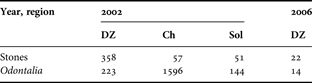
The sample size (total number of zooids investigated from colonies collected in each region for each substratum) is listed in Table 1. Data are presented as means with confidence intervals corresponding to the significance level P = 0.05.
Number of measured zooids in colonies of Cribrilina annulata collected from two different substrata in each of three regions during 2002 and 2006.
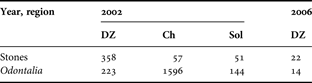
DZ, Dalnie Zelenzi (Barents Sea); Ch, Chupa Inlet (White Sea); Sol, Solovetskiy archipelago (White Sea).
RESULTS
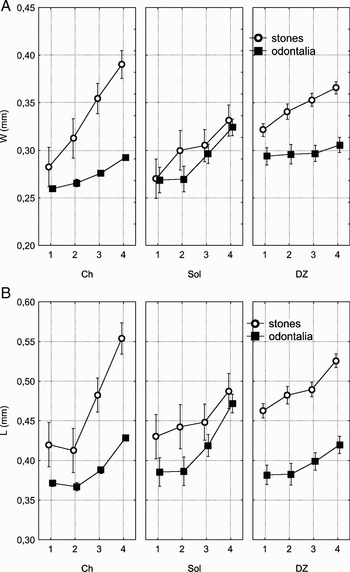
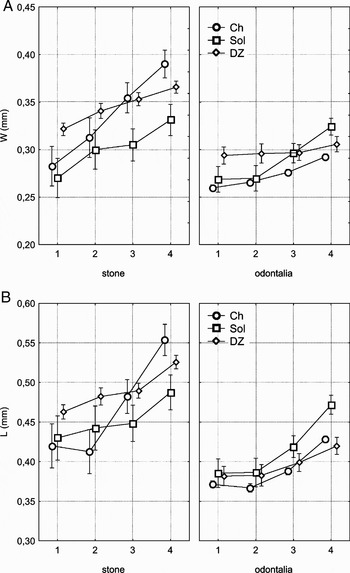
The zooidal length in colonies on stones was much higher than in colonies on algae Odontalia. This was the case in all three geographical regions (Figure 3). The zooidal width in colonies collected on stones in the Barents Sea was significantly greater than the width of zooids collected on the alga O. dentata. In the White Sea the average width of the ancestrula in colonies from the two study substrata appeared to be identical, however zooids of 3rd and 4th generations had greater widths on stones than on algae. The influence of substratum on zooidal size was significant and substantial (Table 2). The habitat component of variability of zooids' length and width was 5% and 8%, correspondingly, and its value was close to the astogenetic component of variability.
Habitat variability of sizes in the first zooidal generations of Cribrilina annulata in three regions. (A) Width variability; (B) length variability (samples from 2002). The numbers on the abscissa axis correspond to the zooidal generation: 1, ancestrula; 2–4 sequential generations of zooids (see Figure 1).

Results of three-factor ANOVA of zooidal size variability in Cribrilina annulata (samples of 2002).

Substratum, stones/Odontalia dentata; region, Ch/Sol/Bar; generation, generation of zooids; *, denotes composition of the factors.
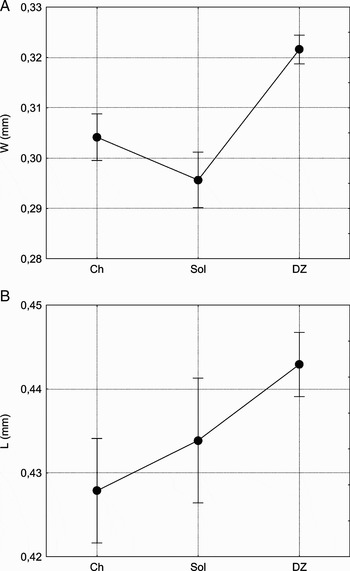
The sampling region also had significant influence on zooidal size (see Table 2): average size (length and width) of zooids in colonies from the Barents Sea was higher than in colonies from the White Sea (Figure 4). It should be noted that the geographical component was less substantial than habitat and astogenetic components of variability (Table 2). Moreover, the geographical differences of zooidal size are irregular: for different generations of zooids and different substrata larger zooids were in different localities (Figure 5 A, B).
Average sizes of zooids in early astogeny of Cribrilina annulata in three regions. (A) Width variability; (B) length variability (samples from 2002).

Geographical variability of size in the first zooidal generations of Cribrilina annulata collected on two different substrata. (A) Width variability; (B) length variability (samples from 2002). The numbers on the abscissa axis correspond the zooidal generation: 1, ancestrula; 2–4 sequential generations of zooids (see Figure 1).

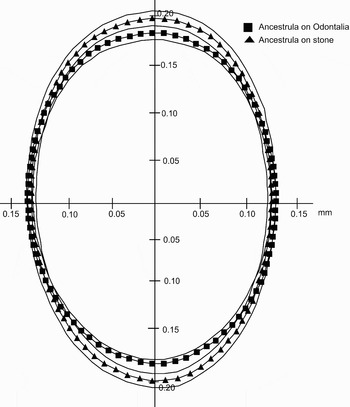
Comparison of the ancestrulae on stones and Odontalia in the Barents Sea to the 2006 sample yielded similar results. The length of ancestrulae was consistently higher when collected on stones compared with those on algae (ANOVA, F = 13.04, P < 0.05). No consistent differences in ancestrular widths were established between different substrata (Figure 6). Additionally, the ancestrulae on stones had a greater average perimeter (ANOVA, F = 4.84, P < 0.05). However, there was no consistent difference in their average area. The ‘average’ (typical) forms of ancestrulae on stones versus those on O. dentata are shown on Figure 6.
Scheme showing an ‘average, ancestrulae of Cribrilina annulata forming on two different substrata’ (samples from 2006, Barents Sea).

Comparison of ranges of variation of ancestrulae length on different substrata showed the length of the shortest ancestrula on stones was greater than the shortest ancestrula on algae. The length of the longest ancestrula on O. dentata was also less than the length of the longest ancestrula on stones.
DISCUSSION
Comparison of colonies of the cheilostome bryozoan Cribrilina annulata living on two different substrata in the White and Barents Seas showed that the type of substratum essentially affects the zooidal size. Length of zooids is more sensitive to the type of substratum than their width. In general zooidal length varies more than width (Taylor & Furness, Reference Taylor and Furness1978; Taylor, Reference Taylor1988). It has been suggested that zooidal width depends on surrounding factors to a lesser degree than their length, and is determined mainly by the position of zooid in the colony and by the shape of its neighbours (O'Dea & Okamura, Reference O'Dea and Okamura1999). Our results confirmed higher stability of zooids' width in a species and environment different to those previously studied, suggesting this finding to be robust.
Our research did not reveal significant ‘geographical’ variability of zooidal size. The early colony formation occurs during summer when the water temperature near the surface in the White Sea is higher than in the Barents Sea (8–15°C and 7–8°C correspondingly). The annual average temperature in the Ch region is also higher than in the DZ region (Kuznetsov, Reference Kuznetsov1960; Climatic Atlas of the Barents Sea, 1998). The colonies collected in the Barents Sea with lower water temperature had, on average, larger zooids. This, at first sight, confirms the ‘temperature rule’ for dimensional changes (see O'Dea & Okamura, Reference O'Dea and Okamura2000; O'Dea & Jackson, Reference O'Dea and Jackson2002; O'Dea, Reference O'Dea2005 and references therein). However, comparisons carried out separately for different substrata and different generations of zooids, did not show the same differences between colonies from the White and Barents Seas. Also, we suggest that the differences in salinity do not play an important role in the zooidal size determination. The salinity is 30–34‰ in the DZ region and 20–24‰ in the Ch region, but geographical differences appeared to be much weaker than habitat ones. On the other hand, we must admit that our approach may have not detected geographical variability due to the similar subarctic nature of the two study areas.
There are some well-known general rules concerning differences between fouling communities on algae and on solid substrata. The major characteristics of a substratum are its longevity and physical properties (e.g. its flexibility) (Manriquez & Cancino, Reference Manriquez and Cancino1996). Habitat conditions on firm substrata are considered to be more stable (Seed & O'Connor, Reference Seed and O'Connor1981). These conditions allow prevailing of those species of bryozoans that have greater sizes of colonies, thicker zooids, and higher growth intensity, forming larger ovicells and producing more larvae per colony (Hillmer et al., Reference Hillmer, Gautier and McKinney1975; Herrera & Jackson, Reference Herrera, Jackson, Gordon, Smith and Grant-Mackie1996). These species are often perennial, and show high ability to regenerate a colony from a fragment (Hughes & Cancino, Reference Hughes, Cancino, Jackson, Buss and Cook1985). The species living on unstable substrata are characterized by an inverse set of properties. Strong calcification of encrusting colonies is considered as an obstacle for living on soft and flexible algae (Seed & O'Connor, Reference Seed and O'Connor1981).
Our results show that similar rules can be observed at intraspecific level too. We found that zooids in colonies on stones were larger than in colonies growing on algae. Since differences are apparent as early as the ancestrulae stage, they are unlikely to be caused by temperature, feeding conditions or substratum longevity. We suggest it could be connected with settlement and metamorphosis of larvae.
The substratum influence on larvae (settling or just settled) can be both direct (the surface properties or emission of metabolites), and indirect—by change of hydrodynamic conditions or the intensity of sediment accumulation (Wahl, Reference Wahl1989; Manriquez & Cancino, Reference Manriquez and Cancino1996; Harvey & Bourget, Reference Harvey and Bourget1997; Lapointe & Bourget, Reference Lapointe and Bourget1999). This influence may act before settlement (during larval seeking of the place for settlement), during metamorphosis or growth (Qian, Reference Qian1999). We considered three competing hypotheses to explain the substrate influence on size of ancestrula. The first hypothesis assumes that the substratum influences only have bearing when larvae choose a place for settling. The second hypothesis assumes that the substratum affects only the survival of the ancestrulae and colonies. In the third we assume that the substratum affects only larval metamorphosis.
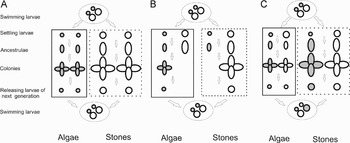
If the first hypothesis is correct then the larvae settling on stones should be larger than on algae (Figure 7A). It has been shown that larval size correlates with the size of ancestrula (Marshall & Keough, Reference Marshall and Keough2003), and the size of ancestrula with the size of zooids and the entire colony. Larger colonies are known to produce larger larvae (Marshall & Keough, Reference Marshall and Keough2004a). Hence, larvae produced by the colonies living on stones should be, on average, larger than larvae of colonies on algae. The probability of settling on stones where their parental colonies live is again higher for these larger larvae. As a consequence of such processes a partial genetic isolation of colonies growing on these two substrata is possible.
Scheme representing three hypotheses of possible origin of size differences in zooids of Cribrilina annulata in colonies living on two different substrata. (A) ‘larger larvae settle on stones’; (B) ‘only larger ancestrula survive on stones’; (C) ‘even small larvae become large ancestrulae on stones’.

If we assume that small and large larvae are uniformly settled on both substrata, then the size differences of ancestrulae may be either a result of their differential mortality (hypothesis 2; Figure 7B) or change of size during metamorphosis (hypothesis 3; Figure 7C).
Colonies of Bugula neritina grown from larger larvae survived better in laboratory experiments. In contrast, in natural conditions better survival has been shown for colonies of the same species formed from smaller larvae (Marshall & Keough, Reference Marshall and Keough2004b). In other words, larvae of the same species of different sizes may be more viable in different conditions. Therefore colonies from ancestrulae of different sizes may survive to reach the reproductive phase better on different substrata: colonies from large ancestrulae survive better on stones, and colonies from small ancestrulae preferentially persist on algae. If this is true, colonies from one substratum should produce mainly small, and from the other, mainly large larvae. For both groups of larvae the probability of survival is higher when they settle on a ‘parental’ substratum. Thus, in this case, as well as in the first, it is possible to expect partial genetic isolation of colonies growing on these two different substrata.
Could the type of substratum affect a process of metamorphosis? In this case (Figure 7C) it is assumed that larvae of the different sizes settle uniformly on both types of substrata. Then the differences in the ancestrulae size should indicate that metamorphosis itself varies, resulting in formation of ancestrula of different sizes on different substrata. Such an assumption does not contradict the high correlation between sizes of larvae and ancestrulae. High correlation between sizes of larvae and ancestrula may indicate the precision of linear dependence between these sizes, but it does not show coefficients of the linear regression itself. One may assume that larger ancestrula will be generated on stones rather than on algae from larvae of the same size. In this case the size of the ancestrula (especially, its length) becomes only a phenotypic characteristic defined by environmental conditions. All three hypotheses agree well with the general understanding of fouling organisms on stones and algae: i.e. larger sizes of colonies and zooids occur on stones, and they tend to have stronger calcification (Hillmer et al., Reference Hillmer, Gautier and McKinney1975; Herrera & Jackson, Reference Herrera, Jackson, Gordon, Smith and Grant-Mackie1996).
A rough (rugose) substratum (each as a typical stone) is traditionally considered as more attractive for settlement of larvae than a smooth one (Marshall & Keough, Reference Marshall and Keough2003). So, other factors being equal, higher densities of ancestrulae might be expected on a rough substratum (Marshall & Keough, Reference Marshall and Keough2003). In addition larger larvae are considered to have higher chances to reach the most attractive substratum for settlement, therefore their average sizes should be higher on an optimal substratum (Bennett & Marshall, Reference Bennett and Marshall2005). These facts argue that stones are better substrate for C. annulata than algae. However, it is known that colonies of Cribrilina annulata on stones in the Solovetsky Archipelago region are rare, and on thalli of Odontalia in the same region they are rather abundant (Grishankov, Reference Grishankov1995). Our observations (unfortunately, only qualitative, not quantitative) confirm this result. Furthermore, the same situation was observed in the Chupa Inlet. Hence, it seems that stones are not an optimal substratum for settling larvae of C. annulata in both of the investigated regions in the White Sea (Ch and Sol). Noteworthy, Barnes & Clarke (Reference Barnes and Clarke1995) observed that stones are not the best substrate for some Antarctic bryozoans as well. In the areas studied by these authors the species diversity was lower on stones in contrast with brachiopod shells of the same size. As to the Dalnie Zelenzi (DZ) region, colonies of C. annulata on the stones were very abundant there. We cannot explain these geographical differences in larvae preferences. We have only an idea about this phenomen. In the White Sea (Ch and Sol) stones and Odontalia were very close to each other. In the Barents Sea (DZ) colonies have been collected on stones on the lower boundary of the intertidal zone where red algae are absent. Probably for this reason colonies on stones in the Barents Sea were rather abundant.
All the above-stated gives us some arguments to doubt that a stone is a more attractive substratum for settling of larvae than Odontalia. Thus, in our investigation the larger ancestrulae were found on a substratum that we consider less attractive for larvae. If we accept the first hypothesis (‘larger larvae settle on stones’, see Figure 7A), then we are forced to reject the thesis ‘the probability to settle on the best substratum is higher for larger larvae’.
Generally the suitability of a substratum for habitation of a colony does not denote its attractiveness for settling of larva and vice versa. Comparison of the second (‘only larger ancestrulae survive on stones’, Figure 7B) and the third (‘even small larvae become large ancestrulae on stones’, Figure 7C) hypotheses leads to opposite conclusions about stones as an optimal substratum for colonies. The second hypothesis assumes, that smaller ancestrula perish on stones, and the third, that they develop successfully. The fact that size differences of zooids from different substrata are stronger for the zooids of later generations (Figure 3) supports the third hypothesis.
Examination of the second versus two other hypotheses may be done by comparison of ancestrulae size: (1) right after settling of larvae; and (2) in survived colonies. If the first or the third hypotheses are true, then size of ancestrulae on stones and algae should differ right after metamorphosis as in survived colonies. If the second hypothesis is true, then the average size of ancestrulae should be the same on both substrata right after metamorphosis, and differ when comparing the survived colonies. One more method to check these hypotheses is a genetic analysis since the first and the second hypotheses necessarily involve partial genetic isolation of colonies living on different substrata. Additional research is planned to check these suggestions.
We suggest that stones are not an optimal substratum for the settlement of larvae of Cribrilina annulata. As the astogeny of encrusting colonies is less stable on stones, than on algae (Yagunova, Reference Yagunova2006), stones are probably not an optimal substratum for habitation of colonies of Cribrilina annulata either. We found that the shortest ancestrulae were on Odontalia, and the longest ones on stones. Two reasons are suggested for this allocation of ancestrulae. Firstly, it is more difficult for a larger larva to attach to the flexible thin thallus of algae. Secondly, irregularities of the rough stone surface make it inconvenient for small larvae. Therefore we conclude that a stone is the best substratum for settling of largest larvae, and alga is an optimum for the smallest larvae. If so, then the principal cause of the size differences of ancestrulae should be the difference in sizes of settling larvae choosing different substrata (the first hypothesis). Size difference of ancestrulae is determined by the optimal substrata for larvae of different sizes being different.
ACKNOWLEDGEMENTS
We are greatly indebted to Professor, Dr A.I. Granovich, St Petersburg State University, for very useful discussions and advice. Thanks are given to Dr P. Strelkov, M. Makarov and A. Poloskin, who helped to organize trips to the Barents Sea. We also thank M. Feduk, Y. Samysko and M. Fokin for their help with collecting. Dr D.K.A. Barnes, British Antarctic Survey, and two anonymous referees kindly read the manuscript and gave useful comments. The research was supported by the Russian Foundation for Basic Research (grant 07-04-00928a, 07-04-10046-κ, and 07-04-10075-κ).