Young children, especially boys, from economically disadvantaged families face increased risks for the development of behavior problems, perhaps in part because of their exposure to nonoptimal parenting (e.g., Angold & Egger, Reference Angold and Egger2007; McLoyd, Aikens, & Burton, Reference McLoyd, Aikens, Burton, Damon, Lerner, Renninger and Sigel2006). Specifically, the stressors stemming from poverty are associated with increased levels of negative (i.e., harsh or intrusive) and decreased levels of supportive (i.e., sensitive or responsive) parenting (e.g., Bradley & Corwyn, Reference Bradley and Corwyn2002; Conger & Donnellan, Reference Conger and Donnellan2007). Experiencing less supportive parenting and more negative parenting has been linked to increased risk for developing preschool behavior problems (e.g., Campbell, Shaw, & Gilliom, Reference Campbell, Shaw and Gilliom2000; Shaw, Gilliom, Ingoldsby, & Nagin, Reference Shaw, Gilliom, Ingoldsby and Nagin2003). However, most economically disadvantaged children thrive despite these risks. Identifying factors that increase or decrease the impact of parenting on children's development of behavior problems will enhance preventative intervention efforts. That is, some children may be more vulnerable to the harmful effects of negative parenting and more protected by the positive effects of supportive parenting. Intervention programs may maximize success by targeting especially malleable children.
Exposure to more supportive, responsive parenting and less negative parenting may protect children from developing problem behaviors because such parenting effectively promotes children's development of emotional and behavioral control skills (e.g., Kochanska, Coy, & Murray, Reference Kochanska, Coy and Murray2001; Mesman, van IJzendoorn, & Bakermans-Kranenburg, Reference Mesman, van IJzendoorn and Bakermans-Kranenburg2012; Sroufe, Reference Sroufe1997). In all likelihood, the impact of specific parenting behaviors on children's social behavior varies based on children's characteristics. That is, according to a differential susceptibility framework (e.g., Belsky, Bakermans-Kranenburg, & van IJzendoorn, Reference Belsky, Bakermans-Kranenburg and van IJzendoorn2007; Ellis, Boyce, Belsky, Bakermans-Kranenburg, & van IJzendoorn, Reference Ellis, Boyce, Belsky, Bakermans-Kranenburg and Van IJzendoorn2011), children vary in terms of their sensitivity to environmental, including parental, influences. For instance, temperamental proclivities may represent behavioral expressions of underlying physiological processes that make children differentially susceptible to specific parenting behaviors (Ellis et al., Reference Ellis, Boyce, Belsky, Bakermans-Kranenburg and Van IJzendoorn2011). Although some children thrive when exposed to supportive parenting, these same children may struggle when exposed to negative parenting (Belsky & Pluess, Reference Belsky and Pluess2009; Bradley & Corwyn, Reference Bradley and Corwyn2008). Identifying child characteristics that affect children's sensitivity to specific parenting behaviors provides important information about risky pathways for the development of early behavior problems (Belsky & Pluess, Reference Belsky and Pluess2009).
In the present study, we consider how three specific child characteristics, fearful and fearless responses as well as child sex, condition associations between parenting quality and children's behavior problems among a predominantly African American low-income sample. We build upon existing research by applying within-family models of mothers’ parenting observed during interactions with preschool-aged siblings to rigorously test interactive influences of observed fearfulness, fearlessness, and child sex with mothers’ supportive and negative parenting behaviors on children's early behavior problems. While an abundance of research has demonstrated links between parenting quality and the emergence of children's behavior problems, we describe our rationale for considering how children's characteristics, specifically fearful temperament traits and child sex, moderate the direct associations between parenting quality and children's problem behavior. Finally, we describe the importance of within-family models for testing models of parenting and child characteristics on levels of problem behaviors.
Child Fear Responses May Increase Risk for Behavior Problems During Early Childhood
Temperament is a complex, multidimensional concept, which includes individual differences in emotional reactivity (e.g., positivity, negative affect, fear, and sadness) and regulatory processes (e.g., approach vs. avoidance; Posner & Rothbart, Reference Posner and Rothbart2000; Rothbart & Bates, Reference Rothbart, Bates, Damon, Lerner and Eisenberg2006) that underlie socioemotional development and functioning. Emotional reactivity propensities and regulatory processes coalesce to influence specific temperamental profiles. For instance, temperamental surgency reflects active engagement with the environment and includes high activity level, impulsivity, high approach behaviors, and high-intensity pleasure (Rothbart & Bates, Reference Rothbart, Bates, Damon, Lerner and Eisenberg2006). In contrast, fearful temperament involves negative emotional reactivity with substantially less fear approach (Rothbart & Bates, Reference Rothbart, Bates, Damon, Lerner and Eisenberg2006). In theory, maladaptive child behaviors develop in the context of parent–child reciprocal interactions, such that parents’ negative responses to children's unregulated and affectively negative emotional reactions lead to escalated angry behaviors that in turn elicit more negative parenting (e.g., Patterson, Reference Patterson, Reid, Patterson and Snyder2002; Scaramella & Leve, Reference Scaramella and Leve2004). However, much of this work on coercive parent–child interactions has focused on children's anger reactivity, or children's propensity toward more generalized negative reactivity that is unregulated. In the present study, we considered the intensity of children's distress reactivity and regulatory behaviors (i.e., approach) during a standardized, commonly used observational fear paradigm.
We focus on fearful temperament because fearfulness is repeatedly identified as a risk factor for the development of behavior problems. Theoretically, children with high levels of fear reactivity or fearfulness are at increased risk for internalizing problems; however, empirical evidence supporting associations between fearfulness and internalizing problems is mixed. Children identified as exhibiting high levels of fear reactivity during infancy or toddlerhood often do not develop behavior problems during childhood (Buss, Reference Buss2011; Colder, Mott, & Berman, Reference Colder, Mott and Berman2002; Stifter, Putnam, & Jahromi, Reference Stifter, Putnam and Jahromi2008). Quite possibly, fearful reactivity interacts with parenting quality to differentially affect risk for the development of problem behaviors. When mothers respond in unsupportive, negative, or parent-centered ways to children's signs of fear distress, children may struggle to develop effective emotion regulation skills, increasing risks for both internalizing (Kiel & Buss, Reference Kiel and Buss2011; Stifter et al., Reference Stifter, Putnam and Jahromi2008) and externalizing behavior problems (Gilliom & Shaw, Reference Gilliom and Shaw2004). For example, and consistent with this notion, Rubin, Burgess, and Hasting (Reference Rubin, Burgess and Hastings2002) demonstrated that overprotective, intrusive parenting of children with inhibited temperaments during infancy and toddlerhood contributed to the development of social anxiety problems later during childhood. Gilissen, Bakermans-Kranenburg, van IJzendoorn, and van der Veer (Reference Gilissen, Bakermans-Kranenburg, van IJzendoorn and van der Veer2008) and Gilissen, Koolstra, van IJzendoorn, Bakermans-Kranenburg, and van der Veer (Reference Gilissen, Koolstra, van Ijzendoorn, Bakermans-Kranenburg and van der Veer2007) reported that temperamentally fearful 4-year-old children had the highest levels of physiological reactivity to fear-eliciting videos when they also experienced poor-quality mother–child interactions, including insecure mother–child attachment relationships. While intended to protect their children, either by discouraging fear reactions that have negative social implications, or by sheltering their children from experiencing this distress (Kiel & Buss, Reference Kiel and Buss2014; Lipscomb et al., Reference Lipscomb, Leve, Harold, Neiderhiser, Shaw and Ge2011), unsupportive, negative parenting behaviors may increase risk for maladaptation over time because such parenting undermines children's development of autonomous emotion regulation (e.g., Sroufe, Reference Sroufe1997).
In contrast to fear distress, fearlessness is indexed by high levels of approach behaviors, during situations that typically produce a fear response (Baker, Baibazarova, Ktistaki, Shelton, & Van Goozen, Reference Baker, Baibazarova, Ktistaki, Shelton and Van Goozen2012; Hirshfield-Becker et al., Reference Hirshfeld-Becker, Biederman, Calltharp, Rosenbaum, Faraone and Rosenbaum2003). Approach behaviors within the context of a novel, anxiety-provoking situation also may place children, particularly boys (Colder et al., Reference Colder, Mott and Berman2002), at increased risk for developing behavior problems, including both externalizing symptoms and peer problems (Raine, Reynolds, Venables, Mednick, & Farrington, Reference Raine, Reynolds, Venables, Mednick and Farrington1998; Wilson, Reference Wilson2006), during later developmental periods. Fearlessness, as indicated by high levels of approach, is not the same as low levels of fearfulness, as indexed by low levels of fear distress. Critically, both fearlessness and fearfulness tap into different aspects of temperament (i.e., reactivity vs. regulation) and different emotion regulation or motivational systems (i.e., Gray's behavioral inhibition system vs. behavioral activation system). While these systems, or more specifically fear reactivity and fear approach, work together to influence behavior (Colder et al., Reference Colder, Mott and Berman2002; Rothbart & Bates, Reference Rothbart, Bates, Damon, Lerner and Eisenberg2006), they may differentially interact with parenting to affect risk for problem behaviors. For instance, mothers who respond to children's fearless approach behaviors in unsupportive or negative ways may undermine children's development of effective emotion regulation and increase children's risk for developing behavior problems (Blandon, Calkins, Keane, & O'Brien, Reference Blandon, Calkins, Keane and O'Brien2010; Kiel & Buss, Reference Kiel and Buss2014). Such parenting may be aimed at restricting children's access to potentially dangerous stimuli without teaching children why they should inhibit their approach tendencies. Although less explored empirically, responding to children's fearless approach with supportive, child-centered parenting or parenting that offers explanations, consequences, and reasons for parents’ requests may teach children consequences of their actions and facilitate adaptive emotion regulation, or skills which may reduce the likelihood of developing problem behaviors.
The current investigation sought to examine how variations in fear responses (i.e., fearfulness and fearlessness) separately moderated associations between supportive parenting and behavior problems as well as negative parenting and behavior problems during the early childhood period. We sought to disentangle these associations among low-income families in which children and parents face considerable risks, including regular exposure to dangerous situations that should produce fear responses. Children who index high levels of fear distress or high levels of fear approach may be more vulnerable to variations in parenting. Further, a more comprehensive approach to child effects or differential susceptibility interactions must account for how multiple child characteristics interact with parenting to shape child development. While variations in fearful temperament may affect children's malleability to environmental influences, in all likelihood, child sex may influence the development of behavior problems independently and interactively with fear reactivity and mothers’ parenting behaviors.
Child Sex Differences, Parenting Quality, and Fear Reactivity: Implications for Behavior Problems
Reliable sex differences in dimensions of behavior problems do not emerge until after the toddler and preschool years (e.g., Sterba, Prinstein, & Cox, Reference Sterba, Prinstein and Cox2007). The lack of reliable sex differences may exist because internalizing and externalizing problems are not distinct phenomena during the toddler and preschool period. That is, both internalizing and externalizing behavior problems may be manifested similarly because both problems are associated with difficulties regulating emotional reactivity (e.g., Blandon et al., Reference Blandon, Calkins, Keane and O'Brien2010; Eisenberg et al., Reference Eisenberg, Cumberland, Spinrad, Fabes, Shepard and Reiser2001). With advances in emotion regulation, reliable distinctions between internalizing and externalizing behaviors may emerge by school entry (e.g., first grade) and into adolescence (e.g., Steinberg, Reference Steinberg2005). This considerable overlap between externalizing and internalizing behaviors may be particularly notable when relying on a single method and reporter (Lilienfield, Reference Lilienfeld2003), and among at-risk populations such as our economically disadvantaged sample. For example, Gilliom and Shaw (Reference Gilliom and Shaw2004) reported that among a sample of disadvantaged boys, initial rates and change over time from ages 2 to 6 of internalizing and externalizing problems were positively associated.
Combining internalizing and externalizing problems into a single, broadband indicator of behavior problems is strengthened by the general lack of sex differentiation of problem behaviors during early childhood. That is, boys are often reported as being at greater risk for externalizing behavior problems (e.g., Campbell et al., Reference Campbell, Shaw and Gilliom2000; Chen, Reference Chen2010; Shaw et al., Reference Shaw, Gilliom, Ingoldsby and Nagin2003) and girls at risk for internalizing problems (Crick & Zahn-Waxler, Reference Crick and Zahn-Waxler2003; Keenan & Shaw, Reference Keenan and Shaw1997; Sterba et al., Reference Sterba, Prinstein and Cox2007), but these studies have either focused only on one sex (e.g., Keenan & Shaw, Reference Keenan and Shaw1997; Shaw et al., Reference Shaw, Gilliom, Ingoldsby and Nagin2003) or have found that sex differences in problem behavior emerge after the early childhood period (e.g., Rutter, Caspi, & Moffit, Reference Rutter, Caspi and Moffitt2003; Sterba et al., Reference Sterba, Prinstein and Cox2007). Although biologically based hormonal sex differences may explain differences in types of behavior problems observed across the transition to adolescence (e.g., Steinberg, Reference Steinberg2005), this biological foundation has yet to be identified among young children. Perhaps later differences in behavior problems emerge as a cumulative result of ongoing patterns of parent–child interactions that begin early in life (e.g., Keenan & Shaw, Reference Keenan and Shaw1997). In the current study, we consider the possibility that underlying sex differences in the effects of parenting directly and interactively affect risk for problem behaviors.
One potential explanation for increased rates of behavior problems among boys after school entry may be that boys are more susceptible to both positive and negative parenting than are girls (Barnett & Scaramella, Reference Barnett and Scaramella2013; Calkins, Reference Calkins2002; Keenan & Shaw, Reference Keenan and Shaw1997; Rothbaum & Weisz, Reference Rothbaum and Weisz1994; Rutter et al., Reference Rutter, Caspi and Moffitt2003). Quite possibly, boys are simply physiologically more vulnerable to negative environmental experiences than girls, as evidenced by higher rates of infant mortality (e.g., Drevenstedt, Crimmins, Vasunilashorn, & Finch, Reference Drevenstedt, Crimmins, Vasunilashorn and Finch2008) and neurodevelopmental disorders (e.g., Fombonne, Reference Fombonne2009) than girls. In addition, because girls tend to develop language skills earlier than boys (e.g. Bornstein, Hahn, & Haynes, Reference Bornstein, Hahn and Haynes2004), these advanced communication skills may facilitate the development of emotion regulation, as girls may be able to verbalize their distress and follow verbal strategies for regulating this distress (Keenan & Shaw, Reference Keenan and Shaw1997). If boys are at greater risk for developing behavior problems, then boys also may require more effective, that is, more supportive and less negative, parenting than girls to reduce those risks. Consistent with this hypothesis, less observed maternal sensitivity was positively related to increases in externalizing behaviors from age 2 to 9 for boys participating in the NICHD Study of Early Child Care, but not for girls (Miner & Clarke-Stewart, Reference Miner and Clarke-Stewart2008). Similarly, Boeldt et al. (Reference Boeldt, Rhee, Dillala, Mullineaux, Schulz-Heik and Corley2011) reported findings from a twin study indicating that, although increases in externalizing behaviors across childhood were linked with decreases in mothers’ observed positive parenting for boys and girls, the effect was strongest for boys. Thus, one explanation for sex differences in rates of behavior problems may be that boys and girls vary in their sensitivity or susceptibility to parenting quality.
Sex differences in temperamental characteristics are rarely proposed theoretically. However, some, albeit mixed, empirical evidence suggests that temperamental characteristics may vary by child sex during childhood. In a meta-analysis of sex differences in temperament across childhood (3–13 years), Else-Quest, Hyde, Goldsmith, and Van Hulle (Reference Else-Quest, Hyde, Goldsmith and Van Hulle2006) reported no sex differences in broadband measures of negative affect dimensions of temperament or general approach behaviors, but boys were reported to have lower levels of fear than girls. A more recent analysis by Olino, Durbin, Klein, Hayden, and Dyson (Reference Olino, Durbin, Klein, Hayden and Dyson2013) compared temperament ratings across mother, father, and observer measures for 865 3- to 6-year-old children drawn from three studies. Substantial sex differences across all three methodologies on a number of temperament domains emerged. Sex differences were found most consistently using observational methods in which girls were rated as displaying higher levels of fear and lower levels of sadness, anger, and activity as compared to boys. Collectively, these sex differences seem most apparent when specific domains of temperament, including fear, are considered rather than more global ratings of children's negative or positive affective responses.
Taken together, we propose that child sex differences in rates of behavior problems may be explained partially by sex-based differences in fear reactivity and sex-based differential susceptibility to mothers’ supportive and negative parenting behaviors. That is, male children with higher levels of fear reactivity, including fear distress and approach, may be particularly susceptible to the influence of mothers’ parenting behaviors. Consistent with a differential susceptibility perspective (e.g., Ellis et al., Reference Ellis, Boyce, Belsky, Bakermans-Kranenburg and Van IJzendoorn2011), these children would be most at risk for developing behavior problems when exposed to high levels of negative parenting, but would also evidence fewer behavior problems when exposed to high levels of supportive parenting. The extent to which fear reactivity, child sex, and mothers’ parenting interact to shape risky developmental pathways remains largely unexplored, especially among African American families from low-income communities. The use of a within-family sibling design in the present study allows us to disentangle these associations among parenting, fear reactivity, and child sex.
The Strength of Within-Family Sibling Designs
Within-family sibling designs provide a rigorous test of child sex differences in the influences of parenting quality on children's behavior problems by accounting for unobservable maternal or shared family characteristics, such as stressors related to economic disadvantage, which could influence parenting and children's behavior problems. The within-family design controls for factors that are constant across siblings, allowing for a less-biased examination of the associations between parenting and children's behavior problems (Conley, Pfieffer, & Velez, Reference Conley, Pfeiffer and Velez2007). Including siblings also accounts for the extent to which child age explains systematic variation in child behavior problems.
Goals of the Present Study
The primary goals of the present study were to examine whether child characteristics moderated the influence of mothers’ parenting on children's behavior problems. We proposed two specific hypotheses.
-
Hypothesis 1: Drawing from a differential susceptibility perspective (e.g., Belsky et al., Reference Belsky, Bakermans-Kranenburg and van IJzendoorn2007), children with higher levels of observed fearful temperament would be most influenced by parenting such that high fear distress (i.e., fearfulness) or high fear approach (i.e., fearlessness) combined with more negative parenting would be associated with elevated behavior problems, whereas high fear reactivity or high approach and more supportive parenting would be associated with fewer behavior problems.
-
Hypothesis 2: Interactions between fearful temperamental characteristics and supportive or negative parenting on elevated levels of behavior problems would be stronger for boys than for girls.
Method
Participants
Participants (n = 151 families; 302 children, 151 mothers) were from a longitudinal study of families recruited from urban Head Start centers when younger siblings were approximately 24-months-old and older Head Start-enrolled siblings were 3–4 years old. Families completed three annual in-home assessments corresponding to the younger child's second, third, and fourth birthdays. Observational mother–child interactional data collected during the first assessment (e.g., younger child aged 2) and mother-reported problem behavior collected from the first two assessments (e.g., younger child aged 2 and 3) are used in the present analyses. While 167 families participated in the first assessment, only 153 completed the second assessment (retention = 91.7%). Two families were missing complete data for the parenting or child fear reactivity tasks, and thus were dropped from the present analyses.
At the first assessment, children averaged 24 months (younger child: M = 24.16 months, SD = 1.77 months) and 48 months (older sibling: M = 47.56 months, SD = 3.15 months) of age. The sample consisted of 137 boys and 165 girls, including 26 male–male pairs, 42 female–female pairs, and 83 mixed-sex pairs. Approximately 43% of the younger children and 44% of the older children were boys. Families were predominantly African American (91%) and low-income (M income to needs ratio = 1.06, SD = 0.70). Mothers averaged 25.31 years (SD = 3.36), and 73% of mothers earned a high school diploma or GED. Approximately 43% of mothers were married or living with a romantic partner.
Procedure
All measures and procedures were approved by the institutional review board of the affiliated researchers. Mothers and children participated in a filmed observational assessment lasting approximately 1 hr. Data collected during one of the family interactional tasks and one of the child temperament tasks were used in the present analyses. Parenting behaviors were observed from a matching game that mothers and children played together. The game was played with pretend plastic sandwich cookies that were separated. Players were each given six cookies that had a raised shape. Players then took turns picking a cream side cookie, which had matching shapes cut out of the cream. Once a cream cookie was selected, the player looked for a corresponding match with his/her own cookies. If the player made a “match,” the two cookie sides were snapped together and the player received a point. If the player did not have a match, the cream side went back into the jar and the other player took a turn.
Mothers were instructed how to play the game and then given 3 min to teach the younger child the rules. If dyads completed the activity before 3 min were up, mothers were told to replay the game. The interviewer returned after 3 min with the older sibling. For the next 3 min, mothers were instructed to moderate the play between the two children and to keep score.
Children's fear reactivity was measured during a commonly used (e.g., Buss, Reference Buss2011; Kiel & Buss, Reference Kiel and Buss2014; Nachmias, Gunnar, Mangelsdorf, Parritz, & Buss, Reference Nachmias, Gunnar, Mangelsdorf, Parritz and Buss1996) 2-min structured fear task derived from the Laboratory Temperament Assessment Battery for preschoolers (Goldsmith, Reilly, Lemery, Longley, & Prescott, Reference Goldsmith, Reilly, Lemery, Longley and Prescott1999). Mothers sat in a different area of the house, so that they could hear, but not see, their child. Younger and older siblings were assessed separately following identical procedures. Children were instructed to sit on a designated spot on a floor mat and a remote-control robot was placed approximately 18 in. from the child. The interviewer turned the robot in a circle for approximately 30 s, and then paused for 15 s. Next, the robot roared four times (approximately 30 s in duration), then paused for 15 s. Finally, interviewers moved the robot to a spot approximately 6 in. from the child and then backward to the end of the mat. This was repeated once (~30 s). Interviewers then turned off the robot, informed the child that the robot was turned off, and invited the child to touch the robot. This task is designed to elicit diverse responses that highlight individual differences in children's reactivity in general, and more specifically in relation to fear-inducing situations. This task has been shown to elicit high levels of fear in samples of toddlers and preschoolers (e.g., Buss, Reference Buss2011), and thus responding with fear distress and lack of approach behaviors may be considered normative responses.
Mothers completed several questionnaires, some of which included measures of basic family characteristics. At Times 1 and 2 mothers completed questionnaires about both of their children's problem behaviors, but did not complete these questionnaires for the siblings back-to-back in order to limit direct comparisons between children in mothers’ reports. Instead, mothers completed a 30-min battery of questionnaires about the younger child, then answered questions about her own and her family characteristics, and then completed the same battery of questionnaires about the older child.
Measures
Mothers’ supportive and negative parenting behaviors
Mothers’ parenting behaviors were assessed during the matching task. Global observational ratings of mothers’ parenting behaviors directed toward each child were made on six 7-point global rating scales revised from scales developed in the NICHD Study of Early Child Care (NICHD Early Child Care Research Network, 1999): sensitivity/responsiveness, intrusiveness, detachment/disengagement, positive regard for the child, negative regard for the child, and stimulation of cognitive development. Similar observational coding systems have been found to reliably predict children's development among low-income samples that include African American families (e.g., Zaslow et al., Reference Zaslow, Weinfield, Gallagher, Hair, Ogawa and Egeland2006). Trained reliable coders, who were blind to other information about the families, scored the interactions for maternal behavior. Mothers’ behaviors directed toward the younger and older children were coded separately by different coders. Two criterion coders trained all other coders until excellent reliability (intraclass correlation [ICC] > 0.80) was maintained for each coder on each scale. The ICC was selected as the measure of interrater reliability for the 7-point parenting behavior scales because it takes into account the magnitude of agreement between two coders (Hallgren, Reference Hallgren2012). Once reliability was met, a random selection of 30% of all interactions was double coded. For those double-coded cases, each coding pair met to reconcile scoring discrepancies, reaching a final consensus score for each scale. Intercoder reliability was calculated by comparing the scores of two coders on every double-coded interaction.
The supportive parenting composite (α = 0.73 for the younger child and 0.74 for the older child) represents the mean of sensitivity/responsiveness, positive regard, and cognitive stimulation scales. Higher scores on supportive parenting indicate parenting that is in tune with the child, aware of and responsive to the child's cues, warm and affectively positive, and appropriately stimulating. The negative parenting composite (α = 0.71 for the younger child and 0.66 for the older child) represents the mean of intrusiveness and negative regard (i.e., negative affect directed at the child) scales. Higher negative parenting scores indicate parenting behaviors that are parent centered, possibly overstimulating, fast paced, inappropriately harsh, controlling, and affectively negative. These interactions may include parenting behaviors that focus on teaching the game or playing according to the mothers’ rules, rather than responding to the child's abilities and interests.
Children's fear reactivity
Trained coders rated children's fear reactivity as observed during the filmed robot task. The intensity of children's distress as well as behaviors reflecting approach were coded for three 10-s intervals across the three 30-s epochs (i.e., turning, roaring, or still close to child). Interrater reliability was measured using the Krippendorff alpha, which is sensitive for small sample size and variable numbers of coders, and is robust against missing data (Hayes & Krippendorff, Reference Hayes and Krippendorff2007). Scores were calculated for the 25% of cases that were rated by two independent coders. The peak scores for distress and approach behaviors across the epochs were computed by averaging the peak rating from each of the three epochs.
Interrater reliability for the intensity of distress scale was 0.91 for the younger child and 0.76 for the older child. Distress vocalizations are restricted to children's communication of distress through verbalizations and vocalizations of anger, sadness, or distress. Negative vocalizations were rated on a 4-point scale ranging from 0 (no signs) to 3 (very intense). Interrater reliability estimates for the approach scale were 0.62 and 0.78 for the younger and older child, respectively. Ratings of the presence of approach behaviors were also made on a 4-point scale (0 = no signs; standing still; 1 = low; leaning or turning toward the robot; 2 = mild; reaching or walking toward; 3 = moderate/high; making neutral or positive physical contact with the robot). The scores in the two domains showed a consistent pattern of correlations across child age and gender. For example, in the entire sample the scores for fear approach were only nominally correlated with fear distress (r = –.18, p < .05). Younger siblings were observed to have statistically significant higher fear distress scores and lower approach scores than older children. The mean score for distress reactivity for the younger child was 1.92 (SD = 1.07), indicating that there was considerable variability in distress reactivity. In contrast, the mean distress reactivity score for the older siblings was 1.12 (SD = 0.74), indicating generally less distress reactivity. Likewise, the mean approach scores were 1.50 (SD = 1.38) for the younger child and 2.82 (SD = 0.64) for the older sibling.
Children's behavior problems
Mothers reported separately on younger and older children's externalizing and internalizing behaviors using the Child Behavior Checklist for Ages 1½–5 Years (Achenbach, Reference Achenbach1994) at Time 1 and at Time 2 (~1 year later). Mothers rated each of their children's behaviors during the past 2 months on a 3-point scale (ranging from 0 = not at all true to 2 = always or often true). Externalizing behaviors consist of 26 items along two dimensions: destructive behavior and aggressive behavior. The items were averaged to create an externalizing behaviors scale (α = 0.90, 0.91 for younger and older child, respectively). The internalizing behaviors scale (α = 0.85, 0.87 for younger and older child, respectively) consists of the average of 25 items from two subscales: anxious/depressed and withdrawn. The mean externalizing and internalizing behaviors scores were highly correlated (range r = .70 to .73), and there were no mean differences for males and females. Therefore, given this correlation and the earlier discussion regarding considerable overlap between these dimensions among low-income, preschool samples, the scores from the two subscales were standardized and combined to create one composite measure of behavior problems at each time point. Note that the analyses were also conducted separately for externalizing and internalizing behaviors with similar patterns of results as for the total behavior problems scores. Therefore, for parsimony and to reduce the number of comparison, only the results for the total behavior problems scores are presented. The results for the externalizing and internalizing behavior models are available upon request from the first author.
Analytical plan
Random effects regression models with restricted maximum likelihood estimates were estimated to test study hypotheses. Multilevel modeling techniques extend multiple regression models to account for the possible nonindependence of within-family data. In this case, siblings are nested within families. Failing to account for this nesting of data could lead to inflated standard errors and inaccurate parameter and model fit estimates (Bryk & Raudenbush, Reference Bryk and Raudenbush1992). All continuous independent variables were grand mean centered.
A series of multilevel models were computed to test study hypotheses. One set of models included three-way interaction terms (and the necessary two-way interaction terms) representing associations between Negative Parenting × Child Sex × Fear Reactivity (i.e., fear distress and approach). A separate set of models included the interactions among Supportive Parenting × Child Sex × Fear Reactivity. The models controlled for child age and Time 1 behavior problems in order to predict Time 2 behavior problems. All statistically significant interactions were interpreted using standard pick-a-point techniques, which have been validated in multilevel models (Preacher, Curran, & Bauer, Reference Preacher, Curran and Bauer2006). Specifically, the simple slopes of the lines defining the associations between the focal independent variable (i.e., supportive or negative parenting) and behavior problems at specified levels of the moderator variable were plotted.
Results
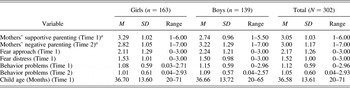
As shown in Table 1, descriptive statistics were calculated separately for girls and boys, and means were compared across boys and girls using t tests. On average, mothers were observed to be more supportive in their interactions with girls than with boys, t (319) = –4.87, p < .001, and observed to be more negative during interactions with boys than with girls, t (319) = 3.13, p < .01. There were no mean sex differences in observed fear reactivity or behavior problems.
Means, standard deviations, and ranges of study constructs

a Statistically significant mean difference for girls and boys.
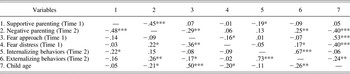
Table 2 presents the results of the correlational analyses separately for girls and boys. In general, similar patterns of statistically significant associations emerged. Negative and supportive parenting scores were inversely related for girls and boys, and child age was statistically and significantly positively associated with negative parenting for girls and boys. The two domains of fear reactivity (i.e., distress and approach) were only moderately inversely correlated for boys and for girls, suggesting that these dimensions of fear reactivity are tapping distinct response patterns. For both boys and girls, mothers’ supportive parenting and negative parenting were associated with behavior problems in the expected direction at Time 1. When boys and girls displayed high levels of fear distress, mothers were observed to exhibit more negative parenting. Fear approach was statistically significantly correlated with mothers’ negative parenting for girls only, such that girls with higher fear approach scores had mothers with fewer negative parenting behaviors; however, a Fisher r to z transformation indicated a statistically significant difference only at the trend level (z = –1.79, p = .07). The two domains of fear reactivity were unrelated to behavior problems with one exception. For boys only, fear distress was positively associated with Time 2 behavior problems, a finding that was confirmed after calculating a Fisher r to z transformation (z = 1.99, p = .04). In addition, we examined the correlations among the independent and dependent variables for siblings. Mothers’ observed supportive parenting (r = .30, p < .001) and reports of behavior problems at Time 1 (r = .43, p < .001) and Time 2 (r = .49, p < .001) were positively correlated within families.
Bivariate correlations of study constructs for girls (above the diagonal) and boys (below the diagonal)
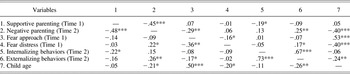
*p < .05. **p < .01. ***p < .001.
Regression models predicting behavior problems
Results of the unconditional means model predicting Time 2 behavior problems indicated systematic nesting of behavior problems within family. Statistically significant between-family (τ00 = 0.58, z = 8.60, p < .001) and within-family (i.e., between sibling; σ2 = 0.96, z = 5.88, p < .001) variance in behavior problems was observed. Approximately 38% (ICC) of the observed variance in behavior problems was accounted for by between-family variance.
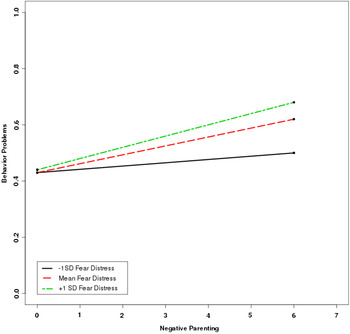
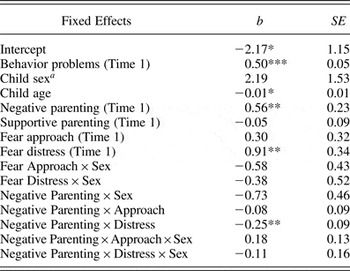
Next, child age, child sex, Time 1 behavior problems, supportive parenting, negative parenting, the two measures of fear reactivity, and terms representing interactions between these measures of fear, negative parenting, and child sex were added to the model as shown in Table 3. Time 1 behaviors were positively associated with behavior problems, and younger children had higher behavior problem scores than did older children. This model failed to produce a statistically significant three-way interaction. However, the term representing the interaction between fear distress and negative parenting behaviors emerged as statistically significant. This interaction was interpreted by plotting the simple slopes of the lines defining the association between mothers’ observed negative parenting and Time 2 behavior problems at 1 SD below the mean, at the mean, and 1 SD above the mean for fear distress. Figure 1 demonstrates that mothers’ negative parenting was associated with increases in behavior problems only for children who were observed to display mean (β = 0.59, p < .05) or higher (β = 0.77, p < .05) levels of fear distress behaviors.
(Color online). Fear distress moderates the association between negative parenting and behavior problems.

Fixed effects from multilevel model with negative parenting predicting children's behavior problems

a Child sex: 0 = male, 1 = female.
*p < .05. **p < .01. ***p < .001.
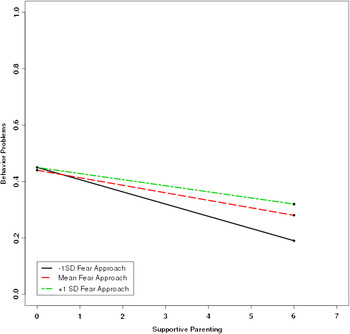
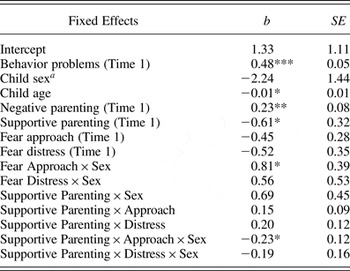
Then, the regression models were recomputed substituting supportive parenting interaction terms for negative parenting interaction terms as shown in Table 4. One three-way interaction term, Supportive Parenting × Fear Approach × Child Sex was statistically significant. This interaction effect was evaluated by plotting the simple slopes of the association between supportive parenting and Time 2 behavior problems at 1 SD below the mean, the mean, and 1 SD above the mean of fear approach, for boys, and then for girls. As shown in Figure 2, the Supportive Parenting × Fear Approach interaction was only statistically significant for boys. When boys were observed to display lower levels (i.e., 1 SD below the mean) of fear approach, increases in mothers’ supportive parenting were associated with decreases in behavior problems (β = –0.073, p < .05).
(Color online). Fear approach moderates the association between supportive parenting and behavior problems for boys.

Fixed effects from multilevel model with supportive parenting predicting children's behavior problems

a Child sex: 0 = male, 1 = female.
*p < .05. **p < .01. ***p < .001.
Discussion
The goal of the present study was to examine the extent to which interactions between children's sex and fear reactivity may influence associations between observed parenting and mother-reported behavior problems among economically disadvantaged, predominantly African American families with toddlers and preschool-aged children. In general, children's fear responses were found to be differentially associated with risks for behavior problems, with some variation by child sex. We begin by discussing the complex findings linking fear reactivity and parenting to level of behavior problems for boys and girls. We conclude by discussing the strengths and limitations of this work, the implications of the research, and future directions for translating work in this area to the development of preventive interventions.
Child fear and sex as moderators of the influence of mothers’ parenting on behavior problems
Multiple complex pathways by which children's characteristics influence the associations between parenting and early behavior problems emerged. Consistent with other research (e.g., Campbell et al., Reference Campbell, Shaw and Gilliom2000; Keenan & Shaw, Reference Keenan and Shaw1997), no evidence of sex differences in levels of behavior problems emerged among this sample of toddlers and preschool-aged children. Statistically significant associations between mothers’ observed parenting behaviors and children's behavior problems were found to vary by fear reactivity and/or child sex. In general, the findings contribute to the increasingly mixed research regarding differential susceptibility (e.g., Kochanska, Kim, Barry, & Philibert, Reference Kochanska, Kim, Barry and Philibert2011; Roisman et al., Reference Roisman, Newman, Fraley, Haltigan, Groh and Haydon2012).
First, mothers’ observed negative parenting increased risk for behavior problems only for those children with fear distress scores at or above the mean. In other words, mothers’ negative parenting behaviors did not predict increases in behavior problems for children with low fear distress scores. While we hypothesized that fear reactivity, specifically high distress and approach, might be an indicator of biological sensitivity to context (Belsky & Pluess, Reference Belsky and Pluess2009; Ellis & Boyce, Reference Ellis and Boyce2008), high fear distress emerged as a marker of risk for boys and girls when they are exposed to negative parenting. This finding provides some support for a diathesis–stress or dual-risk model (e.g., Zuckerman, Reference Zuckerman1999) rather than a differential susceptibility (e.g., Belsky & Pluess, Reference Belsky and Pluess2009) perspective, as the most fearful (i.e., reactive or highly distressed) children seemed to be the most influenced by mothers’ negative parenting behaviors. In other words, children who experienced the combination of high-risk temperament (i.e., high fear distress) and high-risk parenting (i.e., negative parenting) experienced the most behavior problems.
Over time, the cumulative impact of negative parenting on levels of behavior problems may emerge as a result of the mismatch between an easily distressed, highly reactive child with a harsh, intrusive mother. Regular exposure to negative parenting, particularly for highly reactive children, may lead to increased fearfulness because these children may lack opportunities to acquire the skills required to regulate their fear and calm themselves (Degnan & Fox, Reference Degnan and Fox2007; Gillissen et al., Reference Gilissen, Bakermans-Kranenburg, van IJzendoorn and van der Veer2008; Posner & Rothbart, Reference Posner and Rothbart2000). For children residing in dangerous contexts, their own negative emotional reactions may leave them more vulnerable to the dangers of these neighborhood contexts, causing mothers to escalate their negative parenting, which also may contribute to the development of coercive parent–child interaction cycles that have been observed for negative reactivity (Scaramella & Leve, Reference Scaramella and Leve2004).
Second, fear approach may provide an additional pathway by which children's characteristics interact with parenting to confer risk for problem behaviors, especially for boys. Specifically, boys were observed to have the fewest behavior problems when they received the most supportive parenting and evidenced lowest levels of approach, after controlling for other indicators of fearful temperament (i.e., fear distress). This finding is directly opposite of expectations from a differential susceptibility perspective (e.g., Belsky et al., Reference Belsky, Bakermans-Kranenburg and van IJzendoorn2007), which suggests that children with highest levels of fear approach, that is, children who show surgency or fearlessness in a fearful situation, should demonstrate optimal developmental in the context of a supportive environment. In contrast, low levels of fear approach behaviors, our index of fearlessness and surgency, were protective against behavior problems for boys when they experienced supportive parenting. Because the fear task involved a motorized toy at a distance from the child, low approach behaviors may reflect general wariness to unfamiliar stimuli. Children who show this apprehension or caution may be particularly dependent on supportive caregivers to model and reinforce effective emotion regulation strategies (e.g., Degnan & Fox, Reference Degnan and Fox2007; Kiel & Buss, Reference Kiel and Buss2014; Rubin et al., Reference Rubin, Burgess and Hastings2002). Further, children with low approach behaviors may be easier to care for, more likely to be able to pay attention to and follow parental commands, and thus may be more likely to elicit, and over time benefit from, supportive parenting behaviors. This may be especially true for boys, who may be more likely to lack the language skills to express their responses to fearful situations and to comply with parental commands. This finding may provide more evidence that in specific contexts boys are particularly sensitive to supportive parenting. Further, mothers in this urban, economically disadvantaged sample who are aware of the risks their sons face also may be more sensitive to fearlessness displayed by boys, such that lack of fearlessness in boys is more salient and influences the quality of parenting children receive. Consistent with this explanation, Fox (Reference Fox2004) speculated that behavioral inhibition, including fear responses, may be more stable over time for boys than for girls because these behaviors may be more salient to parents, and parents more consistently respond to fearfulness in their sons.
Study strengths and limitations
The present study has a number of strengths and limitations. First, the sibling design provided a rigorous test of child sex differences in the influences of interactions between children's fear reactivity and parenting on behavior problems, although parenting was measured in the same task for both siblings. In addition, all of the siblings in the sample were close (i.e., 1 to 2 years) in age, and child age was controlled statistically in the analytical models. Second, prior theoretical frameworks (e.g., Gray's behavioral inhibition system/behavioral activation system; Rothbart & Bates, Reference Rothbart, Bates, Damon, Lerner and Eisenberg2006) and empirical research (e.g., Baker et al., Reference Baker, Baibazarova, Ktistaki, Shelton and Van Goozen2012; Colder et al., Reference Colder, Mott and Berman2002) suggest that fear reactivity (i.e., fearfulness) and approach (i.e., fearlessness) function as different indicators of the same underlying fear construct. These results suggest that mothers may respond differently to specific dimensions of fear, namely, distress or approach. Third, shared method variance was limited because independent observers rated mothers’ parenting toward each sibling and each sibling's fear distress reactivity.
Despite these strengths, the study includes some limitations. First, the direction of effects is unclear. Although we accounted for children's behavior problems at Time 1 in order to predict change in behavior problems reported at Time 2, mothers’ parenting and children's fear responses were measured at the same time point. Temperament characteristics are generally considered to be biologically based individual traits present from birth, but these levels of reactivity are somewhat plastic early in life (e.g., Blandon et al., Reference Blandon, Calkins, Keane and O'Brien2010; Posner & Rothbart, Reference Posner and Rothbart2000). Thus, we cannot determine if children's responses influenced mothers’ parenting or were a product of mothers’ parenting. Transactional approaches to parent–child relationships (e.g., Patterson, Reference Patterson, Reid, Patterson and Snyder2002; Scaramella & Leve, Reference Scaramella and Leve2004) suggest that both scenarios are likely in that mothers and children influence each other. Future research should include longitudinal measures of parenting and child reactivity. Second, like much research on low-income, especially African American, families, we failed to include measures of fathers’ parenting. Third, the results may not generalize to larger more socioeconomically advantaged and ethnically diverse samples. Fourth, we relied on mothers’ reports of behavior problems. Rosiman et al. (Reference Roisman, Newman, Fraley, Haltigan, Groh and Haydon2012) reported that interactions between children's temperament and observed parenting behaviors in the NICHD Study of Early Child Care tended to support differential susceptibility models when teacher reports of children's behaviors were considered, and diathesis–stress models when parents’ reports were considered. Fifth, we focused on children's observed fearfulness, but other child characteristics, including physiological markers of fear responses (Baker et al., Reference Baker, Baibazarova, Ktistaki, Shelton and Van Goozen2012; Gilissen et al., Reference Gilissen, Bakermans-Kranenburg, van IJzendoorn and van der Veer2008), may interact with child sex and parenting behaviors to predict children's behavior problems.
Overall, these results underscore the value of jointly considering how children's characteristics, especially sex and fearful temperament, moderate associations between parenting and the early development of behavior problems. Within this predominantly low-income African American sample, more fearful children may be at particularly high risk for developing behavior problems when they are exposed to negative parenting. At the same time, supportive parenting seems to be especially protective for boys who are low in fearlessness (i.e., approach). Follow-up work longitudinally linking these child traits and mothers’ parenting to the development of behavior problems is clearly warranted.
Future directions for translating research on the influential child into preventive interventions
The need to examine sex-specific pathways affecting risk and protection for African American, economically disadvantaged children is clear. Developing culturally and contextually sensitive intervention programs that educate mothers and provide the skills necessary to respond to their sons’ and daughters’ individual temperament characteristics in ways that foster positive parent–child relationships may be particularly effective at ultimately reducing the risks for behavior problems encountered by boys and girls during early childhood. Helping mothers understand potentially more effective strategies to shape their children's development along healthy pathways will likely result in more effective interventions. Further, intervention approaches and materials for parents should acknowledge the extent to which parenting strategies need to account for individual differences in children's behaviors. Finally, future research is clearly needed that clarifies how mothers interpret children's emotional reactivity within specific contexts. For instance, mothers’ residing in safe neighborhoods may have different concerns about children's fear reactions than do mothers’ residing in socioeconomically disadvantaged contexts. Research that clarifies mothers’ motivation for parenting also would provide critical information to aid intervention efforts.