Respiratory viruses are increasingly identified as causative pathogens in adult hospitalizations for lower respiratory tract infections, with or without community-acquired pneumonia.Reference Lieberman, Shimoni and Shemer-Avni1-Reference Jain, Self and Wunderink4 Influenza and RSV are predominant during seasonal epidemic waves that typically occur in winter, with yearly variations in severity and duration. However, other viruses circulate year-round, leading to less specific prevalence and morbidity patterns: parainfluenza, human metapneumovirus, rhinovirus, enterovirus, and coronavirus, among others.Reference Visseaux, Burdet and Voiriot5-Reference Lam, Tang and Lai7 Molecular assays (reverse-transcriptase polymerase chain reaction or RT-PCR) are the most reliable techniques for detecting and identifying respiratory viruses. These techniques combine noninvasive sampling (eg, nasopharyngeal swabs) with short turnaround times (TATs). Nevertheless, these techniques are still costly and not widely used as standard of care because their impact on patient management remains controversial.Reference Echavarria, Marcone and Querci8-Reference Vos, Bruning and Reitsma12
Objectives
Adult hospitalizations for severe acute respiratory infections (SARIs) in the winter months have been monitored at our tertiary-care referral center since the 2009 A/H1N1 influenza pandemic wave. An epidemiological surveillance process associated with internal influenza/RSV molecular assays allows us to document the presence of viral pathogens and to optimize patient management, for example, whether to introduce barrier care to reduce patient contact and the spread of potentially infectious droplets and/or antiviral treatment for influenza.
The primary objectives of our study were to assess the prevalence of influenza and RSV viruses in our adult SARI population over a 4-year period and to compare epidemiological features, clinical characteristics, and outcome data among patients with and without a positive viral diagnosis. Our secondary objective was to evaluate the impact of a documented viral infection on empirical antimicrobial management of these patients (ie, antibiotics and antivirals) by comparing with those of patients with negative viral diagnoses.
Methods
Study design
In this observational cohort study, we included patients defined who had a SARI during a 4-year study period. Epidemiological and clinical data were collected prospectively from admission to discharge or death. Microbiological investigations, antimicrobial management data (antivirals and antibiotics), and outcome data were reviewed retrospectively from the hospital’s electronic medical record (EMR).
Setting
University Hospital CHU UCL Namur (Godinne site) is a Belgian tertiary-care referral center affiliated with the Université Catholique de Louvain (UCL). It has 420 acute-care beds and serves a population of 740,000 in a large, rural area. Our center performs hematopoietic stem cell (autologous and allogeneic) and lung transplants, with access to highly specialized hematology, pneumology, and intensive care units.
Antimicrobial stewardship program
An antimicrobial stewardship (AMS) program has been mandatory in Belgian acute-care hospitals for >25 years. In our hospital, one of the missions of the AMS committee is to provide clinicians with updated guidelines for antimicrobial prescriptions for the major infectious diseases and syndromes. The prescription of antifungal and antiviral treatments as well as some broad-spectrum antibiotics is subject to the formal authorization of the infectious disease physicians. This approval requirement does not apply, however, to narrow-spectrum antibiotics. There were no major changes to local prescription guidelines over the 4-year study period.
Epidemiological surveillance criteria
The SARI patient enrollment period was defined according to epidemiological criteria linked to the circulation of RSV and influenza viruses. Annual surveillance began when the first RSV infections were diagnosed in our pediatric population, and surveillance continued until the end of the influenza epidemic wave. These are the epidemiological criteria established by the Belgian Scientific Institute for Public Health—Sciensano.
Participants
A SARI case was defined as follows: adult patient (≥16 years of age) requiring hospitalization for at least 24 hours who presented with an acute respiratory infection, fever ≥38 C° (or history of fever with antipyretic use), cough and/or dyspnea, and onset within the previous 10 days. The main admission pathway was the emergency department, with some intensive care unit (ICU) interhospital transfers and admissions from CHU outpatient areas (mainly hematology-oncology and pneumology consultations).
Sampling and virologic diagnosis
Patients were enrolled after oral informed consent and were sampled with nasopharyngeal swabbing (Universal Transport Medium Kit, COPAN Diagnostics, Italy) for molecular analysis at the microbiology laboratory. Reverse-transcriptase polymerase chain reaction (RT-PCR) targeting influenza/RSV viruses was performed 5 days per week during the 2015–2016 winter season and 7 days per week in the 3 subsequent winter seasons. Turnaround time for influenza/RSV molecular diagnosis was defined as the time between patient admission and a validated laboratory virologic result becoming available in the electronic medical record (EMR). We categorized the availability of results as (1) within 24 hours, (2) within 48 hours, (3) within 72 hours, and (4) exceeding 72 hours of admission.
Patient management
Infection control measures (transmission-based precautions) were applied as recommended for suspected or documented influenza/RSV viral infections. Patients with a SARI case definition were hospitalized under contact and droplet isolation measures, which were discontinued when a negative molecular influenza/RSV result was received.
Medical management of patients was applied according to standard practice for severe acute respiratory infections, including clinical specimen cultures (blood, sputum), urine antigen tests/detection, and chest x-rays ordered at the discretion of the clinician in charge. Empirical antimicrobial treatment was initiated taking into account clinical severity criteria and risk factors. Antiviral treatment with oseltamivir was started on receipt of a positive PCR result, communicated directly by the microbiological laboratory to the clinician in charge of the patient.
Although the prescription of antiviral treatment required infectious disease specialist authorization, infectious disease recommendations on antibiotic management could be provided but was left to the discretion of the physician in charge of the patient, and consequently might not have been followed. The confirmation of a respiratory diagnosis at discharge was assessed, taking into account the lack of specificity associated with the SARI case definition.Reference Fitzner, Qasmieh and Mounts13
Variables under consideration
Data analyzed included the following: epidemiological features; demographic characteristics (age and sex); underlying conditions (pulmonary disease, cardiovascular disease, chronic liver or renal disease, hematological malignancy, immunodeficiency, eg, due to solid malignancy or other illness, diabetes, neurological disorder or other disease); viral diagnosis turnaround time; length of hospitalization; intensive care unit (ICU) admission; outcome status; confirmation of a respiratory diagnosis at discharge; viral (influenza or RSV) and bacterial investigations and results at admission (eg, blood, sputum, and urine antigen); antimicrobial use at admission (antibiotics, antivirals and whether empirical, targeted and whether full course, discontinued, or withheld).
Data sources and measurement
Patient enrollment, demographic characteristics, and underlying conditions were prospectively recorded on admission worksheets. Clinical, microbiological, and antimicrobial management data were retrieved from the EMR.
Sources of bias
Medical management of admitted SARI patients was performed in multiple specialty wards. Antiviral treatments were systematically validated by infectious diseases specialists, whereas supervision of antibiotics management was not systematic. Bacterial infection assessment was performed at the discretion of clinician in charge. Influenza/RSV RT-PCR was performed 5 days per week in year 1 and 7 days per week in years 2–4. No formal documented assessments of clinical severity criteria were recorded at admission for chest X-ray interpretation, hypoxemia level, or biological markers.
Study size
The study took place over 4 consecutive winter seasons to ensure a sufficient number of enrolled SARI patients.
Quantitative variables
Initial antimicrobial management (antibiotics and antivirals) was assessed in patients with and without a documented viral infection. Our main objective was to evaluate the impact of the viral diagnosis on withholding or discontinuing empirical treatment. Demographic characteristics, underlying conditions, ICU admission, and outcome data were compared in patients with and without a documented viral infection.
Statistical analysis
To compare numeric data, we used the Pearson χ2 test with Yates continuity correction or the Fisher exact test if some expected cell frequencies were <5. A multivariate logistic regression model was used to take potential confounding factors into account. These factors included surveillance period, age, sex, pulmonary disease, hematological disease, cardiovascular disease, immunosuppression, diabetes, neurological disease, or other disease. For statistical tests we used R version 3.5.2 software (R Foundation for Statistical Computing, Austria, Vienna).
Ethical committee approval
We obtained ethical committee approval for the retrospective review of medical charts from the CHU UCL Namur Ethics Committee (no. B039201941516).
Results
Population and periods, influenza, RSV prevalence
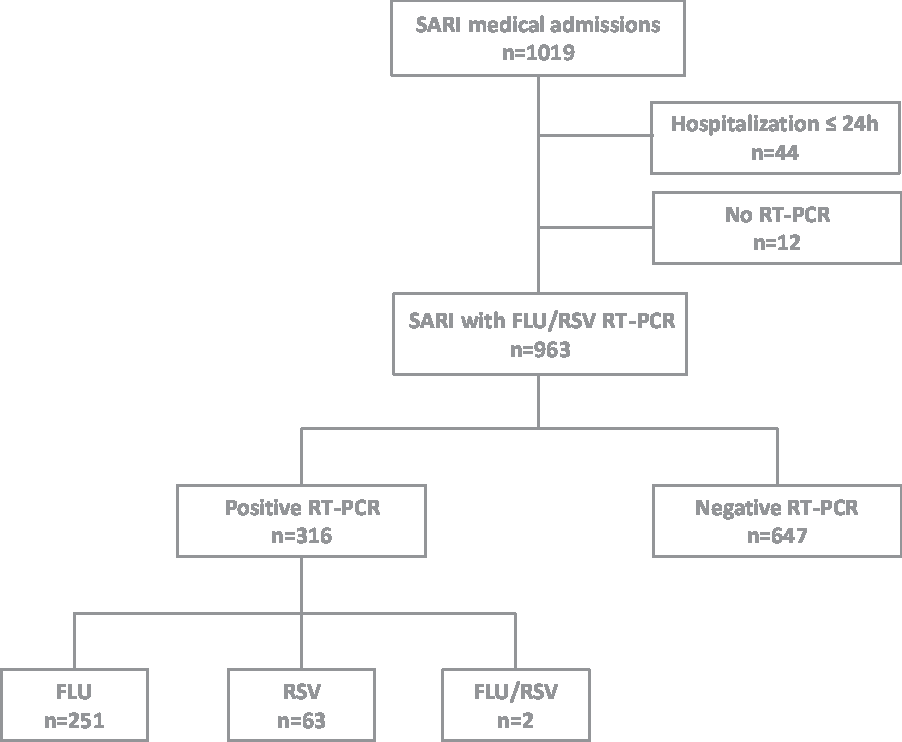
The SARI surveillance process was activated yearly from week 47 in 2015 to week 17 in 2016; from week 44 in 2016 to week 13 in 2017; from week 48 in 2017 to week 16 in 2018; and from week 45 in 2018 to week 15 in 2019. During those periods, 963 adult medical admissions were enrolled and underwent nasopharyngeal swabbing for molecular assay targeting influenza A/B and RSV viruses. Overall, 316 (33%) were positive for at least 1 respiratory virus (Fig. 1). RSV prevalence was 5% to 6% for seasons 2015–2018 and 10% in season 2018–2019; the prevalence of influenza ranged from 21% to 28% in the 4 surveillance years (Supplementary Fig. 1 online). Influenza and RSV viral status was available for 929 of 963 patients (96%): for 700 patients (75%) within 24 hours, for 150 patients (16%) within 48 hours, and for 79 patients (9%) within 72 hours. Also, 34 virologic results (3.4%) became available only after >72 hours.
SARI medical admissions 2015–2019 with viral diagnosis (influenza/RSV-negative).

SARI population characteristics
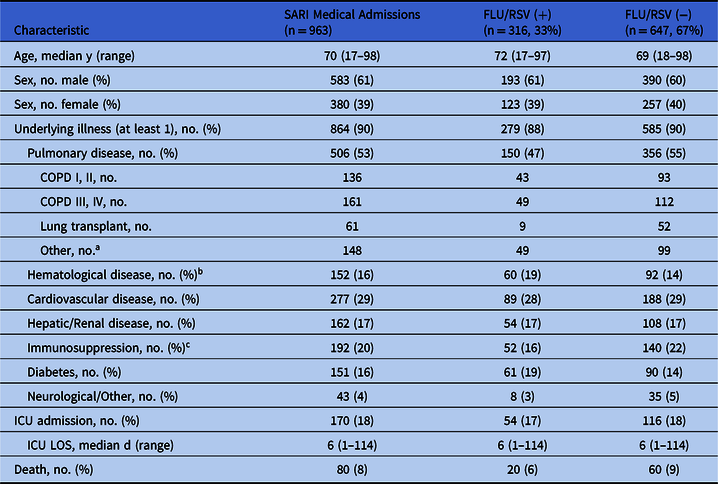
Epidemiological features, clinical characteristics, and outcome data were similar across the entire SARI population, whatever the virologic or bacterial coinfection status (Table 1).
Demographic and Clinical Characteristics of 2015–2019 Severe Acute Respiratory infection (SARI) Population (n = 963)

Note. FLU, influenza; RSV, respiratory syncytial virus; COPD, chronic obstructive pulmonary disease; ICU, intensive care unit; LOS, length of stay.
a Asthma, pulmonary fibrosis, interstitial lung disease.
b Hematological malignancy with or without autologous or allogeneic stem cell transplant.
c Solid malignancy, illness.
Bacterial testing at admission and main pathogens isolated
Clinical specimens for bacterial pathogen identification were collected at admission. Blood samples were obtained from 810 patients (84%); sputum samples were obtained from 471 patients (49%); and urine samples for antigen detection were obtained from 147 patients (15%). Overall, 7% of blood samples were positive, as were 37% of sputum samples and 16% of urine samples. A bacterial coinfection was identified in 51 of 316 patients (16%) with a positive viral diagnosis and in 185 of 647 patients (29%) with a negative viral diagnosis (Supplementary Fig. 2 online). The main bacterial pathogens isolated from admission samples (at least 1, single and coinfections) were Haemophilus influenzae (n = 74), Streptococcus pneumoniae (n = 60), Pseudomonas aeruginosa (n = 47), Escherichia coli (n = 26), Staphylococcus aureus (n = 18), and Moraxella catarrhalis (n = 8).
Viral status and empirical antimicrobial treatments
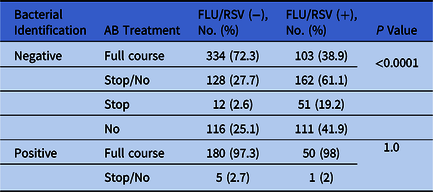
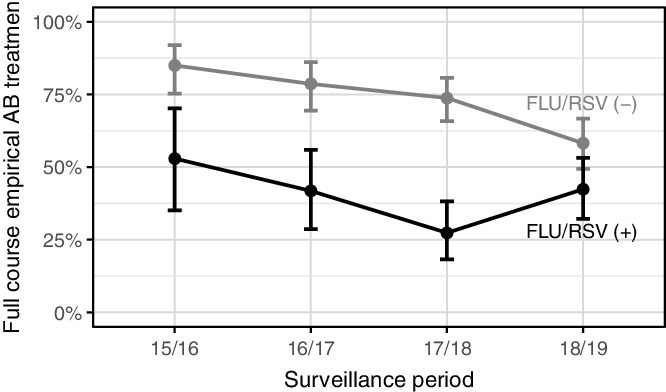
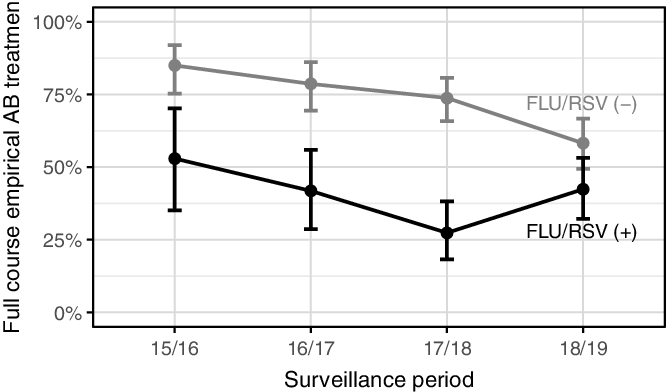
In patients with no bacterial pathogen isolated from clinical specimens sampled within 24 hours of admission, the proportion of empirical antibiotics treatments not initiated or discontinued was significantly higher for the influenza/RSV–positive patients (162 of 265) than for the influenza/RSV–negative patients (128 of 462) (P < .0001) (Table 2). This effect on AB treatment was observed in each annual surveillance period, but it was smaller for the year 2018–2019 (Fig. 2).
Impact of PCR results on AB Treatment Management
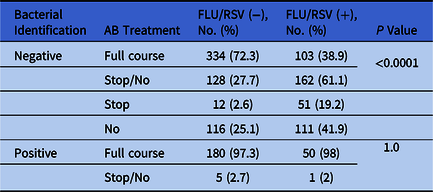
Note. PCR, polymerase chain reaction assay; AB, antibiotic; Stop, treatment discontinued; No, AB treatment withheld.
Evolution of full-course AB treatment in patients without documented bacterial infection across the 4 surveillance periods. Black and grey lines represent influenza/RSV-positive and influenza/RSV-negative groups, respectively. Error bar represent 95% binomial confidence interval around the estimated proportion.
The inclusion of potential confounding factors in a multivariate analysis did not change the estimated difference of full-course empirical treatment between influenza/RSV–negative and influenza/RSV–positive patients without a documented bacterial infection (univariate odds ratio [OR], 0.24; 95% confidence interval [CI], 0.18–0.33; adjusted odds ratio [aOR], 0.23; 95% CI, 0.16–0.32).
Respiratory diagnosis at discharge
A respiratory diagnosis at discharge was retrospectively ruled out in 101 of 647 patients (16%) with a negative influenza/RSV result. In that population, clinical presentation was compatible with a SARI case definition mainly due to the “dyspnea and/or cough” criteria, while an alternate diagnosis was finally made (urinary tract infection, intra-abdominal infection, pulmonary embolism, etc). The exclusion of these patients did not change our results (Supplementary Table 1 online).
Influenza and antiviral treatments
An influenza infection was documented in 253 patients: 184 with influenza A, 67 with influenza B, 1 with influenza A/RSV, and 1 with influenza B/RSV. Targeted antiviral treatment was prescribed for 235 patients (93%) based on virologic results, and 18 patients did not receive antiviral treatment. Only 17 patients (8 admitted to the ICU) received empirical antiviral treatment, which was discontinued when influenza was ruled out.
Discussion
Key results
This epidemiological surveillance process together with an efficient molecular diagnostic assay allowed us to highlight influenza and RSV in adult patients hospitalized for respiratory infections over the winter months. Influenza remained the predominant pathogen detected, with annual positivity rates of 21%–28% in our 4-year study. Although influenza positivity rates could exceed 50% at the epidemiological wave peaks, RSV diagnosis presented more longitudinal features, consistent with an extended epidemiological background circulation and a lower prevalence (ie, 5%–10%, varying with severity of the epidemiological wave in the pediatric population).
Systematic screening based on a standardized SARI case definition at hospital admission (ie, emergency department SARI pathway) ensured the exhaustive enrollment of patients over the surveillance periods, relying on emergency department medical and nursing staff experience, weekly epidemiological updates and annual reproducibility of the screening process.
Although the availability of virologic results mainly ranged from 24 to 72 hours after hospital admission, the impact of influenza/RSV diagnosis on antimicrobial management (antibiotics and antivirals) was nevertheless noticeable. Empirical antibiotic treatments were withheld or discontinued in 61% of patients with a documented viral infection and with no bacterial pathogen isolated from their admission samples (blood and/or sputum and/or urine). These findings contrast with those of the 28% of patients with negative virologic and bacterial results. Similarly, early identification of influenza infections allowed a drastic limitation of empirical antiviral treatments and allowed targeted treatment with oseltamivir for almost all influenza-positive patients. Epidemiological features, clinical characteristics, and outcome data were similar in both patient groups (ie, those with and without a documented viral infection).
Our study has several limitations. Because of the observational study design, we cannot formally attribute the differences in empirical antimicrobial management to the influenza/RSV diagnosis. In a population with a high level of comorbidities, previous antimicrobial use and/or hospital stay can also impact the decision to treat or withhold treatment, and these factors were not assessed. Although underlying conditions were recorded systematically, we did not formally assess the severity criteria at admission that could prompt clinicians to initiate antibiotics (eg, moderate to severe hypoxemia, clinical signs of sepsis, chest X-ray controlled if suggestive of pneumonia).
Interpretation
Influenza testing should be performed in patients requiring hospitalization for acute respiratory infection in an epidemiological context, and rapid molecular assays should be used to improve influenza detection (per the A-II recommendation).Reference Uyeki, Bernstein and Bradley14 RSV infections are increasingly being reported in adults hospitalized for severe respiratory infection in the winter months, and even if the prevalence of RSV remains lower than for influenza, dual influenza/RSV molecular assays should be used to detect these viruses because their epidemiological annual occurrence overlaps.Reference Pastula, Hackett and Coalson15
Recent studies assessing the impact of a viral diagnosis on antimicrobial management in hospitalized adults remain inconclusive or present a wide range of designs with mixed results.Reference Pinsky and Hayden16-Reference Brendish, Malachira and Armstrong25 Furthermore, influenza and RSV illness severity patterns are not necessarily associated with bacterial coinfections (eg, in older patients and/or patients with comorbidities). A positive viral diagnosis can therefore help clinicians to decide whether to withhold or discontinue antibiotic treatment based on patient medical history, clinical presentation, and available bacterial investigations results.
Generalizability
A specific surveillance process favoring a multidisciplinary approach (infectious diseases, infection control, microbiology, emergency and intensive care departments, internal medicine units) in our 4-year surveillance study confirmed the impact of a molecular diagnosis on the antimicrobial management of influenza/RSV patients. One of our main objectives was to help reduce unnecessary use of antibiotics,Reference Walter and Wunderink26 which aligns with growing concerns about antimicrobial resistance and antimicrobial stewardship opportunities.Reference Morris, Calderwood and Fridkin27 Such rapid diagnostic testing also has an important impact on isolation procedures as a negative viral diagnosis will allow costly and inconvenient contact and droplet precautions to be discontinued.Reference Nesher, Tsaban and Dreiher28
Although other respiratory viruses are circulating in the winter months and are recognized as potential etiology in adult hospitalizations, multiplex molecular techniques remain expensive, with lower positivity rates that are correlated with more “background circulation patterns.” The value of RT-PCR targeting these viruses (parainfluenza, human metapneumovirus, rhinovirus, enterovirus, and coronaviruses) should be investigated in the context of the development of antimicrobial stewardship.
Based on our data, we believe that an active and well-established surveillance process associated with diagnosis capacities using rapid molecular tests for influenza and RSV during epidemic waves in patients presenting specific clinical features is a cost-effective strategy. This strategy improves patient care and limits unnecessary overprescription of antimicrobial (antibiotics, antivirals), and it optimizes hospital infection control processes and bed management.
Supplementary material
To view supplementary material for this article, please visit https://doi.org/10.1017/ice.2020.260
Acknowledgments
The authors thank John Carpenter for readability review and Olivier Denis for critical review of the manuscript.
Financial support
No financial support was provided relevant to this article.
Conflicts of interest
All authors report no conflicts of interest relevant to this article.