Introduction
The hypothesis of cognitive reserve asserts that older individuals with greater experiential resources exhibit better cognitive functioning and are able to tolerate higher levels of brain pathology before displaying clinical symptoms (Scarmeas & Stern, Reference Scarmeas and Stern2004; Stern, Alexander, Prohovnik, & Mayeux, Reference Stern, Alexander, Prohovnik and Mayeux1992). One of the most well-established proxy measures of reserve capacity in the elderly is educational attainment, which is thought to reflect more effective use of brain networks or cognitive paradigms (Stern, Reference Stern2009). In line with the hypothesis of cognitive reserve, many studies in both North America and Europe have suggested that educational attainment is associated with better cognitive performance and reduced risk for cognitive impairment and dementia in late life (Brayne & Calloway, Reference Brayne and Calloway1990; De Ronchi et al., Reference De Ronchi, Fratiglioni, Rucci, Paternico, Graziani and Dalmonte1998; Evans et al., Reference Evans, Hebert, Becket, Scher, Albert, Chown and Taylor1997; Fratiglioni et al., Reference Fratiglioni, Grut, Forsel, Viitanen, Grafstrom, Holmen and Winblad1991; Gatz et al., Reference Gatz, Svedberg, Pedersen, Mortimer, Berg and Johansson2001; Katzman, Reference Katzman1993; Launer, Dinkgreve, Jonker, Hooijer, & Lindeboom, Reference Launer, Dinkgreve, Jonker, Hooijer and Lindeboom1993; Mortel, Meyer, Herod, & Thornby, Reference Mortel, Meyer, Herod and Thornby1995; Prencipe et al., Reference Prencipe, Casini, Ferretti, Lattanzio, Fiorelli and Culasso1996; Raiha, Kaprio, Koskenvuo, Rajala, & Sourander, Reference Raiha, Kaprio, Koskenvuo, Rajala and Sourander1998; Stern, Reference Stern2007; Stern et al., Reference Stern, Gurland, Tatemichi, Tang, Wilder and Mayeux1994).
Results with respect to whether educational attainment moderates the trajectory of age-related cognitive decline have been mixed (Antsey & Christensen, Reference Anstey and Christensen2000). Several studies reported that educational attainment attenuates cognitive decline in samples of non-demented, older adults (Albert et al., Reference Albert, Jones, Savage, Berkman, Seeman, Blazer and Rowe1995; Arbuckle, Maag, Pushkar, & Chaikelson, Reference Arbuckle, Maag, Pushkar and Chaikelson1998; Bosma et al., Reference Bosma, van Boxtel, Ponds, Houx, Burdorf and Jolles2003; Butler, Ashford, & Snowdon, Reference Butler, Ashford and Snowdon1996; Evans et al., Reference Evans, Becket, Albert, Hebert, Scher, Funkenstein and Taylor1993; Farmer, Kittner, Rae, Bartko, & Regier, Reference Farmer, Kittner, Rae, Bartko and Regier1995; Lyketsos, Chen, & Anthony, Reference Lyketsos, Chen and Anthony1999). Such results support an active cognitive reserve hypothesis in which education promotes more efficient cognitive processing and use of brain networks, which results in smaller cognitive declines in the face of neuropathology, effectively slowing the process of age-related cognitive decline (Stern, Reference Stern2002).
These findings have been challenged by several subsequent studies that used more sophisticated statistical methodologies (Christensen et al., Reference Christensen, Hofer, MacKinnon, Korten, Jorm and Henderson2001; Glymour, Weuve, Berkman, Kawachi, & Robins, Reference Glymour, Weuve, Berkman, Kawachi and Robins2005; Karlamangla et al., Reference Karlamangla, Miller-Martinez, Aneshensel, Seeman, Wight and Chodosh2009; Tucker-Drob, Johnson, & Jones, Reference Tucker-Drob, Johnson and Jones2009; Van Dijk, Van Gerven, Van Boxtel, Van der Elst, & Jolles, Reference Van Dijk, Van Gerven, Van Boxtel, Van der Elst and Jolles2008; Wilson et al., Reference Wilson, Hebert, Scher, Barnes, Mendes de Leon and Evans2009). These reports support a passive cognitive reserve hypothesis, in which individuals with greater educational attainment continue to perform at a higher level than similarly aged individuals with less education, but decline at a similar rate (Stern, Reference Stern2002). Still other studies have found that educational attainment accelerated cognitive decline in populations with confirmed Alzheimer's disease (Andel, Vigen, Mack, Clark, & Gatz, Reference Andel, Vigen, Mack, Clark and Gatz2006; Stern, Albert, Tang, & Tsai, Reference Stern, Albert, Tang and Tsai1999). These results may support a compensation hypothesis, in which intact domains compensate for declines in other cognitive abilities until they, too, begin to deteriorate, leading the way for more rapid decline (Christensen et al., Reference Christensen, Korten, Jorn, Henderson, Jacomb, Rodgers and Mackinnon1997; Reuter-Lorenz & Mikels, Reference Reuter-Lorenz and Mikels2006).
Likely explanations for these discrepant findings relate to cohort differences and/or differing statistical methodologies. For example, some studies used regression-based techniques, while others used multilevel or structural equation modeling frameworks. Also, some studies adjusted models for baseline cognitive status, while others did not (see Glymour et al., Reference Glymour, Weuve, Berkman, Kawachi and Robins2005). Another possible contributor to discrepant findings is that education may exert different effects on the trajectories of different cognitive domains. For example, Alley, Suthers, and Crimmins (Reference Alley, Suthers and Crimmins2007) used growth curve modeling to show that higher levels of education attenuated decline in overall global cognition, accelerated decline in verbal memory, and were unrelated to decline in working memory. Taken together, the aforementioned studies demonstrate that the effects of education on the rate of cognitive aging have not yet been fully established. The present study sought to contribute to this highly conflicting literature by examining the influence of educational attainment on trajectories of four cognitive abilities (i.e., processing speed, working memory, verbal fluency, and verbal episodic memory) over 12 years in a large sample of initially healthy, community-dwelling older adults who participated in the Victoria Longitudinal Study (VLS).
Method
Participants
The VLS included adult residents of greater Victoria, British Columbia, between 54 and 95 years of age without serious health conditions who were community-dwelling at study entry. Participants were recruited using newspaper and television advertisements and direct appeals to community groups (newsletters and oral presentations). Inclusion criteria were: (a) self-reported good health without recent illness such as stroke or heart attack; (b) ability to read newspaper-size print, hear normal spoken conversation, and produce written responses; and (c) ability to travel to testing site. The VLS followed a longitudinal-sequential design: the original cohort sample was enrolled in 1986–1987 and interviewed approximately every three years; in year 6, a second cohort was enrolled and followed on the same re-interview schedule as the original cohort (Baltes, Cornelius, & Nesselroade, Reference Baltes, Cornelius and Nesselroade1979; Dixon & De Frias, Reference Dixon and De Frias2004). All participants were followed up at approximate 3-year intervals (see Dixon & De Frias, Reference Dixon and De Frias2004, for a description of the design and measures of the VLS). Data were obtained in compliance with the Helsinki Declaration (http://www.wma.net/en/20activities/10ethics/10helsinki/index.html).
The present study included data available from 1014 individuals (99.3% Caucasian) from VLS Sample 1 (N = 484; waves 1–5; >12 years follow-up) and Sample 2 (N = 530; Waves 1–3; >6 years follow-up). Sample 1 comprised a greater proportion of males (41% vs. 33%; χ2(1) = 6.39; p = .01) and evidenced a lower level of education, on average (13.4 vs. 14.7 years; t(998) = −7.02; p < .001). There were no significant differences between Samples 1 and 2 with regard to age at study entry.
Independent Variables
Age, gender, and education, as years of completed schooling, were self-reported at baseline. Education values greater than 20 were top-coded as 20, reflecting completion of a doctoral degree. In primary models, we considered education as a continuous variable. In supplementary models, we examined results dichotomizing education at 13 or fewer years versus 14+ years, as 13 years represents the equivalent of high-school completion for students from these cohorts in most of Canada. Finally, we considered an alternative indicator of cognitive reserve with a vocabulary test (correlated with crystallized intelligence) completed at the baseline occasion (Hultsch, Hertzog, Dixon, & Small, Reference Hultsch, Hertzog, Dixon and Smal1998). In supplementary models, performance on this vocabulary test was included as a continuous primary predictor, instead of education.
Cognitive Outcomes
Composite scores were created for each cognitive domain of interest. Previous studies of VLS data have used similarly constructed composites to index verbal processing speed and episodic memory based on confirmatory factor analysis (Hertzog, Dixon, Hultsch, & MacDonald, Reference Hertzog, Dixon, Hultsch and MacDonald2003; Small, Dixon, McArdle, & Grimm, under revision). Briefly, the verbal processing speed composite comprised two tests: lexical decision (speeded word/non-word; Baddeley, Logie, Nimmo-Smith, & Brereton, Reference Baddeley, Logie, Nimmo-Smith and Brereton1985) and sentence verification (speeded plausible/implausible sentence; Palmer, MacLeod, Hunt, & Davidson, Reference Palmer, MacLeod, Hunt and Davidson1985). The working memory composite comprised three tests: sentence construction (Hultsch et al., Reference Hultsch, Hertzog, Dixon and Smal1998) and two span tests (listening and computation; Salthouse & Babcock, Reference Salthouse and Babcock1991). The verbal fluency composite comprised three written fluency tests from the Kit of Factor Referenced Cognitive Tests (Ekstrom, French, Harman, & Dermen, Reference Ekstrom, French, Harman and Dermen1976): controlled associates, opposites, and figures of speech. The verbal episodic memory composite comprised immediate recall scores from two word list learning and two story memory tasks (Dixon et al., Reference Dixon, Wahlin, Maitland, Hultsch, Hertzog and Bäckman2004).
For all measures, raw scores were standardized to Z-score metric using means and standard deviations derived from baseline scores on the respective test. Composite scores were computed by averaging standardized scores on the tests within each domain. Reliability estimates of all tests were established in previous studies and ranged from acceptable to very good (Hultsch et al., Reference Hultsch, Hertzog, Dixon and Smal1998). Specifically, split-half reliability of the verbal processing speed tasks computed using the Spearman-Brown formula ranged from .93 to .95 for lexical decision and .96 to .96 for sentence verification (Hultsch et al., Reference Hultsch, Hertzog, Dixon and Smal1998). With regard to the three working memory tasks, split-half reliability calculated using the Spearman-Brown formula was reported to be .90 for computation span and .86 for listening span (Salthouse & Babcock, Reference Salthouse and Babcock1991). Reliability of the sentence construction task was estimated to be .67 after applying the Spearman-Brown formula to random item pairs (Hultsch et al., Reference Hultsch, Hertzog, Dixon and Smal1998). Reliability estimates of the verbal fluency tasks were calculated in groups of young adults and were reported in the manual for the Kit of Factor Referenced Cognitive Tests as ranging from .81 to .83 across the three tests (Ekstrom et al., Reference Ekstrom, French, Harman and Dermen1976). With regard to measures of episodic memory, average correlations between pairs of lists used in the word list learning task ranged from .66 to .73, and average correlations between pairs of stories used in the story memory task ranged from .71 to .76 (Hultsch et al., Reference Hultsch, Hertzog, Dixon and Smal1998).
Statistical Analyses
Modeling was carried out using Mplus 6.0 maximum likelihood (MLR) estimation. First, unconditional growth models were built in which the linear and quadratic effects of time were examined separately for each of the four cognitive composites. Nested model comparisons using the chi square test were used to evaluate whether including quadratic time improved model fit. Next, age at baseline (centered at age 70), self-reported education at baseline (in years), and gender were added to the model as continuous (age and education) or dichotomous (gender) variables. As described above, we also examined supplementary models in which education was either dichotomized to reflect high and low attainment or replaced with a baseline vocabulary measure. We also examined primary models separately for younger (<70 years) and older (≥70) participants. In all models, time was parameterized with time scores representing years since study entry. All models were estimated with random intercepts and random slopes for time.
Attrition and Missing Data
Collapsing across samples 1 and 2, attrition rates in the present dataset were as follows: wave 1 to 2: 27.6%; wave 2 to 3: 21.1%; wave 3 to 4: 28.2%; and wave 4 to 5: 30.5%. Data for at least one cognitive domain at all five waves were available for 28.5% participants (38% male). Whereas the range of education within this subset (i.e., 7 to 20 years) was similar to the greater sample, the range of age (i.e., 55 to 83 years) was more restricted. On average, participants with five waves of data available were younger (65.40 vs. 70.21 years; t(682.407) = 11.880; p < .001) and reported higher educational attainment (14.49 vs. 13.94 years; t(998) = −2.610; p < .01). To explore whether selective attrition reduced our ability to detect an effect of education on cognitive trajectories, we re-ran primary models using only a subset of participants with five waves of data (N = 289) who did not differ from participants without five waves of data (N = 675) in terms of education (p > .1). The pattern of results obtained with the subsample (N = 964) was identical to that obtained with the full sample.
Given that attrition in this study was related to age and education, missing data in the present study did not meet the definition of “missing completely at random.” For this reason our analyses are conditioned on age and education, and we use full information maximum likelihood (FIML) estimation. Unlike listwise or pairwise deletion, FIML produces unbiased parameter estimates and preserves the overall power of the analysis under the more plausible “missing at random” assumption (Schafer, Reference Schafer1997; Wothke, Reference Wothke1999). FIML uses the entire observed data matrix to estimate parameters with missing data. FIML procedures are advantageous because they allow inclusion of all observations, even for participants who did not complete all five assessments and are thought to provide better treatment of missing data than traditional approaches such as mean substitution and listwise deletion (Schafer & Graham, Reference Schafer and Graham2002).
Results
The sample comprised 642 females and 372 males who ranged in age from 54 to 95 years at baseline (mean = 68.8 years; SD = 6.8). This under-representation of males (37%) persisted throughout the study period, as only 34% of participants who participated in all five study visits were male. At study entry, participants reported attaining 6 to 20 years of education (mean = 14.1 years; SD = 3.1). There was a significant negative correlation between age and educational attainment (r = −.117; p < .001). Compared to women, men reported significantly higher levels of education (14.5 vs. 13.9 years; t(683.420) = −3.343; p = .001) at study entry. This difference in education level between men and women persisted throughout the study period, as men who participated in all five follow-up visits also reported significantly higher levels of education than women who completed all five waves (14.9 vs. 14.2 years; t(659) = −2.828; p = .005). Men with incomplete data also reported more education than women with incomplete data (13.9 vs. 13.0; t(255.929) = −2.408; p = .017). There was no difference in age at study entry between men and women in the whole sample or within the subgroup of participants with complete data.
Unconditional Growth Models
Unconditional models for each composite containing only linear slopes were compared to corresponding models with both linear and quadratic slopes. For verbal fluency, verbal episodic memory, and working memory, models that included both fixed and random effects of a quadratic slope did not converge. Thus, the model used in nested model comparisons for these three domains included only quadratic fixed effects. Adding quadratic change failed to improve model fit for any of these three cognitive domains. Thus, subsequent models included only linear slopes for verbal fluency, verbal episodic memory, and working memory. For processing speed, including a quadratic slope improved model fit (Δχ2(4) = −43.884; p < .001).
As shown in Table 1, significant linear decline over time was evident for verbal fluency, verbal episodic memory, and working memory. Comparing across domains, scores declined approximately 2–4% of one standard deviation (SD) per year. The fastest decline (3.5% SD per year) occurred in the working memory domain, and the slowest decline (1.5% SD per year) occurred in the verbal fluency domain. Significant positive quadratic (U-shaped) change was evident for processing speed, indicating slight improvements in speed (lower scores) between the first and second assessment waves, but slowing of performance (higher scores) thereafter. There was significant individual variation in cognitive ability in all four domains at baseline. Random effects in slopes were significant for working memory (p = .011) and verbal episodic memory (p < .001). Intercepts and slopes were not significantly correlated within any domain.
Fixed effects from the four separate unconditional growth models

Note. SE = standard error.
Effects of Age, Gender, and Education on Cognitive Performance and Decline
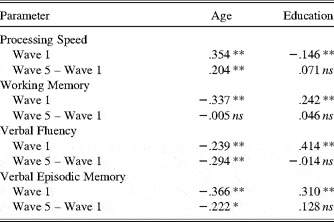
Next, the three independent variables were added simultaneously to the best-fitting models described above. The conditional model for processing speed would not converge without constraining the random variance of the quadratic slope to 0. To obtain estimates of the effects of interest (i.e., regression paths between the independent variables and cognitive change), the quadratic slope was removed from the model. The fixed effect of the linear slope in the unconditional model that did not include the quadratic slope was positive and significant (0.029; p < .001), which reflects increasing scores (slowing) of approximately 3% SD per year. Simple correlations between the cognitive variables and demographic variables of age and education are shown in Table 2.
Zero-order correlations between cognitive variables and age and education

* p < .05.
** p <.001.
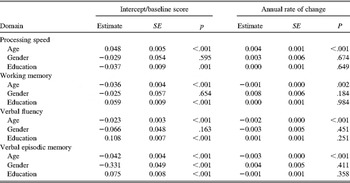
Controlling for the other independent variables, older age at baseline was associated with worse cognitive performance in all four domains (Table 3). Age appeared to exert the greatest effect on processing speed, as each year of age greater than 70 reduced performance by nearly 5% SD. Age appeared to exert the smallest effect on verbal fluency, as each year of age greater than 70 reduced performance by only 2.3% SD. Older age was also associated with accelerated decline in all four domains.
Covariate effects in the four separate conditional models

Note. SE = standard error.
Controlling for the other independent variables, gender was not associated with cognitive performance in processing speed, working memory, or verbal fluency. Gender was associated with poorer verbal episodic memory such that males performed approximately one-third SD worse on this composite, as compared to females. Gender was unrelated to the rate of decline in any domain.
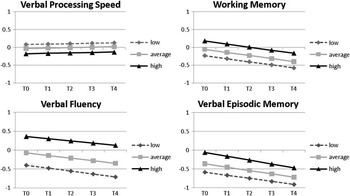
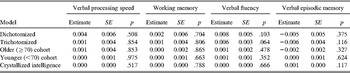
Controlling for the other independent variables, higher education was associated with better performance in all four cognitive domains. This beneficial effect of education appeared to be greatest in the verbal fluency domain, for which each year of education was associated with higher scores of nearly 11% SD. The influence of education on cognitive performance was smallest for the processing speed domain, for which each year of education was associated with higher scores of only 3.7% SD. Education was unrelated to the rate of decline in any domain, which can be visualized as parallel model-predicted trajectories in Figure 1. The pattern of results did not change when the education variable was dichotomized at the sample median or split into tertiles (Table 4). The pattern of results did not change in conditional models that did not control for age or gender.
Model-predicted trajectories over 12 years for individuals with low, average, and high educational attainment. Note: Increase in timed values indicates a slowing of processing speed. Time scores along the x-axis represent approximately 3-year intervals.

Effects of education (or crystallized intelligence) on linear slopes in the supplementary models

Note. SE = standard error.
Because younger individuals in the present sample reported higher levels of education than did older individuals, we examined the possibility that cohort effects masked association between education and cognitive decline. First, we ran all four conditional models excluding the covariate of baseline age. We also ran these models separately in subgroups of younger (<70 years) and older (≥70 years) adults. In all cases, we failed to find an association between education and change on any of the cognitive composites (Table 4). We also explored the potential for an alternative indicator of cognitive reserve (i.e., crystallized intelligence) to moderate cognitive decline. Crystallized intelligence was indexed with scores on a vocabulary test at baseline, which was significantly correlated with education (r = .341; p < .001). We ran the four conditional models using baseline vocabulary in place of the education variable and found no differences in the pattern of results. That is, baseline vocabulary was positively associated with intercepts in all four conditional models, but unrelated to slopes.
Discussion
The present study contributes to the debate regarding a potential influence of educational attainment on the trajectory of cognitive aging by reporting results from longitudinal analyses featuring (a) a long-term follow-up period (i.e., 12 years) for (b) a large sample covering a broad, 40-year band of older adults on (c) specific cognitive domains. In this Canadian sample, education was related to the cognitive abilities of processing speed, working memory, verbal fluency, and verbal episodic memory, but we did not find evidence that educational attainment moderates declines in any of these domains. These results support a passive cognitive reserve hypothesis, in which individuals with greater educational attainment continue to perform at a higher level compared to similarly aged individuals with less education, but decline at a similar rate (Stern, Reference Stern2002).
These findings are consistent with and extend several recent studies that observed no moderating effect of education on cognitive decline with aging. Applying longitudinal structural equation modeling to data obtained through the Advanced Cognitive Training for Independent and Vital Elderly (ACTIVE) study, Tucker-Drob et al. (Reference Tucker-Drob, Johnson and Jones2009) reported that education did not moderate the trajectories of reasoning or processing speed over a 5-year period. Using both latent growth curve models and more traditional regression, Christensen et al. (Reference Christensen, Hofer, MacKinnon, Korten, Jorm and Henderson2001) found that education was not related to change in crystallized intelligence, memory, cognitive speed, or global cognition over 8 years in the Canberra longitudinal study. Reporting 6-year follow-up data from the Maastricht aging study, Van Dijk et al. (Reference Van Dijk, Van Gerven, Van Boxtel, Van der Elst and Jolles2008) reported no significant time by education interaction for individual cognitive tests assessing learning and memory, interference control, set shifting, fluency, mental speed, or global cognition.
Many previous studies adjusted for baseline performance in their analyses, which could account for positive results, particulary if only two timepoints and/or measures with low reliability were used. Conditioning on baseline status can be carried out by using regression adjustment, stratification, restriction, or matching (Glymour et al., Reference Glymour, Weuve, Berkman, Kawachi and Robins2005). Briefly, the following two baseline adjusted regression models, in which Y1 represents cognitive score at time 1 and Y2 represents cognitive score at time 2, provide identical coefficient estimates for education (i.e., α1 = β1):

Consider the common situation in which: Y1 is a measure of a latent variable C1; Y1 is subject to some measurement error or instability (e.g., reliability is imperfect), and education is highly correlated with C1, the baseline cognitive function. In this case, β1 is biased toward the association between education and C1 (the cross-sectional association). Under these assumptions, neither regression equation above can generally provide an unbiased estimate of the effect of education on change in cognition, even if other assumptions (e.g., no confounding due to an unmeasured variable), are fulfilled. This result has previously been proven (Glymour et al., Reference Glymour, Weuve, Berkman, Kawachi and Robins2005; Yanez, Kronmal, & Shemanski, Reference Yanez, Kronmal and Shemanski1998) and illustrated in applied examples with respect to education and cognitive aging (Dugravot et al., Reference Dugravot, Guéguen, Kivimaki, Vahtera, Shipley, Marmot and Singh-Manoux2009; Glymour et al., Reference Glymour, Weuve, Berkman, Kawachi and Robins2005). Intuitively, the bias occurs because adjusting for baseline Y1 score implicitly compares high and low education individuals with the same Y1 value. In such a comparison, it is likely that either the highly educated individual's Y1 reflects a negative random error, or the less educated individual's Y1 reflects a positive random error. At the Y2 assessment, the less educated individual is likely to “regress” to his or her population mean, appearing to decline compared to the highly educated individual. This is a special case of “regression to the mean,” the bias that arises when observing change in a subgroup of people selected specifically for high (or specifically for low) performance. Although this phrase is more commonly applied when the selection was based on defining a specific threshold of baseline performance for inclusion in the study, regression adjustment for the baseline score induces a similar phenomenon.
In one review of longitudinal studies of education and cognitive change, 12 of the 14 available studies reported a benefit of education (Antsey & Christensen, Reference Anstey and Christensen2000). Of these, eight studies had explicitly conditioned on baseline performance. Because of the strong relationship between education and baseline cognitive status, it is likely that at least some of these studies suffered from the statistical artifact described above. That is, conditioning on the baseline measure could have produced biased effect estimates and the potential for a spurious correlation between the exposure variable (i.e., education) and change on a measure since the exposure variable is known to predict baseline level of the measure. Additionally, when cognitive assessments with low reliability are used, such as relatively crude cognitive screens, this bias can be much larger than any plausible causal effect of education on rate of cognitive change (Yanez et al., Reference Yanez, Kronmal and Shemanski1998). It should be noted that previous studies, including those reviewed by Antsey and Christensen (Reference Anstey and Christensen2000), differ in their potential susceptibility to this artifact. For example, those with more than two occasions of measurement and those that used more reliable measures are relatively less vulnerable. Our study advances on prior work by carefully modeling cognitive performance with composites rather than individual tests to improve measurement reliability, using unbiased longitudinal growth models, evaluating long-term cognitive changes, and demonstrating the consistency of results across theoretically distinct (albeit highly correlated) cognitive domains.
Limitations of the present study include under-representation of males (36.7%) and non-Caucasians (0.7%). It should be noted that analyses controlled for sex, which was unrelated to rates of change in any cognitive domain. Another important limitation lies in the relatively high mean educational attainment in the sample. Lyketsos et al. (Reference Lyketsos, Chen and Anthony1999) have highlighted the general lack of understanding regarding a potential incremental association between education and cognitive decline. They assert that individuals with the lowest levels of education may experience the greatest declines, whereas additional education beyond 9 years may not confer further attenuation of decline. Because the present sample included only a very small subset of individuals (3%) with fewer than 9 years of education, we were unable to fully evaluate this issue. However, the pattern of results did not change when the education variable was dichotomized at the sample median or split into tertiles. From these data, we can conclude that in this relatively well-educated sample (mean = 14.1 years), years of education did not appear to moderate cognitive trajectories. Future studies are needed to more fully examine the possibility of steeper decline among older adults with very low educational attainment.
Acknowledgments
The authors acknowledge the Friday Harbor Advanced Psychometric Methods Workshop in Cognitive Aging in the initiation and development of this manuscript. This research was facilitated by the Integrative Analysis of Longitudinal Studies of Aging (IALSA) research network (NIH/NIA AG026453), and other support from P30-DC005803 and the National Institute on Aging (T32AG020499-UF/LBZ). The Victoria Longitudinal Study is funded by the National Institute on Aging (NIH/NIA R37 AG008235) to Roger Dixon. The authors also wish to acknowledge the helpful comments of Dan Mungas in the development of the manuscript. The views expressed do not necessarily reflect the official policies of the Department of Health and Human Services; nor does mention by trade names, commercial practices, or organizations suggest endorsement by the U.S. Government. No authors have a conflict of interest related to the content of this manuscript. The information in this manuscript and the manuscript itself has never been published either electronically or in print.