Introduction
Age-related changes in hepatic blood flow, volume of distribution and renal function mean that older people are at high risk of experiencing psychotropicrelated adverse drug events (ADEs) (Hilmer et al., Reference Hilmer, McLachlan and Le Couteur2007). Use of antipsychotics has been associated with an increased risk of death, falls and cardiovascular events (Schneider et al., Reference Schneider2006; Hartikainen et al., Reference Hartikainen, Lönnroos and Louhivuori2007). While generally considered a safer alternative to tricyclic antidepressants (TCAs), selective serotonin reuptake inhibitors (SSRIs) have been linked to drug-drug interactions, platelet dysfunction, hyponatremia, falls and extrapyramidal disorders (Draper and Berman, Reference Draper and Berman2008). Anxiolytics, hypnotics and sedatives are not recommended other than for short-term use due to the risk of daytime sedation, tolerance, rebound insomnia, depressive symptoms, worsening cognition, and falls and fractures (Hartikainen et al., Reference Hartikainen, Lönnroos and Louhivuori2007; van Vliet et al., Reference van Vliet, van der Mast, van den Broek, Westendorp and de Craen2009).
One in five community-dwelling people aged ≥65 years in the USA was prescribed a psychotropic drug in 1996 (Aparasu et al., Reference Aparasu, Mort and Brandt2003). In comparison, 27% of community-dwelling people aged ≥64 years in Finland were prescribed a psychotropic drug in 1998–99 (Linjakumpu et al., Reference Linjakumpu, Hartikainen, Klaukka, Koponen, Kivela and Isoaho2002). The use of psychotropic drugs in Finland increased between 1990–91 and 1998–99. This increasing trend continued after 1999 in countries including Australia, France, USA and the Netherlands (Sonnenberg et al., Reference Sonnenberg, Deeg, Comijs, van Tilburg and Beekman2008; Dorsey et al., Reference Dorsey, Rabbani, Gallagher, Conti and Alexander2010; Verdoux et al., Reference Verdoux, Tournier and Bégaud2010; Zhang et al., Reference Zhang2010).
Finnish studies conducted in the late 1990s revealed high rates of psychotropic drug use in community-based settings (Linjakumpu et al., Reference Linjakumpu, Hartikainen, Klaukka, Koponen, Kivela and Isoaho2002; Hartikainen et al., Reference Hartikainen, Rahkonen, Kautianen and Sulkava2003; Reference Hartikainen, Mantyselka, Louhivuori-Laako, Enlund and Sulkava2005). This prompted clinicians and policy-makers to implement a series of regional and national initiatives to optimize psychotropic drug use. Over the past decade these initiatives have included comprehensive medication review, counseling on benzodiazepine use by geriatricians and comprehensive geriatric assessment (Bell et al., Reference Bell, Väänänen, Ovaskainen, Närhi and Airaksinen2007; Rikala et al., Reference Rikala, Korhonen, Sulkava and Hartikainen2010b; Salonoja et al., Reference Salonoja, Salminen, Aarnio, Vahlberg and Kivelä2010). However, no studies have specifically investigated the trend in psychotropic drug use among community-dwelling older people in Finland since 1999. The objective of this study was to compare and contrast the use of psychotropic drugs among community-dwelling people aged ≥75 years in 1998 and 2004.
Methods
Study design
This study analyzed baseline data from two comparable prospective population-based cohort studies commenced in 1998 and 2004 in Kuopio, Finland. The studies were the Kuopio 75+ study (Hartikainen et al., Reference Hartikainen, Rahkonen, Kautianen and Sulkava2003; Reference Hartikainen, Mantyselka, Louhivuori-Laako, Enlund and Sulkava2005; Jyrkkä et al., Reference Jyrkkä, Enlund, Korhonen, Sulkava and Hartikainen2009) and the Geriatric Multidisciplinary Strategy for the Good Care of the Elderly (GeMS) study (Pokela et al., Reference Pokela, Bell, Lihavainen, Sulkava and Hartikainen2010; Rikala et al., Reference Rikala, Hartikainen, Sulkava and Korhonen2010a; Reference Rikala, Korhonen, Sulkava and Hartikainen2010b). The study samples were randomly selected from all residents of Kuopio aged ≥75 years on 1 January 1998 and 1 November 2003, respectively. In the Kuopio 75+ study 601 out of 700 randomly selected residents provided written consent to participate, of which 523 were community-dwelling. In the GeMS study 781 out of 1000 residents provided written consent to participate, of whom 700 were community-dwelling. Both studies were approved by the Hospital District of Northern Savo Ethics Committee.
Data collection
In both studies, community-dwelling participants were invited to attend the outpatient study clinic. Trained nurses interviewed the participants to elicit data on sociodemographic factors, social contacts, health behavior, health status and drug use in 1998 and 2004. If a participant was unable to visit the outpatient study clinic, the interview with the nurse took place in the participant's home.
Drug use was self-reported by the participants during the nurse interviews. Drug use was verified from prescription forms and drug packages which the participants were asked to bring to the interview; and from medical records from municipal health centers, home nursing service, local hospitals and the Kuopio University Hospital. The use of prescription, non-prescription and complementary and alternative drugs (CAMs) were recorded. Cognitive function was assessed using the 30-item Mini-Mental State Examination (MMSE), with scores ≤24 considered indicative of cognitive impairment (Folstein et al., Reference Folstein, Folstein and McHugh1975). Functional status was evaluated using the 8-item Instrumental Activities of Daily Living (IADL) Scale (Lawton and Brody, Reference Lawton and Brody1969). Self-reported health was measured using a 5-point Likert scale. The presence of depressive symptoms was assessed using the 15-item Geriatric Depression Scale (GDS-15) in the GeMS study only, with scores ≥5 considered indicative of depressive symptoms (Yesavage et al., Reference Yesavage1982–1983).
Measures and definitions
All drugs used by the participants were classified using the Anatomical Therapeutic Chemical (ATC) Classification System. Psychotropic drugs were defined as antipsychotics (N05A); anxiolytics, hypnotics and sedatives (N05B and N05C, excluding hydroxyzine and buspirone); and antidepressants (N06A and N06C). Drug use was considered regular if the drug was being taken daily or at regular intervals (once a week or once a month). Drug use was considered to be when-required if there was an irregular pattern of use. The total number of drugs was defined as the sum of all prescription drugs, non-prescription drugs and CAMs used on a regular or when-required basis. In the GeMS study, CAMs were categorized as a separate group whereas in the Kuopio 75+ study they were considered together with other regular or when-needed drugs. This means the overall number of regular and when-required drugs is not directly comparable between the Kuopio 75+ and GeMS study. However, this limitation does not apply to the total number of drugs or regular and when-required use of psychotropic drugs.
Data analyses
For the purpose of the analyses, IADL scores (0–8) were dichotomized into participants with difficulties in daily functioning (score 0–6) and participants able to function without difficulties (score 7–8). Health status was reclassified into three groups: good (very good/good); moderate; and poor (fairly poor/poor). Descriptive statistics were expressed as means and standard deviations for continuous variables, and as proportions for nominal and categorical variables. Student's t-tests were used to compare continuous variables, Mann-Whitney U tests for ordinal variables and χ2 tests for nominal variables. Logistic regression was used to compute unadjusted and adjusted odds ratios (ORs) and 95% confidence intervals (CIs) for the prevalence of psychotropic drug use in 2004 compared to 1998. The prevalence of psychotropic drug use was adjusted for differences in health status that were significantly different among participants in 1998 and 2004 (education, BMI, self-reported health and MMSE scores). P-values less than 0.05 were considered statistically significant. All data analyses were performed using SPSS 17.0 for Windows (SPSS Inc., Chicago, IL).
Results
Sample characteristics
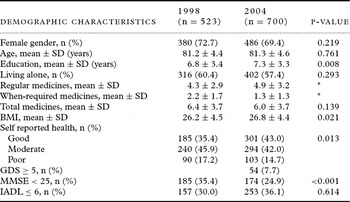
An overview of the sample characteristics are presented in Table 1. People aged ≥75 years in 2004 had a higher level of education (P = 0.008), higher body mass index (BMI) (P = 0.021), higher self-reported health (P = 0.013), and a lower prevalence of cognitive impairment (P < 0.001) compared to people ≥75 years in 1998.
Characteristics of participants aged 75 years and older in 1998 and 2004

BMI = Body Mass Index; GDS = Geriatric Depression Scale; IADL = Instrumental Activities of Daily Living; MMSE = Mini Mental State Examination; ND = no data available; SD = standard deviation; * = data not directly comparable
Change in prevalence of drug classes
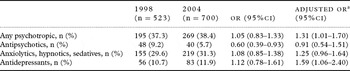
In 1998, 37.3% (n = 195) of participants used a psychotropic drug compared to 38.4% (n = 269) in 2004 (OR 1.05; 95% CI 0.83–1.33) (Table 2). After adjusting for sociodemographic and health status differences this increase was statistically significant (OR 1.31; 95% CI 1.01–1.70). In 1998, 9.2% (n = 48) of participants used an antipsychotic compared to 5.7% (n = 40) in 2004 (OR 0.60; 95% CI 0.39–0.93). However, after adjusting for sociodemographic and health status differences this decrease was not statistically significant (OR 0.91; 95% CI 0.54–1.51). There was no change in the unadjusted prevalence of antidepressant use (10.7% versus 11.9%) (OR 1.12; 95% CI 0.78–1.61), but after adjusting for sociodemographic and health status differences there was an increase in an antidepressant use between 1998 and 2004 (OR 1.59; 95% CI 1.06–2.40). There were no unadjusted or adjusted difference in the prevalence of anxiolytic, sedative or hypnotic use.
Unadjusted and adjusted ORs for use of psychotropic drugs in 1998 and 2004

CI = Confidence Interval; OR = Odds Ratio
a adjusted for education, BMI, self-reported health and MMSE
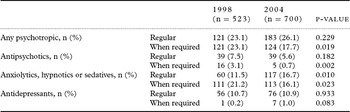
The change in number of regular and when-required users of psychotropic drugs between 1998 and 2004 is presented in Table 3. The when required use of antipsychotics decreased significantly from 3.1% to 0.7% (P = 0.002). Anxiolytics, hypnotics and sedatives were more frequently used on a when-required rather than a regular basis in 1998 (11.5% and 21.2% respectively), whereas, when-required and regular use was equally prevalent in 2004 (16.1% and 16.7% respectively).
Use of psychotropic medicines among participants aged 75 years and older, in 1998 and 2004

Change in prevalence of specific drugs
In 1998 melperone (2.3%; n = 12) and periciazine (2.3%; n = 12) were the most frequent regularly used antipsychotics. In 2004 the two most frequent regularly used antipsychotics were risperidone (1.4%; n = 10) and melperone (1.4%; n = 10). There was a significant decline in the regular use of periciazine from 2.3% (n = 12) to 0.7% (n = 5) (P = 0.020). However, there was a significant increase in the regular use of risperidone from 0 to 1.4% (n = 10) (P = 0.006). There was also a significant decline in the when-required use of haloperidol from 0.6% (n = 3) to 0% (P = 0.045), of melperone from 1.3% (n = 7) to 0.3% (n = 2) (P = 0.014); and of prochlorperazine from 1.3% (n = 7) to 0.1% (n = 1) (P = 0.010).
Zopiclone and temazepam were most the prevalent regular and when-required anxiolytics, sedatives and hypnotics. The when-required use of zopiclone decreased from 10.5% (n = 55) in 1998 to 6.4% (n = 45) in 2004 (P = 0.010). In contrast, changes in use of temazepam were not statistically significant. There was a decline in the when-required use of lorazepam from 0.6% (n = 3) to 0% (P = 0.045), while there was an increase in the when-required use of zolpidem 0% to 2.0% (n = 14) (P<0.001).
Citalopram was the most frequent regularly used antidepressant in 1998 (3.3%; n = 17) and in 2004 (3.7%; n = 26). The regular use of moclobemide decreased from 1.3% (n = 7) in 1998 to 0.3% (n = 2) in 2004 (P = 0.033), while the regular use of mirtazapine increased from 0.8% (n = 4) in 1998 to 2.7% (n = 19) in 2004 (P = 0.013). The when-required use of antidepressants was low and no statistically significant changes were detected.
Demographic and diagnostic differences
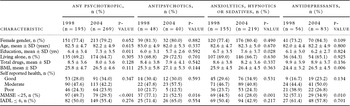
Demographic characteristics of psychotropic, antipsychotic, anxiolytic, sedative and hypnotic, and antidepressant users are presented in Table 4. There was a significant increase in the proportion of users without cognitive impairment for antipsychotics (P = 0.016); anxiolytics, hypnotics and sedatives (P = 0.001); and antidepressants (P = 0.010) between 1998 and 2004. Users of anxiolytics, hypnotics and sedatives in 2004 had one additional year of education compared to users in 1998 (P = 0.028). Antidepressant users had a higher BMI in 2004 compared to 1998 (P = 0.006).
Characteristics of psychotropic drug users aged 75 years and older, 1998 and 2004

BMI = Body Mass Index; IADL = Instrumental Activities of Daily Living; MMSE = Mini-Mental State Examination; SD = standard deviation
Discussion
The main finding of this study was that the unadjusted prevalence of total psychotropic drug use remained stable from 1998 to 2004. However, there was a small increase in prevalence after adjusting for changes in education, BMI, self-reported health and MMSE scores. There was also a trend towards regular rather than when-required use. This period was also characterized by the uptake of newer generation psychotropic drugs, including atypical antipsychotics, the Z-hypnotics, and mirtazapine.
In our study the total prevalence of antipsychotic and antidepressant use was 9.2% and 10.7% respectively in 1998. In comparison, the total prevalence of antipsychotic and antidepressant use was 5% and 9%, respectively among community-dwelling people aged ≥75 years in 1998–99 in Lieto, Finland (Linjakumpu et al., Reference Linjakumpu, Hartikainen, Klaukka, Koponen, Kivela and Isoaho2002). The different prevalences likely reflect regional differences in diagnosis and prescribing within Finland. Regional differences in prescribing have also been reported for strong opioids (Bell et al., Reference Bell, Klaukka, Ahonen and Hartikainen2009).
The percentage of antipsychotic users decreased from 9.2% in 1998 to 5.7% in 2004. However, this decrease was not statistically significant after adjusting for health and sociodemographic differences between the cohorts. The use of atypical antipsychotics increased. This was in contrast to results of an earlier Finnish study that reported slow uptake of atypical antipsychotics between 1990–91 and 1998–99 (Linjakumpu et al., Reference Linjakumpu, Hartikainen, Klaukka, Koponen, Kivela and Isoaho2002). Interestingly, the decrease in percentage of antipsychotic users preceded the US Food and Drug Administration advisory issued in April 2005 regarding increased mortality associated with atypical antipsychotics when used by patients with dementia (later extended to users of typical antipsychotics). Use of atypical antipsychotics increased between 1998 and 2004, consistent with the increase in use of atypical antipsychotics in the USA between 2003 and 2005 (Dorsey et al., Reference Dorsey, Rabbani, Gallagher, Conti and Alexander2010).
There was an increase in the percentage of antidepressant use from 10.7% in 1998 to 11.9% in 2004. This increase was statistically significant after adjusting for changes in health and sociodemographic differences. Antidepressant use increased from 3.9% in 1999 to 5.3% in 2002 among people aged 65–85 years in the Netherlands (Sonnenberg et al., Reference Sonnenberg, Deeg, Comijs, van Tilburg and Beekman2008). There was a similar increase in antidepressant use among community-dwelling people aged ≥65 years from 7.0% in 1999 to 8.6% in 2001 in France (Soudry et al., Reference Soudry, Dufouil, Ritchie, Dartigues, Tzourio and Alpérovitch2008). The findings of the present study were encouraging because under-diagnosis and under-treatment of depressive symptoms among older people has been reported (Snowdon and Fleming, Reference Snowdon and Fleming2008). However, antidepressants have been associated with a range of ADEs and the risks versus benefits should be carefully considered.
The prevalence of cognitive impairment was higher in 1998 compared to 2004. The youngest participants in the Kuopio 75+ study were born nearly six years earlier than the participants in the GeMS study. The introduction of compulsory primary schooling during this period may have been responsible for participants in the GeMS Study having a longer duration of education (P = 0.008). Patients with a lower level of education may be disadvantaged when completing the MMSE (O'Bryant et al., Reference O'Bryant2008). Secondly, the criteria for institutionalization may have changed between studies. There has been a trend towards providing health care in patients’ homes. However, people receiving high-level home healthcare in 2004 were categorized as institutionalized in 2004 and, therefore, were excluded from the study sample. These factors may partly explain why the decrease in prevalence of antipsychotic use was no longer significant after adjusting for differences in education and MMSE scores between the study cohorts.
Antidepressant users had a higher BMI in 2004 compared to 1998. Although the data do not permit investigation into possible causation, this may be partly explained by the fact that mirtazapine is more likely to cause weight gain or increased appetite compared to SSRIs (Watanabe et al., Reference Watanabe2010). Mirtazapine is often prescribed for its appetite-inducing effects in patients experiencing weight loss or at risk for malnutrition (Fox et al., Reference Fox, Treadway, Blaszczyk and Sleeper2009).
Methodological strengths and limitations
The study had a number of methodological strengths. The random population-based sampling strategy was the same in both 1998 and 2003, and there were high resident participation rates. Data collection was also performed in the same way in 1998 and 2004, which facilitated comparisons between the two study samples. Self-reported drug use was verified against prescription forms, drug packages and medical records in both 1998 and 2004. This minimized the possibility of recall bias.
The study also has a number of limitations. The prescribing indications were not assessed and, therefore, no conclusions can be made about the appropriateness of prescribing for individual participants. The results reflect use of psychotropic drugs in community-based settings and are not generalizable to psychotropic drug use in nursing homes or institutions. Similarly, the results may not be generalizable to other areas in Finland because of possible differences in prescribing culture. Possible changes in the concomitant use of two or more psychotropic drugs were not analyzed. Owing to differences in the categorization of CAMs, the total number of regular and when-required drugs could not be directly compared. Further research is needed to investigate the change in psychotropic drug use among people aged 75 years and older since 2004. Based on wholesale sales data, the overall utilization of antidepressants among people of all ages in Finland increased from 52.5 defined daily doses (DDDs)/1000 inhabitants/day in 2005 to 66.0 DDDs/1000 inhabitants/day in 2009 (National Agency for Medicines and Social Insurance Institution of Finland, 2009). Antipsychotic use increased from 17.4 DDDs/1000 inhabitants/day in 2005 to 20.4 DDDs/1000 inhabitants/day in 2009. However, anxiolytic use declined from 31.1 DDDs/1000 inhabitants/day in 2005 to 29.4 DDDs/1000 inhabitants/day in 2009. Sedative and hypnotic use declined from 54.4 DDDs/1000 inhabitants/day in 2005 to 50.8 DDDs/1000 inhabitants/day in 2009.
In conclusion, the unadjusted prevalence of psychotropic drug use remained stable between 1998 and 2004. The regular use of psychotropic drugs was more common in 2004 and there were changes in the use of specific psychotropic drugs. After adjusting for socioeconomic and health status differences, there was a small increase in the prevalence of psychotropic and antidepressant drug use.
Conflict of interest
None.
Acknowledgments
We thank the Social Insurance Institution of Finland, Nordic Red Feather of the Lions Organization and the City of Kuopio for supporting the Kuopio 75+ and GeMS studies. We are also grateful to Piia Lavikainen, MSc, for providing assistance with data management and the statistical analyses, and to the K.U. Leuven “Fonds Apotheker en Mevrouw Ysebaert-Devos” for providing a travel grant to Franciska Desplenter. Charlotte Caenen and Jolein Meelberghs gratefully acknowledge funding received to participate in an Erasmus exchange between Belgium and Finland.