Charles A. Beard's influential work on the origins of the U.S. Constitution has overshadowed other aspects of his long and versatile career as a public intellectual. We are often told that Beard “helped change the way people thought about power, politics, and law,” but rarely has anyone investigated the content of his career as a political scientist and urban reformer.Footnote 1 Even though we now know that Beard was much more than a historian,Footnote 2 the content and meaning of his work as an international expert on municipal government remains unduly neglected. As John Erskine recalled, it was Beard's vision of government—more than his historical work—that captivated his students at Columbia University. “In 1911 and 1912,” Erskine wrote, Beard “was admired by Columbia undergraduates as a great teacher who gave to many of them a new understanding of the American political system and of the organization of American government.”Footnote 3 “Though less known to the world than his contributions in history,” Luther Gulick wrote after Beard's death, his “contributions to and through governmental research and the establishment of pioneer endeavors for the realistic training of men and woman for the public service and for citizenship are equally standing and significant.”Footnote 4 Yet lingering questions remain in this regard. What, precisely, did Beard teach at Columbia University and what does it tell us about his political thought? How did Beard envisage governmental reform in an age prone to rethinking American democracy? How did Beard view the role of democracy in the American system of government?
To unpack Beard's vision of government, it is not enough to turn his polemical An Economic Interpretation of the United States Constitution (1913) upside down, as most scholars have done, without exploring his contributions to municipal government and his teaching at Columbia University. At a time when scholars have started to thoroughly analyze the “ideas, aspirations, and practices that took the offensive in the development of modern American government,” Beard's voice remains silenced under a large shadow of prejudices and arguments about his historical work.Footnote 5 Beard's name still evokes the idea of history as muckraking and myth-busting.Footnote 6 Furthermore, Beard's vision of government has remained unexamined because it seemed uncomplicated—it only aimed to tear down the institutional barriers hampering the voice of the people in American politics.Footnote 7 In this context, Beard's work aimed to stir public opinion by exposing the intervention of self-interest groups in government.Footnote 8 In Richard Hofstadter's influential interpretation, Beard appeared as a champion of measures aiming to restore a pure form of democracy that supposedly permeated American history since its origins but was twisted by the rise of corporations, political parties, and modern cities.Footnote 9 For Beard, according to the traditional story, the formula to fix American democracy was to purge it of interest groups and to liberate it from its conservative constitutional law.Footnote 10
One problem in examining Beard's ideas has been considering them as preordained products of the age rather than as a result of his own intellectual voyage. Since DePauw University's archives began offering access to several of his personal papers, more sophisticated accounts have emerged. Yet the broad outlines that Hofstadter sketched still stand as the main “lenses” for examining Beard.Footnote 11 In Ellen Nore's well-documented biography, Beard's vision of government appeared elusive, veering from grassroots socialism to elitist scientific management.Footnote 12 Mark C. Smith chronicled Beard's journey from embracing empirical social science to his later fight against it, showing how he ended up praising political imagination over the emerging turn toward extreme systematization in the field.Footnote 13 However, those studies highlighting Beard's general approach to politics have only cursorily explored the scope and content of his teaching at Columbia University and his involvement in the New York Bureau of Municipal Research (BMR).
Historian Thomas Bender has rightly emphasized Beard's urban background in shaping his understanding of democratic politics, such as the relationship between experts and policy making or the role of private interests in city government.Footnote 14 Indeed, scholars have often overlooked Beard's cosmopolitan education and urban milieu, depicting his thinking as a by-product of a moralist, midwestern rural town mentality that carries a great deal of “antipathy to the large American city.”Footnote 15 Beard, however, not only praised cities as the source of modern civilization, but also developed a symbiotic relationship with New York City.Footnote 16 In New York, Beard found inspiration, friends, colleagues, his favorite publisher (Macmillan), a popular journal to voice his ideas (The New Republic), and more importantly, a place to study the workings of modern American democracy. In 1911, the New-York Daily Tribune reported that Columbia University (featuring Beard as its rising young star) had become a hotbed of new political ideas and fresh human resources offering “the skill and wisdom of [its] teachers” to serve “the state and the nation.”Footnote 17 Along with his experience in New York, Beard crafted his international reputation in urban affairs by helping to advance the Tokyo Institute for Municipal Research and assisting mayor Gotō Shinpei in outlining a plan for the reconstruction of Tokyo after a big earthquake devastated the city in 1923.Footnote 18 All in all, Beard was part of an international network of urban planners searching for innovative solutions in a multidisciplinary fashion for the common problems of city government.Footnote 19
Charles A. Beard, among prominent figures from Columbia University (Professor E.R.A. Seligman, Professor Frank J. Goodnow, and Professor John D. Prince), portrayed as a leading scholar of the nation. “The State and Nation Draw Upon Columbia University for Advice and Aid,” New-York Daily Tribune, Oct. 29, 1911, A5.

Recent scholarship on the Progressive Era has shown that modern cities like Chicago, New York, Boston, and San Francisco were the seedbed of innovative political thinking and civic experiments aiming to “reinvent American democracy.”Footnote 20 Nevertheless, intellectuals reimagining the American system constantly faced hard choices while trying to combine democratic deliberative ideals with short-term political strategies, thus complicating our modern-day reading of their texts and endeavors.Footnote 21 This tension between normative values and political realities lies at the core of Beard's work and life, yet disentangling this knot has not been easy. Hofstadter has provided us with a simple answer: Beard's moral absolutism made him unwilling to accept any degree of deviation from the democratic ideal in the Founding Era or in the Progressive Era.Footnote 22 However, as Daniel T. Rodgers noted, it remains to be explained “why a ‘democratic’ progressive like Charles Beard should have cozied up so closely to the ‘structural reformers’ of the Bureau of Municipal Research.”Footnote 23
In this article, I argue that featuring Beard as a champion of direct democracy distorts our understanding of his vision of government and reform activism. By reconstructing his career as political scientist and an urban reformer, I aim to show that Beard did not hold any romantic ideal of democracy based on a simple principle of majority rule. Rather, Beard was one of the earliest supporters of modern electoral democracy, which Joseph Schumpeter would later define as a contest among political parties for controlling government in which electoral majorities constitute the normative basis for authoritative decisions.Footnote 24 In the end, Beard's legacy at Columbia University was more connected with rethinking the place of political parties and interest groups in American politics, featuring them as the constant driving force of American democracy, than with attacking the moral grounds of the Constitution.
Beard's vision of government was grounded in two strands of thought that defined early twentieth-century political analysis: functional analysis and early interest group theory. Closely connected with the turn toward history in social sciences, functionalism marked a crucial step in the study of parties and interest groups covering the vacuum left by the retreat from eighteenth-century political theories. Functionalism allowed scholars to disentangle the social functions of institutions from their legally established tasks and to get a closer look at the dynamics of modern politics.Footnote 25 Although functionalism and pluralism helped emerging political scientists to incorporate parties as constructive actors in the history of democracy in the United States, this shift constituted a great challenge to nineteenth-century anti-party thought and previous democratic theory, thus requiring a different moral framework to look at groups and parties as legitimate actors in politics.Footnote 26 In light of the lofty crusade against parties, pluralism did not resonate beyond a cadre of unorthodox intellectuals, and only reached prestige in the field during 1950s.Footnote 27 Today, we tend to see pluralism and functionalism as neutral categories of analysis, yet they undermined the traditional moral grounds of democratic politics.Footnote 28 As such, these two concepts are rather helpful in understanding Beard's normative thinking. In fact, they complemented the social utilitarianism that Beard adopted from John Ruskin. As Beard understood Ruskin, anything, even self-interest, racism, or British imperialism, could be regarded as morally right as long as it accomplishes a useful social function.Footnote 29 Like Ruskin, Beard did not consider that capitalism was inherently wrong, and he trusted in the power of scholarship to direct it to the benefit of society as a whole.Footnote 30 By placing social utilitarianism at the core of Beard's moral vision, this article challenges accounts of Beard as a primarily pragmatic, amoral, or cynical thinker.Footnote 31 Throughout Beard's life, Ruskin's social utilitarianism remained a moral compass for him and constituted the basis for his everlasting critique of individualism and wasteful capitalism.Footnote 32 In a nutshell, functionalism and interest group theory helped Beard to better visualize the role of parties and interest groups in modern society, while social utilitarianism provided him with a moral framework to accept their participation in governmental affairs.
This article covers the time period from when Beard began working at Columbia University in 1904 until the mid-1920s, when he slowly retreated from the academic world and his faith in social science waned. More than in any other period of his life, Beard used all of his energy, imagination, historical expertise, and practical experience in government as a means to develop a comprehensive analytical framework for making sense of modern politics.Footnote 33 The article unpacks Beard's teachings in politics and government, lays out his proposals for governmental reform, details his critique of direct democracy, and concludes by assessing the blind spots and legacy of Beard's vision of government.
Professor of Politics
After earning his doctorate at Columbia University in 1904, Beard taught European history there for three years. In 1907, he moved to the Department of Public Law and Government as an adjunct professor of politics. Due to his inspiring lectures and down-to-earth approach to teaching, Beard became a celebrity on campus. His popularity was confirmed in 1909 when he was elected Dean of the College.Footnote 34 In 1914, Munroe Smith asked for Beard's early promotion as professor of politics because he was “an extremely efficient teacher” and exercised “a very helpful and stimulating influence over students, and also by reason of the valuable contributions which he has made in the literature on the subject, but, and perhaps especially, because of the relation of the subject of politics, of which he is in direct control, to the rest of the department.”Footnote 35 The next year, Beard became a professor of politics but he would leave his dream job in 1917 in protest over the dismissal of two colleagues as a result of the United States’ entry into World War I.
From Columbia University, Beard introduced a new approach to the study of politics and forged his reputation as “the most exciting lecturer in the whole academic world.”Footnote 36 His students admired his magnetic style, which conveyed the idea “that politics mattered far beyond the realm commonly called political.”Footnote 37 At the turn of the twentieth century, most teachers of government largely taught civics, aiming to impart to “the nation's youth the knowledge and the patriotic sentiments deemed essential for the successful function of our democratic system.”Footnote 38 Most courses and textbooks merely described the formal functions of government and tried to instill a sense of reverence for the state.Footnote 39 Seeking to mold exemplary citizens, students were expected to learn the Constitution by rote. Naturally, such courses were unable to convey a more practical knowledge regarding the workings of American government.Footnote 40 In 1908, a report on the state of teaching government made a plea for abolishing “the out-of-date manuals and the lifeless name of ‘civics’” and for training teachers “who can present the subject of government as a living, working reality.”Footnote 41 The president of Columbia University, Nicholas Butler, considered Beard the best person to deliver an alternative and to write a book outlining “in succinct, well ordered, and philosophic fashion the principles and facts regarding American politics which pupils in secondary schools, technical schools, normal schools, teachers training classes, and colleges ought to know and might well be taught.”Footnote 42 In 1910, Beard would publish his famous American Government and Politics in which he relegated constitutional-legal analysis to the background in an effort to avoid “historical disquisitions and theories of the government” in favor of “the great problem of how things are actually done.”Footnote 43 Members of the field extolled its publication. At last, one teacher said, the “government is made to appear a living, working, developing organization, molded at all times by the peculiar characteristics and ultimate purposes of the men at the helm.”Footnote 44 Butler praised Beard's work as an insightful description of the “science and practice of government and politics in our republic” comparable to James Bryce's The American Commonwealth (1888), and convinced Macmillan to publish a German edition.Footnote 45 By 1916, American Government and Politics had gone through thirteen reprints to become an essential textbook throughout the United States.Footnote 46
Overall, Beard's version of government departed from the hitherto dominant legal analysis. The study of law, after all, had been “central to the study of government. Scholars of ‘public law’ in the academic departments that predated the discipline of political science taught American politics in legal terms (constitutional and administrative law) to college students for generations.”Footnote 47 At Columbia University, legal studies were still considered a science based on pure logic, and students mainly examined cases trying to figure out the principles behind them.Footnote 48 Legal scholars were trained to think about the state in highly categorical, moral, and abstract terms, thus depicting it as a mechanical device unresponsive to social change. In this way, Beard begrudged the influence of legal thought over the profession. Political science, he said, “has long been a household drudge for lawyers—political lawyers at that. In a large measure, the printed subject matter of our discipline—at all events the part most easily accumulated and exploited—is composed of statutes, ordinances, decrees, and judicial decisions—often shadowy reflections of the stern realities of life.”Footnote 49 In the end, Beard's approach was in line with the emerging sociological turn in law that marked the beginnings of legal realism in the United States and aimed to understand how social forces shape political institutions.Footnote 50
Political Parties: The Unwritten Constitution
The key social forces shaping modern American democracy off the radar of legal analysts were political parties. In fact, rather than focusing on the Constitution itself, Beard explored the origins and development of political parties as a way of understanding the dynamics of contemporary politics. This area of research, he indicated to a new generation, offered “the richest field of investigation now open to the student of politics.”Footnote 51 “The process,” Beard explained, “by which political parties have built up their organizations from the primary to the national committee and extended their sway throughout the United States and its dependencies forms one of the most interesting studies in all the history of political institutions.”Footnote 52 Today, political parties constitute a central subject matter of political science and have become synonymous with modern democracy.Footnote 53 This connection is so strong that studies about political parties often amount to research of the very fabric of American democracy.Footnote 54 Therefore, it is difficult to imagine that in the early twentieth century, the role of political parties in public affairs was met with deep distrust. They were seen as the enemies of democracy—an anomaly unforeseen by the writers of the Constitution, created only for winning elections and for using public offices as electoral loot, and as such they were ignored or abhorred in previous democratic theory.Footnote 55 Political parties were “equated with ‘factions,’ unwanted divisions that endangered the national order.”Footnote 56 “This thing that we call party,” asserted one contemporary analyst, “is the poison which makes a healthy national life an impossible thing.”Footnote 57 In 1900, Charles Clark pondered, if the Constitution stipulates the power to the people, “through what loophole […] has this spurious authority [i.e., parties] intruded?”Footnote 58 Even in Europe, “modern party organizations struck contemporaries as something new and puzzling at the end of the nineteenth century.”Footnote 59 In selecting political parties as an object of study, Beard had to counter powerful traditions of anti-party thought.Footnote 60
Furthermore, throughout the nineteenth century, political parties functioned as actors unregulated by constitutional law. Thus, it was difficult for legal scholars to account for their role in the political system until the British jurist James Bryce introduced them as a dynamic element of the unwritten constitution of politics: they formed, Bryce wrote, “a second body of political machinery, existing side by side with that of the legally constituted government, and scarcely less complicated.”Footnote 61 According to Bryce, political parties infused energy and direction into government and determined “the directions in which the organs act. A description of them is therefore a necessary complement to an account of the constitution and government.”Footnote 62 Beard would follow Bryce's lead in regarding the “party machinery” as “a veritable government without and within the legal government” playing manifold political functions.Footnote 63 “A practical treatise on government would give party organization and methods the text,” asserted Beard, and would “reduce formal law to the footnotes.”Footnote 64
Beard's courses and lectures on politics and government mainly covered party politics in the United States at every level (national, state, and local) and in all its dimensions (legal and extralegal practices).Footnote 65 He claimed that his teaching was not motivated by any animosity, but by a desire to grasp the nuts and bolts of politics. “The operations of our parties,” Beard argued,
have modified fundamentally the letter and spirit of our constitutional devices; and they determine the actual modes by which the business of our government, state and federal, is carried on. Thus it happens that a description of American government which leaves out of account party organization and methods is generally a lifeless thing because it fails to reveal the realities of governmental practice and also the exact ways in which the citizen can exercise a directive force in the conduct of government—namely, through his party affiliations and collateral pressure on the party organization in power.Footnote 66
Beard paid little attention to the wrongdoings of parties and avoided the high-minded rhetoric about corruption. He preferred to analyze electoral politics, namely nominating methods, contested elections, campaigns, and how parties influenced congressional and municipal politics. For instance, in the first lecture of his course, the Columbia Daily Spectator reported that Beard
spoke of the function of the party in actual politics, that is, the nomination of the candidates for office and the functions of the party in power. He then discussed the early modes for advancing candidates for office during the Colonial times, and from this he traced the rise of national political convention of the present day, conditions favouring its continuation and its adoption in various states. He also spoke of the evolution of municipal political machinery, and as an illustration portrayed the rise and development of Tammany Hall.Footnote 67
As part of his course, Beard simulated a national party convention. He invited the student body to partake in drafting a party platform and in selecting candidates for president and vice president.Footnote 68 The exercise was considered a great success and he won a prize for academic innovation.Footnote 69 Inspired by it, the Columbia Daily Spectator organized the simulation of a national election. Beard did not initiate this project but eventually joined it and lectured on the making of national campaigns, pointing out the hard work needed from political parties in mobilizing voters and marshaling financial support in a “marvelous contest” unrecognized by the Constitution.Footnote 70 A William H. Taft would win the mock election, and Beard was again praised as the architect of an inspiring educative process.Footnote 71 In the heat of this civic fervor, Beard developed another project in an attempt to assess students’ voting preferences (trying to determine what was more important, ideology or self-interest) by studying the source of political inclinations.Footnote 72 In sum, Beard transformed Columbia University's program into a laboratory for the study of modern electoral politics, promoting a new kind of civic culture predicated not on veneration of the Constitution but on citizen participation via political parties.
Beard heralded political parties as necessary institutions for good governance and democracy in line with an emerging trend in political science.Footnote 73 Forerunners of the field such as Frank J. Goodnow, one of Beard's closest partners at Columbia University, along with Woodrow Wilson and Henry J. Ford, argued that political parties were essential for binding together politics and administration regardless of the formal separation of powers; parties were expected to coordinate the law-making with its execution and to function as brokers among interest groups, thus creating the proper conditions for effective government.Footnote 74 Gradually, many scholars adopted a less belligerent approach toward political parties, hoping to transform them into public institutions. Despite their “serious evils,” Goodnow argued that “[t]he destruction or the serious weakening of strong national parties in our unconcentrated [sic] and decentralized system of government would not thus seem to be advisable.”Footnote 75 Considering the country's size, its population, and its diversity, Goodnow reasoned, political parties offered the most concrete version of popular government that the United States could ever attain.Footnote 76 In this view, rather than being a hindrance for democracy, political parties became the only prospect for realizing its ideals; they counterbalanced the anti-majoritarian features of the Constitution and centrifugal tendencies in American politics, thus rendering national democracy feasible. Beard agreed with this functional approach and considered parties essential in countering the dispersion of power and responsibility.Footnote 77 “The party machinery,” said Beard, “is the extralegal instrument with which democracy strives to obtain that coordination of legislative and executive functions, which is indispensable to orderly and effective government.”Footnote 78 Effective popular government—meaning transforming electoral majorities into public policies—required that “those who have decided upon a certain public policy should control not only the makers of the law, but also the principal officials charged with its execution.”Footnote 79 In this regard, Beard cited the United Kingdom's cabinet as an example because the majority party in the Parliament created its own executive agency. “In the United States, however,” Beard pointed out,
this coordination of the legislature and the executive must be secured outside the written law, and it is the party system which makes it possible. It is the party that assures the nomination of candidates who are in a fair degree of harmony with one another, and who, if elected, can work consistently together in legislative and executive positions to carry out the will of the voters expressed at the ballot box.Footnote 80
The major function of parties was to interweave social forces and interest groups with public policies, thus making their implementation easier. Overall, they channeled the process of adjustment of interests. “When a party is in power,” Beard wrote, “it fills offices, makes and enforces laws, grants franchises, and in a multitude of ways regulates private interests.”Footnote 81 “What the government does in practice,” he explained, “depends not upon any theory about its proper functions, but upon the will of the group of persons actually in control at any one time or upon the equilibrium that is established through conflicts among groups seeking to control the government.”Footnote 82 Unlike prominent progressives of the age such as Woodrow Wilson, Mary Parker Follett, and even his mentor Frank Goodnow,Footnote 83 Beard did not embrace a Hegelian concept of the state (nor its related and homogenizing concepts such as an indivisible sovereignty and a singular conception of the people). He adopted instead a pluralistic vision of modern society from Arthur Bentley's The Process of Government (1908) and integrated it into his teaching within a month of the book's publication.Footnote 84 Government, Bentley stated, involved a permanent process of adjustment among groups advancing their interests.Footnote 85 Although most political scientists overlooked it for half a century, Beard believed that “Bentley's attempt to get below formalism into the governing process as a manifestation of social pressures” deserved “serious consideration.”Footnote 86 From Bentley's approach, Beard started to look at interest group politics as a way of making sense of contemporary politics in a positive fashion.
In what became a shibboleth about Beard's work, Louis Hartz accused him of departing from Bentley's pluralism by embracing economic determinism and Marxist class analysis as a way of sorting out social interests.Footnote 87 This charge has proved to be ungrounded, thus often leaving scholars puzzled, without a straightforward theoretical framework to understand Beard's emphasis on economic interests.Footnote 88 However, unlike Bentley, who spent the rest of his life trying to find the optimal method to determine which interest (among individuals’ multiple interests) was the key for political analysis and social organization—thus ending up, along with John Dewey, in endless epistemological conundrums—Beard eschewed this path by asserting that economic interests were uppermost.Footnote 89 Famously, Forrest McDonald tried to refute Beard by demonstrating that the interests of the framers were so diverse that they became irrelevant in the making of the Constitution.Footnote 90 However, economist Robert A. McGuire's sophisticated research has invalidated McDonald's work and vindicated Beard for assuming that economic interests were fundamental factors in influencing the votes of the framers.Footnote 91 McDonald, however, understood well that Beard systematically employed pluralism from 1913 to 1933.Footnote 92
At the turn of the twentieth century, interest group politics had become increasingly important as a result of a struggle between emerging economic groups and liberal ruling elites who were against the regulation of markets.Footnote 93 In the United States, since the federal government had a restricted scope for action, most states took the initiative in trying to bring order to the situation, and many changed their constitutions as a way of dealing with social and economic reforms.Footnote 94 Beard, for instance, highlighted Oklahoma's constitutional reform as an indicator of a new shift in constitution-making that emphasized economic matters.Footnote 95 While Americans tried to change both ideas and institutions to cope with the situation, political parties and city bosses at the state level would respond by tackling the economic problems through informal means. Goodnow suggested that “[o]n the account of the presence of an extremely decentralized administrative organization,” the boss “has been obliged to do much work which in most governmental systems is done in the government.”Footnote 96 Similarly, Beard considered that the party machines played key social functions. For instance, “the professional members of the political machines frequently softened the animosities of political warfare by acting as ‘honest brokers’ between contending economic forces.”Footnote 97 Party bosses even mediated class antagonisms. “Though the reformer fumed and raved,” asserted Beard, “the hated political bosses were in truth, as that cool observer, James Bryce, quietly remarked, buffers between the rich and the poor.” In this light, Beard looked at bribes as part of an informal system seeking to ease social tensions. “Naturally,” Beard explained, “there were brokers’ charges on the collection, but these were small as compared with the cost of riots and revolutions.”Footnote 98 Thus, party bosses were “balancing the interests of many competing groups” in what historian James J. Connolly has termed “machine-style pluralism.”Footnote 99
Reforming Political Parties
In the midst of high anti-party attitudes, Beard did not endorse the abolition or weakening schemes of political parties as most reformers advocated.Footnote 100 For instance, Herbert Croly asserted that the destruction of the party system was “an indispensable condition of the success of progressive democracy.”Footnote 101 Eliminating political parties, Beard thought, was “a vain flying in the face of the hard and unpleasant facts of life and a vain longing for the impossible.”Footnote 102 Although Beard refused to participate in electoral politics, he appreciated that “the political party in the United States, while often it intensifies conflicts among the people, also acts as a mediatory or conciliatory institution.”Footnote 103
Beard's dispassionate understanding of political parties not only stood against the popular outcry, but also in contrast to leading European scholars of parties like Moisei Ostrogorski and Robert Michels and even Bryce, who would recognize their functions but would reject political parties on moral grounds. These European thinkers had seriously questioned the compatibility of political parties with the ideal of democracy. Ostrogorski considered American political parties as profit-driven, unprincipled organizations. He argued that parties’ professed benefits, like the coordination between the executive and legislative powers, were theoretical, while their vices were pervasive and enduring, so much so that even reforms were futile.Footnote 104 On the other hand, Michels concluded that political parties, as any other modern social organization, had an intrinsic oligarchical nature that led him to regard democracy as unworkable in a highly complex world.Footnote 105 Although Beard claimed that Michels’ book contained “more truth than most of us can endure,” Beard envisaged a more optimistic future.Footnote 106 Bryce, in fact, developed a less pessimistic attitude due to Beard's perspective. It has gone unnoticed that Beard not only helped to proofread and to update Bryce's later editions of his The American Commonwealth, but also wrote, upon Bryce's request, specific sections regarding party reforms.Footnote 107
Public regulation of parties began when states assumed the financial burden of printing and distributing ballots. Paying the bills allowed state governments to set requirements for placing political parties’ candidates on the ballot, thus controlling the nomination process. Instead of the colorful and distinctive ballots used to keep track of voters, state governments tried to secure secrecy by adopting the Australian ballot, which required uniform pieces of paper and sealed ballot boxes. However even the enforcement of regulation soon proved to be unfeasible, driving state governments to take full control over the nomination process by establishing compulsory direct primaries where the citizenry, without party gimmicks, could vote for party candidates. The nationwide adoption of direct primaries was a crucial step toward making political parties public institutions, thus raising hopes among reformers for a better party system.Footnote 108
Initially, Beard remained skeptical about the reforms, regarding them more as an opportunity for change rather than means of substantial transformation.Footnote 109 For instance, the adoption of the direct primary in the state of New York was, in Beard's analysis, only a political move by the Republican Party to recover its reputation after a scandal related to insurance investigations.Footnote 110 Beard's criticism, however, did not prevent him from writing a more positive account of the party system for Bryce. “Pending further experience of the working of these measures,” Beard wrote, “the variety of [them] gives ground for hope that one form may ultimately approve itself as the best.”Footnote 111
Beard also pointed out how the rule of the bosses “seem[ed] to be losing its hold in some of the cities,” and noted “the tendency to emancipate them from the State legislatures and stimulate the inhabitants to frame better schemes of government and take a more constant interest in their working has gained ground.” In sum, Beard concluded, “the sky is brighter in 1910 than it was in 1894.”Footnote 112 Although Beard did not endorse any side in the battle between “the direct nomination and anti–direct nomination groups,” he hoped that they “might come to some workable compromise in a simplification of the electoral machinery.”Footnote 113
Beard hoped to see political parties acting in a more transparent manner but distrusted measures seeking to weaken them. The task, Beard said, was “not to run from the machine, but to stand fast in its presence, to explore its significance, and to make ourselves masters of it.”Footnote 114 Goodnow had set up the blueprint for reform: instead of reducing the power of political parties, it was necessary to buttress governments.Footnote 115 In this regard, Beard supported the short ballot movement. As Richard S. Childs, the main leader of the cause, explained, governors lacked appointment powers over the administrative structure because most positions were open to election, thus making the list of candidates on the ballot rather long and the state administration rather weak.Footnote 116 Since the framing of the earliest state constitutions, governors, unlike the president, did not have power over large parts of the executive department. For instance, in the state of New York, the treasurer was elected by popular vote, and key offices regarding state finances depended on the senate. “To control the state financial administration,” Beard pointed out, “the governor has not merely to watch the treasurer, he must watch all of the various independent officers and commissioners, whom he may not have chosen in the first place and whom he cannot remove at will.”Footnote 117 According to Beard, having many executive positions open to elections led to a dispersal of power and responsibility. Following Childs’ analysis, Beard's solution was to simplify the electoral process and to concentrate powers (and therefore responsibility) upon a few elected officialsFootnote 118:
Simplification of politics and reduction in weight and complexity of our party organization—a program which by no means includes the destruction of party organization—ought to have a wholesome effect in giving us some real politics at our city halls and state capitols instead of the same politics of warfare between “reformers” and “bosses.”Footnote 119
Reforming the Executive
Instead of weakening political parties, Beard wanted to underpin governments by centralizing their administrative agencies, streamlining their finances, and making most regulatory activities public. “By simplifying the government and thus allowing light of publicity to bear directly upon responsible officers,” Beard explained, “the old municipal chaos is resolved to order and the electorate is taught where to look for action and whom hold to account for failures. The two most striking features in this simplification of city government are the centralization of administrative authority and the establishment of a sound budgetary system.”Footnote 120
Beard's reform agenda evolved from his involvement at the BMR, one of the earliest private institutions in a nationwide movement for efficient city government, where he worked from 1907 to 1921.Footnote 121 This agency became the headquarters from which Beard tried to prompt governmental change based on scholarly research and the principles of scientific management.Footnote 122 The BMR focused on gathering and analyzing information about social, educational, and administrative matters, couched, under Beard's editorial guidance, in didactic surveys that helped to clarify the concrete dimensions of urban problems.Footnote 123 The BMR, Beard recalled, not only specialized in the systematic analysis of administrative practices but also “took up the study of corporate practices in personnel, supplies, organization, accounts, reporting, and so on, and for the first time … brought within the sphere of public administration the experience of our great private corporations in handling man, men, money and materials, which, after all, is the business of government itself.”Footnote 124
In the lead-up to the 1916 New York state constitutional convention, Beard and BMR director Frederick A. Cleveland wrote The Constitution and Government of the State of New York (1915) outlining the principles and details of the governmental reform they had advocated and reflecting over the lessons of the preceding nine years.Footnote 125 The plan suggested the reduction and centralization of the increasing administrative agencies, which were independent from the executive and open to election. “In fact,” Beard pointed out, “the internal structure of the executive department is founded on no consistent principles. The executive power is vested on one clause on the constitution, and in the next clause he is deprived of a large portion of it.” Furthermore, he added, “there are several elected state officers with executive powers, who are about as independent of the governor as they are independent of the president of the United States.” As such, Beard argued that a system based on the decentralization of power and several elections did not secure democracy but diminished responsibility. He proposed to make the governor fully responsible for appointing and dismissing all administrative officers, a strategy that would better harmonize relations between the legislature and the executive by giving the latter greater powers to initiate and to defend laws, as opposed to giving negative powers to those branches of government. “Under the present conditions,” Beard wrote,
the veto makes the governor responsible for legislation as well as for administration; and the denial of the right to the governor to formulate measures of administrative importance, to introduce and to defend them, makes the legislators responsible for administration as well as for legislation. The result is the utmost confusion, instead of separation, of powers and responsibilities.Footnote 126
In sum, Beard aimed to centralize power and responsibility upon the executive, facilitating full accountability to the electorate at large. Beard also called for the replacement of the territorial system of representation with a proportional method as a way of diffusing the power of local leaders during elections and securing a better representation of the diversity of interests of modern cities.Footnote 127 In other words, he and other scholars and reformers working for the BMR tried to counter the excesses of democracy at the local level to secure an enlightened government at the state level where the executive, aided by experts, could better coordinate interests and social forces.
Direct Democracy
Beard did not support direct democracy measures, as most scholars have assumed. Although statuary initiatives, referendums, and recall elections have been featured as the major innovation in the progressives’ quest for democratic renewal,Footnote 128 Beard remained skeptical about them. He considered them as “another futile effort to solve the problem of unaccountability in government on the old principle of negation.”Footnote 129 Direct democracy measures, Beard argued, mirrored a reasonable lack of faith in the system but constituted a simplistic solution; “they may only worse confound the already tremendous confusion.”Footnote 130 According to Beard, they required an incredible amount of energy and technical knowledge from citizens and effectively extracted power (and therefore responsibility) from public officers, thus rendering governments unaccountable for the failure of their policies. “By a strange perversity of fate, the fear of democracy and the passion of democracy,” Beard said,
have led to the same result—the creation of a heavy and complicated political mechanism, yielding quickly enough to the operations of the political expert and blocking at every turn the attempts of the people to work it honestly and efficiently. Powerful private interests find their best shelter behind a multiplicity of barriers, politicians have no desire to make plain rules of the game, and reformers generally attack corruption and inefficiency by adding some new office or board of control. As an outcome, we now have such a complex of offices, commissions, caucuses, primaries, conventions, and elections that the ordinary citizens, engrossed in the struggle for a livelihood, have been unable to maintain control over their own government, and it has fallen more and more completely into the hands of the professional politician.Footnote 131
In an age of great suspicion toward politics, Beard was more skeptical about the increasing lip service paid to democracy. In particular, he refused to join the cry for referenda and popular initiatives in which majority rule could decide the course of government. “Majority of whom?” Beard often asked. “Of all the potential voters, of those who register, of those who take the trouble to vote?”Footnote 132 “Do those who adhere to the dogma mean that the assent of a majority of the adult population is required to make any act of government lawful?”Footnote 133 Beard, in fact, constantly warned reformers against using direct majority rule as guidance for political action. “If, in real practice we should demand the deliberate and carefully formed will of a majority of all the voters of a commonwealth or their representatives on every important measure,” Beard asserted, “progressive and enlightened legislation would be difficult indeed to secure.”Footnote 134 Beard had less faith in democracy as majority rule than previously assumed. For him, the idea of consent of the majority of the population as a prerequisite of political action was unprogressive. Civilization may have remained in the Paleolithic age, Beard suggested, if “people of ideas, ideals, inventiveness, and superior intelligence had always refused to act on their convictions until they had won a clear majority of their fellow citizens.”Footnote 135 Ultimately, Beard thought of progress as the result of “energetic minorities” pushing forward for change “against the indifference or the opposition of majorities.”Footnote 136
Beard, however, did not join the critics of direct democracy who considered it at odds with republican and constitutional principles. “The real danger is not that representative institutions will perish,” he said, “but that law-making will not receive that critical deliberation and technical attention which it is supposed to receive in legislative assemblies.”Footnote 137 Beard argued that state assemblies embodied the people's will better than the unrepresentative number of voters who participate in referendums or the lower number of signers required for popular initiatives. Beard recognized that the traditional legislative process had recently failed, but that despite its multiple shortcomings, representative democracy still could guarantee better laws than the popular alternatives.Footnote 138 “Law-making by a representative assembly,” Beard said, was “so far superior to occasional law-making by popular vote” and constituted “the best instrument for legislative work yet devised.”Footnote 139 As he later reiterated, the task was “to restore representative government to its fullest prestige and usefulness, thus making democracy truly effective.”Footnote 140 All in all, Beard visualized American legislatures as the best place for obtaining a good balance between deliberation, adjustment of interests, and practical compromises.Footnote 141
Budget Reform
Rather than pushing for direct democracy, Beard aimed to implement budget reform. Today, a budget stands as an ordinary tool in public administration. However, at the turn of the twentieth century, the concept was virtually unknown until the leaders of the BMR developed and expanded it.Footnote 142 Knowing how much public money was spent and what it was spent on not only secured the system against the most evident corrupt practices, but also helped to reduce expenses by locating double spending and clarifying the government's purchasing practices. The budget was not adopted only as a strategy to save money, but also as political tool. “Those who are familiar with European budget practice,” Beard said,
know very well that the budget is not a simple matter of bookkeeping—that as Gladstone said, “budgets are not mere affairs of arithmetic, but in a thousand ways to the root of prosperity of individuals, the relation of classes, and the strength of kingdoms.” The budget is the very heart of the governing process; it involves fundamental problems in administrative organization, in public policy, in legislative responsibility, and in political leadership.Footnote 143
In Beard's perspective, a budget was a way of looking at the most concrete expression of public interest in itemized figures, which, in the last analysis, indicated “the spirit, character, and ideals of the community;”Footnote 144 it represented the clearest expression of the means and ends of government devoid of ideological rhetoric. Furthermore, the making of the budget presupposed more than impersonal figures; it embodied the very process of government where interest groups and technical knowledge could be coordinated openly through the legislature but under the leadership of the executive.Footnote 145 The overarching goal was “making political power […] both visible and responsible.”Footnote 146 As historian Jonathan Kahn pointed out, the leaders of the BMR did not want to cut off the head of the political machine by replacing the city boss, but to “displace it, to make it less relevant and less powerful by appropriating its mediating function to the budget.”Footnote 147
Within the BMR, there were different opinions regarding the meaning of budget reform and its relationship with democracy. On the one hand, BMR director Cleveland placed the expert as the last authority but subject to democratic control. On the other hand, William H. Allen advocated wider popular participation in the making of the budget though guided by experts.Footnote 148 Beard eschewed the idea of giving experts full power over the budget, but also rejected the idea of giving more power to ordinary citizens. Beard had argued against both cases because he did not see popular rule or social science as the way to obtain a proper standard for setting up a budget; both cases, he thought, were predicated on impersonal and therefore irresponsible entities. Beard wanted to keep elected politicians rather than experts or citizens in charge of determining budget outlines. He also insisted on making budgets an instrument for serving communities’ overall goals as expressed in actual interest groups’ pressures, rather than any abstract standard of efficiency set by experts or by any indiscernible electoral majority. “A city government,” Beard often reiterated, “is not an end in itself but an agent designed to serve the purposes of the community or certain groups in the community.”Footnote 149
Efficient Government
In contrast with the traditional progressive stance against political corruption that prescribed a clear separation between private interests and policy making,Footnote 150 Beard accepted interest groups as the basic feature of modern government. As historian Martin J. Schiesl has indicated, most reformers aspired for “the establishment of an area of policy making where there would be no political conflict.”Footnote 151 The purpose was to keep private interests out and to bring ordinary citizens and social science into government.Footnote 152 After all, efficient government evolved as a strategy to hinder the influence of interest group politics and to introduce business-like management in public administration.Footnote 153 However, in following Arthur Bentley's lead, Beard stood apart from the reformers’ crusade against interest groups. While he acknowledged the many flaws in such intimate relation between government, parties, and interests, Beard concluded, “inasmuch as a government is not a mechanical thing to be operated with scientific precision, but a human institution, with a policy to execute and duties to perform, parties are inevitable—as inevitable as the separate groups and interests from which spring different opinions on the functions and policies of the government.”Footnote 154
Government, in Beard's view, could not be simply administration without politics. “It is not true that the organization of any large legislative and administrative system can be ‘streamlined’ and permanently put on a secure operating basis, without aid of [p]olitics and Providence.”Footnote 155 The lesson that Beard sought to instill in his students was that politics was a process of creating raw compromises among interest group and was crucial for governments to function efficiently. “Politics,” he said, “confronts not axioms of law or polity set like the hills, but complicated social questions to be settled, not in the closet with the philosophers, but amid the multitudinous experiences of the market place where society daily meets the pressing needs of life.”Footnote 156 Unlike most progressive thinkers, Beard joined a small number of writers of the age in defense of politics as an art of finding compromises, agreements, and practical solutions to specific issues.Footnote 157
Of course, Beard aspired for a more rational administration of government, but he did not assume that public policies could run on social science alone. Efficiency in politics could not be achieved just by what experts considered the optimal way of administrating resources. Beard, for instance, disapproved of the tendency to leave budgetary matters to non-elected specialists.Footnote 158 He insisted that politics, understood as the process of adjustment among interest groups, could not be avoided if governments aimed to be successful. This was the lesson he drew from his research on the making of the Constitution and practical experience in municipal reform at home (in New York) and abroad (in Tokyo).Footnote 159 Governments, Beard assumed, could not endure without concrete interests buttressing their policies. For instance, he praised John Purroy Mitchel, the young, charismatic, and disinterested mayor of New York City (1914–17), for trying to keep politics out the process of policy making. Nevertheless, this approach, Beard thought, undermined Mitchel's political power and therefore his capacity to further long-term goals.Footnote 160 In fact, after a memorable electoral victory in 1913 and four years of implacable administrative management, which illustrated the ideal of government that many reformers aspired for, Mitchel memorably lost the 1917 election by a wide margin due to his poor politicking skills.Footnote 161
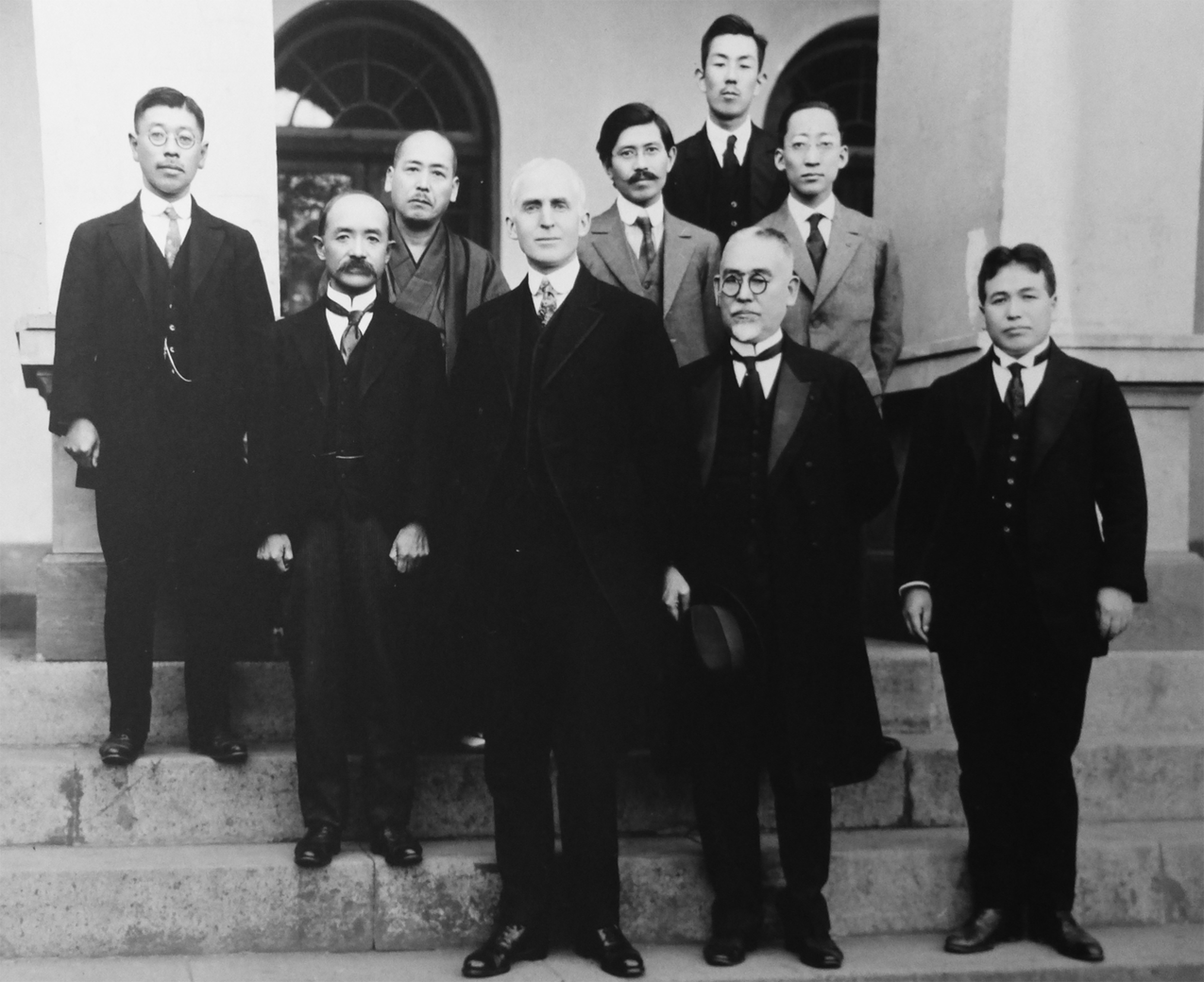
Charles Beard standing next to the Mayor Gotō of Tokyo, and among collaborators in the Japanese municipal research movement. Charles Austin Beard and Mary Ritter Beard Papers, Series II: Mary Ritter Correspondence W-Z and Miscellaneous, DC 1686, fol. 10, DePauw University Archives and Specials Collections, Greencastle, IN.

The best example of the relevance of interest groups for city government that Beard offered came from his experience in advising the mayor of Tokyo, Gotō Shinpei.Footnote 162 Gotō had visited the Bureau of Municipal Research in New York in 1918 and in 1922, and he invited Beard to lecture about the American experience in city government at Tokyo's Institute for Municipal Research to assist in “organizing its [program] library and research methods.”Footnote 163 Besides the legal problems derived from the subordinate place of the city in the administrative imperial system, Beard considered that the essential factor missing was public interest in municipal affairs.Footnote 164 The 1923 Tokyo earthquake provided Gotō with an opportunity to call for public support in building “a perfect new city.” Yet the strategy was conceived in isolation without consulting either political forces or interest groups, and was eventually dismissed at the National Diet (Japan's national legislature), where Gotō came up against financial austerity, rural interests, and constitutional challenges.Footnote 165 As Beard remembered, the Japanese
had the knowledge, they had the training, they had the scientific equipment, they had the plan, they had the experience of the world concentrated on the problem before them. And they were just as futile in the presence of the powerful organized political parties representing the peasants and the landed gentry and the merchants and landlords of Tokyo, as powerless to influence them, as the average professor is to influence his students.Footnote 166
In the end, the very success of city planning rested on integrating the major interest groups into policy making as transparently as possible. “As to whether these groups are selfish or not,” Beard suggested “that the question is irrelevant. But assuming that they are, are they to be condemned for that reason? Must the city planner proceed on the assumption that his projects call for continued sacrifice on the part of powerful interests affected by them?”Footnote 167 “A frank recognition of the nature and role of groups in government,” Beard declared, “is the better hope for efficient government. Let the organization of economic and technical groups continue. Let them raise their standards of procedure. Let the departments of administration and the committees of Congress take advantage of their counsel and advice.” He concluded, “let the business of government proceed on the basis of the fundamental facts of our technological age.”Footnote 168 In the final analysis, knowing the interests that any public policy may have an effect on constituted the key for statecraft. For instance, Alexander Hamilton, Beard claimed, had this incredible vision that allowed him to see “most keenly the precise character of the social groups which would have to be rallied to the new government in order to draw support away from the states and give the federal system a firm foundation.”Footnote 169 Beard considered Hamilton a “great realist and constructor of political power” and appreciated his capacity to play interests against each other “in the realization of a larger program which he had in mind.”Footnote 170 In fact, Beard considered that urban affairs required thinking regionally about the interests involved in their developments, and he urged planners to look for interests beyond the traditional city borders.Footnote 171
Robert Moses, New York's polemical master builder, can be seen as Beard's best disciple in skillfully weaving the city's interests with his ambitious plans. Beard trained Moses at the BMR, and together they drafted an important report for the agency, yet their collaboration ended bitterly because Moses wanted sole credit for it.Footnote 172 Eventually, Moses became the most accomplished planner of the city of New York; his strategy mainly consisted of securing proper legal and administrative powers and assembling key groups as a way of marshaling the necessary resources to implement, successfully and under budget, grandiose projects.Footnote 173 Often, Moses’ approach was seen as synonymous with corruption, even suggesting self-seeking motives. Yet, as historian Kenneth T. Jackson has argued, Moses, like Hamilton, despite his extensive web of relations with powerful economic groups, died without amassing a great personal fortune. Jackson has suggested that Moses did not use this network of interests to get rich, but to transform New York City into powerful global city.Footnote 174 However, when Moses encountered an important opposition of organized interests—in other words, when he failed to integrate the key interest groups affected by his projects—the master builder could not build.Footnote 175
Concluding Remarks
Since the dawn of modern cities, the multiple urban problems that come along with governing large and diverse populations have often been tackled by creative and innovative thinking coming from the cities’ own universities, urban thinkers, and policy makers.Footnote 176 During the Progressive Era, the making of modern cities absorbed the minds of many reformers like Charles Beard who tried to redesign communities, institutions, and public spaces in line with great civic ambitions.Footnote 177 Many of those plans, like most of Beard's ideas, were not fully implemented; therefore, it is hard to assess the impact of his proposals. Nevertheless, we can highlight that by disregarding the power of race and religion in American politics, Beard fell short not only in outlining a comprehensive account of power dynamics but also in devising an adequate framework to understand party formation and realignment and electoral behavior in the United States.Footnote 178 Unsurprisingly, the major flaw in Robert Moses’ grandiose plans was its racist bent: the great parks and colossal bridges and highways were designed to connect certain groups and to exclude African Americans from public services.Footnote 179
Nonetheless, Beard left an inspiring legacy at Columbia University. As John D. Millet pointed out, Beard's approach “fired the imagination of numerous students, [and] from them stemmed, for example, the notable work of later Columbia students such as Peter Odegard and E.E. Schattschneider in studying pressure groups and party politics.”Footnote 180 In fact, Schattschneider became an influential scholar of political parties and was the first thinker to assert their role as the makers of modern democracy.Footnote 181 In a way, Schattschneider only brought full circle the revaluation of the role of parties in the making of democracy that Beard began. The seeds of thinking of democracy in terms of parties and groups can be traced back to Arthur Bentley, but it was Beard who spread them among young political scientists, including his students Arthur W. MacMahon, Edward M. Sait, and Raymond Moley. Eventually, one of MacMahon's students, Peter H. Odegard, wrote the first empirical study on interest group politics and republished Bentley's The Process of Government in 1967.Footnote 182
Rather than trying to restore a pristine, small-town democratic ideal, Beard articulated a modern vision of democracy characterized by political parties and interest groups. In outlining this model, Beard had to counter not only conservative interpretations of the Constitution, but also and more importantly the majoritarian concept of democracy that most progressives embraced. In fact, Beard fought on two fronts: against the traditional laissez-faire philosophy and the mainstream progressive vision of democracy. Both theories Beard thought undermined his vision of efficient government, and, paradoxically, hindered the prospects of the pragmatic reforms necessary to effectively tackle the social problems of the age.
Beard also challenged the belief that good government meant simply the unmediated transformation of the people's interest into public policies that many reformers hypocritically advocated. After all, almost every piece of progressive legislation required unprincipled compromises among heterogeneous groups.Footnote 183 Beard's vision of politics, I argue, should be seen as part of what historian Philip Ethington called “the legitimation of groups in a pluralist ethics.”Footnote 184 Beard did not consider interest group politics as a sordid reality that should be exposed and uprooted from the body politic, but that it constituted, along with political parties, a longstanding practice in American politics that he projected into his interpretation of the making of the U.S. Constitution. Indeed, Beard fully adopted a new pluralist morality that values political compromises over abstract ideas such as majority rule and laissez-faire economics. Rather than appealing to popular majorities, Beard sought to openly integrate a wide spectrum of interest groups into the law-making process, as he thought that the framers of the Constitution did, to construct stable and responsible governments. In Beard's mind, American democracy functioned better through collective forms of organization in associations, interests groups, and political parties, and he was one of the earliest thinkers in asserting that public policies and political behavior do not necessarily have to fulfill nineteenth-century democratic values—grounded in majority rule—to be considered good. However, this pluralistic conception of politics, along with most advances in modern legal sociology, perished with the advent of the First World War. Before the war, Beard foresaw an intellectual milieu more prone “to view society as a complex of many social and economic interests, and to regard the problems of political science—national and international—as problems of power, not of mere head counting or judging counting in accordance with duly constituted rules of law.” After the war, Beard noted, “we began to hear once more a vociferous clamor about democratic ideals.”Footnote 185
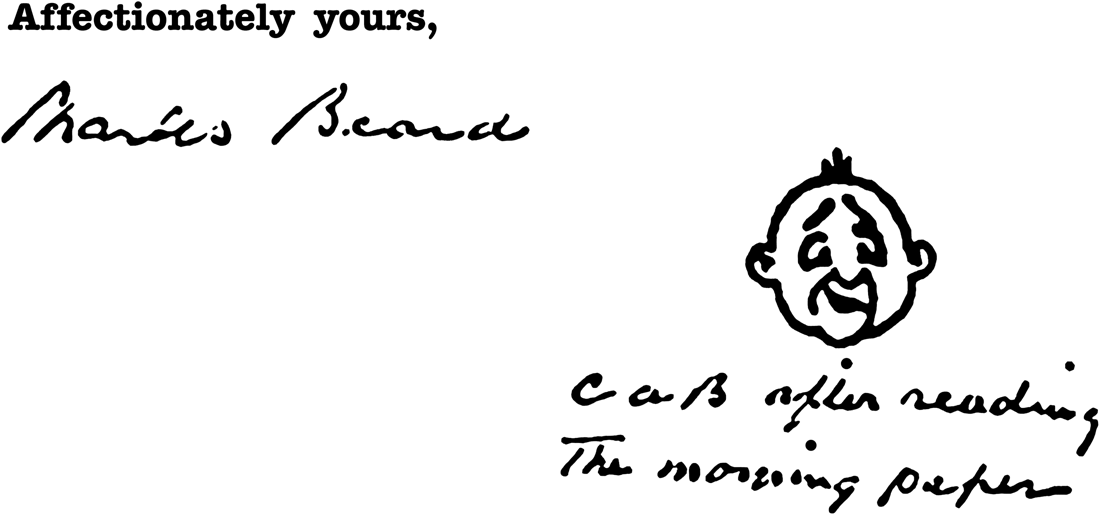
Beard, a self-portrait. CAB (Charles A. Beard) to Arthur W. MacMahon, Sept. 18, 1947, Arthur Whittier MacMahon Papers, Rare Book & Manuscript Library, Columbia University, New York, NY.

Finally, Beard did not assume that he had found the magic formula for governing. All in all, Beard was more a functionalist thinker than a pluralist. He saw institutions as contingent solutions always depending on effective political leadership. At its core, Beard's functional analysis entailed unscrambling and defining the specific functions of governments from their historical and socioeconomic contexts. For instance, he praised Frank Frost Abbott and Allan Chester Johnson's analysis of municipal administration in the Roman Empire, in which Beard saw an astonishing example of a political organization shaped by very peculiar historical, cultural, and economic conditions.Footnote 186 In the end, the course of government for Beard rested on “particular situations and of the character or the quality of men who control the government.”Footnote 187 In politics, Beard did not envisage timeless models but, as his friend Horace Kallen pointed out, resorted to history and social sciences as a way of forecasting “calculated risks” of political actions without guarantee of success “in advance and which must validate [themselves] by the consequences [they] of [themselves] generate.”Footnote 188 In fact, unlike most political theorists who envisioned several mechanisms for controlling and determining governmental functions, Beard paid more attention to training public servants in the arts of politics and administration.Footnote 189
Against all odds, today Beard's ghost has resurfaced once again and wanders around the landscape of American historiography.Footnote 190 Beard's thinking, however, still endures under the heavy stones placed over his tomb by Richard Hofstadter that have prevented us from seeing Beard's contributions to rethinking American democracy. Perhaps we should stop casting Beard as a champion of a folk theory of democracy,Footnote 191 which he fiercely combated, and try to look at American politics as he did, with a comprehensive vision of what makes democracy work. Constitutional provisions, scientific knowledge, and efficient government, he said, were not enough without citizens’ constant engagement in regularly revising and adapting its key institutions—always seeking the best compromise between values and means—in light of the specific problems of the age.Footnote 192 Beard's vision of government remains at odds with traditional democratic and liberal values, but it stands as a reminder of the importance of studying the meaning of American democracy by closely exploring the particular struggles for making it work.Footnote 193
Acknowledgments
I would like to thank to Professor Pope McCorkle and Professor Clyde W. Barrow for their valuable comments on earlier versions of this essay, and the anonymous reviewers for their thoughtful insights. Also, I want to express my gratitude to my friends Joe Curran and Sihan Tan for their help in proofreading the many versions of this work.