1. INTRODUCTION
Marc Battier is one of the few contemporary composers to combine orchestral, contemporary electroacoustic and folk music compositions, and his achievements in the field of electroacoustic music are particularly noteworthy. His recent compositions include pieces for Asian instruments and electroacoustic sounds: I Gysin (pipa), Mist on a Hill (pipa), Capital Bird (shakuhachi, voice and transformed voice), Conversaciones (guqin), Constellations (zheng), as well as pieces for orchestra, such as Rainwater (2014) and Recollections (2016). From these works, it is clear that the composer has shown a keen interest in combining Asian folk instruments with electroacoustic music.
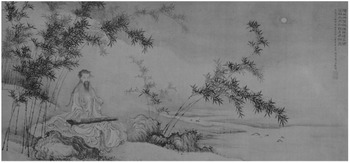
Mist on a Hill (2021; Battier Reference Battier2020) was premiered at the Musicacoustica-Beijing Festival in 2009. The piece was composed in collaboration with pipa player Gao Yunxiang (高韵翔), who provided the pipa sounds (Sound Example 1). The work is composed with harmonic fields in different pitch combinations, with the pipa and the electroacoustic parts interacting through different states of the harmonic fields. In this work, the pipa is like a hidden music master in the mountains, dissecting and conversing with itself in a ‘mist’ of electroacoustic music. Here, the term ‘music master’ is an evocation of the images of hermits playing the qin in the mountains, a scene which frequently corresponds to an artistic figuration in Chinese paintings (Figure 1). The music master is thus a representation of the lone musician in the mountains.
Picture of the Yellow River Roaring, Yu Zhiding (禹之鼎), Song dynasty, Shandong Museum website.

2. ANALYSIS OF THE MUSICAL CHARACTERISTICS OF MIST ON A HILL
The work is characterised by the incorporation of Chinese folk elements. The main features are the overall layout of the musical structure, the musical materials and sound patterns, the rhythm and tempo, and the musical aesthetics.
In a sense, the piece responds to this comment by Peter Chang
In terms of defining of vibratory and articulatory aspects of timbre, the Chinese tradition is more specific and clear than its Western counterpart. The subtlety and variety of the timbral aspect of qin music have always been important sources of literary and spiritual inspiration, and an important barment of the overall scholarly accomplishments of the Chinese literati. (Chang Reference Chang2001: 106)
We will see how Mist on a Hill combines that vision of Chinese instruments and the contemporary techniques of electroacoustic music.
2.1. Overall layout of the musical structure
Li Jiti (李吉提), a professor of music analysis at the Central Conservatory of Music, described free form as a structure that cannot be summarised in any typical pattern. However, freedom of structure is not the same as the abandonment of all principles of organisation or the absence of structural force. It can be the free play of a certain structural principle, or the free application of different structural principles (Li Reference Li2003: 496).
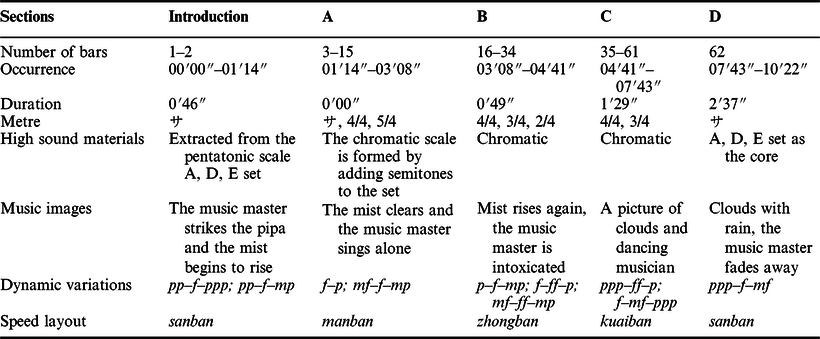
According to Table 1, the structure of Mist on a Hill is quite free and complex, with passages that do not develop in a single way, but rather by distilling the core material and developing it in a progressive manner according to the mood of the piece.Footnote 1 This kind of structure, which has no fixed formula, but only a kind of outline or hint of a plot that the music can play with freely, is called a ‘hidden structure’ (Li Reference Li2004: 246). It is the existence of the ‘hidden structure’ that combines the tempo layout of the music, which Li defines as sanban, manban, zhongban, kuaiban and sanban (散板, 慢板, 中板, 快板, 散板 free metre, slow metre, medium metre, fast metre and free metre), hereafter san, man, zhong, kuai and san (散, 慢, 中, 快, 散), with the qi, cheng, zhuan and he (起, 承, 转, 合opening, development, change and conclusion) of the thematic layout.
The overall layout of Mist on a Hill.

The piece is divided into five distinct sections. In each section, the interaction and alternation of pipa and electronic music form unique structural functions.Footnote 2 The internal structure is segmented according to the differences in sound behaviour, musical development and aural perception, while each section ends with a fading transitional segment, forming a unified developmental process.
Table 1 illustrates the pattern of musical development at many levels of the piece. As can be seen, the development of the pitch material is characterised by a ‘fusion of East and West’. The music is a mixture of Chinese and Western elements, with the traditional pentatonic scale being reduced and the three tones A, D and E being extracted to form the musical theme. Chromatic elements are incorporated into the passages, such as the chromatic progression in the upper part of bar 55 and the A and D tones in the lower part played by the pipa sweeping the strings. The music is interwoven with Chinese and Western elements, forming a framework of ‘Chinese (中)–Western (西)–Chinese (中)’. The development of the sound pattern is characterised by a progression from simplicity to complexity, with the sound pattern enriched by the gradual superimposition of musical materials. At the same time, the electroacoustic music elements are gradually transformed from the initial object form to the main form, and in the D section is developed into a solo passage lasting 1′40″. The synthesis of these pitch materials and acoustic forms make it clear that the qi, cheng, zhuan and he (opening, development, change and conclusion) of the thematic development becomes progressively clearer: the pipa part in the introduction and A section is characterised by distinctive pentatonic pitch materials, a simple musical texture, gentle intensity changes and a leisurely metrical rhythm; the electroacoustic music part acts as a ‘foggy’ theme. The electroacoustic passage is gradually introduced as a ‘foggy’ thematic background.
The pipa and the tape enter in parallel in the B section, painting a scene in which the fog clears and the performer plays alone. The metre shifts from loose to 4/4, 3/4 and so on, and as the beats interlock, the accents shift, thus diluting the sense of simple texture. In the pitch material, the G note appears for the first time, as a cheng (development) part of the music, further extending the former qi (opening) part. At the same time the electroacoustic division fluctuates in accordance with the mood of the music, here imitating the glissando progression of the pipa, but with a contemporary sound, breaking away from the artistic conception built by the previous section, thus creating a collision between tradition and modernity. It is as if the mists are gathering again and the performer has become absorbed in his or her own realm. The modal progressions and harmonic shifts produce new sonic material, heralding the climax of the C section.
The C section is the zhuan (change) of the piece, and shows a fairytale of clouds and fog, with the sound of the lyre appearing in the mountains and dancing in the wind. This passage is the longest, with the greatest fluctuations in intensity, more complex sound patterns, and more varied variations around the pentatonic scales of A, D and E.
The D section, which is the he (conclusion) part of the overall structure, uses the same tempo as the qi (opening) section. The mood is also very similar, except that the main body of the music changes from pipa to electroacoustic sounds. The two echo each other to reinforce the sense of completeness of the piece, creating a picture of mist and rain falling, the performer returning to his music and fading away.
Influenced by the emphasis on unity in traditional Chinese philosophy, the structural form of traditional Chinese music is generally characterised by weak contrasts and blurred passage boundaries (Wang Reference Wang2010: 11). Because of the transitional relationship between passages, there is no fixed musical design in the music, and the mere free play of a certain musical outline or hint of a plot provides a unique advantage for the natural flow of musical themes. The Song dynasty poet Zhang Xiaoxiang (张孝祥) once used the phrase ‘shuihan yandan, wuqing yunbao’ (水寒烟淡,雾轻云薄 ‘The water is cold and the smoke is light, the mist is light and the clouds are thin’) to describe the lightness and indistinctness of the clouds and mist. If a clear syntactic structure were used here, it would undoubtedly destroy the original mood of the music. The combination of the san, man, zhong, kuai and san (free metre, slow metre, medium metre, fast metre and free metre) tempo layout and the qi, cheng, zhuan and he (opening, development, change and conclusion) in the development of the theme form a unique musical development logic.
2.2. Development of pitch materials and sound behaviour
Regarding the use of pentatonic scales, Wang Lin (王林) wrote:
It is well known that the traditional Chinese folk music style is characterised by pentatonic melodies, but pentatonic melodies are not unique to the Chinese musical system; they are also found in Western music. However, the pentatonic melody in Western music is only reflected in the pentatonic scale, whereas the traditional Chinese folk music system reflects the structural phenomenon of pentatonic modulation. (Wang Reference Wang2010: 4)
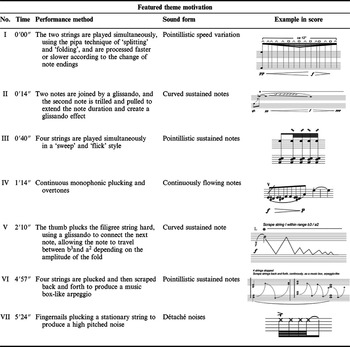
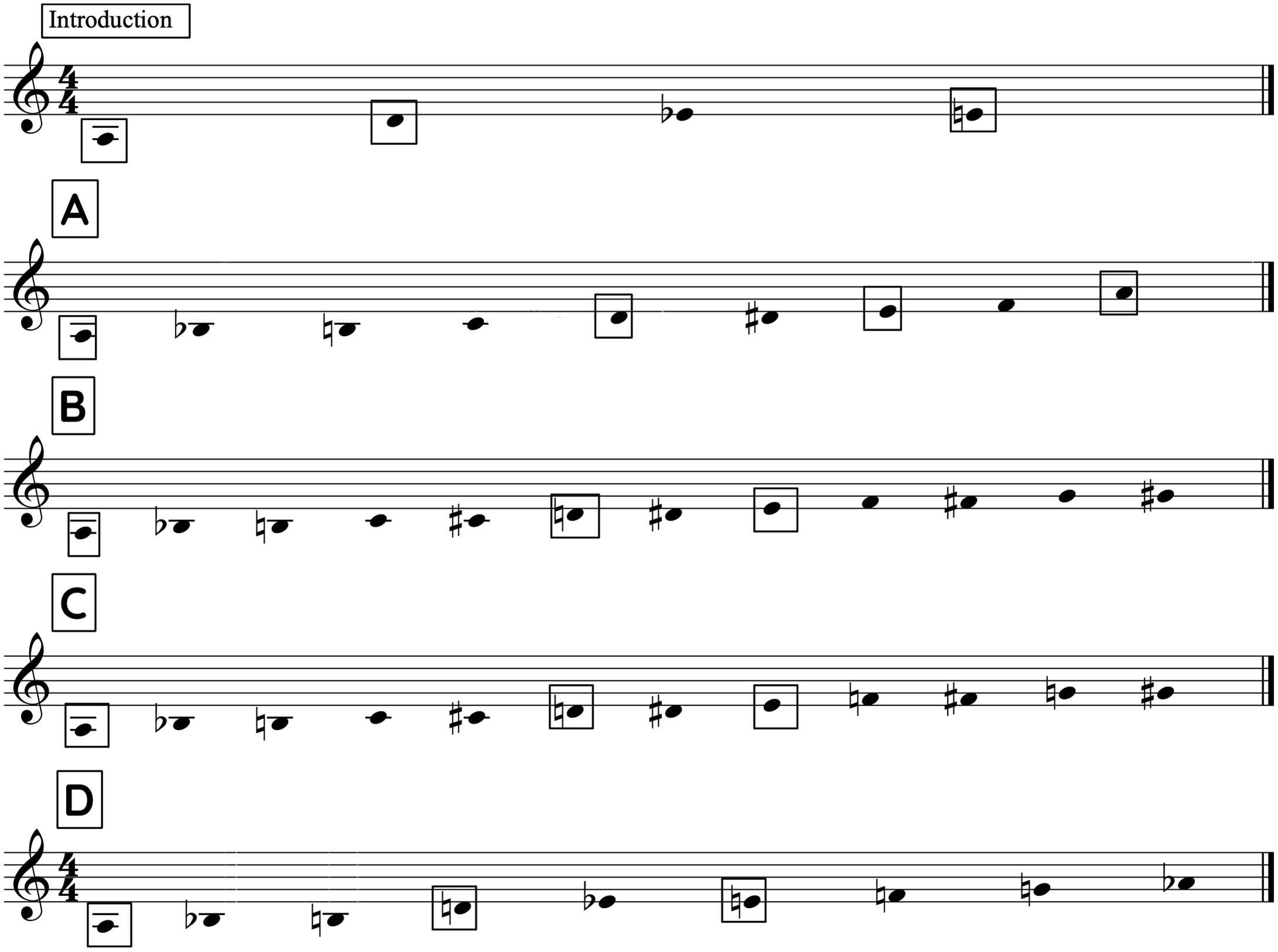
In the presentation section of Ravel’s Jeux d’eau, two sets of pentatonic scales of different tonalities are developed in juxtaposition to shape the various forms of water, producing a fantastically varied soundscape. Mist on a Hill is particularly focused on the expression of the Chinese folk style in terms of pitch organisation, as demonstrated by the extraction of the characteristic pitches of the pentatonic scale as the foundational material amidst the interplay of dynamic pitch. Pipa, a traditional Chinese plucked instrument, has four strings. The strings are usually tuned to A, D, E and A, which are also the core pitches of the pentatonic scale. By extracting these four open string tones as the material basis, dynamic pitch in this work refers to the non-deterministic pitches produced by the use of different pipa performance techniques such as vibrato, glissando and percussion. At the same time, the composer combines these pitch materials with Western chromatic thinking, forming a fusion of musical styles. In the following, the work is further analysed and the representative pitch motifs and their acoustic forms are summarised (Table 2).
Mist on a Hill pitch motifs and sound behaviour.

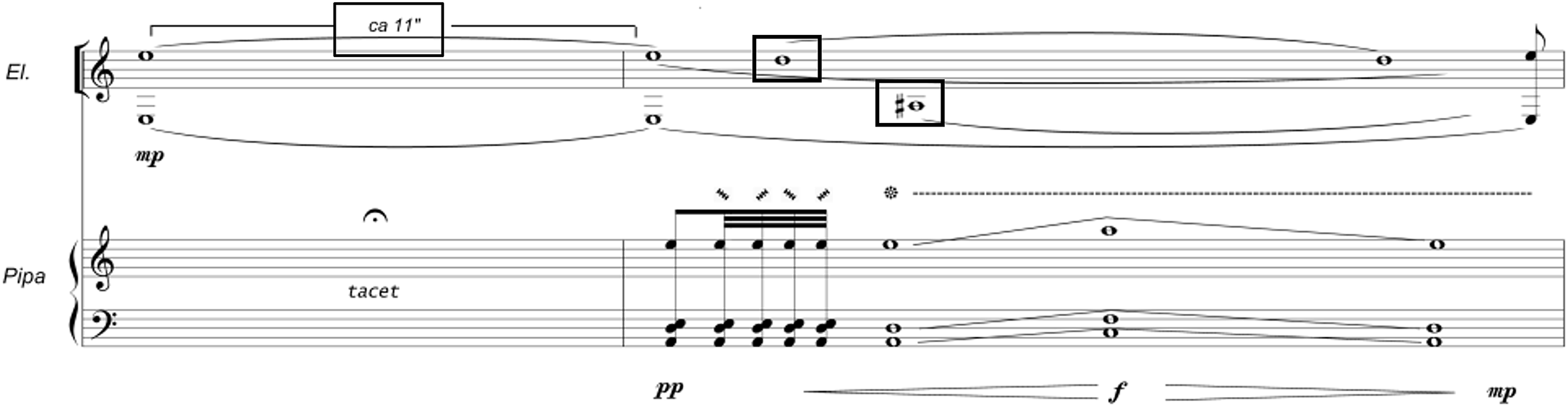
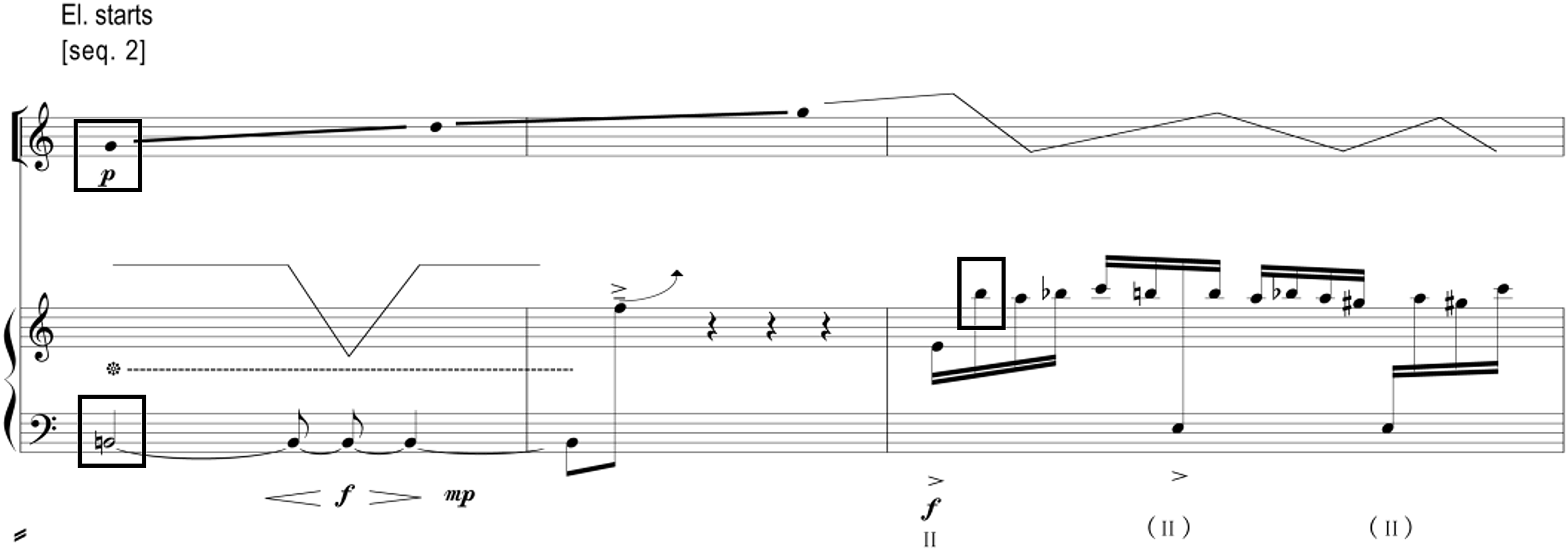
These motivic patterns reveal different musical ideas and moods in different passages of the work. The main pitches of Mist on a Hill revolve around the pipa’s hollow string tones A, D and E, which are used as the core sequence throughout the work. The introduction builds on this by incorporating the chromatic E♭, adding dissonance, before resolving to D and returning to stability. Example 1 demonstrates that the E, D and A♯ form the core group of tape, where the pipa voice uses F, D and modifies D and A to create a sense of wandering. The presence of these notes depicts the image of the performer stroking the pipa as the mist begins to rise. The musical interweaving of Eastern and Western personalities through differences in the nature of intervals and chord colours provides a foreshadowing of the musical development of the A section, forming a sequence of A, A♯, C, D, D♯, E and F.
Mist on a Hill, bars 1 to 2.

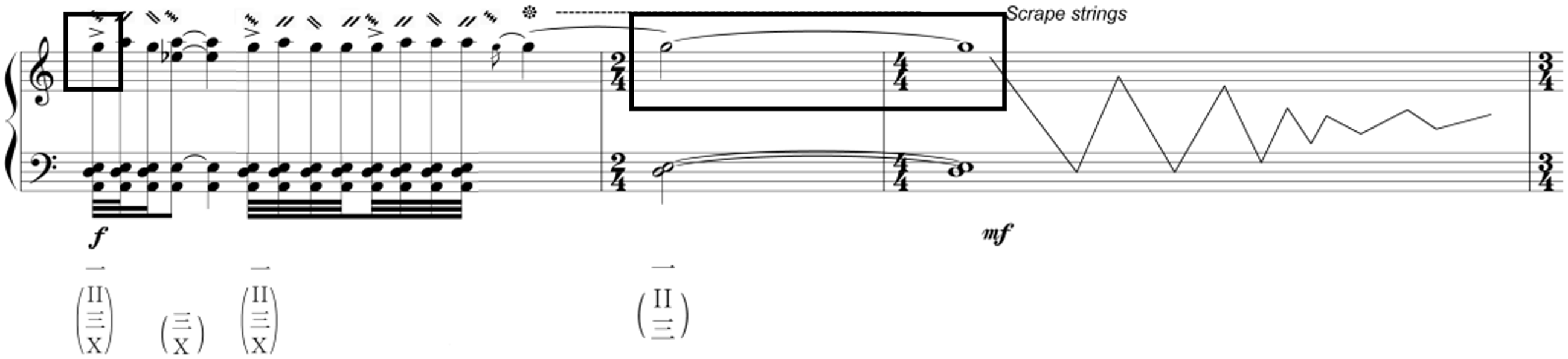
The entry of the pipa part B, B♭, F and G♯ in the B section adds a new dimension and is a further derivation of the introduction and the motive of the A section. The first appearance of G (Example 2) in the tape voice, while sliding upwards continuously, moving to D and the higher octave of G. This is an extension of the A section over D, E and A. In the first 18 bars, E, B are the main notes of the music, and the other notes are centred on B, around which the chromatic progressions take place. The music is always in a strong state, with big leaps driving the music forward. However, step I of Table 2 brings the music gradually back to sanity.
Mist on a Hill, bars 16–18.

After alternating between harmonic and dissonant sounds, A, D and E are used as the chordal base to accompany the melodic note G (Example 3). The A moves and develops before returning to G, emphasising its position as the dominant note. The B section ends with a downward glissando of D, C♯ and B onto a repeated A. It enriches the chromatic motifs of the composition.
Mist on a Hill, bars 28–30.

The C section occupies an important place in the work as the climax of the development of the whole piece. The tape builds on the glissando. At 5′29″ the entering soprano cluster produces a windsong-like effect, the noisy E and A of the pipa emphasising the melodic motive, developing the music through transposition and other means. Bar 41 (Example 4), where the music emerges with motivic material characterised by noise, has a rhythmic component derived from the second bar of the introduction, and bars 53–4 develop this motive further, creating an alternation of demisemiquaver (thirty-second) notes and rests.
Mist on a Hill, bars 41–3.

The most unstable section of the piece is shown in Example 5. It uses rapid sweeping chord changes in the upper voices to intermingle with the demisemiquaver notes of the lower A and D. This gradually intensifies the mood of the music and finally returns to A and D in bar 58, which is eventually replaced by the B♭, A♭, F and E♭, ending with the trills of B♭ and G, creating a picture of clouds and dancing musician.
Mist on a Hill, bars 55–6.

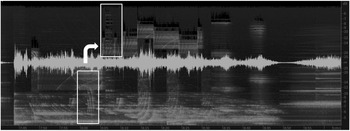
The D section begins with tape as the he (conclusion) in the development of the theme, with the music taking on the image of the performer fading into obscurity, shrouded in clouds and mist. This one minute and forty seconds of tape covers the various transformations of the pipa. According to the spectrum (Figure 2), the music at 7′43 ″ transforms the electroacoustic material that had appeared previously at 3′08″, where the low frequencies are thicker and more powerful than in the previous section. At 8′05″, the ripples change from low to high frequencies, as if to reveal a foggy, rain-swept scene. In the tape, the composer adds pitch material from B♭, D, E♭, F and A♭ to this section.Footnote 3 In bar 62, the pipa freely scrapes the strings back and forth between A and B. The music returns to a free beat and ends with a finger turn on G and an abrupt sweep on D, E, G and A, further consolidating the harmonic effect of the whole piece.
Mist on a Hill spectral analysis 7′40″–9′00″.

Based on the scale structure between the passages listed in Example 6, it can be seen that chromaticised elements are used throughout the music along with a mixture of pentatonic material. The introduction is dominated by A, D and E. The appearance of E♭ indicates a gradual chromaticisation of the music, which is further confirmed by the appearance of B♭ and D♯ in the A section, but the chromatic scale is still incomplete as G is absent. It is not until the arrival of the G♯, F♯, C♯ and G notes in the B section that the chromatic scale takes shape, and the chromaticised motif is promoted from an ‘embellishment’ to one of the central elements in the development of the music. Here, B♭, D, E♭, F and A♭ appear in sequence, ending with a simplification of the pipa’s chromatic scale, but the core notes are retained so that the music keeps its ethnic character.
Mist on a Hill scale structure of the five sections for pipa.

Except for the chromaticism, the pitch material is very simple. It shows the combination between the Chinese pentatonic pitch elements and the Western chromatic system. During the composition process, the composer consciously avoided the pentatonic melody carried out in successive thirds, transforming those intervals into diatonic ones and weakening the influence of the chromatic appearances. In terms of the organisation of pitch relationships, the fundamental pitch structure is always centred on the second, fourth and fifth intervals, regardless of the scale structure, thus maximising the basic idea of highlighting the pentatonic character. The A, D and E notes played on the pipa’s open strings, their dominance and frequent occurrence in the piece, acoustically highlight the characteristic timbre of this folk instrument and reinforce the ethnic flavour of the entire work.
2.3. Metre, rhythm and tempo
Traditional Chinese folk music is characterised by a sanban (free metre) structure in terms of tempo, which is different from the precise expression of time sought by Western music. In this regard, musicologist Wu Yan (吴岩) argued that ‘traditional Chinese music leaves the performer a great deal of freedom to create, reflecting the traditional domestic aesthetic principle of xing fuyu shen (形附于神, form rely on spirit), which is another manifestation of the influence of traditional Chinese aesthetics on traditional music’ (Wu Reference Wu2007: 19).
In traditional Chinese music, free metre is widely used. It is characterised by the fact that the position of the accent and the pattern of the metre are not obvious, so that the performer can artistically express the intonation, prosody of the free metre according to the content of the piece and his personal experience, achieving the core concept of ‘wide and free range of material, with clear and focused ideas’ (Shi Reference Shi2018: 27).
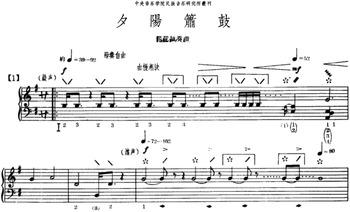
The beat number comes from the traditional Chinese notation, which is often represented by the first three strokes ‘サ’ of the sanban (free metre with a slow and irregular rhythm). As in opera music, free metre is very common in traditional Chinese music, such as the traditional songs Pipa and Drum at Sunset (夕阳箫鼓, Example 7),Ambush on All Sides (霸王卸甲) or East Sea Fishermen’s Song (东海渔歌). The introduction, in Mist on a Hill, begins in free metre and irregular rhythm, in the form of sanban, which is short in structure and serves as a mood builder and musical guide for the piece as a whole.
Excerpt of the score for Sunset xiao drum (pipa solo), bars 1–4 (Music Publishing Co, 1957).

Mist on a Hill combines rhythm with the pipa’s expressive approach, the instrument plays the introduction on a sanban and keeps varying the speed of the piece. In notation, Battier usually leaves the performer free to choose the type of vibrato they feel is most appropriate. The composer believes in and respects the musical and aesthetic decisions made by traditional musicians (Chin Reference Chin2017). Example 1 shows the approximate time taken by the performer to complete the technique. By taking this approach, the music satisfies the Western concept of ‘precision’ while being in line with the sanban style that is unique to Chinese music culture.
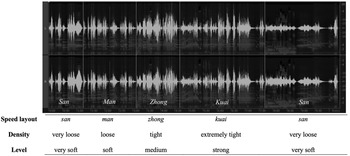
The tempo layout is san, man, zhong, kuai and san (free metre, slow, medium, fast and free). This method of organising music in variable tempi has been in existence since the Han and Wei dynasties, and became more mature in the Tang and Song dynasties. This traditional tempo layout has since permeated all aspects of Chinese folk instrumental music performance and has become one of the important organisational factors in the structure of some Chinese music (Li Reference Li2004: 62). The spectral analysis diagram of Mist on a Hill in Figure 3 shows the compositional concept. The audio file was extracted from the 2009 recording of the Beijing-Musicacoustica Festival performance.
Mist on a Hill spectrum analysis and chart.

In terms of the overall feel of the music, the spectrum chart clearly shows the five stages in the tempo layout. In the mainstream Western musical tradition, the role and significance of tempo is mainly reflected in shaping musical images and setting the mood. In some non-Western music, however, in addition to these roles and meanings, tempo and its changes are often given a certain structural significance, as is evident in traditional Chinese music (Wu Reference Wu2020: 42). The music begins with a sanban and the use of a large number of individualised special patterns in the rhythmic material give the music a free character. The disorderly entry of electroacoustic layers allows the music to remain at a certain level of rhythmic instability. This corresponds to the nature of sanban. At 1′14 ″, the music enters the manban (slow metre) section, where the texture is loose and the overall loudness is soft. The zhongban (medium metre) section of the music starts from 3′08″. Compared to the manban section, the level is approximately doubled, while the overall structure becomes denser, serving as a link between the slow and fast sections. The kuaiban (fast metre) section as a whole can be divided into two parts: the pipa and tape together (4′41″–5′51″) and the pipa solo (5′51″–7′43″), with a crossfade between the two. The spectrum analysis shows that the music evolves from ‘slow’ to ‘fast’ in the solo, with the passage remaining strong and dense throughout. In the fifth stage (7′43″–10′22″), the music returns to a sanban with a clear sense of a softening of the level compared with the former, and a ‘clustering’ of the spectrum. The structural layout evocates the freedom of folk music.
2.4. The concept of space and musical aesthetics
The concept of kongjian (空间, space) is commonly embedded in traditional Chinese musical thought. It is closely related to literature, as can be seen in scores such as White Snow in Sunny Spring (阳春白雪) and Mist and Clouds over Xiao-Xiang (潇湘水云). The presence of the title gives the listener unlimited scope for imagination. The title provides the finishing touch. It is often a perfect introduction to a scene or at least a certain mood, as piano professor Dai Baisheng (代百生) pointed out: ‘When the listener enjoys music, he or she always expects to get some kind of hint or suggestion of the content of the music from the words of the title, to “hear” a scene or at least a certain mood along with the depiction of the title’ (Dai Reference Dai2013: 12).
The Chinese title for Mist on a Hill (山中薄雾, Shanzhong bo wu, Mountain mist) visually depicts a thin mist enveloping a mountain. This evocates a mood, the lightness and indistinctness of the mist matching the beauty sought by the piece. The electroacoustic music’s etherealness and the pipa’s materiality are mutually reinforcing, creating an aesthetic interest in the real and the imaginary. The English title, however, is more realistic, expressing the content of the music directly, telling a story about the fog on the mountain. As Mark Evans Bonds remarked, ‘through an evocative title, a verbal program, or both’, Liszt said that it ‘draws the listener’s attention in advance toward a specific object’ (Bonds Reference Bonds2014: 211). This suggests that both Western and Chinese titles have a musical orientation, but that the Chinese ones, under the combined influence of poetic thinking, cultural tradition and musical aesthetics, are more focused on the portrayal of musical context, as in the landscape ink paintings. This mood is in turn reflected in the unique ethnographic musical treatment of the piece.
From a musical ontological perspective, electroacoustic music, as a particular kind of music, is unique in its ability to imitate the sounds of nature, in addition to its ease in shaping the sense of space. In East and West, Old and New, Chou Wen-chung argued: ‘Obviously, the old days of indulging in so-called “exotic” scales and melodies are gone. In addition to the latter there has been growing interest in certain Eastern philosophies, such as Zen, Tao, and I Ching. Zen and Tao as applied to music would seem to be carrying the fundamental idea of “sound as living matter” even deeper, as they have for a long time’ (Chou Reference Chou1968: 22).
Ancient Chinese philosophy and the concept of nature preached the tianren heyi (天人合一, the harmony of nature and human). This is why humanistic values advocate a way of living in harmony with nature. ‘Although music is limited in its ability to express specific objects and clear intentions, it is noteworthy that imitating natural sound phenomena is a speciality of the art of music, and arguably no other art has the ability to do so’ (Mao Reference Mao2001: 65).
This electroacoustic music recreates the sound of nature by sampling and editing pipa fragments of recordings. In the D section of the solo, one can easily imagine hearing the sounds of birds, flowing water and nature. The simulated character of Mist on a Hill is thus an aesthetic mapping of nature and tradition.
3. SOME CHARACTERISTICS OF THE INTEGRATION AND USE OF ETHNIC ELEMENTS
The use of ethnocultural musical elements in Mist on a Hill provides the whole work with a sense of artistic fusion, rather than a simple juxtaposition of the two. The presence of ethnic elements not only promotes an interesting aesthetic approach to electroacoustic music, but also opens up ideas for the fusion of ethnic musical elements. In the following, we compare and contrast Mist on a Hill with the mixed piece Scorched Strings (灼弦 for pipa and tape 2013) by Yu Lu (郁璐). Footnote 4 This was written during the same period and uses similar musical material, allowing us to further examine the way in which ethnic elements are used in electroacoustic music works.
3.1. Ethnic sound material
Musicologist Yayoi Uno Everett argues that there are
different types of techniques or strategies utilised to juxtapose or integrate Asian and Western musical resources. This is a strategy that has become increasingly popular since the 1960s. The result is that the borrowed cultural elements are frequently placed in some kind of opposition to the primary musical texture in such a way that produces tension through juxtaposition. (Everett Reference Everett, Everett and Lau2004: 8)
In contrast, however, the juxtaposition of pipa and electroacoustic music in Mist on a Hill and Scorched Strings is not a strategy of tension and opposition, but rather of fusion and unity. ‘Because the electroacoustic sounds are made of processed pipa sounds, there is an organic relationship in the texture and often timbre with the live pipa’ said Battier (Chin Reference Chin2017: 207). This approach to music coincides with Yu Lu’s compositional intentions. The pipa is used as the main body of the music throughout the work, but it is also the root of the material used to create the electroacoustic music. In Yu’s piece, by using software such as GRM Tools, Phase vocoder and SoundHack to enrich the material, the pipa and its derivative electroacoustic layers are both similar and refreshing. The sound balance between the two and the dynamics are adjusted according to the mood of the music that needs to be highlighted, thus maintaining an aural integrity in the piece.
3.2. Composition techniques
Then comes the ethnic approach to composition. Electroacoustic music, as a product of the West, tries to demonstrate the kinds of timbres and musical forces that traditional instruments cannot express. Mist on a Hill and Scorched Strings have certain similarities and differences in the application of ethnic elements in their composition. This does not in any way diminish the expression of these ethnic elements.
In their titles, both combine music with figuration. In addition, the ethnic approach to composition is also evident in the pipa’s musical vocabulary. As an instrument, the pipa is characterised by large jumps, glissandi, slides and trills. Its rich folk music vocabulary is expressed through the use of those techniques, which naturally respond to the essence of the prosody of the Chinese language.
In Mist on a Hill, the sounds evoke water drops, rain and clouds, expressing the beauty of nature. In the pipa part of Scorched Strings, musical images of mournful, clear spring water and violent wind and rain can be heard. By electronically manipulating the pipa’s virtuosic and melodic lines, the electroacoustic music produces a sound similar to that of instruments such as bamboo flutes, pipas and drums.
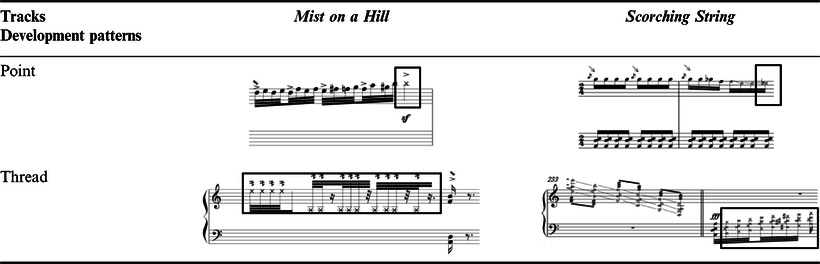
Searing Strings focuses on the demonstration of technique, such as the exploration of tonal styles and rhythmic materials, highlighting the power of the pipa when plucked. The percussive thematic material appears sporadically and sparsely distributed throughout the music. However, it is the episodic presence of percussive thematic material that gives the music a more driving force. In the use of noise tones, the two pieces share a logic of development from ‘point’ to ‘line’ (Table 3). Noise frequently appears suddenly at the end of a phrase. It is used as material for the development of the music, which then leads to groups of noisy sounds. Like a stone thrown into water, it creates ripples. The noises in the two pieces strive to imitate the sounds of nature through the use of the instruments and electroacoustic music.
Mist on a Hill and Scorched Strings noise tones.

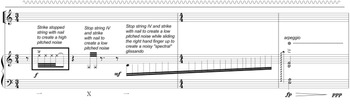
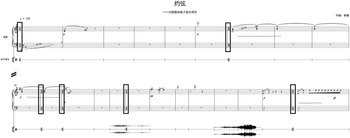
The notion of liubai (留白) is a technique held in high esteem by ancient Chinese painters; in terms of landscape ink painting, it can be translated as ‘leaving blank space’. It is reflected in the way in which the music is combined. The combination in Table 1 shows that the pipa and the tape in Mist on a Hill are not always ‘paved’, but rather that the music takes the form of a dialogue, with the electroacoustic music alternating back and forth with the pipa and the orchestration. The liubai between the orchestrations gives the music a sense of kongjian (space), which is made more real by the wide sound field of the electroacoustic music. The ‘white space’ in Scorched Strings is mainly reflected in the syntax of the pipa, where the music is in regular metre, but the uneven rhythmic notes and frequent beat changes cause the accents to move constantly, and the music is loosely rhythmic, giving it a dotted sense of mood (Example 8).
Scorching String, bars 1–22.

The tianren heyi (harmony of nature and human) is reflected in both the ancient Chinese philosophical and the evocation of nature, and because music has the dual characteristics of ‘non-semantics’ and ‘non-correspondence’, it has a certain degree of flexibility in expressing a specific object or a clear intention. This is due to the dual characteristics of ‘non-semantic’ and ‘non-correspondence’, which makes music somewhat limited in its ability to express a specific object or a clear intention. The so-called tianren heyi is in fact a way of advocating harmony between man and nature. The work uses symbolic and suggestive techniques to represent dynamic images such as ‘fog’, ‘music master’, ‘flowing water’ and ‘sudden rain’, using the imaginary to describe the real, with a simulated aesthetic character.
Finally, let us consider the aesthetic characteristics of ethnicity. Music has always developed in a comprehensive cultural environment, with content and meaning at the core of the aesthetic. The two works are always based on the triple aesthetic characteristics of xieyi (写意), which evocates a sense of ‘spirit’ and describes a philosophy of Chinese culture to emphasise freedom, spirituality, individuality and expressiveness; liubai (leaving blank space); and tianren heyi (harmony of nature and human). Xieyi and liubai were first embodied in painting and later transplanted to music.
4. CONCLUSION
In summary, the fusion and use of Chinese folk music elements in electroacoustic music composition require a combination of multiple dimensions to be reflected upon. In Mist on a Hill, Battier’s understanding of Chinese culture and his own unique musical vocabulary demonstrate the deep interplay between folk elements and modern Western music technology. In the structural layout, all compositional techniques and acoustic forms are closely linked to the development of the musical content. In order to portray the Chinese ink painting of the mountain mist, the whole work takes on a freer ‘gradual’ musical behaviour, without loosing its spiritual path; in the development of pitch materials and acoustic forms, the characteristic tones of the Chinese pentatonic scale are combined with Western chromaticism, forming a comprehensive musical identity.
The concept of fusion and use of folk music elements has been increasingly introduced into the field of mixed music composition. Mist on a Hill emphasises the use and exploration of ethnic sound materials, compositional techniques and aesthetic features. It has contributed to the development of contemporary electroacoustic music, along with similar and different works of the same period. The question of how to achieve an organic and ingenious fusion between East and West, tradition and modernity, history and innovation, and part and whole has undoubtedly become a topic of constant exploration and reflection for the dedicated sector of contemporary electroacoustic music creators in China.
ACKNOWLEDGEMENT
This study was supported by the Philosophy and Social Science Foundation of the Ministry of Education of China (Grant No. 19YJC760140) and the Scientific Research Project of Guangdong Provincial Department of Education of China (Grant No. 2019WTSCX092).
GLOSSARY OF TERMS
-
Kongjian 空间 space
Liubai 留白 leaving blank space, a technique held in high esteem by ancient Chinese painters
Qicheng zhuanhe 起承转合 opening, development, change and conclusion
Sanban, manban, zhongban, kuaiban, sanban 散板, 慢板, 中板, 快板, 散板 free metre, slow metre, middle metre, fast metre, free metre
Tianren heyi 天人合一 harmony of nature and human
Xieyi 写意 write a sense of ‘spirit’. Essentially this describes a philosophy of Chinese culture to emphasise freedom, spirituality, individuality and expressiveness
-
Xing fuyu shen 形附于神 form relying on spirit
SUPPLEMENTARY MATERIAL
To view supplementary material for this article, please visit https://doi.org/10.1017/S1355771822000498