Acute and chronic stress after severe earthquakes can trigger ischemic strokes and cardiovascular events, including acute myocardial infarction (AMI), arrhythmias, deep vein thrombosis, and worsening of heart failure (HF). Reference Kloner1–Reference Inatomi, Nakajima and Yonehara6 A marked increase in the occurrence of HF after massive earthquakes has been reported. Reference Aoki, Takahashi and Fukumoto7–Reference Miyata, Sakata and Miura13 However, the clinical characteristics of patients with HF remain to be elucidated.
The 2016 Kumamoto earthquakes began on April 14. 14 A foreshock with a magnitude of 6.2 on the Richter scale jolted Kumamoto Prefecture and nearby areas. The mainshock (magnitude of 7.3) caused further damage on April 16. More than 1000 seismic aftershocks have been recorded (Figure 1). The maximum on the Japan Meteorological Agency’s (JMA) seismic coefficient scale was 7, which corresponded to XIII degrees on the Mercalli intensity scale. The earthquakes killed 50 people, and 7417 buildings were severely damaged. In the Aso area, approximately 7600 people were forced to evacuate to temporary accommodations. Railways and many national roads were closed due to landslides, massive road rupture, and the danger of falling rocks. A major landslide completely collapsed a large bridge on a national highway. These disruptions made it difficult for emergency vehicles to transport patients, food, and other urgently required materials. The local population experienced long delays in returning to normalcy. The Aso Medical Center is the disaster-based hospital in the Aso area.
Number of earthquakes in the 2016 Kumamoto earthquakes sequence. Histograms show the temporal variation of the numbers of earthquakes listed in the JMA unified catalogue for the periods of 30 days following the 2016 Kumamoto earthquakes. Events with a JMA seismic intensity scale rating greater than 3 are felt by most people while walking (gray bars). Most people are startled and awakened. Events with JMA scale ratings of 1 and 2 are felt by people staying quiet in buildings (black bars).

After the Kumamoto earthquakes, Disaster Medical Assistance Teams (DMAT) provided medical treatment at the Aso Medical Center. We investigated the incidence of cardiac events and the clinical characteristics of patients with HF after the 2016 Kumamoto earthquakes in this area.
Methods
This was a single-center, retrospective, observational study. The population density in the Aso area was 59.6 persons/km Reference Komorita, Fujisue and Sueta2 according to the Population Census in 2015. Aso Medical Center is located in the center of the area. The population served by the Aso Medical Center was approximately 30,000 people. We analyzed the records of patients admitted to the Aso Medical Center from April 14 to June 30, 2016. We also reviewed the records of patients admitted to the hospital during the same period in the prior 2 y as a control. Definitive diagnoses were based on physical examination, laboratory findings, electrocardiography, echocardiography, chest X-P, and computed tomography. Patients with tentative diagnoses were excluded. All records and definitive diagnoses were confirmed by 2 cardiologists. Cardiac events included AMI, angina, HF, out-of-hospital cardiac arrest (OHCA), new onset arrhythmic events (eg, atrial fibrillation), takotsubo cardiomyopathy, symptomatic venous thromboembolism (VTE), and aortic disease. Angina was defined as chest discomfort relieved by nitroglycerine without elevated cardiac enzymes in patients previously diagnosed as having organic or vasospastic angina. Worsening of HF was defined as worsening acute HF signs and symptoms requiring hospitalization. Cardiac arrest due to traumatic injury was excluded.
Subsequently, the number of patients with HF after the earthquakes was compared with the number of patients with HF during the control period. We investigated patient clinical characteristics, nutritional status, and prognosis. Data included etiology of HF, left ventricular ejection fraction (LVEF), nutritional status, chronic kidney disease (CKD), anemia, hospital death, and 1-y survival. The Geriatric Nutritional Risk Index (GNRI) Reference Bouillanne, Morineau and Dupont15 and the Prognostic Nutritional Index (PNI) Reference Buzby, Mullen and Matthews16 were evaluated to assess nutritional status. Body mass index (BMI) was calculated as body weight (kg) divided by the square of the height (m2). The GNRI was calculated with the formula GNRI = 14.89 × serum albumin (g/dL) +41.7 × (BMI/22). GNRI values >98, 98-92, 92-82, and <82 were categorized as no, low, moderate, and high risk, respectively. The PNI was calculated with the formula PNI = 10 × serum albumin (g/dL) +0.005 × total lymphocyte count (/μL). PNI values >38, 38-35, and <35 were categorized as no, moderate, and high risk, respectively. Malnutrition was defined as a GNRI value <92 and/or a PNI value ≤38 according to previous studies. Reference Bouillanne, Morineau and Dupont15–Reference Sze, Pellicori and Kazmi18
The stage of CKD was based on the estimated glomerular filtration rate (e-GFR) calculated with the Modification of Diet in Renal Disease (MDRD) equation. Anemia was defined as a hemoglobin level of less than 13.0 g/dL in men, 12.0 g/dL in women, and 11.5 g/dL in individuals 65 years of age and older.
All data were managed using Microsoft Excel (Microsoft Corp., Redmond, WA). All statistical analyses were carried out with the EZR on R-commander (version 1.53, Saitama Medical Center, Jichi Medical University, Saitama, Japan), which is a graphical user interface for R (The R Foundation for Statistical Computing, Vienna, Austria). Reference Kanda19 For the statistical analysis, the values for patients after the disaster were compared with the average of the previous 2 y under a Poisson distribution, with the mean value taken as the mean number for the previous 2 y. Continuous variables were presented as medians (interquartile ranges [IQR]) and categorical variables as percentages. Multiple group comparisons of continuous data were performed with the Mann-Whitney U-test. Other clinical characteristics were compared with either a chi-square test or Fisher’s exact test. A P-value < 0.05 was considered significant in all statistical analyses. For analyses of patient characteristics according to 1-y survival, the significance level was adjusted (to .05/2 = .025) with the Bonferroni correction, owing to the small sample size. All procedures were conducted in accordance with the Declaration of Helsinki and its amendments. The study protocol was approved by the Institutional Review Board of the Aso Medical Center (Approval No. Rinri 4).
Results
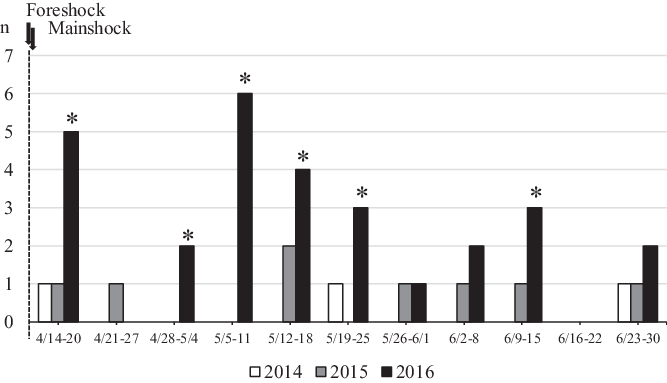
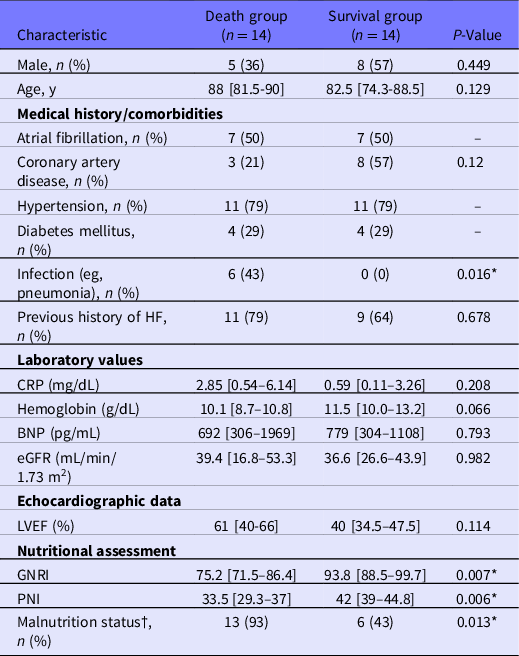
From April 14 to June 30, 2016, admitted patients had a total of 58 cardiovascular events (28 HF, 10 OHCA, 6 arrhythmic events, 4 AMI, 5 angina attacks, 3 VTE, 2 aortic disease). The proportion of cardiovascular events among all hospitalizations increased from 4% to 12%, compared with the prior 2 y. Arrhythmic events included supraventricular tachycardia (n = 2), idiopathic ventricular fibrillation (n = 1), atrioventricular block (n = 2), and sick sinus syndrome (n = 1). Hospitalization due to worsening HF was the most prevalent event. In 29 patients (50%), these events were first attacks or had occurred more than 1 y after a prior event. The total incidence of HF was significantly higher in 2016 compared with the average of the past 2 y (28 cases in 2016 vs an average of 6 cases in the past 2 y; P < 0.01) (Figure 2). The clinical characteristics of patients with HF are shown in Table 1. Among patients with HF, 23 patients (82%) were older patients (>75 y). The GNRI was 88.7 (76.5-97.6), and 18 patients (64%) were classified as moderate to high risk. The PNI was 37.5 (32.3–43), and 15 patients (54%) were classified as moderate to high risk. The prevalence of CKD and anemia were 89% and 61%, respectively. Disaster influence on mental health was suggested by patient history in 20 patients (uncontrolled hypertension, sleep disorder onset in evacuees, and new onset of palpitation). In-hospital deaths occurred in 2 patients (7%), and the 1-y mortality rate among patients with HF was 50%. We subdivided the patients with HF according to 1-y survival (Table 2). There were no differences in LVEF, C-reactive protein (CRP), brain natriuretic peptide (BNP), and eGFR levels between the 2 groups. The prevalence of malnutrition was significantly higher in the group of patients who died (P = 0.013). The trend of HF incidence was subdivided into 3 phases: the early spike phase (4/14-4/27), the second wave phase (4/28-5/25), and the chronic phase (5/26-6/30) (Figure 2). The most frequent precipitating factor of HF in the spike phase was poor medication adherence. There was no difference in nutritional status among patients in the 3 phases (data not shown).
Total number of patients with HF after the disaster. The number of patients with HF during the study period in 2016 (n = 28, black bars), 2015 (n = 8, gray bars) and 2014 (n=3, white bars). The total incidence of HF in 2016 was significantly higher than the average of the prior 2 y (P < 0.01). *Statistically significant (P < 0.05).

Clinical characteristics of patients with heart failure (2016)

Note: Continuous variables are presented as median [interquartile range (IQR)].
Abbreviations: BNP, brain natriuretic peptide; CRP, C-reactive protein; eGFR, estimated glomerular filtration rate; GNRI, geriatric nutritional risk index; HF, heart failure; HFpEF, heart failure with preserved ejection fraction; HFrEF, heart failure with reduced ejection fraction; LVEF, left ventricular ejection fraction; PNI, prognostic nutritional index.
* Malnutrition status was defined as a GNRI <92 and/or PNI ≤38.
Clinical characteristics of patients with HF (2016) in the 1-y survival and death groups

Note: Continuous variables are presented as median [interquartile range (IQR)].
Abbreviations: BNP, brain natriuretic peptide; eGFR, estimated glomerular filtration rate; GNRI, geriatric nutritional risk index; HF, heart failure; LVEF, left ventricular ejection fraction; PNI, prognostic nutritional index.
* Statistically significant (P < 0.025).
† Malnutrition status was defined as a GNRI <92 and/or PNI ≤38.
Discussion
There was a significant increase in cardiovascular events, especially worsening of HF, after the 2016 Kumamoto earthquakes. The major findings of the present study are that most patients with HF were older people at risk of malnutrition. To the best of our knowledge, this is the first report about objective nutritional assessment in patients with HF after severe earthquakes.
We selected the study period for several reasons. First, 2 mo after the disaster, the area’s electricity and water supply were restored. More than 90% of evacuees were able to return home. Evacuees whose houses were destroyed were moved from shelters to temporary emergency housing. Most of the large-scale shelters were closed. Second, the number of patients with HF fell to the control levels 1 month after the major earthquakes. There have been many reports about the associations between cardiovascular events and earthquakes. Although some differences were observed with each earthquake, transient and sharp increases in cardiovascular diseases after disasters were a common finding. Aoki et al. reported a marked and prolonged increase in HF after the Great East Japan earthquake (GEJE). Reference Aoki, Takahashi and Fukumoto7 The Kumamoto earthquakes occurred in the middle of April. The climate is usually mild during that season, so hospitalization due to HF deterioration is relatively low in the Aso region. Nevertheless, HF was the most frequent event after the Kumamoto earthquakes. The incidence of nontraumatic OHCA also increased after the Kumamoto earthquakes. Fatal arrhythmias are often accompanied by worsening of HF. So, the actual number of patients with worsening of HF might be larger.
Various factors may precipitate HF deterioration. Infectious diseases are common driver of HF hospitalization. Reference Yamauchi, Yoshihisa and Iwaya11,Reference Drozd, Garland and Walker20 Disaster hypertension is one of the important factors. 21,Reference Kario22 Abrupt cessation of medication might be directly associated with instability of hemodynamics and blood pressure. Severe disaster stress causes activation of the sympathetic nervous system and renin-angiotensin system, leading to elevation of blood pressure. Reference Kario22 In the present study, 7 patients (25%) complained of a new onset of sleep disturbance due to anxiety. Increased salt sensitivity caused by disrupted circadian rhythm could develop disaster hypertension. Reference Kario22 Owing to lacking data of ambulatory blood pressure monitoring, latent blood pressure instability in evacuees could not be evaluated.
In our study, the in-hospital mortality rate was low compared with that in a previous report. Reference Nakamura, Satake and Abe10 However, half of the patients died within a year, and most patients had malnutrition. Malnutrition is an important prognostic factor for patients with HF. Reference Narumi, Arimoto and Funayama17,Reference Sze, Pellicori and Kazmi18,Reference Hamada, Kubo and Yamasaki23 GNRI and PNI are simple and useful indicators of nutrition status. Malnutrition based on these scores predicts poor prognosis in HF regardless of LVEF. Reference Nishi, Seo and Hamada-Harimura24–Reference Minamisawa, Seidelmann and Claggett26 A shortage of food directly causes malnutrition. Mental stress may affect appetite. Reference Ando, Kuwabara and Araki27–Reference Zhang, Ohira and Abe30 The nutritional component of emergency food was not necessarily appropriate for patients with HF. Restriction of activity in evacuee life exacerbates muscle weakness in older people. These factors contribute to the vicious cycle of frailty in patients with HF after severe earthquakes.
Nutrient intake of evacuees is an important problem. Reference Amagai, Ichimaru and Tai31,Reference Tsuboyama-Kasaoka, Hoshi and Onodera32 In previous reports, 1/3 of hospitalized patients with HF had a thiamine deficiency. Reference Hanninen, Darling and Sole33,Reference DiNicolantonio, Niazi and Lavie34 We routinely administered thiamine to patients at risk for thiamine deficiency, such as elderly patients and patients receiving chronic diuretic therapy. Consumption of imbalanced diets might cause gastrointestinal symptoms. Reference Inoue, Nakao and Kuboyama35 Feeding support is necessary for older people with frailty. Reference Maeda, Shamoto and Furuya36
We experienced an increased incidence of cardiovascular events after a heavy rainfall and severe flooding in the same area. Reference Nagayoshi, Yumoto and Sakaguchi37 The most frequent types of cardiovascular disease observed were different from those after the 2016 Kumamoto earthquakes. Seasonal difference was a possible influential factor, as the disaster of heavy rainfall occurred in the hot summer. The most frequent cardiovascular events were supraventricular arrhythmias due to dehydration under high temperatures. The heavy rainfall settled quickly, while multiple seismic aftershocks caused exacerbation and prolongation of psychological fatigue with the 2016 Kumamoto earthquakes. The magnitude of the disaster is known to correlate positively with the frequency of cardiovascular events. Reference Matsuoka, Yoshioka and Oda38,Reference Kario and Ohashi39 Our experience might support this theory.
Japan is particularly vulnerable to disasters, such as earthquakes, severe rainfall, typhoons, and volcanic eruptions. Experience with disaster medical management has been accumulated. Establishment of the DMAT system reduced the physical and psychological burden of the on-site medical staff. Trained staff members could perform appropriate medical decision making. Awareness of disaster-related diseases possibly contributed to the prevention of the occurrence and worsening of these diseases.
Finally, the importance of HF after severe earthquakes has been increasingly recognized. For a large-scale study in the future, improvements in standard data collection and emergency response protocols are necessary. These data include precise medical history taking, physical assessment, medication adherence status, biomarkers (eg, BNP), echocardiography, nutritional status, dietary intake, and objective psychological tests. Assessment of sodium intake is also necessary for disaster hypertension. Reference Hoshide, Nishizawa and Okawara40 Appropriate therapeutic interventions will be possible by clarifying individual problems.
Limitations
This study had several limitations. First, it was not based on a population-based cohort. In addition, it was conducted in a rural area inhabited by a small population. As a result, the study sample size was too small for multivariate analysis. Actual nutritional intake among evacuees could not be assessed. A large-scale survey is necessary to elucidate the association of HF with malnutrition after severe earthquakes. Second, we did not evaluate the degree of psychological stress of each patient objectively. The association between disaster hypertension and cardiovascular events was uncertain in our study. Third, this was a single institution observational study. The patients included in this study did not represent all cases of cardiovascular events in this area. No emergency hospitals, except for the Aso Central Hospital, were functioning in those days. Most patients were admitted to the Aso Central Hospital; however, it is possible that some patients were admitted to other hospitals in other areas.
We did not investigate patients who presented with cardiac symptoms but did not require hospital admission. DMAT teams rotated personnel every few days. Unification of diagnostic criteria was difficult, especially in outpatients. Although there was a risk of hospitalization bias, hospitalization criteria were rigorously evaluated to prepare for a surge in patients. For these reasons, we examined only the patients who required hospitalization. We also could not investigate the number of patients who died before presenting to the hospital without prehospital treatment. Fourth, several factors influencing long-term prognosis, such as lack of housing and ability to adhere to medication, could not be tracked because of movement of the residents, incomplete data, and lack of study planning. There were no data on BNP levels upon discharge. In addition, we could not evaluate patients’ frailty index and nutritional status upon discharge. Malnutrition was only one of many exacerbating factors. Lack of data on other factors was an important study limitation. Finally, Hamada et al reported the usefulness of the Controlling Nutritional Status (CONUT) Score as a prognostic prediction tool for older patients with HF. Reference Hamada, Kubo and Yamasaki23 Unfortunately, we could not analyze the CONUT Score due to the lack of availability of total cholesterol levels in the present study.
Conclusions
In conclusion, our results demonstrate the poor prognosis of patients with HF with malnutrition after catastrophic earthquakes. The number of HF and malnutrition in the elderly did indeed increase after the disaster. However, we could not show a causal relationship between them in this study. Physicians should be aware of the potential impact of malnutrition in older people with frailty.
Acknowledgments
We thank the Aso Medical Center staff members, including the physicians, co-medical staff, pharmacists, and office employees. We thank the DMAT, fire department, Japan Self-Defense Forces and volunteer staff members for coming to our aid after the disaster. This research was presented in part at the 21st International Association of Gerontology and Geriatrics World Congress, July 23-27, 2017, San Francisco, CA and the American Heart Association Scientific Sessions, November 10-12, 2018, Chicago, IL.