ALICE CHILDRESS AND THE THEATRE OF THE 1960S
Love and hate, varying degrees of colour, patriarchy, and bigotry prevail in Alice Childress's drama Wedding Band: A Love/Hate Story in Black and White.Footnote 1 Originally penned in the early 1960s, the play was not printed or performed professionally until 1966, despite some interest in producing the play on Broadway. However, due to its alleged controversial subject matter, the play remained largely unknown to audiences.Footnote 2 Childress, it appears, unfashionably portrayed a loving, enduring interracial relationship conflictingly juxtaposed with the fervent civil rights atmosphere of the mid-1960s. Furthermore, with predominantly black and white male civil rights activists peacefully enforcing laws upholding desegregation in the South,Footnote 3 Childress demonstrates segregation's insidious nature purely through the perceptiveness of black women. In 1972, Wedding Band was finally produced in New York and subsequently a New York Shakespeare Festival production of the play,Footnote 4 based on Childress's screenplay, was broadcast by ABC in 1974.Footnote 5 Such a conspicuous time lag from dramatic conception to performance demonstrates how more “race” writing needed to appear before Childress's creative output could become palatable.
Exploring what Childress has called the “anti-woman” laws which governed the South after Reconstruction,Footnote 6Wedding Band dramatizes the relationship between a black woman named Julia Augustine and her white lover Herman, and as La Vinia Delois Jennings suggests, considering the play's “restrictive socio-political setting one can comprehend why it is one of Childress's most serious and tragic plays.”Footnote 7 Throughout this love–hate tale, Childress introduces the audience to multifarious characters and invites a deconstruction of their intertwining involvement with each other in the midst of the politics and prejudice of the time.Footnote 8 However, their love cannot last, for by the close of the play Herman has died of influenza. Close textual analysis of this drama will clearly illustrate how inhumane anti-woman laws endorsed patriarchal norms that made life virtually intolerable for black and white women alike. These laws prohibited legal miscegenation, and divorced and dispossessed black women from their property rights. It is important to revitalize this play in order to utilize its historical merits and political relevance within the field of theatre, and, furthermore, from a black twenty-first-century feminist perspective, to illustrate its potential with regard to maintaining and promoting a positive black female identity.
Childress's play examines the enduring nature of “illegal” love between the characters Julia and Herman in South Carolina during the First World War; Childress thus employs a retrospective dramatization with the purpose of illustrating multifarious and contemporary racist attitudes – this historical response being critically important. Wedding Band confronts bigotry and intolerance; however, Childress reveals that prejudice is not only leveled at blacks, but is also displayed by blacks. Childress thereby highlights that personal prejudice, racial discrimination and negative stereotyping may metamorphose, yet they remain constant in American culture. It will be through Julia's budding black sociohistorical awareness that Childress offers us an alternative perception for black female empowerment.
Childress's characters are the imperfect men and women of a real world. Rather than present audiences with a model for racial harmony, Childress exposes the reality of life for black and white Americans as she explores the frailty of humanity so entrenched in maintaining cultural conventions and ethnic boundaries. Thus this commanding drama of interracial tenderness and desire signifies a distinct African American contribution to “realism's contestation of the master narrative of American culture” as it discloses how fragile, imperfect, unrepresentative, or erroneous that narrative has been.Footnote 9
With regard to contemporary reviews of Wedding Band, Clive Barnes of the New York Times wrote that “its strength lies … in the poignancy of its star-cross'd lovers, but whereas Shakespeare's lovers had a fighting chance, there is no way that Julia and Herman are going to beat the system. Niggers and crackers are more irreconcilable than any Montagues and Capulets.”Footnote 10 Richard Eder, also of the New York Times, found that Childress's treatment of the themes and issues in a play such as Wedding Band allows for a timeless quality, that she “used the concentric circles of the play-within-the-play to examine the multiple roles blacks enact in order to survive.”Footnote 11
However, despite contemporary awards and critical acclaim, in the twenty-first century Childress's work has fallen out of mainstream theatrical fashion, judging by the dearth of significant literary analysis. Possibly the content of her work is considered too empathetic towards the sociocultural integration of black and white, and yet Childress succinctly reveals inherent prejudice on both sides of the racial divide. However, this play demands that we recognize the necessity to refigure a female African American heritage, thus the purpose here is to revitalize and give voice to Wedding Band, a drama that compellingly and compassionately reveals the formulation of a modern black female political foundation.
WEDDING BAND – “RACE” AND COLOUR CONSCIOUSNESS
The play opens with particular details. It is “Summer 1918 … Saturday morning. A city by the sea … South Carolina, U.S.A.” (5), that “city” being Charleston and Childress's birthplace. Three houses form the scene, the central one being “gingerbready” in comparison to the other two weather-beaten facades (ibid.). The description of the middle building exemplifies the “perfect” home with picket fence and windowbox, yet symbolically it forms a confused and chaotic melange of both contemporary and dated designs. “Place” in this sense formulates a subtle yet complex parallel setting to the ensuing events whereby shifting individual racial attitudes strikingly conflict with old cultural prejudices. Within this environment Julia sleeps, only to be awakened by a little girl crying. This disturbance drags her from her bed and accordingly she enters a throng of black women outside who will encapsulate the “anti-women” laws that Childress succinctly portrays. We meet Mattie, a neighbour and fellow tenant, and Fanny, the landlady, who believes she is the “self-appointed … representative of her race” (6). Fanny desires more than the lowly lifestyle racially and sociopolitically allotted to African Americans in urban areas; consequently she exemplifies black middle-class aspirations.
It is through the dramatic inclusion of the lighter-skinned Julia, who is unquestioningly considered by Fanny as superior to her other black female tenants, that Childress portrays such differing aspects of ethnicity and further depicts gradations of domestic and working-class attitudes within the black community. Fanny addresses her as “Miss Julia,” and automatically establishes her as socially separate from the other women (7). Unlike the other working women, Julia is objectively described: “She is an attractive brown woman” (ibid.). This designation of a specific colour is relevant when one considers the importance of race with regard to influence and social advantage. For those with light-brown to mid-brown skin, “color tone has not seemed a very important factor in their lives. It is primarily those who are either very dark or very light who are affected the most by the gap in power and privilege.”Footnote 12
Childress wrote during the civil rights era of the 1960s; however, she dramatically juxtaposes her contemporary zeitgeist with the early twentieth century and all the political issues that this period grappled with regarding African American women. In literary terms, Barbara Christian details how “Afro-American literature,” from the late nineteenth century, had begun to “move in a different direction.”Footnote 13 The literary figure of the “Mammy” was intrinsic to Southern white writing, whereas black literature predominantly focussed on the image of the “Tragic Mulatta.”Footnote 14 During and after slavery, the mulatta was considered a privileged individual as opposed to the “poorer, darker-skinned” member of the coloured community, and skin tone, not just colour, increasingly came to represent a sub-hierarchy.Footnote 15 Interestingly, history and Wedding Band intertwine when one bears in mind that after American independence, “mulattoes living free in Charleston, South Carolina … intermingled and intermarried only with each other, actively discriminating against those who were dark.”Footnote 16
Against the historical backdrop of this racial hierarchy, Julia's skin colour attests to an illicit crossing between cultures.Footnote 17 She may not be able to “pass” for white as the pale-skinned mulatta may; however, her lighter complexion means that she is less affected by “the gap in power and privilege.”Footnote 18 As much as the literary “tragic mulatta” was alienated from both white and black cultures, she also represented a sense of powerlessness. This subjection can also be politically transferred to women such as Julia, who, intimately involved with a white man, endures not only the indignity of a sociopolitically inscribed legal inferiority, but also racial discrimination by a black and white social system that contentiously questions how dark is “black” and how light is “white.”
LEGAL IMPLICATIONS
It is not merely Julia who is trapped within the snare of legalized discrimination; Mattie is forced to struggle financially, as the state will not accept her second marriage to October, with the result that she is not legally entitled to any government benefits: “Money can't be had 'til all papers match. Mine don't match” (18). The letter from her “husband” further encapsulates a multitude of sociocultural issues. Firstly, Mattie's lack of education means that she has to ask Julia to read it for her (17). Secondly, Mattie and October embody the reality of poverty; however, the imagined economic salvation of the Marines is soon negated by their “marriage.” Thirdly, a lack of money means October cannot show a photograph “to say this is my wife and child” to the other men (ibid.); a picture that could be deemed physical proof of their existence, especially when one considers trhat the state does not legally recognize Mattie as his spouse.
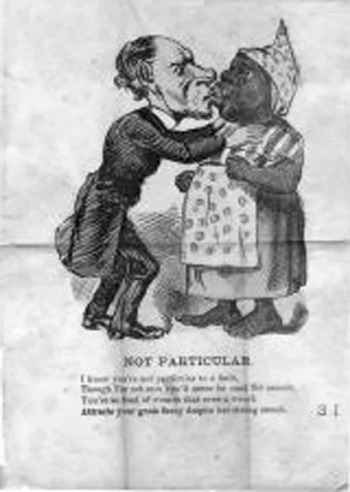
Mammy Postcard from the 1900s: “Not Particular.” Also available at http://commons.wikimedia.org/wiki/File:1900sc_Mammy_Card_Interracial.jpg.

Julia and Herman's union amalgamates legal and racial issues of the eighteenth, nineteenth and early twentieth centuries, whereby many American states passed antimiscegenation laws. These laws prohibited as criminal acts marriages between persons of different ethnic groups and officiation in such marriage ceremonies. Julia and Herman have been together for ten years, and on this anniversary Herman presents her with a wedding ring, but, had they attempted to marry, criminal charges would have been brought against them. The media may have been guilty of continually fuelling cultural attitudes towards interracial unions;Footnote 19 however, antimiscegenation laws maintained that
if any man and woman live together in adultery or fornication, each … must, on the first conviction of the offense, be fined not less than $100, and may also be imprisoned in the county jail or sentenced to hard labor … for not more than six months. On the second conviction … with the same person, the offender must be fined not less than $300, and may be imprisoned … or sentenced to hard labor … for not more than 12 months … for a third … conviction with the same person, must be imprisoned in the penitentiary or sentenced to hard labor for the county for two years.Footnote 20
Herman is a self-employed baker and such fines or prison sentences as laid out by the above section would financially ruin him, his business and his family. However, despite these legal and social pressures, Julia and Herman continue their personal relationship, thereby proving not only their love but also the absolute insanity of the law.
Wedding Band traverses time and embodies the historical continuation of racial discrimination. Set in 1918, the play details the difficulties and dangers of continuing with an interracial relationship, and ironically, as Childress created this drama, discrimination regarding couples such as Julia and Herman still existed. In the 1965 case of Loving v. Virginia, trial court judge Leon Bazile sentenced to jail an interethnic couple who married in Washington, DC, writing, “Almighty God created the races … and he placed them on separate continents. The fact that he separated the races shows that he did not intend for the races to mix.”Footnote 21 This decision was eventually overturned two years later, eighty-four years after Pace v. Alabama, when the US Supreme Court ruled unanimously in Loving v. Virginia that
Marriage is one of the “basic civil rights of man”, fundamental to our very existence and survival … To deny this fundamental freedom on … a basis as the racial classifications embodied in these statutes … is surely to deprive all the State's citizens of liberty without due process of law.Footnote 22
FEMALE VOCALIZATIONS
For Julia in particular, issues of marriage, of name and protection, are difficult to contend with emotionally, considering that she has often had to conceal her relationship with Herman, or physically move on if it is revealed. This continuous movement lends further emphasis to Julia's sense of displacement. Not only is she legally alienated from society because of her interracial relationship, Julia is also emotionally alienated from the other black women she lives amongst, Mattie stating, “I wouldn't live with no man … Man that won't marry you thinks nothin’ of you. Just usin' you” (19). However, the truth of Julia's male “friend” emerges: “you know it's against the law for black and white to get married … that's why I try to stay to myself” (20). This admission allows Julia to vent her frustration and explain her detachment, all of which perpetuate her sense of loneliness. For the other women, this is an opportunity to vehemently voice their black female perspective on the white male: “A white man is somethin' else. Everybody knows how that low-down slave master sent for a different black woman every night … for his pleasure” (21).
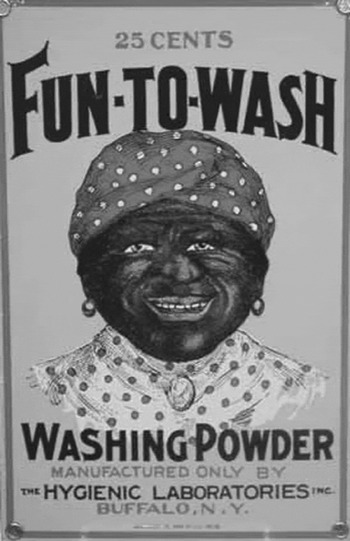
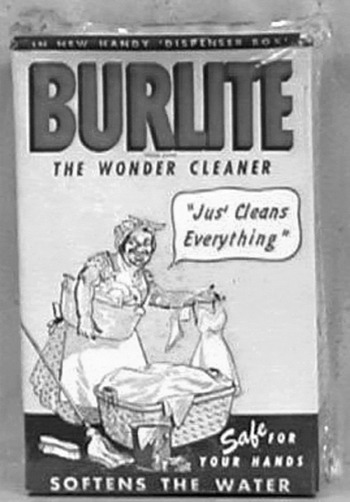
Childress allows these black women a textual space within which they can be at liberty to display their emotions juxtaposed with their comic formulation of a “mean” white male caricature whose “nose is pinched together so close” he “can't get enough air” and his “mouth is set back in [his] face so hard and flat” (ibid.). Thus Childress endows her female characters with the power to reverse negative stereotyping. As early twentieth-century Mammy media representations attest, it has predominantly been the black female who has suffered the indignity of becoming a sanitized sociocultural characterization, her caricature being used principally to advertise household products; the African American female becoming as much an object as the items she purportedly promotes.Footnote 23
Fun-To-Wash Washing Powder (metal advertising sign). Ferris State University Museum of Racist Memorabilia.

Burlite: The Wonder Cleaner (advertisement on original packaging). Ferris State University Museum of Racist Memorabilia.

Unfortunately for Julia, Mattie's and Lula's fervent and fiery odium forces her to defend Herman and retreat back into her solitary status. Consequently, the first scene of Act I ends with Mattie and Lula physically and emotionally abandoning Julia; they cannot understand why she has chosen to spend ten years of her life with a white man. The reality of this interracial relationship becomes not only a question of racial discrimination and segregation, but also a subtle insight into cultural divisions within the black community itself. Julia effectively has no reputable position in either black or white society.
Parallel to these female vocalizations, a tired Herman appears at the rickety fence in front of the three houses. He tries to be polite; however, the women behave awkwardly, Mattie in particular explaining to the ever-vigilant Princess, her young white charge, that Herman is a “light colored man” (ibid.). As racial justifications are made, Julia berates Herman for entering into a conversation with them, and so Childress evokes an atmosphere of apprehension and colour contradiction, whereby Herman is rendered a mulatto. Further racial and wartime tension is relayed through Herman's story of how his house was daubed with “Krauts … Germans live here” because in the past his mother had boasted about “her German grandfather” (25). What becomes apparent is how diverse “races” endure discrimination despite being capable of bestowing equal levels of prejudice. Owing to such sentiments, Julia has been forced to reposition on a regular basis – “Another move, another mess” – unable to fight the antagonism and close-lipped ignorance of those around her (26). As if to alleviate the muted mood, Herman presents Julia with a gold wedding ring on a chain, not merely a proof of his love, but a promise to marry in New York. There is an element in their conversation, however, of time wasted, of existing in a cultural limbo; nonetheless, the sudden decision to move north becomes the necessary impetus to raise them from their lethargy (31). However, Herman's earlier awkward entrance is superseded as he emerges onto the porch and collapses in front of the women. Legal implications suddenly become of importance as Fanny starkly demands, “Get him out of my yard” (33).
FADING DREAMS OF INTERRACIAL POSSIBILITIES
Act I not only ends with the thrilling promise of a ticket to New York for Julia, it also succeeds in silently separating the collected individuals with regard to who is prepared to help Herman. The class-conscious and socially aspirational Fanny demands Herman's removal; Lula and Mattie emotionally and physically “freeze,” giving a dramatic effect of sociocultural inertia (33). Act II, however, begins with Julia, Fanny and Mattie discussing the next best move as they wait for Lula to return with Herman's sister, and at least here we have some semblance of a supportive female community. However, when Julia states that she wants a doctor to see him, Fanny gives a variety of reasons against this train of thought:
It's against the damn law for him to be layin' up in a black woman's bed … we don't tell things to police … he might die on you … That's the work-house … Julia, it's hard to live under these mean white-folks … but I've done it. I'm the first and only colored they let buy land “round here.” (34–35)
Reputation and respect would have been in incredibly short supply in 1918 Charleston for a black woman, and Fanny believes she has succeeded in “representin' her race in-a approved manner” (35). However, despite aligning herself with “her race,” Fanny ironically warns Julia that she, “or any-a the rest-a these hard-luck, better-off-dead, triflin' niggers', cannot ruin what she has socially achieved (ibid.).
In Wedding Band, the community that Childress initially depicts lacks a positive and coherent female heritage, an African American history from which they could gain wisdom with which to contend with and potentially transform their lives. All the women live single lives, for even Mattie's husband is away. Only Teeta exists as an exemplar of the next generation; however, her life revolves around the precocious and cosseted Princess, the little white girl who emits far more social confidence than Teeta and is distinctly more aware of colour variations. Fanny sleeps alone, and the widowed Lula suffered at the hands of a womanizing and violent husband (37). Such fragmentary and variable relationships are bound to struggle and falter when problems arise, and Julia's entrance into their world compels such fissures and fractures to open up accordingly.
Julia's difficulty throughout the play is less her interracial relationship than her reluctance to see herself as a member of the black community, and parallel to this is how her black neighbours perceive her as different for issues more complex than skin colour. She assumes that her racial transgression with Herman will make her socially objectionable to the women with whom she wishes to disclose her secret, but her detachment from their routine existence also serves as a defense mechanism. Julia opted to remain isolated from her immediate community because of Herman and all that his whiteness entails. However, her prospective salvation is situated within the larger community that depends on the stability of its African American female heritage. Neither poor nor uneducated, Julia realizes that she is considered to be defying her black community by affirming her female right to love a man regardless of colour, the question being how she can “account for carin' 'bout [Herman] a-tall?” (42). Nevertheless, Julia's self-assertion is, in a greater social sense, a more precarious non-compliance with the white community. As Catherine Wiley explains, Julia wants her love affair to be one of personal devotion and sacrifice, but it is that only in some measure. Julia's
refinement in manners, education, and financial independence, which are middle-class, traditionally white attributes, make her and Herman available to each other. But theirs is, as the subtitle insists, a “love/hate” story, in which interracial love cannot be divorced from centuries of racial hate.Footnote 24
The entrance of Herman's sister Annabelle, and, more especially, his mother, dramatically inserts that element of conventional and contemporary white aggression and condescension, as Annabelle patronizingly explains to Julia: “I promised my mother I'd try and talk to you. Now – you look like one-a the nice coloreds … ” (39). The tension is apparent between the two women; Annabelle finding it difficult to listen to Herman's feverish chatter about Julia's “pink and brown” feet; her learnt personal prejudice coming to the fore (40). Ironically, just as Fanny aspires to a different class, so Herman's mother, a “poor white” who has “risen above her poor farm background … tries to assume the airs of ‘quality’” (43). Here, Childress textually positions white next to black, locating them in a similar class and allowing their racially circumscribed behaviour to occur. The black women treat the white woman deferentially; Herman's mother in turn groups them together regarding their colour. Herman's mother, or “Miss Thelma,” is content with Fanny's acquiescence, who is immediately promoted to “Friend Fanny,” and despite Herman's dire situation, they take time to peruse Fanny's silver service; after all, “Everybody's gon' die. Just a matter of when, where and how” (44). Julia is officially repositioned on the periphery of this unfolding drama, objectified and vilified by both Fanny and “Miss Thelma” as they discuss the alibi and burning of Herman's clothes and possessions. On the surface this would eradicate any remaining disease; however, on a more profound note, it would also raze evidence of Julia, thus morally purging and racially cleansing Herman's life of her being and “blackness.”
During a moment of reminiscing and within Julia's audible range, Herman's mother recalls the high hopes she had for his future, almost as though “Herman is dead” (47). She specifically evokes an image of a five-year-old Herman being physically forced to learn “his John C. Calhoun speech,”Footnote 25 which fundamentally argues that black people are not equal to white: “Oh, Calhoun knew 'bout niggers. He said, ‘MEN are not born … equal, or any other kinda way … MEN are made’ … Yes, indeed, for recitin' that John C. Calhoun speech … Herman won first mention … at the Knights of The Gold Carnation picnic” (ibid.). The mother's memory enmeshes historical and contemporary racial attitudes that position black people within a substandard and submissive sociopolitical space.Footnote 26 Apart from the link with the Ku Klux Klan, Herman's mother's seemingly desperate need for upward social mobility denies her children any other form of personal positive racial judgement. In this scene, Childress addresses the past and present in multiple ways.Footnote 27 Herman's mother's apparently innocuous recollection belies the appalling effects that the Klan's white supremacist mindset would have had upon a large black population. The crucial and contemporary significance of Childress's historical position forces a 1960s theatre audience to accept the continuation of such racist practices.Footnote 28
The issue of anti-woman and discriminatory laws continues to prevail as Herman's mother refuses to move her son until after dark. Despite his mother's feelings about Julia, Herman remains resolute about their relationship; however, his mother would rather see him dead than be disgraced (48). As Herman slips in and out of a feverish consciousness, fragments of the Calhoun speech whipped into him seep out parallel to clipped instructions for Julia to go north. However, Calhoun's words haunt the scene as Herman lets forth a barrage of the South Carolina politician's beliefs:
It is a great and dangerous error to suppose that all people are equally entitled to liberty … It is a reward to be earned, a reward reserved for the intelligent, the patriotic, the virtuous and deserving; and not a boon to be bestowed on a people too ignorant, degraded and vicious … to be capable either of appreciating or of enjoying it. (49)
Here we witness nineteenth-century America meeting twentieth-century America with a realization that socially prescribed stereotypes and culturally constructed modes of behaviour pertaining to the African American community have not changed. Childress appears to be reminding her audience not only of the reality of racism, but also of the necessity to continue the fight against rampant discrimination and segregation. As if to prove this point, Julia suddenly finds a forceful voice, the fight within her pouring out as she pointedly tells Herman's mother some uncomfortable truths. As Fanny steps in to aid the white woman, the argument descends into a verbal flinging of the worst racial epithets, “Miss Thelma my ass! Her first name is Frieda. The Germans are here … Black, sassy nigger … Kraut, knuckle-eater, red-neck … Nigger whore … sharecropper bitch” (50). Despite Julia's verbal outpouring, as a result of ten years of secrecy, the war of racist words ends with Herman's mother's ultimate political weapon, “White reigns supreme … I'm white, you can't change that” (51). All humanity is stripped from Julia as she angrily attempts to cleanse her house of whiteness; the old woman's vicious words have sullied the beauty and memory of the interracial love she and Herman have preserved for so long.
AN UNSPARING GAZE OF RESISTANCE
The final scene of Wedding Band amalgamates many of the previously highlighted issues, seen most poignantly in the opening section as anti-woman laws are juxtaposed with unremitting racial discrimination. This is all to the background sound of a marching band who will play during the parade sending black servicemen back to the war. Such a cacophony of sound reverberates and within this wall of noise and confusion is the complication of Julia and Mattie's lives. Julia is drunk and feels emotionally abandoned by Herman, and Mattie cannot believe that her “marriage” to October is considered illegal by the state government.
Further cultural complexities arise in the shape of an itinerant salesman, the Bell Man, who attempts to breeze uninvited into Lula's house, her son Nelson, who is more politically empowered than his mother, duly attempting to restrain him. The paradox is that Lula submits to an individual just as impoverished as herself; however, despite such similar economic circumstances, he threatens Nelson that he may well “end [his] days swingin' from a tree” (55). The definitive struggle for control always concludes with a historical and stark reminder of the unchangeable “difference” between the races – “White reigns supreme … you can't change that” (51). As though to alleviate the strained situation, the sound of the strutting band allows an instance whereby the listening women can psychologically surmount and transcend their present predicaments (56). In an unexpected Carolina folk dance “passed on from some dimly-remembered African beginning,” the women momentarily draw on a long-forgotten heritage, a female history that embraced concepts of community, sustenance and mutual respect (ibid.). The powerful image of Lula and Julia dancing and laughing is in stark contrast to previous racial aggression and issues of white supremacy.
Despite Lula's tendency to acquiesce to white folks, this particular point in time endows her with a certain sense of racial pride and self-knowledge, “We got to show 'em we're good”; however, it still remains tinged with a traditional fearful realism: “got to be three times as good, just to make it … 'cause they'll kill us if we not” (56). Julia is in more defiant mood and relates a dream in which she desperately desires that the “dead slaves – all the murdered black and bloody men” – fight back against the white oppressor (57). This dream enables her to acknowledge a suppressed family history; her slave grandmother, her father's unpaid labour as a skilled brick mason building mansions for whites, her kinship with the past, with black women raising the food and making the clothes that helped build the South. She imagines the whole Carolina earth nourished with the heart's blood of her ancestors. In the dream, symbolic slaves are called upon by Julia to rise up and be defiant; in the play, however, few characters depict such necessary insurgency. Nevertheless, Lula recounts a time she begged a white court to keep her son from a chain gang; she consciously resorted, however, to stereotypical black female behaviour and colloquial speech. As one unschooled in the ways of racial resistance, Julia responds naively and pityingly, “Oh, Miss Lula, a lady's not supposed to crawl and cry,” and Lula answers with the voice of maternal authority, “I was savin’ his life” (57). Whether to contest or whether to comply with discrimination and oppression depends upon the situation, and Lula's choice illustrates the contradictory and inconsistent attitudes within the black community regarding their sociopolitical position in America throughout the first half of the twentieth century.Footnote 29
As Nelson prepares to return to the army, Julia gives a rousing speech on the porch: “You're comin' back in glory … And those medals and that uniform is gonna open doors for you … Nelson, on account-a you we're gonna be able to go to the park. They're gonna take down the n—colored signs” (58). Conflicting feelings towards desegregation are voiced by Fanny: “Some of us ain't ready for that,” and equally Nelson asks, “you believe all-a that?” (58–59). Such political rights may be much further in the future than Julia envisages; however, she does embody the necessary spirit that believes in the possibility. Dramatically on cue, Herman appears in the yard, holding two boat tickets bound for New York, yet they are “Colored tickets,” meaning that they obviously cannot travel together, which again paradoxically portrays the whole issue of colour contradiction and awareness (59). She begins to express a keen racial awareness, a dawning realization that she is not separate from the black community, that she is not “different” from those “relatives, friends and strangers” who “worked and slaved free for nothin'”(60–61). The entire history of slavery and the continual perpetuation of racial discrimination haunt Julia; however, Herman attempts to convince her that he “didn't do it … and you blamin' me for it” (62). Her accusation is for all of white society, for the fact that she was never allowed to vocalize her sentiments “whenever somebody was lynched,” that she had to bury and “swallow down” her opinions (62–63). The issues of their racial histories that have remained submerged for ten years in their social seclusion are forced to the surface, and Herman is required to confront history on Julia's terms. The conversation becomes an introspection of their long-term relationship, of how its stagnancy reflects a mutual hidden shame, individual ignorance and anger in general at a law that denies their positive and constant feelings. Their histories are effectively personal narratives, disconnected from race, but over the years Julia has become increasingly troubled by the pretense that their love can transcend racial history.
Herman wearily lies on the bed, both he and Julia having achieved an honest appraisal of their emotions, both happy still to be united. As if already accepting the inevitable, Julia offers her wedding band and tickets to Mattie in an act of sisterhood, demonstrating her new-found black female self-awareness and burgeoning communal consciousness: “juliasilently stares at them, studying each woman, seeing them with new eyes. She is going through that rising process wherein she must reject them as the molders and dictators of her life … ” (65). Julia returns to Herman, her former fear finally dissipated through her political stance on the porch, and for his last moments on earth, she evokes an image of them both on a ship waving goodbye to everyone. Their concluding memory is of togetherness, of leaving behind all the negative aspects of a society that instilled the double cultural encoding of black in a white-dominated culture and female in a male-dominated one. Wedding Band concludes by placing authority within the grasp of Julia, black female hands that would rarely have been allowed such control and potential for future racial empowerment.
Close textual analysis of Wedding Band illustrates the actualities of life for a variety of black women in the early twentieth century, consequently forcing a later audience to consider how much has altered. Moreover, this investigation exposes the black female textual space and social vocalization that Childress allows her characters. This added political and feminist facet has often been overlooked in favor of its interracial theme, therefore it is imperative to demonstrate how, through Julia and her flourishing female and black historical awareness, Childress shows that resistance can be created in ostensibly small ways. The principal importance, even now in the twenty-first century, is to maintain a critical and unsparing gaze of resistance towards the institutions and structures of oppression.