INTRODUCTION
Relatives and friends are of special importance for severely affected multiple sclerosis (MS) patients (Golla et al., Reference Golla, Galushko and Pfaff2012; Strupp et al., Reference Strupp, Hartwig and Golla2012; Galushko et al., Reference Galushko, Golla and Strupp2014), frequently enabling home care (Dunn, Reference Dunn2010) and supporting not only patients but also the community and the healthcare system. MS caregivers bear a high level of physical and emotional burden (McKeown et al., Reference McKeown, Porter-Armstrong and Baxter2003; Wollin et al., Reference Wollin, Yates and Kristjanson2006), and their quality of life is rather low (Aronson, Reference Aronson1997; Patti et al., Reference Patti, Amato and Battaglia2007; Rivera-Navarro et al., Reference Rivera-Navarro, Benito-León and Oreja-Guevara2009; Buchanan & Huang, Reference Buchanan and Huang2011). They are in need of psychological, social, healthcare, and financial support (Dunn, Reference Dunn2010; Kouzoupis et al., Reference Kouzoupis, Paparrigopoulos and Soldatos2010; Akkuş, Reference Akkuş2011; Gupta et al., Reference Gupta, Goren and Phillips2012), require increasing access to and training in MS-focused care (Dunn, Reference Dunn2010; Buchanan et al., Reference Buchanan, Radin and Huang2011), and need to protect and retain their own identities (Dunn, Reference Dunn2010; Hughes et al., Reference Hughes, Locock and Ziebland2013). MS patients and their caregivers often seem inseparable, as a caregiver's well-being depends on the patient's well-being and vice versa (Knight et al., Reference Knight, Devereux and Godfrey1997; Chipchase & Lincoln, Reference Chipchase and Lincoln2001; Gupta et al., Reference Gupta, Goren and Phillips2012), a state that is especially pronounced if the caregivers are spouses (Knight et al., Reference Knight, Devereux and Godfrey1997; Boeije et al., Reference Boeije, Duijnstee and Grypdonck2003; Buchanan et al., Reference Buchanan, Radin and Huang2011). A caregiver's strain increases if their related MS care recipients suffer from hopelessness, social isolation, problems with the activities of daily living, sudden mood changes, motor problems, incontinence, and pain, and if they cannot prevent admission to a nursing home (Knight et al., Reference Knight, Devereux and Godfrey1997; Chipchase & Lincoln, Reference Chipchase and Lincoln2001; Boeije et al., Reference Boeije, Duijnstee and Grypdonck2003).
The unmet needs of caregivers caring for severely affected MS patients are rarely studied, or they are not considered as a separate group (Wollin et al., Reference Wollin, Yates and Kristjanson2006). However, these MS caregivers are those who would predominately contact palliative care (PC) services, if PC were to further open up for MS and be integrated in a standardized manner (Higginson et al., Reference Higginson, Hart and Burman2008; Reference Higginson, McCrone and Hart2009; Edmonds et al., Reference Edmonds, Hart and Wei2010; Strupp et al., Reference Strupp, Romotzky and Galushko2014b ). To focus not only on patients' (Higginson et al., Reference Higginson, Hart and Silber2006; Edmonds et al., Reference Edmonds, Vivat and Burman2007a ; Reference Edmonds, Vivat and Burman2007b ; Golla et al., Reference Golla, Galushko and Pfaff2012; Strupp et al., Reference Strupp, Hartwig and Golla2012; Galushko et al., Reference Galushko, Golla and Strupp2014) but also on relatives' unmet needs is one main aspect stated in the WHO definition of palliative care (WHO, 2002). Thus, in our larger research project of assessing the unmet needs of severely affected MS patients in Germany (Golla et al., Reference Golla, Galushko and Pfaff2012; Buecken et al., Reference Buecken, Galushko and Golla2012; Galushko et al., Reference Galushko, Golla and Strupp2014; Golla et al., Reference Golla, Galushko and Pfaff2014; Strupp et al., Reference Strupp, Golla and Galushko2014a ), we also focused on the unmet needs of caregivers of the severely affected MS patients.
METHODS
Recruitment
We recruited primarily caring relatives who deemed their care recipients as severely affected by MS using a convenience sampling approach, as the original plan of purposive sampling could not be complied with due to recruitment difficulties. Subjective assessment of one's suffering was the decisive factor for recruitment (Golla et al., Reference Golla, Galushko and Pfaff2012; Strupp et al., Reference Strupp, Hartwig and Golla2012; Buecken et al., Reference Buecken, Galushko and Golla2012; Galushko et al., Reference Galushko, Golla and Strupp2014; Golla et al., Reference Golla, Galushko and Pfaff2014; Strupp et al., Reference Strupp, Golla and Galushko2014a ), as in PC, where this should be the most decisive factor triggering an intervention. Further patient data were not gained within this study. MS relatives were informed about the study by leaflet and by personal inquiry in regional MS self-help groups, in a nursing home specialized for young people with disabilities, and in the neurological department at the University Hospital of Cologne. Moreover, one MS outpatient treated at the University Hospital offered to act as intermediator between the study center and potential participants by establishing telephone contacts. Interested relatives were called (by MG and SM) for open questions and to set an interview date in case of consent. Caring relative-like friends could also be included in the study. In the following, we will speak of caregivers in the sense of both caring relatives and caring relative-like friends.
Data Collection
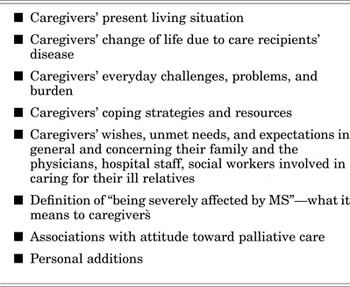
Semistructured face-to-face interviews (Flick, Reference Flick, Bauer and Gaskell2000) were conducted by skilled qualitative interviewers who had experience in palliative care (MG, SM), at a place preferred by the interviewees. Interviewers had no prior contact with patients. An interview guideline was utilized (see Table 1). Fieldnotes were taken. Interviews were audiotaped, transcribed verbatim, and were not returned to participants for comment or correction. Participants filled in a short questionnaire collecting sociodemographic data and gave written informed consent. Transcripts and questionnaires were pseudonymized. Approval from the medical research ethics committee of the University Hospital of Cologne was obtained (IRB #06-191).
The interview guideline encompasses questions related to the following fields:

Analysis
The interviews were analyzed by qualitative content analysis (Mayring, Reference Mayring and Flick2004). First, the interviews were analyzed using global analysis (Legewie, Reference Legewie and Böhm1994). Parts of interviews indicating caregivers' unmet needs were identified and then further analyzed: Interviews were coded (by MG, SM, HG) using constant comparison to reveal minimal and maximal contrasts. Emerging codes were constantly compared, and similar content from different interviews were combined into preliminary categories. Categories at a higher level of abstraction were needed in order to be applicable to the whole dataset. Both categories and subcategories were iteratively refined and key categories evolved (Corbin & Strauss, Reference Corbin and Strauss2008). The data and related codes were discussed in a multi-professional fashion among the authors (MG, SM, HG, RV) (Pope et al., Reference Pope, Ziebland, Mays, Pope and Mays2006). Our study conforms to the consolidated criteria for reporting qualitative research (COREQ) guidelines for reporting qualitative research (Tong et al., Reference Tong, Sainsbury and Craig2007).
RESULTS
Participants
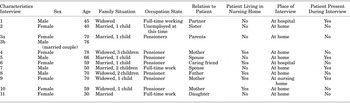
Twenty caregivers showed interest in our study. Contacts were established as follows: at the University Hospital (8), in specialized nursing homes (8), and via an MS patient intermediator (4). No feedback came from the MS self-help groups. Ultimately, 12 of these caregivers agreed to participate (for sociodemographic data, see Table 2). Reasons for refusal cited were: nonattendance of a special family member at the interview or lacking German language abilities. Four caregivers insisted on their care recipient being present during the interview, and one married couple caring together for their diseased adult child agreed to a joint interview only. Due to difficulties in recruitment, we decided to go through with these interviews, though anticipating possible bias. Interviews were conducted at home (8, one with two participants), at the University Hospital (2), and at a nursing home (1), and took 30 to 90 minutes. During interviews, caregivers repeatedly had to be reminded that their unmet needs were of interest, not those of their care recipients. Cited reasons for which caregivers regarded their relatives as severely affected by MS were: fundamental, unpredictable changes in life forced by the MS (Int. 2); disastrous, unmanageable living situations (Int. 6, Int. 7) leading to helplessness (Int. 9); increasing physical barriers (Int. 8); and being continuously dependent on outside help (Int. 10).
Characteristics of the interviewed caregivers

Categories
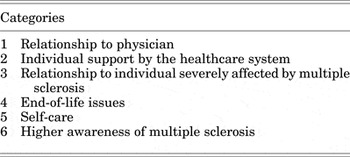
The unmet needs of caregivers of severely affected individuals with MS can be grouped into the following framework of six categories (Table 3).
Categories of unmet needs of caregivers of severely affected individuals with multiple sclerosis

Relationship to Physician
Only one caregiver was satisfied with physicians' medical care for the patient and the physician–patient or physician–relative relationship (Int. 5). More often, caregivers complained about both of these issues (Int. 4, Int. 7, Int. 10, Int. 11) and described physicians as being “incompetent,” “unfriendly,” “insensitive,” and “indelicate.” One caregiver suggested communication training for medical students to prevent such behavior in the future (Int. 2):
For example, in hospitals, maybe someone could ask, if relatives have the necessity to talk, and you don't want to have the feeling of being pushed aside. (…) I know, doctors are very busy, and I don't want to interfere. (Int. 2, ll. 319–324).
Caregivers wished that physicians recognized the burden and needs of both the care recipients and their caregivers (Int. 1, Int. 4, Int. 6) but felt that most physicians only focused on the patients' situation (Int. 6). Some of the interviewees did not feel as if they were being taken seriously by their physicians. Although the interviewees felt they were experienced in handling MS, they claimed that physicians did not appreciate this and excluded them from the decision-making process:
Then the doctor sent us out of the room. Now he has only to deal with the patient, not with us. (Int. 3, ll. 479–481)
I felt like a disturbing factor. (Int. 2, l. 251)
The interviewed couple wanted to be more involved in the medical care plan of their care recipient (Int. 3). Another participant wished for consultation meetings about the patient's precise situation, without the patient being present (Int. 2).
Individual Support by the Healthcare System
Interviewees criticized the lack of profound knowledge in physicians treating MS patients (Int. 1, Int. 4, Int. 11). An unambiguous, early diagnosis of MS would build their confidence in the physicians (Int. 4, Int. 10, Int. 11). Recognizing and naming early symptoms like double vision, ataxia, or incontinence as signs of MS would help in dealing with the disease (Int. 4). Opinions differed regarding nursing care services. Some caregivers considered them helpful, especially if they had a full-time occupation (Int. 5, Int. 7, Int. 10). Others regarded their support as insufficient and wished for a more specialized, individual, and time-intensive care lying beyond the possibilities of nursing services (Int. 3). One caregiver wished for workshops dealing with basic caring skills and would have appreciated an external person to mediate disputes between caregiver and care recipient, one who could bring up serious issues like the patient's will to live:
His health is deteriorating, especially in the last six month, so that now I have really a lot of questions (…), and it is really difficult to talk about such things [like a living will]. I miss someone I can ask. (Int. 2, ll. 239–245; ll. 265–266)
Other caregivers needed more aids (e.g., an electric wheelchair) for their care recipient or a stairlift to improve their physical situation (Int. 5, Int. 7). They would also feel supported by transportation services for both the affected person and their caregiver (Int. 4, Int. 5).
Relationship to the Individual Severely Affected by MS
Caregivers had increasing difficulties in understanding their diseased relatives due to the behavioral and personality changes that had occurred during the progression of their disease. They noticed that this leads to discomfort on both sides (Int. 2, Int. 10). For example, social behavior within a family changed and was experienced as inappropriately strict or uncompromising:
We played Yahtzee, and he [the affected person] said, we haven't even started, but she [the child] had already a good match. But he reacted very strictly. This was in my opinion really inappropriate, because she is only five. (Int. 2, ll. 61–66)
Caregivers were strained if their care recipients demanded an intuitive understanding of their needs. Although being aware of care recipients' restrictions, caregivers wished that their dedicated care would be more appreciated (Int. 3, Int. 2). Being taken seriously by their care recipients meant to caregivers that they both had decided on things, like organizing care to avoid mismanagement and unnecessary work (Int. 2). Moreover, this could mean honestly and constructively discussing difficult topics like end-of-life issues or future plans (Int. 2):
Well, when I really make things clear and say, “We have to make out how we want to deal with each other,” then it is going to work. (Int. 6, ll. 175–176)
Some caregivers suffered from feelings of insufficiency and depression with severe self-blame despite constant commitment to the progressively diseased patient (Int. 3, Int. 4, Int. 10). They felt ashamed if they took a break (e.g., by traveling alone) and could not really enjoy being on their own while continuously thinking of the care recipient left at home (Int. 10). Their lifestyle was adapted to the patient's demands the more the disease progressed. Often, family roles were redefined. Two male participants described how they now had to fulfill “women's tasks” around the house (Int. 5, Int. 7).
End–of–Life Issues
Caregivers appreciated reliable information on symptoms and the changes that accompany disease progression, as they wanted to be well prepared. Information on the final stages of the disease was especially crucial for them but seldom communicated:
Recently someone told me that it is getting worse. I have to deal with more aggression. This was not a formal piece of information. They are all sugarcoated. This was from elsewhere. (Int. 2, ll. 266–273)
Important end-of-life issues included not only worries about death and dying of the care recipient but also of the caregiver's own death. One mother feared for the welfare of her diseased daughter if she were to predecease her (Int. 9):
Sometimes I wish M. dies before I have to die. This is not a nice wish, but then I know she is well cared for. (Int. 9, ll. 453–456)
In contrast to this, another participant insisted that he would never give up hope in spite of the severe MS of his wife, and he refused to tolerate statements like “there is no help anymore” (Int. 7). None of the interviewees could imagine PC as a supporting approach for them. However, only very few had any knowledge of PC (Int. 1, Int. 2, Int. 4, Int. 7), and if they did, they regarded it as an approach to alleviating dying for cancer patients.
Self-Care
Self-care only played a minor role for the interviewees. If stated at all, they named their own resources as follows: work, leisure activities, and a belief in God with support from the faith community (Int. 3, Int. 5, Int. 9, Int. 10). One caregiver's strategy for coping was to form unquestionable beliefs or mantras like “together we are strong” when feeling exhausted (Int. 7). Another felt protected by social withdrawal, as he wanted to escape the pity of others. He refused any kind of help until it was offered by family members (Int. 1). Only one caring mother was psychologically supported and felt relieved that she had learned to accept unchangeable things like the progression of her son's disease (Int. 10).
Higher Awareness of MS
Caregivers felt that the community did not want to be confronted with disease and was afraid and helpless when dealing with disabled people (Int. 9, Int. 11). Caregivers therefore wished that MS, its disease course, and the associated complications were made more public to increase awareness, thus leading to less social isolation (Int. 1). In their view, social awareness of MS should start with a more disabled-friendly environment and appropriate technical devices like lowered curbs, transport connections with level access, or more disabled-friendly toilets (Int. 5, Int. 10, Int. 11). This would help to ensure the best possible autonomy for both care recipients and caregivers.
DISCUSSION
This study focused on the unmet needs of caregivers of severely affected MS patients, a group of MS caregivers who so far have been scarcely considered. This group is, however, of great interest to palliative care if its services are to open its doors to MS patients.
Recruitment and Caregivers
The inclusion criterion was that caregivers felt that their care recipient was severely affected (Golla et al., Reference Golla, Galushko and Pfaff2012; Buecken et al., Reference Buecken, Galushko and Golla2012; Galushko et al., Reference Galushko, Golla and Strupp2014; Golla et al., Reference Golla, Galushko and Pfaff2014). This could have involuntarily served as a barrier for caregivers to participate. Naming care recipients as severely affected could imply that the caregivers felt burdened by them and therefore might have developed feelings of guilt. It may have helped that patients were present during interviews, as was the case in four interviews. The unmet needs of the studied caregivers were strongly connected to those of their care recipients. Five of the six categories evolved were primarily associated with the care recipients or the relationship with them. Only the category “self-care” represented purely caregiver interests. These points stress the close dyad between MS patients and their caregivers (Knight et al., Reference Knight, Devereux and Godfrey1997; Chipchase & Lincoln, Reference Chipchase and Lincoln2001; Boeije et al., Reference Boeije, Duijnstee and Grypdonck2003; Akkuş, Reference Akkuş2011) and that it may become stronger the more the disease progresses.
Unmet Needs of Caregivers
Relationship to Physician
Like patients (Buecken et al., Reference Buecken, Galushko and Golla2012; Galushko et al., Reference Galushko, Golla and Strupp2014) and health professionals (Golla et al., Reference Golla, Galushko and Pfaff2012), the caregivers in this study regarded a well-established patient–physician relationship as an important factor in coping with the disease. Caregivers also wished for an empathic relationship with patients' physicians, including receiving highly useful information on disease status, a crucial factor also known for caregivers of cancer patients (Soothill et al., Reference Soothill, Morris and Thomas2003). In terms of their vital role, these caregivers criticized physicians for excluding them from important discussions and decisions concerning the affected persons. However, the caregivers' belief that they had the right to be involved in the treatment plan (Patti et al., Reference Patti, Amato and Battaglia2007; Kouzoupis et al., Reference Kouzoupis, Paparrigopoulos and Soldatos2010) and in decision-making processes may lead to difficult ethical issues (Toon & Southgate, Reference Toon and Southgate1987).
Individual Support by the Healthcare System
The caregivers in our study felt relieved if the unmet needs of the affected persons were met through individually adapted support and when they were themselves highly engaged. This again stresses their close relationship with the patient. External support was only appreciated if it served to mediate between caregivers and care recipients, and when offered to those who still maintained spheres of life other than caring (e.g., working life).
End-of-Life Issues
Due to an uncertain disease trajectory and a less distinct terminal care phase (McIlfatrick, Reference McIlfatrick2007; Wilson et al., Reference Wilson, Seymour and Aubeeluck2011), physicians seldom discuss end-of-life issues with MS patients, though it might be beneficial for patients and their families (Seeber et al., Reference Seeber, Hijdra and Vermeulen2012). About a third of severely affected MS patients studied would like their doctors to address end-of-life issues with them and their caregivers (Buecken et al., Reference Buecken, Galushko and Golla2012). MS caregivers want to understand MS and what will happen during the progression of the disease (Finlayson et al., Reference Finlayson, Garcia and Preissner2008). The results of our study show that this is also true for end-of-life issues. This is reasonable, as end-of-life issues also raise many questions for caregivers. They have to prepare for the expected suffering of their care recipients, to develop their own coping strategies, or they might have to anticipate a situation where they might die before their care recipient.
An essential question neglected by the caregivers in this study is how they might realign their lives after the death of patients. Perhaps being separated from each other is simply unthinkable for them or to anticipate a time after the care recipient's death might be taboo, as this may not only mean grief but also relief (Wollin et al., Reference Wollin, Yates and Kristjanson2006). The latter might be hard on the conscience and is thus especially avoided in the presence of care recipients. Both severely affected MS patients and their caregivers might profit from the PC approach (Higginson et al., Reference Higginson, Hart and Burman2008; Reference Higginson, McCrone and Hart2009; Edmonds et al., Reference Edmonds, Hart and Wei2010; Strupp et al., Reference Strupp, Golla and Galushko2014a ; Reference Strupp, Romotzky and Galushko2014 b). Recognizing the special unmet needs of these caregivers after a patient's death might be a field of special importance for PC integration. Respite care, as known from children hospices (Champagne & Mongeau, Reference Champagne and Mongeau2012), could be one approach. However, in the current situation, health professionals and patients severely affected by MS often regard PC as a counterintuitive approach for MS (Kümpfel et al., Reference Kümpfel, Hoffmann and Pöllmann2007; Voltz, Reference Voltz2010; Golla et al., Reference Golla, Galushko and Pfaff2014), a view supported by the caregivers in our study.
Relationship to the Individual Severely Affected by MS
During interviews caregivers mostly spoke of unmet needs concerning care recipients instead of their own needs or they grouped these with their own. This can be seen as a sign of a close relationship or even of a lack of differentiation, which might serve as a coping strategy. A dyadic adjustment has proved to have a positive effect on the relationship between caregivers and dependents (Pakenham, Reference Pakenham2005), and a good relationship between caregivers and affected persons reduces the burden of caring (Chipchase & Lincoln, Reference Chipchase and Lincoln2001). However, not all caring partners manage to align their lives with the affected individuals, and this is less likely with a longer illness trajectory (Pfleger et al., Reference Pfleger, Flachs and Koch-Henriksen2010). Caregivers who still care for their relatives when MS gets severe mostly live in a patient–caregiver dyad, as seemed to be the case for most of the caregivers in our study.
Self-Care
The caregivers in this study mainly neglected their own wishes and left themselves little space for self-care. To them, self-care meant support in reducing the caring burden, that is, it was primarily linked with MS and care recipients and only very little space was given solely for the caregivers' resources. The only ones mentioned were: work, some leisure activities, faith in God, and psychological support. Paying less attention to themselves (Gulick, Reference Gulick1998), while simultaneously suffering from increased physical (Buhse, Reference Buhse2008) and psychological burden (Janssens et al., Reference Janssens, van Doorn and de Boer2003) and from impaired social life (Bogosian et al., Reference Bogosian, Moss-Morris and Yardley2009) is often the case for MS caregivers (Kouzoupis et al., Reference Kouzoupis, Paparrigopoulos and Soldatos2010). The results of our study indicate that this seems to be even more pronounced for caregivers of individuals with severe MS. Enabling respite and self-care and assistance in maintaining an identity apart from the caregiver role could be a starting point for integration of palliative care.
Higher Awareness of MS
Caring for individuals with severe MS definitely supports not only the care recipient but also the community (Dunn, Reference Dunn2010; O'Hara et al., Reference O'Hara, de Souza and Ide2004). The expressed unmet need of study participants for a greater awareness of MS indicates that, apart from severely affected MS patients (Strupp et al., Reference Strupp, Hartwig and Golla2012), their caregivers also feel socially isolated due to the MS. The community should undertake more effort to socially support these caregivers and make them feel an important and accepted part of the community, which would improve caregiver well-being (Sherman et al., Reference Sherman, Rapport and Hanks2007).
LIMITATIONS OF THE STUDY
Since we wanted to concentrate on caregivers' perceived burden and feelings, this study focused on primarily caregivers of MS patients deemed by their caregivers to be severely affected by the disease. Therefore, MS patients' self-report on feeling affected and their objective clinical status were not assessed, which limits our data. Caregivers alone presented the study focus and not caregivers and care recipients as a group. This approach led to difficult recruitment, as caregivers perhaps felt inhibited to name their care recipients as severely affected. A mere convenience strategy was finally employed for recruitment, as the original plan of purposive sampling could not be complied with. Therefore, interviews could not be conducted up to theoretical saturation. In some cases, it helped that patients were allowed to be present during interviews if this was set as a condition to participate. In these cases, the results might be biased, as an individual interview might have facilitated the expression of caregivers' feelings, concerns, and unmet personal needs. Due to these constrictions, our study results cannot be generalized, but they can serve to help us gain an insight into the view of caregivers of severely affected MS patients. The recruitment difficulties, on the one hand, limit our findings, but, on the other, they emphasize how closely related these caregivers are with their care recipients, underlying how difficult it is to reach these caregivers and encourage them to advocate for their own unmet needs.
CONCLUSION
Caregivers and patients severely affected by MS form an established dyad, which makes it difficult to investigate caregivers separately. Yet, to study this caregiver group is necessary since their quality of life influences the quality of life of the patients and vice versa. The palliative care approach might be useful not only for patients with severe MS but also for their caregivers. The uncertainties involved with progressive disease and end-of-life issues are important for them, as well as the possibility of respite and self-care to maintain their own identity, one outside the role of caregiver, which in some way anticipates the time after the death of their beloved care recipient.
FUNDING
This work was supported by the Gemeinnützige Hertie Stiftung (grant number 1.01.1/06/009). The Center for Clinical Trials, University Hospital, Cologne, receives support for clinical studies from the Federal Ministry of Education and Research (BMBF01KN0706).
CONFLICTS OF INTEREST
The authors state that they have no conflicts of interest to declare.
ACKNOWLEDGMENTS
We would like to thank all the caregivers who participated in our study, Jacqueline Umlauf for being our intermediator, Marianne Henry for transcribing interviews, and the German MS Society, especially Mrs. Pitschnau-Michel, for supporting our interest in this topic.