


Introduction
Obesity is characterized by accumulation of adipose tissue, which represents a risk factor for non-communicable diseases. Reference Rubino, Cummings and Eckel1 Studies have indicated 1.1 billion adults will be obese by 2030, Reference Goh and Tham2 with women being more impacted than men globally. 3 In humans and animal models, maternal obesity during perinatal period not only causes pregnancy complications, such as gestational diabetes mellitus and preeclampsia, Reference Gupta, Mehta, Patel and Mehta4 but also affects offspring physiology throughout life. Reference Barker5 In humans and several experimental models, this phenomenon, termed ‘metabolic programming’ or Developmental Origins of Health and Disease (DOHaD), is associated with obesity and metabolic disorders in the offspring throughout life, Reference Barker5–Reference Chang, Hafner and Varghese8 and occurs mainly due to epigenetic mechanisms as an adaptation to metabolic challenges in early life. Reference Lin and Li9
The early-life gut microbiota is a determinant of long-term health, impacting physiological, metabolic, and immune processes in humans and animal models. Reference Nunez, Nieto, Mars, Ghavami, Sew Hoy and Sukhum10 Maternal obesity and diet are keys factors for the offspring gut microbiota establishment, whose perturbations are associated with increased risks of chronic conditions, as obesity and diabetes throughout life. Reference Nunez, Nieto, Mars, Ghavami, Sew Hoy and Sukhum10 Maternal obesity and maternal high-fat diet alter the gut microbiota at birth, characterized by depletion of Bacteroides, which persists through 4–6 weeks of age in humans. Reference Chu, Antony and Ma11,Reference Stanislawski, Dabelea and Wagner12 In addition, maternal high-fat diet decreases alpha diversity of gut microbial community in the male rodent offspring at weaning, Reference Xie, Sun and Wu13,Reference Zheng, Zhang, Gao, Wu and Zhang14 although offspring sex-specific effects were not assessed.
Sex dimorphism of gut microbiota has been reported in rodents and humans at adulthood, Reference Kim, Unno, Kim and Park15,Reference Paz, Buddha, Zhong, Sikes and Wankhade16 while the gut microbial community of prepubescent mice did not show any separation between sexes of control animals. Reference Brettle, Tran and Drummond17 However, maternal environmental challenges, such as dexamethasone exposure during pregnancy, can affect gut microbiota of female and male offspring differently in humans and rodents at early life, before puberty. Reference Lu, Chen and Xu18 During early life, gut microbiota maturation involves increases in bacterial community diversity during mid-infancy, influenced by solid food introduction, leading to increased abundance of members from several genera, including Blautia, Reference Nunez, Nieto, Mars, Ghavami, Sew Hoy and Sukhum10 whose abundance shows significant alterations in obese individuals, Reference Chanda and De19 and notably exhibits interplay with endocannabinoid-like molecules. Reference Pirozzi, Coretti and Opallo20
Endocannabinoid-like molecules, such as oleoylethanolamide (OEA) and palmitoylethanolamide (PEA), are bioactive lipids of the endocannabinoidome (eCBome), a recent extension of the endocannabinoid system (ECS), whose signaling is altered in obese humans and rodents. Reference Almeida, Dias-Rocha, Calvino and Trevenzoli21–Reference Veilleux, Di Marzo and Silvestri23 In contrast to bioactive lipids named endocannabinoids, which bind to cannabinoid receptors type 1 and 2 (CB1 and CB2), PEA and OEA activate other receptors, including peroxisome proliferator-activated receptor-α (PPAR-α), orphan G-protein coupled receptors (GPCRs), and the transient receptor potential vanilloid receptor type 1 (TRPV1), while also inhibiting fatty acid amide hydrolase (FAAH), a degrading enzyme of the bioactive lipids from eCBome. Reference Wang, Guo, Mao and Chen24 Lipids from eCBome are produced by specific lipases acting on arachidonic acid, palmitic acid, and oleic acid. Reference Wang, Guo, Mao and Chen24,Reference Petrosino and Schiano Moriello25 While CB1 agonists increase gut permeability, OEA and PEA act as ‘gate keepers’ with anti-inflammatory and anti-obesity effects. Reference Cani, Plovier and Van Hul26,Reference De Filippo, Costa, Becagli, Monroy, Provensi and Passani27 Similarly, CB2 agonists improve inflammatory bowel disease in vitro and in vivo models. Reference Hryhorowicz, Kaczmarek-Rys, Zielinska, Scott, Slomski and Plawski28,Reference Hasenoehrl, Taschler, Storr and Schicho29
Recently, we have demonstrated that maternal obesogenic diet induces early obesity and glycemic impairment but reduces gut permeability in the rat offspring at weaning. Reference Almeida, Calvino and Reis-Gomes30 In parallel, maternal obesity increases gut content of CB2 in males, decreases gut content of FAAH in females, and reduces fecal content of PEA and OEA in both offspring sexes at weaning. Reference Almeida, Calvino and Reis-Gomes30 For the first time, it was demonstrated that maternal obesity induces sex-specific changes on the gut eCBome signaling of offspring, Reference Almeida, Calvino and Reis-Gomes30 providing new molecular insights for intergenerational metabolic and inflammatory disorders, but without investigating the gut microbiota of offspring.
Fecal levels of endocannabinoid-like molecules have emerged as potential non-invasive biomarkers of disease, since altered fecal levels of PEA and OEA have been associated with mental disorders, Reference Minichino, Jackson and Francesconi31 inflammatory bowel disease Reference Fornelos, Franzosa and Bishai32 and adiposity Reference Castonguay-Paradis, Parent and St-Arnaud33 in humans. Importantly, the fecal levels of PEA and OEA have been related to gut microbiota composition, suggesting an interrelationship between the gut microbiota and eCBome involved in the regulation of numerous host biological processes. Reference Castonguay-Paradis, Parent and St-Arnaud33 To the best of our knowledge, the effect of maternal obesity on the gut microbiota of male and female offspring and its correlations with fecal levels of endocannabinoid-like molecules and adiposity in early life remains unexplored. In the present study, we hypothesized that maternal obesity induces sex-specific changes in the gut microbiota composition associated with reduced fecal levels of PEA and OEA of rat offspring at weaning.
Method
Experimental model
Thirty 60-day-old female Wistar rats weighing 180–220 g (female progenitors) and ten 100-day-old male Wistar rats weighing 250–300 g (male progenitors) were obtained from the Center of Reproduction Biology of the Federal University of Rio de Janeiro, Rio de Janeiro, Brazil. All animal procedures met National Institutes of Health guide for the care and use of Laboratory animals (NIH Publications No. 8023, revised 1978) and were approved by the Animal Care and Use Committee of the Health Science Center of the Federal University of Rio de Janeiro (process number 129/21). For all animal procedures, rats were kept in a controlled temperature environment (23 ± 2°C) with a photoperiod of 12 hours (7 a.m. to 7 p.m. – light, and 7 p.m. to 7 a.m. – dark). Water and the experimental diets were offered ad libitum throughout the study.
Thirty progenitor female rats were randomly assigned to two dietary treatments (n = 15/group) (Fig. 1): Control group (C), which received a standard diet for rodents (9% of the calories as fat, 3.34 Kcal/g), and maternal obesity group (D), which received a hypercaloric high-fat high-sugar obesogenic diet (37.2% of the calories as fat and 11.8% of the calories as sucrose, 4.04 Kcal/g). Reference Almeida, Calvino and Reis-Gomes30,Reference Calvino, Almeida and Reis-Gomes34 Lard was used as fat source, and we also added soy oil to provide the minimal amount of polyunsaturated fatty acids for adequate development of rats. Reference Almeida, Calvino and Reis-Gomes30,Reference Calvino, Almeida and Reis-Gomes34 Both diets followed the AIN-93G recommendations for micronutrients. Reference Reeves, Nielsen and Fahey35 Female progenitor rats were fed these diets during 63 days before mating (3 females to 2 male) and throughout gestation and lactation. The fertility rate ranges from 80% to 90%, corresponding to 12–14 pregnant mothers per group with pups during lactation. Control and obesogenic diet mother’s intakes (g/day), expressed as mean ± standard deviation, were 21.0 ± 4.8 and 14.0 ± 3.9, respectively (unpaired t test, p < 0.05). Control and obesogenic diet mother’s intakes (kcal/day), expressed as mean ± standard deviation, were 70.4 ± 15.8 and 60.0 ± 15.6, respectively (unpaired t test, p < 0.05). Previously, we have characterized the obesity phenotype induced by obesogenic diet, consisting of increased visceral adiposity and dyslipidemia of female progenitors before mating and at offspring weaning. Reference Almeida, Calvino and Reis-Gomes30,Reference Calvino, Almeida and Reis-Gomes34 At offspring birth, all litters were adjusted to three males and three female pups per dam to standardize and adequate the milk supply/demand among the litters. Reference Dickinson, Moss and Gatford36
Experimental model of maternal obesity, study design and experimental analysis. Female progenitor Wistar rats (60-day-old) were divided into control (C, control diet) or obesogenic diet (D). Progenitors received C or D diet for 63 days before mating and throughout gestation (21 days) and lactation (21 days). At birth, male and female pups were adjusted to three male and three female per litter. At weaning (21 postnatal day, four experimental groups were evaluated: 1) Control Male (1_CM), male offspring born of C progenitor; 2) Control Female (2_CF), female offspring born of C progenitor; 3) D Male (3_DM), male offspring born of D progenitor; 4) D Female (4_DF), female offspring born of D progenitor. Fecal samples were collected from the rectum for microbiota analysis. Created in https://BioRender.com.

Figure 1. Long description
A flowchart depicting the experimental model of maternal obesity in rats. The process begins with 60-day-old female Wistar rats divided into two groups: those receiving a control diet (C) and those receiving an obesogenic diet (D). The diets are administered for 63 days before mating and continue throughout gestation (21 days) and lactation (21 days). At birth, male and female pups are adjusted to three males and three females per litter. At weaning on postnatal day 21, four experimental groups are evaluated: Control Male (1_CM), Control Female (2_CF), D Male (3_DM), and D Female (4_DF). Fecal samples are collected from the rectum for microbiota analysis. The diagram includes labels for the different diet groups, mating, pregnancy, lactation, and weaning stages, as well as the experimental groups and their respective analyses.
At weaning (21 days old), four offspring groups were evaluated: 1) Control Male (1_CM), male offspring born to C rat; 2) Control Female (2_CF), female offspring born to C rat dams; 3) D Male (3_DM), male offspring born to D rat dams; 4) D Female (4_DF), female offspring born to rat dams. At weaning, offspring were euthanized between 9 a.m. and 12 p.m. in a fed state by decapitation and fecal samples were collected from the rectum for microbiota analysis (sections 16S rRNA amplicon high-throughput sequencing and gut microbiota data processing and statistical analysis).
Correlations between gut microbiota composition, fecal levels of endocannabinoid-like molecules, and offspring adiposity were identified using Spearman’s correlation. Fecal quantification of endocannabinoid-like molecules, PEA and OEA, are assessed by liquid chromatography-high resolution tandem mass spectrometry (LC-HRMS/MS) (n = 12–14/group). Reference Almeida, Calvino and Reis-Gomes30 Previously, we have reported that the fecal levels of PEA (µg/mL) are 1_CM 0.02930 ± 0.01936, 2_CF 0.02175 ± 0.01355, 3_DM 0.00558 ± 0.003491, 4_DF 0.005761 ± 0.003922; and OEA (µg/mL) are 1_CM 0.01988 ± 0.01363, 2_CF 0.01753 ± 0.01206, 3_DM 0.005552 ± 0.003704, 4_DF 0.004074 ± 0.002598. Reference Almeida, Calvino and Reis-Gomes30 Maternal obesity decreases fecal contents of PEA (−77.8%, p < 0.0001) and OEA (−74.2%, p < 0.0001) of offspring at weaning. Reference Almeida, Calvino and Reis-Gomes30 Offspring adiposity is assessed by weighting the retroperitoneal fat pad, as representative of visceral adipose tissue (RET), and the inguinal fat pad, as representative of subcutaneous adipose tissue (ING) (n = 8/group). Reference Almeida, Calvino and Reis-Gomes30 Maternal obesity increases subcutaneous and visceral adiposity (ING: +2.1-fold, p < 0.0001; RET: +3.4-fold, p < 0.0001) of offspring at weaning. Reference Almeida, Calvino and Reis-Gomes30 For each experimental procedure, rats from at least eight different litters per group were used to avoid ‘litter effects’ in the statistical analysis.
16S rRNA amplicon high-throughput sequencing
Fecal samples were collected directly from the rectum in sterile tubes (n = 8 per group) for gut-microbiota analysis. DNA was isolated from the samples using the MagaZorb® DNA Mini-Prep Kit (Promega, Madison, WI, USA). A 16S rRNA high-throughput sequencing was performed for each sample by GenOne Biotechnologies enterprise (Rio de Janeiro, Brazil). For that, the V3-V4 region of 16S rRNA gene was amplified using 341F (5′-CCTAYGGGRBGCASCAG-3′) and 806R (5′-GGACTACNNGGGTATCTAAT-3′) primers. All PCR reactions were carried out with Phusion® High Fidelity PCR MasterMix (New England Biolabs, USA). The PCR products were purified with Qiagen Gel Extraction Kit (Qiagen, Germany). Sequencing libraries were generated using NEBNext® UltraTM DNA Library Prep Kit for Illumina, following manufacturer’s recommendations, and index codes were added. The quantity and quality of the libraries were assessed on Qubit® 2.0 Fluorometer (Thermo Scientific, USA) and Agilent Bioanalyzer 2100 system. Sequencing was carried out on MiSeq (Illumina, USA) platform (2 × 250 bp).
Gut microbiota data processing and statistical analysis
Amplicon Sequence Variants (ASVs) were inferred using DADA2 (Divisive Amplicon Denoising Algorithm 2) method. Reference Callahan, McMurdie, Rosen, Han, Johnson and Holmes37 During the processing, the primers used in amplification were systematically removed. DADA2 was used to filter, trim, denoise, merge paired reads, and generate ASV table. Taxonomy was assigned to ASVs using a naive Bayesian classifier method against SILVA database release 138. Reference Quast, Pruesse and Yilmaz38 Taxonomy and diversity analyses were performed considering ASVs present in at least 5% of the samples, with aid of several R packages, 39 including phyloseq, Reference McMurdie and Holmes40 vegan, Reference Oksanen, Blanchet and Friendly41 and ggplot2. Reference Wickham42
To evaluate Alpha Diversity differences between groups, the Wilcoxon test was carried out, with a statistical significance threshold of p < 0.05. To test for differences in microbial community composition (NMDS), permutational multivariate analysis of variance (PERMANOVA) on Bray-Curtis dissimilarity was used. To identify differentially abundant bacterial taxa, the Wald test from the DESeq2 Reference Love, Huber and Anders43 package was utilized. During this analysis, the selection of candidates was based on adjusted p-values for multiple tests using the Benjamini–Hochberg method (p-adjusted p < 0.01). Correlations between microbial composition, fecal levels of PEA and OEA, and offspring adiposity were identified using Spearman’s correlation.
Results
Taxonomic composition
To evaluate the composition of the gut microbiota of the animals, the 16S rRNA amplicons obtained from DNA samples extracted from rectal feces were sequenced, resulting in 2,521,784 high-quality sequences with an average of 78,806 sequences per sample. Reads were clustered into 21,282 ASVs. For the further analyses, we retained only ASVs present in at least 5% of the samples, totaling 1929. To assess whether sampling provided sufficient ASVs coverage to accurately describe the bacterial composition of each sample, individual rarefaction curves were generated (Figure S1, supplementary).
In Fig. 2, the ten highest abundant phyla from the microbial community across samples. Firmicutes and Bacteroidota were the most abundant phyla across samples accounting for 44% and 37% of the total quality-filtered reads, respectively. The remaining phyla included Proteobacteria (9%), Verrucomicrobiota (3.5%), and Actinobacteriota.
Taxonomic composition of the offspring gut microbiota at the phylum level. Relative abundance of the ten most abundant bacterial phyla in the gut microbiota of control male (1_CM) and female (2_CF) offspring and maternal obesogenic diet male (3_DM) and female (4_DF) offspring (n = 8 per group). The ten most abundant phyla are shown as stacked bar plots (a) and as boxplots with individual samples overlaid (b). These compositional data are presented for descriptive visualization to summarize community structure.

In Fig. 3, the ten highest abundant families from the microbial community, including Muribaculaceae and Lactobacillaceae the most abundant families across samples, accounting for 18% and 15.5% of the total quality-filtered reads, respectively. The remaining families included Bacteroidaceae (10%), Lachnospiraceae (7.5%), and Peptostreptococcaceae (7.4%).
Taxonomic composition of the offspring gut microbiota at the family level. Relative abundance of the ten most abundant bacterial families in the gut microbiota of control male (1_CM) and female (2_CF) offspring and maternal obesogenic diet male (3_DM) and female (4_DF) offspring (n = 8 per group). The ten most abundant families are shown as stacked bar plots (a) and as boxplots with individual samples overlaid (b). These compositional data are presented for descriptive visualization to summarize community structure.

In Fig. 4, is presented the ten highest abundant genera from the microbial community, including Lactobacillus, Bacteroides, Romboutsia the most abundant genera across samples accounting for 14.5%, 13% and 10% of the total quality-filtered reads, respectively. The remaining genera included Prevotellaceae UCG-001 (5%), Lachnospiraceae NK4A136 group (4.6%), Ligilactobacillus (4.4%), and Muribaculum (2.5%).
Taxonomic composition of the offspring gut microbiota at the genus level. Relative abundance of the ten most abundant bacterial genera in the gut microbiota of control male (1_CM) and female (2_CF) offspring and maternal obesogenic diet male (3_DM) and female (4_DF) offspring (n = 8 per group). The ten most abundant genera are shown as stacked bar plots (a) and as boxplots with individual samples overlaid (B). These compositional data are presented for descriptive visualization to summarize community structure.

Figure 4. Long description
Panel A: This panel contains four stacked bar plots representing the relative abundance of the ten most abundant bacterial genera in the gut microbiota of control male (1_CM) and female (2_CF) offspring and maternal obesogenic diet male (3_DM) and female (4_DF) offspring. The x-axis labels the different groups (1_CM, 2_CF, 3_DM, 4_DF), and the y-axis represents the abundance ranging from 0.00 to 1.00. Each bar is divided into segments representing different genera, with a legend on the right indicating the color associated with each genus. Panel B: This panel contains box plots with individual samples overlaid, showing the abundance of specific bacterial genera across the different groups. The x-axis labels the groups (1_CM, 2_CF, 3_DM, 4_DF), and the y-axis represents the abundance. Each box plot shows the distribution of abundance for a specific genus, with individual data points overlaid. The genera include Akkermansia, Bacteroides, Clostridium sensu stricto 1, Lachnospiraceae NK4A136 group, Romboutsia, Lactobacillus, Ligilactobacillus, Muribaculum, Prevotellaceae UCG-001, and Subdoligranulum.
The taxonomic composition we found is similar to that reported in previous studies in rodents, including the high relative abundance of the phyla Firmicutes and Bacteroidota, Reference Aljutaily, Aladhadh and Alsaleem44,Reference Coklo, Maslov and Kraljevic Pavelic45 the families Muribaculaceae and Lactobacillaceae, Reference Bowerman, Knowles and Bradley46 and the genera Lactobacillus, Bacteroides, and Romboutsia genera Reference Aljutaily, Aladhadh and Alsaleem44 in fecal samples from rat offspring, supporting the validity of our analysis.
Microbiota diversity
The gut microbial alpha diversity within the groups did not present statistically significant differences based on observed ASVs and indexes of CHAO1, representing richness (maternal diet: W = 98, p = 0.2662; offspring sex: W = 116, p = 0.6647) (Fig. 5a) and Shannon, representing evenness (maternal diet: W = 140, p = 0.6647; sex offspring: W = 152, p = 03,758), (Fig. 5b). In contrast, beta diversity presented statistically significant differences (PERMANOVA, p = 0.003), and maternal obesogenic diet impacted significantly the microbial community structure only in male offspring (1_CM × 3_DM, r2 = 0.43; p = 0.001 by anosim test), but did not alter beta diversity in female offspring (2_CF × 4_DF, r2 = 0.07; p = 0.14 by anosim test) (Fig. 5c), as well sex offspring also did not change beta diversity (1_CM × 2_CF, r 2 = 0.17; p = 0.462 by anosim test).
Effect of maternal obesogenic diet on gut microbiota diversities of rat offspring at weaning. Alpha diversity evaluated by indexes of (a) CHAO1 (Maternal diet, p = 0.2662; sex offspring, p = 0.6647) and (b) Shannon (Maternal diet, p = 0.6647; sex offspring, p = 0.3758), (c) Beta diversity (PERMANOVA, p = 0.003) of control male (1_CM) and female (2_CF) offspring and D male (3_DM) and female (4_DF) offspring (n = 8 offspring from different litters /group). Beta diversity sex pairwise comparisons showed statistical differences in male groups (1_CM × 3_DM, p = 0.006, anosim test). *p < 0.05.

Bacterial differential abundance
Differential abundance using DESeq2 was also carried out aimed at verifying significant ASVs differences in gut microbiota between male groups (1_CM × 3_DM) or female groups (2_CF × 4_DF). In 3_DM the relative abundance of 9 ASVs were differently compared to 1_CM, while there were no differences between female groups (Fig. 6). Maternal obesity significantly increased [Clostridium] innocuum group (p < 0.0001), Lachnospiraceae UCG-010 (p = 0.0005), Flavonifractor (p < 0.0001) and Blautia ASVs (p < 0.0001) in male offspring. In addition, maternal obesity significantly decreased Lachnospiraceae NK4A136 group (p < 0.0001) Mucispirillum (p < 0.0001) and three Muribaculaceae ASVs (p < 0.0001, p < 0.0001 and p = 0.0001).
Effect of maternal obesity on significant differential abundance in gut microbiota of rat offspring at weaning. Control male (1_CM) and female (2_CF) offspring and maternal obesogenic diet male (3_DM) and female (4_DF) offspring (n = 8 per group). Data are shown in boxplots, and *(p < 0.05) indicates the differential abundances of amplicon sequence variants as detected and filtered by DESeq2.

Figure 6. Long description
Box plots depict the abundance of various microbial groups across different sample groups. Panel A: The box plot for [Clostridium innocuum] group shows abundance on the y-axis and sample groups on the x-axis. Significant differences are indicated by an asterisk. Panel B: The box plot for Lachnospiraceae NK4A136 group follows the same structure, with significant differences marked. Panel C: The box plot for Lachnospiraceae UCG-010 shows abundance with significant differences indicated. Panel D: The box plot for Flavonifractor displays abundance with significant differences marked. Panel E: The box plot for Blautia shows abundance with significant differences indicated. Panel F: The box plot for Mucispirillum depicts abundance with significant differences marked. Panel G: The box plot for Muribaculaceae shows abundance with significant differences indicated. Panel H: Another box plot for Muribaculaceae follows the same structure. Panel I: The final box plot for Muribaculaceae shows abundance with significant differences marked. Each plot highlights variations in microbial abundance across different sample groups, with significant differences noted by asterisks.
Correlation analysis
The correlation analysis between bacterial ASVs classified at genus level and fecal levels of endocannabinoid-like molecules showed that Blautia and Corynebacterium were negatively correlated with the PEA fecal content (r = −0.55, p = 0.050; r = −0.54, p = 0.050, respectively). Furthermore, Mucispirillum and Muribaculum were positively correlated with PEA (r = 0.56, p = 0.05; r = 0.58, p = 0.05, respectively) and OEA (r = 0.53, p = 0.05; r = 0.53, p = 0.05, respectively) fecal content (Fig. 7). On the other hand, there were no significant correlations between bacterial ASVs and offspring adiposity.
Spearman correlations between gut microbiota bacterial genus and fecal levels of endocannabinoid-like molecules of rat offspring at weaning. Palmitoylethanolamide (PEA) and oleoylethanolamide (OEA) were negatively (blue) or positively (red) correlated with the abundance of bacterial genus by Spearman’s correlation (*p = 0.05). n = 8 offspring from different litters /group.

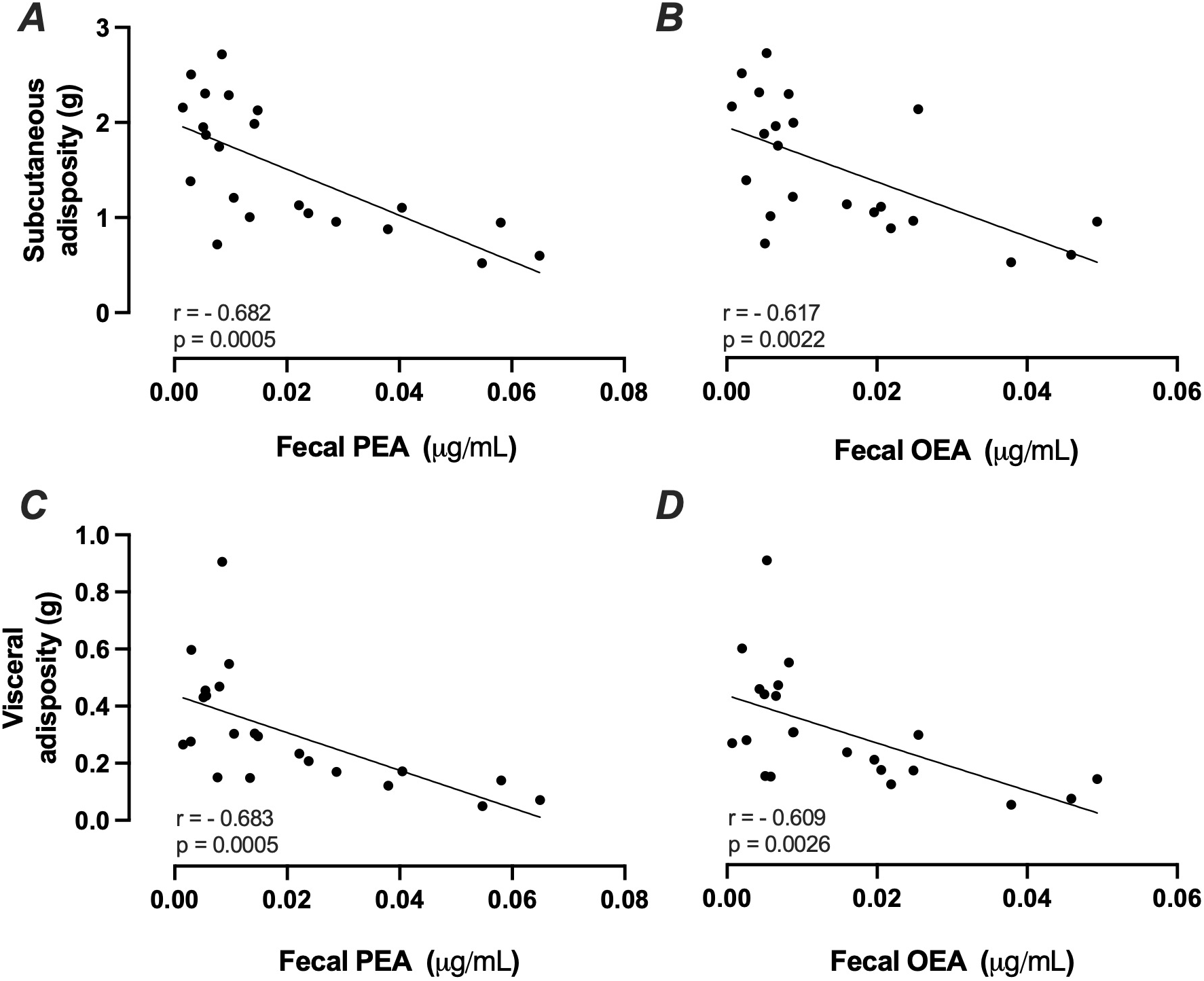
The correlation analysis of offspring adiposity and fecal levels of endocannabinoid-like molecules showed that subcutaneous and visceral adiposity were negatively correlated with PEA (r = −0.68, p = 0.0005; r = −0.68, p = 0.0005, respectively) and OEA (r = −0.61, p = 0.0022; r = −0.61, p = 0.0026, respectively) (Fig. 8).
Spearman correlations between adiposity and fecal levels of endocannabinoid-like molecules of rat offspring at weaning. Palmitoylethanolamide (PEA) and oleoylethanolamide (OEA) were negatively correlated with subcutaneous and visceral adiposity of offspring at weaning. n = 8 offspring from different litters/group.

Discussion
Maternal obesity-induced sex-specific changes in fecal microbiota diversity at weaning
In the present study, we investigated the effect of maternal obesity on the gut microbiota of rat offspring at weaning and explored potential correlations among gut microbial composition, fecal levels of the endocannabinoid-like molecules, PEA, and OEA, and adiposity at early life. Previous studies have reported that maternal high-fat diet decreases alpha diversity and changes beta diversity of the gut microbial community in rodent offspring at weaning. Reference Xie, Sun and Wu13,Reference Zheng, Zhang, Gao, Wu and Zhang14 However, these studies did not investigate sex-specific effects of maternal diet Reference Xie, Sun and Wu13,Reference Zheng, Zhang, Gao, Wu and Zhang14 and only reported outcomes in weanling male offspring. Reference Zheng, Zhang, Gao, Wu and Zhang14 In the present study, we investigated both sexes, and our results partly corroborate previous studies, since we have shown that maternal obesogenic diet changes the beta diversity only in male offspring at weaning but did not alter alpha diversity. The divergent findings between our study and previous investigations could be due to differences between the models, including differences in the fat content of the maternal diet, as we used 39.2% of energy from fat whereas others used 60%; differences in gut microbiota analysis, as we used rectal fecal samples whereas others used cecal feces; and differences in rodent species, as we used rats whereas others used mice. Reference Xie, Sun and Wu13,Reference Zheng, Zhang, Gao, Wu and Zhang14
Previously, we have demonstrated that maternal obesogenic diet induces early obesity in both sexes of rat offspring at weaning. Reference Almeida, Calvino and Reis-Gomes30 In the present study, we show that this early obesity was associated with altered gut microbiota only in male offspring. Interestingly, the early-life gut inflammation has a greater impact on the gut bacterial community in males than females, Reference Sullivan, Sie and Ng47 and we have previously observed increased monocyte chemoattractant protein-1 (Mcp-1) expression in small gut of male weanling offspring. Reference Almeida, Calvino and Reis-Gomes30 On the other hand, human and animal experiments show that maternal prenatal dexamethasone therapy induces abnormal gut microbiota composition in neonate female offspring. Reference Lu, Chen and Xu18 Thus, adverse environmental exposures during early life can differentially affect female and male offspring, which may be caused not only by different circulating levels of sex hormones, not expected before puberty, Reference Almeida, Dias-Rocha and Souza48 but also by differential expression of sex hormone receptors, sex chromosomes, and the sex dimorphism of the placenta, which differentially influence substrate transfer to the fetuses and gut microbiota colonization. Reference Brettle, Tran and Drummond17,Reference Lu, Chen and Xu18
Maternal obesity-induced differential bacterial abundance in male offspring
Maternal obesogenic diet changed the abundance of five ASVs of the phylum Firmicutes in male offspring, including increased abundance of the genus [Clostridium] innocuum group, Lachnospiraceae UCG-010, Flavonifractor and Blautia and decreased abundance of the genus Lachnospiraceae NK4A136. Most of these gut microbiota changes appear to be associated with early obesity induced by the maternal obesogenic diet. Reference Almeida, Calvino and Reis-Gomes30 whereas increased abundance of Flavonifractor and Lachnospiraceae UCG-010 could represent a counter-regulatory gut microbiota response to positive energy balance. For instance, Flavonifractor abundance in gut microbiota has been reported to be inversely associated with visceral fat in humans. Reference Ozato, Yamaguchi and Mori49 Flavonifractor and Lachnospiraceae UCG-010 are major short-chain fatty acid-producing genera, Reference Zhang, Wang and Zhao50,Reference Molino, Lerma-Aguilera, Jimenez-Hernandez, Rufian Henares and Francino51 with butyrate being known to reduce intestinal permeability in humans, Reference Scharf, Forsgard and Prado52 animals and in vitro models. Reference Peng, Li, Green, Holzman and Lin53,Reference Chen, Ran and Li54 Accordingly, we previously demonstrated that maternal obesogenic diet induces early obesity associated with low gut permeability in male offspring. Reference Almeida, Calvino and Reis-Gomes30 which could be related to the increased abundances of Flavonifractor and Lachnospiraceae UCG-010 in the gut microbiota of D males at weaning.
Regarding [Clostridium] innocuum, the findings in the literature are controversial. [Clostridium] innocuum group has already been reported to be associated with decreased body weight gain in adult mice. Reference He, Zhang and Li55 Additionally, other studies have reported that the gut microbiota abundance of the [Clostridium] innocuum group is positively associated with the C-reactive protein, a biomarker of chronic inflammation, in obese children and adolescents. Reference Squillario, Bonaretti and La Valle56 Lachnospiraceae NK4A136 group has been reported at high abundance in the gut microbiota of control mice Reference Wen, Luo and Qiu57 and healthy individuals, Reference Hu, Guo and Mao58 whereas it is depleted in smoker subjects, potentially contributing to post-cessation body weight gain. Reference Duan, Xu and Wang59 Similarly, the low abundance of Lachnospiraceae NK4A136 in gut microbiota of D males could contribute to the early obesity in these animals. Reference Almeida, Calvino and Reis-Gomes30 Accordingly, the elevated abundance of Blautia in the gut microbiota of D males might also contribute to early obesity, since Blautia is increased in stool samples of obese patients with metabolic disorders, Reference Zeng, Li and He60 obese adolescents Reference Nirmalkar, Murugesan and Pizano-Zarate61 and obesity-prone mouse model. Reference Wen, Luo and Qiu57 However, the role of Blautia in host metabolism appears to be ambiguous and context-dependent, Reference Liu, Mao and Gu62 since several studies have also suggested potentially beneficial effects of specific Blautia species or strains, including improvements in obesity, glucose homeostasis, and inflammatory status. Reference Chanda, Jiang and Liu63 For instance, the oral administration of Blautia wexlerae ameliorates obesity and type 2 diabetes via metabolic remodeling of the gut microbiota. Reference Hosomi, Saito and Park64 Dietary Blautia hansenii administration suppresses obesity and improves glucose tolerance in high-fat-diet-induced obesity in a mouse model. Reference Shibata, Ozato and Tsuda65 Therefore, the association between increased Blautia abundance and obesity should be interpreted cautiously, as its metabolic impact may vary according to strain, host background, and dietary context. In the present study, we were unable to resolve Blautia at the species level using 16S rRNA amplicon high-throughput sequencing. This limitation is expected, as 16S-based microbiome profiling often lacks sufficient phylogenetic resolution to discriminate closely related bacterial species; therefore, our data support genus-level, but not species-level, assignment for Blautia, according to previous recommendations. Reference Johnson, Spakowicz and Hong66–Reference Bailen, Bressa, Larrosa and Gonzalez-Soltero68
Bacterial abundances were correlated with fecal levels of PEA and OEA
In the present study, we demonstrated a significant negative correlation between Blautia abundance and fecal PEA content during early life in the offspring. Previously, we showed that a maternal obesogenic diet increases gut expression of Mcp-1 and decreases fecal PEA levels in male offspring at weaning, Reference Almeida, Calvino and Reis-Gomes30 which might be related to the high abundance of Blautia in the gut microbiota. Corroborating our findings, PEA administration to high-fat diet-fed mice decreases Blautia abundance, which is associated with reduced immune cell infiltration in the colon. Reference Pirozzi, Coretti and Opallo20
We also found a negative correlation between fecal PEA level and the abundance of the genus Corynebacterium in the gut microbiota of offspring at weaning, but no differences in Corynebacterium abundance between C and D offspring. Corynebacterium belongs to the phylum Actinobacteriota. Reference Visuthranukul, Sriswasdi and Tepaamorndech69 A decreased abundance of Actinobacteriota, mainly the genus Bifidobacterium, has been reported in stool samples of obese children. Reference Visuthranukul, Sriswasdi and Tepaamorndech69 In contrast, the Corynebacterium genus in human obesity and animal models is poorly investigated. To the best of our knowledge, our study was the first to suggest an interplay between Corynebacterium abundance and fecal PEA levels.
Recently, OEA treatment has been shown to change gut microbiota composition in mice by shifting the Firmicutes-to-Bacteroidota ratio in favor of the Bacteroidota phylum, which has been associated with reduced body weight. Reference Di Paola, Bonechi and Provensi70 Similarly, the phylum Bacteroidota includes the genus Muribaculum, whose fecal abundance was positively correlated with fecal levels of PEA and OEA in the offspring. Therefore, the low fecal PEA and OEA contents in D male offspring Reference Almeida, Calvino and Reis-Gomes30 might be related to the low abundance of Muribaculum, which belongs to Muribaculaceae family, whose abundance of three ASVs was decreased in D male offspring. We speculate that low Muribaculaceae abundance in the gut microbiota of D males could contribute to the early obesity, since Muribaculaceae has been reported in higher abundance in gut microbiota of control diet-fed mice, Reference Pirozzi, Coretti and Opallo20,Reference Wen, Luo and Qiu57 low fat-low sucrose diet-fed mice Reference Agudelo, Leblanc and Bourdeau-Julien71 and obesity-resistance mouse model. Reference Cao, Chin and Chen72
In addition, the maternal obesogenic diet decreased Mucispirillum abundance in the gut microbiota of male offspring at weaning. This reduction could also contribute to early obesity, since higher Mucispirillum abundance has been reported in obesity-resistant mice. Reference Wen, Luo and Qiu57 Mucispirillum is the only genus of the Deferribacterota phylum known to inhabit the vertebrate gastrointestinal tract, and its altered abundance has been associated with inflammation and disease. Reference Herp, Durai Raj, Salvado Silva, Woelfel and Stecher73 Gut pro-inflammatory cytokines have been negatively associated with Mucispirillum abundance in mice. Reference Kim, Lee and An74 Similarly, the decreased abundance of Mucispirillum in the gut microbiota of D males could be related to the increased gut expression of Mcp-1 previously demonstrated in these animals. Reference Almeida, Calvino and Reis-Gomes30 Furthermore, the low Mucispirillum abundance could be related to reduced fecal levels of PEA and OEA, Reference Almeida, Calvino and Reis-Gomes30 since in the present study we demonstrated that Mucispirillum abundance was positively correlated with fecal PEA and OEA contents.
The interplay between the gut microbiota and endocannabinoid-like molecules has emerged as a potent regulatory system of the host energy metabolism and inflammation. Reference De Filippo, Costa, Becagli, Monroy, Provensi and Passani27 PEA and OEA could modify the intestinal environment and the ecological fitness of the bacterial community, promoting survival of specific bacterial groups. Reference De Filippo, Costa, Becagli, Monroy, Provensi and Passani27 Meanwhile, certain gut bacteria could indirectly contribute to the production of endocannabinoid-like molecules by supplying lipid precursors, modulating host enzyme expression and regulating signals that control their synthesis. Reference Pirozzi, Coretti and Opallo20,Reference Di Paola, Bonechi and Provensi70,Reference Dohnalova, Lundgren and Carty75
Fecal levels of PEA and OEA showed a negative correlation with adiposity
Studies in humans and animal models have shown that enhancing endogenous PEA and OEA synthesis could represent a new therapeutic strategy to improve gut-barrier function and treat obesity and inflammatory disorders. Reference Pirozzi, Coretti and Opallo20,Reference Di Paola, Bonechi and Provensi70,Reference Batacan, Briskey, Bajagai, Smith, Stanley and Rao76 For instance, PEA and OEA treatments reduce body weight and colonic immune cell infiltration in mice. Reference Pirozzi, Coretti and Opallo20,Reference Di Paola, Bonechi and Provensi70
For the best of our knowledge, the present study has shown for the first time a significant negative correlation between the fecal PEA and OEA levels and adiposity of offspring in early life. Our findings suggest that reduced fecal PEA and OEA contribute to early obesity and could reflect the biological mechanism by which gut microbiota impacts adiposity. In contrast to our finding, fecal PEA is positively correlated with total and visceral adiposity in humans at adulthood. Reference Castonguay-Paradis, Parent and St-Arnaud33 Further investigations exploring whether correlations between fecal endocannabinoids and adiposity are age-specific and/or species-dependent could provide fecal biomarkers based on the eCBome for obesity development.
The main limitation of the present study is the lack of investigation into mechanisms by which gut microbiota changes might contribute to reduced fecal levels of PEA and OEA in male offspring born to obese dams. It was not possible to identify correlations among gut metabolomics, microbiota, and endocannabinoidome. The findings presented are descriptive and do not indicate causality. Finally, further investigation of molecular mechanisms underlying the effect of maternal obesity on sex-specific gut microbiota changes in the offspring before puberty is desired.
Conclusion
In conclusion, our study showed for the first time that maternal obesity induced sex-specific gut microbiota changes associated with reduced fecal levels of PEA and OEA in offspring at weaning (Fig. 9). Maternal obesity altered gut microbiota beta diversity only in male offspring, characterized by higher Blautia abundance and lower Mucispirillum and Muribaculaceae abundances than control males. In male offspring born to obese dams, gut microbiota changes could contribute to reduced fecal levels of PEA and OEA, since Blautia abundance was negatively correlated, whereas Mucispirillum and Muribaculum, which belongs to Muribaculaceae family, abundances were positively correlated with fecal levels of PEA and OEA. Interestingly, maternal obesity reduces fecal PEA and OEA contents, which were negatively correlated with offspring adiposity, suggesting the involvement of the gut endocannabinoidome signaling in the regulation of energy balance in early life. Fecal endocannabinoids could reflect the biological mechanism by which gut microbiota impacts adiposity in early life. Overall, the present study stimulates future investigation aimed to assessing whether probiotics and/or prebiotics capable of restoring gut microbiota changes and fecal levels of PEA and OEA in male offspring born to obese dams could reprogram early obesity and glycemic impairment induced by maternal obesity. Our findings provide molecular insights into the sex-specific crosstalk between gut microbiota and fecal endocannabinoidome underlying intergenerational metabolic disorders.
Graphical abstract. Our results showed that maternal obesity induced by obesogenic diet altered gut microbiota beta diversity only in male offspring at weaning, mainly characterized by higher Blautia abundance and lower Mucispirillum abundance than males born to control diet-fed dams. These changes could contribute to reduced fecal levels of endocannabinoid-like molecules, palmitoylethanolamide (PEA) and oleoylethanolamide (OEA), since Blautia abundance was negatively correlated, whereas Mucispirillum abundance was positively correlated with fecal PEA and OEA levels. Maternal obesity reduces fecal PEA and OEA contents, which were negatively correlated with offspring adiposity, suggesting the involvement of the gut endocannabinoidome signaling in the regulation of energy balance in early life. Created in https://BioRender.com.

Supplementary material
The supplementary material for this article can be found at https://doi.org/10.1017/S2040174426100865.
Acknowledgments
We thank the technical support of Juliana Pena Gonçalves from Laboratory of Molecular Endocrinology, Carlos Chagas Filho Biophysics Institute, Federal University of Rio de Janeiro, Rio de Janeiro, Brazil.
Financial support
This work was funded by the Research Support Foundation of the State of Rio de Janeiro (FAPERJ; Grants IHT.: E-26/202.668/2018; E-26/201.103/2019; E-26/200.366/2023; E-26/210.010/2024; Grants CCPM.: E-26/210.023/2020; E-26/202.800/2018) and by the Nacional Council for Scientific and Technological Development (CNPq; Grant IHT. 403,339/2021-9). MMA was recipient of postdoctoral fellowships from FAPERJ (E-26/202.029/2020); Coordenação de Aperfeiçoamento de Pessoal de Nível Superior - Brasil (CAPES) – Finance Code 001; The Research Support Foundation of the State of Minas Gerais (FAPEMIG; Grants SCPDL.: APQ-02397-21 TVA.: APQ-01327-24). Nacional Council for Scientific and Technological Development (CNPq) National Institute of Science and Technology (INCT) in DOHaD 409,165/2024-7.
Competing interests
None.
Ethical standard
The authors assert that all procedures contributing to this work comply with the ethical standards of the relevant national guides on the care and use of laboratory animals (National Council for Control of Animal Experimentation) and has been approved by the Animal Care and Use Committee of the Health Science Center of the Federal University of Rio de Janeiro (process number 129/21).