I. INTRODUCTION
Fine grained bioceramics, and more specifically β-tricalcium phosphate (β-TCP) or whitlockite substituted with magnesium (TCMP), as biocompatible and bioresorbabale materials Reference Tardei, Grigore, Pasuk and Stoleriu1 are becoming important in biomaterial research. Reference Dorozhkin2,Reference Veljović, Zalite, Palcevskis, Smiciklas, Petrović and Janaćković3 Their properties can be further improved by synthesizing powders with optimal characteristics as well as accelerated sintering. Reference Dorozhkin2 The broad focus of this paper is on microwave sintering of calcium magnesium phosphate compounds.
Calcium phosphates are well established in orthopedic applications. An important motivation for widespread research and development is their similarity to the bone mineral. From an historical viewpoint, an important step toward proving their utility into biomedical applications is performing research in characterizing dense products. Over the last several decades, calcium phosphates have been used in many different forms such as coatings and self-setting cements. With the advent of nanotechnology, there is an enhanced need for well-characterized materials with well-defined micro/nanostructures. Finally, calcium phosphates are encountered in many applications with different monovalent, divalent, trivalent dopants/substitutions. Reference Tõnsuaadu, Gross, Plūduma and Veiderma4 To get a clear understanding of the behavior of these materials, it is important to produce highly dense sintered materials as benchmarks. All of the aforementioned considerations led to the recent publication of a comprehensive review on the matter, Reference Champion5 which justifies the broad theme of the paper.
Microwave sintering is acknowledged to be quite effective in maintaining finegrains/nanograins in sintered bioceramics due to the high heating rates throughout the volume of the sample and the very efficient transfer of energy as reported by our group and others. Reference Ramesh, Tan, Bhaduri and Teng6–Reference Mousa9 In microwave technique, the heat is generated internally within the material, rather than via radiative heat transfer from an external heat source. Reference Ramesh, Tan, Bhaduri and Teng6 The extent of sintering depends on factors such as green density and chemical composition (i.e., Ca:P ratios, crystallinity, porosity, particle size, and surface area) of the sample. For instance, it is found that the sinterability and densification enhances with greater surface area of powder precursor. Reference Veljović, Zalite, Palcevskis, Smiciklas, Petrović and Janaćković3,Reference Layrolle, Ito and Tateishi8,Reference Ramesh, Tan, Bhaduri, Teng and Sopyan10
This paper has several interesting signatures as noted below. Reference Staiger, Pietak, Huadmai and Dias11–Reference Hanifi, Fathi, Sadeghi and Varshosaz14 First, it is well known that Mg is a prevalent element in the mammalian body. In fact, Mg is the fourth most abundant element after sodium, potassium, and calcium. Thus, incorporating substantial amount (also known as a substitution) of Mg in the calcium phosphate (Ca–P) lattice is not expected to be harmful. Second, Mg being in the same period as Ca (alkaline earth) in the periodic table, there is a good possibility that Mg substitution can take place into the Ca–P lattice, especially in the TCP lattice. Third, it is expected that there would be a saturation limit of substitution and beyond that Mg–P phase(s) would form, thereby creating a new type of biphasic structure consisting of Ca–P and Mg–P compounds.
It is important to note that technically important Mg–P phases are slightly different from those in the Ca–P system. For example, important phases for orthopedic application include dimagnesium phosphate trihydrate (newberyite, MgHPO4·3H2O), dimagnesium ammonium phosphate hexahydrate (struvite, MgMH4PO4·6H2O). Anhydrous phases include magnesium pyrophosphate (Mg2P2O7) and magnesium orthophosphate (Mg3(PO4)2). It is not known a priori how effective microwave sintering is in densifying Mg–P and Mg substituted TCP. Present results will report the proof-of-concept. Finally, amorphous powder will be microwave sintered without significant grain growth.
Conventionally, TCMP powders are synthesized via precipitation from an aqueous solution and solid-state reaction. Reference Tardei, Grigore, Pasuk and Stoleriu1,Reference Cacciotti and Bianco15 Calcination, grinding, and sieving, followed by sintering at high temperatures (conventional sintering) are used to produce a dense TCP or TCMP bioceramic with a controlled microstructure and phase composition from precipitated powder precursor. Reference Kannan, Lemos, Rocha and Ferreira16 Brittleness and insufficient densification after conventional sintering limit its use to non-load-bearing applications. Reference Enderle, Götz-Neunhoeffer, Göbbels, Müller and Greil17 As mentioned before, to the best of our knowledge, microwave sintering of TCMP from amorphous powder precursor has not been reported yet. We have reported the precipitation of amorphous TCMP using ethanol in the precipitation medium. Reference Babaie, Zhou, Lin and Bhaduri18 In this process, the formation of amorphous calcium phosphate substituted with magnesium with controlled chemical compositions occurs, because of the lower solvation effect in ethanol than in water. Reference Babaie, Zhou, Lin and Bhaduri18 When ethanol is the solvent, the intermediate AMCP precipitates remain unchanged, Reference Layrolle, Ito and Tateishi8 showing neither grain growth from nanocrystalline size nor transformation into apatitic tricalcium phosphate which necessitates a calcination step before sintering. Reference Zhang, Jiang, Groth and Vecchio19 Simultaneously, introducing magnesium into amorphous calcium phosphate precursor stabilizes the low temperature β-TCP phase by solid solution formation. The presence of magnesium coupled with the use of microwave inhibits the grain growth, Reference Marchi, Dantas, Greil, Bressiani, Bressiani and Müller20 leading to the formation of ultrafine grained or bimodal size distribution of resultant bioceramic with improved mechanical properties. Reference Ryu, Hong, Lee, Kim, Lee, Chang, Lee, Lee and Chung21,Reference Kalita and Bhatt22
The focus of the present work is to produce dense fine grained β-TCP substituted with magnesium via microwave sintering technique from amorphous powder precursor. The resultant material was studied in terms of structural information, chemical compositions, microstructures, hardness, and toughness properties. Additionally, different ratios of magnesium versus calcium in the precursor composition of magnesium–calcium phosphate (MCP) was selected and its effect on microstructure evolution on sintered CaP, MgP, and TCMP was evaluated. From our previous work, Reference Ramesh, Tan, Bhaduri and Teng6 the sintering temperature was selected at 1150 °C to protect against any possible phase transformation and excess grain growth.
II. MATERIALS AND METHODS
A. Synthesis of powders
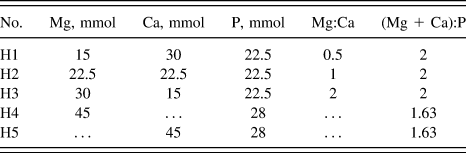
In the present work, the amorphous magnesium–calcium phosphate (AMCP), MgP, and hydroxyapatite (HA) powder were prepared according to a precipitation method using ethanol media. Reference Babaie, Zhou, Lin and Bhaduri18 Table I represents the composition of the powders. Solutions containing different concentrations of calcium nitrate tetrahydrate [Ca(NO3)2·4H2O] and magnesium nitrate hexahydrate [Mg(NO3)2·6H2O] in 100 mL of deionized water and 100 mL of ethanol, were added rapidly, at 37 °C under stirring, to a solution containing diammonium hydrogen phosphate [(NH4)2HPO4] in 250 mL of deionized water, 45 mL of ammonia (11 M), and 295 mL of ethanol (pH = 10.3). After the formation, the precipitates were immediately centrifuged. The as-prepared materials were dried in an oven at 80 °C for 15 h.
Composition of powders.

B. Sintering and consolidation of pellets
Powders were pressed to form compacted pellets prior microwave sintering. 1 g of each powder sample was put into a 1 cm diameter cylindrical steel die and pressed using a uniaxial hydraulic press at 10 ksi for 3 min. The compacted pellets were sintered in a semi-industrial grade microwave furnace (Microwave Materials Technology, M.M.T. Knoxville, Tennessee) with a variable power magnetron. For the sintering process, samples were placed between two self-heating, microwave susceptors to promote heat generation. The susceptors were made of silicon carbide and separated from the MCP samples to prevent chemical interactions using 5 mm thickness alumina plates (AdValue Technology, Tucson, Arizona). The assembly was then insulated with alumina fiber blankets. The assembled samples were placed in the microwave furnace and heated using manual power control until the internal pellet temperature reached 1150 °C. Sample temperatures were monitored optically with a high temperature pyrometer (Mikron M77LS, Mikron Corp, Oakland, New Jersey) with a minimum threshold of 900 °C; therefore early heating data and complete cooling data could not be obtained. All samples were heated at 1150 °C for about 20 min, after which they were allowed to cool to room temperature. Reference Wagner, Jones, Zhou and Bhaduri23
C. Characterization
Samples of powders and sintered compacts were characterized using X-ray diffraction (XRD; Ultima III, Rigaku, Woodlands, Texas) and scanning electron microscope (SEM; S-4800, Hitachi, Tokyo, Japan). The XRD spectra of the powders were obtained using monochromated Cu Kα radiation generated with a voltage of 40 kV and current of 44 mA over a 2θ range of 10–45 with a step width of 0.02 and a speed of 1°/min. All corresponding peaks were identified using Jade™ (Materials Data Inc., Livermore, California) software and labeled. Reference Wagner, Jones, Zhou and Bhaduri23 The morphological features of precipitates were studied using a SEM at 10 kV voltage, and all samples were gold coated for about 30 s before the SEM. The grain size of sintered polycrystalline specimens was determined from SEM micrographs using image J (developed at the National Institutes of Health). More than 100 grains were counted to obtain an average value of grain size. The bulk densities of sintered samples were measured by the gas pycnometer (Micromeritics, AccuPuc 1330, Norcross, Georgia) method. The microhardness (H v) of the samples was determined using the Vickers indentation method. The indentation load (<200 g) was applied and held in place for 10 s. All samples were mounted in epoxy and polished afterward. Ten indentations were made for each sample and the average value is reported. The indentation fracture toughness was determined from the Niihara equation Reference Niihara24 :
 $${K_{{\rm{Ic}}}} = 0.203{\left( {{c \over a}} \right)^{ - 1.5}}\left( {{H_{\rm{v}}}} \right){a^{0.5}}\quad ,$$
where H v is the Vickers hardness, a the half diagonal of the indentation, c the radial crack dimension measured from the center of the indent impression, i.e., c = L + a and L is the crack length. The results were statistically analyzing using one-way ANOVA. Results are expressed as mean±standard deviation. P-values less than 0.05 were considered statistically significant.
III. RESULTS AND DISCUSSION
A. XRD results of sintered powder specimens
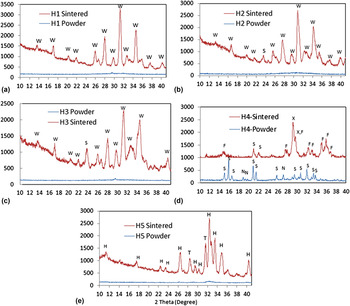
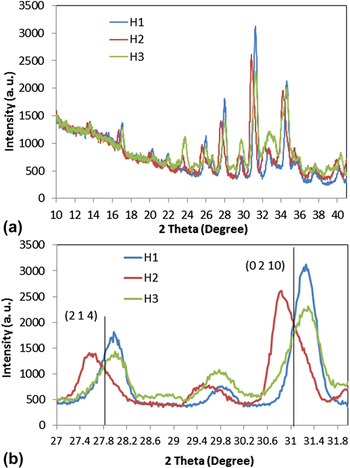
All precursor powders were synthesized through precipitation technique using ethanol as the precipitation medium. Samples of H1, H2, H3, and H5 were amorphous. However, the sample of H4 (MgP) showed the crystalline structure due to difficulty in retaining MgP in stable amorphous phase. Microwave sintering was used to facilitate the densification of all compositions. XRD results of all sintered samples are presented in Figs. 1(a)–1(e). As shown in Fig. 1, all powders transformed into highly crystalline phases upon microwave exposure. Sintered compacts of MCP (compositions H1, H2, and H3) are solid solutions of whitlockite (β-T (Ca, Mg) P) substituted with Mg ((Ca1−x Mg x )3(PO4)2) [Figs. 1(a)–1(c)]. Figure 2 illustrates the effect of different Mg2+ concentrations on crystallinity, and shift in 2θ. Due to the substitution by Mg2+ on Ca2+ sites in the β-TCP structure, the peak positions and intensities changed. For example, the peaks shifted to lower 2θ for TCMP H2 compared to TCMP H1. Additionally, for the sintered compacts of TCMP (H2 and H3), Mg2+ was incorporated into the β-TCP structure, and the secondary phase of stanfieldit (CaMg)3(PO4)2 could also be detected, as reported in the literature. Reference Enderle, Götz-Neunhoeffer, Göbbels, Müller and Greil17 The intensities of characteristic peaks of Stanfieldit in H2 and H3 increased with Mg2+ content (Fig. 2, H2, H3). This suggests that higher Mg concentration in H3 than Ca (Mg: Ca: 2:1) (Table I) reaches a maximum possible solubility of Mg in TCP as it occurred for H2, and results in the formation of more secondary phase of stanfieldit. This decreased purity of TCMP phase for H3 and caused shifting toward higher 2θ for H3 compared to H2 [Figs. 2(a) and 2(b)].
(a–c) X-ray pattern of β-T(Ca, Mg) P (whitlockite incorporated with different mol% Mg2+) and the secondary phase stanfieldit [(CaMg)3 (PO4)2], peaks W represent whitlockite, peaks S represent standfieldit. (d) X-ray pattern of sintered MgP, peaks S represents struvite, peaks with N represent newberyite, peaks F with represent trimagnesium bis (phosphate (v)), and peaks with Χ represents Mg2P2O7. (e) X-ray pattern of HA/β-TCP, peaks H represent HA and peaks T represent β-TCP.

(a and b) Shift of peak positions of the β-T (Ca, P) (PDF#97-009-7500) due to the emplacement of Mg2+ into the β-TCP structure resulted in a change in lattice parameters.

It is reported in the literature that Ca2+ can be replaced by Mg2+ only on Ca (4) and Ca (5) sites in the β-TCP structure. Reference Enderle, Götz-Neunhoeffer, Göbbels, Müller and Greil17 Mg2+ is preferably replaced on the Ca (5) site first, leading to the shifting of peaks toward higher 2θ (Fig. 2, H1). Then, Mg+2 would substitute Ca2+ on Ca (4) sites after a Ca (5) site is completely occupied, and replacement continues until maximum substitution is attained. This results in shifting of peaks to lower 2θ (Fig. 2, H2). Besides, the gradual decrease of crystallinity is one of the indications that suggest increased substitution level of Mg in β-T (Ca, Mg) P structure. This is manifested by the decreased intensity of XRD peaks of H2 specimen compared to H1 (Fig. 2). Lower crystallinity in H3 can also be explained by the increased level of structural disorder due to substitution of much smaller ions like Mg2+. Reference Ren, Leng, Xin and Ge25
As indicated in Fig. 1(e), the H5 (no Mg content) compacts underwent phase transformation/decomposition during microwave sintering and thus generating a biphasic composition of HA/TCP (Ca3(PO4)2). This phenomenon is well known in the literature when the sintering temperature is above 960 °C.
Reference Wagner, Jones, Zhou and Bhaduri23,Reference Cacciotti, Bianco, Lombardi and Montanaro26
Also from Fig. 1(d), it is seen that biphasic MgP compact (H4) of struvite and newberyite formed new phases of Mg3(PO4)2 (Trimagnesium Bis (phosphate (v))) and Mg2P2O7 upon microwave sintering. This is a new biphasic material in the Mg–P system drawing the analogy to its Ca–P counterpart, and yet quite unique and different in composition. Since H4 powder was prepared in an alcoholic medium [Fig. 1(d), H4 powder], it contains many strongly bound water molecules. The water molecules could react directly with
 ${\rm{PO}}_4^{3 - }$
ions based on the reaction (i)
 $2{\rm{PO}}_4^{3 - } + {{\rm{H}}_2}{\rm{O}} \to {{\rm{P}}_2}{\rm{O}}_7^{4 - } + 2{\rm{O}}{{\rm{H}}^ - }$
. However, above 600 °C, the pyrophosphate would react with OH− according to the reaction (ii)
 ${{\rm{P}}_2}{\rm{O}}_7^{4 - } + 2{\rm{O}}{{\rm{H}}^ - } \to 2{\rm{PO}}_4^{3 - } + {{\rm{H}}_2}{\rm{O}}$
. This reaction happened fast and it led to abrupt decrease in pyrophosphate level after 600 °C. However, for the sample prepared in alcoholic medium, the decrease of the pyrophosphate level above 600 °C was slower compared to aqueous medium. At 900 °C, the pyrophosphate content should be very small because the additional pyrophosphate reacts with its associated OH− ions.
Reference Rodrigues and Lebugle27
Magnesium ions are usually in the hydrated form (Mg2+(H2O)
n
),
Reference Ren, Leng, Xin and Ge25
and dehydration needs to occur before incorporation into the crystalline structure of a resultant sintered product. Thus, the high affinity of Mg2+ ions to water, led to the formation of Mg2P2O7 phase in the sintered MgP material [Fig. 1(d)] along with other phases of Mg3(PO4)2. The same mechanism of water molecules leaving [reaction (ii)] also occurs to whitlockite.
Reference Rodrigues and Lebugle27
B. Microstructural evolution and grain size
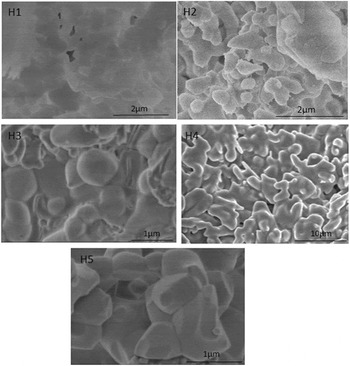
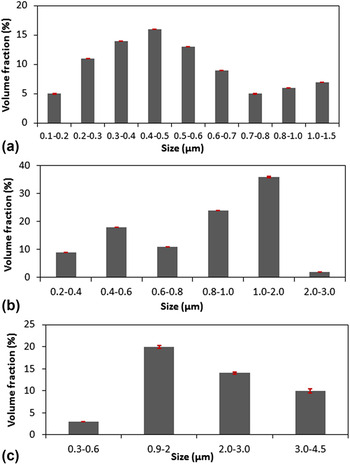
The microstructure of samples sintered at 1150 °C is shown in Fig. 3. It demonstrates the variability in surface features like porosity and grain size. The microstructures of sintered TCMP of H1, H2, and H3 are similar, except in their respective particle sizes. As Mg content increased, the size of the particles increased in TCMP and the particles became more irregular. Additionally, the sintering schedule for microwave processing and the ratio of Mg:Ca did not promote any extensive grain growth in TCMP. Smaller grain size would normally result in enhanced mechanical properties. It has been found that nanotopographical features like nanopores in scaffolds can also suit the cellular attachment and proliferation like microspores one. Reference Wagner, Jones, Zhou and Bhaduri23 The average particle sizes (from SEM images) in the sintered sample of H1, H2, and H3 are shown in Figs. 4(a)–4(c). Grain size distribution of H4 and H5 demonstrate range of 4–14 µm (average value of 8.5 µm) and 1–5 µm (average of 2.66 µm), respectively.
Microstructural evolution of β-T(Ca, Mg) P (H1, H2, H3), MgP sintered (H4), and HA/β-T(Ca, P) (H5) when sintered at 1150 °C.

Average particle size of β-T (Ca, Mg) P of (a) H1 with an average size of 0.6 µm, (b) H2 with an average size of 0.9 µm, and (c) of H3 with an average size of 2.2 µm. (P < 0.005) statistically significant difference between the average grain size of optimum sample of H2 with the rest of samples based on Student's t-test (P < 0.005).

The grain size distribution of sintered TCMP of H1, H2 and H3 showed a bimodal distribution. For example, nanoparticles of H1 started off 100 nm and reached 1.5 µm [Fig. 4(a), H1]. Meanwhile, the size of particles in H2 and H3 shifted to higher values compared to H1 [Figs. 4(a)–4(c)]. It has been reported that during transformation into β-TCP, Reference Marchi, Dantas, Greil, Bressiani, Bressiani and Müller20 particle size of as-synthesized powders first decreases to a minimum value due to de-agglomeration at a temperature of 750 °C. This happens due to loss of water molecules. At temperatures above that, the particle size increases by grain coarsening because of the initial sintering effects. Particles start to coalesce with subsequent neck growth at junction points and eventual loss of porosity. At a temperature of 1150 °C, particles are already sintered. As reported here, particle size increased with increasing magnesium content. This suggests that the presence of Mg might be responsible for the acceleration of the sintering process to the lower temperature. As a consequence of more particles getting fused together, the particle size is increased. Thus, as shown for H4 sintered compact (Fig. 3), particles are extensively fused, and the maximum particle size was obtained compared to the rest of sintered specimens.
C. Bulk density
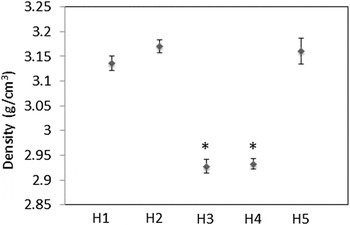
The effects of sintering on the densification of compacts are shown in Fig. 5. For instance, a sintered density of 3.12 g/cc, equivalent to 97% of the theoretical density in nano-HA specimens sintered at 1300 °C was reported in the literature for use in tissue engineering applications, which is very close to the density of HA/TCP of H4 in our sample. Reference Kalita and Bhatt22 Incorporation of Mg into β-T(Ca, P) resulted in a higher density of TCMP in H1 and H2 than the rest of the samples, which is likely due to bimodal distribution of particles. Indeed, bimodal distribution in TCMP probably resulted in marginal improvement and enhanced the densification of TCMP than HA/TCP and MgP. However, smaller grain size in H1 left more residual nanopores at grain boundaries, presenting lower sintered bulk density than H2. It was shown that an increase in the amount of Mg in TCMP of H3 decreased the sintered density compared to H1 and H2. This phenomen can be attributed to the secondary phase formation of Stanfieldit (referring to Fig. 1, H3). The presence of secondary phase prevents further densification during sintering. It acts as a limiting factor in diffusion phenomena in which particles coalescence at a lower temperature. Reference Veljović, Zalite, Palcevskis, Smiciklas, Petrović and Janaćković3 Another indication of lesser extent of densification is the lesser presence of crystalline phase that occurred for H3. Increasing Mg content in H3 produces a more disordered structure or less crystalline phase in H3 compared to H1 and H2 (Figs. 1 and 2, H3). This negatively affects the marginal improvement and the following densification process during sintering.
Density variation of β-T (Ca, Mg) P with different Mg contents (H1, H2, H3), MgP (H4), and HA/TCP (H5) when sintered at 1150 °C. *Statistically significant difference between the optimum sample of H2 with H3 and H4 based on Student's t-test (P < 0.005).

Taking into consideration the attained densities based on the total time of sintering (20 min), the beneficial effect of microwave heating in promoting densification can be appreciated. During solid state sintering of ceramics, transfer of matter from the bulk volume between particles happens via diffusion process. This causes elimination of pores and the following densification. Thus, higher density can suggest that diffusion process was substantially faster during the microwave sintering.
In general, during microwave sintering, the internal field generated by microwave penetration and propagation through dielectric materials induces translational motions. This translational motion occurs between free and bound charges and, rotates charge complexes such as dipoles. However, the electric field would gradually be weakened as a result of inertia, elastic, and frictional forces. The outcome of these losses is volumetric heat generated through the matter. Reference Ramesh, Tan, Bhaduri, Teng and Sopyan10 These principles are also applicable in all the specimens presented in this work.
D. Microhardness and fracture toughness
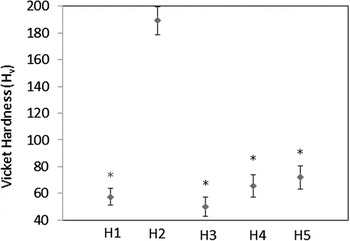
The Vickers hardness of sintered MgP, HA/TCP and effect of Mg:Ca ratios on MCP sintered by microwave technique is shown in Fig. 6. The hardness in TCMP specimens initially increases with increasing Mg content and peaked at a certain value and then decreases by further increasing of Mg (Fig. 6, H1, H2, and H3). Highest hardness value, which was measured for H2 specimen, is due to bimodal size distribution and higher density compared to the rest of specimens. This result corresponds well with the literature that adding a dopant of MgO increases the microhardness of CaP like HA/TCP to about 3 folds. Reference Ryu, Hong, Lee, Kim, Lee, Chang, Lee, Lee and Chung21 The average hardness value of around 80 H v is reported for β-TCP sintered at 1100 °C. However, the average value increases to >150 H v by increasing sintering temperature to 1200 °C. This suggests that the TCMP of H2 can be promising implant in bone substitution. Reference Hesaraki, Safari and Shokrgozar28
Average Vicker hardness variation of β-T(Ca, Mg) P with different Mg contents (H1, H2, H3), MgP (H4), and HA/TCP (H5). *Statistically significant difference between the optimum sample of H2 with the rest of samples based on Student's t-test (P < 0.005).

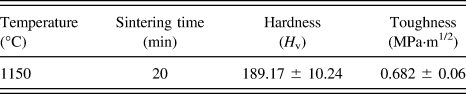
The amount of fracture toughness (K Ic) of microwave sintered TCMP of H2 which showed the highest hardness was measured and shown in Table II. The fracture toughness of about 0.45 MPa·m1/2 was reported for β-TCP and β-TCP/bioglass sintered at 1200 °C. Reference Hesaraki, Safari and Shokrgozar28 The amount of 0.68 MPa·m1/2 obtained in the present work for TCMP was encouraging. The improvement in fracture toughness in the present TCMP could be attributed to both the improved properties of the synthesized powder as well as the improved sinterability with limited grain growth during microwave sintering. The type of crack propagation in our microwave sintered microstructure for all samples were found to be intergranular in which the major contribution to crack resistance is related to the passage of the cracks through the grain boundaries. However, it is reported that the ceramic sintered at high temperature (conventional sintering) shows transgranular fracture toughness. Reference Veljović, Zalite, Palcevskis, Smiciklas, Petrović and Janaćković3,Reference Ryu, Hong, Lee, Kim, Lee, Chang, Lee, Lee and Chung21
Processing conditions and mechanical properties of microwave processed TCMP of H2.

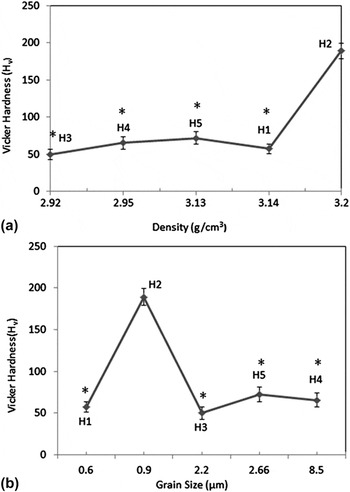
The relationship between hardness and density is indicated in Fig. 7(a). Increase in density for TCMP of H1, H2, and H3 reflected in improved hardness properties. It was seen that sintering via microwave with shorter time inhibits extensive grain growth. Reference Veljović, Zalite, Palcevskis, Smiciklas, Petrović and Janaćković3 For Mg-substituted TCP ceramic, bimodal grain distribution which is a result of the migration of Mg to regions near the grain boundaries provides resistance to cracking. Smaller grain size improves energy dissipation during indentation. Reference Tan, Yaghoubi, Ramesh, Adzila, Purbolaksono, Hassan and Kutty29 Therefore, it appears that the bimodal structure with smaller grain size increased the grain-boundary area and mechanical properties. As can be noted from Fig. 7(b), regardless of different crystalline structure of samples, dependence of hardness with grain size is in agreement with the literature that hardness initially increases with grain size and reached a maximum value at a certain grain size limit and thereafter decreases with further increasing grain size. Reference Ramesh, Tan, Bhaduri, Teng and Sopyan10,Reference Kalita, Bhardwaj and Bhatt30,Reference Laasri, Taha, Laghzizil, Hlil and Chevalier31 So that the highest hardness value for H2 can be explained to the unique bimodal microstructure as well as the highest sintering density. The hardness value for H4 and H5 is nearly similar, emphasizing the potential application of MgP bioceramic as the same as CaP biomaterial.
Variations in hardness with (a) sintered density, (b) the grain size. *Statistically significant difference between the hardness value of optimum sample of H2 with the rest of samples based on Student's t-test (P < 0.005).

IV. CONCLUSION
This paper, for the first time, demonstrates successful densification of magnesium phosphate and AMCP precursors via microwave sintering. The results indicate that initial magnesium to calcium ratio controls single and multiple phase formation in final β-TCP structure due to altering the magnesium substitution amount in β-TCP structure. Magnesium substitution up to the certain amount into the TCP lattice improved mechanical properties and the densification process. Increasing magnesium concentration also accelerates the sintering process by decreasing the initial sintering temperature, leading to increasing particle size for TCMP and MgP. There is a correlation between hardness and bulk density among the all specimens, and hardness increased due to enhanced densification. The TCMP bioceramic showed improved mechanical properties than MgP and CaP sintered ceramics with potential orthopedic uses.