Scholars attribute the politicisation of IndigenousFootnote 1 identities in the Americas to a resurgence of primordial ties,Footnote 2 transnational support networks,Footnote 3 and a neoliberal shift in state policies coupled with the opening of political associational space.Footnote 4 In this article we examine the rise of Indigenous identity politics in Thailand, where transnational support networks and the opening of political associational space have facilitated the growth of an Indigenous movement since the 1980s.Footnote 5 Moreover, in ways distinct from yet similar to the Americas, Indigenous Peoples in Thailand are simultaneously asserting their compatibility with the nationFootnote 6 and their cultural distinctiveness.Footnote 7
Although ethnic difference and associated processes of racialisation have long been evident in Thailand,Footnote 8 the differentiation of people based on Indigeneity is more recent. While the concept of ‘Indigenous Peoples’ — in the sense of recognising ‘first peoples’ — has a longer history in the Americas, Australia and New Zealand, it was not recognised by any government in Asia until the mid-1990s. Most national governments in Asia adhere to the ‘salt water theory’, which stipulates that while the concept of Indigeneity is valid in cases of widespread European settler colonisation, it does not apply for most of Asia, since all Asians can be considered Indigenous to Asia.Footnote 9
Although many Asian governments continue to reject the concept of Indigeneity, it is, nonetheless, becoming increasingly recognised in Asia.Footnote 10 It has been officially adopted by governments in Taiwan (Republic of China), the Philippines, Cambodia, Nepal, and Japan, although to varying degrees.Footnote 11 There have also been efforts to bring about recognition in other Asian countries including Thailand,Footnote 12 although so far unsuccessfully.Footnote 13
The term Indigenous has a long history of use in Southeast Asia, but in the past European colonisers applied it to differentiate between themselves and colonised Asians, and later to separate Europeans and Asians, with the exception of early twentieth century immigrants from other parts of Asia.Footnote 14 More recently the concept of Indigeneity has become associated with ethnic differences amongst Asians. While initially linked to first or original peoples, the United Nations and various nongovernmental organisations (NGOs) have, since the late 1980s, lobbied for a new concept of Indigeneity, one that identifies Indigenous Peoples not only as first peoples, but as colonised or oppressed peoples.Footnote 15 According to the former director of the International Work Group for Indigenous Affairs (IWGIA), Andrew Gray, Indigenous Peoples refers to:
the quality of a people relating their identity to a particular area and distinguishing them from other, ‘alien’ people who came to the territory subsequently. These indigenous peoples are ‘colonized’ in the sense of being disadvantaged and discriminated against. Their right to self-determination is their way of overcoming their obstacles.Footnote 16
This new concept of Indigeneity is associated with self-determination, and the readjusting of power relations and material advantages through providing particular rights and resources to colonised peoples, regardless of where they live, or how long they have lived there.Footnote 17 This makes it possible for relatively recent migrants, such as the Hmong in Thailand, to claim to be Indigenous since they can argue that they have long been colonised, including in China, before having to flee to Vietnam, Laos, and eventually Thailand less than two hundred years ago. Crucially, the United Nations Permanent Forum on Indigenous Issues (UNPFII), which convenes each May in New York, does not have a particular definition of Indigenous Peoples. Instead, self-determination is the basis for identification, thus opening up possibilities for who can claim to be Indigenous.
In spite of being rejected by the Thai government, the political concept of Indigeneity has gained traction among a small network of NGO workers and academics based mainly in northern urban centres.Footnote 18 Still, the concept remains unevenly known and recognised.Footnote 19 Yet the appeal is that it acknowledges ethnic, cultural and linguistic difference, while linking smaller groups to a global Indigenous movement that has emancipatory potential.
As the increasingly global Indigenous movement has become influential in Thailand, it has encountered particular circumstances that have resulted in unique hybridisation processes compared to other countries, and also differences in various parts of Thailand. First and foremost, the main movers and shakers behind Thailand's Indigenous movement belong to a particular group of ethnic minorities, the so-called ‘Hill tribes’, whose cultural and legal membership in the Thai nation have long been questioned and denied by the Thai state and general public. As a result, Indigenous Peoples in Thailand are struggling to assert not merely their cultural distinctiveness but also their membership in the Thai nation.
This article maps out a chronology of how the concept of Indigeneity has been promoted and adopted in Thailand. How has the politics of Indigeneity emerged in Thailand? Where has it gained acceptance and why? How have different groups positioned themselves in relation to the concept of Indigeneity? In addressing these issues, we contribute towards efforts to ground the global by considering the everyday ways in which local actors are variably adopting, resisting, and reworking the global concept of Indigeneity.Footnote 20
We begin by providing some background on the ways in which ideas about ethnicity and ‘Hill tribes’ (Chao khao) have shifted in Thailand.Footnote 21 We then consider the circumstances that led to the concept of Indigeneity being introduced to the country in the late 1980s and 1990s. Following this, we examine the gradual, albeit uneven and contested, development of the Indigenous movement in Thailand.
Ethnic formations and the ‘Hill tribe’ discourse in Thailand
Part of the Othering process at the level of nation-states can be seen in relation to labels attached to particular groups of ethnic minorities. Whereas the governments of Laos and Cambodia started labelling ethnic minorities within their national boundaries as ‘upland and midland Lao’ (Lao Soung and Lao Theung in Lao)Footnote 22 and ‘upland and Islamic Khmer’ (Khmer Loeu and Khmer Islam in Khmer) beginning in the 1950s,Footnote 23 the Thais discursively separated lowlander ‘Thais’ from upland minorities by referring to them as ‘Hill tribes’, with the further connotation of the ‘Other’ as opposed to ‘Us’ or Chao rao.Footnote 24
The government of Thailand has further downplayed ethnoreligious diversity in its portrayal of a homogenous Thai-Buddhist nation.Footnote 25 People from upland ethnic groups, such as the Akha, Hmong, Iu-Mien, Lahu and Lisu, have not always been recognised as Thai, instead being racially categorised as non-Thai migrants or foreign transgressors.Footnote 26 Thus large numbers have had difficulties obtaining Thai citizenship,Footnote 27 although many have received Thai citizenship in recent years.Footnote 28 A 2008 survey conducted by UNESCO and the Thai government found that at least 38 percent of the Hill tribe population of roughly one million at the time lacked Thai citizenship.Footnote 29
The latter roughly 380,000 people possess one of several colour-coded Hill tribe identification cards issued since the early 1990s.Footnote 30 These cards mark their holders as partial citizen-subjects of the Thai state whose rights to mobility beyond their districts of residence are severely curtailed.Footnote 31 These Hill tribe partial citizen-subjects face severe disadvantages in Thai society when attempting to access even the most basic rights to mobility, health care, land tenure, education and political participation.Footnote 32
Ethnic categorisation as a ‘rhetoric of control’ emerged in Thailand during the 1950s when Hill tribes were first seen as ‘a problem’ or threat to the Thai nation.Footnote 33 During the Cold War, government policies towards Hill tribes varied from integrationist to assimilationist.Footnote 34 More recently, however, government policies have become increasingly selectiveFootnote 35 and exclusive due to a post-1988 escalation in irregular migration from Myanmar (Burma), the 1997 Asian economic crisis, and a tendency for the state to view Hill tribes as ‘illegal migrants’.Footnote 36
It was not until 1959, however, that the term ‘Hill tribes’ entered official state discourse in Thailand with the creation of the Hill Tribe Welfare Committee under the Ministry of the Interior.Footnote 37 At the time, nine upland minority groups were designated as Hill tribes (Akha, Hmong, H'Tin, Iu-Mien, Karen/Pwakanyaw, Khamu, Lahu, Lisu, and Lua/Lawa).Footnote 38 More recently, this list was expanded to include four additional groups (Kachin, Dara'ang, Mlabri and Shan), albeit under the slightly reworked designation of ‘Ethnic Hill tribes’ (Klum chatiphan Chao khao).Footnote 39 As of 2004, this re-circumscribed category of Ethnic Hill tribes was estimated to include some 1,034,351 people.Footnote 40
The official designation of frontier-dwelling uplanders in Thailand as non-Thai Hill tribe Others is rooted in both earlier conceptions by lowlanders of the former as ‘forest peoples’ (khon pa) positioned outside of and in opposition to ‘civilisation’ (khwam siwilai),Footnote 41 as well as shifting regional and international geopolitics during the Cold War. During the 1950s, the Thai state recrafted the Hill tribe discourse as a key part of nation-building against the backdrop of United States-supported anti-communist efforts and international pressure against opium production. A key component of the latter entailed the so-called ‘development’ of Hill tribes and upland areas.Footnote 42
The Thai state subsequently constructed Hill tribes as a problem or threat to national security on several fronts.Footnote 43 First, they were stigmatised as nomadic border transgressors lacking any loyalty towards the nation. The Hmong, in particular, were stigmatised as Communists and thus enemies of the Thai nation.Footnote 44 Second, Hill tribes were labelled as the primary producers of opium and other illegal narcotics.Footnote 45 Third, they were stigmatised as destroyers of upland forests and watersheds.Footnote 46 Moreover, while some uplanders, particularly the Karen/Pwakanyaw, have been aided by certain ethnic Thai activists and academics in challenging or at least complicating negative stigmas,Footnote 47 they nevertheless continue to pervade contemporary state and public discourses on Hill tribes.Footnote 48
In order to address these ‘problems’ the Thai state carried out various initiatives to render Hill tribes and the upland border regions where they resided more legible and hence controllable. Concerted efforts were made by various state agencies to survey, demarcate, and police Hill tribes and the areas where they resided.Footnote 49 Efforts were also made to educate, develop, and convert Hill tribes to Buddhism in order to produce loyal Hill tribe subjects to the Thai monarchy as the Thai nation writ large.Footnote 50
In practice, however, state concerns with, first, national security and, more recently, development, have generally entailed the underdevelopment and marginalisation of upland minorities in Thailand and other parts of the region to peripheral border areas.Footnote 51 This has especially been the case in border regions where Hill tribes have long been stigmatised as aliens and either included as third-class citizens or excluded, sometimes violently so, as illegal migrants.Footnote 52 Thus, in spite of being the recipients of large amounts of development aid from various state and international agencies, Hill tribes in Thailand have very little, if any, political representation at levels beyond the particular villages and sub-districts wherein they form a majority.Footnote 53
Since adopting the official label Hill tribes in 1959 the Thai state has thrice revised this official terminology. First, in March 1971 the Ministry of the Interior, which was at the time responsible for overseeing Hill tribe affairs, declared that:
According to a royal recommendation of His Majesty the King, the Hill tribes should henceforth be referred to as ‘Mountain Thai’ (Chao Thai phu khao) in the interests of national unity and security.Footnote 54
Second, in 2002 the government dissolved the Hill Tribe Welfare Division and the Tribal Research Institute — two key state agencies formerly responsible for the development and research of northern Hill tribes.Footnote 55 The dissolution of these agencies and relegation of Hill tribe affairs to the Ministry of Social Development and Human Security (MSDHS) reflected an official stance that Hill tribes legitimately residing within the nation were no longer a problem and were to be considered as any other Thais.
Third, in 2006 a new government office, the Ethnic Affairs Institute (EAI), was established under the MSDHS to deal with ‘ethnic’ issues, including those of Hill tribes reframed as ‘Ethnic Highlanders’.Footnote 56 The establishment of the EAI, however, largely represented a mere gesture on the part of the state to symbolically reframe the Thai nation as ethnically diverse.Footnote 57 The EAI's more implicit directive seems to have been that of governing this newly acknowledged diversity in the form of staged ethnic performances celebrating national unity and promoting tourism. In spite of these official efforts to re-categorise Hill tribes as somehow included in the Thai nation, the older term ‘Hill tribe’ and its associated stigmas of upland ethnic groups as threats to the nation continue to pervade popular Thai discourse and often slip out in official statements.Footnote 58
The state-constructed categories of Hill tribe and Ethnic Highlander mask a great deal of diversity in terms of the histories, languages, cultures, and popular stereotypes of the various groups categorised as such. For example, it is generally held in Thai society that the Lua/Lawa and the Karen/Pwakanyaw have longer and hence more legitimate historical presences within the Thai nation. In contrast, the Akha, Hmong, Iu-Mien, Lahu, and Lisu are perceived as more recent and hence illegitimate migrants.Footnote 59 These perceptions further rest upon the hegemonic view of the Thai nation as existing from time immemorial.
In spite of this diversity, however, the Thai state's policies towards and classifications of Hill tribes as a special group of partial citizen-subjects beginning in the 1950s laid the groundwork for the emergence of a pan-Hill tribe identity in Thailand during the latter part of the twentieth century.Footnote 60 This pan-Hill tribe identity first emerged and gradually solidified during the 1970s and 1980s as a result of five key factors. Ironically, it developed in certain lowland, urban centres in north Thailand, thereby defying the upland–lowland binary that has long defined the ethnoscapes of not only Thailand, but much of Southeast Asia.Footnote 61
First, foreign Christian missionaries established several pan-Hill tribe church-based associations.Footnote 62 Upland minorities in Thailand and the larger region have historically been more susceptible to Christian proselytisation than lowland Buddhist majorities. Second, foreign and Thai Hill tribe advocates established numerous non-denominational NGOs working with Hill tribes. The majority of these groups were centred in the expanding urban centres of Chiang Mai and Chiang Rai. Third, as Jonsson notes, Hill tribes were afforded greater political associational space in Thailand during the 1980s following the end of the Cold War and due to greater regional economic integration.Footnote 63
Fourth, in 1988 the Center for the Coordination of Non-governmental Tribal Development Organizations (CONTO) was established in response to demands by the Thai National Security Council and the Third Army that Hill tribe NGOs be represented by a single coordinating body.Footnote 64 While the government sought to control the work of NGOs working with Hill tribes through CONTO, the grouping was nevertheless instrumental in bringing together a larger coalition of Hill tribe NGO leaders from throughout the north.Footnote 65 Last, growing numbers of Hill tribes began to more permanently settle in lowland urban centres for reasons related to education, employment, business, and kinship relations.Footnote 66
In these lowland-Thai dominated settings, individuals from distinct ethnic groups were perceived and stigmatised as Hill tribes, regardless of ethnic affiliation. As a result of their common experiences of discrimination as the internal Other, Hill tribe newcomers to the urban scene, particularly a new generation of youth educated in national schools, came to identify with an emerging pan-Hill tribe identity.Footnote 67 Many of these youth were initially brought together as Hill tribe beneficiaries of various NGO (Christian and nondenominational) and state-royal sponsored education programmes.
Certain youth rose to positions of leadership and decided to establish independent organisations to work on behalf of issues such as legal citizenship status, land tenure, livelihoods, education, gender relations and drug addiction. The earliest example of one such organisation is the Association for Inter-Mountain Peoples’ Education and Culture in Thailand (IMPECT), which broke off from its mother organisation, the Mountain Peoples’ Culture, Development and Education Foundation (MPCDE), in 1991. At the time of its official founding in 1989, MPCDE was the first NGO in Thailand to specifically work with Hill tribes.Footnote 68
In their emerging positions as cultural brokers between the uplands and lowlands, these young ethnic leaders grew increasingly aware of how they were being (mis)represented within Thai society, especially via the massive tourism industry in which Hill tribes figure as exemplary forms of exotica for the gaze of domestic and foreign tourists.Footnote 69 They began to challenge the labels and stigmas that outsiders had long imposed upon them — whether in relation to their distinct ethnic groups or their pan-Hill tribe identity. For example, they tended to prefer the term ‘Tribal person’ (Chon phao) in more popular discourse. The term ‘Tribal’, which some Indigenous scholars argue connotes ‘primitiveness’,Footnote 70 is generally viewed as less derogatory and spatially confining than the term ‘Hill tribe’, at least within the Thai context. Finally, more recently these ethnic leaders began to look beyond the state for alternative terms of self-reference, such as Indigenous Peoples, as is explained below.
The Indigenous Peoples’ movement comes to Asia and Thailand
Although ethnic minorities in Thailand have long struggled against oppression and discrimination, including some as fighters in the Communist Party of Thailand (CPT) between the 1960s and 1980s,Footnote 71 the introduction of the modern concept of Indigeneity to Thailand did not emerge as a direct result of the involvement of those who identify as Indigenous Peoples today. Instead, it originated with outsiders who came to politically organise and live in Thailand in the late 1980s and early 1990s. One of the first was Luingam Luithui, an ethnic Naga leader from India with a history of engagement in radical Left politics.Footnote 72
Before discussing Luithui's involvement in the movement, however, we must stress that we are aware of the potential dangers of arguing that the modern concept of Indigeneity in Thailand originated with outsiders. Indeed, numerous Indigenous movements the world over have been discredited nationally as lackeys of their foreign sponsors.Footnote 73 Our argument is rather that while the modern concept of Indigeneity was first introduced to Thailand by outsiders such as Luithui, certain local actors in Thailand have since localised and reworked the concept in ways reflecting not only their distinct circumstances, but also their historical struggles to overcome oppression and discrimination as discussed earlier.Footnote 74
Luithui was invited to attend an inter-faith meeting in the Philippines in 1977, and on his way back the YMCA invited him and 16 other meeting participants to visit Thailand. During this first trip to Thailand, Luithui was taken on a two-day trek in the north, where he first encountered Thailand's upland minorities, including some who were hiding in the forests and being accused of being communists.Footnote 75 That experience left a mark on Luithui, who was beginning to learn about the concept of Indigeneity, especially from people he met from the Americas.
Luithui did not, however, return to Thailand until over a decade later, when, in August 1988 he was invited by the Christian Conference of Asia (CCA), an NGO, to an Indigenous Peoples’ Forum in Chiang Mai. The main organiser of the Forum was a South Korean Reverend named Kwon Ho-Kyung.Footnote 76 According to Luithui, some minority ‘Dayak’ participants from Kalimantan were unhappy when they learned that there were Javanese participating. Believing that the Javanese were Indonesian government spies, the Dayak refused to speak during the forum.
Many were sympathetic with the Dayak, including Rev. Kwon, who realised that Indigenous Peoples from Asia wanted their own forum. Therefore, the idea for creating the Asia Indigenous Peoples Pact (AIPP) emerged, with CCA supporting the initiative. Luithui became the first forum chair. Initially based in Bombay, India, Luithui began working to build connections with other groups in Asia supporting ethnic minority rights.Footnote 77
After four years, the first general assembly of AIPP was organised on 4 June 1992 in Bangkok, just days following serious political unrest in Thailand related to the events known as ‘Black May’.Footnote 78 Luithui and others decided to hold the meeting in Bangkok because of its central location in the region, and because, as he put it, ‘Thai people are generally polite and friendly’. Representatives from 11 organisations in Asia attended.
Although Prasert Trakansuphakon, an ethnic Karen/Pwakanyaw man, had attended the meeting in Chiang Mai in August 1988, at the time of the 1992 meeting he had returned to his village due to the political turmoil in Thailand and could not be contacted. Therefore, no Indigenous Peoples from Thailand attended. Instead, a prominent Thai figure, Tuanjai Deetes, represented Thailand, even though she is ethnically Thai.Footnote 79 Representatives from groups in Nepal, Bangladesh, India (Nagaland), Indonesia as well as the Philippines and Solomon Islands also attended.Footnote 80
During the first General Assembly of AIPP it was agreed to establish an official secretariat. Due to the considerable NGO support coming from Thailand, Luithui decided to establish a small office in Bangkok. Two prominent Thais, scholar Gottama Ariya and social critic Sulak Sivaraksa, were important supporters of AIPP at the time. Although Luithui could not speak Thai, and had a very limited budget and no staff from Thailand, these Thais were willing to help, and he felt accepted.
Luithui's wife, Peingam, joined him from India in February 1993. He initially wanted to move AIPP's secretariat to Chiang Mai, but people in the Thai government security services warned him that doing so would be dangerous, especially as a Naga dissident. Indeed, in 1995 the Indian government impounded Luithui's passport.Footnote 81 As a result, he remained based in Bangkok until 1999 when his Thai contacts informed him that it would be safe to move to Chiang Mai.Footnote 82
AIPP slowly began organising in Thailand, working closely with the IWGIA based in Copenhagen, Denmark, and IMPECT, which, as noted earlier, was officially established in Chiang Mai by various Tribal leaders in 1993. In October 1995, AIPP, IWGIA and IMPECT jointly organised a conference called ‘Indigenous Peoples in Asia’. Over 50 representatives attended, mostly Indigenous, from Thailand, Nepal, India, Bangladesh, Burma, Malaysia, Indonesia, Vietnam, Taiwan and the Philippines.
Early one morning in January 1996, the Thai police raided AIPP's office in Bangkok, apparently based on a complaint from the Indian government, which opposed the establishment of AIPP.Footnote 83 The police had been informed that AIPP was involved with gun smuggling and drug running. According to Luithui, when the Thai police raided his house, they commented, ‘You aren't Indian’, since their physical features were more akin to Southeast Asians. Moreover, when the Thai police found that none of the allegations were true, they were embarrassed, apologised, and never bothered Luithui again.Footnote 84
Later in 1996, AIPP planned to organise their second General Assembly in Nepal, but when Luithui flew into Kathmandu from Bangkok to attend he was detained by Nepalese officials following a complaint from the Indian government. The Indians wanted Luithui extradited to India, since his work with the Indigenous movement was deemed a security threat. The Nepalese officials, however, while not permitting Luithui to attend the General Assembly, allowed him to return to Thailand.Footnote 85
Shortly after coming back to Thailand it was decided that AIPP should be registered in Thailand, and the Thai scholar Chupinit Kesmanee became the first chair of AIPP's board in Thailand in 1997. Chupinit noted that the growth of the Indigenous movement in Thailand in the 1990s was especially influenced by the groundbreaking 1987 report of José R. Martínez-Cobo,Footnote 86 the Special Rapporteur on the United Nation's Sub-Commission on Prevention of Discrimination and Protection of Minorities.Footnote 87 Together with IMPECT, AIPP began to increasingly support the development of an Indigenous movement in Thailand and other parts of Asia.
The formation of an Indigenous Peoples’ movement in Thailand
AIPP and IWGIA have played crucial roles in developing the concept of Indigeneity amongst NGOs and academics, especially in Chiang Mai, the centre of the movement. Reflecting the particularities of Thailand, however, Jonsson notes that with IMPECT's establishment in the early 1990s, ethnic minorities in the north began to be concerned with both representing themselves as ‘loyal members of the nation-state’ and also drawing on ‘an international discourse of indigenous peoples and their right to engage in culture and development on their own terms’.Footnote 88
Other developments that served to mobilise upland minorities in the north during the late 1980s and 1990s involved a burgeoning resistance movement to government efforts to resettle communities from forested areas, block access to upland farmlands, and repatriate Hill tribes from Burma considered illegal migrants.Footnote 89 Although these struggles did not initially employ arguments associated with Indigeneity, groups like IMPECT and supporting academics from Chiang Mai University and elsewhere began supporting communities faced with resettlement and land and forest loss.
From the late 1980s onwards through the 1990s, Hill tribes — long stigmatised as forest destroyers — were being increasingly blamed for the widespread deforestation taking place in northern Thailand.Footnote 90 The stakes of this stigmatisation escalated following a devastating flood in southern Thailand in January 1989 that was attributed to upland deforestation. In response, the government issued a nationwide logging ban and the Royal Forestry Department rapidly expanded efforts to designate protected areas.Footnote 91 The ideological framework guiding these efforts is one wherein people and forests are viewed as separate and incompatible.
In the early 1990s, AIPP was already cooperating with the World Rainforest Movement, the Netherlands Organization for International Development Cooperation (NOVIB), and various other European organisations with an interest in creating alliances with Indigenous Peoples in order to protect the environment and Indigenous Peoples’ rights. This work extended to investigating the status of Indigenous Peoples in protected areas.Footnote 92
Although there was initially not a term for ‘Indigenous Peoples’ in Thai, sometime between 1988 and 1993, as AIPP became more involved in Thailand, a Thai translation for the term was worked out in the form of ‘Chon phuen mueang’. On 20 May 1993, ‘The Organization-Network of 13 Tribal Peoples in Thailand’ (ONTP)Footnote 93 issued the following statement:
On the occasion of the UN's declaration of 1993 as the International Year of ‘Indigenous Peoples’, we the ‘Tribal peoples’ of Thailand announce the following intentions ….Footnote 94
According to Chupinit Kesmanee, ‘At the time, people from the Americas did not like the term tribal, but those from Asia preferred it.’Footnote 95 In their 1993 declaration, the ONTP demanded that ‘tribal persons’ be granted greater political participation, full Thai citizenship, and land tenure.Footnote 96 These demands continue to figure prominently in the burgeoning Indigenous movement, alongside increasing calls for the protection of Indigenous Peoples’ distinct cultures and languages.
The ONTP's decision to release its declaration in 1993 may have been influenced by factors taking place nationally and internationally. First, the United Nations declared 1993 to be the International Year of the World's Indigenous Peoples. The ONTP leadership, however, refrained from directly referring to themselves as Indigenous Peoples but rather as ‘Tribal peoples’. The latter may have been due to the fact that in the prior year of 1992 the Thai government first conveyed its view to the United Nations that ‘Hill tribes … are not considered to be minorities nor indigenous peoples but as Thais who are able to enjoy fundamental rights … as any other Thai citizen.’Footnote 97 In addition, the political aftermath of Black May 1992, as described earlier, may have emboldened the ONTP's members to convey their demands to the larger Thai society.
Three years later, in May 1955, representatives from Tribal NGOs, such as the ONTP and IMPECT organised a peaceful walking demonstration of some 3,000 Tribal peoples from Chiang Mai to Lamphun to protest government efforts to relocate communities from upland watersheds.Footnote 98 The immediate impact was that the government temporarily postponed relocation efforts. Thai scholar Chayan Vaddanaphuti, a veteran activist-intellectual from Chiang Mai University, comments that, ‘(this) demonstration (was) the first such event in modern Thai history and indicates the frustration of the minority peoples who have not been treated justly’.Footnote 99
It would take an additional three years before this expanding coalition of Tribal leaders officially adopted the label ‘Indigenous Peoples’, albeit solely in English and in relation to the international rather than national scene, with the establishment of ‘The Assembly of Indigenous and Tribal Peoples in Thailand’ (AITT) in 1998.Footnote 100 In Thai, however, this organisation was referred to as ‘The Assembly of Tribal Peoples in Thailand’ (ATT), Samatcha chon phao nai prathet Thai.Footnote 101 Representatives from eight Tribal groups formed the AITT in order to push for changes in government policies relating to land tenure and citizenship status.Footnote 102
In May 1999, the AITT and IMPECT aligned with Thai academics from Chiang Mai University and the largely ethnic Thai members of several NGOs, including the Northern Farmers Network and the Assembly of the Poor,Footnote 103 in staging a large peaceful demonstration at Chiang Mai's City Hall.Footnote 104 Some 10,000 people participated, including 5,000 northern Tribal peoples.Footnote 105 Officials stationed at the usual roadblocks along the main highways into Chiang Mai prevented individuals carrying Hill tribe ID cards from joining the protest.Footnote 106 The demonstrators demanded that the government permit greater public participation in efforts to create a community forestry bill and protect the rights of individuals lacking citizenship status and residing in upland areas reclassified as conservation districts off-limits to people.Footnote 107
While the demonstrators were shortly thereafter forcibly dispersed by Thai police and forestry officials, they were nevertheless able to push the government to agree to establish ad hoc committees to review the existing forestry laws and procedures for obtaining citizenship.Footnote 108 However, sometime later after the demonstrators reestablished themselves some 6 kilometres away on the grounds of Chiang Mai University, they were taunted by agitators using loudspeakers to convey the following: ‘The Hill tribes are not Thais, they are aliens. They should have no rights as Thais. They don't pay taxes, they don't go for military conscription.’Footnote 109 Nevertheless, Sakda Saenmi, an ethnic Lisu and key Indigenous leader, commented that the demonstrations were instrumental in bringing ‘Indigenous and Tribal Peoples together to forge a broader unity for recognition of their rights’.Footnote 110
Two months later in July 1999, a group of Thai academics, and Thai and Tribal NGO leaders travelled to Amsterdam for the Seventh International Thai Studies Conference where they organised a special roundtable on ‘Citizenship and Forest Policy’ highlighting the issues bringing about the May 1999 demonstrations in Chiang Mai.Footnote 111 During the roundtable, Chutima Morlaeku, an ethnic Akha woman and prominent Indigenous leader, adorned in Akha dress from head to toe, informed the roughly one hundred foreign delegates: ‘All we ask is equal rights with Thai citizens. We have long suffered discrimination because we lack citizenship.’Footnote 112
International coverage of the special panel, including a BBC interview with Chayan Vaddhanaphuti, brought the plight of Hill tribes in Thailand to the attention of foreigners.Footnote 113 Chayan, who has facilitated numerous collaborations between ethnic minorities and the academy in Thailand,Footnote 114 is quoted as saying: ‘The authorities are using citizenship as a weapon to deny forest land to people, saying they cannot give land to ‘non-Thais’. This has become nationalistic in nature, highly politicized. Influential business people want the land, so hilltribe people have to move out.’Footnote 115 Nationally, however, Thai language newspapers fixated on the Governor of Chiang Mai's accusations that the participants, all personally identified, had ‘betrayed the nation’ by tarnishing its image abroad.Footnote 116 As a result, upon returning to Thailand several of the participants were harassed and some received death threats.Footnote 117
It would take another eight years until ethnic leaders in Thailand were confident to begin using a slightly revised version of the Thai translation for Indigenous Peoples in officially referring to themselves and the communities they claimed to represent. However, the particular term chosen, Chon phao phuen mueang, has the connotation of ‘Indigenous tribal peoples’.Footnote 118 As noted earlier, some Indigenous representatives see the inclusion of the term ‘Chon phao’ or ‘Tribal peoples’ in this term as a compromise, given its suggestion of ‘primitiveness’ in addition to ‘Indigeneity’.Footnote 119 Moreover, the use of the term Chon phao phuen mueang has evoked debate within the Indigenous movement for other reasons as discussed below (see Figure 1).Footnote 120
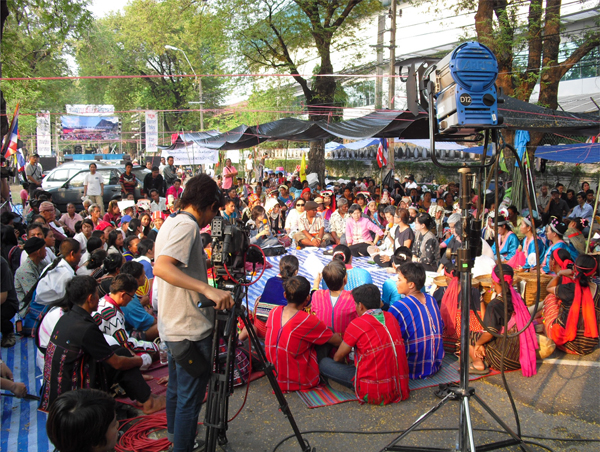
The Network of Indigenous Peoples in Thailand (NIPT) promotes awareness of Indigenous issues via supportive media such as the Thai Public Broadcasting Service (PBS). The photograph above shows a forum in March 2012 on Indigenous issues, later broadcast by Thai PBS, held as part of a two-day peaceful demonstration in front of Government House, Bangkok, by several hundred Indigenous people. The forum was joined by key ethnic Thai advocates, including scholars and a human rights lawyer (photograph by Micah F. Morton).

Nevertheless, in 2007 the Network of Indigenous Peoples in Thailand (NIPT) was established.Footnote 121 Prasit Leepreecha notes that the establishment of the NIPT in 2007 marked the very first occasion that a group in Thailand explicitly used the label of ‘Indigenous Peoples’ in naming its organisation in Thai language.Footnote 122 Joni Odochao, a Karen/Pwakanyaw village headman and NIPT's first president, officially announced the establishment of the network on 11 September 2007, shortly after Thailand's first observance of the International Day of the World's Indigenous Peoples, which was held on the grounds of Chiang Mai University from 8 to 9 August 2007. This was twelve years after the inauguration of the day by the United Nations in 1995.
Revealing of the unique position of Indigenous Peoples in Thailand, however, the event was officially referred to as the ‘Festival of Indigenous Peoples in Thailand’. As noted above, Indigenous Peoples in Thailand are simultaneously stressing their compatibility with the Thai nation and their cultural distinctiveness. This multilayered framing of the movement is reflected in Headman Joni's remarks during the opening ceremony:
We have a distinct way of life … that is intimately linked to nature. Our way of life is sustainable and nature friendly and has long been transmitted from one generation to the next. But now, because of state policies and modernization trends, we are struggling to maintain our traditional ways of life. The purpose of organizing this festival is to celebrate the diversity of Thai society, and, especially, promote understanding about the culture and way of life of the Indigenous Peoples in Thailand.Footnote 123
Representatives from 24 ethnic groups participated in the first festival — namely Akha, Dara'ang, Hmong, Iu-Mien, Kachin, Karen/Pwakanyaw, Khamu, Lahu, Lisu, Lua/Lawa, Mabisu, Mlabri, Moken, Moklaen, Mon, Oraklawoi, Shan, Song, Tai-Khoen, Tai-Lue, Tai-Yawng, Tai-Yuan, Thai-Song-Dam, Thai-Yong and Yahagun.Footnote 124 However, during the 2007 festival representatives from only 14 of these groups actually aligned themselves with the NIPT — namely the Akha, Dara'ang, Hmong, Iu-Mien, Kachin, Karen/Pwakanyaw, Lahu, Lisu, Lua/Lawa, Shan, Song, Tai-Lue, Thai-Song-Dam and Thai-Yong.Footnote 125 Furthermore, representatives from each of the 10 so-called Hill tribes (Akha, Dara'ang, Hmong, Iu-Mien, Kachin, Karen/Pwakanyaw, Lahu, Lisu, Lua/Lawa, and Shan) in the north have been the main promoters of the Indigenous movement in Thailand.Footnote 126 It is no coincidence that each of these groups is represented within IMPECT, which has received financial and advisory support from AIPP and IWGIA.
Headman Joni Odochao also publicly read a document entitled the ‘Declaration of the intentions of the Network of Indigenous Peoples in Thailand’.Footnote 127 Similar to the ONTP's declaration in 1993, the NIPT's 2007 declaration began by referencing UN efforts on behalf of Indigenous Peoples. The NIPT went further, however, in explicitly calling on the Thai government to ‘create policies and actively work to protect the human rights’ of Indigenous Peoples in Thailand according to a series of international agreements that it had already ratified.Footnote 128
The NIPT's declaration further called upon Thailand and other nations to ratify what was at the time referred to as the ‘Covenant on the Rights of Indigenous Peoples’. In the final clause of the declaration, the NIPT announced the establishment of the ‘Council of Indigenous Peoples in Thailand’ (CIPT) in order to ‘safeguard the rights, dignity and humanity of Indigenous Peoples in Thailand’.Footnote 129 Over the next four years the Indigenous leadership would shape the CIPT into a largely urban grassroots coalition working to represent Indigenous Peoples nationally while pushing for state recognition of Indigenous Peoples.
Starting in 2011, the NIPT began to, first, publicly call for the Thai state to officially recognise and fund the CIPT,Footnote 130 and, second, work more closely with both the Thai state via the EAI and a growing coalition of Indigenous Peoples from regions beyond the north. Later, in 2012, the NIPT modified the council's title to ‘The Council of Ethnic and Indigenous Peoples of Thailand’ (CEIPT). The NIPT made this decision in the interest of building a larger national coalition of Indigenous and ethnic (chatiphan) peoples, a key part of which entailed being more inclusive so as to not convey the notion that they were pursuing special rather than equal rights relative to other Thais.
The years 2006 and 2007 were watershed ones for the Indigenous movement internationally and nationally. In 2006, a coalition of Tribal NGO staff members, upland Tribal leaders, Thai scholars, and leading human rights advocates from Asia joined a seminar at Chiang Mai University during which they addressed three main issues.Footnote 131 First, they discussed developments taking place within the international Indigenous movement. Second, they considered the possibility of organising a national-level celebration of the International Day of the World's Indigenous Peoples. Last, a smaller forum was held during which participants debated the actual words in Thai that they should use to refer to their movement.Footnote 132
The participants eventually agreed to use the phrase ‘Indigenous Peoples in Thailand’ (Chon phao phuen mueang nai prathet Thai) to refer to the movement. Further revealing of the unique position of Indigenous Peoples in Thailand, they defined the concept of Indigeneity in a broad manner so as to be inclusive of not only ‘groups that had had the label of Hill tribes imposed upon them’ but also various ‘ethnic groups’ (klum chatiphan) and ‘local cultural groups’ (klum watanatham thongthin) residing throughout Thailand.Footnote 133 Second, as noted earlier, in 2006 the government established the EAI to:
support and push forward equitable and just social policies … to end all forms of discrimination on the basis of race, skin color, ancestry or national and ethnic origins … according to the International Convention on the Elimination of All Forms of Racial Discrimination which Thailand ratified in January 2003.Footnote 134
The EAI was a larger and expanded version of both the earlier Hill Tribe Welfare Division and the Tribal Research Institute that were dissolved in 2002, thereby addressing, in principle at least, the lack of discrete attention that had been paid to Hill tribes in the intervening years. Under the EAI, however, Hill tribes were reclassified alongside numerous other ‘ethnic groups’ as ‘ethnic highlanders’, thereby only partially reframing the former upland–lowland ethno-spatial division.Footnote 135
The larger ministry (MSDHS) under which EAI operated has played a crucial role in financing each of Thailand's Indigenous Peoples’ festivals. In addition, beginning with the second festival held in Chiang Mai in 2008, the EAI between 2007 and 2012 came to play an increasingly significant organisational role. A key result of the latter was the decision to hold the sixth annual festival near Bangkok in Nonthaburi and revise the official title of the festival from that of the ‘Festival of Indigenous Peoples in Thailand’ to the ‘Festival of Ethnic and Indigenous Peoples in Thailand’.
Several other significant events occurred nationally and internationally in 2007. Most importantly, on 13 September 2007 — just two days after the inaugural Indigenous Peoples’ festival in Chiang Mai — the Thai government ratified the UN Declaration on the Rights of Indigenous Peoples (UNDRIP) alongside 142 other nations.Footnote 136 Earlier, however, during the first Indigenous Peoples’ festival, a government representative affirmed the Thai state's ‘commitment to the standards enshrined’ in UNDRIP while further stressing that any ‘benefits flowing from (UNDRIP) would be based on the laws and Constitution of Thailand’.Footnote 137
In the coming years the NIPT would repeatedly stress the Thai government's lack of progress in adhering to not only UNDRIP but also Articles 4, 66 and 67 in the 2007 Thai Constitution relating to Thailand's ‘international obligations’ and the closely related cultural and land rights of ‘traditional communities’. The NIPT and its advocates have further brought repeated attention to the government's persistent lack of recognition of Indigenous Peoples by virtue of the latter word's absence from the Constitution.
Just one year later, in September 2008, the Thai government reiterated at the United Nations that there were no Indigenous Peoples in Thailand.Footnote 138 The statement copied below was issued in response to allegations brought to the UNPFII by US human rights activist Matthew McDaniel. McDaniel, who was expelled from Thailand in 2004, had worked since 2003 to bring international attention to the Thai government's seizure of the ‘ancestral lands of the Akha indigenous people living in Hooh Yoh, Pah Nmm, and Pai ah Pai villages in Chiangrai Province’ in order to make way for a Royal Project.Footnote 139
473. The Royal Thai Government stated that it does not recognize the existence of indigenous peoples in Thailand. It maintains that the Hill Tribes peoples in Thailand are migrants to the country, who by nature and historical background are not indigenous to the country.Footnote 140
Regardless of the government's official stance, however, the NIPT remains steadfast in its efforts to gently push for the official recognition of Indigenous Peoples by the Thai state. Towards that end, in Chiang Mai in January 2010, NIPT representatives, in collaboration with AIPP and IWGIA, submitted a ‘Report on the Situation of Human Rights and Fundamental Rights of Indigenous Peoples in Thailand’ to James Anaya, then UN Special Rapporteur on the Situation of Human Rights and Fundamental Freedoms of Indigenous People.Footnote 141 Apart from detailing the continuing injustices faced by Indigenous Peoples in Thailand relating to citizenship and land rights, the report concluded with a ‘request’ for Anaya to ‘recommend’ the Thai government to officially recognise them as Indigenous Peoples.Footnote 142
Notably, in the report's introduction, NIPT argues that ‘many Indigenous Peoples living in remote highlands and forests’ in Southeast Asia were divided from each other as a result of the ‘drawing of national boundaries … during the colonial era and in the wake of decolonization’.Footnote 143 Earlier in 2009, the NIPT publicly declared that, ‘Our ancestors were residing in their traditional territories before the emergence of nation states and the (infiltration) of the international capitalist system.’Footnote 144
These claims, while generally perceived as valid with respect to certain Indigenous groups in Thailand, such as the Lua/Lawa, Karen/Pwakanyaw or Suay/Kui, are seen by some as more problematic in reference to others such as the Akha, Dara'ang, Hmong, Iu-Mien, Kachin, Lahu, Lisu, and Shan. In reference to the latter groups, these particular claims of Indigeneity seem to rest more squarely on the newer concept of Indigeneity as referring not simply to autochthonous groups, but also colonised peoples, regardless of where they live, or how long they have lived there.Footnote 145
Further developments and debates within Thailand's Indigenous movement
Between 2010 and 2013 the Indigenous coalition gradually expanded to include non-Hill tribe groups such as the Tai-Phuan, Lao-Wieng and Phu-Thai from the northeast, as well as the Kayong from the north. The latter group's representatives have raised a number of questions regarding not only the meaning and scope of the label Indigenous Peoples in its Thai manifestation, but also its applicability or appropriateness to Thailand.
During a meeting at IMPECT in March 2012, CEIPT representatives appointed Surayuth Kaenphongthong, an ethnic Kayong representative, as chair of the committee to develop draft legislation for establishing CEIPT, replacing the Karen/Pwakanyaw leader Joni Odochao. As noted earlier, it was also in 2012 that NIPT representatives decided to revise their official labels of self-reference to include ‘ethnic(s)’ in addition to ‘Indigenous Peoples’.Footnote 146
The NIPT's decision to amend their label of self-reference in a more inclusive manner stemmed from both their increasing collaborations with the state via the EAI and also the closely related factor of the expansion of the Indigenous movement to include more diverse groups. The movement's members, moreover, have expressed different ideas regarding what term of self-reference to adopt, with some arguing for the more inclusive term ‘ethnic(s)’, and others advocating for the more exclusive term ‘Indigenous Peoples’. Thus, initial efforts by the early Indigenous leadership to redefine the Thai manifestation of Indigenous Peoples in a more inclusive manner as noted above failed to resonate with their expanding membership.
In general, NIPT members from each of the Hill tribes represented within IMPECT tend to favour the term ‘Indigenous peoples’ while non-Hill tribe members prefer the term ‘ethnic(s)’. Those arguing against the use of ‘Indigenous Peoples’ in its Thai manifestation claim that it creates ethnic division that could lead to conflict and discrimination.Footnote 147 Those arguing for it state that it is necessary as they are faced with particular problems that other ethnic groups are less likely to encounter.Footnote 148 As Yongyuth Seubtayat, an ethnic Hmong Indigenous leader put it: ‘We prefer the term “Indigenous Peoples” because many people continue to face particular problems associated with citizenship, land rights and access to natural resources, issues that are not as important for those who prefer the term “ethnics”.’Footnote 149
In particular, hundreds of thousands of Hill tribes people remain without Thai citizenship, and many face serious problems related to land and resource tenure. As Kittisak Rattanakrajangsri stressed, ‘We prefer the term Indigenous Peoples because we are facing particular problems that are different from other groups.’Footnote 150 Chupinit Kesmanee further stated that while many Thai academics prefer the term ‘ethnic minorities’, most of the Indigenous movement's representatives reject the term ‘minority’.Footnote 151 In 2015, however, it was decided to revert to just using the term ‘Chon phao phuen mueang’.Footnote 152
Yet another layer of complexity can be found when considering the degree of receptivity or lack thereof towards the concept of Indigeneity and the larger Indigenous movement among divergently positioned individuals and communities in the rural and urban north that have not been directly involved in the movement per se. The interests and strategies of the largely urban-based ethnic leadership behind the movement have not always reflected those of the communities that they have claimed to represent.Footnote 153
Nevertheless, as noted earlier, the Indigenous movement arose out of an earlier pan-Hill tribe movement to claim the basic rights to citizenship, land and mobility that they had been increasingly denied in 1980s and 1990s Thailand. Each of these issues, particularly land rights, continues to be pertinent for many Hill tribe communities in the north. As such, the Indigenous leadership is working to frame their movement to push for political recognition as Indigenous Peoples, in conjunction with the ongoing and far from complete movements for not only full legal citizenship status and land rights, but also ‘cultural citizenship’ or ‘the right to be different and to belong in a participatory democratic sense’.Footnote 154 In this manner, the Indigenous leadership is striving to frame the movement as an amalgamation of these multiple and shifting interests and thereby promote greater receptivity of the concept of Indigeneity and their movement among the general population.
Conclusions
In this article, we provided a chronology of the challenges and growth of the concept of Indigeneity in Thailand and analysed the particular ways in which the global Indigenous movement has taken root in the country. In Thailand, transnational support networks along with the opening of political associational space played key roles in facilitating the growth of, first, a regional, and, later, a national Indigenous movement during the 1980s and early 2000s, respectively. In asserting their Indigeneity, Indigenous Peoples in Thailand are drawing on a new concept of ‘Indigeneity’ being promoted by the United Nations and other international advocacy organisations that identifies Indigenous Peoples not only as first peoples, but crucially as colonised or oppressed peoples.Footnote 155
Indigenous Peoples in Thailand are simultaneously asserting their cultural distinctiveness as Indigenous Peoples and their compatibility with the Thai nation.Footnote 156 In this manner, the Indigenous movement in Thailand differs from those in ‘liberal democratic settler states’ such as Australia, New Zealand, Canada and the United States, where Indigenous Peoples ‘must perform their cultural difference in order to maintain political recognition’, and who in turn face the accusation of being ‘not culturally different enough’ when actually exercising their political rights.Footnote 157 In Thailand, rather, Indigenous Peoples must address the accusation of being ‘not Thai enough’ in their efforts to gain any political recognition whatsoever.
Although the Thai government has at various points since the 1990s denied the relevance of the concept of Indigeneity to Thailand, it is clear that the Indigenous movement is continuing to grow. In spite of this denial, however, state policies between the 1950s and early 2000s contributed towards the scaling-up of a pan-Hill tribe identity among the core groups associated with the Indigenous movement. While these policies have been geared towards controlling and rendering upland spaces and communities legible, they have clearly had other consequences as well.
In addition, the state via the EAI implicitly supported the employment of the Indigenous Peoples’ label in its Thai manifestation by endorsing and funding each of the post-2007 annual national festivals of ‘(Ethnic and) Indigenous Peoples’ held between 2007 and 2012. The EAI further recognised Indigenous Peoples as a particular target group in its 2011 draft ‘Strategic Plan for the Development of Ethnic and Indigenous Peoples in Thailand’.Footnote 158 Finally, government decrees from 2010 designed to protect the cultures of the Karen/Pwakanyaw and Moken suggest that the Thai government is becoming more receptive to giving certain ethnic groups particular rights and protections, although the government still seems far from adopting the concept of Indigenous Peoples (see Figure 2).Footnote 159
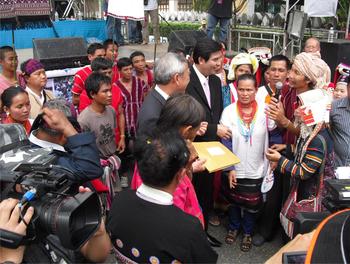
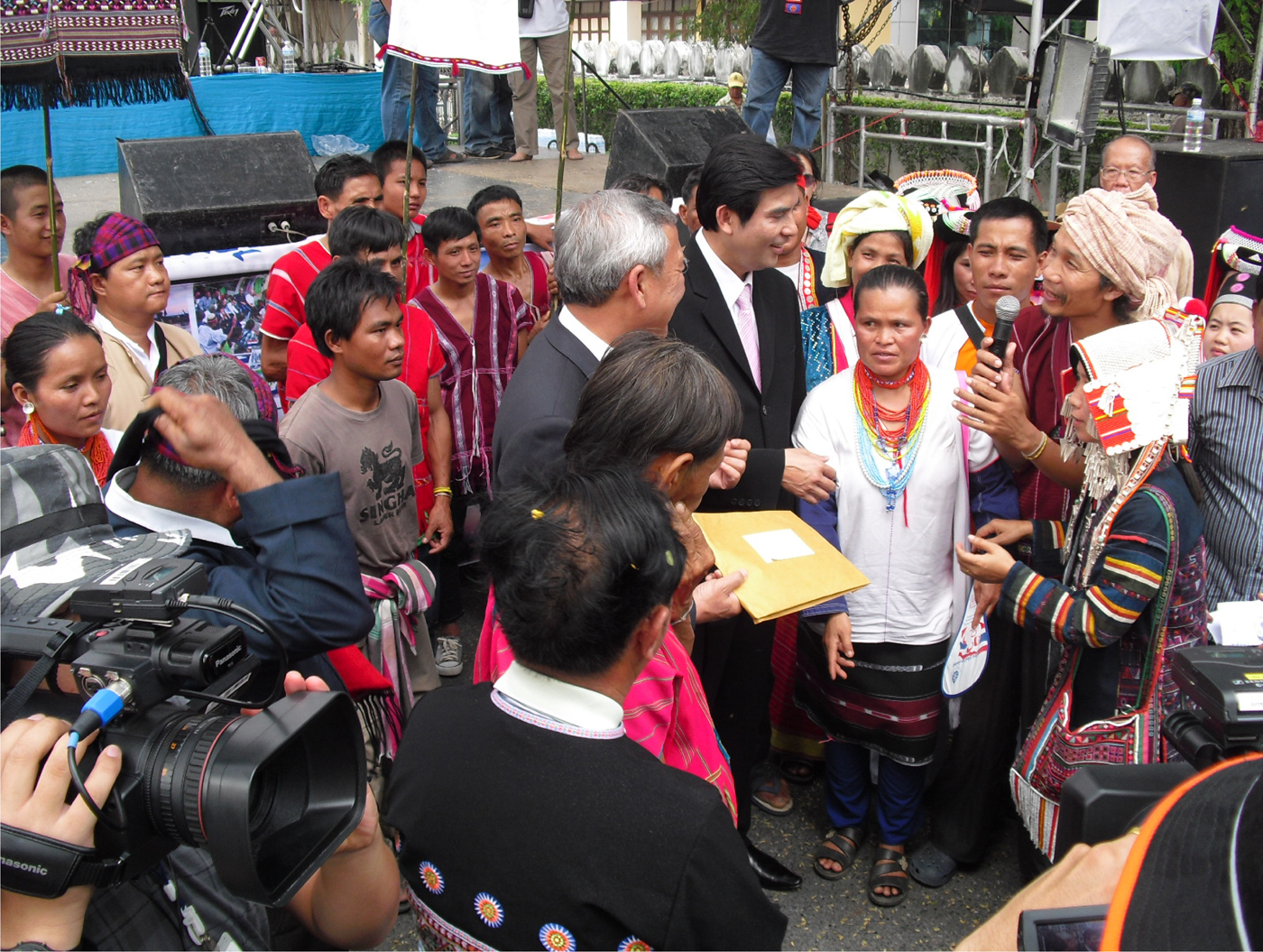
In 2010, the Vejjajiva government issued two decrees calling for the ‘revitalisation’ of the ‘ways of life’ of the ‘ethnic’ Moken and Karen. The decrees contain sections on land management, citizenship, culture, and education, etc., and call for ‘Special Cultural Zones’ for the Moken and Karen/Pwakanyaw. The photograph shows Indigenous representatives presenting a petition to government spokespersons in March 2012, calling on the administration of Yingluck Shinawatra to follow through on the decrees, and include other Indigenous groups. The petition was part of a two-day peaceful demonstration by hundreds of Indigenous people in front of Government House, Bangkok (photograph by Micah F. Morton).
It is not entirely clear if and in what ways the Indigenous movement in Thailand will develop in the coming years, but it seems to be gaining momentum, even as it also continues to face setbacks. Most importantly, the concept of Indigeneity is gradually being localised in Thailand, particularly by Indigenous and non-Indigenous activists and intellectuals amongst Thailand's upland minorities, which may be the most significant change taking place, even if Indigenous Peoples are likely to continue evoking Thai national identities as well, depending on the context.