Introduction
Background
Mass gatherings can be defined as events that have the capacity to place a strain on planning and response resources of a community or country, due to the volume of attendance within a designated timeframe. 1 Examples of mass gatherings include festivals, music concerts, and sporting events. Mass-gathering events impact both in-event and external health services; such an impact has been evident for a number of years.Reference Ranse, Hutton and Keene 2 However, the impact on health care services related to patients presenting affected by alcohol and/or drugs at mass-gathering events has not been explored.
There is a growing concern as to the health risks mass-gathering events pose, particularly related to the effects of alcohol and drugs consumption.Reference Steffen, Bouchama and Johansson 3 In a 2002 study, it was identified that 27% of all patient presentations to in-event health care services were from alcohol use.Reference Milsten, Maguire, Bissell and Seaman 4 In addition, Hutton, et al.Reference Hutton, Ranse, Verdonk, Ullah and Arbon 5 found that 15% of patient presentations were as a consequence of alcohol and drug use, and it is this percentage of patient presentations that can impact those people providing on-site event health care. Further, a recent study found that alcohol places an unnecessary strain and burden on emergency services and resources. 6 This report found that through drunken physical, sexual, and verbal abuse, one-half of ambulance respondents had been injured in alcohol-related incidents. However, this phenomenon has not been investigated with in-event health care services. 6
Aim
This literature review aimed to develop an understanding of the impact on mass gathering in-event health care services from patients presenting affected by alcohol and/or drugs. Having a greater understanding of this patient population and the impact on in-event health care services will provide a valued step in human and physical resource management for future mass-gathering events. The research question for this integrative literature review was: What is the impact of alcohol and drugs on in-event health care services at mass-gathering events?
Methods
Design
This paper used integrative review as a methodology.Reference Torraco 7 This approach synthesizes literature in an integrated way and is useful when there are two separate topics to consider, such as alcohol use and the role of on-site health care services, thus building a bridge between related areas of study.Reference Russell 8 Following this review, a thematic analysis was undertaken to identify commonalities of findings amongst the included articles.
Data Collection
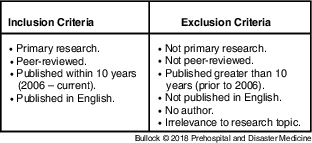
Manuscripts included in this literature review were sourced from databases inclusive of Medline (Ovid; US National Library of Medicine, National Institutes of Health; Bethesda, Maryland USA), Scopus (Elsevier; Amsterdam, Netherlands), PsycINFO (Ovid; American Psychological Association; Washington DC, USA), and Pub Med (National Center for Biotechnology Information, National Institutes of Health; Bethesda, Maryland USA). Key terms used for searches included: “mass gathering,” “music festival,” “drug,” “alcohol,” “mass behavior,” “worker,” “first aid,” “emergency medical service,” and “on-site care worker.” Searches were undertaken using inclusion and exclusion criteria outlined in Table 1.
Inclusion and Exclusion Criteria

Data Analysis
Papers included in this review were thematically analyzed. The thematic analysis of the manuscripts was undertaken using a modified approach from Ranse and Arbon.Reference Ranse and Arbon 9 In this approach, the authors reviewed the manuscripts for suitability in the literature review against the inclusion criteria. Following this, the authors identified broad themes relating to the manuscript content. The themes were then discussed amongst the authors and final themes were identified. Manuscripts were ordered under the final themes.
Results
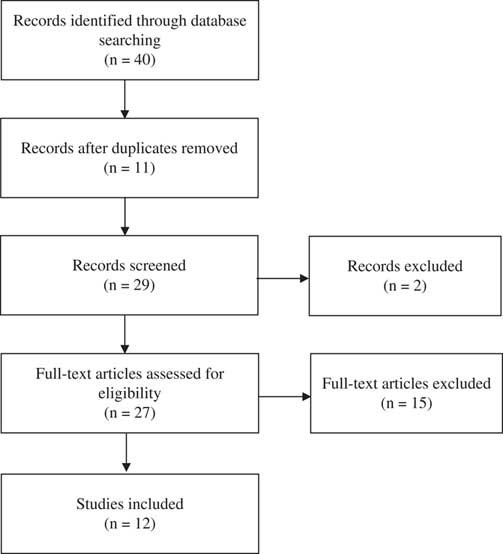
In total, the initial search returned 40 journal articles. Throughout the review process, 28 articles were excluded leaving a total of 12 articles. A PRISMA chart was utilized to trace the review process (Figure 1).Reference Liberati, Altman and Tetzlaff 10
PRISMA Flow Diagram.Reference Liberati, Altman and Tetzlaff 10

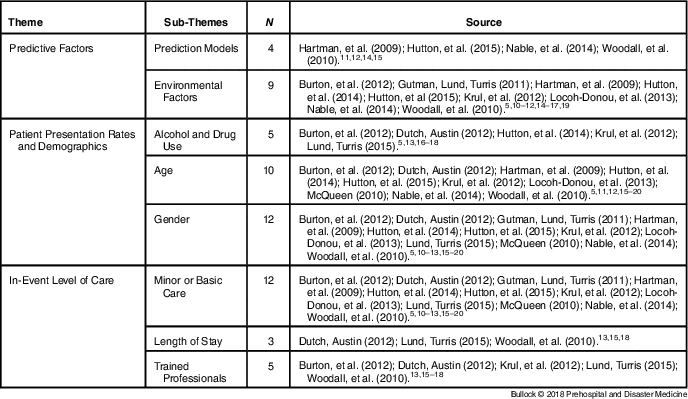
The themes are displayed in Table 2.Reference Hutton, Ranse, Verdonk, Ullah and Arbon 5 , Reference Gutman, Lund and Turris 11 – Reference McQueen 21 Elements of identified themes were also included into the table as sub-themes. The manuscript contents relating to the research question were intrinsically linked across and between themes, thus some manuscripts appeared in multiple themes or sub-themes.
Themes

Discussion
Predictive Factors
Prediction models were prominent in the reviewed literature. There are a number of factors that predict patient presentations at mass-gathering events.Reference Liberati, Altman and Tetzlaff 10 – Reference Nable, Margolis and Lawne 15 Event predictive factors can be inclusive of the type of event, crowd attendance, crowd demographics, indoor versus outdoor, weather, health promotion, and availability of alcohol. Alcohol and weather appear to be two of the more prominent environmental factors that have been utilized to predict patient presentation rates.Reference Gutman, Lund and Turris 11 , Reference Hartman, Williamson and Sojka 12 , Reference Lund and Turris 14
Environmental conditions influence predictive factors. While alcohol contributes to patient presentations, one study indicated that a music festival held indoors lead to a higher percentage of patients treated for alcohol and substance intoxication.Reference Hutton, Savage, Ranse, Finnell and Kub 13 It was hypothesized that without environmental elements, such as heat, to contribute to illness or injury, patients tended to be of a higher level of acuity and intoxication. As well as alcohol, heat played an important factor in patient presentations. Heat and dehydration tended to go hand-in-hand with patients presenting at in-event health care services at music festivals.Reference Hutton, Ranse, Verdonk, Ullah and Arbon 5 , Reference Hutton, Savage, Ranse, Finnell and Kub 13 , Reference Woodall, Watt and Walker 16 Most of the reviewed manuscripts highlighted the link with temperature and dehydration contributing to a large number of presentations. In comparison, one study suggested that higher temperatures did not affect patient presentations, but rather reduced them.Reference Nable, Margolis and Lawne 15 This could be due to alcohol availability, if the events were indoor or outdoor, and the age demographic of the event. Thus, further research is required on the effects of temperature and patient presentations at mass-gathering events.
Patient Presentation Rates
Gender influences patient presentation rates. Patient presentations at mass gatherings, regardless of size, appeared to have a majority patient demographic of females.Reference Hutton, Ranse, Verdonk, Ullah and Arbon 5 , Reference Nable, Margolis and Lawne 15 , Reference Krul, Sanou, Swart and Girbes 17 However, some literature found males to have a higher presentation rate.Reference Burton, Corry, Lewis and Priestman 18 This could be linked with the predictive factors already discussed, such as alcohol presence, weather conditions, indoor versus outdoor events, and age restrictions. Other literature found little correlation between gender and presentation rates.Reference Woodall, Watt and Walker 16 It has been suggested that females present at a higher rate at outdoor music festivals in Australia, whereas males were more likely to have more serious injuries and a higher level of acuity.Reference Hutton, Ranse, Verdonk, Ullah and Arbon 5
Age and alcohol are linked in predicating patient presentations. If the crowd in attendance had a younger age demographic and alcohol was served, patient presentations appeared to increase and have a greater number of substance-related issues.Reference Hutton, Ranse, Verdonk, Ullah and Arbon 5 , Reference Burton, Corry, Lewis and Priestman 18 This is in comparison to events where median aged crowds were over 25 years of age that had a patient cohort that presented with musculoskeletal and lacerations more than substance intoxication and weather-related illnesses.Reference Liberati, Altman and Tetzlaff 10 , Reference Nable, Margolis and Lawne 15 , Reference Woodall, Watt and Walker 16 This cohort had less presentations and medical usage rates than that of the younger cohort. There are a number of factors that could contribute to these statistics, such as the possibility that the events attended by primarily persons 25 years or under could have also had age restrictions on the event. This could entice underage persons to attend and lead to pre-loading or tailgating before entering the event.Reference Hutton, Ranse, Verdonk, Ullah and Arbon 5 , Reference Hutton, Savage, Ranse, Finnell and Kub 13 With this evidence in mind, future research could utilize an inclusion/exclusion criterion of events with younger patient demographics when assessing the impact of alcohol and drugs at mass-gathering events.
Common presentations to in-event health care services were substance-related. Most events reviewed relating to higher substance intoxication rates when they were outdoor, alcohol was sold at the event, and had a demographic median age between 19 and 25.Reference Hutton, Ranse, Verdonk, Ullah and Arbon 5 , Reference Hutton, Savage, Ranse, Finnell and Kub 13 , Reference Burton, Corry, Lewis and Priestman 18 A study of Australian music festivals found gamma hydroxybutyrate (GHB) not only is a common recreational drug of choice among males aged 20 to 25, but furthermore, it accounted for 64% of male patient presentations.Reference Burton, Corry, Lewis and Priestman 18 Of the 64%, 45% had co-ingested either alcohol, other recreational drugs such as ecstasy, or both. Further correlation of alcohol and drugs being a large contributor to patient presentation rates, 89% of patients who presented to in-event health care services had an altered level of consciousness or substance intoxication. This study is conferred by Lund and TurrisReference Hutton, Savage, Ranse, Finnell and Kub 13 who discovered 79% of patient presentations at an indoor music event were under the influence of drugs and alcohol, or were intoxicated. Furthermore, another study found 32% of patient presentations were alcohol-related, 18% drug or substance-related, and 16% presented with a combination of the two. This supports the question in research of what kind of impact alcohol and drugs have on in-event health care services.
Level of Care
In one Australian study, it was found that at outdoor music festivals where there was a high rate of substance intoxication, 89% of patients presented with altered levels of consciousness, requiring a mean length of stay of 90 minutes.Reference Burton, Corry, Lewis and Priestman 18 Interestingly, while the length of stay was longer, transfer to hospital rates were less than other mass-gathering events. This could be due to the presence of higher qualified staff, such as nurses, doctors, and paramedics, rather than first responder volunteers. This evidence was supported by others who also found an average length of stay of 70.8 minutes.Reference Hutton, Savage, Ranse, Finnell and Kub 13 Having a higher quality skill mix of health professionals lead to an almost 73% decrease in hospital transfer rates when compared to on-site volunteer medical services. Based on the findings of Dutch and AustinReference Burton, Corry, Lewis and Priestman 18 and Lund and Turris,Reference Hutton, Savage, Ranse, Finnell and Kub 13 a hypothesis could be formulated that substance intoxication is directly linked with length of stay when in-event health care services are available. If so, does the transfer to hospital rate decrease when skilled health professionals are present to provide in-event care such as hydration and monitoring? Further research should consider the level of care and strategies in hospital avoidance.
The acutely unwell cases that are presented in the literature tended to be around two percent of total presentations. Some cases resulted in the death of participants at music festivals.Reference Hutton, Ranse, Verdonk, Ullah and Arbon 5 , Reference Hutton, Savage, Ranse, Finnell and Kub 13 Lund and TurrisReference Hutton, Savage, Ranse, Finnell and Kub 13 discussed to what extent, if any, substance overdose was the case, with the discussion centering on media attention to deaths at music festivals. There is a need for further research in the link between substance intoxication, overdose, and death at mass-gathering events and its impact of in-event health care services.
Limitations
While the database searches were limited to publication dates within the past 10 years, the 12 articles included only ranged from 2009 to 2015. The publication dates of the articles further suggest the research topic is in its infancy stages, requiring further investigation.
Conclusion
From this literature review, it is evident that substance use and intoxication can potentially have an impact on in-event health care services at mass-gathering events. Of the various types of mass-gathering events, music festivals appear to be the most affected by substance and/or alcohol intoxication, with high presentation rates and length of stays reported. Age demographics have highlighted young adults aged 25 years or less are at most risk of substance influence. Where an increase in substance-related presentations occurred, a decrease in transfers to hospital occurred. Further research needs to be conducted to substantiate links between substance use, patient presentations, and the impact substance and/or alcohol has on in-event health care services at mass-gathering events.