Recent advances in medical and surgical techniques have significantly changed the outlook for patients with CHD, giving rise to a new group of patients – adults with CHD. Until recently, ~50% of these patients would not have survived through childhood, but a large proportion can now be expected to survive into adulthood (85%).Reference Gatzoulis, Webb and Daubeney 1 In the United Kingdom, an estimated 1600 CHD patients reaching 16 years of age are referred for follow-up care in adult services each year.Reference Wren and O’Sullivan 2 A similar rise has also been reported in Canada.Reference Gatzoulis, Hechter and Siu 3
The steady rise in the number of survivors with CHD has shifted attention to the long-term impact of the condition in this new patient population. Interest is moving away from mortality to long-term psychosocial outcomes such as quality of life, social functioning, and well-being.Reference Fteropoulli, Stygall and Cullen 4
A potential difficultly affecting this patient group is impairment of cognitive function. Existing literature indicates a relationship between CHD, its related treatments, and patients’ cognitive functioning. This study, however, has largely focussed on child cohorts.Reference Tyagi, Austin and Stygall 5 The impact of CHD on cognition in adults is relatively understudied, despite recent research suggesting that cognitive impairment persists into adolescence.Reference Schaefer, Rhein and Knirsch 6
The primary focus of research on cognitive functioning has been on the assessment of IQ in both children and adult patients. A recent meta-analysis suggested that IQ was adversely affected in children with complex heart defects, but remained within the normal range in those with simpler forms of CHD.Reference Karsdorp, Everaerd and Kindt 7 The limited adult literature suggests that IQ is relatively unaffected in adult CHD.Reference Tyagi, Austin and Stygall 5 To date, only one study has reported lower IQ in adult CHD patients in comparison with a normal group.Reference Eide, Skjaerven and Irgens 8 Despite being informative, the assessment of IQ alone does not provide a comprehensive and clear understanding of cognitive function, as it fails to capture performance in specific domains of cognition such as memory, executive functioning, verbal fluency, and attention.
Preliminary research in child cohorts has reported cognitive deficits across a range of domains, particularly language, psychomotor functioning, visuo-spatial skills, attention, and memory.Reference Eide, Skjaerven and Irgens 8 – Reference Newburger, Jonas and Wernovsky 11 In a review of the literature, we identified only five studies that examined cognition in adult CHD, two in the same cohort,Reference Tyagi, Austin and Stygall 5 , Reference Eide, Skjaerven and Irgens 8 , Reference Daliento, Mapelli and Volpe 12 – Reference Utens, Versluis and Verhulst 15 of which only one study tested cognitive domains beyond IQ. These patients exhibited significant impairment of executive function and marginal memory, attention, and learning deficits, suggesting that patients may have difficulty with planning, dealing with novel situations, learning and recalling new information, and remaining focussed on a task. This sample, however, was restricted to tetralogy of Fallot, and hence does not provide an understanding of the cognitive problems in different forms of adult CHD.Reference Daliento, Mapelli and Russo 9
The literature is further limited by the inclusion of heterogeneous patient samples in many studies. The varying complexity, treatment regimens, and associated complications seen across congenital heart conditions are likely to differentially impact upon cognition. Greater cognitive impairment may be expected in cyanotic conditions due to increased risk of cerebral hypoxia.Reference Newburger, Silbert and Buckley 16 Similarly, patients with more complex forms of CHD and those requiring multiple surgical interventions may be at increased risk of cognitive impairment. Research has suggested that micro emboli entering cerebral blood flow during cardiopulmonary bypass may cause infarcts resulting in cerebral injury and consequent cognitive impairment.Reference Pugsley, Klinger and Paschalis 17 Grouping patients with diverse forms of adult CHD may mask the true nature of the relationship between adult CHD and cognitive impairment.
This study assessed cognitive function in a group of adult CHD patients, from different structural complexity groups with varying levels of morphological complexity, on a wide range of domains of cognitive function. The study aimed to assess the level of cognitive functioning in adult CHD patients in comparison with age-matched norms and investigate differences in cognitive function between different adult CHD structural complexity groups.
Methods
Participants
Participants were recruited from the Grown Up Congenital Heart Unit at the Heart Hospital, University College Hospital, London, United Kingdom. Inclusion criteria were as follows: age 16 years or over, diagnosis of CHD, and fluent in English. Exclusion criteria included presence of chromosomal anomalies such as Trisomy-21 (Down’s syndrome) or 22q11deletion (Di George syndrome), history of stroke, presence of mental retardation and learning difficulties, Patent Foramen Ovale without any other structural anomaly, physically disabled, unable to undergo exercise testing and/or neuropsychological assessment, and presence of sensory loss or communication difficulty sufficient to interfere with the assessment.
Patient classification
Patients were classified into four groups on the basis of the morphological complexity of the congenital heart condition: first, tetralogy of Fallot diagnosis – major aortopulmonary collateral arteries and pulmonary valve replacement; second, transposition of the great arteries diagnosis – atrial switch operation; third, single ventricle – single ventricle physiology and Fontan repair; and fourth, simple – atrial septal defect, ventricular septal defect, and coarctation of the aorta, including re-coarctation. Groups first to third represent cyanotic conditions, and group four represents acyanotic conditions. A sample size calculation indicated that for a four-group study to detect significant group differences on cognitive functioning, 280 participants were required to attain 80% power to detect a small–medium effect size, at the 0.05 significance level.
Procedure
A purposive sample of patients was recruited into the four structural complexity groups from patient databases and outpatient clinic lists. From an estimated 5000 patients, 1199 were assessed for eligibility, and 708 patients who met inclusion criteria were invited. Eligible patients were invited by letter. A total of 273 (38.6%) patients declined the invitation, 81 (11.4%) did not respond, and 29 (4.1%) withdrew from the study. The final sample included 310 patients – that is, 43.8% of those invited. Written informed consent was obtained from all patients following the provision of information sheets and the opportunity to ask questions (Ethics ref: 08/H0715/105). All the assessments were conducted in a suitable private room by a trained researcher.
Measures
Neuropsychological assessments
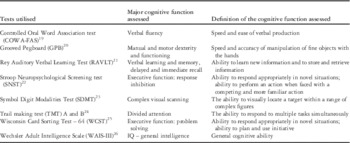
A comprehensive range of neuropsychological tests was utilised to assess several cognitive domains including memory, attention, executive function, and verbal fluency (see Table 1). The three-subtests short-form measure of IQ (Wechsler Adult Intelligence Scale – WAIS-III) was scored to produce an estimated full-scale IQ (FSIQ-EST), which was derived using a formula by Tellegen and Briggs.Reference Tellegen and Briggs 18
Summary of neuropsychological assessments.

Measures of Mood
Mood was assessed to examine whether it influenced cognitive performance.
The Positive and Negative Affect Scale
The Positive and Negative Affect Scale is a 20-item, self-report measure of positive affect – for example, proud, alert, and inspired – and negative affect – for example, upset, guilty, and scared. Both subscales have shown good reliability: PA (α=0.89) and NA (α=0.85). Higher scores on each subscale indicate stronger affect.Reference Watson, Lee and Tellegen 27
Centre for Epidemiological Studies Short Depression Scale
The Centre for Epidemiological Studies Short Depression Scale is a self-report measure of depressive symptomology over the previous week. In this scale, 10 items are rated on a four-point scale ranging from “0=rarely/none of the time” to “3=All of the time”. Higher scores indicate greater depression. The Centre for Epidemiological Studies Short Depression Scale has demonstrated satisfactory internal consistency (r=0.84) and test–re-test reliability(r=0.71).Reference Andresen, Malmgren and Carter 28
State Trait Anxiety Inventory
The six-item version of State Trait Anxiety Inventory was used to assess state anxiety associated with a medical condition. Higher scores indicate greater anxiety. The scale has shown good internal consistency (0.82).Reference Marteau and Bekker 29
Statistical analysis
Data analysis was conducted using IBM SPSS, (version 21). Data were tested for the assumptions of normality; preliminary analysis indicated a non-normal distribution of the neuropsychological data. Square root and logarithmic transformations did not improve the data distribution. The overall level of missing data was <5%; to address this and obtain a complete data set, a single imputation model was run using predictive mean matching; further details of missing levels and imputation are available from the authors.
The data (raw scores) were transformed into standardised scores (z-scores). The z-scores were derived using the standard deviation from age-matched normative data for each test, according to the scoring recommendations for each test – for example, scoring manuals (see Supplementary file) – which were then used to compare the performance of the patient group with that of a healthy population. Taking account of the direction of poorer performance – lower number correct in memory tests and slower performance in timed tests – patient performance of 1.5 SD or greater in the direction of poorer functioning than that of the normative group was used as an indicator of the presence of cognitive difficulty in the particular test; 1 SD, 1.5 SD, and 2 SD are commonly used cut-off criteria in the neuropsychological literature.Reference Ingraham and Aiken 30 Use of 1 SD is likely to identify false positives, whereas the stringent 2 SD criteria may increase the number of false negatives. The 1.5 SD criterion was selected as an attempt to balance Type I and Type II errors.Reference Lezak, Howieson, Bigler and Tranel 31 Furthermore, this criterion is utilised in the diagnosis of mild cognitive impairment.Reference Petersen 32 For ease of interpretation, poor performance will be described as 1.5 SD below the mean, irrespective of the actual direction of scoring.
Ingraham and AikenReference Ingraham and Aiken 30 provide useful data on determining criteria for impairment in multiple test batteries. On a single test, 7% of a population would be expected to score 1.5 SD below the mean by chance.Reference Ingraham and Aiken 30 In a battery of 15 tests – the present study yielded 15 scores from eight neuropsychological tests – 66% of a normal population would be expected to score 1.5 SD below the mean score on one test, and 8% of a normal population would be expected to score 1.5 SD below the mean score on three tests.
A total mean composite z-score was computed from all neuropsychological test z-scores to provide a single measure of neuropsychological function. Group differences were tested on demographic and clinical variables using χ2-tests, the Mann–Whitney U-test, or the Kruskal–Wallis test where appropriate, with two-tailed significance levels reported. Analysis of Covariance was used to assess differences in cognitive test scores (z-scores) between the structural complexity groups, whereas controlling for covariates educational attainment and mood, as these are factors known to influence cognition.
Results
Sample characteristics
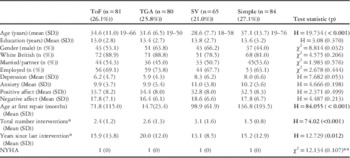
Of the 314 participants, four did not provide complete neuropsychological data and were excluded from further analysis. Participants had a mean age of 33.3 years (SD 10.7) and 56% were male. Demographic and clinical characteristics of the sample are presented in Table 2. The single ventricle group was significantly younger than all other structural complexity groups (transposition of the great arteries U=1845, p=0.003 tetralogy of Fallot U=1770, p<0.001, simple U=1714, p<0.001).
Sample demographic and clinical characteristics (by disease classification).

Bold values significant at p < 0.05
H=Kruskal–Wallis test
* Interventions include catheter intervention, palliative surgery, or reparative surgery
** Fisher’s exact value reported
As expected, clinical variables differed between patient groups. The transposition of the great arteries group was significantly younger at age of first repair than the tetralogy of Fallot, single ventricle, and simple groups (U=1066.0, p<0.001, U=157.5, p<0.001, U=1423.5, p<0.001, respectively). Tetralogy of Fallot patients were significantly younger at age of first repair than single ventricle patients (U=1142.5, p<0.001). In addition, simple patients had significantly fewer interventions than tetralogy of Fallot (U=1768.0, p<0.001), transposition of the great arteries (U=1311.0, p<0.001), and single ventricle patients (U=907.0, p<0.001). Single ventricle patients had a greater number of interventions than tetralogy of Fallot (U=1944.0, p=0.005) and transposition of the great arteries patients (U=2101.5, p=0.036). Time since last operation was significantly longer in transposition of the great arteries patients than in single ventricle patients (U=1577.5, p<0.001).
Cognitive function in adult CHD compared with general population norms
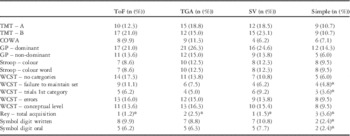
Cognitive performance of the adult CHD sample in comparison with age-matched normative populations was assessed with z-scores calculated using the mean and the standard deviations of the normative data. Nearly three-quarters (71.3%) of the sample performed 1.5 SD below the mean of the normative data on at least one test, higher than the 66% expected in a normal population using a battery of 15 tests – that is, only 5.3% greater than expected. In addition, 41% of the sample scored at least 1.5 SD below the normative mean on three or more tests, which was significantly greater than the 8% expected in the normal populationReference Ingraham and Aiken 30 The number of domains affected ranged from 1 to 13.
Compared with normative data, the majority of patients showed deficits in executive function (problem solving) (21.3–25.2%), divided attention (20.3–23.9%), verbal fluency (22.3%), and fine motor function (20.6–27.4%). Deficits were seen in Wisconsin card sorting test scores, which primarily assess executive function, with the exception of the Wisconsin card sorting test failure to maintain score, which is dependent on working memory and attention rather than problem-solving skills. This result is consistent with the lack of memory deficits seen on the Rey Auditory Verbal Learning Test. In this sample, 24% had an IQ score at least 1 SD below the normative mean of 100 (i.e. scored <85).
Structural complexity group differences in cognitive functioning
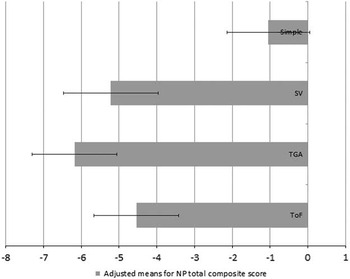
The percentage of patients in each group scoring 1.5 SD below the normative mean on at least one or three neuropsychological test scores is shown in Table 3. The simple group showed the lowest levels of impairment with only 26.2% demonstrating impairment on three or more tests. The simple group showed significantly less deficits compared with transposition of the great arteries on three or more tests (p<0.05). All other comparisons were non-significant. All groups showed greater frequency of impairment than that expected to occur in a normal population.Reference Ingraham and Aiken 30 Overall mean neuropsychological performance using a composite z-score (norm-adjusted standardised scores) indicated the highest performance (−1.004) and occurred in the simple group, whereas the transposition of the great arteries group had the poorest performance (−6.15) (see Fig 1).
Norm adjusted mean scores on the total composite score with 99% error bars in each structural complexity group. A lower score is indicative of a poorer performance. ToF=tetralogy of Fallot; TGA=transposition of the great arteries; SV=single ventricle.

Percentage of patients scoring 1.5 SD below the normative mean score by structural complexity group.

SV=single ventricle; ToF=tetralogy of Fallot; TGA=transposition of the great arteries.
Analysis of covariance was used to investigate between-group differences in overall neuropsychological performance with years of education and mood as covariates. Age was controlled for using age-corrected normative scores. A significance level of p<0.01 was used to allow for multiple comparisons.
Analysis of covariance revealed a group difference in composite neuropsychological test scores (Group: F (1303)=3.992, p=0.002, partial η2p=0.038, Education: F (1303)=33.29, p=0.000, partial η2p=0.099, Positive affect: F (1303)=8.68, p=0.003, partial η2p=0.028). Post hoc (Sidak) tests indicated a significant difference between the simple group and the transposition of the great arteries group (adjusted mean: −5.9694, SE=1.305, p=0.008).
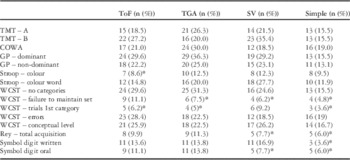
Table 4 shows the proportion of patients within each structural complexity group showing impaired performance on the neuropsychological tests (>1.5 SD below the mean). See Table 5 for 2 SD cut-offs indicating more extreme deficiencies. Both are higher than expected by chance compared with normative data.
Proportion of participants scoring >1.5 SD below the mean for each of the neuropsychological assessments in each of the four structural complexity groups.

COWA=controlled oral word association test; GP = Grooved Pegboard; SV=single ventricle; TMT=trail making test; ToF=tetralogy of Fallot; TGA=transposition of the great arteries; WCST=Wisconsin card sorting test
* <8% that would be expected in the normal population, Ingraham and Aiken30
Proportion of participants scoring >2 SD below the mean for each of the neuropsychological assessments in each of the four structural complexity groups.

COWA=controlled oral word association test; SP=grooved pegboard; SV=single ventricle; TMT=trail making test; ToF=tetralogy of Fallot; TGA=transposition of the great arteries; WCST=Wisconsin card sorting test
* <5% that would be expected in the normal population, Ingraham and Aiken30
Analysis of covariance was used to explore between-group differences in cognitive performance on each neuropsychological test. Only one neuropsychological function significantly differed between groups: divided attention (Trail Making Test-B) (Group: F=5.01, p=0.002, η2=0.047, Education: F=5.54, p=0.019, η2=0.018, Positive affect: F=9.97, p=0.002, η2=0.032). Post hoc tests (Sidak) revealed that the simple group performed significantly better than the tetralogy of Fallot (Adjusted Mean=0.958, SE=0.180, p=0.009) and single ventricle (Adjusted Mean=0.147, SE=0.177, p=0.007) groups.
Borderline significant differences were found in response inhibition (Stroop–Word test) (Group: F=3.56, p=0.015, η2=0.034), executive functioning (Wisconsin Card Sorting Test-No of categories) (Group: F=3.49, P=0.016, η2=0.033), and motor function and dexterity (Grooved Pegboard) (Group: F=3.30, p=0.021, η2=0.032).
IQ scores
The results indicated that the mean scores for all four groups were within the “average” IQ category as classified by Wechsler (IQ=90–109). No significant difference was observed between-group IQ scores after controlling for education and mood (Group: F=1.04, p=0.375). Visual inspection of these data suggested that the simple group attained the highest IQ (mean=100.4), followed by single ventricle (mean=96.6), transposition of the great arteries (mean=95.2), and finally tetralogy of Fallot (mean=95.04) groups (Group: F (3299)=1.04, p=0.375, η2=0.001).
Discussion
The persistence of cognitive deficits into adulthood as a result of CHD and its associated treatments was examined in this study. The cognitive function of adult CHD patients was compared with age-matched population norms, and differences in cognitive function between structural complexity groups were assessed.
The results indicated that a considerable proportion of adult CHD patients had cognitive abilities below that of age-matched healthy adults in a range of domains of cognitive functioning, including executive function, divided attention, and fine motor function. These findings suggest that adult CHD patients may have difficulty attending to multiple tasks, dealing with novel and complex situations, and performing fine motor tasks. A considerable number of patients displayed deficits in multiple domains. Almost a quarter of the sample showed deficits in IQ, suggesting a generalised effect of CHD on cognition; however, in line with previous research, memory was found to be largely unaffected.Reference Daliento, Mapelli and Russo 9
As expected, investigation of structural complexity group differences indicated that patients in the “simple” group had better cognitive function than other groups. This indicates that the more morphologically complex the disease is, the greater the possibility of experiencing cognitive deficits. A possible explanation of this pattern is the inherent risk involved with having a severe form of CHD, including an increased risk for congenital brain anomalies.Reference Glauser, Rorke and Weinberg 33 Patients with severe heart conditions also have an increased risk of cognitive deficits due to frequent surgery, particularly high-risk surgical interventions such as cardiopulmonary bypass,Reference Stavinoha, Fixler and Mahony 34 preoperative and postoperative poor cerebral perfusion, and seizures.Reference Goldberg, Schwartz and Brunberg 35 The findings of the present study are consistent with a meta-analysis reporting patients with more severe forms of CHD having poorer levels of cognitive functioning than those with less severe forms.Reference Karsdorp, Everaerd and Kindt 7
The general cognitive assessment of IQ did not show statistically significant differences between patient groups. This finding, in contrast to the assessment of specific domains of cognition, emphasises the limitations of generalised measures of cognitive function such as IQ.
Executive function and other so-called “higher-order” cognitive skills were the most impaired domains within our sample. Deficits of this nature have the potential to impact on educational attainment and employment prospects.Reference Marino, Lipkin and Newburger 36 They may also cause difficulties for patients during their daily lives when performing instrumental activities of daily living, such as managing finances and problem solving.
Limitations
Several limitations must be considered, although the present study is one of the largest and first of its kind to explore cognitive functioning in adult CHD patients across a range of cognitive domains and levels of disease complexity. The sample included the major adult CHD structural complexity groupings; however, it does not encompass all forms of adult CHD, and generalisability is restricted to the conditions included in the study. Although a broad range of cognitive domains were assessed in the study practicalities, including participant fatigue and time constraints, there was limited inclusion of a greater range of assessments. A broader range of memory abilities and visuo-spatial skills could be explored in future studies. Cognitive performance within the sample was compared with normative data corrected for age. Although this gives a good indication of the sample’s performance against a healthy population, the inclusion of an age-matched health control group may have further strengthened the study design.
The present study highlights the significant extent of cognitive dysfunction present in patients with adult CHD compared with established normative data. Further research is now needed to identify the underlying mechanisms that can explain the specific causes of these deficits, and inform tools and interventions to evaluate and address potential deficits within clinical practice. Investigations into the long-term stability of these deficits will further inform clinicians and healthcare practitioners to be able to identify vulnerable groups and offer appropriate ongoing support and care.
Implications
This study is one of the first to include a large sample of adult CHD patients and assesses a wide range of cognitive domains as opposed to a composite measure of cognitive functioning. It is hoped that this may enable clinicians to identify and intervene with patients at an increased risk of cognitive deficits and enable provision of additional developmental support where appropriate.
Acknowledgements
The authors acknowledge the University College London Hospital (UCLH)/University College London National Institute for Health Research, Comprehensive Biomedical Research Center for supporting this research. The authors thank all the participants and members at the Heart Hospital, London who assisted in completing this study. Authors’ contributions: Professor S.N. is the guarantor and the principal investigator of the study. M.T. drafted the paper and was involved in the design and execution of the study. C.H. and L.R. made significant contributions to the drafting of the paper. T.F., N. P. and F.K. were involved with the execution of the study. Dr S.C., Professor J.D. and Professor S.N. were involved with the design and management of the study. All authors contributed to the writing and review of the paper.
Financial Support
This work was supported by the University College London Hospital (UCLH)/University College London National Institute for Health Research, Comprehensive Biomedical Research Center (UCLH Project ID number: 08/0326).
Conflicts of Interest
None.
Ethical Standards
The study was approved by the Research Ethics Committee (ref: 08/H0715/105).
Supplementary Material
To view supplementary material for this article, please visit http://dx.doi.org/10.1017/S1047951116001396