Suicide is the 10th leading cause of death in the United States (Centers for Disease Control, 2015), and an estimated 25 additional suicide attempts occur for every death by suicide (Drapeau & McIntosh, Reference Drapeau and McIntosh2015). Furthermore, the prevalence of suicide increased 24% from 1999 to 2014, with more a marked increase from 2006–2014 (Curtin, Warner, & Hedegaard, Reference Curtin, Warner and Hedegaard2016). People with disabilities have been found to have increased and elevated rates of suicidal thoughts, attempts, and deaths relative to the general population (Lund, Nadorff, & Seader, Reference Lund, Nadorff and Seader2016; Pompili et al., Reference Pompili, Forte, Palermo, Stefani, Lamis, Serafini and Girardi2012; Wetzel et al., Reference Wetzel, Gehl, Dellefave-Castillo, Schiffman, Shannon and Paulsen2011). This has been consistently demonstrated across disability types, including multiple sclerosis (Giannini et al., Reference Giannini, Bergmark, Kreshover, Elias, Plummer and O'Keefe2010; Pompili et al., Reference Pompili, Forte, Palermo, Stefani, Lamis, Serafini and Girardi2012), autism spectrum disorders (Segers & Rawana, Reference Segers and Rawana2014), spinal cord injury (Giannini et al., Reference Giannini, Bergmark, Kreshover, Elias, Plummer and O'Keefe2010), Huntington's Disease (Wetzel et al., Reference Wetzel, Gehl, Dellefave-Castillo, Schiffman, Shannon and Paulsen2011), chronic pain (Fishbain et al, Reference Fishbain, Bruns, Meyer, Lewis, Gao and Disorbio2012), and psychiatric disability (Lund et al., Reference Lund, Nadorff and Seader2016).
As professionals who work specifically with those with disabilities, vocational rehabilitation (VR) professionals may be important frontline professionals in interacting with, noticing, and intervening with individuals with disabilities who at high risk for suicide. Furthermore, suicide prevention efforts have highlighted the need to train as many individuals as possible in gatekeeper suicide risk assessment and intervention strategies, including non-clinical staff, such as teachers and other school staff (Condron et al., Reference Condron, Garraza, Walrath, McKeon, Goldston and Heilbron2015; Isaac et al., Reference Isaac, Elias, Katz, Shay-Lee, Deane, Enns and Sareen2009). As frontline professionals in a disability-focussed counselling setting, VR support staff may interact significantly with client populations as they receive VR services. Additionally, they may also be literally the first point of contact for clients if they call or come into the VR office in a state of crisis. Thus, VR support staff would benefit from knowing how to respond to these situations in an effective, compassionate, appropriate, and safety-promoting manor. Thus, it is important to be able to assess support staff member's perceived competency and comfort in working with clients who have been, are currently in, or are at risk for a state of suicidal crisis. Such information would help agencies and state offices assess baseline competency and comfort, areas of strengths and weakness, and any benefits resulting from staff training or intervention.
Although we are not aware of any suicide-related competency measures developed for rehabilitation support staff specifically, suicide assessment competency measures have been developed for use in other, more clinically trained populations, such as nurses, physicians, and psychology trainees (e.g., Cramer, Johnson, Mclaughlin, Rausch, & Conroy, Reference Cramer, Johnson, Mclaughlin, Rausch and Conroy2013; Graham, Rudd, & Bryan, Reference Graham, Rudd and Bryan2011). Two such published measures are the Suicide Competency Inventory (SCI; Graham et al., Reference Graham, Rudd and Bryan2011) and the Suicide Competency Assessment Form (SCAF; Cramer et al., Reference Cramer, Johnson, Mclaughlin, Rausch and Conroy2013). The SCI is a measure that assesses professionals’ willingness, comfort, and perceived competency in asking about suicidality and working with clients who are or have been suicidal. The SCAF is a measure that assesses professionals’ perceived competency in 10 core skills related to suicide assessment and suicide-related crisis intervention.
Existing psychometric data on these measures are very limited. Although there is preliminary support for the psychometric properties of these measures in rehabilitation counsellors (Authors, in press), they have not been evaluated for reliability or validity in support staff populations. It is possible that they may function differently when used with support staff than when they are used with clinicians. Thus, the purpose of the present study is to evaluate the internal consistency, factor structure, and convergent validity of the SCI and SCAF in a multistate sample of VR support staff. The present analyses allow us to determine if and how these measures can be used to assess self-perceived suicide assessment competency in VR support staff. Our research questions are as follows:
-
1. What is the factor structure and reliability (internal consistency) of the SCI in a sample of VR support staff?
-
2. What is the factor structure and reliability (internal consistency) of the SCAF in a sample of VR support staff?
-
3. Do scores SCI and SCAF correlate with each other, supporting their convergent validity as measures of suicide assessment and intervention competency?
Method
Participants and Procedures
Participants were recruited as part of a multistate study on the suicide-related knowledge and competency in VR counsellors and support staff in the State/Federal VR system. Participating state VR agencies and technical assistance centres sent out a recruitment notice to counsellors and support staff that included a link to the survey. Participants were informed that their participation was voluntary, no identifying information would be collected, and that participation or lack thereof would in no way affect their employment with VR nor could their responses be linked to them in any way. All materials and procedures were approved by a university institutional review board prior to data collection. Participants completed the survey via a Qualtrics account hosted on a secure, university-based server. Participants typically took 10 to 15 minutes to complete the survey.
Ninety-three participants indicated that they were support or line staff and provided complete data for both suicide assessment measures. The participants represented six states in the United States. Most participants were from Texas (57.0%; n = 53), followed by Utah (22.6%; n = 21), Idaho (11.8%; n = 11), New Mexico (6.5%; n = 6), North Dakota (1.1%; n = 1), and South Dakota (1.1%; n = 1). Eighty-four participants (90.3%) were female, and nine (9.7%) were male. The mean age was 48.36 years (SD = 11.10; range = 19–69). Two participants did not give their age. We did not collect on participants’ race or ethnicity.
In terms of education, most participants (64.5%; n = 60) had an associate's degree or less, 18 (19.4%) had a bachelor's degree, 11 (11.8%) had a master's degree, and one (1.1%) had a doctorate. Three (3.2%) participants did not answer the question regarding their highest degree. In terms of certification or licensure, four (4.3%) were certified rehabilitation counsellors (CRCs) and one (1.1%) was a licensed clinical social worker.
Eighty-four participants provided information regarding how long they had worked in rehabilitation counselling. The vast majority of these participants (91.5%; n = 77) had worked in rehabilitation counselling for at least a year, with two-thirds (66.7%; n = 55) having worked in rehabilitation counselling for more than 5 years The mean number of years worked in rehabilitation counselling was 11.61 years (SD = 9.58; range = 0–39).
Twenty-seven participants (29.0%) reported having received training on suicide. Most participants (84.9%; n = 70) reported working with suicidal clients, and more than one-third (37.6%; n = 35) reported doing so more than once a year. One participant did not answer the question. Two-thirds of participants (65.6%; n = 61) reported having a friend or family member who ‘attempted or completed’ suicide. Again, one participant did not respond to this question.
Measures
Demographics
Participants were asked their age, gender, number of years working in ‘rehabilitation counselling’ (not specifically State/Federal VR), and the state in which they work. They were also asked about any licenses or certifications that they hold and their highest degree earned. In order to assess participants’ personal and professional experiences with suicide, we also asked them how often they worked with clients who expressed suicidal thoughts or behaviours and if they had a family member or friend who had attempted or completed suicide.
Suicide competency inventory
The suicide competency measure is a modified version of the 11-item suicide assessment competency measure developed by Graham and colleagues (Reference Graham, Rudd and Bryan2011). The original measure included three additional items assessing suicide training and experience; these were not included in the present study as they were not part of the rating scale itself and because other items assessing prior suicide training and experience were included in the demographic items of the survey. Additionally, the word ‘patient’ in items was replaced by ‘client’ in order to better represent the terminology used in rehabilitation counselling settings.
Each item on the SCI is rated on a five-point Likert scale from 1 – ‘strongly disagree’ to 5 – ‘strongly agree’. Items representing hesitance or discomfort are reserve-coded. After reverse-coding, items are then summed, with higher scores representing greater comfort and perceived competence in dealing with suicidal clients. The items can be seen in Table 2. The possible scores on the measure range from 11 to 55. The mean score in the present sample was 34.43 (SD = 9.20); scores in the present sample ranged from 11 to 55.
Graham and colleagues (Reference Graham, Rudd and Bryan2011) conceptualised the scale as having three subscales (perceived competency, willingness to treat, and willingness to assess). The first two items were conceptualised as assessing perceived competency, with the second four items assessing willingness to treat suicide, and the final five items assessing willingness to assess for suicide. Graham and colleagues initially used the measure with a sample of 195 primary care providers (physicians, nurses, and physician assistants) and found that all three hypothesised subscales demonstrated adequate internal consistency (α = 0.82, 0.74, and 0.88, respectively). With regards to inter-correlation between the three subscales, they found that the proposed willingness to assess and willingness to treat subscales were significantly correlated with each other but that perceived competency was only correlated with the willingness to treat subscale.
Existing psychometric data on the SCI are very limited. Although Graham and colleagues (Reference Graham, Rudd and Bryan2011) conducted initial analyses for the internal consistency and inter-correlation of the proposed subscales, they did not conduct a factor analysis to validate them nor did they establish initial construct validity by comparing the SCI to another measure of suicide competency. Lund et al. (in press) conducted an exploratory factor analysis (EFA) of the SCI in a multistate sample of rehabilitation counsellors. They found initial support for the proposed three-factor model. However, it is possible for the psychometrics of measures, including the factor structure, to differ between populations, and so we chose to conduct an EFA of the measure in our support staff subsample in order to assess the preliminary psychometrics of the measure in this population.
Suicide competency assessment form
The SCAF (Cramer et al., Reference Cramer, Johnson, Mclaughlin, Rausch and Conroy2013) was developed for both self- and observer rating of suicide assessment competency, particularly in trainee populations. The SCAF is designed to assess core competencies of suicide risk assessment and intervention as outlined by an extensive review of the scientific and professional suicide prevention literature (Cramer et al., Reference Cramer, Johnson, Mclaughlin, Rausch and Conroy2013). The SCAF consists of 10 items on which respondents rate their perceived level of competence in different areas related to suicide assessment (e.g., understanding laws regarding suicide, developing a safety plan, and engaging in self-care); items can be seen in Table 4. Each item is rated on a four-point Likert-type scale, with high scores indicating greater perceived competency. Specifically, scores of 1 represent incapability to perform the task, scores of 2 represent approaching or partial competency, scores of 3 represent competency, and scores of 4 represent advanced competency. Total scores can range from 10 to 40. The mean total score in the present sample was 18.30 (SD = 6.85; range = 11–37). The SCAF also allows for observer ratings of competency via live or video observation; however, the present study was restricted to self-report data due to issues of confidentiality and practicality.
In addition to the items addressing 10 specific suicide assessment and intervention-related competencies, the SCAF also provides a place for respondents to rate their overall suicide assessment competency on a scale from 1–8. Scores from 1–2 represent ‘unacceptable’ competency (I have not been trained or an unable to do this task), scores of 3–4 represent ‘working towards competency’ (I have been partially trained or educated to do this task), scores of 5–6 represent ‘competent’ skill (I have adequate training and skill in this task), and scores of 7–8 represent ‘advanced’ competency (I have exceptional skill on the most current techniques for this task). Overall suicide assessment competency scores were available for 91 participants in the current sample. The mean overall competency rating was of 2.64 (SD = 1.51), with a range of 1–7.
Existing psychometric data for the SCAF is very limited. The measure's original authors did not publish any psychometric data on it (Cramer et al., Reference Cramer, Johnson, Mclaughlin, Rausch and Conroy2013). We are only aware of one existing study that reported psychometric data on the measure. In a sample of rehabilitation counsellors, Lund et al. (in press) found strong support for one-factor model and high levels of internal consistency. Given the limited psychometric data available and the analysis of this measure's properties in a new population (i.e., support staff) we elected to conduct an EFA of the measure.
Analyses
Our initial psychometric analysis was a multistep process. First, we assessed the initial suitability of the items for factor analysis. To do this, we examined inter-item correlations between all items in a given measure. We also used the Kaiser–Meyer–Olkin (KMO) Measure of Sampling Adequacy and Barlett's Test of Sphericity, two statistical tests that are specifically used to assess item's suitability for factor analysis via inter-item correlation. Per standard use, we looked for scores above 0.6 for the KMO Measure of Sampling Adequacy and p values below 0.05 for Barlett's Test of Sphericity as indicators that the items were suitable for factor analysis (Cerny & Kaiser, Reference Cerny and Kaiser1977; Snedecor & Cochran, Reference Snedecor and Cochran1989).
After assessing the suitability of the data for factor analysis, we conducted EFA for both measures using principal axis factor analysis (PAF) and varimax factor rotation. PAF analysis is a means of factor extraction that does not assume multivariate normality of the data (De Winter, & Dodou, Reference De Winter and Dodou2012; Gaskin & Happell, Reference Gaskin and Happell2014). Because our initial descriptive analyses indicated that data for many of our variables was not normally distributed and because PAF has shown some superiority over other methods of factor extraction (De Winter, & Dodou, Reference De Winter and Dodou2012), especially in smaller datasets (Gaskin & Happell, Reference Gaskin and Happell2014), we elected to use PAF as our primary means of factor analysis Eigenvalues of 1 were used as a cut-off in determining factor structure and were supplemented with visual analysis of scree plots (Cattell, Reference Cattell1966). Additionally, we also ran parallel analysis (Horn, Reference Horn1965) using 1,000 permutations of the dataset (O'Connor, Reference O'Connor2000) and Velicer's minimum average partial (MAP) test (Velicer, Reference Velicer1976) for each measure to further examine the factor structure of the measures. The use of permutations in parallel analysis is especially useful in situations like ours where the data for all variables are not normally distributed (O'Connor, Reference O'Connor2000). For the parallel analysis and MAP tests, we used O'Connor's (Reference O'Connor2000) SPSS syntax. For situations where the results for the different analyses were conflicting or unclear, we examined forced factor models for the possible solutions.
Internal consistency (Cronbach's α) was also assessed for both the total measures and any subscales that resulted from factor analysis. Finally, convergent validity was assessed by correlating total SCI scores, total SCAF scores, and overall suicide assessment competency scores from the SCAF, as well as any subscales that resulted from factor analysis.
Results
Suicide Competency Inventory
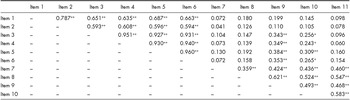
An initial correlation matrix (Table 1) appeared to suggest a two-factor model. Item 1 through Item 6 were generally significantly correlated with each other whilst Items 7 through 11 were generally significantly correlated with each other. There were some exceptions to this rule – for example, Item 9 (I worry that bringing up suicide with a client might make the problem worse) and Item 10 (I would be more hesitant to ask a male client about suicide) were significantly correlated with Items 3 through 6 as well as Items 7 through 11. Despite the apparent two-factor structure of correlations, the measure as whole demonstrated more than adequate overall inter-correlation for the purposes of factor analysis. The KMO Measure of Sampling Adequacy was 0.846, well above the recommended cut-off of 0.6. The anti-image correlation matrix, which provides item-level KMO values, produced diagonal correlations of 0.740 to 0.909. These are well above the suggested cut-off of 0.5 (Yong & Pearce, Reference Yong and Pearce2013), further supporting the adequacy of these data for factor analysis. Additionally, Barlett's Test of Sphericity was significant at the p < 0.000 level, providing more support for the adequacy of the item pool for factor analysis. Finally, the overall internal consistency of the measure (α = 0.884) was at the upper end of the ‘very good’ range (George & Mallery, Reference George and Mallery2003), again suggesting high inter-correlation within the measure. Thus, we proceeded with the EFA.
Correlation Matrix for Suicide Competency Inventory (Graham et al., Reference Graham, Rudd and Bryan2011)

Notes: *p < 0.05; p < 0.01.
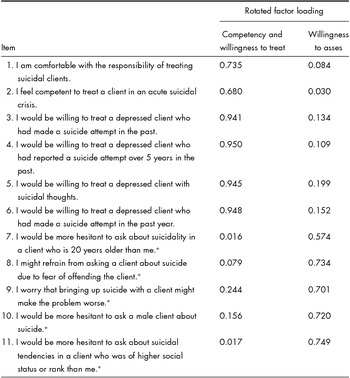
Principal axis factoring yielded a two-factor model that explained a cumulative 71.64% of the variance. The eigenvalues for both factor 1 (5.290) and factor 2 (2.590) were well above the cut-off of 1. Visual analysis of the scree plot (Figure 1) further supported a two-factor model, as demonstrated by the sharp drop off after the second factor and the ‘bend of the elbow’ (Goodwyn, Reference Goodwyn2012) occurring at the third factor. The rotated two-factor solution can be seen in Table 2. Conversely, parallel analysis of the data using 1,000 permutations of the dataset suggested a three-factor model, as did Velicer's MAP test. However, the value for the third factor in the parallel analysis with 1,000 permutations was 0.536, only slightly above the 95% percentile of 0.498 for that factor, suggesting a weak third factor and possible overextraction. Indeed, parallel analysis has been noted for its tendency to extract more factors than warranted (Buja & Eyuboglu, Reference Buja and Eyuboglu1992; O'Connor, Reference O'Connor2000).
Scree plot for the suicide competency inventory (Graham et al., Reference Graham, Rudd and Bryan2011).

Factor Structure for Suicide Competency Inventory (Graham et al., Reference Graham, Rudd and Bryan2011)

Note: *Item was reverse-scored.
Because of these conflicting results and because a three-factor model was proposed by the scale's authors and found in psychometric analysis of the scale with rehabilitation counsellors (Lund et al., in press), we also tried forcing a three-factor solution via PAF with varimax rotation. The third factor had an eigenvalue of 0.817 and brought the cumulative per cent of variance explained to 79.06%. However, the two items (Item 1 – ‘I am comfortable with the responsibility of suicidal clients’ and Item 2 – ‘I feel competent to treat a client in an acute suicidal crisis’) that loaded most strongly on the newly derived third factor with rotated factor loadings of 0.742 and 0.781 still retained fairly high loadings of 0.490 and 0.420 on factor 1, respectively, after rotation. On this basis as well as the results of correlation matrix and eigenvalues, we chose to retain the two-factor model as the best fit in this sample. The rotated factor loadings for the two-factor model can be seen in Table 2.
The retained two-factor model yields one factor that addresses perceived comfort, competency, and willingness to treat suicidal or previously suicidal clients and a second factor that addresses willingness to enquire about suicidality. Similar to the patterns seen in the correlation matrix (Table 1), the first factor (competency and willingness to treat) is made up of Items 1 through 6, and the second factor (willingness to assess) is made up of Items 7 through 11. Both factors demonstrated high factor loadings; loadings for factor 1 ranged from 0.680 to 0.950, and loadings for factor 2 ranged from 0.574 to 0.749. Additionally, there was little double-loading between factors; the highest loading for an item on its non-primary factor was 0.244. This suggests that the two factor model is a good fit for this measure in this population. Internal consistency was excellent for the six-item competency and willingness to treat subscale (α = 0.952) and very good for the willingness to assess subscale (α = 0.826).
Suicide Competency Assessment Form
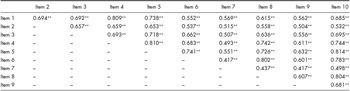
As with the SCI, we ran an initial correlation matrix for the items on the SCAF (Table 3). All items were significantly correlated with each other at the p < 0.000 level, with correlation values ranging from 0.407 to 0.809. The measure also had excellent internal consistency (α = 0.945). The KMO Measure of Sampling Adequacy was 0.932, and the Bartlett's Test of Sphericity was significant at p < 0.000. The anti-image correlation matrix, which provides item-level KMO values, produced diagonal correlations of 0.905 to 0.975. These are well above the suggested cut-off of 0.5, further supporting the adequacy of these data for factor analysis. All of these results strongly support the adequacy of the data for factor analysis.
Correlation Matrix for Suicide Competency Assessment Form (Cramer et al., Reference Cramer, Johnson, Mclaughlin, Rausch and Conroy2013)

Notes: **p < 0.001.
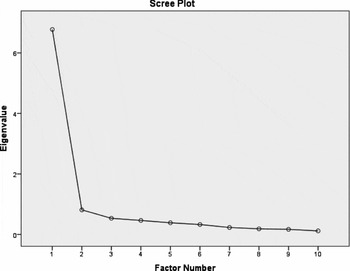
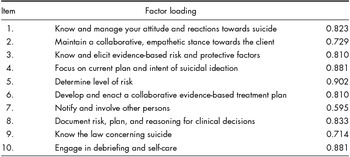
As with the SCI, we conducted an EFA using PAF for the SCAF. The results strongly supported a one-factor model for the SCAF, producing an eigenvalue of 6.773 and explaining 67.73% of the variance. Visual analysis of the scree plot (Figure 2) also strongly supported this model, with the bend of the elbow occurring at the second factor. No rotation was required given the one-factor model obtained. Parallel analysis with 1,000 permutations and Velicer's MAP test also indicated one-factor solutions. In the PAF analysis, all 10 items loaded strongly on the single factor and ranged from 0.595 (Notify and involve other persons) to 0.902 (Determine level of risk). Furthermore, only one item had a factor loading of less than 0.700. Factor loadings for all items can be seen in Table 4.
Scree plot for the SCAF (Cramer et al., Reference Cramer, Johnson, Mclaughlin, Rausch and Conroy2013).

Factor Loading for Suicide Competency Assessment Form (Cramer et al., Reference Cramer, Johnson, Mclaughlin, Rausch and Conroy2013)

Convergent Validity
The SCAF total score was significantly correlated with the SCI total score (r = 0.563, p < 0.000) as well as the competency and willingness to treat subscale (r = 0.537, p < 0.000) and the willingness to assess subscale (r = 0.315, p = 0.002). The SCAF overall competency score was significantly correlated with the SCAF total score (r = 0.850, p < 0.000), the SCI total score (r = 0.495, p < 0.001), the SCI competency and willingness to treat subscale (r = 0.450, p < 0.000), and the SCI willingness to assess subscale (r = 0.323, p = 0.002). As expected, the SCI total score was significantly correlated with both the competency and willingness to treat subscale (r = 0.897, p < 0.000) and the willingness to assess subscale (r = 0.655, p < 0.000). The two SCI subscales were also significantly correlated with each other (r = 0.254, p = 0.014).
Discussion
The present study provided a preliminary investigation into the psychometric properties of the SCI (Graham et al., Reference Graham, Rudd and Bryan2011) and the SCAF (Cramer et al., Reference Cramer, Johnson, Mclaughlin, Rausch and Conroy2013) in a multistate sample of 93 VR support staff. We found that both the SCAF and SCI had very good to excellent overall internal consistency in this sample and were well-suited for factor analysis.
The SCI was hypothesised by the measure authors to load on a three-factor model (competency, willingness to treat, and willingness to assess) and a prior psychometric analysis with a sample of rehabilitation counsellors supported this model (Authors, in press); however, in our sample, the SCI instead loaded on a two-factor model, with the competency and willingness to treat scales combining to form one factor. Both the six-item competency and willingness to treat subscale and the five-item willingness to assess subscale demonstrated very good to excellent internal consistency. The differing factor structure in the present sample suggests that the SCI may factor differently in different populations, particularly support staff. This may be due to the fact that they are not directly working as clinicians in their role and do not have the same clinical obligations as counsellors regarding things like abandonment, duty to assess risk and warn, or explicit, carefully planned transfer between counsellors (Commission on Rehabilitation Counselor Certification, 2010). Thus, their willingness to work with clients who are suicidal or have a history of suicidality may be more closely aligned with their perceived comfort in doing so due to their somewhat decreased level of clinical, ethical, and legal obligation to and responsibility for the client.
The SCAF loaded on a strong single-factor model, consistent with both the developer's hypothesis (Cramer et al., Reference Cramer, Johnson, Mclaughlin, Rausch and Conroy2013) and previous analysis of this measure in rehabilitation counsellors (Lund et al., in press). It demonstrated excellent internal consistency. Additionally, the SCI, the SCAF total score, and the SCAF overall suicide competency ratings were all significantly correlated, providing initial support for their convergent construct validity as measures of perceived suicide assessment comfort and competency.
Implications for Training and Practise
An important finding from the data collected is verification that support staff in VR offices are working directly with individuals expressing suicidal thoughts and intentions. A significant training need exists with 84.9% of participating support staff reporting they have worked with suicidal clients, and only 29.0% reporting having received training to do so. This discrepancy illustrates the critical need for research and training in this area and thus the need for psychometrically sound measures of suicide competency in these populations.
These results provide initial support for the convergent validity, reliability, and factor structure of the SCAF and SCI in VR support staff. As such, they may serve as useful tools for assessing the competency and comfort of support staff in working with suicidal or potentially suicidal clients. For example, VR offices could use these measures to both assess their staff's comfort and perceived competency in working with suicidal clients as well as a means by which to open a conversation about the often difficult to broach topic of suicide and people's experiences with working with suicidal clients. Additionally, VR offices could also use these measures as part of supervision and training to assess support staff's perceived needs, strengths, and weaknesses in these areas and to provide directions for skill development. Finally, the measures could also be used as outcome measures before and after suicide-related training occurs in order to assess the perceived effectiveness of said training. The measures could also serve as a means of measuring needs and progress over time, giving agencies, staff, and trainers information of what areas were enhanced by training and supervision, and what areas need to be further targeted by future training or supervision.
Limitations and Directions for Future Research
One limitation of the present study is the relatively small sample size of 93 participants. Varying guidelines for factor analysis sample size exist (Kelsey, Reference Kelsey2012), but one common guideline is five to ten participants per test item (Kelsey, Reference Kelsey2012; Tinsley & Tinsley, Reference Tinsley and Tinsley1987). Although our sample size well exceeds five participants per item for both the 11 item SCI and the 10 item SCAF, we fall short of the 10:1 participant to item ratio for both measures. Thus, this study should be replicated with a larger sample of support staff in order to see if the two item factor structure of the SCI is still optimal, especially given the somewhat mixed results between the different factor analytic methods employed. Additionally, although we used a multistate sample of participants, only six states were represented, and two of those states were represented by only one participant each. Similarly, our sample was not diverse in terms of gender, with 90.3% of the participants being female. Although this may represent the general under-representation of men in the counselling profession, a larger sample may still be more demographically diverse and thus more generalisable. Thus, researchers who are replicating or expanding these analyses may benefit from using a larger, more geographically diverse sample, such as a national sample, and to collect additional demographic data such as data on participant race and ethnicity in order to see if there are demographic differences in self-reported suicide assessment competency. Researchers may also wish to examine the psychometrics of these measures in other support staff populations, such as university counselling centre and community mental health centre support staff.
Future research on the psychometrics of these measures should include other measures of validity and reliability, such as administrating the measures at two separate time points in order to assess test–retest reliability. Also, researchers may wish to validate the observation-based and informant-report functions of the SCAF (Cramer et al., Reference Cramer, Johnson, Mclaughlin, Rausch and Conroy2013). This would allow researchers to assess to what degree participant perceptions of competency correlate with both observer-assessed competency and supervisor perceptions of competency. Furthermore, researchers may wish to assess these measures sensitivity to change as the result of training or assessment in order to provide support for their use as assessment measures.
Although it is possible that some items on the SCAF may not be particularly relevant to support staff – for example, one would not generally expect a member of the support staff to develop a safety plan with a client – the extremely high internal consistency and inter-item correlation seen in this sample suggests that perceived competency is highly correlated across the 10 domains assessed by the measure. Thus, participants who rate themselves as having low competency on more clinical domains (e.g., developing a safety plan) also rated themselves as having lower competency in less clinical domains (e.g., risk assessment, knowledge of suicide-related laws). It may be that having increased knowledge of how to intervene in a crisis situation could increase one's perceived competency in addressing suicide in general, due having a better understanding of how things should proceed if a critical situation does become evident. Thus, support staff may benefit from being trained in all the assessed domains of suicide assessment and intervention, even if they may be the sole or primary person involved in the process. Additionally, support staff may be involved in assisting counsellors during portions of the suicide assessment and intervention process and thus may benefit from training in all of its steps. In future studies, researchers should examine the roles, responsibilities, and practises of VR support staff when working with suicidal clients.
Conclusion
We found preliminary support for the reliability, factor structure, and convergent validity of two self-report measures of suicide assessment competency in a multistate sample of 93 VR support staff. Both measures demonstrated very good to excellent internal consistency and were significantly correlated with each other, suggesting possible convergent construct validity. The SCAF loaded on one factor whilst the SCI loaded on two factors. These results provide initial support for the use of these measures to assess perceived suicide assessment and intervention competency in VR support.
Acknowledgements
The authors would like to extend our gratitude to the state vocational rehabilitation offices and vocational rehabilitation support staff who participated in this study. Enquiries about this paper should be sent to Emily M. Lund, Center for Psychiatric Rehabilitation, Boston University, 940 Commonwealth Avenue, Boston, MA 02215, via email at emlund@bu.edu or emily.m.lund@gmail.com
Statement of support
This material is based upon work supported by the Office of Academic Affiliations, Department of Veterans Affairs.
Conflict of Interest
None.