


Recent understanding of education and human development recognises the importance of psychosocial factors, particularly personal resiliency, in the academic success of youth (Prince-Embury & Saklofske, Reference Prince-Embury and Saklofske2013, Reference Prince-Embury and Saklofske2014). However, there are a number of methodological issues related to resilience/resiliency research and practice, which include defining, measuring, and interpreting resilience. This article will describe the Resiliency Scales for Children and Adolescents (RSCA; Prince-Embury, Reference Prince-Embury2006a, Reference Prince-Embury2007) as a measure of resiliency in students that is applicable for school practice within the classroom environment. Particular attention will be paid to the RSCA's utility as a screening measure to identify students with strengths or limitations in personal resiliency, as a planning measure to focus the design of resiliency interventions for individual or groups of individuals, and as an evaluation measure of the impact of resiliency interventions. The RSCA has been designed to be an assessment method that is useful in school settings because it is: (a) based on developmentally appropriate factors of personal resiliency that are well grounded in theory; (b) brief, user friendly and easy to administer and thus applicable for classroom-wide and individual use; (c) easy to interpret, as well as theoretically and practically linked to intervention; and (d) has the sound psychometric properties required to monitor progress or evaluate the effectiveness of interventions.
Broadbased Resilience Assessment Issues
Resilience researchers and theorists have defined resilience from a systemic perspective, as the complex interaction of child characteristics and external supports that buffer the effects of adverse situations that place children at risk of negative outcomes. Resilience, viewed as a product of complex interactions of personal attributes and environmental circumstances, mediated by internal mechanisms, has presented an assessment challenge to developmental researchers in the past (Luthar, Cicchetti, & Becker (Reference Luthar, Cicchetti and Becker2000). In an effort to clarify constructs, Luthar (Reference Luthar1991) has distinguished ‘resilience’ from ‘resiliency’, in that the former is defined as interactive and contextual, and the latter addresses personal attributes of the individual. Previous studies of resilience have been longitudinal, have employed a developmental-psychopathology perspective, and have tried to capture contextual aspects of resilience specific to the group and sets of circumstances. Studies assessing personal resiliency have employed extensive batteries of pre-existing tests, along with measures of achievement. Researchers of both resilience and resiliency have used different measures across studies and across populations, in an attempt to understand resilience better.
Glover and Albers (Reference Glover and Albers2007) argue that screening tools used in educational settings should demonstrate appropriateness, usability, and technically adequate norms, reliability, and validity. They suggest that few current screening tools have adequate norms, reliability, sensitivity and specificity. Similarly, Levitt, Saka, Romanelli, and Hoagwood (Reference Levitt, Saka, Romanelli and Hoagwood2006) conclude that few of the currently available screening instruments demonstrate high levels of both sensitivity and specificity. They call for additional assessment tools with demonstrated reliability and validity. Adequate reliability is particularly important if follow-up testing is needed. Screening tools should have sufficient internal consistency and test–retest reliability for different age groups and populations that differ by ethnicity, culture, gender, and geographic region. Lack of internal consistency indicates that the characteristic measured is not clearly defined and may include substantial error variance. Such measures are in turn likely to have poor test–retest reliability. This is important, because if a measure does not assess consistently in an untreated or control sample over time, it is unlikely to detect the effect of an intervention in a treatment group. Measures that are sensitive enough to measure change over time at a group and individual level are important in determining whether or not interventions are effective.
On a practical level, there is work to be done to make resiliency assessment tools more field-friendly (Masten, Reference Masten2001; Masten & Powell, Reference Masten, Powell and Luthar2003). Hence, there is a need for measures and benchmarks describing resiliency that are brief, easily administered, and simple to score and interpret. In addition, measures used with diverse school populations must be bias free with respect to gender and ethnicity, and worded so that they might be used with a broad range of reading levels. In order to be acceptable to parents, students and teachers in school settings, a measure assessing resiliency needs to be strength-based and informative, while at the same time not stigmatising or ‘pathologising’ of groups or individuals.
Developmentally Appropriate Factors of Resiliency
The first step in the assessment of resiliency is to define what aspect to assess. As mentioned previously, resilience research has identified lengthy lists of protective factors present in the child's family, school, and community, as well as in personal characteristics of the child. An ecological perspective also considers the complex interaction of these factors and their effect on the child. Selecting what factors to assess or determining how to assess complex interactions presents a measurement challenge. First, researchers must decide whether to focus on the context or environmental factors (resilience), personal attributes of the youth (resiliency), or the interaction between the two. Assessment of the interaction that underlies resiliency requires multiple measures and specific plans on how to assess them in conjunction with each other. Alternatively, assessment of personal attributes must be based on developmental research and research showing that these attributes are correlated with protective factors and successful behavioural outcomes.
The RSCA provides an assessment of the personal attribute of resiliency and is comprised of three core developmental factors of personal experience: Sense of Mastery, Sense of Relatedness, and Emotional Reactivity and the relationship of these factors to one another (Prince-Embury, Reference Prince-Embury2006a, Reference Prince-Embury2007). Focus on the personal experience of the child assumes that this experience mediates between external protective factors and positive behavioural outcomes. The developmental research that demonstrates relevance of these three constructs to children's subsequent coping and success is discussed below.
Sense of Mastery
One core mechanism that has been consistently identified as important for resiliency in developmental and resilience research is the development of children's sense of mastery or self-efficacy. White (Reference White1959) suggested that children's sense of mastery or efficacy provides them with the opportunity to interact with and enjoy cause and effect relationships in the environment. According to White, a sense of competence, mastery, or efficacy is driven by an innate curiosity, which is intrinsically rewarding and is the source of problem-solving skills. Bandura (Reference Bandura1977) suggested that students’ self-efficacy beliefs for regulating their own learning and mastering academic activities determine their aspirations, level of motivation and academic accomplishments. The parallel construct of competence also found its way into what has been termed the third wave of resilience research. This work examined competence as a strategy for preventing or ameliorating behavioural and emotional problems (Masten, Burt, & Coatsworth, Reference Masten, Burt, Coatsworth, Cicchetti and Cohen2006; Masten & Coatsworth, Reference Masten and Coatsworth1998). Consistent with this, the Project Competence group, focused on competence criteria for positive adaptation in age-salient developmental tasks (Masten & Powell, Reference Masten, Powell and Luthar2003). Several studies conducted as part of the Rochester Child Resilience Project supported the hypothesis that positive expectation is related to resilience. Positive efficacy expectations in 10- to 12-year-olds predicted better behavioural adaptation and resilience to stress (Cowen, Pryor-Brown, Hightower, & Lotyczewski, Reference Cowen, Pryor-Brown, Hightower and Lotyczewski1991). Positive expectations about their future predicted lower anxiety, higher school achievement and better classroom behaviour control (Wyman, Cowen, Work, & Kerley, Reference Wyman, Cowen, Work and Kerley1993). In summary, previous research and theory suggests that children and youth who have a greater sense of mastery may be more likely to succeed in a school environment and less likely to develop pathological symptoms. Consistent with this assumption, preventive interventions may be designed to increase general and specific sense of mastery by increasing children's problem-solving skills and associated expectations of success.
Sense of Relatedness
Children and youths’ relational experiences and abilities buffer them against adversity in two ways. First, they may view relationships as providing specific supports in specific situations. Second, internal mechanisms that emerge from children's cumulative experience of previous support may shield them from negative psychological impact. The importance of relationships and relational ability as mediators of resilience has been supported in research by developmental psychopathologists such as Werner and Smith (Reference Werner and Smith1982). Throughout their writing, they have stressed the importance of children having relationships with caring adults other than, or in addition to, their parents. Werner and Smith (Reference Werner and Smith1982) noted that resilient youth sought support from non-parental adults (especially teachers, ministers, and neighbours) more often than non-resilient youth. These supportive relationships were influential in fostering resilience.
One aspect of relational ability, trust, most clearly represents Erik Erikson's (Reference Erikson1963) first stage of social emotional development, upon which all social development is built. Erikson defined basic trust as the ability to receive and accept what is given, and he believed that basic trust was initially based in infants’ oral mode of functioning before it evolved through aggregated experiences with the caregivers to establish children's balance of trust versus mistrust. Temperament differences have also been cited by developmental and personality theorists as influencing the relationships that individuals have with others, which in turn influence the development of the capacity to trust. Constructs such as ‘slow to warm up to others’ (Thomas & Chess, Reference Thomas and Chess1977) or internality (Eysenck, Reference Eysenck1967) have been used to describe variation in comfort with others. In summary, we may expect that children and youth with a higher sense of relatedness will be more resilient and less vulnerable to negative outcome when faced with life's adversities.
Emotional Reactivity
Research in the field of developmental psychopathology has demonstrated that children's development of pathology in the presence of adversity is related to their emotional reactivity and their ability to regulate this reactivity. Specifically, strong emotional reactivity and related difficulty with regulation of this reactivity have been associated with behavioural maladjustment and vulnerability to pathology. Emotional reactivity is the child's arousability or the threshold of tolerance that exists prior to the occurrence of adverse events or circumstances. It is important because it affects the degree of emotional arousal prompted by adversity and consequently defines how difficult it will be for the child to regulate, modify and redirect this arousal. Alternatively, Rothbart and Derryberry (Reference Rothbart, Derryberry, Lamb and Brown1981) have defined emotional reactivity as the speed and intensity of a child's negative emotional response. Children's reactivity varies in its intensity, sensitivity, specificity, windows of tolerance, and recovery (Siegel, Reference Siegel1999). Conversely, emotional regulation, or the ability to modulate emotional responses is a significant factor in fostering resilience (Cicchetti, Ganiban, & Barnett, Reference Cicchetti, Ganiban, Barnett, Garber and Dodge1991; Cicchetti & Tucker, Reference Cicchetti and Tucker1994; Eisenberg, Champion, & Ma, Reference Eisenberg, Champion and Ma2004). Regulation and redirection of emotional arousal is necessary for children to function adaptively in emotionally challenging situations (Cicchetti et al., Reference Cicchetti, Ganiban, Barnett, Garber and Dodge1991; Thompson, Reference Erikson1990). Thus, high pre-existing emotional reactivity is a risk factor in that it interferes with children's preparation for facing difficult circumstances.
Resiliency Scales for Children and Adolescents: An Example
The Resiliency Scales for Children and Adolescents (RSCA; Prince-Embury, Reference Prince-Embury2006a, Reference Prince-Embury2007) were designed to measure personal resiliency within three developmental domains using three student self-report scales: Sense of Mastery, Sense of Relatedness and Emotional Reactivity. A particular contribution of the RSCA is the assessment of personal resiliency so that it emphasises competence and not pathology, and is grounded in extensive empirical research on developmental competence. Most existing measures of resiliency are assessments of disturbance or pathology, and those that are assessments of positive characteristics of children are assessments of current behavioural status. Instead, the RSCA examines children's experiences of the personal resources that are available to them for coping with adverse events.
The full measure includes 64 Likert-type items and yields two Index Scores: Resource and Vulnerability (Prince-Embury, Reference Prince-Embury2006a, Reference Prince-Embury2007). A Resource Index combines the two strength-based scales (Mastery and Relatedness) into one score. The Vulnerability Index expresses the discrepancy between the youth's Emotional Reactivity Scale and Resource Index scores. Evidence of internal consistency was good to excellent for all three global scales across three age-bands (Prince-Embury, Reference Prince-Embury2007). Internal consistency for both Index scores was excellent (Prince-Embury, Reference Prince-Embury2007). The three global scales are made up of 10 subscales that constitute aspects of the three major constructs. Previous research has supported the three-factor structure underlying the RSCA three global scale format in normative samples (Prince-Embury & Courville, Reference Prince-Embury and Courville2008a). Measurement invariance for the three-factor structure was found across gender within the normative sample aged 9–18, and partial invariance was found across three age bands (Prince-Embury & Courville, Reference Prince-Embury and Courville2008b). This research suggests that the three-scale structure applies similarly across gender. Partial invariance across age-band did not affect the basic three-factor structure of the RSCA. These findings support the use of the RSCA as formatted across gender and across ages 9–18. Additional research has also found that the RSCA is not sensitive to differences in race/ethnicity when parent education level is controlled for (Prince-Embury, Reference Prince-Embury2009). This finding supports the use of the RSCA across groups of different race/ethnicity without bias by these factors. Additional validity evidence is provided in the technical manual. The multi-factor, multi-construct structure of the RSCA allows for the plotting of a Personal Resiliency Profile for individuals that may be compared longitudinally to visually track progress, or for groups of individuals for aggregate comparison. See additional work by Prince-Embury and Steer (Reference Prince-Embury and Steer2010) for more detailed explanation of this plotting procedure.
RSCA Summary Scores
Although the three-factor structure of the RSCA was found to be the best fit for the normative sample, screening requires simplification into summary scores. The multi-factor structure of the RSCA allows for the calculation of two theoretically sound summary scores that combine the three global scale scores. This first summary score, the Resource Index, is the standardised average of the Sense of Mastery and Sense of Relatedness scales for a given individual. This average is an estimate of the youth's personal strength or resources weighting Sense of Mastery and Sense of Relatedness equally. Factor analytic studies indicate that although the three RSCA scales represent three distinct factors, Sense of Mastery and Sense of Relatedness are highly related and thus may be considered together for screening purposes (Prince-Embury & Courville, Reference Prince-Embury and Courville2008a). Resiliency theory suggests that youth who perceive themselves as having sufficient personal resources will be more resilient and less likely to develop psychopathology than those who experience themselves as having insufficient personal resources. Thus, youth with high scores on the Resource Index are likely to be more resilient than youth with low scores. Youth with significantly below average scores on the Resource Index might be identified through screening for preventive interventions that increase personal resources.
The second summary score, the Vulnerability Index score, is the standardised difference between the Emotional Reactivity score and the Resource Index score. The Vulnerability Index quantifies children's personal vulnerability as the relative discrepancy between their combined self-perceived resources (the Resource Index) and their fragility as described by emotional reactivity (the Emotional Reactivity Scale score; Prince-Embury, Reference Prince-Embury2007). This index score is consistent with theories that define vulnerability as resulting when internal fragility is not balanced by personal resources. In summary, youth with a low Vulnerability Index Score are more likely to be resilient in the face of adversity while those with a high Vulnerability Index score are unlikely to have the resources to cope effectively with their own emotional reactivity. Both Index scores provide important information in assessing the personal resiliency of individuals.
Linking Personal Resiliency Assessment to Preventive Screening
Multi-Tiered Universal Screening Using the RSCA Index Scores
The RSCA may be used for initial screening to place students within the continuum of support needs based on relative resiliency and vulnerability. Universal screening requires as much simplification of scoring as possible, along with the potential to unfold the scores into deeper levels of information as needed. The RSCA Index scores are useful for screening purposes because they combine substantial information into two scores for initial screening. The Index scores may also be unfolded to provide more detailed information at the global and subscale levels. The internal validity of the Index scores is based on the fact that they were derived from empirical analyses of RSCA Scale score profiles, factor analytic studies and validity studies (Prince-Embury, Reference Prince-Embury2006a, Reference Prince-Embury2007; Prince-Embury & Courville, Reference Prince-Embury and Courville2008a, Reference Prince-Embury and Courville2008b).
Within primary prevention or Tier 1 of a three-tiered school-wide prevention program, the Vulnerability Index is the best first line predictor to identify students for Tier 2 selected services in resiliency promotion (Prince-Embury, Reference Prince-Embury2007, Reference Prince-Embury2008). Even though students may be coping effectively in the present, a high Vulnerability Index (>T60; 20–25%) suggests that they might struggle if they encounter adverse events.
The nature of specialised Tier II resiliency-promoting interventions could be planned using the RSCA global scales. Students with Emotional Reactivity Index Scores in the high range (>T60) would be offered preventive intervention to reduce stress and foster emotional regulation. Those with Resource Index Scores in the low range (<T40) would be offered support with coping skills and relating to others (see Prince-Embury, Reference Prince-Embury, Doll, Pfohl and Yoon2010, for more detail). Tier III prevention would consist of identifying children with Vulnerability Index scores greater than T65 for referral or special individualised services.
Profile Analysis
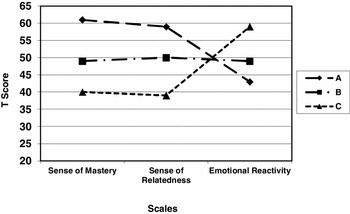
The RSCA Personal Resiliency Profile may also be used in screening to provide a simple, empirically based, graphic decision tree. Characteristic Personal Resiliency Profiles in the RSCA standardisation sample were identified using cluster analysis, a statistical technique for summarising the variability of profiles into profiles that most characterise the sample (Prince-Embury & Steer, Reference Prince-Embury and Steer2010). This method produced three Personal Resiliency Profiles that most characterise the normative sample of children and adolescents. These profiles are displayed in Figure 1. Profile C corresponds to a mean Vulnerability Index score >T60 or High Vulnerability. Students manifesting this profile would be selected for Tier 2 additional services, while those with Profiles A (High Resiliency) or B (Adequate Resiliency) would not. Profile C (High Vulnerability) represents 25% of the normative U.S. sample (Prince-Embury & Steer, Reference Prince-Embury and Steer2010) and is characterised by low mean Sense of Mastery and Sense of Relatedness Scale scores along with a high mean Emotional Reactivity Scale Score. A computer-based program designed to identify students whose RSCA profiles resemble Profile C could assist in identifying students for Tier II intervention.
Profiles of Personal Resiliency in a normative sample. n = 641 (Prince-Embury and Steer, Reference Prince-Embury and Steer2010; copyright © 2010 by SAGE Publications).

Outcome Assessment
One advantage of systematic screening and targeted intervention is that outcome assessment can be implemented to determine whether a specific preventive intervention had a statistically meaningful desired impact. To the extent that preventive interventions are provided before the appearance of symptoms, positive outcomes often need to be inferred from the observation that symptoms did not occur for a specified period of time during and after the intervention. Screening with the RSCA provides another option for the assessment of the impact of resiliency-promoting interventions. For example, interventions designed to lower emotional reactivity could be evaluated based on their effectiveness in producing lower scores on the RSCA Emotional Reactivity Scale. Similarly, interventions designed to increase Sense of Mastery could be evaluated based on their effectiveness in producing higher scores on the RSCA Sense of Mastery Scale.
Personal Resiliency and Academic Resilient Classrooms
Resiliency in children and adolescents is related to many aspects of their functioning in an educational setting, including academic achievement, school attendance and school completion. Resiliency assessment makes it possible to assess variables other than cognitive ability that influences the ability of students to benefit from the education that is provided for them. For example, Doll, Zucker, and Brehm (Reference Doll, Zucker and Brehm2004) described the use of the ClassMaps Survey for the purpose of selecting classrooms and interventions for enhancing classrooms’ resilience. This is an ecologically based tool that uses students’ reports of classroom experience to provide feedback for teacher modification of the classroom environment to foster resiliency in students (Doll et al, Reference Doll, Kurien, LeClair, Spies, Champion, Osborn, Gilman, Huebner and Furlong2009; Doll, Spies, LeClair, Kurien, & Foley, Reference Doll, Kurien, LeClair, Spies, Champion, Osborn, Gilman, Huebner and Furlong2009). The RSCA and the ClassMaps Survey are similar in developmental factors that are essential to resiliency and both use self-reports of children. These tools differ in that the ClassMaps Survey focuses on aggregate student perceptions of specific aspects of classroom environment while the RSCA focuses on experiences of youth that relate to their overall mental health and vulnerability to a variety of negative outcomes. Future research might use the RSCA and the ClassMaps Survey concurrently to better understand group and individual differences in response to educational interventions. Schools that use the ClassMaps Survey may also aggregate RSCA scores within classrooms rather than focusing on individual scores. In this way, classrooms rather than individual students may be identified as high in Vulnerability or Emotional Reactivity, or low in Sense of Mastery or Sense of Relatedness, and classroom interventions could be designed and monitored on these factors along with ClassMaps Survey dimensions.
Preparation for and Assessment of Impact of Unanticipated Events
Another application of resiliency constructs in universal screening is the assessment of resiliency preparation for unanticipated events and circumstances. The RSCA may be administered as a regular part of the school curriculum at the beginning of each academic year as part of universal screening. Subsequent administration at the end of the year could assess both impact of preventive intervention as well as impact of unanticipated circumstances on those who did versus those who did not receive preventive intervention.
Summary
In summary this article examines the assessment of personal resiliency in the context of the school environment. In this process, conceptual and measurement issues are discussed. The Resiliency Scales for Children and Adolescents (RSCA) is presented as a tool for the assessment of personal resiliency that is grounded in extensive empirical research on core developmental constructs, and which emphasises strength rather than pathology. The RSCA is presented as unique in that most of the existing assessment tools for children and youth are assessments of disturbances or pathology and those that are assessments of positive characteristics are limited to current behavioural status.
Second, models of universal screening and prevention are suggested, using the RSCA Index and global scales to provide cut scores in a three-tiered screening process. Logistically, the simple format of the RSCA would allow a computer-based administration and scoring so that students could complete the scale in the school's computer lab and then the teacher or school leaders could pull down individual or summary reports.
Finally, such a school-wide database would allow immediate evidence of whether an intervention had been effective, without waiting for the distal outcomes such as school completion or mastery of the transition from elementary to middle or middle to high school. In addition the specific mediating role of sense of mastery, sense of relatedness and emotional reactivity in predicting these outcomes may be examined for future intervention.