The annual incidence of clinical mastitis in dairy sheep is usually lower than 5%. In sporadic cases, high prevalence of Staphylococcus aureus has been reported for severe clinical manifestations. Staph. aureus is usually isolated from intramammary infections that become chronic, accounting for 3–37% of cases (Bergonier et al. Reference Bergonier, de Cremoux, Rupp, Lagriffoul and Berthelot2003). Its presence in sheep causes concern because infections caused by this pathogen can lead to loss of the mammary gland and even death of the ewe and/or lamb (Radostits et al. Reference Radostits, Gay, Blood and Hinchcliff2000; Menzies & Ramanoon, Reference Menzies and Ramanoon2001).
Some studies have suggested that only a few specific clones of Staph. aureus are responsible for most cases of mastitis in dairy farms and that some of these clones may have wide geographic distribution (Annemuller et al. Reference Annemuller, Lammler and Zschock1999; Katsuda et al. Reference Katsuda, Hata, Kobayashi, Kohmoto, Kawashima, Tsunemitsu and Eguchi2005; Smith et al. Reference Smith, Green, Medley, Bird, Fox, Schukken, Kruze, Bradley, Zadoks and Dowson2005). However, molecular epidemiological studies of Staph. aureus isolates from sheep are still scarce. In Brazil, the first registration of a sequence type (ST) of a Staph. aureus strain from sheep in the MLST database (http://www.mlst.net) was made by Aires-de-Souza et al. (Reference Aires-de-Sousa, Parente, Vieira-da-Motta, Bonna, Silva and Lencastre2007) in research including different species of ruminants in southeastern Brazil. Multilocus sequence typing (MLST), a method based on sequencing of conserved genetic fragments, allows the analysis of the geographical distribution of clones of important pathogens by comparing them with STs recorded in an international database. In the case of Staph. aureus, the analysis of seven loci that present variations within the species generates a significant number of different allelic profiles, giving a high discriminatory power to MLST.
In order to know the distribution of Staph. aureus strains associated with infectious mastitis in flocks of sheep in the northeast of Brazil and establish whether these clones are related to the strains distributed internationally, this study analysed the genetic diversity of Staph. aureus isolates from cases of clinical and subclinical mastitis in ewes by pulsed-field gel electrophoresis (PFGE) and MLST. From the molecular profiles, it is possible to infer genetic relations between different clones, to detect the gene flow, and to trace the spread of the infection in the herd (Kapur et al. Reference Kapur, Sischo, Greer, Whittman and Musser1995). These elements may help the development of strategies to reduce infections caused by this pathogen.
Materials and Methods
Clinical examination and sample collection
From August 2004 to October 2005, 31 herds located in 15 districts of State of Pernambuco (northeast of Brazil) were surveyed and 135 primiparous and multiparous Santa Inês ewes in different stages of lactation were sampled. A total of 270 mammary glands were examined clinically; 26 were diagnosed with clinical mastitis and the California Mastitis Test (CMT) was carried out in locus on the other 244 mammary glands. Ewes were separated from their lambs about 12 h before mammary gland examination and subsequent milk collection. Clinical examination was carried out following the recommendations of Diffay et al. (Reference Diffay, Mc Kenzie, Wolf, Pugh and Pugh2005). CMT was done on a foremilk sample from each udder half and scored, as recommended by Schalm et al. (Reference Schalm, Carroll and Jain1971). Ewes in the dry period, newly lambed, within 15 d after parturition or in the final stages of lactation were not selected. In these herds, ewes had never been handled for milking.
Collection of milk samples and bacteriological culture was performed according to standard laboratory procedures of the National Mastitis Council (1999). Samples were collected after cleaning the teats and discarding a few streams of milk. After scrubbing the teat ends with cotton moistened with 70% alcohol, 5 ml of milk were collected in tubes previously sterilized. All samples were immediately transported to the laboratory in ice-cooled containers and incubated at 37°C for 18–24 h. Subsequently, 10-μl milk samples were inoculated on 5% sheep blood agar at 37°C, taking measures after 24, 48, 72 and 96 h.
Identification of Staph. aureus isolates
Conventional methods that included Gram staining, colony morphology, catalase and coagulase tests were used (Quinn et al. Reference Quinn, Carter, Markey and Carter1994). Colonies identified as Staph. aureus were confirmed by polymerase chain reaction (PCR) performed on the nuc gene using the primers F:5′TATGGTCCTGAAG CAAGTG3′ and R:5′GCCACGTCCATATTTATCAG3′ that were designed based on sequences of genomic DNA of MRSA strain 252 (GenBank database accession number NC_002952).
Pulsed-field gel electrophoresis (PFGE)
Bacterial DNA for PFGE typing was digested with SmaI according to Struelens et al. (Reference Struelens, Deplano, Godard, Mães and Serruys1992) with a modification: digestion of chromosomal DNA was performed with the restriction enzyme FastDigest®SmaI (CCC↓GGG) (Fermentas Life Sciences, Canada). DNA macrorestriction fragments were separated in a 1% agarose gel (Sigma, USA) using a CHEF DR1I System (BIO-RAD, USA) at intervals of pulse 5–60 s for 23 h, at an angle of 120, temperature 14°C and voltage of 6·0 volts/cm (Pfaller, Reference Pfaller and Isemberg1993). PFGE fingerprints with one to three band shifts were considered to be closely related, thus of the same pulsotype (PT), indicated by a capital letter. Isolates differing by more than three bands were classified as unrelated or different.
DNA extraction and multilocus sequence typing (MLST)
Chromosomal DNA of Staph. aureus strains was obtained using the technique of phenol-chloroform extraction adapted from Sambrook et al. (Reference Sambrook, Fritsch and Maniatis1989). The primers and PCR conditions for MLST were used as described by Enright et al. (Reference Enright, Day, Davies, Peacock and Spratt2000). Internal fragments of the following seven housekeeping genes: arc (carbamate kinase); aro (shikimate dehydrogenase); glp (glycerol kinase); gmk (guanylate kinase); pta (phosphate acetyltransferase); tpi (triosephosphate isomerase); yqi (acetyl coenzyme A acetyltransferase) were amplified and PCR products were purified using a GE Healthcare Purification kit and then sequenced. Alleles and sequence types (STs) were identified using the MLST database (http://www.mlst.net). Novel alleles and the allelic profiles of this novel STs were sent to the database curator for allele and ST number assignment and entry into the database. Thus, the isolates were grouped in clonal complexes (CCs) and analysed using the program e BURST v3 (Feil et al. Reference Feil, Li, Aanensen, Hanage and Spratt2004).
Antimicrobial susceptibility test
The susceptibility of bacterial isolates was tested using disk-diffusion method for penicillin, oxacillin, cephalothin, amikacin, clindamycin, sulphonamides, vancomycin, gentamicin, erythromycin, ofloxacin, tetracycline, chloramphenicol, azithromycin and linezolid according to the guidelines of the Clinical Laboratory Standards Institute (CLSI, 2007). Penicillin MIC was performed for all the strains using Etest (AB Biodisk, Solna, Sweden) and, subsequently, the production of β-lactamase was verified by the activity of clavulanic acid (10 μg) in combination with two β-lactam antibiotics: cefotaxime (30 μg) and ceftazidime (30 μg) (CLSI, 2007). In addition, the nitrocefin stick test was also used (Oxoid).
Results
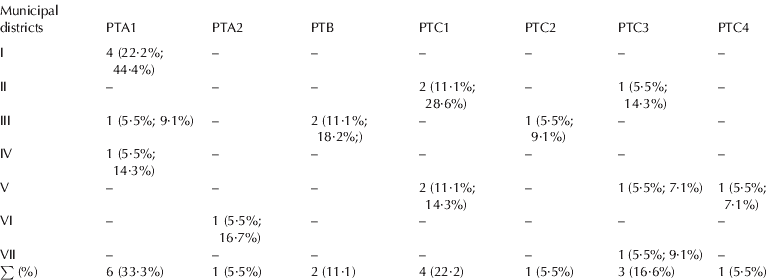
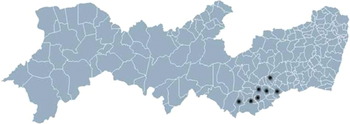
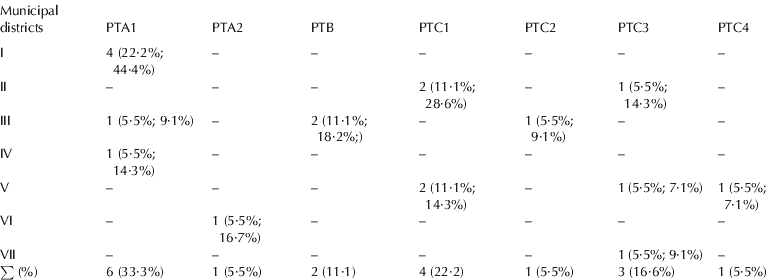
Staph. aureus was isolated from sheep milk in 9 (29%) out of 31 herds located in 7 (47%) of the districts surveyed accounting for 18 isolates (6 from clinical mastitis samples and 12 from subclinical mastitis cases; Fig. 1). The rate of Staph. aureus occurrence in regard to the total amount of species of bacteria obtained from milk samples ranged from 7% to 44% depending on the district (Table 1).
Distribution of pulsotypes (PTs) of Staphylococcus aureus isolates from ovine mastitis in the municipal districts surveyed. Shown are the number of Staph. aureus isolates (percent of Staph. aureus isolates; percent of total isolates)
Map of Pemambuco state, Brazil. Distribution of the municipal districts from where Staphylococcus aureus strains were recovered.

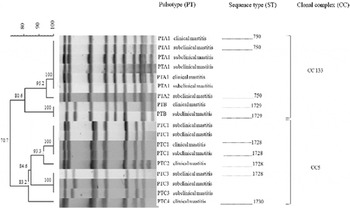
The genetic diversity of these isolates was analysed by PFGE and MLST (Fig. 2). Analysis of restriction profiles obtained by PFGE showed three pulsotypes (PTs) with different subtypes distributed in 7 of the 15 municipalities included in this study. Strains PTC and PTA corresponded, respectively, to 50% and 39% of the isolates. As for the strains PTB, restricted only to one municipality, they occurred less frequently, accounting for 11% of total isolates.
Dendrogram-Dice (Tol 2·0%–2·0%) (H>0·0%S>0·0%) [0·0%–100%]

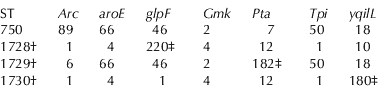
MLST analysis allowed the identification of four STs (ST750, ST1728, ST1729 and ST1730), the last three of which have been recently reported in the Staph. aureus MLST database (http://www.mlst.net) along with their respective new alleles (glp-220; pta-182 e yqil-180) (Table 2). Each new allele showed only one nucleotide different from those already described.
Allelic profiles of Staphylococcus aureus strains recovered from ewes with mastitis in herds from Pernambuco State, Brazil
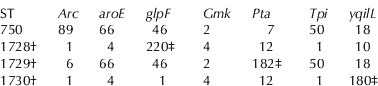
† Novel STs recently reported in http://saureus.mlst.net
‡ Novel alleles recently reported in http://saureus.mlst.net
All Staph. aureus isolates were susceptible to antimicrobial agents tested by disc-diffusion method and their MIC values for penicillin were ≤0·12 μg/ml. The nitrocefin stick test was negative for β-lactamase production and it was confirmed by the presence of clavulanic acid (10 μg), which does not result in a significant change (≥5 mm) in cefotaxime (30 μg) or ceftazidime (30 μg) zone sizes.
Discussion
The association of two or more techniques in epidemiological studies may be essential for a reliable interpretation of data. The occurrence of isolates with the same ST that differed only by one to three bands by PFGE (PTA1 and PTA2; PTC1, PTC2 and PTC3) allows us to infer that these isolates are descendants of a common ancestor that has existed for a longer time (Enright et al. Reference Enright, Day, Davies, Peacock and Spratt2000). Recent diversifications such as losses, acquisitions of plasmids, prophages or other mobile genetic elements (Barrett et al. Reference Barrett, Gerner-Smidt and Swaminathan2006) may have occurred during the persistence of the bacteria in chronic cases of infection or even during the most acute phases of mastitis. The distribution of different subtypes among municipalities located in a region covering a broad area highlights the geographical spread of these strains that have suffered diversifications. Many virulence factors of Staph. aureus are encoded by mobile genetic elements, which means that new variants with different combinations of those virulence genes may develop rapidly (Fitzgerald et al. Reference Fitzgerald, Sturdevant, Mackie, Oil and Musser2001; Lindsay et al. Reference Lindsay and Holden2006) promoting the distribution and selection of the new clones.
Single-locus variants (SLV) of ST1729 (ST133, ST481, ST712, ST745) were detected among isolates from cattle and goats and the changes in these cases were identified exclusively in locus pta (VetR61-Portugal; SK17A-Norway; SG17F-Norway; PP333-United Kingdom; Sg104a-Norway; LMA1171-France; BR477-Brazil). The nucleotide substitution found in the new allele pta-182 of ST1729 could suggest an adaptation of the bacteria to ovine mammary glands, since their SLVs are exclusive of Staph. aureus isolates from cattle and goats. Mørk et al. (Reference Mørk, Tollersrud, Kvitle, Jorgensen and Waage2005) suggested that specific anatomical sites of the bacteria, rather than host specificity, could better explain the occurrence of common genotypes that cause mastitis in cattle, goats and sheep. Unfortunately, the absence, so far, of other records of this new allele pta-182 of ST1729 renders it difficult to predict the spread of this clone.
The occurrence of ST750, the second most prevalent in this study, is in agreement with other studies reporting that only a few specific clones of Staph. aureus seemed to be responsible for most cases of mastitis in dairy farms and that some of these clones might have broad geographic distribution (Fitzgerald et al. Reference Fitzgerald, Meaney, Hartigan, Smyth and Kapur1997; Annemuller et al. Reference Annemuller, Lammler and Zschock1999; Smith et al. Reference Smith, Green, Medley, Bird, Fox, Schukken, Kruze, Bradley, Zadoks and Dowson2005). The first record of ST750 in http://www.mlst.net refers to a Staph. aureus strain (vet-BZ29) that was also obtained from sheep in Brazil (Aires-de-Souza et al. Reference Aires-de-Sousa, Parente, Vieira-da-Motta, Bonna, Silva and Lencastre2007). However, published data are still too limited to suggest some specificity of this clone to the host or to the geographical location. Further analysis is needed to evaluate the possible occurrence of ST750 in Staph. aureus isolates from other animal species. Both SLVs and DLVs of ST750 have already been found in Staph. aureus strains from cattle and goats in different countries: ST131, ST132, ST133 and ST481 in Norway; ST133 in Portugal; ST745 in Brazil and ST712 in France (http://www.mlst.net). To date, no Staph. aureus isolate ST750 from humans has been registered.
ST5, belonging to CC5, is an important genetic profile related to cases of colonization or infection in humans. Strains belonging to this clonal complex have characteristics that favour their spread among humans (Enright et al. Reference Enright, Robinson, Randle, Feil, Grundmann and Spratt2002). However, Staph. aureus related to CC5 have been isolated from cows in some studies (Smith et al. Reference Smith, Green, Medley, Bird, Fox, Schukken, Kruze, Bradley, Zadoks and Dowson2005), including methicillin-resistant strains (MRSA) (Kwon et al. Reference Kwon, Park, Moon, Jung, Kim, Kim, Hong, Koo, Joo and Park2005). In Brazil, Aires-de-Souza et al. (Reference Aires-de-Sousa, Parente, Vieira-da-Motta, Bonna, Silva and Lencastre2007) found a strain ST5 in a single sample of buffalo milk and Rabello et al. (Reference Rabello, Moreira, Lopes, Teixeira, Riley and Castro2007) reported ST744 with the new allele gmk-72, belonging to CC5, in Staph. aureus isolates from cows with subclinical mastitis. These two surveys occurred in different places of the same region (the southeast of Brazil). The geographical distribution of isolates of CC5 in our study differs from the previous ones by its widespread occurrence. ST1728 and ST1730, both SLVs of ST5 (CC5), were found in 4 of the 7 municipalities selected for this research, and accounted for 50% of total isolates. The prevalence of ST1728 and ST1730 with the new alleles glp-220 and yqil-180, respectively, among Staph. aureus isolates from sheep could be a consequence of human contamination followed by selective pressures on these diversifications. The possibility of transmission of these clones between man, dairy products and animal hosts has been considered, although it appears to be a rare event (Zadoks et al. Reference Zadoks, van Leeuwen, Barkema, Sampimon, Verbrugh, Schukken and van Belkum2000; Lee Reference Lee2003).
Conclusions
The genotypic characterization of Staph. aureus isolates from ovine mastitis by MLST and PFGE showed that the infections in sheep flocks of different municipalities in the northeast of Brazil were caused by a limited number of clones related to those already circulating in different regions of the world. However, except for ST750, the other three STs presented allelic variations still not described in Staph. aureus strains from man or animals. Published data are still too limited to establish specific relations between these new STs with the host or with a restricted geographic location, but their identification and association to other STs related to the course of mastitis suggest that these clones have specific features that favour their survival and capacity of causing infections in the mammary gland of different animal hosts.
The identification of novel STs in such a limited number of isolates highlights even more the scarcity this type of study in ewes. Additional studies are necessary for a better understanding of the epidemiology of Staph. aureus in sheep flocks.
This study was supported by Conselho Nacional de Desenvolvimento Científico e Tecnológico (CNPq).