Coronary artery fistulae are defined as an abnormal connection between a coronary artery and the pulmonary artery, coronary sinus, cardiac chamber, or systemic circulation. Its incidence in patients with CHD varies between 0.08 and 0.4%.Reference Farooki and Pinsky 1 – Reference Mavroudis, Backer, Rocchini, Muster and Gevitz 5 In adult patients, treatment usually includes intervention or surgical closure in order to prevent potential complications such as aneurysm formation, myocardial infarction, or congestive heart failure.Reference Schumacher, Roithmaier and Loren 6 , Reference Kamiya, Yasuda and Nagamine 7 The approach appears to be different in the paediatric population and is more conservative, especially in patients who present with small fistulae.Reference Farooki and Pinsky 1 , Reference Sherwood, Rockenmacher, Colan and Geva 8 , Reference Davis, Allen and Wheller 9 The objective of this study was to document the incidence and course of our paediatric patients with coronary artery fistulae and to address the controversial issue of the conservative management strategy.
Materials and methods
This retrospective study was carried out to review data regarding children who were diagnosed with coronary artery fistula and to analyse their cardiac assessment and follow-up over 6 years. All the patients were seen in a Canadian paediatric tertiary centre (London Health Sciences Centre, London, Canada).
The study was approved by the local ethics committee. All the charts of coronary artery fistula patients from 2008 to 2014 were included. Diagnosis was established by two-dimensional and colour Doppler echocardiography.
The following data were collected: age at diagnosis, mode of presentation – for example, incidental finding, murmur, chest pain, or heart failure – location and drainage of the fistula, association with cardiac defect, and course over time – that is, development of symptoms or spontaneous closure. In all patients, electrocardiography was performed, and patients aged 9 years and above were asked to participate in an exercise stress test.
Results
From 2008 to 2014, 31 patients were diagnosed with coronary artery fistula, which comprised 0.43% of our entire patient group. Mean age at presentation was 6.14 years with a standard deviation of 5.4 years. Among all, 21 patients were male, resulting in a male:female ratio of ~2:1. Mean duration of follow-up was 3.9 years with standard deviation of 2.8 years. None of the patients were lost to follow-up.
Mode of presentation
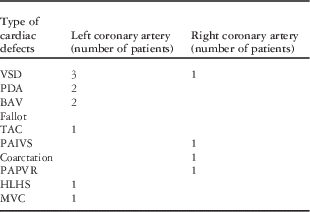
In our study, 16 patients (52%) had an associated cardiac defect [see Tables 1 and 2], and the diagnosis of a fistula was made incidentally during work up in 12 patients. In four patients, the diagnosis was made after surgical repair for an underlying congenital heart defect.
Characteristics of fistulae: origin and drainage.

Pts=patients
Characteristics of fistulae: type of cardiac defects.

BAV=bicuspid aortic valve; HLHS=hypoplastic left heart syndrome; MVC=mitral valve cleft; PA IVS=pulmonary atresia with intact ventricular septum; PAPVR=partial anomalous pulmonary venous return; PDA=patent ductus arteriosus; TAC=truncus arteriosus communis; VSD=ventricular septal defect
Echocardiography was performed to detect cardiac murmurs in eight patients (26%). Coronary artery fistula was an incidental finding in four patients (13%) who received a screening echocardiogram before chemotherapy, in conjunction with a genetic syndrome or suspicion of endocarditis; three patients (10%) were evaluated for chest pain.
Location
Among our patients, 26 (84%) had a left coronary artery fistula and the remaining five patients (16%) had right coronary artery fistulae. All right coronary artery fistula patients had associated cardiac defects; however, this was true in 42% of patients with left coronary artery fistula. The majority of fistulae (74%) drained into the pulmonary trunk, and the rest into the right ventricle. None of them drained into left-sided heart structures or into the coronary sinus (please see Table 1 and Supplementary figures S1to S3).
Further investigations
All patients with isolated coronary artery fistula had a normal electrocardiogram.
Exercise testing was performed in eight patients (26%) who were older than 9 years of age and revealed normal results; in particular, there were no ischaemic changes.
Follow-up
All our patients had asymptomatic fistulae that did not require any intervention; three patients (10%) died due to underlying disease not related to their coronary artery fistulae: one from cancer, one from idiopathic pulmonary hypertension, and one patient from hypoplastic left heart syndrome, who developed necrotising enterocolitis before a scheduled Norwood procedure.
Spontaneous closure was confirmed via echocardiogram in 12 patients (39%) during a mean follow-up of 3.6 years (standard deviation 3.3); 10 patients originally had a left coronary artery fistula – 38% of all those with left coronary artery fistula – and two patients had a right coronary artery fistula – 40% of all patients with right coronary artery fistula.
Discussion
Congenital coronary arterial fistulae are uncommon lesions. In our patient population, consisting of a cohort of children from a paediatric cardiac outpatient clinic, the incidence of coronary artery fistula was 0.43%, which is comparable to the data published in the literature.Reference Farooki and Pinsky 1 – Reference Mavroudis, Backer, Rocchini, Muster and Gevitz 5 The incidence of coronary artery fistula in the general population might be even lower.
The majority of our patients had left coronary artery fistulae, and only 16% had right coronary artery fistulae. This is in contrast with the numbers presented by other authors who found that 50–60% of all fistulae were branching from the right side.Reference Ismail and Stumper 10 , Reference Kirklin and Barrat-Boyes 11 We do not have an explanation for this discrepancy in our patient population. All the fistulae drained into low-pressure right-sided cardiac structures; this is in agreement with other studies, which have shown that more than 90% of all fistulae drain into the pulmonary trunk, right ventricle, right atrium, or coronary sinus as opposed to left-sided heart structures.Reference Burch and Sahn 4 , Reference Ismail and Stumper 10 – Reference Mitropoulos and Triantis 12
An association with additional congenital heart defect ranges from 5 to 30% in the literature.Reference Wong and Menahem 3 Half of our coronary artery fistula patients had underlying cardiac defects, and this was true for all patients with right coronary artery fistulae. The improved quality of high-resolution echocardiography machines that are available today may also play a role in detecting very small coronary artery fistulae. This may partially explain the slightly higher incidence at our centre compared with the other studies, which were carried out more than a decade ago.
The clinical presentation in more than half of the coronary artery fistula patients was a heart murmur without any further cardiac symptoms.Reference Holzer and Kitchiner 13 In general, a continuous murmur indicates significant shunting; 25% of our patients had a murmur that was attributed to the fistula, but none of them were described as continuous, which indicated that the coronary artery fistula was not haemodynamically relevant. The remainder was detected incidentally, as the patients were screened by echocardiography for a known cardiac defect or for other reasons.
The electrocardiograms of all non-CHD patients with coronary artery fistula were normal. This is consistent with previous studies that did not demonstrate any additional benefit for diagnosis or assessment of the haemodynamic relevance.Reference Holzer and Kitchiner 13 We also carried out an exercise treadmill test in patients older than 9 years (ca. 25%), and no patient demonstrated ischaemic changes under exercise conditions. This may be the most reassuring finding in this study. A run-off of arterial blood supply away from the myocardium could potentially pose a relevant threat of ischaemia.
Possible complications of coronary artery fistulae include progressive enlargement, aneurysm formation and rupture, development of congestive heart failure, infective endocarditis, risk of premature atherosclerosis, and thromboembolism. Coronary steal syndrome could lead to myocardial infarction.Reference Mavroudis, Backer, Rocchini, Muster and Gevitz 5 , Reference Nathani, Reddy, Suresh and Maheshwari 14 – Reference Qureshi 17 A particular study cited the occurrence of aneurysms in 19% of coronary artery fistula patients, but these data are from the 1980s, when the diagnosis of a coronary artery fistula was made during catheterisation in symptomatic patients.Reference Nathani, Reddy, Suresh and Maheshwari 14
There is general agreement that an indication for closure is given for patients who are symptomatic due to volume overload, left ventricular dysfunction, and ischaemia.Reference Valente, Lock and Gauvreau 16 – Reference Sapin, Frantz, Jain, Nichols and Dehmer 19 Therapeutic options are surgical closure with low mortality and percutaneous transcatheter embolisation as an effective and safe alternative. In collaboration with a paediatric cardiology centre, we were able to refer patients who were in need for intervention. None of our patients had a large fistula that required cardiac catheterisation or intervention, as there was no evidence of haemodynamic relevance – for example, cardiac function, cardiac enlargement, or any other symptoms. Therefore, no therapeutic measures were undertaken in our patient group.
Some controversy remains about the management of asymptomatic patients who have a small shunt – Qp/Qs<1.3 when measured by cardiac catheterisation – as the natural history of coronary artery fistula is variable. Recommendations are based on anecdotal cases or on small retrospective series. Modern imaging techniques such as low-radiation CT scans and MRI are now able to demonstrate the exact anatomy of a fistula and can aid the non-invasive assessment of the haemodynamic relevance of a coronary artery fistula. They may, thus, replace the need for diagnostic cardiac catheterisation.
The traditional viewpoint has been to close all fistulae early, as the size of the fistula might increase, in order to prevent complications.Reference Schumacher, Roithmaier and Loren 6 , Reference Kamiya, Yasuda and Nagamine 7 , Reference Ismail and Stumper 10 , Reference Mitropoulos and Triantis 12 , Reference Valente, Lock and Gauvreau 16 Elective closure of the fistula has also been recommended, as the mortality and morbidity of an interventional or surgical closure appear to be lower than the risks of complications beyond the age of 20 years and given that the true natural history of coronary artery fistula in infancy and childhood remains unclear.Reference Farooki and Pinsky 1 , Reference Liberthson, Sagar, Berkoben, Weintraub and Levine 2 , Reference Kirklin and Barrat-Boyes 11 , Reference Valente, Lock and Gauvreau 16 , Reference Qureshi 17 Furthermore, the relationship between the size of the shunt through a fistula and symptoms was not statistically significant in a study by Sapin.Reference Kayalar and Schaff 15 Other studies, however, have found that small shunts in general remain small and that the role of coronary arterial steal phenomena may be questionable.Reference Davis, Allen and Wheller 9 , Reference Qureshi and Reidy 18 , Reference Sapin, Frantz, Jain, Nichols and Dehmer 19 , Reference Latson 20 Further argument against closing all fistulae irrespective of symptoms included the high rate of recurrence or residual fistulae that have been closed by intervention, which is currently the preferred mode of treatment.Reference Schumacher, Roithmaier and Loren 6
Some authors recommend anti-platelet therapy, especially in patients with distal coronary artery fistulae and abnormally dilated coronary arteries.Reference Latson 20
Prophylactic precautions against sub-acute bacterial endocarditis are not recommended as per the American Heart Association Guidelines of 2007, despite a risk as high as 2–5% for endocarditis being previously reported.Reference Liberthson, Sagar, Berkoben, Weintraub and Levine 2 , Reference Kayalar and Schaff 15 , Reference Gowda, Vasava and Khan 22 , Reference Said, Lam and Van der Werf 23
None of our patients experienced any haemodynamic sequelae secondary to their fistulae, and they remained asymptomatic throughout the entire study period. A considerable part of the fistulae (39%) closed spontaneously during the follow-up period, which is in agreement with the findings as described by Sherwood and Davis. They found a spontaneous closure in 20% of their study population.Reference Schumacher, Roithmaier and Loren 6 , Reference Kamiya, Yasuda and Nagamine 7 We will follow-up our patients with closed fistulae one more time to assure definitive closure. Patients with remaining fistulaes who are asymptomatic will be assessed every 2–3 years with an echocardiogram to determine the size of the fistula and cardiac function, and we recommend ongoing follow-up by an adult cardiologist once they have reached adulthood. This approach is similar to the recommendations outlined by the American College of Cardiology/American Heart Association for the management of adults with congenital heart disease 2008.Reference Warnes, Williams and Bashore 24 We do not routinely use anti-platelet therapy and do not recommend endocarditis precautions for our patients.
Conclusion
Small coronary artery fistulae in children are, for the most part, an incidental finding and many close spontaneously. Our data are supportive of a conservative, observant approach in asymptomatic patients with small coronary artery fistulae in the paediatric population.
Acknowledgements
The authors thank Judy Jones, Senior Paediatric Cardiac Sonographer who provided the echocardiographic images and Stefanie de Jesus for critical review of the manuscript.
Financial Support
This research received no specific grant from any funding agency, commercial, or not-for-profit-sectors.
Conflicts of Interest
None.
Supplementary Material
To view supplementary material for this article, please visit http://dx.doi.org/10.1017/S1047951115001225