The voice is a figureless occurrence that emerges from a source. Its temporality is determined by the immediate experience of the body from which it vibrates. What is the consequence, however, of a separation of the voice from its source – its acoustic medium? That is, what happens when the voice ceases to function as a sign of subjective interiority? Can the disembodied voice express a temporality that transgresses the body carrying it, and, moreover, can it perform a time dimension that has yet to materialize? In the following discussion I examine the means by which the future is reflected through the illusion of a disembodied voice – the disembodied voice that is performed by the Israeli vocal artist Victoria Hanna.
Hanna's vocal performance combines spoken language, theatre, electronic music and video art. Her 2005 performance Signals (directed by Ruth Kanner), which is discussed here, was performed at The Kitchen in New York City (with music by Ronen Shapira, video art by Ofri Cnaani and costumes by Hagit Vitman). The performance fuses electronic sounds of contemporary modes of communication with sacred Hebrew texts, emerging from Hanna's orthodox religious background in Jerusalem. Throughout the performance Hanna explores the sonorous and graphic materiality of linguistic signs, and the performance shifts constantly between the English and Hebrew languages. In what follows I analyse four scenes from this performance: the opening scene where Hanna performs the Hebrew and English alphabet; a biblical love poem from the Song of Songs in which Hanna voices a lovers’ dialogue;Footnote 1 another verse from the Song of Songs in which Hanna sings while simultaneously biting, chewing, and spitting apples;Footnote 2 and, finally, a scene staging a text from the Midrash ‘Order of the Creation of the Embryo’ (‘Seder Yezirat Ha-Valad’) in which Hanna dramatizes the moment of procreation.Footnote 3
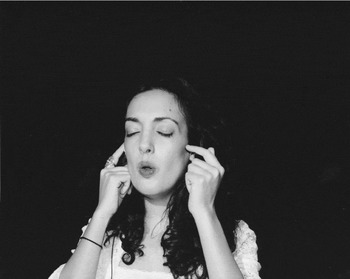
Victoria Hanna in Signals. Performed at The Kitchen in New York City, January 2005. Photo: Oded Halachmy.

In the opening scene of Signals, Hanna, dressed as an innocent pupil, stands behind a podium in the center of an empty and dark stage. Didactically, she pronounces each letter of the Hebrew alphabet, re-enacting a tutoring practice of the biblical language that originated in the Orthodox Jewish communities in the Diaspora. Hanna performs this traditional teaching method, through which she also re-embodies the voice of her father, a rabbi. Thus, while her voice materializes in the ‘here and now’, it is rooted in a world steeped in religious and patrilineal values. In the concluding sequence of this scene, Hanna plays an authentic recording of this tutorial practice as it actually used to take place between teachers and students. A choir singing the alphabet resonates from the small tape recorder, repeating the same instructive act of pronunciation that Hanna has just performed, but this time through mechanical means. According to Steven Connor, a voice emanating from a recording is analogous to a ‘direct voice’: a voice facilitated by a physical medium with the ability to allow disembodied entities to communicate independently.Footnote 4 Therefore, when Hanna ‘gives voice’ to her cultural and family background by performing the traditional didactic practice, her body is perceived as a transmissive medium performing an act of ‘envoicement’, an act by which Hanna represents a voice different from her own, thereby inhabiting another's voice. I propose the neologism ‘to envoice’ in reference to a body–voice relationship where the body functions as a surrogate for a distant voice and, hence, stages multiple identities.
In the opening scene of the performance, Hanna's vocal practice becomes transformed into a recorded sound emerging from a tape recorder. The integration of the technological and the human establishes a hybridized voice with a bipolar nature. While the human voice is limited to the corporeal boundaries of Hanna's body, the electronic voice represents the rise of the future, symbolizing the innovations of the new media technology, with their vast potential for transgressing the human body. The duality of the voice – technological and human – which is repeated on many other occasions during the performance, thus interweaves past and future.
For Hanna, the world is formed by the elocution of linguistic signs. For example, as the scene described above continues, Hanna demonstrates the oral enunciation as a creative force in Jewish spirituality, and states, ‘Everything spoken emanates from one name. One; one two.’ She goes on to say that there are ‘22 letters [in the Hebrew alphabet] – from them God depicted all that was formed’. Hanna continues and deconstructs the alphabet into its foundational elements, focusing on each letter's phonetic, semantic and cultural meanings and associations. In Hanna's words, ‘C is for Cell-phone; once upon a time it was for Cookie.’ Furthermore, ‘E is for Email; once upon a time it was for Emotion’.Footnote 5 The theme of duplicity is presented here by the different semantic fields connected to each letter, representing the contradicting and conflicting claims of past and future. In variation on Hanna's words, it can then be concluded that F is for Futuristic communication technology; once upon a time it was for Feelings and Familiarity.
In the next episode of this scene, Hanna recites the alphabet once again, this time in continuous repetitions, and slowly the letters turn into meaningless phonetic sounds. The voice is then undercut by the intervention of conflicting vocal signals: the sounds are alternately performed in a profound cantor-like melodic voice, broken by a vocal simulation of electronic sounds and other synthetic tones that Hanna imitates. The difference in the vocal textures of these various voices creates a montage of temporalities – integrating a traditional spiritual voice with technological sonorous patterns.
By expanding her vocal timbre, while pronouncing consonants and vowels, Hanna transposes the letters into a realm where they are, in effect, divorced from their natural daily use and instead are expressed as material sounds, disconnected from their meaning. In other words, the constant repetition of the phonetic structure of each letter engenders an abstract voice, a continuous sound without explicit sense. This dual nature of the voice persists in Hanna's act: as creator of meaning on one hand, and as sonorous abstract entity on the other.
Through these vocal manipulations (human–technology, past–future, meaning–materiality), Hanna stages a split subject, an internal ambiguity through which the voice that emanates from the performer's body is simultaneously heard as if it is derived from a source that is exterior to the subject. Hanna thus presents a body that inhabits two intertwined identities: her own as well as an exterior other. However, since Hanna performs both voices, it follows that the voice that enacts the illusion of identity becomes the carrier of dissociation. Connor, referring to a dialogue between a present body and a distorted voice, maintains that ‘the dialogue with the voice of the other, which is always part of the staging of possession, suggests the representation of an illusionary distance between the spoken voice and the speaker's corporeality’.Footnote 6 Accordingly, because the voice is presented as if it is exteriorized from her body, Hanna's carnal body may be considered as a technological device that enables and produces the other's voice.
The dialogue with the voice of the other is further demonstrated when Hanna sings a verse from chapter 5 of the biblical love poem the Song of Songs (Shir Ha Shirim), which has traditionally been interpreted as an allegorical representation of the relationship between God and Israel. The verses Hanna sings constitute a dialogue narrated by a woman who enacts a male figure: ‘I sleep, but my heart waketh; Hark! My beloved knocketh: “Open to me, my sister, my love, my dove, my undefiled; for my head is filled with dew, my locks with the drops of the night”.’Footnote 7 Hanna performs this dialogue vocally, while transforming her voice into a thick male voice. Moreover, she illustrates the lover's speech-act by simulating his knocking, emphasizing the consonants in the dialogue with her voice, tongue and lips. The absent masculine voice issuing from Hanna's mouth conceptualizes Hanna's body as a medium, voicing a figure that is separated from her staged identity. According to Walter Ong, the ‘voice is the foundation for role playing among men in the sense that the use of voice and its understanding forces man to enter into others’.Footnote 8 Ong thus describes the penetration of the voice into a foreign body as an explicit masculine activity. It follows from his argument that by ‘envoicing’ a dual character in this scene, Hanna uses her body as an instrument, a passage, for another vocal entity that transgresses that of her own gender. Hanna's vocal performance could therefore be viewed as an act in which she lends her own voice to an acoustic agency that enters her body and speaks through her.
In the beginning of the love scene from the Song of Songs, Hanna lies down (as if preparing to go to sleep), covered by large paper sheets on which Hebrew letters are projected. In her study of Victoria Hanna's vocal architecture, Carol Martin refers to this scene as an act in which Hanna's ‘body becomes like the core of a scroll, a living Torah, explicitly Jewish’.Footnote 9 The scroll, a central literary mechanism in Judaism, is considered to be an embodiment of God in words. It follows that the scroll in Hanna's performance represents a hollow container, inhabited by her own body – an image by which Hanna expresses her own identity. However, by simultaneously manipulating her voice, thereby performing dual characters (man and woman), she produces an image of a voice detached from a body, strange to its own presence. Slavoj Žižek claims that
the voice acquires a spectral autonomy, it never quite belongs to the body we see, so that even when we see a living person talking, there is always some degree of ventriloquism at work: it is as if the speaker's own voice hollows him out and in a sense speaks ‘by himself’, through him.Footnote 10
Following Žižek, then, the broken symmetry between the speaking voice and its physical presence is demonstrated in Hanna's work through her (female) body's ventriloquist act of producing the sound of a male voice.
In another part of the Song of Songs love scene, Hanna performs the dialogue between a woman and her lover in dual voices. The sung love scene is interrupted by another vocal timbre, namely phone signals suggesting ‘no answer’ and ‘disconnected number’, which Hanna simulates. The telephone represents a technology of remote speech. In the performance it expresses a speaking body communicating with a disembodied voice that resonates from a secondary body. Through electronic-like sounds Hanna presents her body as a communicative technological agent, creating the connection for the exterior other's voice by embodying and vocally producing the signals.
Throughout this scene, Hanna repeats the dialogue phrase from the Song of Songs, while accelerating the rhythm each time. With the various dissonant and fractured sounds that she voices (both technological and human), Hanna stages herself as caught in a frantic trance-like condition, which is finally reduced to the pronunciation of the pronouns ‘I–You’ – the primal social discursive relation. The co-presence of a woman (‘I’) and a man (‘you’) in one body stresses the encounter between Hanna and the voice of an absent other that exceeds the gender of the body from which it erupts. This encounter stages Hanna's body as caught by a possessing spirit – a dybbuk. The Jewish legend of the dybbuk, as it appears in S. Y. Ansky's eponymously titled play (1919), fuses erotic love, demonic possession and two lovers coupling in a single carnal body. Referring to this image, Hanna – dressed in a wedding gown – embodies the paradoxical unification of these polarities, mediating between two worlds: a disembodied male voice speaking through a material feminine presence.
The intracorporeal illusion of the two identities within Hanna's body dramatizes a utopian dimension of her possessed body: inhabiting the ambivalent categories of the I–You in her body, Hanna stages a ‘We’. According to Martin Buber, the ‘We’, composed of the ‘I–Thou’ relation (or the I–You in Hanna's performance), is characterized as a utopian relation of wholeness and openness to the other.Footnote 11 In the performance, the coexistence of a male and female identity in one body is ‘utopian’ insofar as it represents the desire to overcome the impossibility of fully incarnating the disembodied voice of the other – the exterior voice.
Emmanuel Levinas connects the notion of exteriority to the perception of the future. He argues that ‘the future is what is not grasped, what befalls us and lays hold of us’, and notes that ‘the other is the future’ and, accordingly, ‘the very relationship with the other is the relationship with the future’.Footnote 12 In other words, the meaning attributed to the future is never conveyed in the presence of the other, but rather in its absence; that is, signifying practices that represent the absent exterior referent stage the future. Hanna enacts the absent exterior referent vocally by creating the illusion of a disembodied voice. This idea could be traced in another scene, where Hanna, holding an apple in each of her hands, simultaneously performs four acts: singing while biting, chewing and spitting the apple. The spitting indicates that Hanna cannot restrain her speech, as if she is controlled by an exterior force. By concurrently performing the four acts, Hanna materializes the desynchronization between her voice and her body. She places her mouth at the center of a struggle between her corporeality and the voice that is distorted from her body. The text she sings while eating the apple is another love song from the Song of Songs (chapter 2): ‘He hath brought me to the banqueting-house, and his banner over me is love. “Stay ye me with dainties, refresh me with apples; for I am love-sick”.’Footnote 13
The apples carry a dual meaning, referring to the original sin that led to the exile from Paradise, as well as to Apple Computers, whose logo is projected onto the stage floor. The apples stage the craving for the forbidden fruit in analogy with the hunger for technology – epitomizing the tension between past and future. The appeal to the future is further exemplified in Hanna's vocal texture as she sings the text in a soft melody that is broken and disrupted by vocal imitations of technological sounds. Again, the dual nature of the voice supplements a conflicting meaning to the text: the term ‘refresh’ gains a human–erotic interpretation when it is sung in a tender harmonious voice; however, it receives a technological connotation when it sounds in a machine-like discordant voice. Singing in her soft melodic voice, Hanna, once again, returns to traditional human communication; however, by producing the technological voice, she presents herself as a channel for an absent disembodied voice that, according to Levinas, is ascribed to the future. In other words, the polarity of the voice ‘refreshes’ the meaning of the text by contributing the perspective of both past and future.
Hanna further highlights this idea of the exterior other as the future when she performs a text from the Midrash ‘Order of the Creation of the Embryo’ (‘Seder Yezirat Ha-Valad’).Footnote 14 She dramatizes the moment of creation as a dialogue (in dual voices) between ‘the holy one’ and ‘a spirit:’ ‘– “Don't make me enter this drop.” – “Enter.” –”Don't make me.” – “Enter”.’Footnote 15 A climax is reached when Hanna dribbles saliva down her chin, creating an image of semen. The scene concludes in a description of pregnancy: ‘a man does not have better days than those in which he is inside his mother, where he is placed like a notebook’.Footnote 16 The forcible entry of the alien voice into the body, once again, exposes the discrepancy between the speaker and the exterior other. Here, however, Hanna points directly at the prospective outcome of the encounter between the body and the voice: revealing the ultimate future as birth.