Introduction
The coronavirus disease 2019 (COVID-19) pandemic greatly changed how people live and work worldwide. As business conditions worsen, more employees experience the fear of losing their jobs due to COVID-19. In particular, a recent study has indicated that employees' perception of the level of COVID-19 impact is positively related to perceived job security; in turn, this influences their attitudes and behaviors in organizations, such as emotional exhaustion and organizational deviance (Lin, Shao, Li, Guo, & Zhan, Reference Lin, Shao, Li, Guo and Zhan2021). Furthermore, individuals who perceive high job insecurity due to COVID-19 are more likely to experience mental health problems, such as depression; therefore, this decreases the employees' job performances (Kumar, Kumar, Aggarwal, & Yeap, Reference Kumar, Kumar, Aggarwal and Yeap2021; Vo-Thanh, Vu, Nguyen, Nguyen, Zaman, & Chi, Reference Vo-Thanh, Vu, Nguyen, Nguyen, Zaman and Chi2020; Wilson, Lee, Fitzgerald, Oosterhoff, Sevi, & Shook, Reference Wilson, Lee, Fitzgerald, Oosterhoff, Sevi and Shook2020).
Perceived job insecurity (PJI) does not necessarily mean an actual job loss; rather, it refers to ‘the perceived powerlessness to maintain desired continuity in a threatened job situation’ (Greenhalgh & Rosenblatt, Reference Greenhalgh and Rosenblatt1984: 438). Given that PJI has been considered to be a hindrance stressor, which refers to the undesirable work-related demand that thwarts work achievements (Cavanaugh, Boswell, Roehling, & Boudreau, Reference Cavanaugh, Boswell, Roehling and Boudreau2000), it is negatively associated with employees' attitudes and behaviors at work, and further affects their health and well-being (De Cuyper, De Witte, Vander Elst, & Handaja, Reference De Cuyper, De Witte, Vander Elst and Handaja2010; Shoss, Reference Shoss2017). In particular, when employees feel insecure about their job, they are less committed to the organization and less engaged in extra-role behaviors such as voice (Berntson, Näswall, & Sverke, Reference Berntson, Näswall and Sverke2010). Past studies have revealed that the fear of losing one's job makes employees undermine the contribution of their opinions to the organization and consolidates their silence (Breevaart, LopezBohle, Pletzer, & Medina, Reference Breevaart, LopezBohle, Pletzer and Medina2020; Sheng, Keeler, & Keener, Reference Sheng, Keeler and Keener2021). The negative effects of job insecurity on employees' voice behavior are well-established (Cheng & Chan, Reference Cheng and Chan2008; Jiang & Lavaysse, Reference Jiang and Lavaysse2018), but relatively little attention has been given to the links between job insecurity and employee silence.
Employee silence is defined as intentional behavior that involves the withholding of ideas, information, and opinions about potential concerns or issues at work (Pinder & Harlos, Reference Pinder, Harlos, Rowland and Ferris2001). It is not merely a lack of speech but a choice to remain silent, even if employees have a suggestion, concern, or information about an issue or a situation (Milliken, Morrison, & Hewlin, Reference Milliken, Morrison and Hewlin2003; Van Dyne, Ang, & Botero, Reference Van Dyne, Ang and Botero2003). As active employee behavior, such as sharing opinions, discussing problems, and offering suggestions, is crucial for knowledge creation and organizational innovation, employees' withholding of information, ideas, and suggestions has been perceived as a considerable threat to an organization's success (Morrison & Milliken, Reference Morrison and Milliken2000). Some empirical evidence suggests that employee silence has adverse effects on organizational outcomes such as managerial effectiveness in decision-making (Beheshtifar, Borhani, & Moghadam, Reference Beheshtifar, Borhani and Moghadam2012), organizational learning (Milliken & Lam, Reference Milliken, Lam, Greenberg, Edwards and Brinsfeld2009), and organizational ethical climate (Wang & Hsieh, Reference Wang and Hsieh2013).
Due to the negative effects of employee silence on organizational outcomes, it is important to understand factors that cause employee silence. As noted earlier, PJI can be a key determinant that leads to employee silence. However, there are still some research gaps that must be addressed to fully understand the relationship between job insecurity and employee silence. First, previous studies on silence used silence as a unidimensional concept, despite silence having been discussed and empirically supported as multidimensional by various researchers (Brinsfield, Reference Brinsfield2013; Knoll & Van Dick, Reference Knoll and Van Dick2013). Several scholars insisted organizational silence is considered as a multidimensional construct including acquiescent and defensive silence based on employee motives (Pinder & Harlos, Reference Pinder, Harlos, Rowland and Ferris2001; Van Dyne, Ang, & Botero, Reference Van Dyne, Ang and Botero2003). The former refers to passive and disengaged behavior due to feelings of futility, while the latter refers to active and strategic behavior to protect oneself from negative repercussions (Van Dyne, Ang, & Botero, Reference Van Dyne, Ang and Botero2003). Since these two types of silence theoretically follow distinct motive mechanisms, it would be important to incorporate the multidimensional silence in relation to PJI. Therefore, the first purpose of this study is to explore the relationship between PJI and the two dimensions of silence.
Second, while a recent study revealed the positive relationship between PJI and employees' silence (Breevaart et al., Reference Breevaart, LopezBohle, Pletzer and Medina2020), the circumstances that strengthen or weaken the relationship remain unclear. Given the negative impact of employees' silence on an organization's success and the pervasiveness of job insecurity at the workplace, it is important to examine conditions that can strengthen or weaken the effect of PJI on employee's negative behavior, such as silence. To date, there have been few studies to investigate the contextual factors that influence the relation between PJI and employee silence. Although employees choose silence for personal reasons (i.e., PJI), their choice to not speak up is developed through social interactions and is affected by many organizational characteristics, such as managerial practices and culture (Morrison & Milliken, Reference Morrison and Milliken2000). In particular, some studies have shown that perceived fairness and politics in organizations are influential contextual factors in employee attitudes and behavior (Goo, Choi, & Choi, Reference Goo, Choi and Choi2019). In this study, it is suggested that perceived organizational politics (POP) – the extent the work environment is characterized by organizational members' actions aimed at maximizing their self-interests without caring for the well-being of others or their organization (Kacmar & Baron, Reference Kacmar, Baron and Ferris1999) – acts as a moderator of the relationship between PJI and silence.
Finally, relatively less attention has been given to the joint impact of individual and contextual factors on employee silence. Previous studies have indicated that the subjective social status (SSS) of an employee influences an individual's behavior and attitudes since SSS is strongly associated with one's perceived sense of control over the environment (Kraus, Piff, Mendoza-Denton, Rheinschmidt, & Keltner, Reference Kraus, Piff, Mendoza-Denton, Rheinschmidt and Keltner2012; Lachman & Weaver, Reference Lachman and Weaver1998). SSS typically refers to one's perception of available resources and opportunities in society (Liu, Ali, Soleck, Hopps, Dunston, & Pickett, Reference Liu, Ali, Soleck, Hopps, Dunston and Pickett2004). In this study, employees' SSS was proposed as an important factor influencing the relationship between PJI, POP, and employee silence. In particular, an employee with a low SSS in a highly political organization would be more silent due to the fear of damaging consequences; conversely, an employee with high SSS would more easily express their opinions and ideas, even if organizational politics were perceived. Accordingly, the SSS of an employee is conjectured to moderate the PJI–POP interaction, resulting in a three-way relationship that influences employee silence.
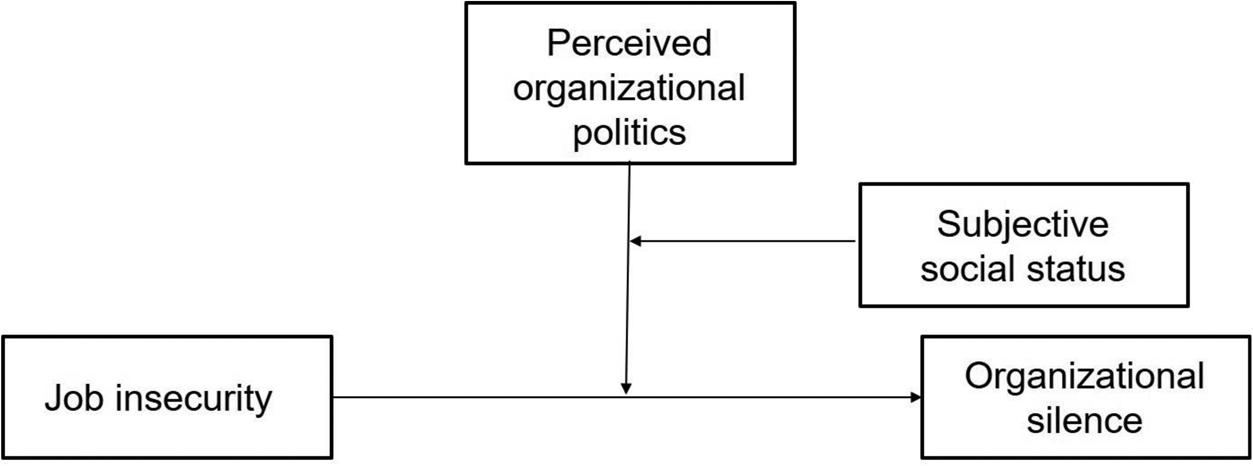
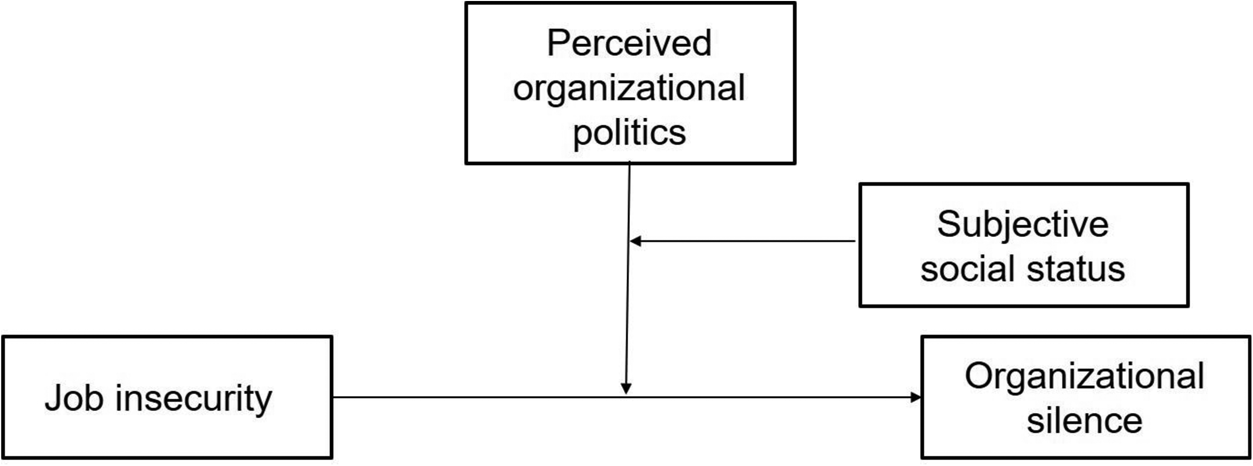
We expect that this study makes several contributions to the research on both silence and job insecurity. First, by integrating the conservation of resources (COR) (Hobfoll, Reference Hobfoll1989) and self-determination theories (SDT) (Deci & Ryan, Reference Deci and Ryan1980), we extend our knowledge about how PJI influences acquiescent and defensive silence separately. Additionally, investigating the antecedents (i.e., PJI) and conditional factors (i.e., POP) that influence different types of employee silence deepens the understanding of employee silence behavior in relation to job insecurity. Moreover, this study identifies the situations wherein employees become more reluctant to express their ideas and opinions by illustrating the impact of employees' SSS as it relates to PJI and POP. Therefore, this study may broaden existing knowledge on employee silence by including an important but relatively ignored factor (i.e., SSS) in relation to employee silence. Figure 1 presents the proposed model of the study.
Proposed model.
Theoretical development and hypotheses
PJI and organizational silence
Although PJI has been defined diversely, it is generally understood as employees' perceived threats to the continuity and stability of their current position (Greenhalgh & Rosenblatt, Reference Greenhalgh and Rosenblatt1984). Scholars have emphasized unique characteristics of PJI that differ from similar constructs such as unemployment and job mobility. First, PJI is a subjective perception of the potential threats regarding the future existence of one's current job, thus it differs from objective insecure conditions, which include temporary contracts or objective organizational layoffs (Greenhalgh & Rosenblatt, Reference Greenhalgh and Rosenblatt1984; Sverke, Hellgren, & Näswall, Reference Sverke, Hellgren and Näswall2002). Accordingly, even employees in the same organization may experience different levels of PJI.
Second, PJI is focused on the threat to an employee's current job position with their current employer, not a previous or future job nor the employee's overall career. Given that the threat is related to the current employment, contextual factors such as organizational environment and relationships with supervisors – as well as macro-level social and economic factors – affect employees' perception of job insecurity (Sverke, Hellgren, & Näswall, Reference Sverke, Hellgren and Näswall2002).
Third, PJI reflects an employee's concerns about the uncertainty of involuntary and uncontrollable future job loss (De Witte, Reference De Witte1999). Since employees continue to work at their organizations, job insecurity does not mean an actual job loss. It is also different from other organizational job stressors, such as work demand and time pressure, because these have clear causes and solutions, unlike job insecurity. A growing number of studies has indicated that PJI, as a critical job stressor, is negatively associated with employees' work attitudes, behaviors, health, and performance (De Witte, Pienaar, & De Cuyper, Reference De Witte, Pienaar and De Cuyper2016; Lee, Huang, & Ashford, Reference Lee, Huang and Ashford2018; Selenko, Mäkikangas, & Stride, Reference Selenko, Mäkikangas and Stride2017; Shoss, Reference Shoss2017).
As for the consequences of PJI, employee silence was investigated in this study. Several scholars regard organizational silence as a multidimensional construct that depends on the underlying motives for withholding information (Brinsfield, Reference Brinsfield2013; Pinder & Harlos, Reference Pinder, Harlos, Rowland and Ferris2001; Van Dyne, Ang, & Botero, Reference Van Dyne, Ang and Botero2003). Initially conceptualized by Pinder and Harlos (Reference Pinder, Harlos, Rowland and Ferris2001) and later extended by Van Dyne, Ang, and Botero (Reference Van Dyne, Ang and Botero2003) and Knoll and Van Dick (Reference Knoll and Van Dick2013), there are four different forms of silence: acquiescent, defensive, prosocial, and opportunistic silence. Acquiescent silence (AS) refers to passive and disengaged behavior occurring when employees feel resigned, powerless, and are unable to change an unfair situation (Cullinane & Donaghey, Reference Cullinane, Donaghey, Wilkinson, Donaghey, Dundon and Freeman2014; Pinder & Harlos, Reference Pinder, Harlos, Rowland and Ferris2001). The primary motive driving AS is an employee's feelings of futility and/or beliefs that the expression of information, ideas, and opinions is neither wanted nor valued by their organization (Pinder & Harlos, Reference Pinder, Harlos, Rowland and Ferris2001). Meanwhile, defensive silence (DS) is an active and strategic behavior that occurs as self-protection when employees fear negative repercussions of speaking up. Unlike AS, the key motive for DS is self-protection and fear of retaliation. Therefore, as a survival strategy, employees decide to remain silent despite knowing the alternative outcomes (Van Dyne, Ang, & Botero, Reference Van Dyne, Ang and Botero2003). Prosocial silence (PS) describes an employee's intentional withholding of information with the intent to benefit their colleagues, the organization, or both, such as keeping competitive information confidential. Contrary to DS, the main motive for PS is characterized by altruistic and cooperative motives, rather than the fear of negative personal consequences that might result from speaking up (Van Dyne, Ang, & Botero, Reference Van Dyne, Ang and Botero2003). Finally, opportunistic silence (OS) is viewed as a strategic adaptive behavior that occurs when employees are motivated by self-interest, for example, strategically withholding information to protect their advantageous knowledge or to avoid additional workload at the risk of causing harm to others (Knoll & Van Dick, Reference Knoll and Van Dick2013). Of these proposed types, PS and OS can be manifested in an ambivalent (i.e., beneficial or harmful) way (Brinsfield, Edwards, & Greenberg, Reference Brinsfield, Edwards, Greenberg, Greenberg and Edwards2009; Chou & Chang, Reference Chou and Chang2020). As such, this study focused on examining the implications of PJI for the remaining two forms of silence – AS and DS – which have proved consistently detrimental to the organization, with the aim of furthering the understanding of a detrimental organizational phenomenon resulting from employee silence.
To address the relationships between PJI and two forms of silences, we adopt the COR theory and SDT. The COR theory suggests that people are motivated to obtain, retain, and protect valuable resources such as objects, conditions, and personal characteristics (Hobfoll, Reference Hobfoll1989). Accordingly, psychological stress occurs when there is (a) a threat of resource loss, (b) an actual resource loss, or (c) a lack of resource gain after investing resources (Hobfoll, Reference Hobfoll1989: 516). In addition, when resources are threatened, individuals typically are more likely to avoid further resource investment to preserve the remaining resources. According to this perspective, PJI implies an unpredictable threat that employees feel due to a potential job loss (De Witte, Reference De Witte1999), so that job insecure employees would be silent to avoid any possible risks associated with speaking up.
To deepen the understanding of how the threat of losing one's job influences employee silence, SDT as a complementary perspective was employed. According to SDT, three basic psychological needs influence individuals' motivation and behavior: competence, relatedness, and autonomy (Deci & Ryan, Reference Deci and Ryan1980). When individuals satisfy these three needs through social interaction and self-perception, the individuals' growth and development are promoted. However, nonfulfillment of these basic needs negatively affects individuals' psychological well-being. Given that the feeling of losing one's job involves unpredictability and uncontrollability of the future, one's sense of volition (the need for autonomy), work achievements (the need for confidence), and social interactions (the need for relatedness) may be undermined. When these basic needs are not fulfilled, employees' commitment to their organization also decreases (Van den Broeck, Vansteenkiste, De Witte, Soenens, & Lens, Reference Van den Broeck, Vansteenkiste, De Witte, Soenens and Lens2010), which induces employees to be more likely to refrain from pro-organizational behaviors or to engage in anti-organizational behaviors. As a result, employees are more likely to be silent when their needs are not fulfilled (Morrison, Reference Morrison2014). Relating SDT to the COR theory, experiencing job insecurity induces feelings of losing valued resources in employees. Loss of valued resources signals to employees that their basic needs could be thwarted; therefore, the situation becomes stressful to employees. In stressful situations, employees strive to protect their resources. Given that silence is a way to regulate individuals' personal resources, employees are likely to avoid wasting their resources (e.g., time, energy) by engaging in silence.
The primary motivating factor of AS is an employee's feelings of futility and/or belief that their organization neither wants nor values their opinions (Pinder & Harlos, Reference Pinder, Harlos, Rowland and Ferris2001). Given that individuals do not know what will happen in the future, PJI is likely to be perceived as an uncontrollable situation that may undermine employees' sense of control at work. In addition, individuals who feel highly insecure cannot concentrate on their work and are more likely to fail to achieve their work goals, thereby affecting their sense of autonomy and competence (i.e., failure of the need for autonomy and confidence). Some empirical studies have shown that PJI is negatively associated with employees' performances (Cheng & Chan, Reference Cheng and Chan2008). As such, it is expected that when employees perceive a low sense of control over a situation based on low self-efficacy at work, they consequently believe that it is meaningless for them to express their ideas and opinions. This sense of futility would cause employees to remain silent (AS).
Unlike AS, DS is considered fear-driven and aims to protect the self from external threats such as the loss of career-related resources, including rewards, promotion, and material support. The self-protection motives of DS include withholding information due to the fear that voicing one's ideas may cause them to endanger themselves, or avoiding problems due to the fear of being held responsible. Given that job insecurity is the subjective perception of the potential threat of job loss, not all employees may share the same perception of job security. Therefore, employees who perceive greater job insecurity may feel less protected and even at risk around their social contacts, such as colleagues and supervisors (i.e., failure of the need for relatedness). Previous studies have shown that employees did not actively seek resources from their colleagues and supervisors when they perceived high job insecurity (Breevaart & Tims, Reference Breevaart and Tims2019; De Cuyper, Mäkikangas, Kinnunen, Mauno, & Witte, Reference De Cuyper, Mäkikangas, Kinnunen, Mauno and Witte2012). That is, job insecurity may act as a psychological hindrance that reduces investment in social resources to protect the employees' own resources in relation to their colleagues. Accordingly, individuals who perceive greater job insecurity may choose to remain silent to protect themselves, due to the fear that voicing their ideas may endanger them (DS). Therefore, the following hypotheses are proposed:
Hypotheses 1a–b: PJI is positively related to AS (a) and DS (b).
The moderating role of POP
In this study, it is also proposed that POP moderates the relationship between PJI and the two types of silence. POP involves employee perceptions of the degree their work setting is characterized by illegitimate, self-serving actions that are strategically constructed to benefit and enhance self-interest (Ferris, Frink, Galang, Zhou, Kacmar, & Howard, Reference Ferris, Frink, Galang, Zhou, Kacmar and Howard1996). POP is considered a subjective, context-specific psychological phenomenon rather than an objective assessment made by employees (Ferris et al., Reference Ferris, Frink, Galang, Zhou, Kacmar and Howard1996). In a political organization, powerful coalitions, favoritism, a lack of meritocracy, and the perception of in-groups are common. Accordingly, POP is perceived negatively by employees and affects the quality of the relationships at work, resulting in greater stress and strain for employees (Chang, Rosen, & Levy, Reference Chang, Rosen and Levy2009). Moreover, given the hidden nature of political activities in the decision-making processes, POP reflects perceptions of the social context where employees feel uncertain about the consequences of their behavior at work. Consequently, individuals who are in highly political organizations may feel that they have fewer resources available to allocate and need to expend psychological resources (Chang, Rosen, & Levy, Reference Chang, Rosen and Levy2009; Ferris et al., Reference Ferris, Frink, Galang, Zhou, Kacmar and Howard1996; Halbesleben & Wheeler, Reference Halbesleben, Wheeler, Vigoda-Gadot and Drory2006). In addition, it would be difficult to fulfill the basic needs (i.e., need for autonomy, competence, and relatedness) in highly political organizations since it implies highly unpredictable and uncontrollable environment which threatens employees resources.
In this regard, it is expected that employees who experience PJI are more likely to remain silent (AS and DS) when they perceive their organizations as highly political. From the viewpoint of psychological uncertainty, since conflicts among individuals that pursue self-serving interests occur frequently and the work effort–positive outcome links are obscure, individuals may view political work environments as highly uncertain (Kacmar & Carlson, Reference Kacmar and Carlson1997). Furthermore, in organizations in which political activities take place, employees become unable to adequately foresee the consequences of making suggestions or indicating their concerns. In other words, they cannot ascertain whether they will be rewarded or punished for doing so. That is, the state of the political environment provides clues to employees regarding whether their attempts at making changes in the organization will be ineffective. Therefore, job-insecure employees may feel a greater sense of worry under a highly political environment, which is characterized by uncontrollable and unanticipated threats. This is because they may be aware that they do not possess sufficient power to control the situation and that their opinions and suggestions are not valued by the organization. Such a belief may induce feelings of hopelessness and helplessness among individuals (Pinder & Harlos, Reference Pinder, Harlos, Rowland and Ferris2001; Van Dyne, Ang, & Botero, Reference Van Dyne, Ang and Botero2003). Conversely, job-insecure employees can more actively voice their opinions within organizations that are not as political because they feel capable of altering a stressful situation in such an environment. Accordingly, employees with higher PJI are more likely to remain silent (AS), particularly when they perceive their organizations as highly political.
Furthermore, within a highly political context, there are significantly powerful coalitions that act for their self-interests. Individuals in positions of power are more likely to use political tactics to manipulate employees to achieve their desired goals. When individuals perceive organizations as highly political, they may think that there are groups of people who can ‘acquire, develop, and use power and other resources to obtain… preferred outcomes’ (Pfeffer, Reference Pfeffer1981: 7). Since job-insecure employees may feel a lack of social support from colleagues and supervisors, they are more likely to fear conflict with people who possess greater power, particularly within a highly political environment. As the feeling of fear activates self-protective tendencies and promotes avoidance behaviors (Grupe & Nitschke, Reference Grupe and Nitschke2013), job-insecure employees are more likely to avoid voicing their concerns to protect themselves from negative consequences within the organization. Conversely, when they perceive organizations to not be particularly political, job-insecure employees may be less fearful of conflict with people in positions of power and can speak up because they consider themselves to be capable of managing potential threats. Therefore, job-insecure employees may remain silent to protect themselves (DS) when they consider their organizations to be highly political (Brinsfield, Reference Brinsfield2013; Van Dyne, Ang, & Botero, Reference Van Dyne, Ang and Botero2003). For these reasons, it is expected that employee perception of organizational politics will amplify the effect of PJI on the two types of silence behavior.
Hypotheses 2a–b: POP moderates the positive relationship between PJI and AS (a) and DS (b), such that the relationship is stronger for individuals with a high level of POP.
The moderating role of SSS
Previously, it was posited that the relationships between PJI and employee silence will be stronger when they perceive their organizations as highly political, with POP being presented as a significant environmental stressor that may threaten employees' resources (e.g., Ferris et al., Reference Ferris, Frink, Galang, Zhou, Kacmar and Howard1996). According to the COR theory, individual resources are significant in helping people cope more effectively when facing stressful events because individuals may respond differently toward the loss of resources (Hobfoll, Reference Hobfoll1989). In this study, it is proposed that an employee's SSS (as an individual resource) will further moderate the two-way interaction effect of PJI and POP on silence; specifically, the interaction effect will be stronger for employees with a low rather than high level of SSS.
Social class has been conceptualized as a multifaceted construct with both objective (often termed socioeconomic status [SES]) and subjective components (i.e., SSS). While SES represents objective indicators of power, prestige, and control over resources, such as income, education level, employment status, and occupational prestige (Diemer & Rasheed Ali, Reference Diemer and Rasheed Ali2009), SSS typically refers to an individual's perception of their place in a social hierarchy. Therefore, SSS taps into one's evaluations of their own social status in relation to others (Liu et al., Reference Liu, Ali, Soleck, Hopps, Dunston and Pickett2004). Previous research has indicated that SSS is a better predictor of individuals' behavior and attitudes in the context of social class compared to objective social class (Adler, Epel, Castellazzo, & Ickovics, Reference Adler, Epel, Castellazzo and Ickovics2000; Liu et al., Reference Liu, Ali, Soleck, Hopps, Dunston and Pickett2004). That is, even if an individual has a higher objective social status (e.g., high income and education level), they can have a low perceived social status (Liu et al., Reference Liu, Ali, Soleck, Hopps, Dunston and Pickett2004).
Research consistently shows that SSS or SES influences how individuals perceive their relationship with the environment. In particular, SSS is closely related to personal control (Kraus et al., Reference Kraus, Piff, Mendoza-Denton, Rheinschmidt and Keltner2012; Lachman & Weaver, Reference Lachman and Weaver1998), where those with higher SSS are likely to have more economic and psychological resources available to them, such that they have stronger beliefs about the extent they can control their personal outcomes and social events. Conversely, those with lower SSS have relatively weaker beliefs about their ability to shape their outcomes due to their limited resources.
Accordingly, SSS can be considered a significant individual resource that enables employees to cope more effectively when they experience a highly political situation. More specifically, individuals with a higher SSS are less sensitive to resource loss and have more opportunities to gain resources. Therefore, employees with a higher SSS may not perceive organizational politics as a critical challenge because they believe that they possess sufficient resources to effectively operate within their environment. However, those with a lower SSS may believe that they do not have sufficient resources and are more susceptible to additional resource reductions owing to stressful situations, such as organizational politics.
Due to these differences in SSS, it is suggested that the moderating effect of POP on the relationship between PJI and employee silence (AS and DS) will be stronger among employees with a low SSS. The interactive relation of PJI and POP is expected to be particularly salient among employees with low SSS because these employees are more concerned about the depletion of their existing resources and are more susceptible to the additional reduction of resources owing to environmental stressors such as POP. When they perceive their organizations as highly political, they are more likely to react passively and remain silent because they possess fewer resources to cope with stressful situations. However, individuals with a high SSS may not be strongly affected by stressful situations because they possess adequate personal resources to effectively cope with such situations.
Considering the nature of employee silence as behavior driven by the fear of adverse consequences or by the belief that one's opinions are not appreciated (Pinder & Harlos, Reference Pinder, Harlos, Rowland and Ferris2001), it is proposed that SSS is a particularly relevant variable. In a highly political situation characterized by increased uncertainty and social threats, individuals with a lower SSS may feel a lack of control. Consequently, they may choose to remain silent. However, individuals with a higher SSS may feel a greater sense of control over their environment, thus they would actively voice their opinions, even in political situations. Therefore, we propose the following hypotheses:
Hypotheses 3a–b: There is a three-way interaction effect of PJI×POP×SSS on AS (a) and DS (b), such that under conditions of high POP, the relationship between PJI and AS (or DS) is stronger for employees with a low level of SSS than for those with a high level of SSS.
Methods
Participants and procedures
We recruited this study's participants through an online panel data collection service with over 180,000 members in South Korea. A total of 5,500 employees working at small, medium, and large firms located in South Korea were invited to respond. A cross-sectional online survey that assessed job insecurity, organizational politics, SSS, and demographics was distributed and collected between May 16 and May 31, 2020. The ratings of a total of 350 employees for all study variables were obtained for data analysis. The respondents were mostly from privately owned firms (86.6%) operating in various industries, including manufacturing, service, distribution, and finance. More than half of the respondents were female (52.6%), full-time and permanent employees (93.7%), aged 30–49 years (56%), with years of tenure between 1 and 7 (51.6%), and fairly well-educated (81.1% had completed junior college or university degrees).
Measures
Given that the original questionnaires were developed in English, forward–backward translation was used. All authors independently translated and back-translated all the items. When there are discrepancies between the original and back-translated versions appeared, the researchers discussed these differences and provided a final version together. The participants responded to the items on a 5-point scale ranging from 1 (strongly disagree) to 5 (strongly agree).
Job insecurity
Job insecurity was measured using four items developed by De Cuyper et al. (Reference De Cuyper, De Witte, Vander Elst and Handaja2010). A sample item is ‘I feel insecure about the future of my job.’ The scale's Cronbach's α was .79.
Employee silence
AS and DS were measured with two five-item subscales from Van Dyne, Ang, and Botero's (Reference Van Dyne, Ang and Botero2003) version of employee silence (see Appendix). Sample items for AS and DS are ‘I am unwilling to speak up with suggestions for change because I am disengaged’ and ‘I withhold relevant information due to fear,’ respectively. The two components were rated on a 5-point Likert scale (1 = strongly disagree; 5 = strongly agree), with a Cronbach's α of .91 and .88, respectively.
Perceived organizational politics
POP was measured with a five-item scale (Ferris & Kacmar, Reference Ferris and Kacmar1992). A sample item is ‘Favoritism rather than merit determines who gets ahead.’ The Cronbach's α for this scale was .78.
Subjective social status
The MacArthur Scale of Subjective Social Status was used for measuring SSS (Adler et al., Reference Adler, Epel, Castellazzo and Ickovics2000). For this item, the participants were asked to follow these instructions: ‘Think of this ladder as representing where people stand in our society. At the top of the ladder are people who are better off or those who have the most money, highest education level, and best jobs. At the bottom are people who are worse off or those who have the least money, lowest education level, and worse or no jobs.’ Then the participants were asked to indicate where they fall on the ladder on a scale from 1 (bottom rung) to 10 (top rung).
Control variables
Four demographic variables were included as covariates: gender, age, tenure, and organizational status (full-time vs. temporary). Previous studies have shown that these demographic characteristics are strongly associated with employee silence (Rai & Agarwal, Reference Rai and Agarwal2018).
Results
Descriptive statistics
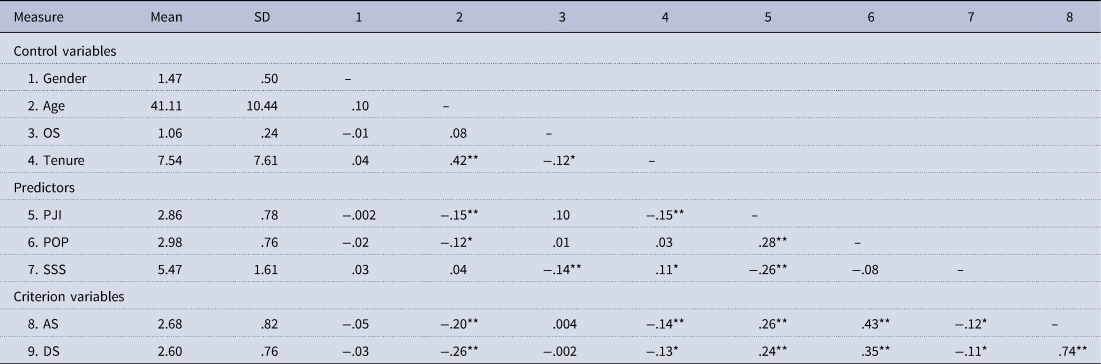
Means, standard deviations, and correlations are presented in Table 1. Table 1 shows that PJI is significantly but weakly associated with both AS (r = .26; p < .001) and DS (r = .24, p < .001), allowing for the possibility of the relationship being moderated by the other two predictors – POP and SSS – as correlated with AS (r = .43; p < .001, and r = −.12; p < .05, respectively) and DS (r = .35; p < .001, and r = −.11; p < .05, respectively).
Correlations among all study variables
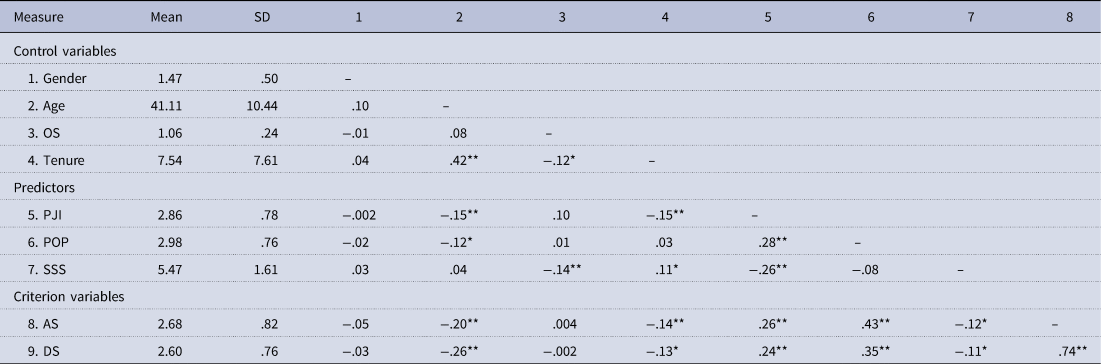
Gender is coded as female = 1, male = 2; OS, organizational status (coded 1 = permanent and 2 = contingent); PJI, perceived job insecurity; POP, perceived organizational politics; SSS, subjective social status; AS, acquiescent silence; DS, defensive silence.
*p < .05; **p < .01.
Test of measurement model
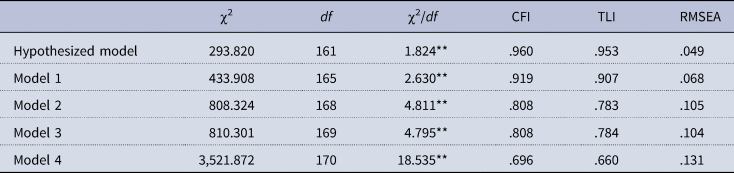
We conducted a series of confirmatory factor analyses (CFAs) to assess the discriminant validity of the variables using structural equation modeling with AMOS 21. The hypothesized five-factor model fits the data well (χ2 [161] = 293.82; CFI = .96; TLI = .95; RMSEA = .05). We compared several alternative measurement models with the hypothesis model. As presented in Table 2, the hypothesis model fits the data better than any of the other alternative models. Thus, the results demonstrate support for the discriminant validity of the five constructs in the current study. Furthermore, we compared the two-factor (AS and DS) and one-factor (combining AS and DS as one factor) models to assess the distinctiveness of the two dimensions of silence since these constructs are highly correlated. The two-factor model fits the data better (χ2 [34] = 111.60; CFI = .97; TLI = .95; RMSEA = .08) compared to the one-factor model (χ2 [35] = 248.08; CFI = .91; TLI = .88; RMSEA = .13). The results displayed a significant χ2 change (Δχ2 [1] = 136.48, p < .001) and confirmed that the two constructs are distinct. We also conducted additional analysis with the CFA marker technique (Williams, Hartman, & Cavazotte, Reference Williams, Hartman and Cavazotte2010) by employing a marker variable to investigate the possible common method variance (CMV) effect. The results indicated no shared CMV between the measured items and no CMV effect on the relationships among the variables. In conclusion, the sample data do not have a significant CMV concern.
Results of the confirmatory factor analysis
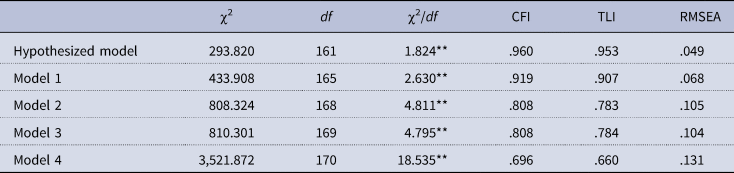
χ2, chi-square fit index; df, degrees of freedom; CFI, comparative fit index; TLI, Tucker–Lewis index; RMSEA, root-mean-square residual.
The models listed above are described as follows:
Hypothesized model: five-factor model.
Model 1: four-factor model combining acquiescent silence (AS) and defensive silence (DS) as one factor, subjective social status (SSS), job insecurity, and perceived organizational politics.
Model 2: three-factor model combining job insecurity and perceived organizational politics as one factor, with AS and DS combined as one factor, and SSS.
Model 3: two-factor model combining SSS, job insecurity, and perceived politics as one factor, and AS and DS combined as one factor.
Model 4: one-factor model combining all variables.
**denotes significance at the 1% level.
Test of hypotheses
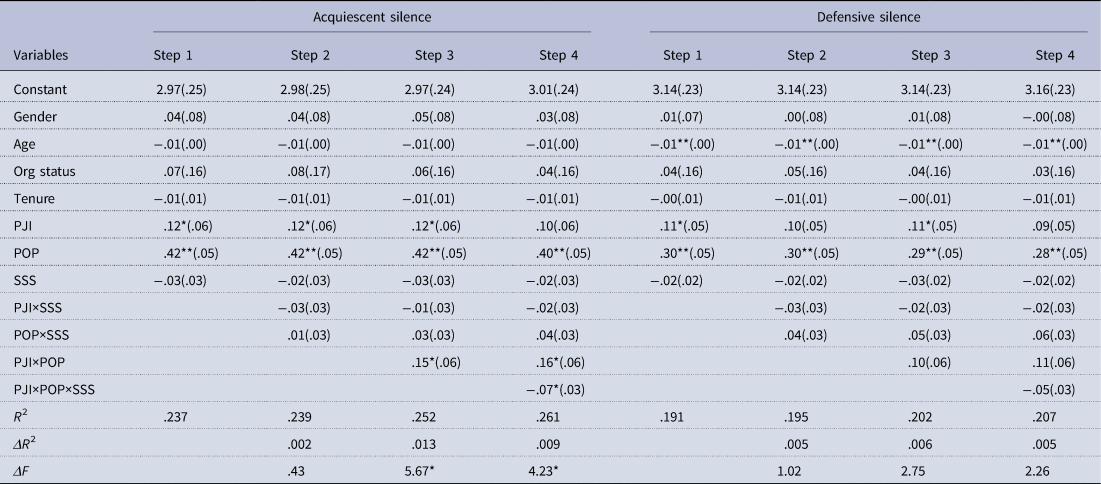
First, to test the proposed hypotheses, we conducted separate hierarchical regression analyses for AS and DS. The independent variables and moderators were centered on the mean prior to the analysis to avoid multicollinearity between the main effects and interaction terms. Specifically, the control variables, PJI and the two moderators for examining the main effect, two-way interaction terms, and the three-way interaction term were entered in steps 1, 2, 3, and 4, respectively. Table 3 summarizes the results of the hierarchical regression. Later, as a supplemental analysis of the interaction effects, PROCESS macro for SPSS (Model 3) was used with 5,000 bootstrap resamples.
Results of hierarchical regression
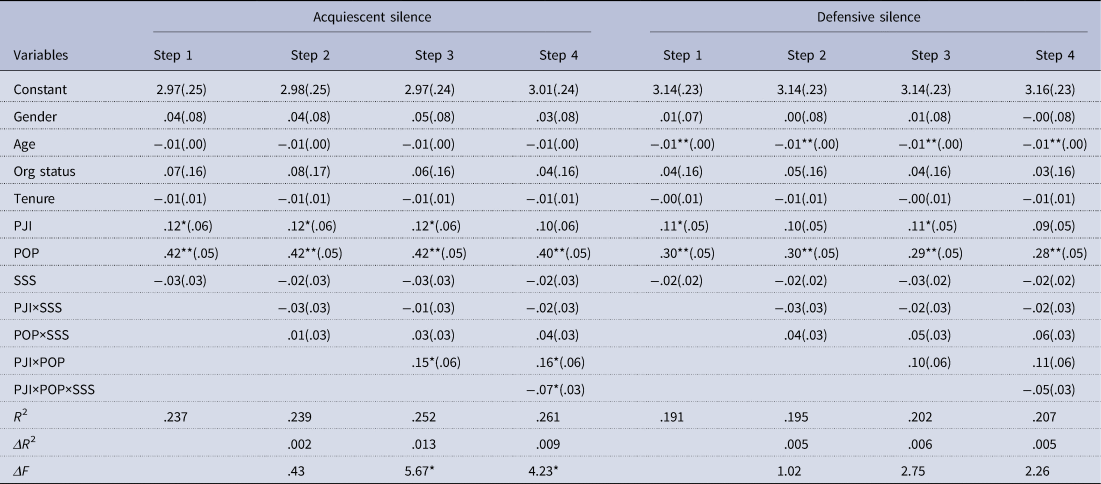
All regression coefficients are unstandardized; numbers in parentheses are standard errors; gender is dummy-coded as male = 0, female = 1; organizational status is dummy-coded as permanent = 1, contingent = 0.
**p < .01, *p < .05.
Hypothesis 1 predicts that PJI is positively related to the two types of silence. Table 3 (step 1) illustrates that PJI has a significant main effect on AS (b = .12; p < .05) and DS (b = .11; p < .05), thereby supporting Hypotheses 1a and 1b. As for POP and SSS, which were not formally hypothesized, POP is positively related to AS (b = .42; p < .01) and DS (b = .30; p < .01). This indicates that employees would not speak up in a highly political environment. Meanwhile, SSS was not significantly related to employee silence.
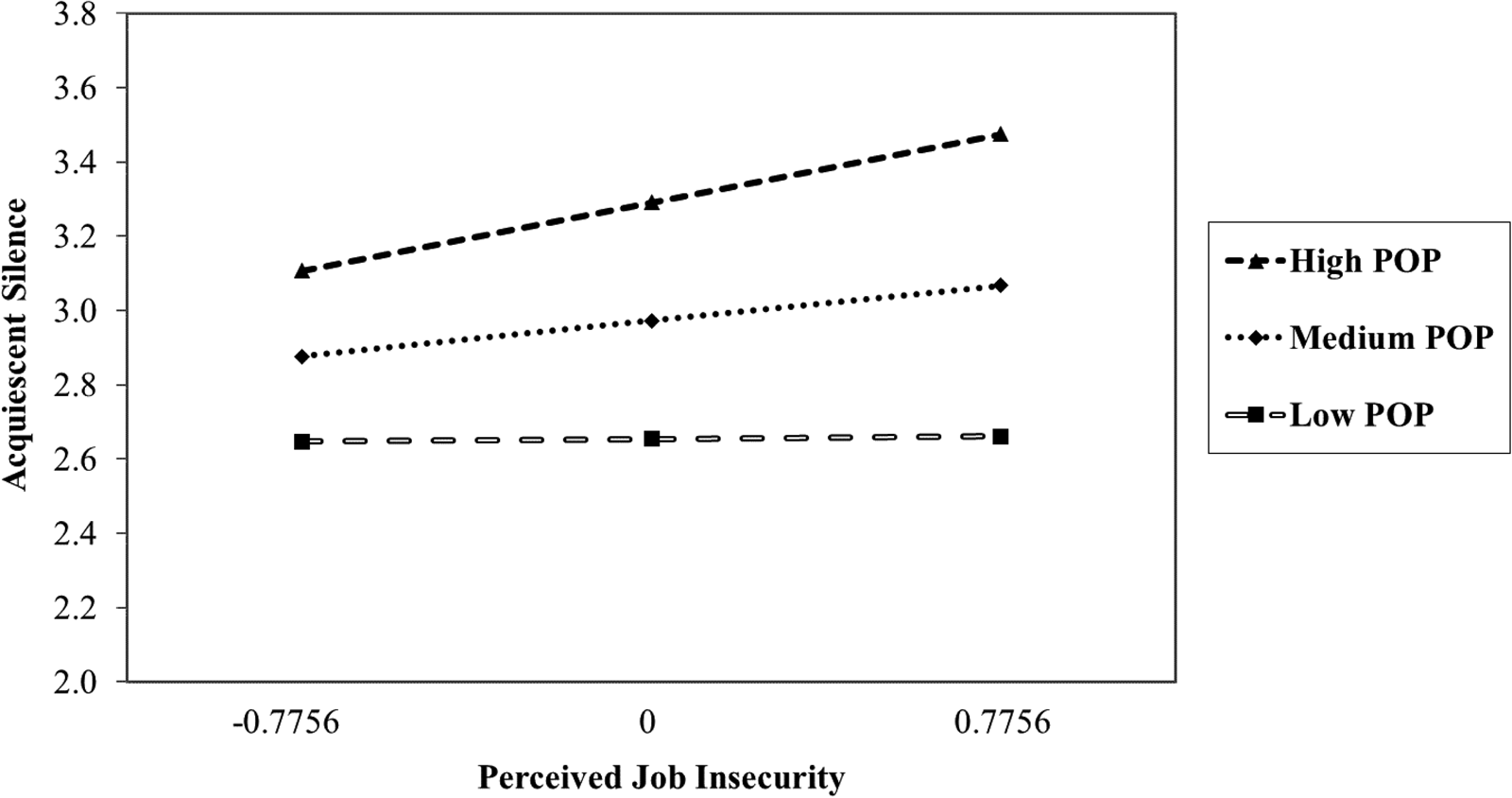
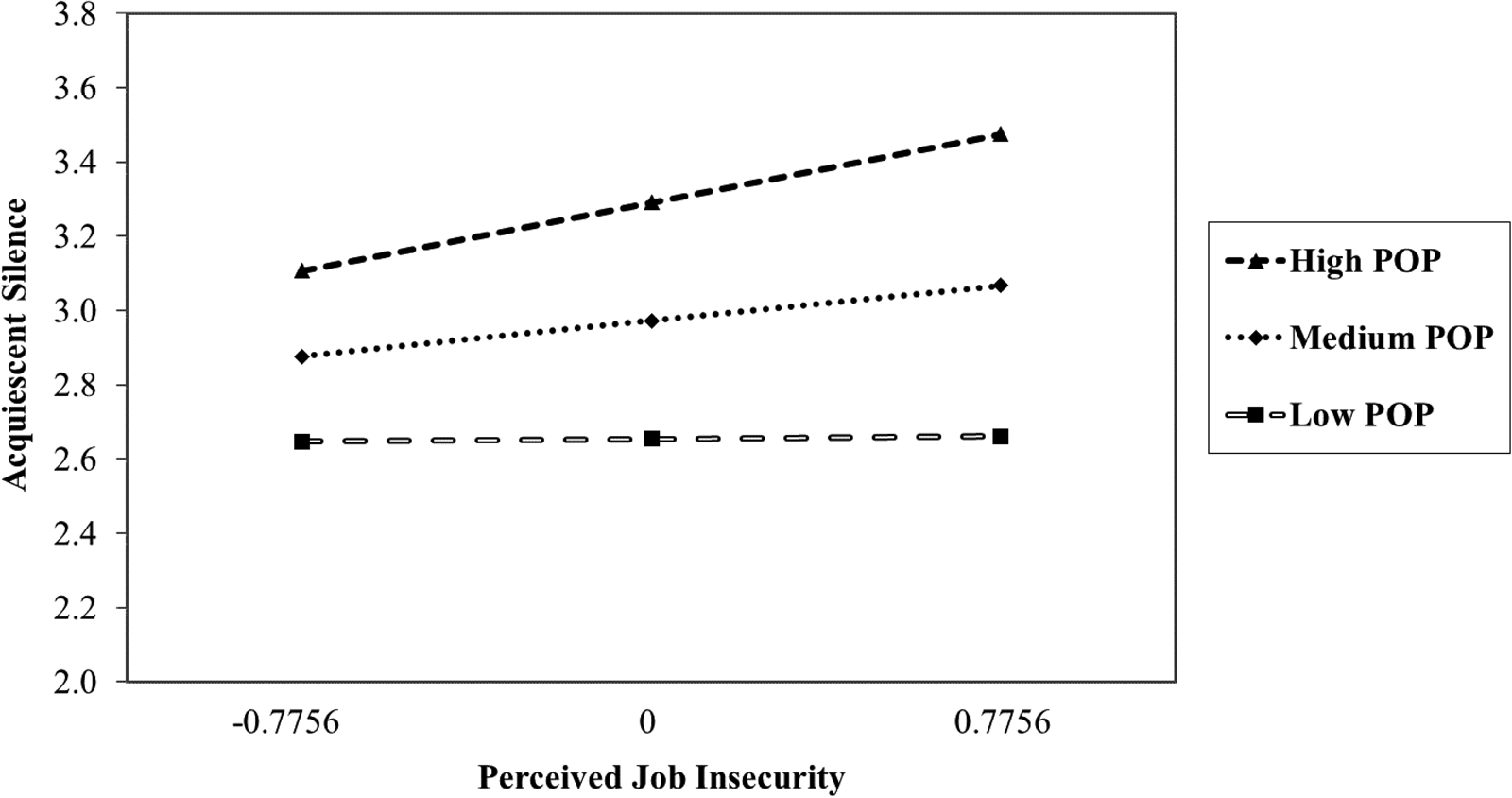
Hypothesis 2 predicts a moderating effect of POP on the relationship between PJI and both types of silence. To account for additional variance due to the interaction between PJI and POP, a moderated multiple regression analysis was conducted by incorporating control variables and predictors (i.e., PJI, POP, and SSS) in step 1, the other two interactions (i.e., PJI × SSS and POP × SSS) in step 2, and the PJI × POP interaction in step 3. As illustrated in Table 3, the coefficient of the PJI × POP interaction was positively significant only for AS (b = .15; p = .02), resulting in an R 2 change of .013, F(1, 339) = 5.67 (p = .02). To comprehensively understand the nature of this interaction effect, a simple slope analysis was conducted by computing one standard deviation above and below the mean of POP to plot the interaction. Figure 2 reveals that the positive effect of PJI on AS, as found in the main effect, only occurs when POP is high (slope = .24; t = 3.24; p < .01). When POP was low, the relationship of PJI with AS became nonsignificant (slope = .01; t = .13; p > .05). In other words, the higher the POP, the stronger the positive impact of PJI on AS. Therefore, Hypothesis 2a was supported. However, the interaction between PJI and POP was not significant for DS (b = .10, p = .10), thus Hypothesis 2b was not supported.
Moderating effect of perceived organizational politics on the perceived job insecurity–acquiescent silence relationship.
Probing the three-way interaction effect
The effect of the PJI × POP interaction was also expected to be conditional upon the level of SSS, as stated in Hypothesis 3. Accordingly, in step 4, the three-way interaction effect of PJI, POP, and SSS on the two types of silence was assessed by adding the three-way interaction term to the PJI × POP interaction effect model (i.e., step 3). As shown in Table 3, the coefficient of the PJI × POP × SSS interaction was found to be negatively significant only for AS (b = −.07; p < .05), resulting in an R 2 change of .009, F(1, 338) = 4.23 (p = .04). However, this pattern was not reliable for DS (b = −.05; p > .10). These results suggest that the interaction effect of PJI and POP on AS depends on the employees' level of SSS, which supports Hypothesis 3a. However, Hypothesis 3b is not supported.
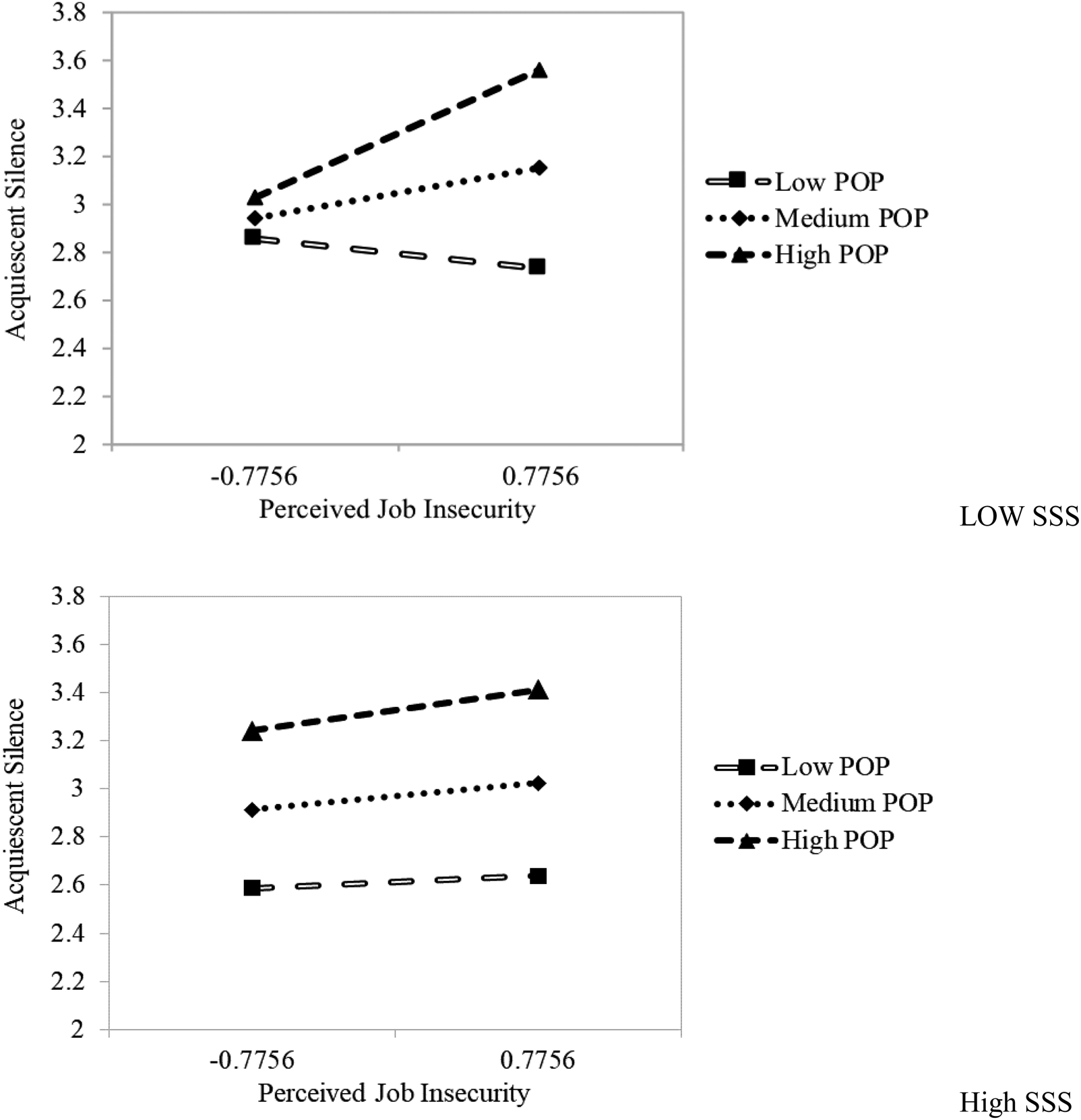
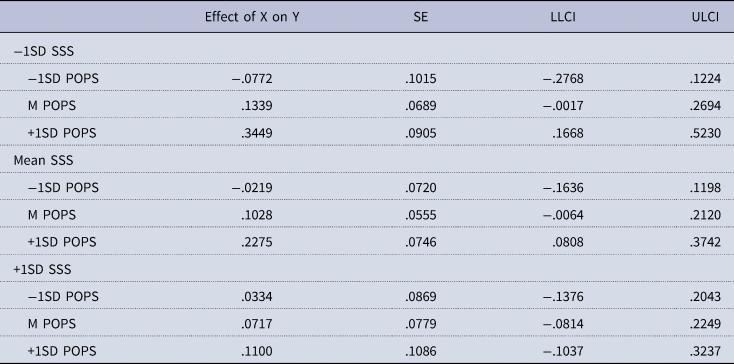
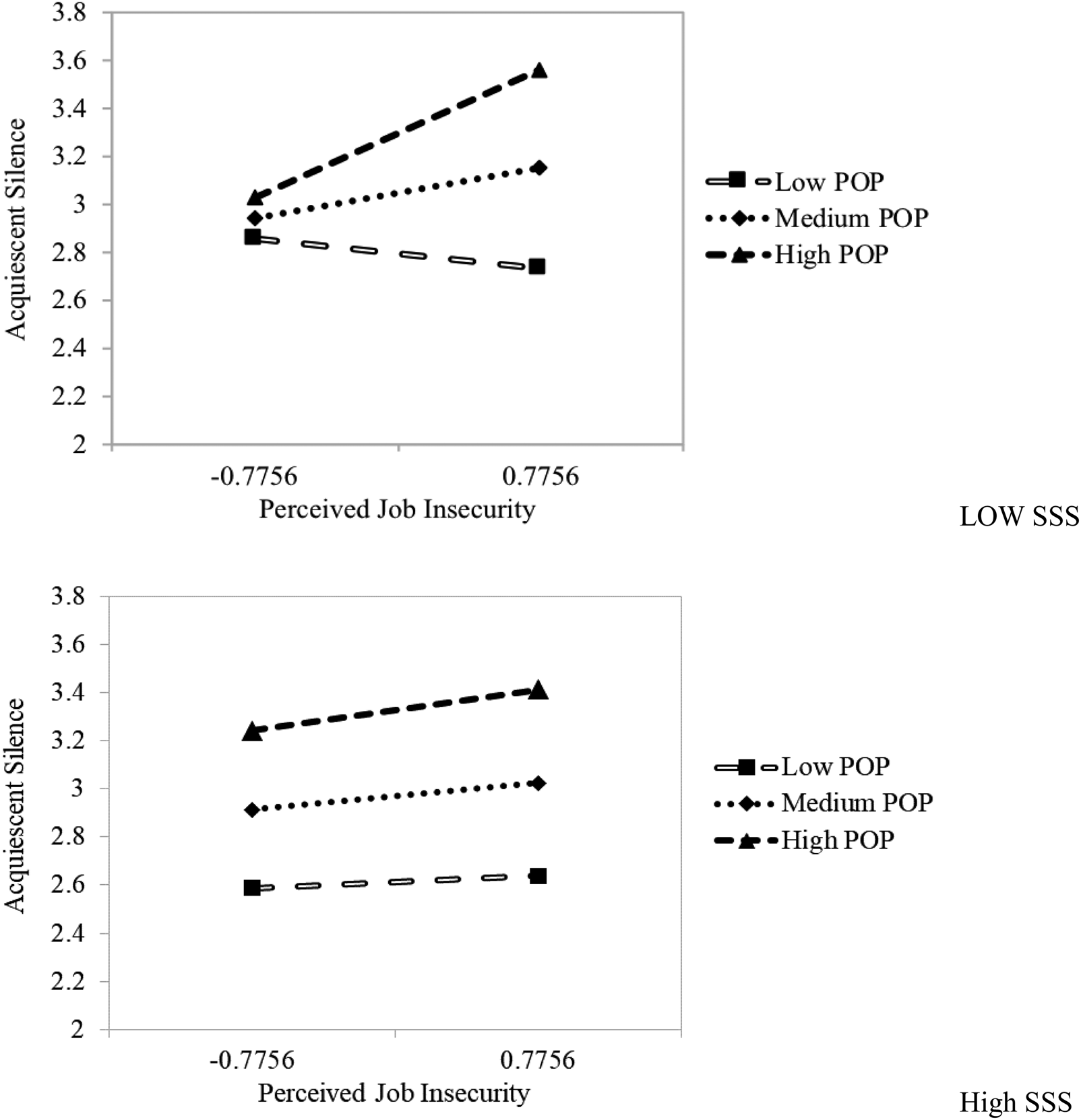
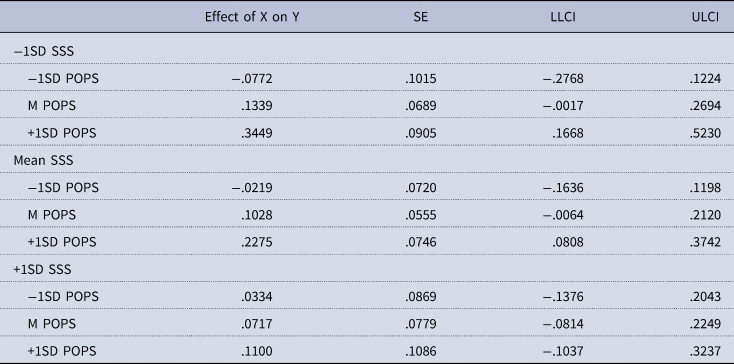
The results from the PROCESS analysis indicate that the significant two-way interaction effect of PJI and POP on AS occurs only among employees with low (interaction effect = .28; p < .01) and medium (interaction effect = .16; p < .01) SSS levels. No interaction effect was observed for those with a high SSS level (interaction effect = .05; p > .10). The three-way interaction was plotted under conditions of high and low SSS. The interaction slopes in Figure 3 show a positive effect of PJI on AS among employees who perceive their organization as highly political and consider themselves as having relatively low- or mid-level social status. The simple slope analyses (Table 4) revealed that under a high level of POP, the slopes of the PJI–AS relationship were significantly positive for those with low (b = .34; 95% CI [.1668, .5230]) and medium (b = .23; 95% CI [.0808, .3742]) levels of social status but was nonsignificant for those with a high level of social status (b = .11; 95% CI [−.1037, .3237]). Therefore, insecurity in job status increases employees' AS more strongly as employees perceive higher political intensity in the organization. This relationship may be more salient among employees with low to medium social status; or those with high social status, the relationship between their PJI and silence behavior does not change according to the perceived level of organizational politics. In sum, individuals who feel highly insecure and have low SSS are more likely to remain resignedly silent, particularly when they perceive their organizations as highly political.
The three-way interaction effects of job insecurity, perceived organizational politics, and subjective social status on silence.
Conditional effects of perceived job insecurity on acquiescent silence at values of the moderators
Discussion
Drawing from the COR and SDT, this study examined the antecedents and conditional factors that influence two types of employee silence (i.e., AS and DS). This study hypothesized PJI as a predictor and POP as an influential conditional boundary in the relationship between PJI and employee silence. Furthermore, it was proposed that the employees' SSS moderates the two-way interaction effect of PJI and POP on silence. The results indicated that PJI was positively associated with AS and DS and that POP moderated the relationship between PJI and AS. However, the same pattern did not exist in the relationship between PJI and DS. Furthermore, this significant three-way interaction existed only for AS. Therefore, the two-way interaction of PJI and POP on AS was moderated by employees' SSS. In other words, job-insecure individuals with a lower SSS may choose to remain silent under a highly political situation, which is characterized by increased uncertainty and social threats, as they are more susceptible to harm from stressful situations due to their lack of resources.
Theoretical implications
This study contributes to the literature on silence in several ways. First, the results show that PJI is positively related to two types of silence – AS and DS – even after controlling for POP and SSS. In other words, when employees are concerned about losing their jobs, they are more likely to become silent. Complementing previous research that demonstrated job insecurity to be predictive of withholding ideas, opinions, and/or information from one's current boss (Breevaart et al., Reference Breevaart, LopezBohle, Pletzer and Medina2020), the current study highlights the influence of PJI on employee silence in the workplace in general. Particularly, this study contributes to the literature by including two different types of silence – AS and DS. Silence is multidimensional, suggesting that its subdimensions (i.e., AS and DS) are somewhat related but represent distinct facets of silence rather than the overall concept of silence (Van Dyne, Ang, & Botero, Reference Van Dyne, Ang and Botero2003). However, most studies examining silence have used a unidimensional concept of silence. For instance, a recent meta-analysis about voice and silence (Sherf, Parke, & Isaakyan, Reference Sherf, Parke and Isaakyan2021) found relatively few silence studies that adopted the different types of silence. Since the utility of multidimensional constructs provides a holistic understanding of complex phenomena, this study may contribute to deepening the collective understanding of silence in the organizational setting.
Second, the results show that POP moderates the relationship between PJI and AS, but not between PJI and DS. More specifically, the impact of PJI on AS is observed only when employees' perception of organizational politics is high. As such, it is expected that the level of silence caused by a feeling of futility (AS) would increase in the absence of job security, but this predicted phenomenon stands out more clearly as the intensity of organizational politics increases. Organizational politics are then more likely to instill among employees feelings that their opinions and views will not be taken seriously by their supervisors and organizations, eventually discouraging them from speaking up (Pinder & Harlos, Reference Pinder, Harlos, Rowland and Ferris2001; Van Dyne, Ang, & Botero, Reference Van Dyne, Ang and Botero2003). Accordingly, the level of POP amplifies the relationship between PJI and AS. However, the results showed that the positive effect of PJI on silence caused by fear of negative consequences (DS) was not dependent upon the condition of organizational politics.
One possible explanation for the results could be the cultural impact on employee silence. South Korea is characterized by high power distance and collectivism (Hofstede, Hofstede, & Minkov, Reference Hofstede, Hofstede and Minkov2005). Subordinates in an environment with high power distance perceive that their supervisors have more control over valuable resources, such that they feel more susceptible to threats and unfair treatment in the organization. Accordingly, the influence of leaders on their subordinates' attitudes and behavior could be stronger in South Korea than other cultures. According to Rhee, Dedahanov, and Lee (Reference Rhee, Dedahanov and Lee2014), individuals in a collectivist culture with a high power distance are more likely to engage in AS since those with a high power distance orientation and collectivistic cultural beliefs want their superiors to make decisions for them. They are thus less likely involved in the decision-making process, resulting in the pervasion of a sense of futility (AS). However, the results of their study showed that individuals in a high power distance culture are not more likely to remain silent due to fear (DS). Similarly, in a high power distance culture, one may expect that POP amplifies the impact of PJI on AS more strongly in comparison to DS.
Furthermore, fear of speaking up to one's boss (DS) may result from the boss' behavior or style, rather than the overall organizational climate. Some scholars insist that the fear of an immediate supervisor is a typical cause of employees' motivation to remain silent (e.g., Milliken, Morrison, & Hewlin, Reference Milliken, Morrison and Hewlin2003; Ryan & Oestreich, Reference Ryan and Oestreich1991; Van Dyne, Ang, & Botero, Reference Van Dyne, Ang and Botero2003). Similarly, Dedahanov and Rhee (Reference Dedahanov and Rhee2015) found that lack of trust in the supervisor affects DS rather than AS, while trust in the organization negatively affects AS rather than DS. Their study shows that the direct relational impact from the supervisor on fear-driven silence is stronger than the overall organizational climate. Given that POP represents only the overall climate of the organization and not necessarily the behaviors or attitudes of the direct supervisor (or other superiors), the impact on DS could be relatively weak compared to AS.
Finally, the present study highlights the moderating effects of SSS relative to employee silence. Specifically, the proposed two-way interaction effect of PJI and POP on AS was stronger for employees with a low rather than high level of SSS. Consistent with previous studies emphasizing that SSS is closely related to a sense of control (Kraus et al., Reference Kraus, Piff, Mendoza-Denton, Rheinschmidt and Keltner2012; Lachman & Weaver, Reference Lachman and Weaver1998), the current study shows that SSS is a significant personal resource that influences the ways employees perceive and respond to their work environment. Notably, SSS is an individual's perception of their place in a social hierarchy; it differs from objective indicators of power and control over resources such as income, educational level, and employment status (i.e., permanent vs. contract). The results of the current study show that for employees with low SSS (vs. those with high SSS), the perception of PJI in a highly political situation is considered a more serious problem, discouraging them from voicing their opinions, since they feel resigned to their situation even though they have the same objective employment status. However, contrary to the proposed hypothesis, the results show no three-way interaction between PJI, POP, and SSS relative to DS.
One plausible explanation for these inconsistent findings regarding the three-way interaction is that, unlike objective social status, SSS is considered an intrapersonal factor involving a person's belief or perception of their place in the socioeconomic structure (Jackman & Jackman, Reference Jackman and Jackman1973). Given that AS stems from internal sources, such as low self-efficacy to make any meaningful change, and DS results from external sources, such as fear of being stigmatized as a troublemaker by others (Van Dyne, Ang, & Botero, Reference Van Dyne, Ang and Botero2003), SSS seems to be a more influential factor in relation to AS than DS (Milliken, Morrison, & Hewlin, Reference Milliken, Morrison and Hewlin2003). Accordingly, it is conjectured that the impact of SSS on employees' silence is more salient when they decide to be silent for intrinsic (i.e., AS) rather than extrinsic (i.e., DS) reasons.
Practical implications
The findings of this study also provide several practical implications for organizations. First, given that employees' perceptions of their PJI are positively associated with two types of silence, organizations need to address their employees' fear of job loss by increasing their sense of control over their future. As some scholars have suggested, providing diverse professional development opportunities to enhance their perceived employability helps employees feel confident about their skill and ability, which increases their sense of control and decreases their concern about job loss (Van der Heijden, Gorgievski, & De Lange, Reference Van der Heijden, Gorgievski and De Lange2016). Therefore, HR practitioners must consider providing training programs or upskilling opportunities for employees. Building learning communities that facilitate employees' informal learning would also be helpful. Furthermore, to reduce employees' feelings of job insecurity, managerial roles are highly important. Managers could provide an outlet where employees can share their anxiety. Therefore, managers must build trusting relationships with employees, where the latter can share their feelings of anxiety.
Second, considering that the relationship between PJI and employees' AS is activated under highly political environments, organizations should pay attention to managing organizational politics. For example, organizations may need to develop an organizational culture where policies, procedures, and practices are perceived to be fair because fairness and equity in organizations shape employees' overall perception of organizational politics. Supervisors have the most direct and significant influence on employee behavior, and employee's perception of the climate of silence is formed based on their supervisors' behaviors and the policies related to voicing their opinions (Vakola & Bouradas, Reference Vakola and Bouradas2005). As such, supervisors' proactive involvement in constructing a voice-friendly environment is crucial. Trust in management could reduce feelings of uncertainty and fear among employees; therefore, enhancing trust through empowerment could be an effective approach for the supervisors. An empirical study found that empowering leadership increases employees' trust in their leaders, reducing employee silence in public organizations (Hassan, DeHart-Davis, & Jiang, Reference Hassan, DeHart-Davis and Jiang2018). In addition, practices that enhance information sharing among employees and facilitate the active involvement of employees in decision-making could help encourage employees to be open and transparent in a work environment where politics is minimized.
Finally, the results of the study indicated that managers should pay special attention to employees with a low level of SSS because they are likely to remain acquiescent silent based on a loss of self-efficacy they may suffer in current workplaces. Accordingly, organizations are required to invest in career development interventions directed at increasing employees' confidence in employability, a buffer against unfavorable consequences of job insecurity (Yeves, Bargsted, Cortes, Merino, & Cavada, Reference Yeves, Bargsted, Cortes, Merino and Cavada2019). Moreover, providing counseling service on matters concerning issues encountered by employees – such as unfair treatment or PJI – might be beneficial, particularly for employees with a low level of SSS. In addition, having a mentor in the organization can help employees receive emotional support and guidance, thus encouraging them to speak up.
Limitations and future research directions
This study has some limitations. First, silence is naturally a lack of action, making it is exceedingly difficult for observers to detect it. Therefore, silence and other variables were self-reported in data collection to accurately assess silence behavior. In turn, this may have increased the possibility of CMV from same-source bias. Furthermore, a cross-sectional design was used to collect data for this study. Even though the CFA results did not indicate the existence of a CMV effect, the self-report and cross-sectional design may have limited the inferences regarding the causality of the variables. Thus, future studies should consider both using a longitudinal or lagged design to capture the causal relationships among the variables more appropriately and measuring the construct from other sources (e.g., coworker ratings).
Second, a relatively strong correlation was found between AS and DS (r = .74). Although the CFA analyses indicated that all the variables, including AS and DS, were distinct, further analysis was conducted using a structural equation modeling technique to examine whether the same results can be replicated even when correlating AS and DS (i.e., covarying the error terms of AS and DS) in the tested model. The results obtained from this additional analysis were consistent with those of the two hierarchical regressions illustrated in Table 3. The integration of these findings with the CFA results suggests that AS is related to, but empirically distinguishable from, DS in relation to PJI, POP, and SSS. Therefore, it can be concluded that the observed correlation of .74 between AS and DS in this study is not a concern.
Third, considering the potential multifaceted nature of silence (Greenberg & Edwards, Reference Greenberg and Edwards2009), it is a promising direction for future studies to extend the investigation to different types of silence. In this study, silence behaviors without harmful intentions – such as revenge against the organization or other members for injustice experienced by employees – were examined. However, one stream of research that examined why people choose to be silent argues that silence is an active coping strategy for avenging the injustice they experienced (Tripp & Bies, Reference Tripp and Bies2009). Accordingly, future researchers may want to include instrumental silence (remaining silent to create a good impression of oneself on the supervisor for rewards) or OS (withholding information to achieve advantages for oneself) in their study.
Given the negative impact of employee silence on organizational effectiveness and innovation, it is critical to understand the relevant factors that make employees keep silent about their ideas and opinions in the organizations. The results of this study emphasize that both individual resources – such as PJI and SSS – and contextual resources – such as organizational politics – are jointly associated with employee silence. Although the generalizability of this evidence may be limited to privately-owned companies, we hope that this study can help organizations provide a fair and secure environment where employees in the private and public sectors can speak up about their opinions and ideas, regardless of their level of social status and PJI.
Acknowledgements
This study was supported by research fund from Chosun University (K207806003-1).
Appendix
All items of acquiescent silence and defensive silence
Acquiescent silence
(1) I passively support the ideas of others because I am disengaged.
(2) I passively express agreement and rarely offer a new idea.
(3) I agree and go along with the group, based on resignation.
(4) I only express agreement with the group based on low self-efficacy to make suggestions.
(5) I passively agree with others about solutions to problems.
Defensive silence
(1) I do not speak up and suggest ideas for change, based on fear.
(2) I withhold relevant information due to fear.
(3) I omit pertinent facts in order to protect myself.
(4) I avoid expressing ideas for improvements, due to self-protection.
(5) I withhold my solutions to problems because I am motivated by fear.
SuJin Son is an Assistant Professor of the College of Business at Chosun University in South Korea. She received her PhD degree in Human Resource Education from the University of Illinois at Urbana-Champaign. Her research interests include mentoring relationships, trust building, and career development of employees.
Tae Seok Yang is an Associate Professor in the School of Management and Marketing at Western Illinois University. He received his PhD degree in Management (OB/HR) from the University of Texas at Arlington. His research interests include organizational politics, impression management, organizational citizenship/deviant behaviors, and work-family issues.
Junsu Park is a Research Professor in the Department of Social Entrepreneurship and Humanistic Future Studies, Sungkyunkwan University, South Korea. He earned two PhDs from both Ajou University and University of Eastern Finland. His research focuses on individual and contextual factors associated with risk-related behavior in an organizational setting.