


Introduction: Cold War Literary Itineraries in Faiz Ahmed Faiz's Months and Years of Friendship: Recollections (1979)
In his 1979 Urdu-language memoir about his time in the Soviet Union, the Pakistani poet Faiz Ahmed Faiz (1911–84) recounts his extensive travels throughout that nation and his encounters there with luminaries of Soviet and world literature alike, from Ilya Ehrenburg to Jean-Paul Sartre and Nazim Hikmet.
Although he published just seven books of poetry during a career spanning over half a century, Faiz is widely acknowledged as one of the most significant modern poets of South Asia. He was a leading figure of the Progressive Writers’ Movement, a leftist group founded in India in 1936 that advocated for a literature responsive to societal ills. A champion of the movement's call for littérature engagée, Faiz is credited with invigorating the Urdu poetic idiom by infusing it with political meaning: his widely known poem “Freedom's Dawn (August 1947)” (صُبحِ آزادی [“Ṣubaḥ-i āzadī”]), for instance, filters the experience of Partition through the traditional metaphors of the Urdu love lyric.
Having already earned a reputation as an important poet on his native subcontinent, Faiz was propelled onto the global stage by his imprisonment in the 1950s: he attended the Afro-Asian Writers’ Conference in Tashkent in 1958 (Vasilʹeva, Faiz Akhmad Faiz 280) and received the International Lenin Peace Prize from the Soviet government in 1962. Faiz's relationship to the Soviet Union had begun much earlier, when he learned about the October Revolution as a young boy growing up in pre-Partition India (Faiz, Mah o sāl-i āshnā'ī 8), and in 1949 he met Soviet writers for the first time at the second meeting of the Progressive Writers’ Movement in Lahore (21).
Published by the Progress Publishing House in Moscow, Months and Years of Friendship: Recollections ( مہ و سالِ آشنائی : یادوں کا مجمُوعہ [Mah o sāl-i āshnā'ī: yādoṉ kā majmūʻah]) is a surprisingly understudied document that helps us understand Faiz as a man, political actor, and author.Footnote 1 It also contributes to a fuller picture of twentieth-century literary and cultural exchanges as we seek to expand our collective purview of diverse literary vantage points—a project Faiz himself championed (Vasilʹeva, Faiz Akhmad Faiz 76).
In its sensitivity to questions of borders and language, Months can be seen as an extension of Faiz's poetics, which, as Aamir Mufti has argued, ambitiously question “whether the nation-state can account for the complexities of culture and identity in modern South Asia” (215). The travelogue sheds light on the often fraught negotiation between the local and global as Faiz explores the challenges of cosmopolitan postcolonial identity in what Terry Martin has called the world's first “affirmative action empire” (1).Footnote 2 Building on the tradition of Urdu travel narratives, Months also foregrounds a multifaceted self as it adapts to ever-changing linguistic and cultural surroundings.
This adaptation is part and parcel of the contradictory figure that is Faiz: he was both a sincere admirer of the Soviet project and ambivalent about the Communist Party, a leading figure of the Progressive Writers’ Movement and autonomous from it (Mufti 215). His travelogue speaks to the intricacies of his allegiance to what Nancy Condee has called the Soviet Union's “anti-imperialist empire” (829). Tellingly, the brief portion of the text set in Moscow and presented here is also the only place where Faiz's traumatic memory of his years in Pakistani jails surfaces—twice. The challenges of writing this text and the feeling of obligation from which it likely sprang speak to the difficulty with which Faiz negotiated his role as a literary diplomat and fellow traveler.Footnote 3
Months also reveals the extent to which Faiz himself mobilized the utopian trope of “perfect understanding across linguistic boundaries [that] occurs again and again in stories about the international travels of authors from the Global south” (Kantor 608). In reality, language frequently served as a barrier between Faiz and his Soviet hosts, but as the excerpt presented here shows, linguistic differences are frequently cited when they have been overcome.Footnote 4 Such is the case in Faiz's account of moving the American journalist Albert Kahn to tears with his impromptu English translation of his poem dedicated to Ethel and Julius Rosenberg, an American couple executed in 1953 for spying for the Soviet Union. By contrast, Faiz's account of his close encounter with the Soviet medical bureaucracy points repeatedly to the linguistic barrier between him and his Soviet hosts. His coy remark upon being discharged from the hospital (“My virtue was nearly shattered. . . .”) is a nod to Indo-Persian poetry and the travel-writing tradition both and suggests that the things Faiz prized most in the Soviet Union were, as his title suggests, the friendships that he made there, largely (though not exclusively) with other foreign visitors.Footnote 5
In the pages to come, readers will find the entire “Moscow” section of Months and several selections from the “Dialogues” chapter. In the passages set in Moscow, Faiz chronicles some of the pleasures and challenges of his time in the metropole and expresses his overt admiration for and, more subtly, reservations about the Soviet Union. He also evinces a desire to see in his host country a model for his own newly independent native country, Pakistan—as he does, for example, in his discussion of his poetic predecessor Allama Iqbal's notion of khūdī, or selfhood. The selections from “Dialogues,” meanwhile, are fascinating not only for what Faiz chooses to document but also for how he does so: through Faiz, Ilya Ehrenburg speaks in a uniquely Hindustani idiom to defend Soviet literature, and Jean-Paul Sartre refers to righteous struggle, or jihad, in his address to writers from recently decolonized and decolonizing countries.
Umar Anjum and I hope that the section of Months that we have translated will prompt scholars to examine the full text more closely to better understand Faiz's role as a global literary actor. Deserving of consideration, too, is the question of what Faiz's accounts of his Soviet itineraries can teach us about the negotiation between the local and the global in a postcolonial and cosmopolitan context.
Preface
Last year in Moscow when I received a request that I put pen to paper and record my impressions of the Soviet Union, I of course said yes. And I also sent a draft to Progress Publishing House, but it was a very rough draft, and it was still unclear to me what I should write in this book and how it should be written in the first place. When I beheld the Soviet Union for the very first time about seventeen years ago (in 1958), such a multitude of impressions spread in my heart and such amazement and delight in my mind of the kind that comes at the beginning of every new discovery, that perhaps a book like this could have been written in one sitting. But at the distance of so many years and so many trips there it is hard to be acquainted with this state anew.Footnote 1 Many heartwarming memories have already become a blur, many interesting things consigned to oblivion, and what impressions are left of them have been mixed with what I subsequently experienced. Therefore when it came time to write, alas no satisfactory formula came to mind for the organization of these individual scattered sections, and, as a result, I could not complete this book in the agreed-upon time frame. Finally I decided that I would write off the cuff whatever came to mind in whatever form without giving much thought to precedent, delay, organization, or composition, and this is what I have done. Though I have included an article on Dagestan that had been written previously, in truth this book is neither some sort of journalistic reportage nor some sort of clear-sighted study. Rather, it is a friendly observer's scattered recollections that will perhaps not contribute much to the knowledge of those who have already seen the Soviet Union or have read about it extensively. But for those readers who have not had this opportunity, perhaps this scattered album of memories might occasion a half-interesting picture by means of which they might feel some sense of proximity to that great land and its inhabitants. If that happens, then as every author writes at the beginning of every book, I too will consider this effort not to have been wasted, even though labor played a lesser role in the writing of this book than love, and demanding topics such as history, geography, political science, statistics, etc. have already been written about in books by hard-working people and are easily available to the scholastically inclined.
Do not ask of us anything except love and loyalty.Footnote 2
Moscow, August 1975
Moscow
1958, Moscow. Moscow that even now both is and isn't the same, Moscow that perhaps has always been exactly like this and yet is ever-changing. In the beginning when there wasn't even a Sheremetyevo airport here and I arrived at the old Domodedovo, it was less like an airport and more like some wealthy lord's palace. But the forests that spread as far as the eye could see were the same as they are now, and in them the tall, slender white trees were also. So was the blooming greenery, the river, the triangular cathedral-like towers of government offices, the gilded onion-like dome of the Kremlin, and ruby-red star, the Bolshoi Theater, vast boulevards, statues, and memorials. But all the same, how different this Moscow was! In those days you couldn't see skyscrapers on the horizon in every direction but, in their place, cranes. On Kalinin Avenue there was no procession of glass buildings, no pencil-like Ostankino TV tower to reach as high as the sky, no stores brimming with wares on Kutuzov Boulevard, no bustle of cars on the streets, just trucks laden with goods speeding by. There was no profusion of stores for food, clothing, or household items, there weren't as many cinemas, and there weren't as many fashionable girls. A lot of other things were different too, but Moscow was still Moscow.
At first glance a few things struck me as strange. The first was that there wasn't even a single advertisement in the whole city, neither on buses nor on the sides of buildings nor inside stores; nor were there flickering neon lights. Even now there are very few, but back then they were absent entirely. The other thing was how quiet the city was: there were no honking horns, no rumbling of buses, no shouts of grocers hawking goods or bells of tongas or rickshaws. The third thing was that the sort of shoving and pushing, stampede, and chaos that you might experience in the streets or markets of London, Paris, and New York was nowhere to be found. People amble around as if they haven't a care in the world. Nor has anyone here ever heard of rush hour; nor do people swell up out of the underground stations, and neither do they elbow one another while riding the bus. There is a strangely peaceful atmosphere. When I was released from jail after several years, for two or three days I was unable to sleep at home without the sort of noise I had grown accustomed to in jail. It occurred to me that tourists from New York or London must have had a similar kind of feeling upon arriving in Moscow.
Whenever you look at pedestrians, they are invariably going somewhere, but for some reason around the Red Square there is always some sort of mela occurring. Some people just stand around chatting, some are busy strolling around in small groups, some are taking photos, and some are devouring ice cream. And wherever you go in the city, you'll see people of all stripes walking around: European, African, Asian, white, black, wheatish. And you can tell at first glance how insouciant their manner of dressing is. Adolescent girls, well, they get dolled up as is their nature, but as for the rest of the population, some are fat, some short, some tall, some skinny, some wear suits and some laborers’ overalls, some ties, some stroll around in vests. Old or young, they are preoccupied with their own affairs and clearly untouched by vanity. It's a strangely contented, carefree, and indolent state of affairs the likes of which is not much seen elsewhere.
The first three or four days in Moscow were spent walking around and greedily taking in the sights with wonder, and the rest of the time in the company of old and new friends. I had seen them in Tashkent, but because of the busy conference schedule there I had not had my fill of them. Here there was more free time, so our gatherings would sometimes begin in the afternoon and end at night, and sometimes nocturnal salons would last until morning. Personal anecdotes were told, verses recited, and bons mots exchanged. I remember one such gathering well: everyone had assembled in Sajjad Zaheer's (Banne's) room.Footnote 3 I was asked to recite some verses, so I recited the Rosenberg poem “We Who Were Killed on Dark Pathways” after a brief preamble.Footnote 4 When I finished translating it into English, a man who had been sitting quietly in the corner suddenly stood up and, holding a handkerchief up to his eyes, left the room crying. Someone explained that it was the famous American Progressive journalist and writer Albert Kahn, who had been the Rosenbergs’ personal friend and was now the guardian of the couple's orphaned children.
And then I came into contact with a local organization for public welfare for the first time and became somewhat acquainted with societal life here from this angle.
Only a few days had passed since my arrival to Moscow when some pimples first appeared on my calves and then spread to my arms. At first I thought nothing of it, but then the itching became a bit uncomfortable and I told Mariam Salganik to ask the hotel doctor to give me some ointment etc.Footnote 5 Or let's go and have him examine me. The doctor took one look and told me to go to the clinic for a check-up. The Writers’ Union has its own clinic here, just as other large institutions do. At the clinic there are specialists in every illness and every provision for analysis and diagnosis. When we arrived, the entire board of doctors was assembled. Having thoroughly poked and prodded me, they all looked as if a blessing from the heavens had fallen into their hands. Then they spoke to the interpreter. I found out that the ambulance was coming and that instead of the clinic, I would go straight to the hospital. I asked the interpreter, what is so serious that it requires a hospital? I already have a lot of meetings set up for tomorrow. Give me some medicine here, I said, and I'll do whatever needs to be done myself at the hotel. The interpreter said, “The doctors were happy because this virus of the skin does not exist here and they haven't been able to get their hands on it before. Now that they finally have a case, they won't let you get away that easy.” We arrived at some far-off hospital, and after being admitted, I was reminded of my jail cell. A guard is stationed outside and even the doctors cannot enter without first showing their passes. Visitors are only allowed one day a week, and even then just for a little while; the rest of the time you're imprisoned and eat and drink as prescribed. Based on this experience I will tell you that if you should find yourself in the Soviet Union and God forbid you get a runny nose, cold, or stomach ache and call for a doctor, don't expect that you will get off with a simple aspirin or digestive mixture. Before prescribing a medicine, they will first inspect your heart, brain, liver, kidneys, and lungs. X-ray, cardiogram: you will have to undergo every possible examination aside from a C-section (as the late Patras Bokhari would say),Footnote 6 and only after that perhaps medicine will be prescribed to you. But happily, here the doctors, nurses, and hospital staff generally do not act as if they have been forced to work without pay, nor do they treat patients as if they aren't living, breathing human beings who, aside from medicine, have no need for kindness and compassion but are, instead, just some sort of strange object with no need for personal connection. More will be said later about the role of personal relationships in every occupation; here the attitude toward socialized medicine is that individuals are a society's greatest wealth and that every other form of wealth is the result of those individuals’ labor. Because of this, every individual's life is considered precious capital whose care is the responsibility of both society and the state. Hence, medical staff remain invested in every life “from cradle to grave,” as the saying goes. As soon as a child is born, the designated neighborhood doctor and nurse arrive at the new mother's house, and from then until the age of sixteen that child remains in that same doctor's care. Generally, having reached puberty, every man and woman must go to their local polyclinic for an X-ray yearly, and if they do not, a policeman will come knocking on their door. There are two types of clinics: one is the general neighborhood clinic and the other is an institution's specialized clinic. The patient gets to choose if they want to go to this one or that, and anyone who is too indisposed can request a house call from the doctor. For children and new mothers there are separate centers with adjoining stores containing all the necessary items to care for a newborn—in other words, bottles, milk, etc. are always available.
After about a week spent cooped up in solitude, I began to grow weary. Luckily the anniversary of the October Revolution came (fig. 1), and after much pleading I obtained permission to be discharged. When I arrived at the hotel, Banne, Bedi, Taban, and other friends were waiting for me.Footnote 7 They asked me how it had gone and I replied, “Don't ask, my friends. There was not a single man in the hospital, just women. My virtue was nearly shattered. …”
Faiz Ahmed Faiz's entry ticket to the festivities marking the sixtieth anniversary of the October Revolution. Image courtesy of Faiz Ghar (Lahore, Pakistan).
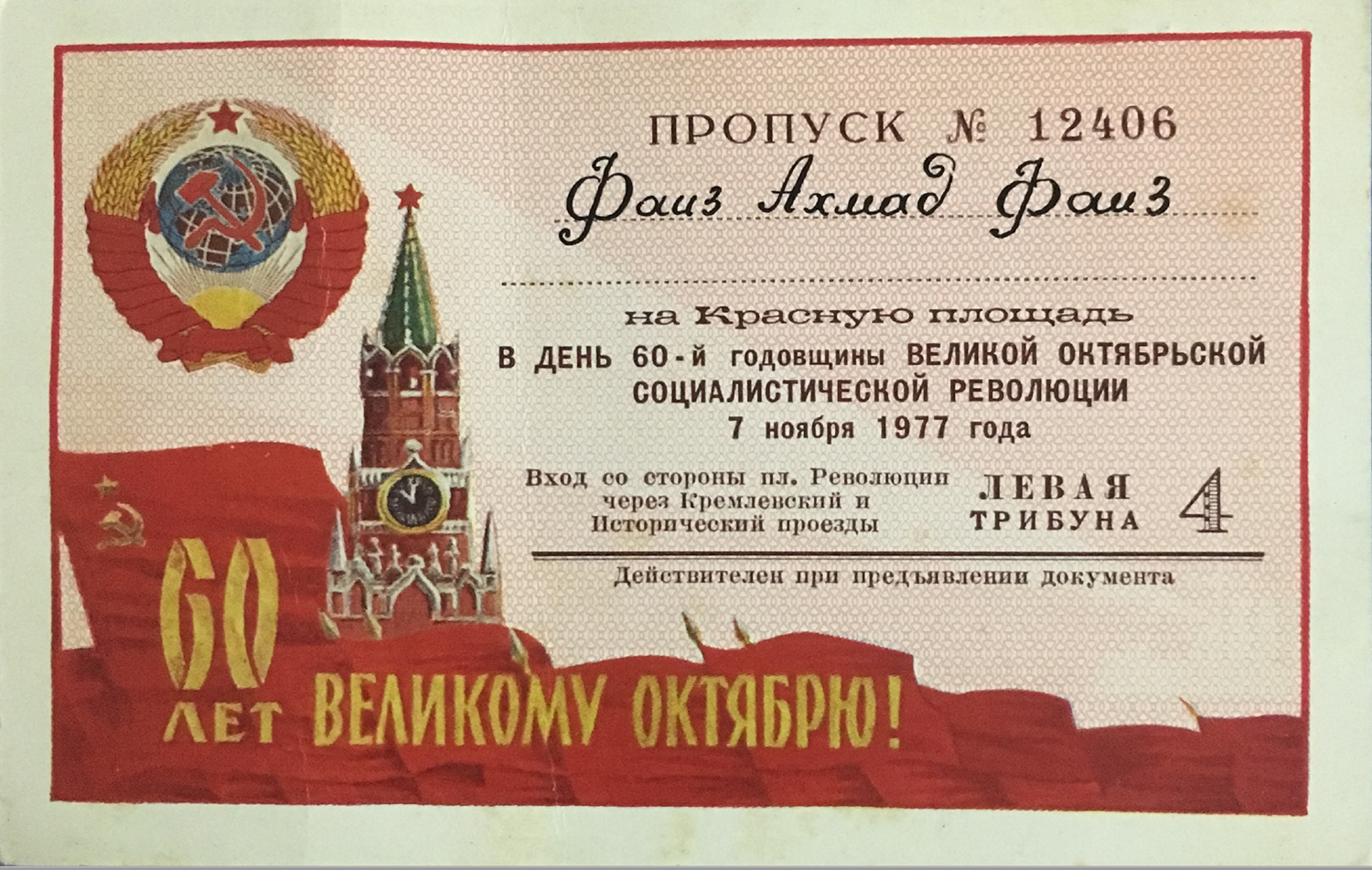
Now foreign visitors have begun to arrive, but even before that Moscow had exactly the same crowds. People from all of the republics just keep arriving, some for business and others for pleasure. The city's shops are mostly filled with these visitors. I asked someone how the city could possibly sustain all these people; where do the hotels find the space? I was told that this is not Europe; the custom here is that if anyone's friend, loved one, relative, or acquaintance is in town, they come and stay with them without standing on ceremony. Whether there is room for them or not, one way or another some space must always be found.
One friend of mine was telling me that nowadays there is not such a dearth of space in the city, but there was a time when two or three families shared one flat. She also lived in such a one-room flat with her husband and two children. One day when her husband had gone out somewhere for work, an elderly woman knocked on the door and asked if so-and-so lives here. She said yes, he is my husband. The woman said, I am his aunt; I've come from Siberia and have just recently retired. Now that I am no longer working, I yearn to finally see Moscow; I got your address from somewhere and here I am. My friend welcomed her in and told the woman to make herself at home. “I thought she would stay for a few days, but she sat in state with us for an entire month. And I found out from my husband that she wasn't even his aunt, but his uncle's mother-in-law's niece.” The traditional Eastern manner of family, relatives, domestic relations, neighborliness, and close relationships is entrenched here, and not only did it not need to confront the dilapidation of the West, but some new foundations of shared proximity and kinship have been established in this new system, also. For example, in Western societies newly wedded couples concern themselves first and foremost with having a house of their own, but here it is the opposite: new parents cajole one of their fathers or grandfathers, mothers or grandmothers into living with them so that when the couple is busy, they can look after the children or help out with the housework. In my childhood I saw the words “Who ventures to lend loses money and friend” written on numerous stores, and when I grew up, I understood that in every industrialized society there are a lot of other ways to lose friends, besides. But in a society without class, every relationship—not just the above-mentioned family or friend relations—is transformed. For example, somewhere above there was mention of relationships in the daily business of life. In Europe and in Western nations it is considered very indecent to do what is known as “taking liberties,” or treating a stranger informally for no reason. Everyone is separated in their quarters; some are doctors and some patients, some customers and some shopkeepers, some drivers and some passengers, some employers and some, employees. There is a shared conversational standard among them that it is considered insolent to transgress. In London, a ticket taker or an elderly woman in a cigarette store will of course call you “dear” or “love,” but these words are a mere figure of speech. They do not have a familiar meaning. The reason for this alienation is clear—in a capitalist system all people must remain guarded lest one person take advantage of another somehow. The problem here is exactly the opposite: when a passenger gets in a taxi, as soon as he sits down, a close friendship develops between him and the driver. And if you didn't eat well at breakfast in the hotel, then the waitress will complain and ask your interpreter if you hadn't liked the food or if you are not feeling well. A supervisor and a subordinate in an office, a factory manager and a skilled worker—they talk to each other in exactly this informal tone. And another thing is that here words like jinab, huzoor, or sirkar are unheard of.Footnote 8 Everyone is either a “comrade” or is called by their first name. If there is a need for formality, then someone's full name is used, meaning their first name and then their father's name—for example, Andrei Petrov, or Muhammad Bakhsh Allah Bakhsh. Here there is certainly etiquette and discipline in businesses and administrative settings—quite a bit, in fact. So too are there different levels of income and comfort, but in social and personal relationships neither lowliness nor preeminence is acknowledged.
From this one should not get the impression that only angelic people who have eradicated from themselves all human weakness live here. When my friendly acquaintance with people here grew, I heard many stories, and listening to them provided some comfort that love affairs fail here as well, hearts get broken, rivalries develop, mothers-in-law fight with their daughters-in-law, quarrelsome wives also exist, and so do bad-tempered husbands. Thus, people have found many cures for the enduring miseries of existence, but the remedy for pains of the heart has yet to be discovered.Footnote 9 And it's a good thing, too, otherwise what would some of our poet friends do?
Of course, some aspects of escape from the enduring miseries of existence became apparent to me. We have an old saying, less common these days, that money is like dirt on your hands: it comes and goes; why give it special thought? This expression probably comes from the times when nawabs and the rich were provided everything they needed by the toil of their subjects and money was squandered on frivolities. Now those days are over. Now, in this commercialized world, every cent is examined many times, and if it can be spared, then it is invested to make even more, and if it cannot, then it goes to whichever need is most pressing—food, clothing, housing, or medicine. This is how money is treated in the land of the Soviets. Whether in a big city like Moscow or a small town, stores for food, clothing, and household items are crowded, and everywhere it seems as if people are bent on spending money. When we were here the first time, many basic necessities were in short supply, especially imported goods. As a result, it was not surprising to see crowded shops. But this is no longer the case. First, various sorts of fine goods began to be produced in other socialist European countries and are now available in several places. But besides this, trade with capitalist countries has increased so much that though their products are still in short supply, these items are no longer a curio. In keeping with this proportion, instead of small shops, big department stores have opened where every type of product is available, but despite this, the number of customers has only increased. Well, perhaps this is nothing special. Once when I was going to Leningrad from Moscow along with my translator, I laid eyes on her wallet with its bundles of ten-ruble notes. She told me that she had to buy something. Later I found out that she needed a type of harp for her daughter that is made in Leningrad and costs 1,700 rubles—around seventeen thousand rupees in today's terms.Footnote 10 I expressed my objection to this prodigality, to which she replied that, after all, one has to spend surplus money somewhere, and if we save money it's because we intend to spend it on things like buying a car, constructing a dacha, or getting something expensive for the house. What is the point of letting it rot in the bank? Detachment toward money is one aspect of freedom from the griefs of earning a livelihood.Footnote 11 The other is to put that leisure and spare time to some use. Our elders suggested just one hobby for this purpose: “If you don't have any sorrows, keep a goat.”Footnote 12 At that time keeping a goat must have really been something interesting. Now what is the fun in it? Hence people here cultivate some interests of their own, and others derive satisfaction collectively, through state and social institutions. For example, there is a museum in Moscow for handmade things: pictures made out of straw; landscapes; likenesses; statues made out of dried branches, wood, and junk iron; abstract, design, and decorative things made out of different types of stone, metals, and seashells. Everything is a very fine example of hard work, taste, and craft. A while back, different professionals like doctors, engineers, and scientists organized an exhibition in Moscow called the Micro Exhibition. The special thing about this exhibit was that you could not view it without a microscope. We have seen the sūrat al-Fātiḥah written on a grain of rice,Footnote 13 but a chessboard and carved pieces on one side of a kernel of corn and a colored copy of a painting by a famous artist on the other? I thought splitting hairs was just a proverb, but in this exhibition one artisan not only removed the skin of the hair, but inside that skin you could see a rose with petals made of green and red particles. Well, these must have been done by professionals: take the example of ordinary people. Once, I was in a taxi with my translator Olga when the taxi driver offered her a cigarette. “How do you know I smoke?” she asked. “I know a lot of other things about you too,” said the driver. “I have seen you coming and going from your office multiple times.” We learned that this gentleman was studying psychology and physiognomy.
I have already mentioned that Moscow contains every manner of God's creation, but that was just glimpses of this city; just how colorful and heterogeneous the whole brotherhood of this land is here in this city will be revealed later. Somebody told me that in Dagestan, when they start a radio program in the morning, the broadcaster has to greet listeners in twenty-six languages. That may be a joke, but this much is certain: these days writing and teaching proceed in seventy-six languages from various regions, and it is evident that just as many cultures prevail here, too. Some of these have vast areas and big populations like the federal republic of Russia, and there are smaller regions and nations. For example, there are Kalmyks or Bashkirs. North, south, east, west, go in any direction and after a few hundred miles the language, dress, buildings, and lifestyle—in short, everything—changes radically. There are modern majestic cities, old village houses made of clay, Siberian hunters’ small wooden houses, and the woolen tents of Kazakhstani shepherds. Every area has its own history and heroes. In Gurjistan (or Georgia), Rustaveli is famous, and in Uzbekistan they praise Ali-Shir Nava'i.Footnote 14 The people of Estonia and Latvia consider Kalev a hero,Footnote 15 and inhabitants of Leningrad are proud of Peter the Great. This much you can probably gather from any basic book; what is worth looking into is how this unlikely alliance was cobbled together,Footnote 16 how, from so many different cultures’ traditional dispositions and manners, from so many different high social classes and low ones, that one thing that we consider common Soviet culture emerged. Its material and economic effects are immediately apparent. For example, if you are sitting in a restaurant in Moscow, there is good possibility that the fish in front of you comes from Kamchatka, the meat you are eating from Estonia, the apple from a garden in Moldova, and the orange from Gurjistan. The cap you wear might be from Samarkand and the fur coat from Siberia. If you are traveling by train, then the train car has been made in a factory in Riga and the engine in Leningrad. That is to say the whole Soviet Union is a vast, shared marketplace in which trade, profit, and loss do not have those contradictions that cause daily disturbance on the European common market. But that's not all. When it comes to culture and civilization, you will find the same features, only in slightly different form. Most of the communities here had lived for centuries in backwardness and submission and had a chance, after the Revolution, to realize their selfhood (in the words of Allama Iqbal) and promulgate their literature and arts.Footnote 17 And because the Soviet Union is an alliance and not a fusion, here a unique thing, analogous to the product and commodity market, is born that we might call the shared marketplace of culture and civilization. Think of the Russian language as the common currency or foreign exchange through which a product from one place can easily reach another. Whether it is Russia's Sholokhov or Siberia's Shukshin, Kyrgyzstan's Chyngyz Aitmatov or Dagestan's Rasul Hamza,Footnote 18 Georgia's Irakli Abashidze or Tajikistan's Tursunzoda, their writings are equally popular in every area and are shared capital in this shared marketplace. The same is true of masterpieces of classical literature and other arts such as dance, music, painting and architecture. If today a troupe from Armenia is entertaining someone in Siberia, then tomorrow a dancer from Ukraine or a musician from Azerbaijan is showing off his skills in Riga. There are also other opportunities for connection among these people. Besides different organizations for local craftspeople there is also a centralized organization. Authors have an organization, actors have an organization, and other professionals do, too. Similarly, besides local clinics, sanatoriums, etc., some health resorts have central lodging places: for example, in the north near Riga there is a town called Dubulti. There, on the shore of the Baltic Sea surrounded by pine trees, is a multistory building reserved for authors where writers from different regions gather in summer. I have written a few pages of this narrative there. In the south, a similar lodging place is situated on the shore of the Black Sea at Gagra, and in those lodges various ceremonies, meetings, and gatherings are held regularly.
One property of this shared marketplace is that its customers are not from a specific educated or prosperous class and also that it does not have to feature local goods alone. In Moscow I have paid my respects to Mona Lisa, who came all the way from Paris to hold court; I saw Goya's pictures imported from Spain; I've seen the precious artifacts of pharaohs brought from Egypt. To behold such masterpieces there is always a mile- or two-mile-long queue of admirers, and you can never tell exactly who is in it. Students, taxi drivers, hotel waitstaff, factory workers, ministers’ wives and their maidservants can all be found there. The other unique feature is that taste and admiration for arts and culture are instilled in children from birth. Whether in a museum, historical building, or art gallery, there will always be an army of children accompanied by their teachers. Schools and playgrounds are located on premises in every neighborhood (so that the children do not have to cross the street), but it also seems like every cultural center has opened a school of its own.
In addition to this are those historical experiences that this whole community has gone through together—for example, the October Revolution and the Second World War. In both these conflicts all have fought side by side; they have given their lives, shed their blood, and monuments to these struggles have been built in every city and every village. And these two rallying cries, revolution and peace, govern their thoughts and actions.
I was discussing Moscow and one thing led to another. Only recently, at a film festival, I met with an American girl who had acted in my Pakistani friend Jamil Dehlavi's film.Footnote 19 One evening when we came out of a screening, she suggested we go for a stroll. I said, “Go ahead; who's stopping you?”
The damsel said, “But the streets are rather deserted and soon it will be dark. …”
I said, “And?”
“Isn't it dangerous?”
“Dangerous how? Here people come and go from work all night long.”
“Really? In New York I would be afraid of riding in an elevator alone or with some stranger these days.”
I said, “This isn't New York—this is Moscow.”
Dialogues
The city of Moscow is, in a way, the international oasis of authors and intellectuals from the world over. One came for a day and another for a month; another, like the late Turkish poet Nazim Hikmet, came and never left. Hence it would take an entire tome to count the names alone of the accomplished people whom I encountered here or in the other cities of the Soviet Union. Among them is an entire army of skilled individuals, some of whom have already been mentioned. Then there is the caravan of European, Asian, African, and Latin American writers. For instance, Italy's Alberto Moravia, France's Sartre, England's Professor Empson, Angus Wilson, William Golding, Africa's Leopold Senghor (who is now the president of Senegal), Latin America's Neruda, Iraq's al-Jawahiri, Lebanon's Michel Suleiman and Suhail Idriss, Palestine's Mahmoud Darwish and Muin Bseiso,Footnote 20 Egypt's Abdel Rehman Khamissi,Footnote 21 Doctor Mandur, Yusuf al-Siba'i, Japan's Yoshi Hotta,Footnote 22 and all my old Hindustani friends. In short, take any one of the Soviet hosts who have already left this world and for whom I had great reverence, such as the great novelist and journalist Ilya Ehrenburg or the elderly poet Tvardovsky.Footnote 23 With some, such as the critic and novelist Kochetov,Footnote 24 I had a friendly acquaintance; and with some—such as Yuri Rumiantsev—a deep friendship.Footnote 25 If I sit and recall whom I met with how many times and what we talked about over the course of some sixteen years, it would probably take the rest of time. And my memory is so unsound that I do not even remember the sum of what I heard, and since setting sail from the shores of journalism,Footnote 26 I am no longer in the habit of taking notes. Presently I will content myself with the half-remembered fragments of two or three encounters that have been preserved in my mind.
Nazim Hikmet
During the 1958 Afro-Asian Writers’ Conference in Tashkent, we held a mushaira—a fairly new thing for the locals. Our custom of poetry readings does exist in the Soviet Union,Footnote 27 but on these occasions usually the work of only one famous poet is recited. Or people present poems or prose related to a specific theme for a special occasion. They don't feel the need to put on a show. It was at this mushaira in Tashkent that I met Nazim for the first time, and after this our love and friendship lasted until his untimely passing in 1963. … After the Tashkent conference, when we arrived in Moscow, Nazim invited a few friends to his dacha, a kind of suburban cottage. It was a very airy wooden structure with three enormous rooms.
One or two hours were spent eating, drinking, and talking about this and that, when Nazim said, “Come on, now let's go to the other room and chat. The thing is that the ancient Romans, who only ate while reclining, were familiar with our kind of customs for chit-chat, but this art is totally lost on those Europeans. They always sit as though glued to their chairs.” So we got up and went to another room. There, a very long throne-like couch had been placed along every wall. Paintings by famous present-day artists hung on the walls alongside posters of Nazim's various plays that had already been produced in many other cities beyond Moscow. Nazim said, “There, now let's recline and chat at our leisure.” A conversation about the style, form, and composition of poetry began that continued to unfold over several encounters between Nazim and me. Nazim said, “We can see from the very word ‘verse’ that free verse and free nazm is an absolute impossibility.Footnote 28 The act of joining words in an order is itself a restriction and in poetry there are additional paronomastic elements that allow it to surpass prose. And because poetry was born from the womb of music alone, the very first condition is that it should be required to have a specific and manifest rhythm, pulse, or melody in accordance with its subject and mood. But the treacherous thing is usually that it is inappropriate to deviate from the pulse or melody established by our elders. And there is also the assumption that the creation of any other pulse or melody aside from that one is impossible. That is incorrect. In reality the colloquial mode of speech of every language has its own concealed and somewhat dispersed melody from which many types of harmonious vocal sketches can be deduced if you give it your whole attention. Popular song is clear enough, but if you listen to some ancient story from a dastango in some village or old city, you will hear the melody of that language.Footnote 29 Having discovered the possibilities of their language's natural melody and intonation, poets should endeavor to approximate it in the pulse of their poetry. But we usually do not do this. Take, for instance, your Urdu language or my language, Turkish. Both languages have their own cadence, vocal tune, and more, but in poetry everyone follows Arabic prosody. Why is that? The Arabs had exported these old meters from their own language, way of speaking, rajaz,Footnote 30 and melodies, and as you must have read, the real origin of their pulse is the rhythm of a camel's gait. So why are we following the beaten path of Arab custom? Thus the ancient poets modified and improved Arabic meters as they saw fit and everyone accepted them, but no one had the courage to deviate from the foundational structure of prose. For this reason, when I began to write poetry, this was the very first problem I was faced with, and I endeavored to find a manner of creating a melody that would serve as an alternative to prosody. Then, little by little, I stopped depending on prosody entirely. As a result, now many modern Turkish poets write in exactly this way.”
We discussed this subject several times, and several of the poems that I composed in Moscow and are included elsewhere in this book were influenced by these very encounters.
Ilya Ehrenburg
It is probably July or August 1963. The city: Leningrad. . . . A conference of European writers has been organized here for the next couple of days and several Afro-Asian writers have been invited to observe. . . .
Back then Mr. Ehrenburg appeared feeble, hunched over. His eyes were somewhat dim as well, his face jaundiced—a thin man of average height the sight of whom reminded me of some sort of tired bird of prey. I heard many of Mr. Ehrenburg's words only at the conference when he gave his rebuttal to several of the Western writers’ criticisms of the Soviet Union.Footnote 31 Some lines still come to mind. “You say that some of the writing taking place here today is good, but according to you, the better part of contemporary literature is insipid and without taste and cannot, from a creative standpoint, be considered quality literature. ‘It is obvious,’ you say, ‘that instead of expressing their own feelings and emotions, authors write at the behest of the administration of the Writers’ Union in order to promulgate your ideology.’ The answer to this is that you are right to an extent, but consider one or two things more closely. The first is that when we incited the Revolution and formed the Soviet Union we of course pledged before you and the entire world that we are founding a socialist society. That we will put an end to capitalism, feudalism, autocracy, exploitation, and all those depravities that distinguish the class system. We made all these vows and we have kept them, too. But when did we promise that we would not give birth to lowly literature, and when was it said that a few silly people would not preside over our writers’ organization like some sort of latter-day Hippocrates? Anyway, let's move on: now tell me, you who speak of lowly literature, in which language, which country, and which time period was it not more abundant than high-quality literature? Just look within yourselves and tell me, of the hundreds and thousands of base and childish books that are published, how many examples of serious and quality literature do you see in an entire year? So be it, our literature is insipid, flat, and flavorless, but at least it isn't a venomous cocktail of sludge like your commercial institutions. The majority of our writers write about the lives of local laborers or national construction projects, and sometimes they do not succeed, but at least they do not settle for their subject on crimes and obscenities or on the airs and coquetry of the domestic lives of the rich like your professional writers.
“Why, you ask, have we not given birth to a great writer like Tolstoy, Dostoevsky, Chekhov, or Gorky since the Revolution, seeing as even Gorky is the fruit of prerevolutionary days? And here again you are correct; in the past ten or twenty years we have not given birth to a writer as great as Tolstoy, but we have given birth to a breed of people the likes of which you couldn't in one thousand years. We have given birth to the ‘great reader.’ He doesn't exist in your society—not today and not ever in his present form. So Shakespeare is your writer and not ours, but we have probably published more editions of his works in the past twenty years than you have in the past three hundred. Moreover, in your society, who outside of school or university reads Shakespeare? Here every single person is familiar with him. What's more, no matter where or when a genius like Homer or Shakespeare or Tolstoy is born, it is always a coincidence, and because of this it is not fair for a given society or age to take credit for his birth,Footnote 32 and it is equally unfair to blame a place if he refuses to be born there.” . . .
Sartre
Sartre began speaking. “For two or three hundred years the West was overcome with the intoxication of victory; during this period victories and defeats happened among them, but in these battles none of the defeated acknowledged their defeat and instead continued to blame crooked politicians, good-for-nothing generals, or Jewish capitalists and foreign agents. Therefore this victory or defeat made no difference to their ego or superiority complex. Their arrogance and pride could only be broken when they were forced to confront their defeat by a foe whose human or national existence they could not even acknowledge—in other words, any Asian or African subject or backward people's country. Therefore I think that the freedom fighters in Vietnam and Algeria have done a great service not only to their own land but to France and America also. If that weren't the case, the people of France would not have tried to clear their own conscience and spent so much time doing it. If the English have retreated from your midst without a fight, they have done no service either to you or to their own people but have, rather, cheated both. If they had given you a chance to partake in the struggle as well,Footnote 33 perhaps blood wouldn't have been shed here among you in the first place and, second, the power of your people's hearts and hands would have been sized up correctly. And then the British would begin to think of you as equals rather than believing themselves superior.
“Moving on, consider the issue in a purely literary light. Having avoided the bloodshed of battle, you have been deprived of so many great literary masterpieces.” Then, interrupting himself, he said, “No, that's not quite so; I absolutely do not mean that great literature is only born of war or battle. What I meant was that in order to birth great literature you must have an emboldening, valiant subject through which a person can measure himself against some big power in battle. Unlike in ancient times, now neither Greek gods or goddesses nor their agents remain so that heroes may measure themselves against them. Now the confrontation can only be with material, societal, and political forces. Hunger, poverty, backwardness, violence, collective sorrow and collective struggle, torment and salvation, sacrifice and exploitation; if anywhere these subjects are available to writers, it is only on Asian and African soil, or else in another form in socialist countries where humans are busy battling not one another but rather human nature. And what could be a greater subject than vanquishing nature? But in Europe and Western countries what remains to be written? We have left hunger, illness, indigence, and servitude behind. Now we have no continent to conquer. Even if we search our countries high and low, there are no great subjects to be found. Social remedies have alleviated the tension between the classes, and now the way forward is to be mired in sex and the unconscious and to pick at the worms and serpents of lowly feelings or to let our imagination run wild with various thought experiments in a transcendental vacuum. It's true that if someone knows how to write and think, he can write a good book about it, and good books are indeed being written, but you cannot compare a single one of these books to Homer, Shakespeare, or Tolstoy even if interesting artistic and technical experiments are being conducted in them. For you, too, progress is happening, and even now you are moving along at a snail's pace in that arena. That is because we have not allowed you to carry on the literary traditions of your own forefathers, and you were inevitably obliged to start again using our styles of expression. Some promising people have mastered this style, but they are the exception. It is possible that there are many more jewels that have not come to light for the sole reason that they have not had access to higher education. So the current state of affairs is that we have the techniques, you have the subjects, and if some great man unites the two, then this century's Homer or Shakespeare or Tolstoy will be born.”


