Telemedicine (used synonymously with telehealth and teleconsultation) describes the application of information technology, video conferencing, and digitally sending images and biometric data to improve and enhance health-care delivery. The ability to communicate, forward diagnostic test results, and remotely monitor patients improves clinician effectiveness when there is limited or no access to specialist care. Telemedicine can improve medical response, both in daily hospital operations and in crisis situations when regional hospital systems and tertiary care facilities are overwhelmed by sudden peaks in patient volume, all while concurrently caring for the normal census. Reference Shahid and Xinhai1 With a surge in patient volume caused by a disaster, primary receiving hospitals are called upon to care for and manage critically ill patients triaged to their facility.
Telemedicine can alleviate patient surge challenges by serving as a workforce multiplier for clinicians and specialists. Telemedicine has been used nationally and internationally Reference Shahid and Xinhai1,Reference Patoli2 in disaster responses for earthquakes, hurricanes, and areas devastated by war. This technology is indispensable for organizations such as Médecins Sans Frontier Reference Delaigue, Bonnardot and Steichen3 (Doctors Without Borders or MSF) and the North Atlantic Treaty Organization Reference Doarn, Latifi and Poropatich4 (NATO), both of which have conducted extensive telemedicine pilots. Queueing analysis is a method for matching random demand with fixed capacity. In a stressed health-care setting, this method determines the resources necessary to meet surging patient demand. Researchers used queueing analysis to quantify the potential of this technology: increased patient throughput, lowered emergency department (ED) boarding, and lowered patient mortality. Reference Xiong, Bair and Sandrock5
While many US hospitals have specialty-specific telemedicine programs, including emergency telemedicine programs, these efforts are not typically included in disaster preparedness planning. Disaster telemedicine brings together multiple specialties and has the potential to provide disaster victims access to appropriate specialty care, improve patient safety, and lower cost.
In 2018, the Office of the Assistant Secretary for Preparedness and Response in the US Department of Health and Human Services funded the development of the Massachusetts/Region 1 Partnership to develop a pilot Regional Disaster Health Response System (RDHRS) to improve state and regional medical response capabilities. This scoping review was conducted by the Telemedicine Advisory Group as part of a multi-institutional partnership to support development of a pilot disaster telemedicine system for implementation in regional disaster health response.
Our objective of this review was to examine prior disaster telemedicine use strategies with a focus on system design and operating models for implementing telemedicine. Ultimately, our goal was to develop a set of recommendations for regulatory and policy changes needed to overcome previously identified barriers to support successful clinical implementation. While the collected literature came from around the world, with relevant findings dating between 1989 and 2019, our conclusions and analysis were conducted with a US-centric perspective.
Methods
Selection of Databases
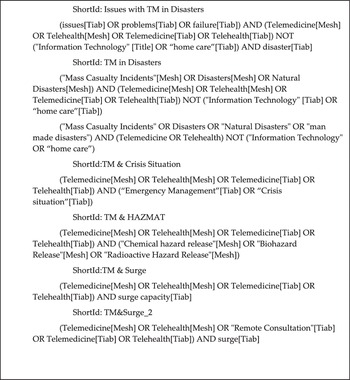
In collaboration with the Harvard University Countway Library and Brigham and Women’s Hospital Brigham Educational Institute, we collected literature on telemedicine in disasters on a rolling basis beginning in March 2019 until late July 2019 through weekly notifications set up per each search strategy. Literature concerning telemedicine in disasters was identified using various search strategies (Figure 1) in PubMed, Web of Science, Ovid Medline, ClinicalKey, Cochrane, PLoS, Google Scholar, and the AHRQ database.
Search strategies used for literature collection. Note: the strategies listed below follow the syntax used on the PubMed and Google Scholar databases. For other databases, these same strategies were used after adjusting the syntax to fit the user interface of those databases.

Data Collection and Processing
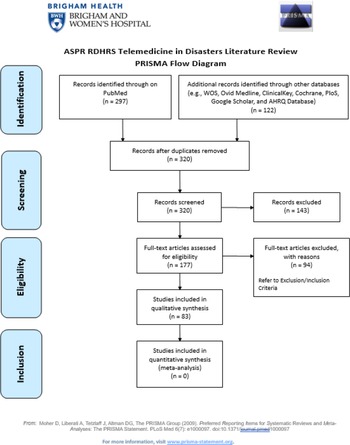
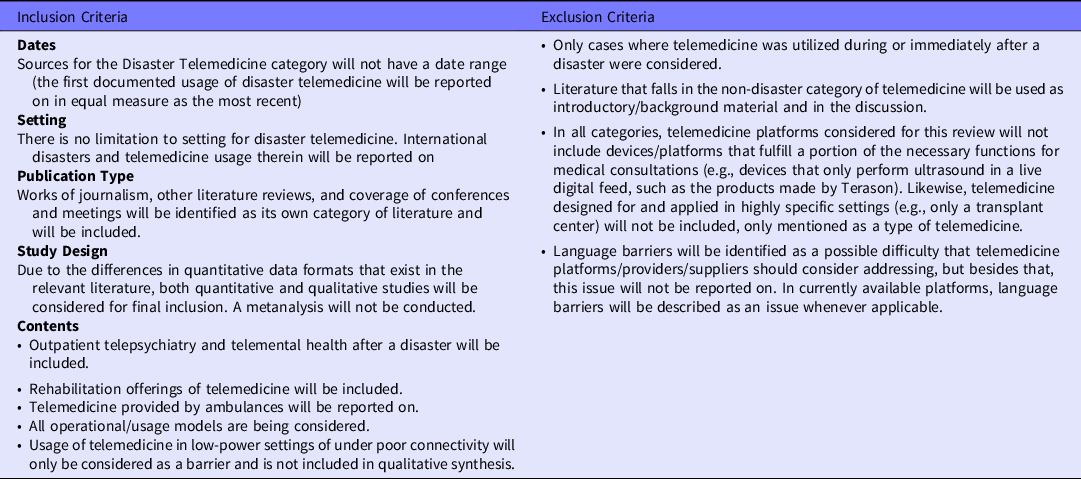
To better process the literature that met the search criteria, we applied the PRISMA flow diagram as a framework for identifying literature that was directly relevant to telemedicine in disasters. After applying the PRISMA Guidelines Flow Diagram (Figure 2) and the Inclusion/Exclusion Criteria (Table 1), researchers collected and stored publications using Zotero, 6 a citation manager software.
PRISMA Flow Diagram.

Inclusion/exclusion criteria

Data Analysis
Two reviewers independently read the full-text versions of each article that met the eligibility criteria. Reviewers scored the literature according to the Literature Review Scoresheet (Figure 3), which categorized the collected literature by type of publication and type of data presented. This scoresheet assigns Likert-scale ratings of 1 to 5 for author’s contributions to the following topics: usage of telemedicine, system design and operating models, and issues with credentialing, licensure, liability, reimbursement, and technology. Results were obtained by identifying works with a mutual rating of 4 or higher. While scoring the literature, other important themes were identified and summarized. Because the literature review scoresheet rating system did not encompass these additional themes, they were not ranked.
Results
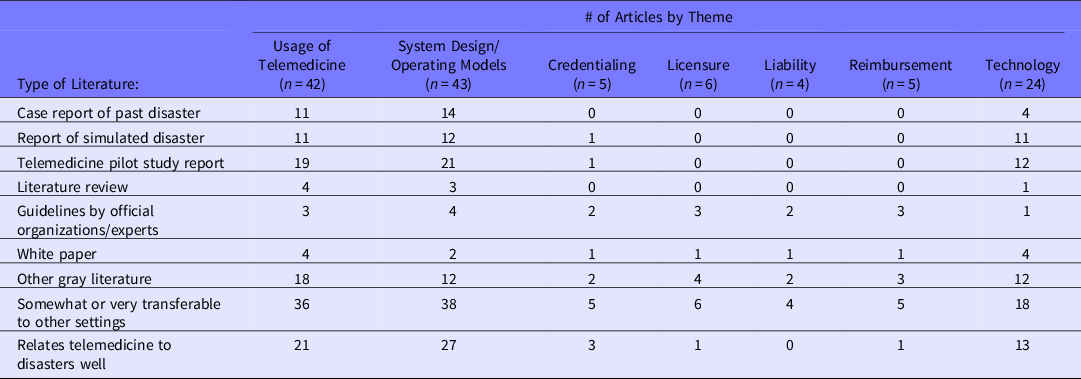
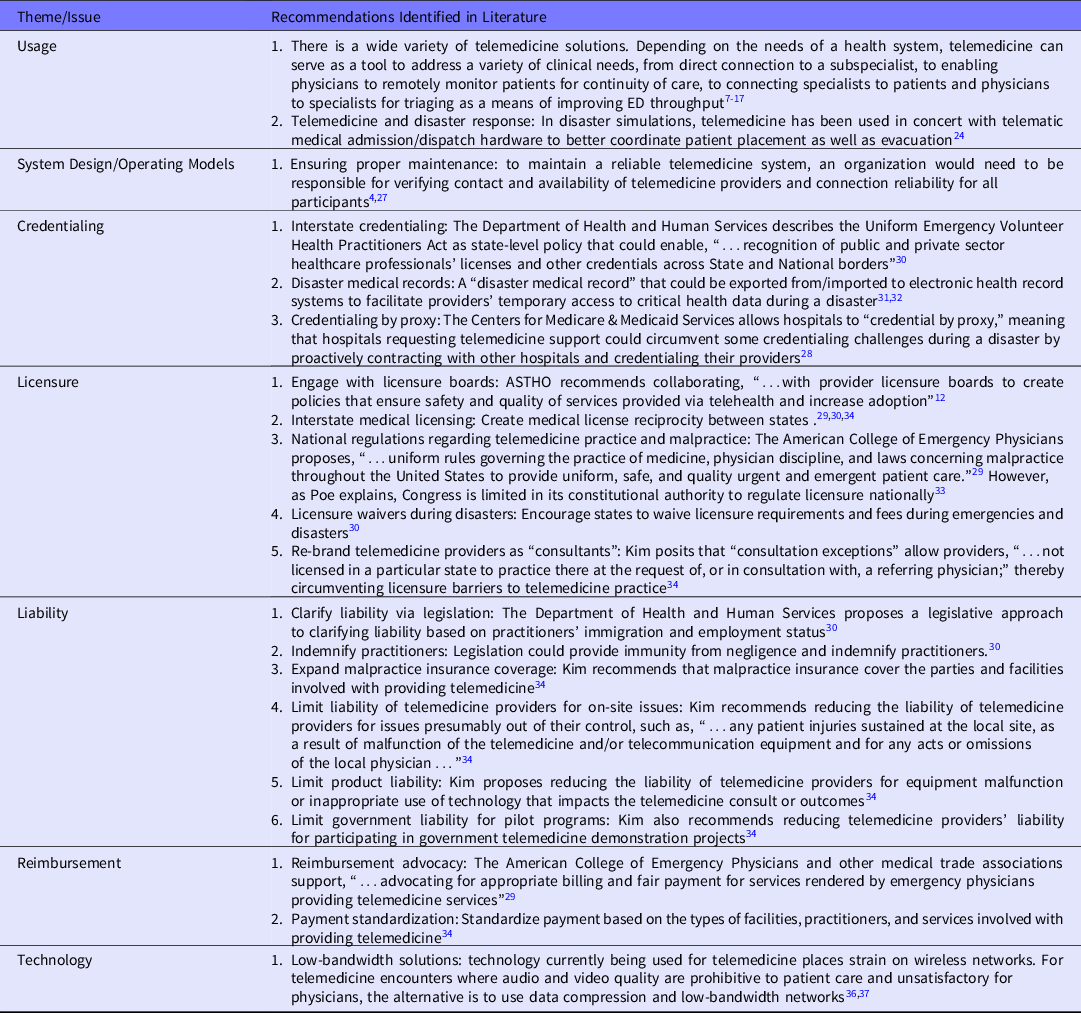
The database search strategies yielded 320 unique publications for screening (Figure 2), with 83 (26%) meeting criteria for eligibility (Table 1). A metanalysis was not performed. Independent review and ranking of the publications by 2 reviewers using the Literature Review Scoresheet identified and isolated works that contributed well to the topics of usage (42 publications), system design/operating models (43 publications), credentialing (5 publications), licensure (6 publications), liability (4 publications), reimbursement (5 publications), and technological issues (24 publications) (Table 2). Recommendations regarding these issues were summarized (Table 3). Other major themes in addition to the 7 key themes were briefly summarized.
Highly rated publications, organized by issue and type of literature

Recommendations identified in the literature

Based on our review of the literature, we identified 7 key themes regarding telemedicine use and disasters: (1) usage of telemedicine, (2) system design/operating models, (3) credentialing issues, (4) licensure issues, (5) liability issues, (6) reimbursement issues, and (7) technology issues. Of note, some authors did not separate the credentialing and licensure categories; thus, the recommendations proposed addressed both issues.
Discussion
Recommendations found in the literature regarding these 7 themes are detailed in Table 3. It is important to note that literature published since the end of this review period continues the trend of recommendations discussed in this literature review. While adoption of telemedicine has skyrocketed across all different types of telemedicine, there have not been developments that contradicted the conclusions written here.
Usage
To describe ways that patients, physicians, and hospital systems can benefit from telemedicine, a major category for this scoping review is the usage of telemedicine in disasters. Authors contributed data that reflect the impact of telemedicine on patient care, throughput, cost savings for both patients and hospital systems, and other important variables to demonstrate the potential of this technology.
Telemedicine exists in various forms and serves many clinical specialties. Reference Reissman, Schreiber and Klomp7-12 Types of telemedicine include direct-to-patient, provider-to-provider (including midlevel providers, who are intrinsic participants in the telemedicine process), asynchronous, store-and-forward tools, as well as synchronous, and live video telemedicine encounters. This topic encompasses literature where authors detailed the clinical reasons telemedicine was used in disaster settings. Uses of telemedicine include: patient triage, patient placement, and disaster management; Reference Doarn, Latifi and Poropatich4,Reference Simmons, Murphy and Blanarovich10,Reference Hwang, Lappan and Sperling13-Reference Balch, Taylor and Rosenthal15 as well as direct clinical intervention Reference Sahloul, Monla-Hassan and Sankari9,Reference Teich, Wagner and Mackenzie16 ; and remote patient monitoring (in-hospital, tele-home care, telemedicine that aids in continuity of care). Reference Reissman, Schreiber and Klomp7 Key findings within this topic were collected from: (1) data simulations, (2) literature reviews, and (3) simulated disaster preparedness exercises.
Following a disaster-based data simulation, authors recommend that procedures for telemedicine consultations are clearly defined and provided in advance as a preparedness measure. They also concluded that the use of telemedicine should be a routine part of disaster training. Reference Garshnek and Burkle17
Queueing modeling analysis, a method for matching random health-care demand with fixed hospital capacity, was performed of a simulated earthquake and found a reduction in ED wait time and lowered mortality when using a telemedicine hub for triage and remote treatment as opposed to relying on standard communication and transfer protocols. Reference Xiong, Bair and Sandrock5 The authors reported system-wide mortality decreases ranging in magnitude from 5.4 to 36.5% (depending on severity of earthquake event). Reference Xiong, Bair and Sandrock5 One simulated Designated Receiving Center projected a mortality decrease ranging from 15 to 99%. Reference Xiong, Bair and Sandrock5 Likewise, authors reported a projected decrease in ED wait time ranging from 40.72 to 94.34%. Reference Xiong, Bair and Sandrock5
To describe the effects of using telemedicine, authors of previous literature reviews contribute that telemedicine produces cost savings for both patients Reference Saadi and Mateen18,Reference Istepanian and Nikogosian19 and hospital systems by increasing patient throughput and lowering practice and resource costs. Reference Smith, Jamin and Malik20-22 Estimating the cost savings is difficult because there are many types of telemedicine, and specific figures are only offered in pilot studies. Reference Chu and Ganz23
In disaster preparedness exercises (a type of simulation tool), telemedicine has been used in concert with medical admission and dispatch hardware to better coordinate patient placement, as well as evacuation. Reference Cabrera, Arredondo and Rodriguez24
The Usage of Telemedicine category of literature is fundamental to comprehending how telemedicine has previously benefited disaster response and patient throughput, while also highlighting its future potential. These findings provide significant insight into how telemedicine may benefit patients, physicians, and health-care systems universally. The remaining categories provide insights into what is necessary to make disaster telemedicine possible.
System Design/Operating Models
To harness the benefits of telemedicine for disaster medical response, it is important to understand how telemedicine operates. “Operating model” refers to the organizational design (staffing, scheduling, monitoring, and quality assurance, etc.) that enables telemedicine. This topic also refers to telemedicine encounter workflows, as well as the logistical preparation required to use telemedicine (such as creating an on-call roster of subspecialists). Reference Dichter, Kanter and Dries25 “System Design” refers to the technological elements that enable telemedicine such as proprietary hardware, data logistics, and bandwidth requirements across multiple hardware options (satellite, data, wi-fi, radio, etc.) Rather than discussing the impact and clinical use of telemedicine, these categories jointly describe the technological and operating requirements for implementing a telemedicine system.
Key findings for the system design and operating models category include authors matching different types of users with types of telemedicine. Literary contributions list the following successful operating models: telemedicine conducted between first responders (civilian and military settings) and physicians for the purpose of triage, clinical management of critical patients, and disaster management Reference Doarn, Latifi and Poropatich4,Reference Hwang, Lappan and Sperling13-Reference Balch, Taylor and Rosenthal15 ; telemedicine conducted between generalists and subspecialists, including triage and secondary triage, Reference Doarn, Latifi and Poropatich4 clinical management (decision-making, diagnostic support, Reference Teich, Wagner and Mackenzie16,22 and remote procedural guidance Reference Sahloul, Monla-Hassan and Sankari9,Reference Teich, Wagner and Mackenzie16 ); and telemedicine between patients and physicians, including clinical management, remote patient monitoring, store-and-forward of laboratory results and diagnostic imaging. Reference Patoli2,Reference Doarn, Latifi and Poropatich4,Reference Teich, Wagner and Mackenzie16
Telemedicine facilitates connections between multiple participants. There are different modes fundamental to telemedicine, such as direct connection, in which telemedicine uses video or audio conferencing to directly connect participants; and connection by means of proxy, where requesting patients or clinicians are connected to a coordinator who triages their request and connects to a specialist. Reference Delaigue, Bonnardot and Steichen3 Digital proxies also exist where a request for telemedicine is coded and read by a software before being triaged with increased precision to a specialist. Reference Burke, Berg and Vee11,Reference Min, Megumi and Andrew26
Another key finding from this category of literature is the need for maintenance. Authors found that it is necessary to use an organization that would be tasked with maintaining the contact information for the providers of telemedicine. Reference Doarn, Latifi and Poropatich4,Reference Kyriacou, Nicolaidou and Hadjichristofi27 Maintaining telecommunication reliability is also recommended. Reference Doarn, Latifi and Poropatich4,Reference Kyriacou, Nicolaidou and Hadjichristofi27
Credentialing Issues
“Credentialing” refers to the accreditation of physicians that enables the practice of telemedicine. 12 Credentialing is a known barrier to effectively providing telemedicine, particularly in disaster scenarios and across US state lines and in countries with similar credentialing arrangements. The Joint Commission subjects a telemedicine provider to the credentialing requirements of the patient’s location. 28 The American College of Emergency Physicians (ACEP) similarly recommends that telemedicine providers abide by all credentialing requirements required for standard in-person care. 29 Requiring authentication of each telemedicine system user during an emergency response, while protecting system security, could compromise system functionality, perhaps impacting speed of care. Reference Kyriacou, Nicolaidou and Hadjichristofi27 Furthermore, state government emergency powers during a disaster vary, limiting some states’ ability to enable temporary licensing or credentialing for out-of-state providers. 30
Technical Reference Simmons, Alverson and Poropatich31 and policy innovations, 28-30 if implemented, could reduce the credentialing challenges providers face Reference Morton, DeAugustinis and Velasquez32 . The literature offered 3 recommendations to overcome this: (1) implement interstate credentialing 30 ; (2) create disaster medical records that facilitate providers’ temporary access to critical health data Reference Simmons, Alverson and Poropatich31 ; and (3) credential practitioners by proxy, developing streamlined channels between medical staff offices that account for interfacility provision of telemedicine. 28
Licensure Issues
“Licensure” is the formal regulatory recognition of a physician’s education, training, and performance on exams that enable physicians to provide telemedicine. 12 As above, ACEP recommends that telemedicine providers abide by all licensure requirements required for standard in-person care. 29 Several “interstate licensure compacts” exist to support licensure compliance across multiple states. 12,28 However, requiring practitioners to be licensed in multiple states places significant financial and educational burden upon practitioners to remain compliant with each states’ requirements. Reference Poe33 Additionally, only some states can waive licensure requirements during federally declared disasters, which is unhelpful to states without that authority and for all states responding to non–federally declared disasters. 28,30
Again, as above, the policy landscape surrounding the licensure process during disasters for telemedicine providers is difficult to navigate and may cause delays in care. State licensure policies are not keeping pace with new technology and must be updated to reduce barriers to telemedicine use. 12,28,Reference Kim34 The literature included 5 recommendations to address licensure barriers: (1) engage with licensure boards to create telemedicine-friendly policies 12 ; (2) create interstate medical licensing 29,30,Reference Kim34 ; (3) establish national regulations regarding telemedicine practice and malpractice 29 ; (4) implement licensure waivers during disasters 30 ; and, (5) rebrand telemedicine providers as “consultants” to circumvent licensure barriers. Reference Kim34
Liability Issues
“Liability” refers to the legal protections for physicians engaging in telemedicine consultations, including malpractice insurance. 12 Telemedicine providers are encouraged to be knowledgeable of the laws, policies, and regulations of the states in which they practice (ie, where their patients are located during their telemedicine evaluations). 29 However, this can be challenging given the ambiguity surrounding telemedicine malpractice liability and tort law jurisdiction. 30,Reference Poe33 Poe notes, “Few legal precedents exist and legislation has not kept pace with telemedicine’s practical applications,” specifically with regard to telemedicine and its interface with informed consent, confidentiality, privacy, security, and standards of care. Reference Poe33
Employment status and the location of the disaster can affect practitioners’ liability protection. 30 There are important differences between the tort liability of government employees and private sector providers. Furthermore, there are different tort liability protections available to out-of-state practitioners under policies and regulations such as but not limited to states’ emergency powers, Good Samaritan statutes, and federal volunteer protections. 30
Additionally, the Department of Health and Human Services explains that telemedicine practitioners are not indemnified even if they are immune from civil action. 30 While a legal case against a telemedicine practitioner may be stopped, the practitioner may still have to pay the costs associated with their legal defense. 30 There have not been many telemedicine malpractice cases to date; perhaps contributing to the ambiguity about telemedicine liability during disasters. 28 The Department of Health and Human Services notes that, “This lack of protection could serve as a potential barrier to engaging health-care practitioners to assist during public health emergency or disaster medical responses.” 30
Ambiguous and dated Federal and state liability laws and protections may create a barrier to engaging providers in disaster telemedicine. 30 There are 6 recommendations in the literature to address liability barriers to telemedicine practice: (1) clarify practitioners’ liability, 30,Reference Kim34 particularly by means of legislation 30 ; (2) indemnify telemedicine practitioners 30 ; (3) expand the scope of malpractice insurance coverage Reference Kim34 ; (4) limit liability of telemedicine providers for on-site issues Reference Kim34 ; (5) limit the liability of telemedicine practitioners for equipment issues Reference Kim34 ; and, (6) limit the liability of telemedicine providers when participating in government pilot programs. Reference Kim34
Reimbursement Issues
“Reimbursement” refers to the methods of payment to physicians engaging in telemedicine consultations. 12 As authors for the journal HealthcareReady note, “Reimbursement is widely considered the largest barrier for telehealth.” 28 In 2006, the Pandemic and All Hazards Preparedness Act (P.L. 109-417) framed payment and reimbursement for telemedicine as an, “Immediate (challenge) to the use of Telehealth for public health emergencies and disaster medical responses.” 30
The American College of Emergency Physicians cautions telemedicine providers to be vigilant regarding federal and state reimbursement policies until there is uniform, national telemedicine reimbursement regulation. 29 The Association of State and Territorial Health Officials (ASTHO) explains that, “…how states define telehealth or telemedicine in legislation affects the reimbursement and coverage of services and state legislation or rulemaking can impact Medicaid or private payer coverage.” 12 This finding is supported by HealthcareReady, “Varied policies across Medicare, Medicaid, and private payers are also constantly evolving, compounding challenges in understanding reimbursement for telehealth.” 28
The literature also refers to telemedicine parity. Telemedicine parity laws, “require private payers in a state to reimburse for telehealth services the same way they would for an in-person service.” 12 There is no parity for telemedicine under Medicare, and Medicare restricts the type and location of reimbursable telemedicine services. 12,28,Reference Kim34 The federal government sets Medicare reimbursement policies. 28 Conversely, Medicaid coverage is set at the state level 28 and is more expansive than Medicare: according to ASTHO, “As of March 2017, a total of 48 states and the District of Columbia have some type of (Medicaid) coverage for telemedicine.” 12 As of 2017, there is state employee health plan coverage for telemedicine in 26 states, and 56% of federal employee health plans cover telemedicine. 12 However, when telemedicine services are reimbursed, it is frequently at a lower rate than traditional services, which disincentivizes practitioners from participating in telemedicine. 28
Addressing reimbursement challenges is critical to the future of telemedicine. As indicated by HealthcareReady, “Providers surveyed by the US Government Accountability Office (GAO) cited inadequate payment and coverage options as the principal barrier to (telemedicine) adoption.” 28 The literature offered 2 recommendations to address telemedicine reimbursement challenges: (1) advocate for better reimbursement 29 ; and (2) standardize payment based on the types of facilities, practitioners, and services involved with providing telemedicine. Reference Kim34
Technology Issues
Successful operation of a telemedicine system requires a reliable technological infrastructure. The technology issues theme encompasses literature that detailed challenges that users of telemedicine encountered and what steps were taken to overcome those issues. Fundamental failures in the telemedicine system can include but are not limited to the inability to form a connection for connectivity or system capacity reasons, and a prohibitively poor transmission of video, audio, images.
Although recommendations in the literature are limited, there are low bandwidth solutions for what is currently being done using high-bandwidth technology. For still image transmission over poor connectivity (radiology results), options exist to compress image files. This compression makes files small enough for weaker networks, such as satellite networks, 35 to transmit (larger file sizes failed to transmit). Reference Istepanian and Nikogosian19 Such compression works for audio and video multimedia. Reference Olariu, Maly and Foudriat36,Reference Meade and Lam37 For extending wireless reliability into zones where network access is limited, another solution is using a system of Local Access Networks for Internet connection. Reference Simmons, Murphy and Blanarovich10
Other Salient Themes
Other themes that arise frequently in the literature as challenges or important considerations for telemedicine use in disaster response include: protecting patient privacy and confidentiality 12,Reference Teich, Wagner and Mackenzie16,22,30,Reference Poe33,Reference Kim34,Reference Davis, Barden and Dean38-Reference Chen41 ; ensuring the security of technology used in telemedicine (which directly relates to protecting patient privacy and confidentiality) Reference Kocev, Achkoski and Bogatinov14,22,30,Reference Poe33,Reference Kim34,Reference Davis, Barden and Dean38,Reference Arisoylu, Mishra and Rao42 ; respecting patients’ right to education and informed consent 12,29,Reference Poe33-35,Reference Davis, Barden and Dean38,Reference Turvey, Coleman and Dennison39 ; upholding standards of care and maintaining the integrity of the physician-patient relationship 12,28,29,Reference Poe33-35,Reference Davis, Barden and Dean38,Reference Chen41 ; creating clinician-friendly protocols for telemedicine use and documentation, continuing education, and quality improvement Reference Burke, Berg and Vee11,Reference Garshnek and Burkle17,Reference Poe33,Reference Kim34,Reference Davis, Barden and Dean38,Reference Turvey, Coleman and Dennison39 ; increasing cultural acceptance of telemedicine, particularly among medical leaders, and consequently integrating telemedicine into preparedness planning Reference Delaigue, Bonnardot and Steichen3,Reference Sahloul, Monla-Hassan and Sankari9,Reference Burke, Berg and Vee11,28,30,Reference Simmons, Alverson and Poropatich31,Reference Meade and Lam37,Reference Davis, Barden and Dean38,Reference Chen41,Reference Stănescu, Gordon and Copotoiu43-Reference Reynolds, Sheinfeld and Chang46 ; providing sufficient training to practitioners involved in telemedicine Reference Doarn, Latifi and Poropatich4,12,Reference Teich, Wagner and Mackenzie16,Reference Garshnek and Burkle17,Reference Istepanian and Nikogosian19,28,30,Reference Davis, Barden and Dean38,Reference Norris, Martinez and Labaka44,Reference Rolston and Meltzer45 ; and securing ongoing funding for telemedicine initiatives. 12,Reference Istepanian and Nikogosian19,22,28,30
Limitations
There were several limitations encountered throughout the process of this scoping review, including use of online databases to access literature, the academic quality of the identified literature, and the quantity and uniformity of telemedicine data available.
The scope of this scoping review only extended to publications that are stored and maintained on online databases. As shown in (Figure 1), where search strategies contained the code MESH, some search strategies relied on the indexing of these publications, which is rarely done for the most recently published works. To limit the impact of this, weekly updates were enabled for each search strategy.
This scoping review did not include a metanalysis due to the lack of compatible quantitative data in the literature. The investigative methods used by authors yield a wide variety of data. While there are exceptions, small-scale telemedicine pilots (ie, pilots of telemedicine that last for approximately a year, encompass 1-3 specialties, and vary greatly in terms of how they describe demand for telemedicine services) were a general trend. While results from such pilots are valuable, it is difficult to draw definitive conclusions for a wider range of implementation (ie, statewide). The lack of case-control comparison groups is also a trend in the literature; while there are exceptions, pilot studies of telemedicine and reports of past disasters do not provide input on how hospitals fared using standard consultative methods compared with telemedicine use. Another limitation is the limited input on patient-centered outcomes.
This scoping review illustrates the wide use of multiple telemedicine operating models, both during disasters and in preparedness drills and pilot programs. To date, telemedicine suppliers and enterprising health-care organizations have produced and tested a wide variety of technological options and solutions, some of which have already been and continue to be used in disasters in the forms of pilot programs. Many lessons have been learned in how to construct a telemedicine system and operate it.
A trending finding in the literature is that a policy landscape that addresses credentialing, licensure, liability, and reimbursement needs to be implemented to facilitate interstate telemedicine use. While solutions exist for each category of issues (credentialing, licensure, liability, reimbursement), the available literature has fundamentally not quantified the impact or scale of existing laws and regulations on telemedicine for patient care during a disaster. There is also need for further research into the efficacy of the different telemedicine platforms in disasters. While it is evident that the telemedicine industry of today is comprised of various small-scale telemedicine programs at individual hospitals/hospital systems, a region-wide (ideally nationwide) telemedicine system would make it possible for overtaxed hospitals and their patients to benefit from improved access to specialty care during disasters. To achieve this, there is an urgent need to continue to guide the current policy landscape toward wider and easier emergency telemedicine adoption, to improve physician familiarity and comfort with telemedicine, and to develop more robust telemedicine system solutions.
Supplementary material
To view supplementary material for this article, please visit https://doi.org/10.1017/dmp.2020.473
Glossary