During oral sentence comprehension, listeners must build up a representation consisting of the thematic roles that a verb assigns to the arguments in the sentence, such as agent, theme, and goal. Lexicosemantic information, syntactic information, and world knowledge need to be brought together in one coherent representation. Different theories diverge about the moment at which various sources of information start to interact and are integrated, but they generally agree that it happens very rapidly.
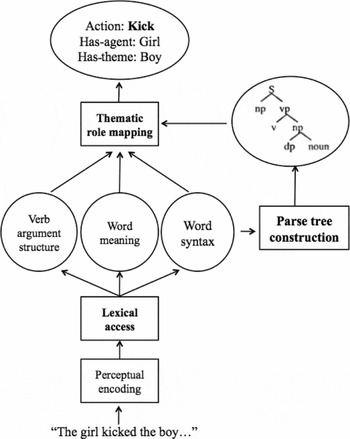
The sentence processing computational model proposed by Haarmann, Just, and Carpenter (Reference Haarmann, Just and Carpenter1997) provides an appropriate framework to ground research on sentence comprehension because it takes into account the incremental process of thematic role assignment and is adopted here to discuss comprehension deficits in children with specific language impairment (SLI; cf. Figure 1). The model is built up in such a way that the thematic roles are assigned incrementally using the argument structure information specified by the verb, without the contribution of lexicosemantic information. However, there are many studies that show that lexicosemantic information and world knowledge are used to assign thematic roles very rapidly during on-line sentence comprehension, for example, eye-tracking studies (Boland, Tanenhaus, Garnsey, & Carlson, Reference Boland, Tanenhaus, Garnsey and Carlson1995; McRae, Ferretti, & Amyote, Reference McRae, Ferretti and Amyote1997; Tanenhaus, Carlson, & Trueswell, Reference Tanenhaus, Carlson and Trueswell1989; Trueswell, Tanenhaus, & Garnsey, Reference Trueswell, Tanenhaus and Garnsey1994) and event related potential studies (e.g., Hoeks, Stowe, & Doedens, Reference Hoeks, Stowe and Doedens2004; Kim & Osterhout, Reference Kim and Osterhout2005; Kuperberg, Sitnikova, Caplan, & Holcomb, Reference Kuperberg, Sitnikova, Capland and Holcomb2003).
A sentence processing computational model. Adapted from “Aphasic Sentence Comprehension as a Resource Deficit: A Computational Approach,” by H. J. Haarmann, M. A. Just, and P. A. Carpenter, Reference Haarmann, Just and Carpenter1997. Brain and Language, 59. Copyright 1997 by Elsevier. Adapted with permission.

For instance, Nakano and Blumstein (Reference Nakano and Blumstein2004) show facilitation on the recognition of the target word drunk for the sentence, The bartender is kicking out the drunk, but not when the target word is embedded in an agrammatical sentence, for example, kicking out is bartender the drunk, or when the target word is not predictable on the base of lexicosemantic information and world knowledge, for example, The bartender is kicking out the patient, showing that the facilitation effect is coming from the integration of lexicosemantic and syntactic information and world knowledge (see also Foss, Reference Foss1982; Masson, Reference Masson1986; O'Seaghdha, Reference O'Seaghdha1989; Simpson, Peterson, Casteel, & Burgess, Reference Simpson, Peterson, Casteel and Burgess1989).
The present study investigates how, in the course of thematic role assignment, different types of information are integrated online in children with typical language development and children with SLI.
Many studies have investigated comprehension problems in children with SLI clearly pointing to a difficulty in assigning thematic roles in a sentence. Although they appear to present good comprehension at the single-word level and also at the sentence level, as long as the interpretation of the sentence is strongly constrained by its lexical content and word knowledge, children with SLI tend to misinterpret the sentence if its interpretation is dependent on structural cues rather than on the meanings of the individual lexical items. They appear to be unable to fully exploit syntactic structure for the purposes of sentence comprehension. To cite only some representative examples of the problems they experience in comprehension, children with SLI misinterpret passive semantically reversible sentences (e.g., Bishop, Reference Bishop1979; van der Lely & Harris, Reference van der Lely and Harris1990), short passives (e.g., van der Lely & Harris, Reference van der Lely and Harris1990), sentences with postmodified subject (Bishop, Reference Bishop1982), reversible relative clauses (Stavrakaki, Reference Stavrakaki2001) and rely more heavily than controls on semantic information to assign thematic roles (van der Lely & Dewart, Reference van der Lely and Dewart1986).
A number of explanations have been proposed in the literature to account for their comprehension deficit. The hypothesis of a deficit specific to the language domain has focused on a deficit characterized by a variously specified problem with syntactic representation. It has been proposed, for instance, that thematic roles are not correctly assigned because of an ill-formed syntactic hierarchical structure (e.g., Clahsen, Reference Clahsen1993; van der Lely & Battell, Reference van der Lely and Battell2003; van der Lely & Harris, Reference van der Lely and Harris1990; van der Lely & Stollwerck, Reference van der Lely and Stollwerck1996). An alternative approach stresses the role of processing and the computational cost associated with language comprehension and production. In this view, children with SLI will dispose of limited processing capacities that interfere with language acquisition and language processing (Ellis Weismer, Reference Ellis Weismer1994; Ellis Weismer & Hesketh, Reference Ellis Weismer and Hesketh1996; Johnston, Reference Johnston and Miller1991, Reference Johnston, Watkins and Rice1994). For instance, it has been proposed that they present reduced working memory (Ellis Weismer, Evans & Hesketh, Reference Ellis Weismer, Evans and Hesketh1999), reduced processing speed (e.g., Kail & Salthouse, Reference Kail and Salthouse1994; Leonard, Reference Leonard1998; Miller, Kail, Leonard, & Tomblin, Reference Miller, Kail, Leonard and Tomblin2001), or reduced computational energy or efficiency (e.g., Bishop, Reference Bishop1997).
The present investigation adopts a slightly different perspective on the comprehension problems of children with SLI, but it does not seek to propose a new hypothesis to explain the deficit. It instead addresses the question of whether problems occur only at the syntactic level or whether a postlexical processing level of integration is also problematic, which to our knowledge has been neglected in the literature. According to Haarman and colleagues (Reference Haarmann, Just and Carpenter1997), “problems can in principle occur not only at a purely syntactic level but also at a post-syntactic level where syntactic structure is mapped onto thematic roles” (cf. Figure 1). As will be evident below, integration problems can be compatible with some of the proposed explanations for SLI, both domain-specific and domain-general hypotheses.
INTERFACE VULNERABILITY
The interface between syntactic structure and lexical items has been individuated as a vulnerable stage of sentence processing by various authors, and here we term it interface vulnerability. Despite different approaches emphasizing different aspects, they share the assumption that failure to assign thematic roles may not necessarily result from a complete loss of all syntactic abilities. One of the first hypotheses in the 1980s, the mapping hypothesis proposed that under some circumstances (e.g., brain lesions causing agrammatism), comprehenders recover the structural information that is required for thematic assignment, but they fail to integrate it with the thematic information supplied by the lexical entries (Linebarger, Schwartz, & Saffran, Reference Linebarger, Schwartz and Saffran1983; Schwartz, Linebarger, Saffran, & Pate, Reference Schwartz, Linebarger, Saffran and Pate1987).
More recently, similar hypotheses stress the role of performance constraints on sentence processing: Avurtin (Reference Avurtin, Grodzinsky and Amunds2006) suggests that the interface between syntactic and discourse modules are the most “energy consuming” operations. In the processing perspective, in some cases, the resources required to integrate different linguistic sources of information may exceed the available resources in the system. Limitation in processing resources may thus result in a less efficient integration of multiple sources of information in on-line comprehension (Avurtin, Reference Avurtin, Grodzinsky and Amunds2006; Sorace & Serratrice, Reference Sorace and Serratrice2009). Processing resources can be conceptualized in terms of space, energy or time (e.g., Kail & Salthouse, Reference Kail and Salthouse1994). As thematic dependency must be established in a timely fashion, the time dimension is particularly salient and integration can be disturbed by a timing deficit involving either a slower than normal rate of processing, or a faster than normal rate of decay (Burkhardt, Piñango, & Wong, Reference Burkhardt, Piñango and Wong2003).
In spite of a preserved ability to build up the dependency structure of the sentence on the base of syntactic information, thematic role assignment deficit can also result from delayed syntactic composition (slow syntax hypothesis). If the parse tree construction is available too late, syntactic information cannot be used and consequently alternative systems can lead to thematic role assignment (e.g., lexicosemantic and pragmatic information) establishing nonsyntactic dependency between the arguments in the sentences (Avurtin, Reference Avurtin, Grodzinsky and Amunds2006; Piñango & Zurif, Reference Piñango and Zurif2001).
INTEGRATION IN CHILDREN WITH SLI
Some results suggest that in some cases children with SLI, despite being able to build up the syntactic structure, still experience difficulties in thematic role assignment, which can be suggestive of integration (Friedmann & Novogrodsky, Reference Friedmann and Novogrodsky2007; Pizzioli & Schelstraete, Reference Pizzioli and Schelstraete2008, Reference Pizzioli and Schelstraete2011).
In one study, Friedmann and Novogrodsky (Reference Friedmann and Novogrodsky2007) used Hebrew homograph words that are read differently if they are nouns or verbs. Participants were asked to read sentences, where the correct reading of the target word depended on the build-up of the underlying deep syntactic structure, and in particular the trace of an element (e.g., The judge1 that the man drew t1 is talking on TV). The authors showed that children with SLI were able to build up the syntactic structure and activate the trace at the correct position, yet they misinterpreted thematic roles, suggesting an inability to transfer the thematic role to the trace.
Furthermore, children with SLI appear to be affected by the number of thematic roles even in sentences where the processing of syntactic structure and grammatical information is not necessary to assign thematic roles, that is, canonical, semantically constrained active sentences (Pizzioli & Schelstraete, Reference Pizzioli and Schelstraete2008). Children with SLI omitted more mandatory grammatical morphemes when a thematic role had to be assigned to the internal complement compared to sentences where the internal complement does not receive a thematic role. In addition, the number of thematic roles to assign affected the comprehension of simple active sentences (Pizzioli & Schelstraete, Reference Pizzioli and Schelstraete2011). Using a picture sentence-matching task, the authors showed that in very simple active sentences, children with SLI commit more errors when the internal complement is assigned a thematic role compared with when it is not. Taken together these results suggest that in children with SLI, besides a syntactic deficit, something else causes their comprehension deficit.
This evidence is however rather modest and the argument is speculative as offline methods were adopted. These methods are intrinsically limited, as they fail to recreate the extremely rapid dynamics of language processing. Furthermore, offline methods provide very limited and indirect information about what happens from the moment the sentence is perceived to the instant the answer is given, and say very little about how different types of information are used in real time during thematic role assignment. A final problem with offline methodologies is that they require cognitive skills other than language, since sentences have to be remembered, pictures explored, and attentional capacities are necessary to complete the task. Online methods such as lexical decision tasks could potentially overcome these problems and yield useful insights about lexical and postlexical processing in children with SLI.
LEXICAL DECISION IN CHILDREN WITH SLI
Concerning the typicality of lexical processing, according to some researchers, children with SLI seem to present lexical processing appropriate for their vocabulary level, though not for their age (Edwards & Lahey, Reference Edwards and Lahey1996; Pizzioli & Schelstraete, Reference Pizzioli and Schelstraete2007). In particular, Edwards and Lahey (Reference Edwards and Lahey1996) considered a group of children with SLI with both expressive and receptive deficit (SLI-mix; mean age = 8 years, 0 months [8;0]), a group of children with SLI with only expressive deficit (SLI-exp; mean age = 7;0) and a group of age-matched children. Only children with SLI-mix, but not children with SLI-exp, were slower than age control children. Pizzioli and Schelstraete (Reference Pizzioli and Schelstraete2007) used frequent and early acquired French words in a lexical-decision task, showing that 15 children with SLI (mean age = 10;8) with comprehension and production problems were as fast and as accurate as younger children matched on receptive vocabulary scores (mean age = 7;7). At the same time, they were slower, but not less accurate, than age-matched children, similarly to what is reported in Edwards and Lahey (Reference Edwards and Lahey1996). In contrast, one study yielded different results: children with SLI were less accurate than younger language control children in simple lexical decision tasks (Crosby, Howard, & Dodd, Reference Crosby, Howard and Dodd2004).
Another series of studies used a sentence-embedded monitoring task demonstrating slower word recognition times than control children, when the target word is embedded in a sentence (e.g., Montgomery Reference Montgomery2000, Reference Montgomery2002, Reference Montgomery2006; Montgomery & Leonard Reference Montgomery and Leonard1998; Montgomery, Scudder, & Moore, Reference Montgomery, Scudder and Moore1990; Stark & Montgomery, Reference Stark and Montgomery1995).
However, one study suggests that a deficit of lexical processing is unlikely to account for the slow word recognition time demonstrated by children with SLI in sentence context (Montgomery, Reference Montgomery2006). Sixteen 8-year-old children with SLI had to monitor a target word presented before the sentence and press a button when they recognized the target word in a sentence or a word list (Montgomery, Reference Montgomery2006). Results showed that children with SLI and control children with typical language development performed similarly when words were presented alone with no linguistic context, but they were slower than even the language matched group when the word had to be recognized within the sentence.
These results suggest that a deficit at the level of lexical processing itself is not likely to explain the slower lexical decision times in sentence contexts, and rather points to problems with constructing “the sentence-level representation of the input,” and problems with the “integration of each incoming word into the developing sentence representation” (Montgomery, Reference Montgomery2006, p. 288).
The present investigation
To our knowledge, no study has explicitly investigated interface vulnerability in children with SLI. The current research tried to fill this gap, and explored how a word is recognized in sentence context using a sentence-embedded lexical decision task. This task is based upon the assumption that the recognition speed of the target word is influenced by the online processes of combinatorial thematics of different types of information as demonstrated in the literature (cf. Nakano & Blumstein, Reference Nakano and Blumstein2004; Swaab, Brown & Hagoort, Reference Swaab, Brown and Hagoort1998).
Two experiments were designed; the first one aimed at disentangling lexical processing and postlexical processing of integration in children with SLI. To this end, we compared a condition where lexical decisions had to be performed on words presented one by one without sentence context, and another condition where the same words were embedded in sentence context.
The second experiment focused more precisely on how different sources of information (syntactic information, lexicosemantic information, and world knowledge) are integrated in sentence context to build up the thematic structure. The magnitude of the priming effect was compared in these different conditions where syntactic structure, lexicosemantic associations, and the fit of the target word with the context were systematically manipulated.
EXPERIMENT 1
For the lexical decision, two conditions were devised: a simple lexical decision task and a sentence-embedded lexical decision task, with the same target words in the two conditions. In the sentence-embedded lexical decision task, the target word was always the internal argument and last word of a transitive sentence and was assigned a thematic role, for example, the mother was preparing the room. The target word was preceded by a prime, a sentence fragment made by the subject noun phrase and the verb that determined the thematic structure.
In addition, a sound discrimination task was used to assure that differences in reaction time (RT) do not depend on a general slowness to make a decision in auditory modality in children with SLI compared with children with typical language development.
Participants
Thirty-nine French-speaking children were recruited from primary schools in the region of Wallonia, the French-speaking region of Belgium. The description is reported below. The families of the children with SLI as well as the parents of typically developing children received an informed consent form, where they explicitly agreed for their son or daughter to be involved in the study.
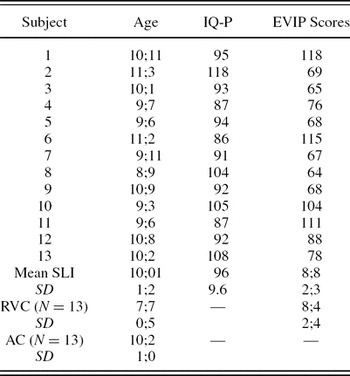
Children with SLI. Thirteen children (11 boys, 2 girls) with SLI were recruited from three special schools for learning disabilities and were 10 years old (M = 10;1, SD = 1;2, range = 8;9–12;8). All the children were diagnosed by speech and language therapists as having SLI and were enrolled in speech–language treatment. Further, all children were tested with two standardized tests of oral language for French: the Epreuve de Compréhension Syntaxico-Sémantique (ECOSSE; Lecocq, Reference Lecocq1996), a French adaptation of the Test of Reception of Grammar (evaluation of utterance understanding), and the Echelle de Vocabulaire en Images Peabody (EVIP; Dunn, Theriault-Whalen, & Dunn, Reference Dunn, Theriault-Whalen and Dunn1993), a test of receptive vocabulary (the Peabody test adapted to French). For all the children with SLI, language performance was at least 1.5 SD below the age-appropriate level in sentence comprehension as measured by the ECOSSE. The raw scores obtained in the EVIP (M = 83.9, SD = 21, range = 68–123) were used to match a group of children on receptive vocabulary. All children with SLI fell within the normal range of performance IQ on the Wechsler Intelligence Scale for Children—Revised (Wechsler, Reference Wechsler1974; M = 96, SD = 7, range = 87–125). Hearing was within normal limits as verified by clinicians using pure tone hearing screening (20 dB HL at 500, 1000, 2000, and 4000 Hz); cases of otitis media with effusion were reported. No neurological dysfunctions were signalled in the clinical history of any of the children. None of the children had a history of psychopathology. In addition, no bilingual children were included in the study.
Receptive vocabulary matched control children (RVC). Thirteen children (8 boys, 5 girls) with typical language development served as vocabulary-matched controls. These children were matched on the base of the raw scores of EVIP (M = 81.8, SD = 16). They were younger than children with SLI (M = 7;7, SD = 0;5, range = 7;0–8;9). No hearing problems, malformations, or low IQ were reported. Following teachers' reports, children that were not particularly brilliant or particularly bad at school were selected. No psychopathological or neurological problems were reported in any children. Bilingual subjects were not included.
Age-matched control (AC) children. The AC children consisted of 13 age controls (11 boys, 2 girls) matched to the children with SLI for age. They were in the 10-year-old group (M = 10;2, SD = 1;0, range = 9;4–11;8). The same criteria that were applied to the language control group were used for the age-matched children (see Table 1).
Individual age, nonverbal IQ (IQ-P), and receptive vocabulary scores (EVIP) for children with SLI and mean for RVC and AC

Note: IQ-P, performance IQ; EVIP, Echelle de vocabulaire en images Peabody; RVC, receptive vocabulary matched children; AC, age-matched children; SLI, specific language impairment. Ages are in years;months.
Materials and procedure
Three tasks were administrated to the participants in the following order: (a) a nonlinguistic auditory discrimination task, (b) an auditory lexical decision, and (c) a primed auditory lexical decision. Each child was tested individually in a quiet room in the school he or she attended. The experiment was on a Fujitzu–Siemens 3600-MHz laptop. Items within each task were presented in a random order over the speakers at a comfortable listening level. Responses were given using an ergonomic response box with two response keys: the green right key for the target sound (Task 1) or the real word (Tasks 2 and 3), and the red left key for nontarget sounds (Task 1) or pseudowords (Tasks 2 and 3). Responses were recorded online on the laptop and included accuracy and response time. The child was seated in front of the computer at approximately 40–60 cm from the screen, while the experimenter sat next to the child and started each trial when the child was ready. Five hundred milliseconds before the auditory stimulus onset, a fixation point appeared at the center of the screen and, as a reminder of the response key meanings at the bottom of the screen, two circles appeared: a green circle with a smiling face on the right, alluding to a positive answer and corresponding to the right green key, and a red circle on the left with an angry face, alluding to a negative answer and corresponding to the red left key.
Sound discrimination task. Eight easily recognizable animal sounds were selected (dog, lion, elephant, cat, bird, sheep, and cow), presented on the mean for 1501 ms. The dog bark was the target sound: the child was required to press on the green key when the target sound was presented and the red left key for the other animal sounds. It was presented 15 times. All other sounds were presented 20 times in total. The order of presentation was randomized, with the only constraint being that the target sound could not occur more than 3 times successively. The experimenter encouraged the children to complete each trial as quickly as possible.
Simple lexical decision task. The stimuli in the auditory lexical decision task included 42 target real words, 60 filler real words, and 68 pseudowords. All real words were selected to be high frequency and highly imageable (on the basis of Brulex, a lexical database for French; Content, Mousty, & Radeau, Reference Content, Mousty and Radeau1990). The pseudowords were all legal strings in French and were matched on a one to one fashion with real words for length in terms of number of phonemes. All the selected pseudowords had no close lexical neighbor (the least difference was not less than two phonemes from the closest lexical neighbor).
For the auditory lexical decision task, the children were instructed to press the green key as fast as possible when they heard a word that they knew and the red key when they heard a funny word that does not exist or that they did not know. Children were trained with ten practice trials where they received feedback; the practice trials were repeated if it seemed that they had not understood the task or were responding randomly. The experiment was split over five blocks, whose order was randomized, along with the order of the items within blocks. A pause was allowed between each block. The experiment was administrated in one session that lasted about 10 min.
Primed auditory lexical decision task. Forty-two simple active declarative transitive sentences were constructed. In all sentences, “the-N-aux+V-the” was used as a prime (e.g., La grand-mère lit le . . . The grandmother reads the . . .) and the final word was the target (e.g., livre/book). All the sentences described events that were possible in the real word. The number and the gender of the subject, the internal argument and the tense of the verb were variable. For all of the sentences, the transitive verbs had only one possible argument structure—obligatory transitive verbs—and only one possible subcategorization frameFootnote 1—verb–noun phrase (V_NP). In all the sentences, the subject noun phrase was attributed the thematic role of agent and the internal argument, the role of theme. The subject noun, the verb, and the internal argument noun were selected to be concrete and maximally frequent (based on the Brulex French database; Content et al., Reference Content, Mousty and Radeau1990). It was important that the target nouns, which were the internal complements, were the same as the nouns used in the simple lexical decision task; the same wave files were used in both sentence context and in isolation. Moreover, the same 42 sentence primes were also run with pseudowords: the same files were used in the word and pseudoword condition. Eighty fillers were used with different structures that included transitive sentences, intransitive sentences, and passive sentences and occurred with a real target word that was not part of the experimental set of words; 60 of these sentences also ran with a pseudoword. Each audio file was connected with a 50-ms silent interval such that the interstimulus interval was 50 ms between the prime sentence and the target word. The intertrial interval was 2 s.
For the primed auditory lexical-decision task, the children were instructed to attend to the sentence and to press the green right key as fast as possible if the final word of the sentence was a word they knew and the red left key when they heard a funny word that does not exist or that they did not know. The ten practice trials were given and repeated if the children did not understand the task or were responding randomly. The experiment was divided into four blocks, whose order was randomized; the order of the items within blocks was pseudorandomized in order not to have more than three real words in a row at the sentence end. A pause was allowed between each block.
Results
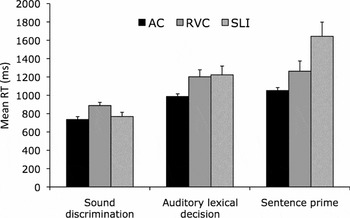
Sound discrimination task. Two mixed-model analyses of variance (ANOVAs) were computed where stimulus type (target or nontarget) was the within subjects factor, and group the between subjects factor with the percentage of correct answers for the first ANOVA and the mean RTs for the second one as the dependent variable. The results showed no significant difference between groups in terms of accuracy (AC: M = 96.9%, SD = 2.9; RVC: M = 97.2, SD = 3.4; SLI: M = 96.2, SD = 2.3), F (2, 36) = 1.190, p = .316. Figure 2 plots the mean response times (ms) for correct responses, standard deviations, and range for the sound discrimination time task for the three groups of children separately. In the sound discrimination task, in terms of speed of response there was no group difference (AC: M = 736, SD = 112; RVC: M = 888, SD = 162; SLI: M = 768, SD = 167), F (2, 36) < 1. Outliers were eliminated applying an individual threshold value that eliminated for each individual the 5% of the longest RT (Ratcliff, Reference Ratcliff1993), which are the same criteria applied to all experiments. The results show that children with SLI were making a decision on auditory stimuli at an accuracy and speed level that was appropriate for their age level and as fast as younger children matched on receptive vocabulary.
Mean reaction times (ms) for correct responses for the three tasks of age-control children (AC), receptive vocabulary matched children (RVC), and children with SLI.

Lexical-decision task. Considering accuracy, a mixed ANOVA was computed where word type (real word and pseudoword) was the within subjects factor and group the between subjects factor. The results showed that there was no group effect (AC: M = 90.33%, SD = 3.70%; RVC: M = 85.56, SD = 4.28; SLI = 86.85, SD = 5.05), F (2, 36) < 1. More errors were committed with pseudowords than with real words, F (1, 36) F = 5.077, p = .033 (AC: M = 75.44, SD = 10.94; RVC: M = 76.22, SD = 11.31; SLI: M = 75.20, SD = 8.2). No interaction of Word Type × Group emerged, F (2, 36) < 1.
Response times for correct answers for real words (cf. Figure 2) were entered into a two-way mixed ANOVA (group: SLI vs. AC vs. RVC; word type: real word vs. pseudoword). The results showed a significant effect of group (AC: M = 987, SD = 98; RVC: M = 1202; SD = 252; SLI: M = 1223, SD = 333), F (2, 36) = 3.619, p = .037. A pairwise comparison within the ANOVA with Bonferroni correction revealed that children with SLI were comparable to younger RVC children (p = .1), whereas they were overall slower than age controls (p = .062). As often observed in the literature, there was a significant effect of word type, with longer RTs for pseudowords than real words, F (1, 36) = 46.94, p = .000. The interaction of Word Type × Group was not statistically significant, F (2, 36) < 1.
The last analysis considered speed/accuracy trade-off. This analysis aimed at ruling out the possibility that accuracy was inversely related to response time, and that any trade-off between speed and accuracy was occurring. There was no correlation between accuracy and RT in children with SLI for real (r = −.198, p = .228) or pseudowords (r = −.006, p = .970), in RVC children for real (r = −.077, p = .803) or pseudowords (r = .003, p = .992), and in AC children for real (r = .529, p = .063) or pseudowords (r = .227, p = .457).
Primed auditory lexical-decision task. With regard to accuracy, a mixed-model ANOVA was computed where word type (real word vs. pseudoword) was the within subjects factor and group the between subjects factor. There was no group effect (SLI: 84.4.6%, SD = 8.6; AC: 88.9%, SD = 6.2; RVC: 88.3%, SD = 7.2), F (2, 36) < 1, and no interaction of Word Type × Group emerged, F (2, 36) < 1.
Response times for correct answers (cf. Figure 2) were also entered in the same ANOVA as for accuracy. The results showed a highly significant effect of group, F (2, 36) = 9.235, p = .001. A pairwise comparison within the ANOVA with Bonferroni correction showed that children with SLI (M = 1783 ms, SD = 625) were significantly slower than AC group (M = 1044 ms, SD = 119, p = .000) and compared to RVC group (M = 1263 ms, SD = 385, p = .000). The two groups of control children were not significantly different for RT (p = .603). There was a significant effect of word type, with longer RTs for pseudowords than real words, F (1, 36) = 10.600, p = .002. The interaction of Word Type × Group was not significant, F (2, 36) < 1.
The speed/accuracy trade-off analysis revealed that no correlation between accuracy and RT in the group of children with SLI for real (r = −.149, p = .626) or pseudowords (r = .321, p = .284), in RVC children for real (r = .402, p = .165) or pseudowords (r = .405, p = .169), and in AC children for real (r = −.188, p = .558) or pseudowords (r = −.459, p = .114). This shows that the observed difference between groups did not depend on a difference in speed/accuracy trade-off between groups.
Finally, in order to evaluate if the groups of children performed differently across the three experimental tasks a further ANOVA was computed where task (sound discrimination task, simple lexical decision task, and primed auditory lexical decision task) was the within subjects factor and “group” the between subjects factor. As can be seen in Figure 2, children with SLI were slower than control groups in the primed lexical decision task. The other two groups were comparatively fast in making the lexical decision when the words were presented in isolation or in sentence context, whereas children with SLI were much slower in sentence context than in isolation. These differences emerged in a significant effect of task type, F (2, 35) = 72.362, p = .000, and effect of group, F (2, 36) = 8.445, p = .001, and most important a significant interaction of Group × Task, F (4, 72) = 4.902, p = .001. Of particular interest was the comparison between the auditory lexical decision task and the primed auditory lexical decision task; a further analysis revealed a significant interaction of Group × Task, F (2, 36) = 5.902, p = .006. The planed comparisons showed that both age peers, t (12) = −1.365, p = .198, and RVC children, t (12) = −0.500, p = .626, had similar latencies in the two tasks, while children with SLI were much slower in sentence context than in the simple lexical decision task, t (12) = 3.457, p = .005, even though the same audio files were used in both experiments.
INDIVIDUAL DIFFERENCE. As the group size of children with SLI is not large, and considering that the clinical homogeneity of children with SLI is sometimes questioned, we considered individual performances. The slower lexical decision times in sentence context as compared to the simple lexical decision time is consistent at individual level: only one child with SLI presented a reversed pattern with a slightly faster RT in sentence contexts. However, there are some peculiarities about this specific child: he was the oldest in the group of SLI, he presents among the highest IQs (118) and was the fastest in the sentence condition. All other children with SLI were slower when the target word was embedded in a sentence as compared to when it was presented without linguistic context.
Discussion. Although the performance of the three groups was similar in the three tasks in terms of accuracy, some differences emerged when the latencies were taken into consideration.
The performance of children with SLI was comparable to that of the RVC group and the AC group in the sound discrimination task, which shows that slower overall decision times cannot be invoked to explain other differences. In the task of lexical decision in isolation, children with SLI were slower than age controls, but not significantly different from children of the same vocabulary level. Finally, as evident in Figure 2, in the sentence context condition, where the same target words were used, children with SLI were significantly slower than both control groups. These results highlight how children with SLI are much slower to recognize a word in sentence context than when words are presented one by one, suggesting that problems emerge at postlexical processing rather than lexical.
Lexical processing itself was not appropriate for their age; children with SLI were slower then age matched controls, but they appear to have adequate lexical processing for their vocabulary level, even though that the receptive vocabulary test and the lexical decision task tap different processes. The former probes vocabulary size, but the latter taps into the organization of the lexicon and the quality of the phonological representation. These results support the view that children with SLI are delayed rather than deviant from a typical lexical development perspective (e.g., Edwards & Lahey, Reference Edwards and Lahey1996; Pizzioli & Schelstraete, Reference Pizzioli and Schelstraete2007) and is consistent with the idea of a less efficiently organized lexicon rather than underspecified lexical representations compared to age matched children (cf. Crosby et al., Reference Crosby, Howard and Dodd2004). However, the present study was not designed to test acoustic/phonological representations in children with SLI. As reported in the literature, when more subtle manipulations of the acoustic characteristics of the pseudoword are considered, impairment can emerge (cf. Maillart, Schelstraete & Hupet, Reference Maillart, Schelstraete and Hupet2004). Differences in the strength of phonological representation between children with SLI and typical control appear unlikely to account for differences observed here, but the relationship between phonological deficit and poor sentence integration abilities in children with SLI needs to be carefully addressed in further studies (Mainela–Arnold & Evans, Reference Mainela–Arnold and Evans2005).
Overall, results from Experiment 1 are compatible with the idea that postlexical processing is problematic in children with SLI, but does not offer any insights about how different sources of information are integrated online to build up the thematic structure in children with SLI and in typically developing children. A second experiment followed up the first one; we tested the same participants using a similar task, but carefully manipulated syntactic structure, lexicosemantic association, and congruency prediction created on the basis of world knowledge.
EXPERIMENT 2
This experiment was constructed to explore the online contribution of different sources of information in the build-up of the thematic structure of a sentence and how they are integrated online in children with SLI and control children.
Considering the ample evidence in the literature that points to a variously characterized syntactic deficit in children with SLI (e.g., Bishop, Reference Bishop1979; Novogrodsky & Friedmann, Reference Novogrodsky and Freidmann2006; Stavrakaki, Reference Stavrakaki2001; van der Lely & Dewart, Reference van der Lely and Dewart1986; van der Lely & Harris, Reference van der Lely and Harris1990; van der Lely & Stollwerck, Reference van der Lely and Stollwerck1996), the prediction is made that children with SLI are less sensitive to syntactic structure manipulations than children with typical language development.
Concerning lexicosemantic and world-knowledge processing, predictions are based on recent results obtained in our lab using a similar paradigm and testing a comparable group of children with SLI. Results suggested that during development, as a consequence of their syntactic impairment, children with SLI are relatively more dependent on lexicosemantic mechanisms and use semantic context more than usual as a compensatory mechanism in language comprehension. Accordingly, we expect an increased sensitivity to lexicosemantic and world-knowledge manipulations in children with SLI as compared to children with typical language development.
With respect to how various sources of information are integrated, the following predictions can be drawn following the hypothesis that the interface between various linguistic modules is vulnerable in children with SLI, and they do not consistently integrate different levels of processing:
1. Various sources of information will contribute and will be used independently from others to the build-up of the thematic structure; we expect that even when one source of information is missing or is incorrect children with SLI can use other sources of information independently.
2. The benefit derived from the combination of all the different sources of information will not be larger than the sum of the benefit from individual sources.
Participants
The same participants as in Experiment 1 were tested approximately 1 month later.
Materials and procedure
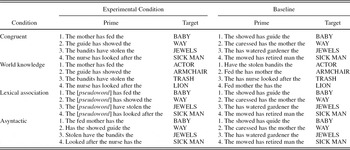
Four experimental conditions were constructed to investigate the relative contribution of (a) world knowledge, (b) lexical associations, and (c) syntactic structure. Each condition was compared to a baseline where the same target words were presented but there was no association between the prime sentence fragment and the target word (see Table 2).
Examples of sentences for each condition

Note: In the baseline the target words are the same as in the experimental condition.
The following conditions were used:
1. Congruent condition: Twenty-one simple active declarative transitive sentences were selected; “the-N-aux+V-the” was always used as prime (e.g., La mère a nourri le/The mother fed the); and the final word, the target, was always strongly associated with the thematic structure (e.g., bébé/baby). The sentences were constructed in the same way as in the primed lexical-decision task in Experiment 1, but the degree of cloze probability of the internal argument was manipulated to be very high. The combination of the subject noun phrase, the semantic/thematic information from the verb, and the conceptual information based on real world knowledge (i.e., that mothers are most likely to feed babies) is assumed to be used to build up a thematic structure. The association of the target word with the thematic structure was determined using cloze probability based on sentence completion by 30 children (7–10 years; average = 56.1%, SD = 8.2%; cf. Table 2 for some examples). The lexical frequency of the target word was high (lexical frequency = 381, SD = 59) as determined by the French database Brulex (Content et al., Reference Content, Mousty and Radeau1990), the mean imageability value was 3.38 according to the Brulex database, the mean length in phonemes was 4.38 (SD = 1.46), the mean number of syllables was 1.81 (SD = 0.67), and the mean duration was 527 ms (SD = 126).
2. World-knowledge condition: This condition was designed to investigate the influence of world-knowledge information on combinatorial thematics. The 21 sentences in the congruent condition were used changing the target words so that the congruency with the thematic structure was reduced considering world knowledge. Sentences thus represented events in the real world that were unlikely to happen although they were possible (e.g., La mère a nourri l'acteur/The mother fed the actor). The stimuli were carefully constructed to avoid semantic or world-knowledge violations, for example, sentences such as, “The mother fed the bed,” were not used, and lexical restriction information such as animacy constraints were always respected. The target words in the world-knowledge condition were matched with those in the congruent condition for frequency, lexical frequency: world-knowledge condition (M = 368, SD = 46): t (40) = 0.460, p = .352; for length in the number of phonemes, world-knowledge condition (M = 4.28, SD = 1.31): t (40) = 9.222, p = .825; number of syllables, world-knowledge condition (M = 1.81, SD = 0.61): t (40) = 0.0, p = 1; and duration (ms), world-knowledge condition (M = 539, SD = 107): t (36) = 0.349, p = .729. Finally, words were matched for imageability as determined by the French database Brulex, world-knowledge condition (M = 3.15, SD = 2.21): t (36) = 0.740, p = .463.
3. Lexical association condition: In this condition, the same 21 sentences as in the congruent condition were used but the subject noun was substituted by a pseudoword (e.g., Le nirmis a nourri le . . . bébé/The nirmis (pseudoword) fed the . . . baby) in order to evaluate whether the subject noun phrase and the verb were integrated and combined online and to exclude intralexical priming effects. If the semantic content of the subject noun phrase is integrated with the meaning of the verb into a higher order representation that specifies the thematic roles, the priming effect in this condition is expected to be absent or reduced compared to the Congruent Condition where both the subject noun phrase and the verb semantically contribute to combinatorial thematics.
4. Asyntactic condition: This condition was included to evaluate the relative contribution of syntactic structure to thematic role assignment. Twenty-one sentences were used where the stimuli in the congruent condition were modified changing the word order: the within phrase structure or the between phrase structure were disrupted (e.g., La nourri a maman le . . . bébé/The fed has mother the . . . baby). If thematic integration processing can bypass syntactic processing relying on intralexical associations and world-knowledge information only, a significant priming effect should be observed compared to the baseline. If subjects are not at all sensitive to syntax the magnitude of the priming in this condition is expected to be comparable to the priming in the congruent condition. Conversely, if syntactic information is required to build up the thematic structure and to integrate the incoming internal argument (the target word), no priming effect is expected compared to the baseline. Finally, if in the asyntactic sentences, lexicosemantic information and world knowledge are used but less efficiently than in syntactic sentence, we expect a reduced priming effect in the asyntactic condition compared to the syntactic condition.
As mentioned above, each experimental condition was compared to a baseline. The same target words were used in the baseline and in the experimental condition (cf. Table 2). In the baseline the prime sentence had no syntactic structure and no semantic association with the target word (e.g., The fed has mother the . . . WAY). Overall, the same prime sentences were used in the baseline and in the asyntactic condition as in the following examples:
Experimental condition
(1) The mother has fed the . . . BABY
(2) The guide has shown the . . . WAY
Baseline
(3) Guide the has shown the . . . BABY
(4) The fed has mother the . . . WAY
The words used for the prime sentence in the experimental condition (cf. (1) and (2)) became the prime sentence in the baseline (cf. (3) and (4)) where the syntax is disrupted, and there is no semantic association between the sentence prime and the target word. This way the same words were used in the prime sentence in the experimental conditions and its baseline.
Faster response time latencies were expected compared to the baseline (Nakano & Blumstein, Reference Nakano and Blumstein2004, p. 97):
if the target word is associated with the thematic structure built up by combining information in the subject noun phrase and in the verb compared to the baseline; the build up of the thematic structure is conditioned to the manipulation of syntactic world-knowledge and lexicosemantic variables,
Because in the congruent condition and world-knowledge condition the target words were not the same, in order to counterbalance the number repetitions of target words across conditions, two more conditions were used but not entered in the statistical analysis: (a) lexical association condition and (b) asyntactic condition with the same target words as in the world-knowledge condition.
All the experimental test sentences ran once with the target real word and once with a pseudoword. The experimental list thus consisted of 336 sentences. Moreover, 140 fillers were used that included longer transitive and intransitive sentences and passive sentences (81 target real words, 59 target pseudowords).
The sentences were recorded by a male native Belgian French speaker. All the test stimuli were read in a careful reading style with natural sentence prosody. Target words and pseudowords were recorded separately, and acoustically edited and saved as a separate audio file. The same audio files were used for the prime in the congruent and world-knowledge conditions. In the lexical association condition, the same WAV files were used but the subject noun was substituted by a pseudoword separately recorded. Noise in the audio files was reduced and volume adjusted using a sound-editing program (Cooledit 2000) and saved in WAV format at a 22-kHz rate and an 8-bit quantization in stereo mode. Each audio file was connected with a 50-ms silence interval such that the interstimulus interval was 50 ms between the sentence prime and the target word, as in Nakano and Blumstein (Reference Nakano and Blumstein2004). Once the participants gave a response, an intertrial interval of 2 s followed.
The sentence stimuli were randomly assigned to three experimental sessions each further divided in four blocks. Each block was counterbalanced and the item order within each block was randomized as well as the block order and the session order. Each session lasted for about 30 min; the interval between sessions was quite variable and ranged from a couple of days to a couple of weeks.
The procedure was the same as in Experiment 1.
Results
We followed the rationale used to analyse data in Nakano and Blumstein (Reference Nakano and Blumstein2004); in order to fully describe the results, the following planed analyses were computed.
1. Presence of the prime: The first analysis considered the presence of the priming effect (difference between single conditions [congruent, world knowledge, lexical association, and asyntactic conditions] and the baseline for each condition and group).
2. Comparison of conditions: In this analysis the magnitude of the prime was compared across pairs of conditions for different groups independently to establish the effect of different factors: (a) world knowledge: congruent versus world knowledge; (b) lexical association: congruent versus lexical association; and (c) syntactic structure: congruent versus asyntactic.
3. Cross group comparison: The magnitude of the priming effect was compared across groups in order to determine (a) if the SLI group presented different priming effects in different conditions (congruent, world knowledge, lexical association, and asyntactic conditions), and (b) whether different factors (world knowledge, lexical association, syntactic structure) differently influenced the speed of word recognition in SLI as compared to children with normal language development.
Our primary focus was on decision times rather than accuracy, given that the results from Experiment 1 showed longer lexical decision times in children with SLI but no differences in accuracy. The analysis of accuracy resulted in a less interesting pattern of result and has thus been shortened below, presenting only the possibly relevant differences. The most interesting data emerged from the analysis of RT.
Accuracy. Accuracy was considered in order to explore whether or not it was affected by the experimental manipulation. The mean overall percentage of correct lexical responses in test sentences was 81.7% (SD = 4.3) for children with SLI, 87.1% (SD = 3.7) for AC children and 87.7% (SD = 3.9) for RVC; a one-way ANOVA revealed no significant difference between groups, F (3, 36) = 2.137, p = .113.
Subsequently, three independent mixed model ANOVAs were computed, where group was the between subjects factor and condition the within subjects factor, to determine the effect of (a) world-knowledge information, (b) lexical association, and (c) syntax. For the purpose of determining the impact on accuracy of world knowledge, the prime effect (difference in accuracy between experimental condition and baseline) in the congruent condition was compared with world-knowledge condition. When the target word was highly semantically associated with the thematic structure (congruent condition), the prime effect was not statistically larger than when it was weakly associated (world-knowledge condition), F (1, 36) = 2.744, p = .106. No group effect emerged, F (3, 36) = 1.292, p = .292, and children in different groups were similarly influenced by semantics as shown by a nonsignificant Group × Prime interaction, F (3, 36) = 0.218, p = .883.
In order to test the lexical association between the verb and the target word, the priming effects in the congruent and lexical association conditions were compared. There was no effect of lexical associations on the percentage of errors, F (1, 36) = 1.161, p = .289, nor was there a group effect (F < 1), although there was a tendency for a significant interaction, F (3, 36) = 2.413, p = .089, due to a larger priming effect in children with SLI in the congruent condition compared to lexical association condition.
Finally, in order to investigate the contribution of syntax, the priming effect in the congruent condition was compared to that observed in the asyntactic condition. There was no effect of condition, F (1, 36) = 1.696, p = .201, but there was a significant effect of group, F (1, 36) = 3.223, p = .034, with children with SLI presenting the largest priming effect; finally the interaction of Group × Condition was not significant (F < 1).
In summary, the analysis of accuracy shows that the three groups of children perform at similar levels of accuracy, but it does not enlighten us about the influence of semantic, lexical, and syntactic information on thematic integration. In the next section, we consider response times.
Response times. As for Study 1, outliers were eliminated applying an individual threshold value that eliminated for each individual the 5% of the longest RT (Ratcliff, Reference Ratcliff1993).
CONTROL GROUPS. As concerns response times, even though RVC were consistently slower than older AC children (AC: M = 1079, SD = 187; RVC: M = 1249, SD = 222), t (24) = 2.531, p = .018, the two groups showed a very similar performance across conditions. A t test was computed for each group for each condition comparing primed condition versus baseline to determine the presence of a priming effect and using the RT from the offset of the target word as the dependent variable for each condition. Both groups were significantly faster (significant priming effect) in accepting the target word in the congruent condition (e.g., Le docteur a soigné – le patient/The doctor nursed – the patient), compared to the baseline (e.g., Le arrosé a le jardinier – le patient/The watered gardener – the patient), AC: t (12) = −6.365, p = .000, RVC: t (12) = −2.457, p = .030. No priming effect emerged in any other conditions. In the world-knowledge condition (e.g., Le docteur a soigné – le chat/The doctor nursed – the cat), the priming effect was not significant for age control group, t (12) = 0.064, p = .950 and for the vocabulary matched children, t (12) = 0.198, p = .847. When the first word was a pseudoword (lexical association condition), for example, Le [pseudoword] a soigné – le patient/The [pseudoword] nursed - the patient, the priming effect was not significant, AC group: t (12) = −1.730, p = .109; RVC group: t (12) = −1.251, p = .235. Finally, the priming effect did not emerge when the sentences were asyntactic (asyntactic condition), for example, Le soigné a docteur – le patient/The nursed doctor – the patient, AC group: t (12) = 1.037, p = .320; RVC group: t (12) = 0.504, p = .624.
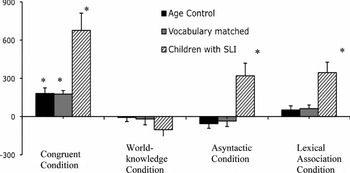
Comparison of conditions: Significant priming in one condition and lack of priming in another condition does not necessarily mean that subjects perform differently in the two conditions. In order to demonstrate a difference between two conditions, they are directly compared for the magnitude of the priming for each group separately (cf. Figure 3).
Magnitude of priming (ms) for each condition for age matched children (AC), receptive vocabulary matched children (RVC), and children with SLI in the four experimental conditions. The asterisks indicate that the response times in the experimental condition were significantly shorter than in the baseline condition.

The first analysis aims to determine the effect of world knowledge comparing the congruent condition (e.g., Le docteur a soigné – le patient/The doctor nursed – the patient) with the world-knowledge condition (e.g., Le docteur a soigné – le chat/The doctor nursed – the cat). A two-way ANOVA of the RT was computed for each group independently where cloze probability and priming condition (difference between the experimental condition and baseline) were the within subjects factors. Overall the effect of priming condition was significant for both groups: AC children: F (1, 12) = 13.079, p = .004; RVC children: F (1, 12) = 7.114, p = .021. The effect of cloze probability was also significant, AC children: F (1, 12) = 5.059, p = .044; RVC children: F (1, 12) = 6.478, p = .026. A significant interaction of Priming Condition × Cloze emerged (AC children: F (1, 12) = 8.920, p = .011; RVC children: F (1, 12) = 5.244, p = .041, indicating that for both groups the magnitude of the priming effect was greater in the congruent condition than in the world-knowledge condition.
In order to evaluate lexical association and whether the subject noun phrase and the verbs were integrated online, a third repeated measures ANOVA was computed for each group, where Lexical Association (congruent condition vs. lexical association condition) and Priming Condition were the within subjects factors. Once again Priming Condition was significant overall for both groups, AC group: F (1, 12) = 7.168, p = .020; RVC group: F (1, 12) = 10.394, p = .007, as was the Lexical Association Effect, AC group: F (1, 12) = 8.798, p = .012; RVC group: F (1, 12) = 6.448, p = .026; and the interaction of Lexical Association × Priming Condition, AC group: F (1, 24) = 8.798, p = .012, RVC group: F (1, 12) = 6.448, p = .026, showing that the magnitude of the priming effect was greater when both the subject noun phrase and the verb semantic information contributed to the thematic structure (congruent condition) than when just the lexicosemantic association between the verb and the internal complement was available (lexical association condition).
The last analysis considered the magnitude of the priming as a function of syntactic structure where Priming Condition (experimental condition vs. baseline) and Syntax (congruent condition vs. asyntactic condition) were the within subjects factors. The AC and RVC children showed overall a significant effect of Priming Condition, AC group: F (1, 12) = 11.410, p = .005; RVC group: F (1, 12) = 10.920, p = .006, but no main effect of Syntax, AC group: F (1, 12) = 1.712, p = .215; RVC group: F (1, 12) = 2.259, p = .159. A significant interaction of Priming Condition × Syntax emerged for both groups, AC group: F (1, 24) = 11.410, p = .005; RVC group: F (1, 12) = 10.920, p = .006, indicating that there was a significantly greater magnitude of priming effect when sentences were grammatical compared to when they were ungrammatical.
CHILDREN WITH SLI. There was a group difference in lexical decision times in sentence context (AC: M = 1079, SD = 187; RVC: M = 1249, SD = 222; SLI: M = 1714, SD = 407), F (2, 36) = 24.811, p = .000, where children with SLI were slower than both age matched children, F (1, 24) = 38.821, p = .000, and younger children matched on receptive vocabulary, F (1, 24) = 17.227, p = .000.
For children with SLI, the same analyses were conducted as for control groups. When the presence of the priming effect was considered, children with SLI showed a priming effect in the congruent condition, where they were significantly faster in accepting the target word, for example, Le docteur a soigné – le patient/The doctor nursed – the patient, compared to the baseline, for example, Le arrosé a le jardinier – le patient/The watered gardener – the patient, t (12) = 3.522, p = .004. Children with SLI did not present a prime effect in the world-knowledge condition. Instead, they were slightly slower when the target word was weakly associated with the thematic structure, for example, Le docteur a soigné – le chat/The doctor nursed – the cat, than in the baseline, although this difference was not statistically significant t (12) = 0.859, p = .407. They were also more rapid in the lexical association condition, for example, Le [pseudoword] a soigné – le patient/The [pseudoword] nursed – the patient, than in the baseline, t (12) = 3.320, p = .006. Finally, they were significantly faster in accepting the target word when the sentence was asyntactic (asyntactic condition), for example, Le soigné a docteur – le patient/The nursed doctor – the patient, t (12) = 2.541, p = .026, than in the baseline.
Comparison of conditions: In order to be able to say whether there is a difference in the magnitude for the priming effect, different conditions were directly compared.
The first ANOVA, evaluating the impact of world knowledge, considered Cloze (congruent condition vs. world-knowledge condition) and Priming Condition (experimental condition vs. baseline) as the within subjects factors. The prime effect showed only a tendency to significance, F (1, 12) = 3.681, p = .079, as the result of the lack of priming effect in the world-knowledge condition. The effect of Cloze was significant, F (1, 12) = 5.964, p = .031, and a significant interaction of Priming × Cloze emerged, F (1, 12) = 12.867, p = .004, demonstrating that the priming effect in the congruent condition was significantly larger than in the world-knowledge condition.
The lexical association between the verb and the internal complement was considered in a second repeated measures ANOVA where Lexical Association effect (congruent condition vs. lexical association condition) and Priming were the within subjects factors. The Priming effect was significant, F (1, 12) = 10.484, p = .007, as well as the Lexical Association effect, F (1, 12) = 6.952, p = .022, and the interaction of Lexical Association × Priming, F (1, 12) = 6.952, p = .022 (because the baseline is the same in the two conditions, the F value in the Lexical Association effect and the interaction are the same), the magnitude of Priming effect was greater in the congruent condition than when the subject noun phrase was substituted with a pseudoword (lexical association condition).
The last analysis considered the magnitude of the priming effect as a function of syntactic structure (congruent condition vs. asyntactic condition). A two-factor repeated measure ANOVA was computed, where Priming Condition and Syntactic Structure were the within subjects factors. The effect of priming was significant, F (1, 12) = 8.320, p = .014, as well as the main effect of Syntactic Structure, F (1, 12) = 4.935, p = .046, and the interaction of Priming Condition × Syntactic Structure, F (1, 12) = 4.935, p = .046, indicating that there was a significantly greater magnitude of priming when sentences were grammatical than when they were ungrammatical.
In order to be able to draw complete conclusions about the performance of children with SLI, it is essential to directly compare the performance of these children with the two groups of normal developing children.
CROSS-GROUP COMPARISON: TYPICALLY DEVELOPING CHILDREN VERSUS CHILDREN WITH SLI. The following analyses are critical to determine group differences: the comparison of the magnitude of the priming effect across groups in the congruent condition, world-knowledge condition, lexical association condition, and asyntactic condition. Finally, in order to establish the effect of (a) world knowledge, (b) lexical factors, and (c) syntactic structure in different groups, three different ANOVAs must include groups as the between subjects factor and compare the magnitude of the priming effect in the congruent condition versus (a) world-knowledge condition, (b) lexical association condition, and (c) asyntactic condition.
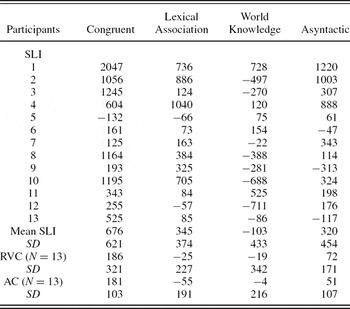
The one-way ANOVA of the magnitude of the priming effect in the congruent condition with groups as the between subjects factor and prime condition (experimental condition vs. baseline) as the within subjects factor was computed. A significant effect of group emerged as children with SLI were slower overall than the other two groups as shown before, F (2, 36) = 26.455, p = .000. The priming condition was significant overall, F (1, 36) = 27.831, p = .000, and the most interesting effect was an interaction Priming Condition × Group, F (2, 36) = 6.428, p = .004, which was due to the larger priming condition in children with SLI than in the control groups; the priming effect was larger than in the age matched, F (1, 24) = 8.013, p = .009, and RVC matched groups, F (1, 24) = 6.632, p = .017. Considering the world-knowledge condition, overall the analysis showed an effect of group, F (2, 36) = 34.086, p = .014 (cf. Table 3), due to the larger magnitude of the priming effect in children with SLI in the congruent condition. No priming effect and no difference between groups (F < 1) were found when the internal argument was not expected according to world knowledge (F < 1). In the lexical association condition, there was also a group effect, F (2, 36) = 18.734, p = .000, and in the experimental condition, F (1, 36) = 14.531, p = .001. Furthermore, the magnitude of the priming effect was larger in the language impaired group than in the two control groups, as shown by the interaction, F (2, 36) = 5.734, p = .007; the priming effect was larger in children with SLI than both the AC group, F (1, 24) = 7.375, p = .012, and the RVC group, F (1, 24) = 7.375, p = .012. Finally, there was a group effect for the world knowledge, F (2, 36) = 19.778, p = .000, and overall there was no effect of experimental condition, F (2, 36) = 2.333, p = .135. The magnitude of the priming effect also differed in the asyntactic condition across the three groups of children, F (2, 36) = 5.838, p = .006: children with SLI showed a larger priming effect in this condition than the AC children, F (1, 24) = 7.530, p = .011, and RVC children, F (1, 24) = 6.269, p = .019.
Magnitude of priming (ms) and standard deviations for children with SLI as a function of condition and as compared to AC and RVC

Note: SLI, specific language impairment; RVC, receptive vocabulary matched children; AC, age-matched control children.
The last analysis aimed to establish the different effect in different groups of the three factors considered: (a) world knowledge (congruent vs. world-knowledge condition), (b) lexical association (congruent condition vs. lexical association condition), and (c) syntactic structure (congruent condition vs. asyntactic condition). Three ANOVAs were computed on the priming effect where the three groups were the between subjects factor and priming effect in the experimental condition was the within subjects factor. Concerning world knowledge, there was an effect of condition, F (1, 36) = 25.258, p = .000, and the interaction Group × Experimental factors was significant, F (2, 36) = 6.520, p = .004: the effect of world knowledge was significantly larger for children with SLI than for age control children, F (1, 24) = 8.022, p = .009, and vocabulary control children, F (1, 24) = 6.793, p = .015. With regard to the effect of lexical association, there was an overall effect of group, F (1, 36) = 7.746, p = .002 and the effect of condition was also significant, F (1, 36) = 12.601, p = .001, whereas the interaction of Group × Lexical Association was not significant, F (2, 36) = 1.670, p = .203. Finally, the effect of syntax was considered: there was a significant effect of group, F (1, 36) = 7.512, p = .002, and the effect of syntax was also significant overall, F (1, 36) = 27.259, p = .000, whereas the interaction Group × Syntax was not significant (F < 1).
DISCUSSION
The present experiment followed up a previous experiment on the same groups of children with SLI and typically developing children to investigate how syntactic, lexicosemantic information and world knowledge are integrated online to establish the thematic structure of a sentence.
The results show that children developing language typically as young as 7 years old are able to integrate online semantic and syntactic information into a higher level of representation like adults (cf. Nakano & Blumstein, Reference Nakano and Blumstein2004). When semantic and syntactic information converge, the target word is primed, but when the subject noun phrase is replaced with a pseudoword (e.g., the afacal is feeding the . . . BABY) children do not benefit from the sentence context, showing that the meaning of the subject noun phrase was combined online with that of the verb. In typically developing children, lexicosemantic information is mapped onto syntax as in adults and does not simply depend on lexicosemantic association between the verb and the internal argument. Finally, thematic integration processing is mediated by world knowledge: when the internal argument was not expected on the basis of world knowledge there was no priming effect. This suggests that children as young as 7 years do not simply juxtapose and linearly sum different bits of information, but they are able to integrate different types of information in the sentence. Multiple convergent sources of information generate a higher-level representation, which is more than the simple sum of individual cues. When one source of information is missing or is incorrect the system fails to generate the higher order representation that primes the target word.
In typically developing children, the integration of various sources of information in the sentence is demonstrated by the fact that the benefit from the sentence context emerges only when both syntactic and semantic information are present. To put it differently, control children integrate different sources in a nonlinear way, where the resulting representation is stronger than the simple sum of the contribution of single information. Children with SLI appear to be able to use the syntactic, lexicosemantic information and world knowledge as shown by the significant priming effect in the congruent condition, in the asyntactic condition, and in the lexical association condition, but appear to struggle to incrementally integrate them.
It was surprising and contrary to our predictions that children with SLI were as sensitive to the disruption of syntactic structure as children with typical language development. However, even when syntactic structure was completely disrupted, children with SLI benefitted from sentence context, whereas control children, like adults (cf. Nakano & Blumstein, Reference Nakano and Blumstein2004), failed to show any priming. These results indicate that in children with SLI, lexicosemantic information and world knowledge are used independently from syntactic information, which argues against the idea of a thorough integration of syntactic and semantic information.
Concerning the contribution of semantic information in the build-up of the sentence level representation, we investigated the influence of world-knowledge and lexicosemantic associations. Children with SLI appear to rely more than control children on both world-knowledge and lexicosemantic associations. On the one hand, they presented a larger effect of world-knowledge manipulation; on the other hand, they showed a significant priming effect both when the subject noun phrase was substituted with a pseudoword and in asyntactic sentences. These results are congruent with recent results obtained in our lab of a larger semantic priming effect in children with SLI than in typically developing children (Pizzioli & Schelstraete, Reference Pizzioli and Schelstraete2011). They also agree with results from a cross-modal picture priming study, which reported a larger priming effect in a condition tapping the processing of lexicosemantic information (Marinis & van der Lely, Reference Marinis and van der Lely2007) and with results demonstrating higher reliance on semantic cues (van der Lely & Dewart, Reference van der Lely and Dewart1986).
Finally, children with SLI do not seem to integrate different sources of information in a nonlinear way as typically developing children do. Syntactic and semantic information are used independently, juxtaposing and linearly, summing different sources of information, but do not appear to be efficiently integrated. Children with SLI showed that the sum of the priming effect in the asyntactic condition and lexical association condition was almost exactly equal to the priming effect in the congruent condition, where all information converged (asyntactic condition = 320 ms, lexical association condition = 345 ms, asyntactic condition + lexical association condition = 665 ms, congruent condition = 676 ms), while in children with typical language development the sum of the priming in the two conditions was less than the priming effect in the congruent condition.
CONCLUSIONS
In summary, we claim that results reported in the present investigation support the idea that children with SLI present postlexical and postsyntactic problems of integration of each incoming word into the developing sentence representation, rather than lexical processing, and more specifically they would inefficiently integrate syntactic and semantic information. This is congruent with previous studies in different languages and with different paradigms (e.g., Montgomery Reference Montgomery2000, Reference Montgomery2002, Reference Montgomery2006; Stark and Montgomery Reference Stark and Montgomery1995). The slower lexical decision times in sentence context and different pattern of priming effect in children with SLI seem to also go beyond a syntactic deficit. Two arguments support this conclusion: the sentences that were employed were syntactically extremely simple (grammatical morphology processing was not required to build up the syntactic structure), had canonical word order, and were semantically constrained; in contrast, children with SLI demonstrated comparable reduction of the priming effect when syntax was disrupted. The current results support the idea that some problems originate at the interface between the parse tree construction and word meaning where the thematic roles are mapped (Haarmann et al., Reference Haarmann, Just and Carpenter1997).
The exact causes of these difficulties cannot be disentangled by the present results and three main explanations can possibly account for the present results. Within the framework of the limitation of computational resources hypothesis in children with SLI (Ellis Weismer, Reference Ellis Weismer1994; Ellis Weismer & Hesketh, Reference Ellis Weismer and Hesketh1996; Johnston, Reference Johnston and Miller1991, Reference Johnston, Watkins and Rice1994), as the interface between modules is among the most “energy” consuming of operations (Avurtin, Reference Avurtin, Grodzinsky and Amunds2006), integration processing would require resources that exceed those available in the system, resulting in a less efficient online integration of multiple sources of information (Avurtin, Reference Avurtin, Grodzinsky and Amunds2006; Sorace & Serratrice, Reference Sorace and Serratrice2009).
A related domain-general hypothesis clams that children with SLI have difficulty in simultaneous processing of information (Marton, Reference Marton2006). As integration requires the simultaneous processing of syntactic, lexicosemantic information and world knowledge, the problem in processing concurrent information is predicted to result in a failure to correctly semantically combine words.
Alternatively, the domain-specific hypothesis of a syntactic deficit is also compatible with the evidence of integration problems. There are at least two versions of the domain-specific hypothesis: one focusing on the quality of the output of the syntactic parser, and the other on its timing. Several researchers claim that children with SLI present a variously specified syntactic deficit that produces ill-formed syntactic hierarchical structure (e.g., Clahsen, Reference Clahsen1993; van der Lely & Battell, Reference van der Lely and Battell2003; van der Lely & Harris, Reference van der Lely and Harris1990; van der Lely & Stollwerck, Reference van der Lely and Stollwerck1996). This output could therefore be so degraded as to be unsuitable for mapping online lexicosemantic information onto the structural relations.
Otherwise, similarly to the slow syntax hypothesis (Piñango, Reference Piñango2000; Piñango & Zurif, Reference Piñango and Zurif2001), children with SLI could carry out syntactic operations at a slower rate but still be capable of accessing syntactic information or establishing dependency-based relations within elements in a sentence. As dependencies must be established in a timely fashion, the integration of syntactic, lexicosemantic information and world knowledge may fail. This hypothesis predicts that integration of syntax and lexicosemantic mechanisms could be observed if more time is given.
In both cases, if the syntactic processing is “weakened” and is no longer the most economical option, “there should be no prohibition against establishing a nonsyntactic dependency between” arguments in the sentence (Avurtin, Reference Avurtin, Grodzinsky and Amunds2006, p. 6). This is what we observed in our group of children with SLI.
In summary, the results reported in this paper show for the first time that children with SLI experience problems in normally integrating syntactic information, lexicosemantic information, and world knowledge, even in very simple active sentences.
ACKNOWLEDGMENTS
The research reported in this paper was supported by Research Grant FSR (Fond Spécial pour la Recherche). The authors thank Agnesa Pillon, Victoria, and two anonymous reviewers for their helpful comments.