Introduction
Over the past few decades, a growing body of research from linguistic anthropological perspectives has examined the expression of affect in interaction (e.g. Haviland Reference Haviland1989, Irvine Reference Irvine, Lutz and Abu-Lughod1990; see review in Besnier Reference Besnier1990). In particular, affect is central to interaction with children and is socialized from infancy (e.g. Harkness & Super Reference Harkness and Super1983, Herot Reference Herot, Blum-Kulka and Snow2002). In Japan, the preschool is an important setting of this socialization whereby children are encouraged to express feelings and understand the feelings of others (Ben-Ari Reference Ben-Ari1997, Lewis Reference Lewis1995). Even casual observations in a Japanese preschool brought to our attention that affect, particularly positive affect, is central to interaction. In particular, we often observed teachers saying the word kawaii ‘cute’ while touching, gazing at, or pointing toward things in the surround, such as animals, flowers, food, toys, and children’s clothes and accessories, in showing positive feelings toward them. While lately there has been a good deal of academic interest in “cuteness” in relation to Japanese society and psychology (e.g. McVeigh Reference McVeigh2000) and the globalization of Japanese culture (e.g. Allison Reference Allison and Tobin2006), there has been little analysis of the word kawaii in interaction, particularly that involving children (Clancy Reference Clancy1999), for whom sociocultural understandings of cuteness take shape. Yet such an analysis can shed light on the sociocultural meanings of cuteness, and how children come to understand them in early social life. This article examines the word kawaii in a Japanese preschool. In particular, it analyzes ways teachers and children use kawaii within everyday communicative practices utilizing multiple resources, including talk, embodied actions, material objects, and participation frameworks. The questions addressed include (i) how preschool children come to understand things in the social world as kawaii, (ii) how girls in particular come to understand themselves and female peers as kawaii, (iii) how boys come to think of girls as kawaii, and (iv) how children display understandings of kawaii in social interaction. The analysis suggests that teachers’ uses of kawaii in making assessments of particular things in the social world, and in “glossing” (Schieffelin & Ochs Reference Schieffelin and Ochs1986) children’s affectionate actions toward younger peers, are central practices in shaping children’s understandings of kawaii. Moreover, in examining children’s use of kawaii, the findings show that while both boys and girls use kawaii in displaying empathy, girls in particular also use kawaii toward their own and female peers’ personal items and appearance in displaying affect.
Kawaii
Kawaii, an adjective meaning ‘cute’, ‘adorable’, and ‘lovable’, is an important aspect of Japanese material culture and a key “affect word” (Clancy Reference Clancy1999) used to describe things, such as animated characters, infants, animals, and natural objects, that have certain qualities and features. Kawaii is rooted in a sociohistorical aesthetic for things that are small, delicate, and immature, as evidenced in early Japanese art forms and literary writings (Yomota Reference Yomota2006). In particular, in the Makura no Sooshi (The Pillow Book), a renowned collection of more than 300 writings from the late 990s to early 1000s by the court lady Sei Shônagon, the author describes a series of utsukushiki mono ‘adorable things’, part of which is shown in the following translation by Morris (Reference Morris1991:168–69).
“The face of a child drawn on a melon.”
“A baby sparrow that comes hopping up when one imitates the squeak of a mouse…”
“One picks up a tiny lotus leaf that is floating on a pond and examines it. Not only lotus leaves, but little hollyhock flowers, and indeed all small things, are most adorable.”
While the earlier word utsukushiki (now utsukushii ‘beautiful’) is translated above as ‘adorable’, the modern word kawaii has taken on the principal meanings associated with utsukushiki (Yomota Reference Yomota2006). In particular, similar to utsukushiki, kawaii is used to describe things that are small, delicate, and immature, and to express and evoke kookan ‘fondness and feeling’ for them (Masubuchi Reference Masubuchi1994).
Since the 1970s, Japan has undergone a kawaii boom, which is recently spreading across Asia and the West through Japanese animation, comics, and “cute” goods. In relation to Japan, McVeigh (Reference McVeigh1996:291) notes, “Cute objects are encountered everywhere.” In particular, according to Kinsella (Reference Kinsella, Skov and Moeran1995:226), animated characters that are “small, soft, infantile, mammalian, [and] round,” such as Hello Kitty (a white and pink female cat), are quintessentially kawaii because they appear kind, innocent, and helpless (e.g., Hello Kitty has no mouth, so is ostensibly not able to speak). While cute goods have appeal in many societies, in Japan they have attained a pervasiveness rarely seen elsewhere. According to Allison (Reference Allison and Tobin2006:16), “Characters, often designed to be cute, come in toys, backpacks, lunch boxes, clothes, theme parks, telephones, wristwatches, bread, snacks, key rings, and icons promoting everything from neighborhood meetings and government campaigns to banks and English schools.” In addition to animated characters, kawaii is often associated with infants, the elderly, and adolescent boys (particularly those who have feminine qualities), as well as styles of writing (e.g. maru moji ‘rounded characters’, symbols such as hearts), clothes (e.g. pastel, flowery), and food (e.g. petite and frilly sweets). In these ways, kawaii is not just for children but has wide appeal in Japanese society. White (Reference White1993:126) points out that kawaii products are popular among Japanese adults because “Childish cuteness soothes and provides a release from adult responsibilities.”
While transcending age and gender to a degree, kawaii is especially associated with femininity (e.g. Kinsella Reference Kinsella, Skov and Moeran1995). In particular, young women in trendy areas of Tokyo set the standard for kawaii fashion (Yano Reference Yano2009). Media and literature offer advice to young women on how to dress and behave kawaii (McVeigh Reference McVeigh1996). Such behaviors can include making a peace sign with the fingers while posing for a picture, and bending the knees while tilting the head to the side when serving tea (Ueno Reference Ueno1982). An extreme version of such behavior is called burikko ‘fake child’, which, according to Miller (Reference Miller, Okamoto and Shibamoto Smith2004:149) is “a woman who plays bogus innocence” that includes speaking in a high-pitched, nasalized voice and using baby-talk register, and covering the mouth or putting the hands to the cheeks while smiling. Such ways of speaking and behaving, though unappealing to some, are related to being polite, gentle, and innocent – norms associated with femininity in Japan (see Loveday Reference Loveday1981).
Japanese social critics have lamented a kawaii “syndrome” (shookoogun) (Masubuchi Reference Masubuchi1994) in which there is an overabundance of kawaii goods, resulting in self-centeredness and a deemphasis on interpersonal relationships that are a hallmark of Japanese society. Kawaii has also come under criticism from feminists who argue that it drives women to be childish, which subordinates them to men and promotes eating disorders in the pursuit of being kawaii (Asano Reference Asano1996). Despite these concerns, kawaii does not seem to be a temporary fad but remains an important aspect of everyday life in Japan, and it shapes young children’s understandings of their social world. In particular, psycholinguistic interviews have suggested that preschool girls (ages three to six) are much more likely than boys (3:1 for the youngest children, up to 9:1 for the oldest children) to describe themselves as kawaii (Tomomatsu Reference Tomomatsu1994), suggesting that kawaii is an important aspect of gender identity in young children, particularly girls.
In summary, kawaii is (i) linked to an aesthetic in Japan for things that are small, delicate, and immature, (ii) more amplified in Japan in comparison to “cute” in English-speaking societies, (iii) spreading across the globe via popular culture (the word kawaii has even entered the lexicon of fans of Japanese animation and comics in the U.S.), and (iv) associated especially with femininity. Our data illustrate that central meanings of kawaii in relation to affect, gender, and relationships are socialized within everyday interaction in preschool.
Socialization, Affect, and Gender
In communities across the globe, children learn to act, think, and feel through a process of language socialization, the integration of language and cultural acquisition across the lifespan (Garrett & Baquedano-López Reference Garrett and Baquedano-López2002, Ochs & Schieffelin Reference Ochs, Schieffelin, Shweder and LeVine1984, Schieffelin et al. 1986). Language and culture are integrated in that language (e.g. phonology, words) indexes (Silverstein 1976) socioculturally meaningful realities such as stance (Ochs Reference Ochs, Gumperz and Levinson1996) and identity (Ochs Reference Ochs1993). Here, we focus on affective stance, which, according to Ochs (Reference Ochs, Gumperz and Levinson1996:410), refers to “mood, attitude, feeling and disposition, as well as degrees of emotional intensity vis-à-vis some focus of concern,” and on gender, which is a central aspect of identity that actors perform (Butler Reference Butler1989) and do through social action (West & Zimmerman Reference West and Zimmerman1987). According to Ochs Reference Ochs, Duranti and Goodwin1992, language directly indexes affective stance through “affect specifiers,” such as lexicon, pragmatic particles, and diminutive markers, and “affect intensifiers,” such as repetition and reduplication, phonological lengthening, and quantifiers, which in turn can indirectly index gender. That language has indexical properties means that speakers do not simply map language onto social categories, but rather they actively draw upon language to index affective stance, gender, and other meaningful realities in interaction.
Japanese is a good case in which to examine the relationship among language, affect, and gender. First, speakers draw upon a wealth of resources to index affective stance, such as honorifics, pronouns, and pragmatic particles (affect specifiers) (Suleski & Masada Reference Suleski and Masada2000), and voice quality, sound play, and vocatives (affect intensifiers) (Maynard Reference Maynard1993). Second, speakers also use a variety of resources to index gender, such as honorifics, pronouns, and pragmatic particles (e.g. Ide Reference Ide, Ide and McGloin1991). As in many other languages, Japanese men’s language is conventionally rough, assertive, and direct (Sreetharan 2004), whereas women’s language is conventionally polite, emotional, and indirect (Shibamoto Reference Shibamoto1985). In everyday interaction, however, men and women use language to index various stances that may not always conform to gender stereotypes (see Okamoto & Shibamoto Smith Reference Okamoto and Shibamoto Smith2004). These stereotypes include boys as tsuyoi ‘tough’, takumashii ‘brave’, and kakkoii ‘cool’, and girls as sunao ‘gentle’ and kawaii ‘cute’ (Funabashi Reference Funabashi2004).
Children are socialized through language into affect (Clancy Reference Clancy1999, Ochs & Schieffelin Reference Ochs and Schieffelin1989) and gender (Joffe Reference Joffe1971, Kyratzis & Cook-Gumperz Reference Kyratzis, Cook-Gumperz, Duff and Hornberger2008) within interaction inside and outside the household. In particular, in the home, Japanese mothers socialize children into affect through various linguistic resources such as lexicon (Clancy Reference Clancy1999), pragmatic particles (Cook Reference Cook1990), and grammatical forms (Akatsuka Reference Akatsuka, Clancy and Thompson1991, Suzuki Reference Suzuki1999). For instance, they use affect words such as kowai ‘scary/be afraid’ to encourage children to avoid certain stimuli and behaviors (Clancy Reference Clancy1999), and they attribute speech to third parties who have not spoken to encourage children to anticipate others’ needs and wants as a form of empathy (Clancy Reference Clancy, Schieffelin and Ochs1986). Also, mothers speak to boys and girls using pronouns and pragmatic particles normatively associated with the child’s sex (Sakata Reference Sakata1991). In the preschool, teachers engage boys and girls in activities in different ways. For instance, teachers rarely intervene in boys’ physical fights and encourage girls to play the role of peacemaker (Tobin, Wu & Davidson Reference Tobin, Wu and Davidson1989). Teachers also lead boys in outside activities that develop courage (Hendry Reference Hendry1986). Peers are crucial agents of gender socialization in the home and school. In particular, girls and boys may separate into same-sex groups and engage in different activities (Peak Reference Peak1991), in which they use language in gender-appropriate ways, and they may sanction those who do not (Nakamura Reference Nakamura2001).
While these studies suggest that socialization into affect and gender occurs through everyday communicative practices, in what follows we identify practices that contribute to this socialization in preschool. In preparation, in the next section we briefly describe the setting and data collection procedures.
Setting and Data
The preschool under study is a medium-sized (20–25 children), private daycare center (hoikuen)Footnote 1 located near Tokyo. Similar to those studied by Holloway Reference Holloway2000, this center is “child-oriented” in that (i) there is no organized instruction in academic subjects, (ii) teachers often scaffold children’s interactions with peers, and (iii) there is an abundance of materials (e.g. toys, picture books) for children to use. Children bring various personal items from home, such as a change of clothes, pajamas, and hand towels, as well as swimsuits in the summer. The daily schedule includes free play, outdoor walking, meal and snack, and nap time.Footnote 2 As observed in other Japanese preschools (Tobin, Karasawa & Hsueh 2004), a good deal of time is also spent transitioning from one activity to another as a group, such as cleaning up toys, moving from inside to outside, and washing hands.
While the teachers and staff members are all female, native (monolingual) speakers of Japanese,Footnote 3 approximately half the children are from non-Japanese families who are residing in Japan because of the parents’ study and work at a nearby university. The children are divided into two groups: ‘chicks’ (hiyoko; several months to two years), and ‘bunnies’ (usagi; two to five years). The analysis draws upon 48 hours of audiovisual recordings among the bunnies. Though the number of children fluctuated for various reasons (e.g. a child joined the group having turned two years old, or left the group to return to her home country), there were about 14 children in total. Six of these children were native speakers and eight were non-native speakers of Japanese,Footnote 4 and there were similar numbers of girls and boys. Recordings were made once to twice a month for four to five hours at a time over the course of a year.
Assessment, Multimodality, and Gender
Assessment is a frequent practice in interaction in various languages, such as English (e.g. Goodwin & Goodwin Reference Goodwin and Goodwin1987, Reference Goodwin, Goodwin, Duranti and Goodwin1992; Pomerantz Reference Pomerantz, Atkinson and Heritage1984), Japanese, and Korean (Strauss & Kawanishi Reference Strauss, Kawanishi, Akatsuka, Iwasaki and Strauss1996), and in various settings such as classrooms (e.g. the third turn in the Initiation-Response-Evaluation [IRE] sequence; see Mehan Reference Mehan1979). Assessment is multifunctional, performing a range of social actions, such as compliment, praise, and bragging (Pomerantz Reference Pomerantz, Atkinson and Heritage1984), and it plays an important role in socialization (Ohta Reference Ohta1999).
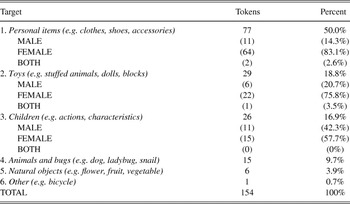
The daycare teachers often make assessments, particularly positive assessments, of children and things using words such as kawaii ‘cute’, kakkoii ‘cool’, ii ‘good’, joozu ‘skillful’, subarashii ‘wonderful’, sugoi ‘terrific’, suteki ‘lovely’, and yasashii ‘kind’. Among the most frequent of these words is kawaii (154 tokens). While these assessments are evaluative, sequentially they do not appear as the third turn within an IRE sequence (i.e., following a teacher initiation and student response). In fact, these teachers rarely initiate such sequences. Rather, such assessments are responsive to what Goodwin & Goodwin (Reference Goodwin, Charles, Budwig, Uzgiris and Wertsch2000:247) refer to as an “assessable” – “some relevant current event, available either in the local scene or through a report in the talk of the moment.” As shown in Table 1, in relation to kawaii the “assessable” (henceforth, target) includes personal items, toys, children, animals and bugs, and natural objects. Most of these targets are something in the “local scene.”
Teachers’ use of kawaii.

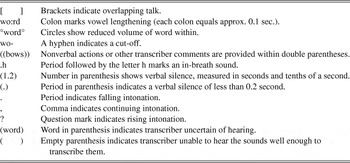
Table 1 also shows that, in relation to gender, teachers make assessments with kawaii more often when the target and/or addresseeFootnote 5 was female than when male. The most frequent target is personal items (77 tokens, 50.0%), including those children bring from home or create at the center (64 tokens female, 11 tokens male, 2 tokens both). An illustration is seen in example (1). Here several children are seated around a table drinking cold tea while wearing paper wristwatches, which they had decorated earlier in the day during an organized group craft activity. When a teacher (T-1)Footnote 6 is admiring a boy’s (Kazu 5;0) wristwatch, a girl (Mao), who is seated at the other end of the table, tries to get this teacher to look at her watch, which is decorated with a sticker of Hello Kitty. The excerpt begins as the teacher responds to her (see Appendix for transcription conventions).
(1) Teacher-1, Mao (female, Japan, 2;5)7
1 T-1: Maochan wa nan no tokei da kke.
‘What kind of watch was yours again, Mao?’
2 T-1: Mise[te:::. ((leans towards Mao))
‘Show me.’
3 Mao: [((holds up arm with wristwatch))
4 T-1: .h A Kittichan no. ((appreciative intonation, smiling))
‘Ah, a Hello Kitty one.’
5 → T-1: Kawaii tokei ne::::::. [Figures 1 and 2]
‘A kawaii watch, right’8
6 T-1: Oribon made tsuitete.
‘There’s even a ribbon on it ( =on Hello Kitty’s head).’
7 Mao: ((turns head towards center of table))
Teacher puts hands on cheeks and tilts the side with saying kawaii (A kawaii…).

Teacher leans forwards with hands on cheeks while saying tokei ne:::::: (…watch, right).

Similar to the observation by Goodwin et al. (1992:156), “a speaker doesn’t just describe something, but also does an assessment of it,” here, upon looking at the child’s watch the teacher describes it (line 4), and then makes an assessment of it with kawaii (‘A kawaii watch, right’ in line 5). In saying ‘a Hello Kitty one’ (line 4), the teacher uses prosodic features (appreciative intonation) and facial expression (smiling face) to display affect, and builds upon this affect in the central assessment that follows (line 5). In particular, in the initial part of the assessment (Kawaii ‘A kawaii’), shown in Figure 1, she leans forward and tilts her head to the side while putting her hands on her cheeks as if resting on a pillow. In the latter part (tokei ne ‘watch, right’), shown in Figure 2, while keeping her hands on her cheeks, the teacher makes a rocking motion with her upper torso, which extends across the pragmatic particle ne ‘right’ with vowel elongation (ne::::::). While the particle ne is deployed to elicit an addressee’s affiliation (Tanaka Reference Tanaka2000), here the teacher also uses ne to align with the child’s implicit display of fondness for Hello Kitty.
In this excerpt, the teacher’s use of verbal language and embodiment helps constitute with the child an “assessment activity” (Goodwin et al. 1987) that indexes affect and gender. In particular, this assessment is reminiscent of a burikko ‘fake child’ performance as described earlier in relation to Japanese femininity (Miller Reference Miller, Okamoto and Shibamoto Smith2004). While particular contexts of assessments, such as when the target is ostensibly female (e.g. Hello Kitty) and the addressee is a girl, may trigger such gender indexing displays, this excerpt also reveals more generally that assessment is an “affect display” (Goodwin et al. 1992) that involves the deployment of a variety of resources including talk and embodied action in evaluating a target (Goodwin et al. 2000).
Girls are kawaii, boys are kakkoii
In addition to personal items (and toys, which are not examined here in relation to teachers, but see excerpt 5 in relation to children), teachers also make assessments with kawaii of children, particularly girls, such as in response to their “cute” poses and in relation to gender categories such as “girl.” The next three excerpts examine children as the target of assessments, shedding light on ways teachers use “participation frameworks” (Goffman Reference Goffman1981) to socialize affect, gender, and relationships.
In (2), as the children are seated on the floor in the entrance prior to going outside for a walk with their teachers (T-1, T-2), one of the teachers (T-2) tells them about the need to wear a mask over the mouth, as when one is catching a cold (a common practice in Japan). The teacher then slightly shifts topic. While gesturing toward her mouth, she says that instead of putting on a mask (sensei wa ne koko wa ne, masuku janakute ne:::) she puts on lipstick (°kuchibeni na no°), and then she gazes toward two of the girls in the group (Mao and Hina), and addresses each of them (lines 1 and 4).
(2) Teacher 2, Teacher 1, Mao (female, Japan, 2;6), Hina (female, Japan, 3;1), Eli (female, Bangladesh, 3;7), Kazu (male, Japan 5;1).
1 T-2: °Maochan no mama yatteru yo ne.° ((gazing towards Mao))
‘Mao’s (=your) mom wears (lipstick) right?’
2 Mao: ((gazing towards teacher))
3 T-1: °Suteki.°
‘Lovely.’
4 T-2: °Hinachan no mama mo kuchibeni suru?° ((puts index finger to lips))
‘Does Hina’s (=your) mom wear lipstick too?’
5 Hina: ((slightly nods))
6 Eli: Atashi no- atashi [no mama wa [(0.3) o]chi no- okuchi no naka ni [shita no.
‘My- my mom (0.3) put it on her lips.’
7 T-2: [n [n n n ] [Un.
‘Mm’ ‘Mm mm mm’ ‘Mm.’
8 T-2: A [honto:::? ((waves hand in front of face once))
‘Oh really?’
9 Eli: ((nods))
10 T-1: [°Sugoi ne[::.
‘It’s terrific, right.’
11 T-2: [Mama no kirei na no aru yo [ne::. ((pretends to put on lipstick))
‘Moms have pretty ones (=lipstick), right.’
12 T-1: [N::[:::].
‘Mm:::::.’
13 Eli: ((nods))
14 T-2: [Pin]ku toka aka toka ne::::.
‘Pink, red, and so on, right::::.’
15 Eli: ((nods))
16 T-2: So::.
‘Right::.’
17 T-2: ((turns towards Kazu))
18 → T-2: Onnanoko wa k(h)awaii kara. ((pretends to touch Kazu on the leg))
‘Since girls are kawaii (they have/wear/put on pretty lipstick).’
19 Kazu: ((gazing towards teacher))
After Mao and Hina respond nonverbally to the teacher, another girl (Eli) volunteers a verbal response by saying that her mom puts on lipstick (line 6). The teacher aligns by making a generalization (line 11), which Eli responds to by nodding (line 13). After adding an “increment” (Schegloff Reference Schegloff, Ochs, Schegloff and Thompson1996) to this generalization (‘Pink [lipstick], red, and so on, right’ in line 14), the teacher turns toward Kazu, the oldest boy in the group by about two years (line 17), and makes an assessment of the category onnanoko ‘girl’ using kawaii (line 18). In contrast to excerpt (1), here the target is something constructed within the content of talk, rather than something visible in the immediate surround. Also, this assessment ends with the clause linker kara ‘since’, which indirectly references earlier talk about lipstick, implying, “Since girls are kawaii, they put on/wear/have lipstick.” In relation to the proposal by Antaki & Widdicombe (Reference Antaki and Widdicombe1998:2) that identity is linked to being in a “category with associated characteristics or features,” here the teacher uses an assessment to link the category “girl” to particular appearances and actions.
By turning and gazing toward Kazu (line 17), in Goffman’s (Reference Goffman1981) terms, the teacher reframes the participation framework to position him as the recipient (one to whom message is addressed) of the assessment. This assessment is linked to expectations surrounding children’s developing understandings of gender. In particular, by the age of five, boys may no longer be expected to think of themselves as kawaii, and may be encouraged to distinguish girls as kawaii and themselves and other boys as kakkoii ‘cool’, as the continuation of this sequence reveals in line 20.
(2, continuation)
20 T-2: O[tokonoko wa? ((makes hand gesture and gazes towards Kazu))
‘What about boys?’
21 T-1: [°Ne:::.° ((gazing towards Kazu))
‘°Right.°’
22 (0.8)
23 Kazu: °Kakkoii.° ((shaking head slightly))
°‘They’re cool.°’
24 T-2: Kak[koii n ] da yo ne:::::::.((pulls in both arms making two fists))
‘(Boys) are cool, right.’
25 T-1: [Kakkoii.]
‘They’re cool.’
26 T-2: Soo nan da yo ne:. ((nods head))
‘That’s right.’
After Kazu comes up with the expected assessment of boys (line 23), both teachers repeat this assessment in partial overlap (lines 24 and 25), displaying “congruent understanding” (Goodwin et al. 1992). In contrast to the association she made earlier between girls and kawaii, here the teacher (T-2) does not verbally associate boys and kakkoii with a particular appearance or behavior. However, when she makes this assessment, the teacher pulls in both arms and makes two fists (line 24), as a nonverbal index of strength normatively associated with boys (Funabashi Reference Funabashi2004).
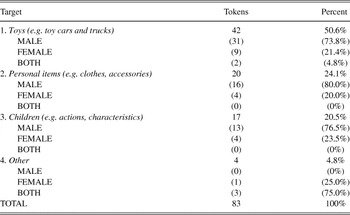
This sequence co-constructs the contrastive assessments, “Girls are kawaii” and “Boys are kakkoii” and links them to particular demeanors. Although such direct assessments of boys and girls are relatively infrequent, they reveal preferences surrounding speaking and acting in relation to gender. In comparison to kawaii, as shown in Table 2, while the target of assessments with kakkoii also includes toys, personal items, and children, teachers make assessments with kakkoii more often when the target and/or addressee is male than when female, such as the toys boys were playing with (31 tokens for boys, 9 tokens for girls), and the personal items of boys (16 tokens for boys, 4 tokens for girls).
Teachers’ use of kakkoii.

Direct assessments of boys and girls using kawaii and kakkoii as in excerpt (2) reveal underlying ideologies of kawaii and kakkoii in relation to gender that are shared not only among these teachers but also throughout much of Japanese society. It should be noted, however, that teachers do not always use kawaii and kakkoii in relation to such ideologies. For instance, on occasion they make assessments of girls as kakkoii, such as in response to a display of athleticism and bravery (e.g. jumping down from a high place), which suggests that these ideologies are not fixed.
Glossing Children’s Actions as Thoughts and Feelings
Similar to a practice observed in other communities, such as among U.S. (Ochs et al. 1984) and Athabaskan caregivers (Scollon Reference Scollon1982), Japanese caregivers gloss (verbally interpret or guess) children’s unintelligible utterances and nonverbal actions (Okamoto Reference Okamoto2001). In the present data, teachers on occasion use kawaii to gloss children’s actions toward younger peers as thoughts and feelings. For instance, in (3), while a teacher (T-3) is assisting a young boy (Wataru) in putting together a train, a nearby girl (Hina) puts her arms around the boy as if to try to pick him up (line 1 and Figure 3).
Hina puts her arms around Wataru.

(3) Hina (female, Japan 3;0), Teacher 3, Wataru (male, Japan, 2;2)
1 Hina: ((putting arms around Wataru)) (0.7) [Figure 3]
2 → T-3:Kawaii:::?
‘Is (he) kawaii:::?’
3 (0.3)
4 T-3: Un, Hinachan to issai chigau mon ne:::.
‘Well, (he) is a year younger than Hina (=you), right:::.’
5 Wataru: ( ) (0.7)
… ((turns skipped, as T-3 addresses other children))
10 Hina: ((reaches arms out towards Wataru)) [Figure 4]
11 → T-3:Kawaii no:::.
‘(The fact is you think he) is kawaii:::.’
12 Hina: ((puts arms down))
13 T-3: N: dakedo ne, omotai kara ne: kiotsukete ne.
‘Mm but, since (he) is heavy, be careful okay.’
14 Hina: ((withdraws her arms))
Hina reaches her arms out towards Wataru.

In response to Hina’s actions, the teacher uses kawaii to address Hina in two different turns. First, she makes a query (line 2), which provides a candidate gloss of Hina’s actions as thought and feeling in relation to the boy, meaning, “You think/feel he’s kawaii?” The teacher follows this assessment by saying, ‘Well, he is a year younger than Hina (=you), right’ (line 4). In relation to this utterance, in Japanese schools (Hendry Reference Hendry1986) children are encouraged to differentiate themselves from other children in relation to age, year in school, and other characteristics linked to status, respect, and the like. This differentiation begins earlier and may be linked to ways of acting, thinking, and feeling toward others. Here, by referring to a difference in age between the children, the teacher indicates that Hina’s actions are related to normative ways that older children are expected to feel toward younger children.
Second, in response to Hina’s reaching out her arms towards the boy (line 10 and Figure 4), the teacher makes an assessment using kawaii (line 11). This assessment ends with the pragmatic particle no, which Japanese caregivers use to index fact or common knowledge of the social group (Cook Reference Cook1990), e.g. “The fact is everyone thinks/does X.” That is, by using the particle no the teacher implicitly conveys, “The fact is you think he’s kawaii.” In this way, the teacher provides a socioculturally appropriate gloss of Hina’s thought and feeling in relation to the boy, which is located within norms shared by members of the preschool. In the next turn, however, the teacher shifts “footing” (Goffman Reference Goffman1981) – in this case the stance she takes up with respect to Hina’s actions – by issuing a directive (line 13), which functions to discourage Hina from continuing such actions (to the extent she could harm him or herself). In these ways, teachers may encourage and discourage children’s actions and feelings toward others, which may guide them to regulate their displays of affect (cf. Clancy Reference Clancy1999).
In comparison to Tzotzil Mayan (León 1998) and Wolof caregivers (Rabain-Jamin Reference Rabain-Jamin1998), who often gloss young children’s verbalizations and nonverbal actions as intention and desire, in (3) the teacher does something a bit different. In particular, while Japanese grammar does not preclude her from glossing Hina’s actions as intention and desire (e.g. ‘You want to hold him?’), here the teacher chooses to gloss these actions as thought and feeling, framing them as an affect display. This choice may be linked to the emphasis placed on feelings in Japanese preschools (Lewis Reference Lewis1995). Moreover, the teacher glosses these actions as an indirect display of affect through kawaii rather than a direct display of affect through a word such as suki ‘to like’ (e.g. ‘You like him?’). The notion that suki is incorporated in the word kawaii has been proposed by Masubuchi Reference Masubuchi1994, who suggests the word kawaii indicates kookan ‘fondness and feeling’. As indirectness is an important aspect of Japanese communicative style (e.g. Okabe Reference Okabe and Kincaid1987), which is socialized from a young age (Clancy Reference Clancy, Schieffelin and Ochs1986), this excerpt further suggests that by glossing children’s thoughts and feelings toward a target as kawaii, teachers convey expectations for thinking and feeling that are linked to indirectness as a preferred communicative style.
Triadic glossing through reported speech
Similar to a practice observed among Tzotzil Mayan (León 1998) and Wolof caregivers (Rabain-Jamin Reference Rabain-Jamin1998), Japanese teachers also gloss children’s actions as thoughts and feelings to others. Here this will be referred to as triadic glossing. In triadic glossing a teacher positions two children in different roles – in Goffman’s (Reference Goffman1981) terms, one as a principal (one whose views are represented) and another as a recipient (one to whom an utterance is addressed) – by “reporting” the speech, thoughts, and the like of one child to the other. For instance, in (4) a girl (Hina), comes over to a younger boy (Shakir) and playfully touches him on the cheeks (line 1 and Figure 5).
Hina touches Shakir on the cheeks.

(4) Hina (female, Japan, 3;5), Teacher-4, Shakir (male, Egypt, 2;6)
1 Hina: ((touches Shakir on the cheeks)) [Figure 5]
2 T-4: A h h h h h.
3 (0.3)
4 T-4: Kawaii ne::::. ((gazing towards Hina))
‘(He/Shakir) is kawaii, right::::.’
5 Hina: ((begins to skip away)) (0.5)
6 T-4: Shakiiru da ne. ((gazing towards Shakir))
‘Shakir is (=You are), right.’
7 (1.4)
8 → T-4: Kawaii tte. ((to Shakir)) [Figure 6]
‘She thinks/says (you)’re kawaii.’
9 (0.3)
10 T-4: °h h h° ((smiling))
11 Shakir: ((gazing towards teacher)) (0.9)
Teacher addresses Shakir by reporting the speech/thoughts of Hina.

In response to Hina, the teacher turns and addresses her by making an assessment of Shakir using kawaii (line 4). After Hina begins to leave, the teacher turns toward Shakir and makes an assessment of him with kawaii, attributing it to Hina (line 8 and Figure 6). This assessment ends with the particle tte, which is used in Japanese to mark reported thought and speech (Hayashi Reference Hayashi, Sohn and Haig1997). Here, the particle can be interpreted as either of these, meaning, “She thinks/says you’re kawaii.” As observed in societies such as Tonga (Besnier Reference Besnier, Hill and Irvine1993) and the United States (C. Goodwin Reference Goodwin, Holt and Clift2007), the teacher uses reported speech to convey affect of a third party and take up a stance toward it, in this case one of alignment. In contrast to typical adult–adult interaction (see Holt & Clift Reference Holt and Clift2007), here the reported speech is based on an immediately prior action, rather than one in the distant past. Moreover, by using reported speech in relation to a child who has not actually spoken, the teacher positions the quoted child as an “embedded speaker” (León 1998), as one who displays positive affect towards a peer. As in other examples in these data, triadic glossing also functions to scaffold interaction between children by encouraging an “addressed” child about how to interpret another’s nonverbal actions. In particular, along with the teacher’s smile and laughter in the next turn (line 10), this gloss encourages Shakir to interpret Hina’s actions as kind and playful, which helps promote a positive relationship between the children. As the addressed child (Shakir) is a non-native speaker of Japanese (his home language is Arabic), who has been at the center only a few months, this type of glossing may be a particularly important practice for children who may have a different set of understandings on the relation between nonverbal actions (e.g. touch) and affect in their native language and culture.
Similar to observations of Japanese mothers (Clancy Reference Clancy1999), in excerpts (3) and (4) the daycare teachers use kawaii to encourage empathy and nurturing in children, which is not unrelated to gender. In particular, although in this preschool children are not expected to assist in caretaking activities (cf. Tobin et al. 2004), such glosses may indirectly encourage displays of affect that are linked to preferences surrounding the role of females in child caretaking (Rice 2001).
Heretofore having examined teachers’ use of kawaii, we turn in the next section to an analysis of children’s use of kawaii.
Children’s Use of Kawaii
Children around the age of three years use kawaii in interaction with teachers and peers. In particular, there are 33 tokens of kawaii by children. Among these, the target includes personal items (26 tokens, 78.8%), toys (6 tokens, 18.2%), and animals (1 token, 3%). The following examines some common features of the use of kawaii by boys and girls, and then addresses ways the use of kawaii is particular to girls in these data.
Children, kawaii, and omoiyari ‘empathy’
Both boys and girls use kawaii in making assessments of things in the surround such as toys and animals. For instance, in (5) an older boy (Kazu) has fashioned a make-believe car out of four small chairs (two in front and two in back) and invited two other boys (Ichiro and Sinh) to ride in it. While helping the youngest boy (Ichiro, not shown here) into the back seat, where there is a “baby” (a stuffed toy cat wrapped in a blanket) sitting down as a “passenger,” the teacher (T-3) picks up the cat so that Ichiro can sit down and then addresses Kazu.
(5) Teacher-3, Kazu (male, Japan, 5;0), Sinh (male, India, 2;6)
1 T-3: Akachan koko no (.) nimotsu no ue dame?
‘Is it no good (to put) the baby on top of the luggage?’
2 → Kazu: Ya da. Kawaiso[o.
‘No. It’s pitiful.’
3 T-3: [Kawaisoo?
‘It’s pitiful?’
4 (.)
5 T-3: Sasuga. Oniisan da ne.
‘That’s great. You’re such an older brother.’
6 T-3: Ja dakko shite agenasai.
‘Well then, hold/cradle it.’
7 Kazu: °Ya da.°
‘No.’
8 T-3: °( )°
9 Kazu: Shin dakko. ((giving stuffed animal to Sinh))
‘Hold/cradle it, Sinh.’
10 (1.0)
11 Kazu: Shin dakko (shite.)
‘Hold/cradle it, Sinh.’
12 (0.7)
13 T-3: Shin dakko shite(reba ii) ((touching Sinh))
‘Sinh (=You) could hold/cradle it.’
14 (0.2)
15 T-3: Hai. ((putting stuffed animal into Sinh’s hands))
‘Okay.’
16 Sinh: ((holding stuffed animal))
17 T-3: Shin akachan dakko shite [(.) ne.]
‘Okay, Sinh, hold/cradle the baby.’
18 → Kazu: [Akachan] kawaii.
‘The baby is kawaii.’
19 T-3: Ne Sootokun dakko shiteru yoona kanji ne. ((while walking away))
‘Right, it’s like he (=Sinh) is holding Sooto (=Kazu’s baby brother).’
In response to the teacher’s inquiry about moving the ‘baby’ (the toy cat) on top of the ‘luggage’ (line 1), Kazu responds using the word kawaisoo ‘it’s pitiful’ (line 2), which is related to kawaii. In discussing the use of kawaii and kawaisoo by Japanese mothers, Clancy (Reference Clancy1999:1406) points out,“There is an interesting etymological relationship between these two words: kawaii-soo, ‘pitiful’, is derived from the same stem as kawai-i, ‘lovable’, by the addition of the evidential suffix –soo, i.e. look/seem lovable’.” According to Kinsella (Reference Kinsella, Skov and Moeran1995:222), “the term kawaisoo, derived directly from kawaii, means pathetic, poor, and pitiable in a generally negative, if not pleasing sense.” In other words, both kawaii and kawaisoo are related to expressing omoiyari ‘empathy’, broadly meaning a capacity to be thoughtful and considerate of others, to have sympathy for their feelings and present condition, and to understand and guess their will, desire, and emotions (Endo 2000). Of course, omoiyari may be projected not only toward other humans but also toward animals, and inanimate objects.
In relation to Kazu’s response (line 2), it can be noted that the teacher’s inquiry (line 1) is formulated to elicit such a response. In particular, the preferred response to a “negative” question (e.g. X dame? ‘Is it no good to X?’) may be a negative answer (see e.g. Tanaka Reference Tanaka2005 on preference organization in Japanese). Here, Kazu’s response (‘No. It’s pitiful’) functions to align with the teacher’s formulation that it is ‘no good’ to put the baby on the luggage. Following this response, the teacher says, ‘That’s great, you’re such an older brother’ (line 5), which functions to praise Kazu for his response and links it to understandings and actions associated with being an older child.
In the remainder of the excerpt, when the teacher directs Kazu to dakko ‘hold/cradle’ – a word especially used for holding infants, young children, small animals, and other precious things (i.e. hold something “tenderly”) – the baby (line 6), Kazu refuses (line 7) and then directs a peer (Sinh, who is sitting next to him) to hold it (lines 9 and 11). When Sinh finally holds the baby (line 16), Kazu makes an assessment of it with kawaii (‘The baby is kawaii’ in line 18).
Similar to Allison’s (Reference Allison and Tobin2006:43) observation that Japanese understand kawaii not only in relation to the appearance of kawaii things, “but also, and more importantly, [to] the relationships people form with them,” this excerpt suggests that children’s use of kawaii (and kawaisoo) is linked to empathy and relationships forged in preschool activities. This excerpt underscores the notion that empathy is not a private thought lodged within an individual mind, but a public understanding co-constructed in interaction.
Girls, self and others, and embodiment
While both boys and girls use kawaii toward toys and animals, girls also use kawaii in relation to their own and female peers’ personal items. Among the 26 tokens of kawaii in relation to personal items, female children produced 25 of these (96%), which were distributed among six girls (four native and two non-native speakers). Excerpt (6) is the most extensive sequence of kawaii in these data, and it illuminates patterns common to other examples. Here, several children wearing bathing suits are seated in chairs while waiting to go outside to play in the portable pool. Two girls (Lan and Eli), who are sitting next to each other, are wearing brightly colored bathing suits decorated with flower patterns. Eli turns to Lan and makes a query (line 1 and Figure 7).
Eli addresses Lan while pulling on her own swimsuit skirt.

(6) Lan (female, Vietnam, 3;2), Eli (female, Bangladesh, 3;8), Teacher-1
1 → Eli: Atashi kawaii? [Figure 7]
‘Am I kawaii?’
2 → Lan: Kawaii kawaii ((pulls on her skirt, gazes down))
‘Kawaii kawaii.’
3 (1.2)
4 Eli: ( )
5 (0.7)
6 → Eli: Kore kawaii? ((pulling on her swimsuit skirt))
‘Is this kawaii?’
7 → Lan: K- kawaii. [Figure 8]
‘K- Kawaii.’
8 (0.4)
9 Lan: Hora. ((stands up))
‘Look.’
10 → Eli: Kawai[i. ((gazing towards Lan))
‘Kawaii.’
11 Lan: [Hora. ((twirls around with arms out))
‘Look.’
12 Lan: ((twirling around with arms out)) (1.0)
13 → Eli: Kawaii?
‘(Am I/Is this) kawaii?’
14 Lan: ((twirling around)) (0.2)
15 → Eli: Kore kawaii::::?
‘Is this kawaii?’
16 Lan: ((twirling around)) (0.3)
17 → Eli: Kore kawaii:::?
‘Is this kawaii?’
18 Lan: ((twirling around)) (2.4)
19 Eli: Kore. ((stands up and puts arms out))
‘This.’
20 Eli: Atashi. ((begins twirling around, similar to Lan))
‘I.’
21 Lan: ((stops and watches Eli twirl around)) (1.5)
22 Eli: ( )
23 ((Eli and Lan twirl around)) (1.3)
24 Eli: Atashi ( ).
‘I ( ).’
25 ((Eli and Lan continue to twirl around)) (3.6) [Figure 9]
26 Lan: Sensei, mite.
‘Teacher, look.’
27 T-1: Ha::i. ((while coming over to group of children))
‘Oka::y.’
28 T-1: Ara suteki:. ((towards Eli and Lan))
‘Wow, lovely.’
29 T-1: Minna kawaii, mizugi kite.
‘Everyone is kawaii, wearing a bathing suit.’
Lan pulls her swimsuit skirt over her knees.

Eli and Lan twirl around together.

When Eli initiates a query to Lan using kawaii while pulling on her own swimsuit skirt (line 1 and Figure 7, also line 6), Lan responds with a similar assessment while gazing down and pulling on her own swimsuit skirt (line 2, also line 7 and Figure 8). Similar to findings on children’s interaction (e.g. Keenan 1977), here the girls use repetition not as simple imitation but for pragmatic functions such as to align with the partner’s display of affect. They also use a range of other verbal resources such as vowel elongation (e.g., ‘Is this kawaii::::?’ in line 15), attention getters (e.g. ‘Look’ in lines 9 and 11) and deictic words (‘Is this kawaii?’ in lines 6, 15, and 17), which function to display alignment and direct attention, and they use nonverbal resources to these ends. In particular, as she gets up out of her chair, Lan flails her arms out to the side and begins to twirl around, an action that the teacher (T-1) had earlier demonstrated in front of the children (both boys and girls), who had just put on their bathing suits (not shown). Eli imitates these actions (lines 19 and 20), and the girls perform them together (line 25 and Figure 9).
Throughout this sequence Eli and Lan use kawaii to query, affirm, and negotiate affect in relation to self and other. While they display alignment through repetition, they also display subtle opposition (Cook-Gumperz Reference Cook-Gumperz, Baron and Kotthoff2001) by shifting the target of the assessment from other to self, such as through the use of first-person atashi (a female pronoun) (lines 1, 20, and 24). Similar to observations of adolescent girls in the United States (M. Goodwin Reference Goodwin, Holt and Clift2007), this excerpt suggests that assessment plays an important role among preschool girls for creating relationships and constituting their social world. Here, this world is not completely separated from the teachers. In particular, when Lan calls for the teacher to look at them (line 26), the teacher joins in the assessment activity in relation to the girls (line 28), and then extends this activity in relation to all the children (line 29).
This section has examined ways that children use kawaii in interaction with teachers and peers. In relation to the findings reported earlier that preschool girls chose the word kawaii much more often than boys to describe themselves (Tomomatsu Reference Tomomatsu1994), the present data suggest that girls’ use of kawaii through talk and embodied action is a key means through which they come to understand themselves and other girls as kawaii.
Conclusion
While kawaii is a central aspect of material and popular culture in Japan, and increasingly of other societies in Asia and the West, this analysis has suggested it is through interaction that children learn kawaii as imbued with social and emotional meaning.
The analysis has shed light on ways that Japanese preschool teachers use language to socialize children into affect, gender, and relationships. In particular, teachers used kawaii with verbal and nonverbal resources in making assessments of children and things in the social world. These assessments had a range of functions, such as compliment and praise. In particular, compliments are a form of positive politeness (Brown & Levinson Reference Brown and Levinson1987), in which a speaker attends to an addressee to promote concord in social relationships. Teachers frequently addressed such compliments and other positive politeness practices, such as greetings, to children at the beginning of the day. While preschool teachers may try to soothe children who display unease when entering preschool for the first time (Peak 1991), the present data suggest that teachers recruited assessments with kawaii (and kakkoii ‘cool’) to create an ethos of positive feelings that would extend throughout the day and beyond.
While speakers of English may use the word cute for compliments and other social actions, these data suggest that in Japan kawaii is tied to empathy and relationships. In particular, while Japanese mothers in the home frequently point out the feelings of humans, animals, and inanimate objects as part of training in empathy (Clancy Reference Clancy, Schieffelin and Ochs1986), the finding that preschool teachers use kawaii to gloss children’s actions toward younger peers (excerpt 3) as thinking and feeling underscores the importance of kawaii in relation to empathy and relationships among children and things in the social world. This finding also suggests that learning to use kawaii is part of learning an indirect communicative style, where kawaii is a cover term to express underlying likes and desires. Finally, teachers’ use of triadic glossing (excerpt 4) performs double duty in that it also encourages the addressed child to interpret another child’s nonverbal behaviors. This practice may be particularly important for non-native-speaking children in Japanese preschool, who may have a different set of expectations for the use of nonverbal behavior and affect.
The observations that preschool children used kawaii in making assessments of things in the social world suggest that they learn to use and understand kawaii in relation to empathy (excerpt 5). Similar to findings among speakers of English (e.g. Goodwin et al. 2000), here teachers and children deployed multiple resources, such as pragmatic particles, prosodic features, and embodied actions. In particular, teachers’ use of the particles ne (excerpt 1) and no (excerpt 3) following kawaii contributes to the organization of affect. For instance, ne encourages alignment (Tanaka Reference Tanaka2000), whereas no signals understandings shared by the social group (Cook Reference Cook1990). In these ways, the organization of affect both structures the local interaction and indexes affective meaning in the larger society in which it is embedded. These findings contribute to research on the socialization of affect from a language socialization perspective (Clancy Reference Clancy1999, Ochs et al. 1989, Ohta Reference Ohta1994), and they extend this research by integrating the analysis of verbal and nonverbal resources in preschool.
These data also show that teachers use kawaii (and kakkoii) to index gender. In particular, teachers made assessments using kawaii more often when the target and/or addressee was female than when male, which reflects preferences of speaking and acting in relation to gender in Japanese society. In particular, female–female conversation is a prominent context for the use of compliments on appearance and possessions, and kawaii is a frequent word deployed in this social action (Daikuhara Reference Daikuhara1986). As in some English-speaking communities, females (and their appearances and possessions) are more frequently the objects of compliments, constructing them as more open to social scrutiny than are men (Holmes Reference Holmes and Coates1998). In our data, teachers not only made assessments of girls using kawaii, but also on occasion they positioned girls as the target of these assessments when addressing boys (excerpt 2). In this way, these data suggest that teachers may position children in various interactional roles in channeling gender in everyday interaction. Moreover, the observation that female children were the primary users of the word kawaii in relation to themselves and female peers suggests that they are acquiring kawaii as an index of female gender identity (excerpt 6). However, since teachers’ use of kawaii and kakkoii in relation to gender stereotypes appears to be a preference and not a one-to-one relationship, this raises the question of at what age children begin to use kawaii and kakkoii in relation to counter-gender stereotypes. Addressing this question in relation to somewhat older children could relate to a discussion of the creative use of linguistic resources to challenge norms of gender, as may be observed in the use of pronouns by Japanese adolescents (Miyazaki Reference Miyazaki, Okamoto and Shibamoto Smith2004). The findings here suggest that in interaction preschool children largely adhere to kawaii and kakkoii in relation to gender stereotypes.
Finally, these data suggest that sociocultural understandings of kawaii are linked to the goals and organization of the institution. While Japanese preschools are generally either play-oriented or academic-oriented (Holloway Reference Holloway2000), the daycare we observed was play-oriented. Its stated goals included fostering yasashisa ‘kindness’ and omoiyari ‘empathy’ in children. The uses of kawaii in assessment and glossing are practices that teachers subconsciously deploy in working toward these goals. As children will be exposed to different patterns of classroom discourse when they enter elementary school (Anderson Reference Anderson1995, Cook Reference Cook1999), these data suggest that the goals of a preschool, which may vary among preschools, frame children’s socialization into affect, gender, and relationships. As such, we wonder to what extent academic-oriented preschools provide the type of rich environment observed here for this development, and whether a push by some parents and educators in Japan for academic lessons at an earlier age may ultimately affect the nature of this socialization.
Transcription Conventions