Introduction
There is growing evidence that even in remission, patients with bipolar disorder (BD) have dysfunctions in several cognitive areas, such as verbal memory, executive functions and attention (Reference Balanzá-Martínez, Tabarés-Seisdedos and Selva-Vera1–Reference Thompson, Gallagher and Hughes6). Patients with BD and a history of psychotic symptoms have more impaired executive function and verbal memory deficits Reference Martínez-Arán, Torrent and Tabares-Seisdedos(7) than those without psychotic episodes. Genetic studies indicate that BD is highly heritable Reference McGuffin, Rijsdijk, Andrew, Sham, Katz and Cardno(8,Reference Kieseppä, Partonen, Haukka, Kaprio and Lonnqvis9). However, the specific susceptibility genes remain unknown. Endophenotypes are intermediate phenotypes that are considered a more promising index of underlying genetic liability than the illness itself. One criterion is that the marker is more frequently observed in unaffected relatives of patients in comparison with the general population Reference Gottesman and Gould(10). Only a few studies investigated cognitive deficits of unaffected relatives of patients with BD. The findings have been less consistent than those conducted in affected patients themselves. Recent meta-analysis studies showed that besides verbal learning/memory, set shifting and target detection impairments, an impaired response inhibition could be the most prominent cognitive endophenotype of BD Reference Martínez-Arán, Torrent and Tabares-Seisdedos(7,Reference Bora, Yucel and Pantelis11).
Response inhibition is considered a key component of executive control (Reference Andrés12–Reference Stuphorn and Schall16). The ability to suppress responses that are no longer required or inappropriate supports flexible and goal-directed behaviour in ever-changing environments. An abnormal response inhibition may underlie the increased impulsivity, which is a core component of BD, prominent across all phases of the illness Reference Swann, Steinberg, Lijffijt and Moeller(17). Recent findings have revealed a disrupted response inhibition brain network, involving the middle frontal gyrus, the middle and superior temporal gyri, and the striatum in euthymic patients with BD Reference Strakowski, Delbello and Adler(18).
Besides the cognitive dysfunctions, BD is characterised by emotional instability and fluctuations of mood Reference Green, Cahill and Malhi(19). Studies of emotion perception and affect generation in BD suggest that misinterpretation of neutral material as negative and impairments in the capacity to inhibit emotional material may evoke the generation of inappropriate and extreme emotional responses that are difficult to regulate (Reference Phillips20–Reference Murphy, Sahakian, Rubinsztein, Michael, Rogers and Robbins23). This unstable affective state is thought to contribute significantly to the vulnerability of patients with BD to external stressors, which may trigger new episodes. Mood induction paradigms where subjects are requested to draft autobiographical scripts detailing a sad event in their lives are frequently used in positron emission tomography (PET) studies to investigate dysfunction in the emotional network. After induction of a transient sadness, euthymic patients with BD were found to have a decreased blood flow in the orbitofrontal and inferior temporal cortices and an increased blood flow in the dorsal/rostral anterior cingulate and anterior insula Reference Krüger, Seminowicz, Goldapple, Kennedy and Mayberg(24,Reference Krüger, Alda, Young, Goldapple, Parikh and Mayberg25). Interestingly, the blood flow changes in response to an emotional challenge of healthy siblings had a higher similarity to the patients with BD compared with the healthy controls, which may suggest that modified emotional processing is a familial ‘trait marker’.
It has been suggested that emotional dysregulation accounts for cognitive disturbances by reciprocal interactions between cognitive and emotional brain networks Reference Strakowski, Delbello and Adler(18,Reference Phillips, Ladouceur and Drevets26). However, studies that have examined a direct cognitive-emotional interference are scarce. To investigate the interrelation between emotional regulation and cognitive function, we used an acute memory-evoked sad mood provocation and a relaxation induction with a stop-signal paradigm. The stop-signal paradigm is most suitable for the investigation of response inhibition in a laboratory setting (Reference Logan, Cowan and Davis14,Reference Gauggel, Rieger and Feghiff27–Reference Verbruggen and Logan31). We measured reaction and inhibition times in patients with BD, their healthy siblings and healthy controls under an acute mood state and after induction of relaxation. We hypothesised that mood-related stress amplifies response inhibitory deficits in patients with BD and unmasks a vulnerability in unaffected siblings, which is similar to that seen in the patient group.
Materials and methods
Subjects
For this study, three groups of subjects were recruited: euthymic patients with BD, their healthy siblings and healthy controls. Subjects were recruited at the outpatient departments of the Clinic of Psychiatry and Psychotherapy of the University of Dresden and at the Clinic of Psychiatry in Chemnitz, Germany, which is a teaching hospital affiliated with the University of Dresden. All participants were assessed with the Structured Clinical Interview for Diagnostic Statistical Manual-IV (DSM-IV) Reference Strauss, Spitzer and Muskin(32). The following medications were permitted: lithium, valproate and carbamazepine. Exclusion criteria were other axis I or II diagnoses and severe internal or neurological disorders. Siblings and healthy controls also received an SCID for exclusion of any axes I and II disorders. Patients with BD and their siblings were randomised to the same emotional conditions (acute sadness or relaxation). Healthy controls were matched to patients with BD and healthy siblings regarding sex, age and school education level. Written informed consent was obtained from all subjects, and the study was approved by the local Ethics Committee.
Screening for emotional vulnerability
All subjects were assessed with the scale of experience of emotions (SEE), a self-administered questionnaire Reference Behr and Becker(33) that contains seven subscales (1. acceptance of own emotions, 2. emotional flooding, 3. lack of emotions, 4. somatic expression of emotions, 5. imaginative symbolisation of emotions, 6. regulation of emotions and 7. self-control). Results were compared with standard values for men and women expressed as T-values (a scaled score of the norm-referenced standardised test). A cut-off value was determined by > 40. Furthermore, data were collected using the subscales for emotionality and impulsiveness of the Freiburger Persönlichkeitsinventar (personality questionnaire), revised version—FPI-R Reference Hampel and Selg(34). FPI-R scores are given as stanine scores (a scaled score of the norm-referenced standardised test) with a median value of 5.
Study design
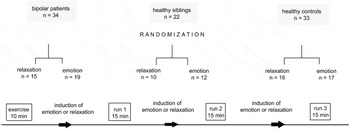
The three groups (patients with BD, healthy siblings and controls) were randomised to the two emotional conditions (acute sadness or relaxation). The design of the study is shown in Fig. 1. The choice task was to discriminate words presenting on the monitor according to their pleasant or unpleasant emotional content. Participants performed one practice block (10 min) after induction of acute sadness or relaxation. After the practice block, participants performed three experimental blocks, each consisting of 300 trials. The stimulus was presented for 1000 ms. After an interval of 2000 ms the next trial started. The words have been validated in the study of Pratto and John Reference Pratto and John(35). Between the three experimental blocks (15 min), the emotion/relaxation induction was repeated.
Study design. Thirty-three healthy controls, 34 patients with BD and 22 healthy siblings were randomised to the two emotional conditions. Participants performed one practice block (10 min) after induction of acute sadness or relaxation. Between the three experimental blocks (15 min), the emotion/relaxation induction was repeated. The choice task in the stop-signal paradigm was to discriminate words presenting on the monitor according to their pleasant or unpleasant emotional content.

Mood induction and induction of relaxation
Induction of transient intense sadness was performed using a mood induction paradigm, which has successfully been validated in PET studies (Reference Liotti, Mayberg, Brannan, McGinnis, Jerabek and Fox36–Reference Mayberg, Liotti and Brannan38). In brief, subjects were requested to draft a short individualised autobiographical script describing a sad life event. Sad scenarios most commonly centred on loss of friends, relatives or significant relationships. In patients with BD, hospitalisation on an involuntary basis and forced medication were frequently used to provoke sad memories. One week before the actual experiment, the script was used during a test run to ascertain that it would cause transient sadness in the subjects. All subjects experienced sadness and all bipolar subjects cried. On the day of the experiment, the script was projected onto a PC screen and read by subjects before the initiation of the task. Intensity of sadness was quantified using a self-rating visual analogue scale (VAS) with a range of 0–100. For each subject, the paradigm was not performed unless the mood state reached a value over 50 on the VAS. Confounding emotions like anxiety, anger and agitation were excluded using additional VASs. Relaxation was induced using the standardised method of progressive muscle relaxation according to Jacobson Reference Jacobson(39). Intensity of relaxation was quantified using a self-rating VAS. Again, the paradigm was not performed unless a value > 50 on the VAS was reached.
Stop-signal paradigm
Subjects performed the choice reaction time (RT) task by pressing the right or the left button on a PC with the preferred hand depending on the pleasant or unpleasant emotional content of the presenting word. For example, the word ‘flower’ was a word with a pleasant emotional content (pleasant trial) ‘nauseous’ was a word with a unpleasant content (unpleasant trial). Participants were seated approximately 50 cm in front of a computer screen. Occasionally, the go stimulus was followed by an auditory tone (the stop signal, 1000 Hz tone of 500 ms duration), which instructed subjects to withhold their response. The stop-signal delay was set by a staircase tracking algorithm, which adapts to the response rate. We used one staircase to adjust the delay in a way that participants could inhibit approximately 50% of all stop trials. This was done in the following way: if in a stop-signal trial the response was not inhibited, the stop-signal delay (SSD) was reduced by 50 ms the next time a stop signal occurred, thus increasing the chance of successful inhibition. Successful inhibition was followed by an increase of the delay by 50 ms. For all subjects p (respond/signal) was between 0.45 and 0.52. Therefore, the stop-signal reaction time (SSRT) represents the latency of the stop process as an index of inhibitory control and can be estimated by calculating the difference between the average reaction time (RT) on trials without stop signal and the average SSD. For a detailed description of the stop-signal task and its mathematical formulation, see reference Logan and Verbruggen (Reference Logan, Cowan and Davis14,Reference Verbruggen and Logan30,Reference Verbruggen and Logan31).
Statistical analysis
Reaction and inhibition time data were analysed using SPSS for Windows version 12.0. Differences in the RT task between the three groups and the two conditions were carried out using three-way or two-way analysis of variance with repeated measures followed by Tukey or LSD post hoc test. Significance was accepted for p < 0.05. For the emotional screening questionnaires, standardisations are available and parametric tests were used to examine differences between the three groups.
Results
Subjects
A total of 34 euthymic patients with DSM-IV BD, type I in a euthymic mood state [Hamilton Depression Rating Scale (HDRS) score ≤ 6 and Young Mania Rating Scale (YMRS) ≤ 4], their healthy siblings (n = 22) and healthy controls (n = 33) were included in the study. The mean age was 41.7 ± 12.3 for the group of patients with BD, 35.6 ± 14.9 for the groups of healthy siblings and 33.1 ± 9.9 for the control group. The three groups did not differ significantly in HDRS or YMRS scores.
Emotional vulnerability
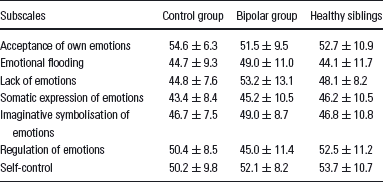
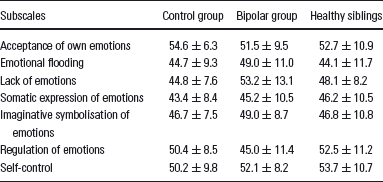
Results of the SEE scale are shown in Table 1. Patients with BD experienced their emotions more pronounced in the subscales ‘emotional flooding’, ‘imaginative symbolisation of emotions' and ‘lack of emotions', but self-evaluated their ‘regulation of emotions' lesser. Analysis of the subscale T-values revealed significant differences in ‘lack of emotions' (F 2,83 = 5.562, p < 0.005) and ‘regulation of emotions' (F 2,83 = 3.952, p = 0.023) between the three groups. Patients with BD self-evaluated their emotional regulation lesser (45.0 ± 11.4) compared with their siblings (52.5 ± 11.2, p = 0.030) and healthy controls (50.4 ± 8.5, p = 0.095, trend). In contrast, patients with BD had higher values in the subscale ‘lack of emotions' (53.2 ± 13.1) compared to controls (44.8 ± 7.6, p = 0.004).
Results of the SEE test are shown as means of the T-values and SD
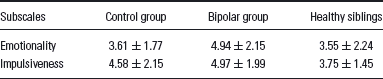
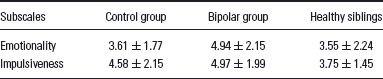
In the variance analysis of the FPI-R values, significant differences in the subscale ‘emotionality’ between the three groups (F 2,83 = 4.523, p < 0.014) were found, whereas patients with BD had higher values (4.94 ± 2.15) than controls (3.61 ± 1.77, p = 0.025) and their siblings (3.55 ± 2.24, p = 0.047) in this subscale (Table 2).
Results of the FPI-R subscales are shown as means of the stanine values and SD
All subjects reached the required sad state. The experiment had not to be repeated for anyone. During the mood induction paradigm, subjects with BD required on average 2 min to become sad after reading the script. Healthy controls required on average 5 min to achieve an adequately sad mood state. Siblings required a longer time to become sad than their siblings with BD, but the average time until the sad state was achieved (approximately 2–3 min) was still shorter than that required by controls. All subjects with BD cried, whereas only 10 controls and 5 siblings cried on reading their sad autobiographical script. No difference of time needed for sufficient relaxation and deepness of relaxation (self-evaluation) were observed between the three groups.
Reaction times
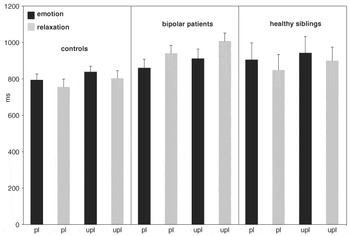
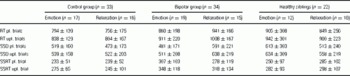
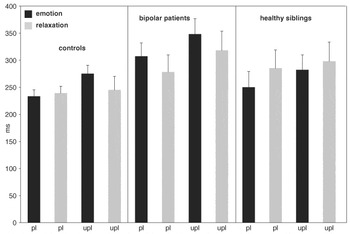
Mean RTs in the stop-signal task are presented in Fig. 2 and Table 3. Statistically significant differences were observed comparing RTs of patients with BD, siblings and controls independent of emotional state or word valence (F 2,78 = 3.734, p = 0.03). Patients with BD exhibiting longer RTs compared with controls (p = 0.034). RTs differed highly significantly depending on the word valence, whereas longer RTs were observed presenting unpleasant go trials (F 1,78 = 62.65, p = 0.001).
Reaction time (RT) under acute mood state and relaxed state in patients with BD, healthy siblings and controls. The stimuli for the choice RT task were words with either a word with a pleasant emotional content (pl, pleasant trial; e.g. flower) or unpleasant content (upl, unpleasant trial; e.g. nauseous). Data are expressed as standard error of means (SEM).

Results of the choice reaction time (RT) task. Subjects had to decide between ‘pleasant emotional content' (pl trial) or ‘unpleasant emotional content' (upl trial) of the presented word

Occasionally, the go stimulus was followed by a stop signal, which instructed subjects to withhold their response. Means and SDs of the RT, stop-signal delay (SSD) and stop-signal reaction time (SSRT) are shown (in ms). The SSRT represents the latency of the stop process as an index of inhibitory control.
Comparing the six groups (control group/relaxed, control group/sad, bipolar group/relaxed, bipolar group/sad, sibling group/relaxed and sibling group/ sad), we found significant longer RTs in the bipolar group under a relaxed mood state compared with controls in a relaxed mood state (p = 0.01).
Patients with BD in a relaxed mood state showed longer RTs than the control group in an acute negative mood state (p = 0.031). Interestingly, no differences were observed comparing RTs of subjects with BD in an acute sad mood state with controls under both emotion conditions. Healthy siblings showed a trend for longer RTs when in a sad mood state compared with controls under relaxation (p = 0.070). However, this effect was not statistically significant.
Inhibition time
Inhibition times (SSRT) were measured using a stop-signal task (Fig. 3; Table 3). Inhibition times differed significantly between the three groups independent of emotional state or word valence (F 2,78 = 3.959, p = 0.023), whereas patients with BD exhibited longer inhibition times compared with controls (p = 0.014). Inhibition times differed highly significantly depending on the word valence, whereas longer inhibition times were observed presenting unpleasant go trials (F 1,78 = 18.19, p < 0.001).
Response inhibition time under acute mood state and relaxed state in patients with bipolar disorder, healthy siblings and controls. The stimuli for the choice reaction time task were words with either a word with a pleasant emotional content (pl, pleasant trial; e.g. flower) or unpleasant content (upl, unpleasant trial; e.g. nauseous). Data are expressed as standard error of means (SEM).

Comparing the six groups (control group/relaxed, control group/sad, bipolar group/relaxed, bipolar group/sad, sibling group/relaxed and sibling group/ sad), we found that inhibition times were longer in the bipolar group after induction of transient sadness compared with controls in the same mood state (p = 0.022). Comparing the bipolar group in a sad mood state with the control group after induction of relaxation revealed significantly higher inhibition times in the bipolars (p = 0.009). Healthy siblings showed longer inhibition times under relaxation compared with relaxed controls, but this was not statistically significant (p = 0.203).
Discussion
Euthymic patients with BD and their healthy siblings required less time to become sad and cried more frequently than the healthy controls in our mood induction paradigm. Our results confirm previous findings Reference Henry, Van Den Bulke and Bellivier(40,Reference M’Bailara, Demotes-Mainard, Swendsen, Mythieu, Leboyer and Henry41) and suggest that emotional vulnerability could be an endophenotype of BD. Krüger et al. investigated emotional challenge in euthymic bipolar patients and their healthy siblings using the same mood induction paradigm combined with PET and found that biological correlates of emotional vulnerability in patients and healthy siblings are decreased regional cerebral blood flow (rCBF) in the orbitofrontal cortex coupled with an increase in the dorsal anterior cingulate Reference Krüger, Alda, Young, Goldapple, Parikh and Mayberg(25).
Our study provides evidence that a relaxed mood state may have a negative influence on RT in subjects with BD, whereas a state of heightened emotional arousal may improve cognitive functioning in this area. It is well known that optimal performance requires an intermediate level of emotional intensity—too little emotional intensity has negative effects on performance, whereas too much emotional intensity may lead to disorganisation of thinking and physical self-control Reference Buck(42,Reference Yates43). This implication forms the basis of the Yerkes-Dodson (YD) law which states that the relationship between arousal and performance resembles an inverted U (Reference Yerkes and Dodson44–Reference Kaufmann46).
The higher emotional arousal of subjects with BD in response to the emotion induction paradigm may lead to a better performance regarding the RT by moving to the right on the YD curve and convergence to the peak of the curve (optimum of performance). It is remarkable that patients with BD required this higher emotional arousal to react as fast as healthy people. Furthermore, relaxation induction methods could impair the RTs in patients with BD.
In contrast to the results regarding RT, we found longer inhibition times under acute emotional arousal in patients with BD suggesting that inhibitory deficits become more apparent under a high emotional arousal. An associated hypothesis to the YD law is that the optimal level of arousal is lower, the more complex is the task Reference Kaufmann(46). As inhibitory function is more complex, it might be possible that the higher emotional arousal of patients with BD leads to surpassing the optimum peak of the YD curve and to an impaired inhibitory performance. A functional magnetic resonance imaging study combined with an emotional and non-emotional go/nogo task provided evidence for a cognitive-emotional interference in euthymic bipolar patients Reference Wessa, Houenou and Paillère-Martinot(47). On the non-emotional go/nogo task, bipolar patients and healthy controls performed similarly, and no activation difference has been detected between both groups. In contrast, they found a frontostriatal over-activation in patients with BD under emotional go/nogo conditions Reference Wessa, Houenou and Paillère-Martinot(47). These findings support the hypothesis of an altered emotional modulation of cognitive processing in euthymic bipolar patients. The fact that inhibitory deficits are also observable in patients with BD without emotional stimulation suggests that other variables besides the impaired emotional regulation impact on inhibitory function.
Response inhibition studied with stop-signal tasks requires inhibition of a prepotent motor response. Performance on these tasks is well modelled as a race between reflexive/prepotent go processes and volitional/controlled stop processes. Neurobiologically, response inhibition depends upon the interaction of frontal control systems with the basal ganglia and motor output regions. Failed attempts at response inhibition need not necessarily reflect a specific deficit in inhibitory mechanisms. Instead, they may be because of failures of executive control, for example, to maintain task goals in the working memory and rapidly recruit the inhibitory mechanisms underlie the stop process Reference Dillon and Pizzagalli(48). A meta-analysis described deficits in verbal memory, sustained attention and psychomotor speed in euthymic patients with BD, which could have an influence on the performance in stop-signal task. It is not completely clarified if these deficits are illness-related impairments or a medication effect Reference Bora, Yucel and Pantelis(11).
An alternative explanation for some of the findings could be that subjects develop response strategies to balance between going and stopping in the stop-signal paradigm Reference Liddle, Scerif and Hollis(49,Reference Verbruggen and Logan50). Thus, it cannot be ruled out that different mood states influence how the task is done and how different strategies are used. Although this most probably would only influence go trials, it could also possibly influence SSRT.
Frangou et al. examined euthymic patients with BD under different types of medication (antipsychotics, mood stabiliser antidepressants) and found that antipsychotic treatment predicted worse performance in executive function tests, particularly in general memory and working memory tests Reference Frangou, Haldane, Roddy and Kumari(51,Reference Frangou, Donaldson, Hadjulis, Landau and Goldstein52). Therefore, we excluded patients receiving antipsychotic medication. But we cannot completely rule out that the allowed medication in this study (lithium, valproate and carbamazepine) influences performance in the stop-signal paradigm. The literature on this is controversial, with one study by Hessen et al. finding that tasks of attention and RT revealed no difference between valproate-treated and valproate-untreated subjects with epilepsy Reference Hessen, Lossius, Reinvang and Gjerstad(53). By contrast, Holmes et al. reported that subjects with bipolar depression treated with valproate or lithium exhibited greater response latency in affective processing tasks compared with a non-medicated group Reference Holmes, Erickson and Luckenbaugh(54).
Although a variety of frontal regions are recruited by these tasks, right ventrolateral prefrontal cortex (VPFC) activity has been directly tied to inhibitory control across multiple paradigm Reference Dillon and Pizzagalli(48). VPFC-related functions are detected as endophenotypes of BD (Reference Bora, Yucel and Pantelis11,Reference Frangou, Haldane, Roddy and Kumari51,Reference Frangou, Donaldson, Hadjulis, Landau and Goldstein52). The more episodes patients have, the more pronounced are the cognitive deficits. We did not correlate number of episodes in our patients with the cognitive deficits we found; however, the finding of an inverse relationship between cognitive performance and emotional state may be independent of the number of episodes.
In all groups, performance in the stop-signal paradigm depended highly significantly on the word valence, in that longer reaction and inhibition times were observed in words with an unpleasant emotional content. Similar results were obtained in another emotional go/nogo task presenting fearful, happy and neutral facial expressions. RTs were slower for responses to fearful facial expressions suggesting that an unpleasant emotional content has a negative influence on behavioural performance Reference Hare, Tottenham, Davidson, Glover and Casey(55). In contrast, Verbruggen has shown that the presentation of an emotional stimulus prolonged both response and stopping latencies regardless of the valence of the emotional stimulus, but in dependence of the arousing level of the pictures Reference Verbruggen(56). These findings support the arousal hypothesis, which stated that high-arousal stimuli interfered more with responding and stopping than low-arousing stimuli. In our study, we have not measured the arousing level of the words. Therefore, it is possible that the negative words, presented in our study, induced higher arousing levels and lead to consequential prolonged reaction and inhibition times.
Even though we found evidence of higher emotional vulnerability in healthy siblings, we were not able to verify significant differences of cognitive performance depending on the emotional state in healthy siblings compared with controls. Presumably, the small sample size constrained our ability to find significant differences. Moreover, the complex design is a further limitation of the study.
In conclusion, our data provide evidence that patients with BD have faster RTs under strong emotional arousal. In contrast, under the same emotional arousal the inhibitory deficits become more apparent. It is possible that patients with BD will function best under a moderate emotional arousal. Psychotherapeutic strategies for emotion regulation could help patients with BD to deal better with their strong emotions and could improve inhibitory deficits.