INTRODUCTION
In 2010, the Alabama GOP took control of the state legislature for the first time since Reconstruction. The next year, in a sharply partisan vote, the legislature passed, and Governor Robert Bentley (R) signed into law, the Beason-Hammon Alabama Taxpayer and Citizen Protection Act, also known as House Bill 56, the harshest immigration law in the country. H.B. 56 required Alabama schools to report statistics on undocumented immigrant students and denied all medical care to immigrants without documentation except for emergency care and immunizations. Its “papers please” provision required local and state law enforcement to question suspects about their immigration status during routine traffic stops and to detain them if they were in the country without documentation. The law also made it a crime for an undocumented immigrant to apply for a job, for property owners to rent housing to undocumented immigrants, and even for a legal resident or citizen knowingly to give an undocumented immigrant a ride. In addition, because of a provision that abrogated contracts between an unauthorized immigrant and local government, municipal water services notified their customers soon after the law went into effect that residents would have to prove their legal status to continue receiving water in their homes.
Drawing from newspaper reports and interviews conducted both before and after H.B. 56, we found that this punitive law spurred native-born Black leaders in Birmingham, Alabama to view immigration through the lens of past exclusionary policies championed by the state (Du Bois Reference Du Bois1992; McWhorter Reference McWhorter2001); in particular we discovered a greater inclination among Black elites to find similarities between the immigrants’ current struggle and the Civil Rights Movement. We present exploratory evidence suggesting that when the Alabama GOP moved to the Right on immigration, the Black elite in the liberal enclave of Birmingham moved to the Left. This pattern of rethinking, and the motivations behind it, underscores the role of Black history and ideology in conditioning Black elites’ responses to immigration.
Conflict between Blacks and immigrants in the 1990s and early 2000s was commonplace across the South (Lippard and Gallagher, Reference Lippard and Gallagher2010; Marrow Reference Marrow2009; McClain et al., Reference McClain, Carter, DeFrancesco Soto, Lyle, Grynaviski, Nunnally, Scotto, Alan Kendrick, Lackey and Cotton2006; McClain et al., Reference McClain, Lyle, Carter, DeFrancesco Soto, Lackey, Cotton, Nunnally, Scotto, Grynaviski and Kendrick2007; Murphy et al. Reference Murphy, Blanchard and Hill2001; Odem and Lacy, Reference Odem and Lacy2009; Weeks and Weeks, Reference Weeks and Weeks2010). In recent years, however, conflict has given way to increasing cooperation (Alvarado and Jaret, Reference Alvarado and Jaret2009; Gordon and Lenhardt, Reference Gordon and Lenhardt2007; Jones Reference Jones2012; Marrow Reference Marrow2013; Rodriguez Reference Rodriguez2012). In Birmingham—a predominantly Black city with a small immigrant population and a legendary civil rights history—interviews with Black leaders, and an analysis of newspaper reports, help us to understand this change in attitude. Our first interviews in Birmingham, conducted in 2007, involved thirty-five African American business leaders, academics, politicians, clergy-members, attorneys, and advocates for social welfare; our questions centered on attitudes toward Latino political encroachment. Footnote 1 In the summer of 2007, against the backdrop of an immigration debate in Washington, a large proportion of Birmingham’s Black elite told us that they had no stake in immigration matters. By 2013, however, local leaders had roundly repudiated H.B. 56 and, in the context of crises wrought by that law, had begun to perceive immigrant rights as civil rights. Follow-up interviews in 2013 with ten of the original interviewees indicate some reasons for this shift.
Alabama is located relatively far from international borders, but despite this fact the state’s immigrant population grew 145% between 2000 and 2010, the nation’s second largest rate of growth in that time frame. Only South Carolina had a larger rate of growth (three other Southern states—Tennessee, Kentucky, and Arkansas—were in the top five). The pull of low-wage job opportunities in farming, chicken processing, and construction created incentives for many immigrants, both legal and undocumented, to come to Alabama in the 1990s (Odem and Lacy, Reference Odem and Lacy2009; Passel and Cohn, Reference Passel and Cohn2011), while push factors in Latin America, such as NAFTA and U.S. labor recruitment in Mexico, spurred migration. By 2010, Alabama contained approximately 120,000 unauthorized migrants. In Birmingham, the foreign-born population (22,224 people) had nearly quadrupled from a decade earlier, although immigrants remained a small minority, accounting for just 2.1% of the city’s total population. This city, long defined by its Black/White divide, had come by 2002 to be considered a “new immigrant destination” (Singer and Suro, Reference Singer and Suro2002).
Immigration in Birmingham has taken place against a background of recent racial transformation. From 1890 to 1960, the racial makeup of Birmingham was almost constant: about 60% White and about 40% Black (Connerly Reference Connerly2005). Then, in the 1970s, the racial mix began to change rapidly. The nationwide, post-industrial trend of White flight accelerated in Birmingham after the city became infamous for brutality against the nonviolent civil rights demonstrators led by Dr. Martin Luther King, Jr. Between 1960 and 1980, the White population of Birmingham decreased by over 30%, and by the time Richard Arrington made history as the city’s first Black mayor, in 1979, Blacks had become the majority of the population. Many had been rooted in the city for more than a century, operated major businesses, and were active in promoting social change. Since that turning point in 1979, Blacks have controlled the civic and political institutions of the city (Connerly Reference Connerly2005).
In Birmingham, the racial past is never far from public view. With its many statues, monuments, libraries, schools, and street names that canonize both the famous and the everyday heroes of the Civil Rights Movement, Birmingham makes it impossible to forget the racial brutality that occurred there or the countless acts of resistance that finally brought down Jim Crow (McWhorter Reference McWhorter2001; Morris Reference Morris1984). Although Birmingham now has a long-established tradition of Black rule, the depiction of City Hall as a “hollow prize” (Kraus and Swanstrom, Reference Kraus and Swanstrom2011) rings true there. White flight from Birmingham triggered a wave of disinvestment, as wealth consolidated in the suburbs. The city has become smaller and poorer as well as Blacker over time. In 2010, 73% of Birmingham’s 212,000 residents identified as Black and 22% as White. Only 3.6% identified as Latino (U.S. Census of Population and Housing 2010). Even with the recent influx of native and foreign-born Latinos, the city shrank to just over 212,000 residents by that year, far down from its high of 340,000 in 1960 (Connerly Reference Connerly2005; U.S. Census of Population and Housing 2010).
Until 1999, the tiny but rapidly growing immigrant population in Birmingham lacked any services to help them adapt to life in a new country. That year, Isabel Rubio, a Latina social worker at the University of Alabama at Birmingham who had been born in nearby Mississippi, formed the nonprofit Hispanic Interest Coalition of Alabama (HICA), with headquarters in Birmingham, to help Alabama immigrants acclimate and avail themselves of city and county services. By 2002, HICA had trained over fifty bilingual individuals in and around Birmingham to provide professional translation.
In 2001, Phyllis Wyne, then the director of the Literacy Council of Central Alabama, partnered with HICA to identify ways to help newcomers in Alabama because “it seemed like nobody cared about them” (Wyne Reference Wyne2007). The task force concluded that the most important issue was language. Wyne, one of the Black leaders we interviewed in 2007, told us in that year:
When the Hispanics first came [to Alabama] they wanted to operate and do everything in Spanish…but we were able to make them understand that…if there was going to be a mingling of the culture, that it needed to be in English, simply because…it wasn’t that we didn’t want to learn Spanish, but that the culture itself represented English, that the school system had to operate in English. But in the meantime, we realized that we needed to hire interpreters to work in city agencies. Once we did that, it really opened the door up…for us to get to the next issue: what services were available for them. We also decided that…they needed some kind of socialization, and by that…I mean that they wanted a day, or a week, or a month, or something that focused on their culture.
I: Something like Black History Month?
Yes, something like Black History Month. And so we had the very first Cinco-de-Mayo celebration [in Birmingham], and we were there, and everybody spoke Spanish except for us, and it really helped, that helped. And it grew into the city having something called the Fiesta, and just all kinds of things. Another thing, too, was…the city then saw a need to hire a cultural representative for the Hispanic community, and…she helped a lot. And so people who were looking for employment in the city of Birmingham, she could help them, to direct them to the right places, and that kind of thing…because our city government, let’s face it, is mostly African-American (Wyne Reference Wyne2007).
In short, even before the 2011 law, some of Birmingham’s Black leaders had partnered with Latinos to help make the new immigrants welcome. Approximately 7,000 people attended Fiesta in 2001, its first year. October 2013 marked the eleventh annual Fiesta celebration in downtown Birmingham, with over 30,000 attendees. The Fiesta’s mission is to offer a “place for Latino people to share customs and traditions with their new friends in Alabama” (Fiesta Birmingham 2013). Phyllis Wyne and Isabel Rubio also helped to persuade the predominantly Black City Council to hire interpreters for resident communication with City Hall in the early 2000s. The Latino presence in Birmingham slowly increased in these years. In 2002, HICA published Bienvenidos a Birmingham, the first comprehensive Spanish-language resource guide for newcomers. The following year, HICA became the first Alabama affiliate of the National Council of La Raza (NCLR) and relocated its offices to a shared space in the heart of the local Latino community in East Birmingham. Approximately 4,000 Birmingham residents, along with about five million people in cities across the country, marched for immigrant rights on May 1, 2006. HICA and the Alabama Coalition for Immigrant Justice, of which HICA is a founding member, organized the May Day march in Birmingham with help from Alabama Appleseed, a non-profit legal advocacy organization, and Welcoming America, a national grassroots organization focused on immigrant integration. Across the South, over a similar time frame, a number of other cities took similar steps to integrate immigrants (Marrow Reference Marrow2011; Telles et al., Reference Telles, Sawyer and Rivera-Salgado2011; Winders Reference Winders2013).
As Birmingham was experiencing these shifts in population and immigrant activity, other changes were also taking place in the state. In 1998, the year before HICA was founded, Scott Beason (R- Gardendale) was elected to the Alabama House of Representatives, where he served until 2006. In that year, Beason won a Senate seat in the 17th District and made undocumented immigration a priority in his first year in the upper chamber. Meanwhile, a stalemate in Washington emboldened states and localities across the nation to take immigration matters into their own hands. In 2007 alone, state legislatures introduced over 1,000 immigration measures across the country. Against this backdrop, Beason and his colleague, Rep. Micky Hammon (R- Decatur), floated a number of punitive immigration bills in 2006-07, all of which died in the then Democratically controlled statehouse. In June of 2007, we interviewed Bernard Kincaid, the African American Mayor of Birmingham, whose business card was printed in English on one side and in Spanish on the back. He said he had heard local radio commentators say: “The solution to the immigrant ‘problem’ is to shoot them” (Kincaid Reference Kincaid2007). Mayor Kincaid surmised that Latinos had become the “new Negro” in Alabama (Kincaid Reference Kincaid2007).
Yet on balance, in our first interviews in 2007, which measured how Black political elites across the country were responding to Latino migration to their cities, we found that Black leaders in Birmingham were not invested in the new immigrants and tended to view them as an afterthought. Some mentioned that the Latino population was growing more visible, especially in East Birmingham, where immigrants had opened small businesses that catered to the Latino population. “Who would have ever thought you’d be in the South with all of this Confederate pride and seeing bilingual signs? I never would have thought I’d see the day,” remarked one of our interviewees (Dulin Reference Dulin2007). The Black elites interviewed in 2007 also mentioned that the selection of ethnic foods was expanding in grocery stores and that ATMs now had instructions in English and Spanish. But in that year, for most of our Black elite interviewees in Birmingham, the presence of immigrants simply meant the possibility of new economic markets and perhaps, down the line, political allies to further the cause of African Americans.
HOUSE BILL 56: ITS ORIGINS AND IMPACT
In 2010, three years after our first round of interviews, Alabama Republicans took control of the state legislature. It was their first moment in power since Reconstruction. Scott Beason became Chairman of the Rules Committee, one of the most powerful positions in the state. He joined forces with Rep. Hammon to promote an anti-immigration bill that they framed as a job-saving measure and a law-and-order imperative. Although H.B. 56 was eventually named for these two conservative legislators, neither actually wrote the law. Its author was Kansas Secretary of State Kris Kobach (R), who also penned the controversial 2010 Arizona immigration law (S.B. 1070). Why such a harsh crackdown in a state with such a small foreign-born population? The Alabama GOP’s call for urgency rested on the same claims as their Arizona counterparts.
First, they invoked the issue of states’ rights. Standing on the Alabama statehouse steps in 2008, Sen. Beason told a throng of supporters that powerful groups in Alabama and in Washington are “opposed to us doing anything about securing the border of Mexico, and they are very much opposed to us moving and acting on a state level. My position is that the federal government has failed at the border. It’s their job to protect us at the border, and once those people come across the border, it is no longer a federal issue, it is a state issue” (Klass Reference Klass2008). (The Supreme Court later rejected this interpretation of the Constitution in Arizona et al. v. United States (2012) in a 5-3 ruling.) Beason also condoned vigilante enforcement of what he regarded as a state prerogative. At a Cullman County Republican Party breakfast, he advised Republicans to “empty the clip and do what has to be done” (Rolley Reference Rolley2011) with respect to undocumented immigrants.
Second, they stressed jobs. Beason and his allies framed H.B. 56 as a jobs bill that would protect taxpayers and boost employment for native-born citizens. They stoked citizens’ fears with claims that immigrants were stealing native Alabamans’ jobs and draining scarce resources that would otherwise go to deserving, upstanding, and law-abiding citizens. Third, they cast Alabama as a demographic time-bomb, headed toward a disaster that would have dire implications for the GOP. Over bacon and eggs in Cullman County, Beason told fellow Republicans that “Democrats do not want to solve the illegal immigration problem because they know, this is a fact, when their children grow up and get the chance to vote, they vote for Democrats” (Rolley Reference Rolley2011).
On June 2, 2011 Alabama’s Republican-controlled state legislature passed a law that both critics and supporters agreed was the toughest immigration law in the country. H.B. 56 sailed through the House by 67-29, in a vote sharply polarized by race and partisanship. Only three Democrats voted for it (two White and one Black), and no Republicans voted against it. H.B. 56 passed in the Senate by 25-7, on a vote that broke down along similar lines. Only one GOP state senator voted against it (the Alabama GOP Senate is all White) while just five Democratic state senators voted for it (three Whites and two Blacks).
When H.B. 56 took effect, the Southern Poverty Law Center (SPLC) set up a telephone hotline for those with questions and concerns about the law. In the first weekend they received nearly 1,000 calls. A victim of domestic violence reported that a state employee had told her that Immigration Customs and Enforcement (ICE) would be notified if she proceeded with an effort to obtain a protective order against her abuser. A judge advised a lawyer to report to ICE any of her clients who requested translation assistance, as such requests amounted to reasonable suspicion of undocumented status. An undocumented mother tried to obtain food stamps to feed her citizen children, but the social worker threatened to turn her in to the federal government for deportation. In Madison County and Decatur, public utilities announced that they would cut off water, gas, and sewage services to people who could not prove their legal status (Bauer Reference Bauer2011).
The predominantly Black Birmingham City Council made national news a few days later, when it unanimously condemned H.B. 56 and approved a resolution calling for a commission to search for a more humane solution to the issue of immigration. Black Councilman Jonathan Austin said of H.B. 56: “[I]t is hateful. It is mean-spirited and takes us back to an era that we worked hard to get over” (Bryant Reference Bryant2011). Councilwoman Valerie Abbot lamented, “Once again our state is in the forefront of doing something negative” (Bryant Reference Bryant2011). The mayor, a Black man with roots in the Civil Rights era, compared H.B. 56 to apartheid and Jim Crow segregation.
Although he later conceded that the bill needed slight “tweaks,” Governor Bentley rejected the City of Birmingham’s proposal for a study commission. A number of challenges from the U.S. Department of Justice and immigrant advocacy organizations temporarily enjoined but only partially succeeded in beating back some of the law’s harshest provisions. Judge Sharon Lovelace Blackburn left much of the law intact in her September 28, 2011 ruling. She allowed those sections of the law to be implemented that require police to check the immigration status of anyone suspected to be in the country without authorization, and she upheld the section making it a felony for an undocumented immigrant to enter into a contract with a government entity. She also allowed the mandate that schools check and report on the legal status of their students. The following Monday after her ruling, 2,285 Latino students—out of 34,000 in the state—did not show up for school (Lee Reference Lee2011). HICA plaintiffs and the U.S. Department of Justice quickly appealed the ruling, and Judge Blackburn granted injunctions pending appeal. Two weeks later, the U.S. Court of Appeals halted the provisions requiring schools to gather citizenship data and making it illegal for an alien not to carry documentation. But the damage was done: by February about 13% of Latino students had dropped out of school altogether (Baxter Reference Baxter2012).
In early 2012, Republican legislators presented a modified bill, H.B. 658, to address unintended consequences of H.B. 56, clarifying the types of documents that could serve as official identification and retreating from the strictest measures against subcontractors who unknowingly hire undocumented immigrants. The new law left intact the most onerous aspects of the original one and added a new provision authorizing the use of state funds to create a database of undocumented immigrants. H.B. 658 passed both Houses, again on stark partisan lines, and Gov. Bentley signed it into law in May.
According to two statewide surveys conducted in Alabama around this time, a majority of Alabamans supported H.B. 56. A Pulse Opinion Research poll, conducted March 6, 2012 on behalf of the anti-immigration group FAIR (N=500), found that 75% of residents in the state supported “enforcing laws against illegal immigration” (52% strongly supported and 23% somewhat supported), while only 24% opposed it. Just 28% agreed with “the Obama administration that immigration is a federal matter and Alabama should not try to enforce laws against illegal immigration” (Pulse Opinion Research 2012). The other poll, conducted by the left-leaning organization Anzalone Liszt Research (ALR) among 500 likely voters between February 1 and 6, 2012, also registered support for H.B. 56. According to the ALR poll, only 13% of likely Alabama voters said the “law is not working, and should be entirely repealed,” while 55% said the law needs “minor changes” and 19% said the law needs no changes (Anzalone Liszt Research 2012). Neither poll reported the results by race or ethnicity.
A few months later, in June 2012, the Supreme Court handed down a ruling on Arizona’s S.B. 1070 that had implications for Alabama. The Court blocked three out of four provisions of the Arizona law and affirmed that the U.S. Constitution grants exclusive authority over immigration matters to the federal government. However, the Court left intact the “papers please” provision, so Arizona state law enforcement can still check on the immigration status of anyone suspected of being in the country without documentation. That September, the Eleventh Circuit Court reaffirmed a similar provision in Alabama. Critics claimed that both decisions amounted to state-sanctioned racial profiling (Brooks Reference Brooks2012). The Circuit Court left open a sliver of hope for the forces opposed to H.B. 56, however, in its suggestion that future Constitutionally-based challenges might succeed if the statute were not narrowly applied. Footnote 2
RECEIVING COMMUNITIES: BLACKS AND IMMIGRANTS IN THE SOUTH
The standard theories of assimilation, segmented incorporation, and racial/ethnic disadvantage tend to place the spotlight on newcomers. As a result, the lion’s share of research on immigrant incorporation focuses on the immigrants themselves. Recent work, however, has turned attention to the receiving communities—the places where newcomers settle—for answers to important questions about immigrant integration. Some states and localities actively promote integration through immigrant-friendly policies, while others crack down on immigrants through laws designed to run them out of town. Explaining this variation is a central preoccupation of the literature on receiving communities.
We contribute to this enterprise by showing that harsh anti-immigrant laws can trigger dramatic responses in receiving communities, shifting opinion in particular among African Americans toward support of immigrants. In our Birmingham case study, H.B. 56 caused members of the city’s Black elite to find similarities between the immigrants’ plight and the Civil Rights Movement. H.B. 56 influenced them to change their stances on immigration issues and inspired them to invoke Black history in their objections to the law’s draconian measures.
As recently as the 1990s, Latinos were politically disadvantaged in cities with Black majorities or pluralities (McClain and Karnig, Reference McClain and Karnig1990; McClain and Tauber, Reference McClain and Tauber1998). Latinos also struggled politically when Black elite coalitions were entrenched in power (Browning et al., Reference Browning, Marshall, Tabb, Browning, Marshall and Tabb1990; Giles and Evans, Reference Giles and Evans1986; McClain and Karnig, Reference McClain and Karnig1990). In a comparison of three cities—Memphis, Durham, and Little Rock—Black leaders were found to be least concerned about immigration in Memphis, the city with the most Blacks, and most concerned about immigration in Little Rock, the city with fewest Blacks (Lyle et al., Reference Lyle, McClain, Perez, Carew, Walton, Watts, Lackey, Clealand and Nunnally2009). In our interviews in 2007, Birmingham Blacks dominated politics, and the city’s Black leaders largely fit this model: they were, for the most part, unconcerned about immigration. By 2013, however, newspaper reports show that Black elites in Birmingham had become markedly invested in immigrant rights. Our interviews suggest that the passage of H.B. 56 was a primary reason for this change.
Daniel Hopkins (Reference Hopkins2011) has argued that national developments are crucial in the process of local politicization: “The effects of local context—that is, living in heavily immigrant neighborhoods or in rapidly changing ones—will hinge on the visibility of immigration as a national issue….The local context is not inherently political, but must be made so” (pp. 501-502). Although we agree that local contexts must be made political, in Birmingham we found that the strongest proximate activator was a drastic change in state-level (as opposed to national-level) immigration policy. The passage of H.B. 56 marked a turning point, after which the city’s Black elites both paid more attention to the immigrants in their local community of Birmingham and moved to the Left in their opinions on immigration policy.
When H.B. 56 was enacted, Birmingham City Council President Roderick Royal made a national name for himself as a champion of immigrant rights by advocating for a path to citizenship. Facing questions about his tireless advocacy on immigration in a city that is almost 75% Black and predominantly native-born, Councilman Royal, who is himself an African American, defended his stance. He said that his mostly Black constituents often ask, “What’s in it for me?” His answer: “The catch is that it’s always good to do right. In fact, Birmingham has a very small Hispanic population. I would be just fine politically if I said nothing. But that’s not the right thing to do. The right thing…is to provide an equal opportunity to everyone who comes to the State of Alabama and the City of Birmingham. The next step is to get a plan together to integrate people into society” (Americas Society/Council of the Americas 2011). The Birmingham City Council’s unanimous repudiation of H.B. 56 on grounds of fairness and equality equally reflects the way in which changing attitudes among political leaders can affect immigrant integration (Alvarado and Jaret, Reference Alvarado and Jaret2009; Jones-Correa Reference Jones-Correa2011; Rodriguez Reference Rodriguez2012).
In his work on immigration, Nestor Rodriguez (Reference Rodriguez2012) identifies four possible directions for intergroup relations in the South, in light of the many restrictions there on Latino immigrants. We consider the two scenarios most significant in the context of Birmingham. In the first, curbs on immigration “may lessen the perception among African Americans of Latinos as economic competitors” (Rodriguez Reference Rodriguez2012, p. 31). This aligns with the message that Alabama’s GOP strove to impart to Blacks in that state: fewer immigrants means more jobs for Blacks. In practice, however, there is little evidence to suggest that the GOP’s efforts to frame H.B. 56 as a “jobs bill” that would help Black Alabamans met with success among Blacks. Alabama’s Black elite, at least, chose instead to embrace a competing perspective, that H.B. 56 is a throwback to the days of state-sanctioned segregation. In Rodriguez’s second scenario, Latinos may “turn inward for survival, lessening contact or the potential for contact, with other groups” (Rodriguez Reference Rodriguez2012, p. 31). Indeed, H.B. 56 did encourage many immigrants in Alabama not only to turn inward but also to remove themselves from the state entirely: the objective in passing the law was to isolate and frighten immigrants and thus force them to ‘self-deport’ (Waslin Reference Waslin2012). Evidence abounds of individual immigrant withdrawal in the aftermath of H.B. 56 (Baxter Reference Baxter2012; Brooks Reference Brooks2012; Waslin Reference Waslin2012). Thus Rodriguez’s second scenario seems to fit the situation in Alabama after the passage of the law. Yet the situation is made more complex by the many protests mounted against the law, both by immigrants themselves and by their supporters, many of whom were Black.
2007 AND 2013 INTERVIEWS WITH BIRMINGHAM’S BLACK ELITES
Our event data from 2006-2013 indicate that, as Alabama Republicans moved to the Right on immigration as the champions of H.B. 56, Black leaders in Birmingham moved to the Left. Our interview data, collected in 2007 and 2013, suggest reasons that the media do not readily provide. In a sense, H.B. 56 created favorable conditions for a natural experiment. Our efforts to locate the thirty-five members of Birmingham’s Black elite who had been interviewed in 2007 revealed that five participants had relocated to another city, two had died, and one was in prison. Of the remaining twenty-seven leaders eligible for follow-up interviews, we were able to contact and interview ten of them, yielding a 37% response rate. This small sample size makes our interviews only suggestive. However, the ten interviewees were strikingly similar in their commentary on the effects of H.B. 56, both on their own thinking and on the Birmingham community. Moreover, the media and social science research are rarely able to report specific changes in attitudes among elites. Our research, although limited, is able to do exactly this.
In both 2007 and 2013, we asked participants to provide open-ended responses to a series of questions as well as answers to four closed-ended, Likert-scale questions. The data were digitally recorded and transcribed into text to facilitate thematic analyses of the content using Atlas.ti qualitative software. The participants in 2013 completed a truncated version of the 2007 questionnaire, with the addition of specific questions related to H.B. 56. In these follow-up interviews we sought to ascertain the views of our participants with respect to the primary grievances articulated by the Alabama GOP in Section 2 of H.B. 56:
-
• Undocumented immigrants are causing a drain on public resources.
-
• Public agencies encourage illegal immigration when they provide social resources or welfare without verifying citizenship.
-
• Undocumented Latino immigrants should be deported and should not be provided with a path to citizenship.
Participants who provided answers in support of these sentiments were considered to be conservative on immigration and were coded as being on the “Right” politically. Those who disagreed with these claims were considered to be liberal on immigration and coded as being on the “Left” politically. The “Moderate” category captured sentiments in between. An example of a Likert item in the survey instrument follows:
What do you think about policies that extend eligibility for government social services to undocumented immigrants? Do you support such measures?
-
a) A Lot
-
b) Some
-
c) Not Much
-
d) Not at All
-
e) Don’t Know
In this case, we coded response “a” as “Left,” responses “b” and “c” as “Moderate,” and response “d” as “Right.”
In our 2007 interviews, Birmingham’s Black elite did not readily connect the movement for immigrant rights with the state’s ugly racial past. When we asked: “Some people have compared the struggles of today’s non-citizen, undocumented immigrants to the historic Black struggle against second-class citizenship. Is this an apt comparison?” the reply of African American Professor George Munchus III was typical of most respondents: “Black people were brought here primarily as slaves to work…[while] most Hispanics, I submit, are coming here seeking opportunities to improve their quality of life” (Munchus Reference Munchus2007). In 2013, however, Prof. Munchus responded to our follow-up question on this topic as follows: “I see the link [between immigrant rights and civil rights] and am proud the Birmingham City Council did [too]” (Munchus Reference Munchus2013). He declared that he wanted H.B. 56 rescinded “because the law is racist on its face” (Munchus Reference Munchus2013).
In a similar pattern, Councilman Steven Hoyt had responded to our question in 2007 by saying: “There’s no comparison. Nobody’s ever rolled up, you know, sat at a traffic light and rolled up their windows and locked their doors because you were Latino, okay. So there’s no comparison. But they do it every day because you’re Black. And even Latinos are able to get loans quicker than Blacks now, and we [Blacks] have…built this country” (Hoyt Reference Hoyt2007). In 2013, Councilman Hoyt was more attuned to discrimination against immigrants. He also made it clear that H.B. 56 had triggered his perception of the possible parallels between Latino and Black experience. He proposed that the bill was “designed to oppress a particular population. I think we [Blacks] can’t really embrace H.B. 56 [given that] it was just fifty years ago that we were subjected to the same kinds of stuff that this law proposes” (Hoyt Reference Hoyt2013). Councilman Hoyt also reported having attended two local immigrant rights rallies, at Linn Park and Kelly Ingram Park, since 2007.
In another of our 2007 interviews, Raymond Goolsby had told us that immigrant rights and civil rights were “totally different struggles” (Goolsby Reference Goolsby2007). In 2013, he saw a “loose connection” (Goolsby Reference Goolsby2013) particularly in terms of law enforcement. In a more marked shift, in 2007 James Ephraim had said that comparing the struggles of Blacks and immigrants was like “comparing apples and oranges” because African Americans had been brought to America against their will (Ephraim Reference Ephraim2007); in 2013, however, Mr. Ephraim thought H.B. 56 should be repealed because “we need to support people and not put hardships on people already coming out of hardships” (Ephraim Reference Ephraim2013). Akilah Dulin, who in 2007 had said the comparison between immigrant rights and civil rights was “not even close” (Dulin Reference Dulin2007), told us in 2013 that she wanted H.B. 56 abolished because the law is “really discriminatory” and it is wrong to “treat people poorly and make it so harsh where they can’t eat or feed themselves or their families” (Dulin Reference Dulin2013). All told, in our 2013 interviews with ten of Birmingham’s Black leaders, every single respondent strongly supported repealing H.B. 56.
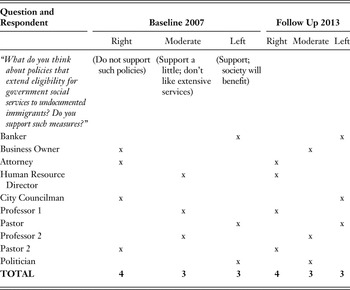
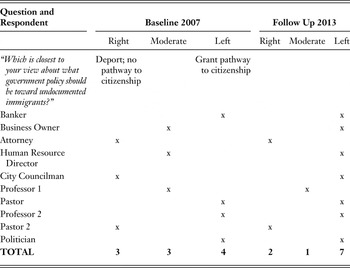
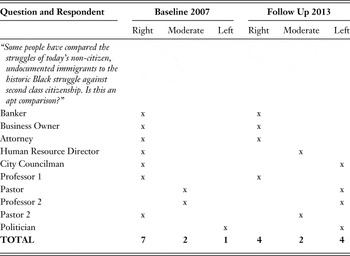
Tables 1A-C indicate the 2013 responses of our interviewees to the three questions we find most pertinent for this analysis.
Categorized Responses of Leaders at Follow Up

Categorized Responses of Leaders at Follow Up

Categorized Responses of Leaders at Follow Up

As a group, the positions of our interviewees did not change between 2007 and 2013 on the first question, “What do you think about policies that extend eligibility for government social services to undocumented immigrants? Do you support such measures?” Both times, four of the interviewees did not support such measures, three took in-between positions, and three supported the measures. Within the group, however, one of the interviewees moved from Right to Moderate while another moved from Moderate to Right, balancing the move of the first. In addition, the “politician” moved from Left to Moderate, but the most important change came from Steven Hoyt, a City Councilman, who moved all the way from Right (no support) to Left (full support).
Those who did not support social services for immigrants in both rounds seemed to be hesitant to allocate scarce public dollars to immigrants. Many preferred to devote such resources to needy citizens as opposed to those whom they saw as voluntarily risking success or failure by coming to the United States. In 2007, Kenyatta Knight, an attorney, told us that extending social services to undocumented immigrants would increase the probability of “higher taxes…[which will] therefore create more demands for public services” (Knight Reference Knight2007). Others agreed, assuming that public services for undocumented immigrants would ultimately translate into higher taxes on citizens and subsequently create even more economic burden.
We saw greater changes over time with regard to a pathway to citizenship for immigrants, the subject of our second question (Table 1B). On this question none of the respondents in the follow-up interviews of 2013 shifted Right. The attorney and one of the pastors stayed in favor of deporting the immigrants; the politician, banker, one professor, and the other pastor stayed in favor of a path to citizenship; and the second professor stayed Moderate. However, the businessman and the human resource director both moved from Moderate to all-out support for citizenship, and City Councilman Hoyt once again moved all the way from opposition to full support.
Most telling for our story were the responses to the question that asked whether the struggles of today’s immigrants could be compared to the Black struggles in the Civil Rights Movement (Table 1C). Many of our ten respondents were involved in the Civil Rights Movement themselves as participants or eyewitnesses. In 2007, a majority of them believed that it was an inappropriate comparison, with only one person considering it apt. In 2013, by contrast, only four considered the comparison inappropriate. One of these, the attorney, argued that it is not “respectful of the Black American struggle to be often lumped in with other struggles such as immigration” (Knight Reference Knight2013). She added: “The Black struggle is so undeniably mentally suppressive, we have been brainwashed into this inferiority mentality that we accept and expect to be last. We were forced to come to America against our will; we had no choice. Every law created was rooted in the hatred of Blacks by the White American community, and [laws] are today continually created to target Black America. All other struggles, such as H.B. 56, are a result of choices” (Knight Reference Knight2013). Four respondents in 2013, however, considered the comparison a good one. Most importantly, City Councilman Hoyt, as on the previous two questions, moved all the way from opposition to support.
Overall, our data reveal a shift among these members of Birmingham’s Black elite in favor of immigrants, particularly on the question of a path to citizenship for undocumented immigrants and in seeing a comparison with the Civil Rights struggle.
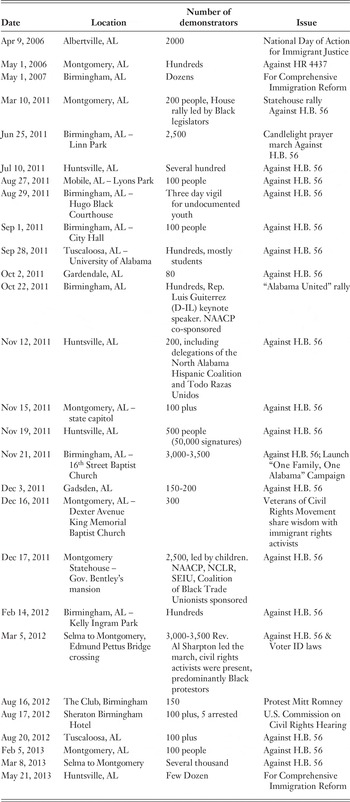
Event data from 2006 to 2013, tabulated from newspaper reports, support these findings, indicating heightened Black attention to the plight of immigrants in Alabama over the course of this period (Table 2). Beginning with a 2011 march in Montgomery, Black leaders not only attended but also participated at the forefront of public action supporting immigrants. That year saw a pro-immigrant rally in Birmingham co-sponsored by the NAACP as well as a rally in the predominantly Black Dexter Avenue King Memorial Baptist Church. On November 21, 2011, thousands of Alabamans from diverse racial and ethnic backgrounds packed into the historic and predominantly Black Sixteenth Street Baptist Church to sing “We Shall Overcome” and launch the “Alabama United: One Family, One Alabama” campaign against H.B. 56. The venue and the rhetoric signaled an embrace of the immigrant rights cause by powerful Black clergy in Birmingham.
Alabama Immigration Demonstrations, April 2006 - May 2013*

* Thanks to Jackie Altamarino for compiling this table from newspaper sources.
Also in 2011, the predominantly Black Southern Baptist Convention approved a resolution to denounce bigotry and harassment toward any and all groups and called for a path to legal status for undocumented immigrants (Reeves Reference Reeves2011). On December 17, the NAACP and the Coalition of Black Trade Unionists, among others, led a march of 2,500 people on the governor’s mansion protesting H.B. 56. Perhaps most tellingly, with regard to the use of Black symbols and history in the fight for immigrant rights, demonstrators in March 2012 and again in March 2013 deliberately marched along the same streets where Civil Rights activists had clashed with police in the 1960s, rallying at a park under a statue of the Rev. Martin Luther King, Jr. Activists at these and other demonstrations regularly invoked Civil Rights Movement tactics, strategies, and songs.
CONCLUSION
Our central finding in this study is that ideas matter. Political ideologies and historical struggles resonate over time (McConnell et al., Reference McConnell and Miraftab2009; Thompson Reference Thompson2006) and can be triggered by specific political acts, producing major changes in the attitudes of one group toward another. In Birmingham, Alabama, a restrictive state immigration law spurred Black elites to re-frame the immigration debate as a matter of civil rights. Before H.B. 56, the majority of Black elites in Birmingham were indifferent or even antagonistic to immigrants; after H.B. 56, many became actively involved in supporting immigrant rights.
The members of the Republican Party in the South, many of whom represent the Whitest and most conservative districts in the country, are steadfast in their opposition to immigrant rights. As partisan differences between the parties sharpen and both Black and Latino groups find support in the Democratic Party on the state and national levels, it is plausible that support for immigrant rights in predominantly Black, Southern, and Democratic enclaves like Birmingham will continue to increase, especially in the face of draconian threats to immigrants.
Given the small sample size of this study, our findings cannot be considered conclusive, although they have the advantage of tracking actual opinion change among identifiable elites. Our research allows us, in addition, to identify three potentially fruitful directions for future research. First, although some authors question the political utility of a civil rights frame for immigrant rights (Rodriguez Reference Rodriguez2013), in Birmingham the Civil Rights Movement became a powerful lens for Black elites after perceptions of similarity were triggered by anti-immigrant legislation. The resonances between present threats to immigrants and past threats to Blacks may well present opportunities for coalition building in other Southern cities as well as Birmingham (Brown and Odem, Reference Brown and Odem2012; Jones Reference Jones2012; Rodriguez Reference Rodriguez2012; Winders Reference Winders2013). After all, Birmingham is not the only Southern city with an outsize civil rights legacy, a large Black majority, and an exponentially growing immigrant population. To heighten the parallels, on the heels of the Arizona and Alabama laws, a number of other states, including Georgia, South Carolina, Tennessee, Louisiana, Texas, and Mississippi, either passed or introduced anti-immigrant legislation. Comparative research would help to clarify the impact of such punitive immigration measures on coalitions between immigrants and Black elites in predominantly Black receiving communities.
Second, although Black elites in Birmingham roundly rejected the GOP’s frame of H.B. 56 as a “jobs” bill, embracing instead an alternative “civil rights” interpretation, the extent to which non-elite Black citizens were exposed to and embraced either frame is unclear. Ordinary citizens often rely on cues from political elites when forming their opinions about politics (Berelson Reference Berelson1954; Downs Reference Downs1957; Gilens and Murakawa, Reference Gilens, Murakawa, Delli Carpini, Huddy and Shapiro2002; Lee Reference Lee2002; Wallsten and Nteta, Reference Wallsten and Nteta2012; Zaller Reference Zaller1992) but little attention has been paid to the relationship between contemporary Black elite cues and broader Black public opinion on immigration. In this case, Black elites might have stronger commitments to ideology and less material vulnerability than the Black public on the question of immigration. On the other hand, conservative White elite cues on immigration (Diamond Reference Diamond1996; Hajnal and Abrajano, Reference Hajnal and Abrajano2015) may also shape Black public opinion by confirming the view that Blacks and Latinos share a common enemy in conservative Whites.
Finally, further research could investigate what will happen to Black support for immigrant rights in cities like Birmingham if Congress passes an immigration bill that includes a path to citizenship for undocumented immigrants. It is true that attitudes about immigration wax and wane (Tichenor Reference Tichenor2002; Zolberg Reference Zolberg2006), the color line is not static (Hochschild et al., Reference Hochschild, Weaver and Burch2012; Omi and Winant, Reference Omi and Winant1994), and intergroup solidarity is often short-lived (Browning et al., Reference Browning, Marshall and Tabb2003; Jones-Correa Reference Jones-Correa2001; Kaufmann Reference Kaufmann2007). Nevertheless, the ideological congruence that has emerged in recent years between Blacks and immigrants, in the context of increasing political polarization, may strengthen the political bond between immigrants and Blacks, despite possible material antagonisms in economic and social realms.
ACKNOWLEDGMENT
Thanks to the Alfred A. Taubman Center for State and Local Government at the Harvard Kennedy School; the Harvard Kennedy School Ash Institute for Democratic Governance and Innovation; the David Rockefeller Center for Latin American Studies at Harvard University; and the Radcliffe Institute for Advanced Study for funding this research. Special thanks to Alan Altshuler, Peter Eisinger, Merilee Grindel, Jennifer Hochschild, Christopher Jencks, Jane Mansbridge, Helen Marrow, John Mollenkopf, Gowher Rizvi, Laura Tach, Sidney Tarrow, Jamie Winders, and William Julius Wilson.