Legionnaires’ disease (LD) is a type of pneumonia caused by Legionella pneumophila. These bacteria thrive in warm water with stagnant flow, commonly present in hospital plumbing systems.Reference Falkinham, Hilborn, Arduino, Pruden and Edwards 1 Infections occur when water containing Legionella is inhaled. Risk factors for LD include comorbid conditions common among hospitalized patients: older age, immunosuppression, and chronic lung disease. For these reasons, LD prevention deserves particular attention from the infection control community.
With the proliferation of LD reports in recent years, the healthcare epidemiology community has received new information to reduce the risk of Legionella growth in potable and nonpotable water systems.Reference Soda, Barskey and Shah 2 In 2015, ASHRAE (formerly the American Society of Heating, Refrigerating and Air-Conditioning Engineers) released ASHRAE 188, an industry standard intended to minimize Legionella growth and transmission through the implementation of facility water management programs. 3 In June 2016, the Centers for Disease Control and Prevention (CDC) published a tool kit to translate ASHRAE 188 for audiences with less technical expertise. 4 In June 2017, the Centers for Medicare and Medicaid Services also issued a requirement for all Medicare-certified healthcare facilities to establish a water management plan. 5
In this study, we sought to understand variations in LD prevention strategies including clinical practices for diagnosing LD and characterization of water management plans within the Society for Healthcare Epidemiology of America Research Network (SRN) hospitals.
Methods
A 24-item electronic survey was e-mailed to SRN principal investigators on October 17, 2017. Up to 3 reminders were sent to nonrespondents until survey closure on November 30, 2017. Any US-based acute-care hospital within the SRN was eligible. For questions requiring nonepidemiologic expertise, consultation with colleagues was strongly encouraged.
Respondents were asked questions on clinical protocols for diagnosing cases of LD, maintenance practices of potable and nonpotable water systems, Legionella-specific prevention strategies, and knowledge of recent guidelines and regulations. Facility names, respondents and locations were not disclosed to the research team; responses were limited to 1 per facility. Results were analyzed using descriptive statistics in SAS version 9.4 software (Cary, North Carolina). The Emory University Institutional Review Board deemed this study to be nonhuman subjects research.
Results
In total, 29 respondents from 101 (29%) eligible facilities completed the survey. Respondents represented mostly academic medical centers (59%), and 93% were from facilities where the SRN principal investigator was registered with the SRN as having “hospital epidemiologist” or “infection committee chair” listed as a primary professional activity. Facilities were large (ie, 80% had >250 beds), and 83% had transplant or inpatient dialysis units. Most facilities (79%) had cooling towers; 28% reported having operational indoor decorative fountains or aesthetic water features; and 10% had whirlpool therapy spas.
Among the 29 respondents, 24 (83%) reported diagnosing LD cases at their facility in the previous 5 years, of which 9 (38%) suspected or confirmed at least 1 case to be healthcare-associated. Regarding diagnostic capacity, 25 respondents (86%) reported an ability to test for LD in house using urine antigen tests (UAT), 21 respondents (72%) reported using respiratory culture, and 8 respondents (28%) reported using multipathogen molecular assays. However, 19 respondents (66%) indicated that routine LD testing for hospital-acquired pneumonia was limited to non–culture-based tests (eg, urine antigen tests or molecular assay), and only 4 respondents (14%) reported always conducting bacterial culture in conjunction with nonculture tests.
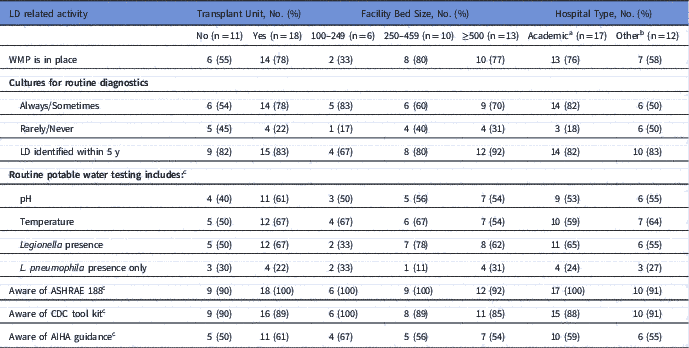
Moreover, 19 respondents (66%) had an established water management plan (WMP) for both potable and nonpotable water; 8 respondents (28%) reported a WMP was in development, 1 respondent (3%) had a WMP for nonpotable water only (with planning underway for potable water), and 1 respondent (3%) had no WMP. The facility without a WMP reported having no cases of LD in the past 5 years. To monitor potable water quality, 18 of 28 respondents (64%) reported routinely measuring disinfectant levels (eg, residual chlorine), 17 respondents (61%) reported routinely measuring temperature, and 15 rsepondents (54%) reported routinely measuring pH level. In addition, 17 respondents (61%) reported routinely testing for Legionella presence as part of their WMP. Having an existing WMP and performing routine tests on potable water were more frequently reported among larger facilities and those with transplant units, compared to those without (Table 1). Existing WMPs covering potable and nonpotable water were also more prevalent among the 9 facilities reporting a healthcare-associated LD case in the previous 5 years than in facilities not reporting a healthcare-associated case: 8 of 9 (88.9%) versus 11 of 20 (55%).
Differences in Legionella Prevention Activities by Presence of Transplant Unit, Facility Size and Facility Type, 29 SHEA Research Network Respondents, October–November 2017

Note. SHEA, Society for Healthcare Epidemiology of America; LD, Legionnaires’ disease; WMP, water management plan; CDC, Centers for Disease Control and Prevention; AIHA, American Industrial Hygiene Association.
a Academic medical center or university-affiliated academic medical center.
b Community teaching hospital with academic affiliation, community hospital, federal non-military hospital.
c Only 28 respondents to these questions.
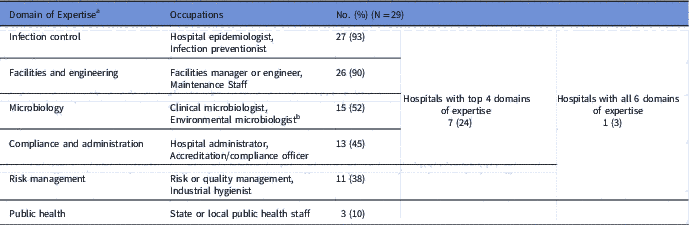
Regarding personnel actively engaged in WMP development, the most commonly reported domains of expertise were infection control (93%) and facilities and engineering (90%); risk management and public health staff were less frequently involved (Table 2). Although most facilities reported awareness of ASHRAE Standard 188 (97%) and the CDC toolkit (89%)—and used these to develop their facility's WMP—fewer were aware of the American Industrial Hygiene Association (AIHA)'s Legionella guidelines from 2015. Moreover, 24% of facilities reported not having conducted a risk assessment to identify areas within their infrastructure susceptible to Legionella growth, as outlined in these standards.
Domains of Expertise Represented on Hospital Water Management Plan Development Teams, 29 SHEA Research Network Respondents, October–November 2017

a Because various Legionella prevention guidance documents currently differ in regard to suggested expertise represented on a WMP team, the domains presented here represent general categories of expertise. The CDC toolkit suggests all domains and roles mentioned in Table 2, although there is no hierarchy of importance conveyed in various guidance documents.
b All provided by external consultants.
Discussion
In this sample of acute-care hospitals, the reported prevalence of established WMP and awareness of key LD prevention guidance documents was high. Nearly two-thirds of facilities reported already having established a WMP covering both potable and nonpotable water, though we did not determine their adequacy or comprehensiveness. This is substantially more than the 27% of hospitals in Minnesota that reported having a WMP before the release of the CMS directive in June 2017.Reference Danila, Koranteng, Como-Sabetti, Robinson and Laine 6
Close to 60% of respondents reported having conducted a risk assessment for Legionella since 2014, yet some of these assessments likely occurred before publication of new prevention guidelines. As facilities continue refining their WMP, conducting periodic risk assessments with emphasis on Legionella prevention will be a continued priority.
For diagnosing LD, the UAT was the most prevalent diagnostic, with 86% indicating capacity to conduct UATs at their facility. This proportion is substantially higher than the 18.8% of acute-care hospitals reporting this capability in 2013.Reference Garrison, Shaw and McCollum 7 Although this increase could signal general improvements in LD diagnostic capacity, it more likely reflects the greater attention and capacity for LD prevention among the hospitals responding to this survey.
Although UAT may be the easiest and most ubiquitous diagnostic, it is not comprehensive; it only detects infections caused by Legionella pneumophila serogroup 1.Reference Formica, Yates and Beers 8 Although serogroup 1 is responsible for more than 80% of LD cases, relying solely on this test would miss cases caused by other pathogenic strains.Reference Yu, Plouffe and Pastoris 9 , Reference Kazandjian, Chiew and Gilbert 10 Notably, 72% of respondents reported the capacity to perform culture-confirmation testing in house, whereas only 14% reported doing so routinely. Thus, exploration of barriers to routinely culturing pneumonia patients should be considered.
The response rate for this survey was low, which limited our ability to conduct statistical analyses. While we lacked ample data on nonrespondents, they did not differ substantially from respondents in facility size or type. It is also likely that facilities participating in the SRN represent more prepared facilities; therefore, the SRN members who responded may substantially over represent Legionella preparedness in the general population of healthcare facilities. If true, these data still offer a timely snapshot of LD diagnostic capacities and water management planning at what may be the most prepared facilities in the country.
Although our results suggest that some facilities may meet current LD prevention guidelines, there is room for improvement. Infection control and facilities and engineering departments are frequently involved in WMP development, but consideration should be given to a broader range of expertise, including environmental health, environmental microbiology and industrial hygiene. At a time when LD cases are rising and pressures to improve LD prevention are increasing, lessons learned from facilities with robust WMP may benefit facilities developing or updating their plans.
Acknowledgments
We would like to thank Laura A. Cooley, MD, MPHTM, from the Respiratory Diseases Branch in the Division of Bacterial Diseases within the CDC’s National Center for Immunization and Respiratory Diseases for her input on survey design and earlier versions of this manuscript.
Financial support
This study was supported in part through funding from the O. Wayne Rollins Foundation.
Conflicts of interest
The authors declare no conflicts of interests.