
I. INTRODUCTION
Semisolid forging is a typical technological route of semisolid metal processing, which involves forming of alloys in the semisolid state to near-net shaped products. Reference Abolhasani, Ezatpour, Sajjadi and Abolhasani1 For semisolid forging, it is necessary to have a fine globular microstructure with high solid fraction in a semisolid range. Reference Rogal, Dutkiewicz, Atkinson, Lityńska-Dobrzyńska, Czeppe and Modigell2 Semisolid forging has been recognized as a new technique offering significant advantages over forging or casting process, such as a low forming pressure, the reduction of segregation and porosity. Reference Hassas-Irani, Zarei-Hanzaki, Bazaz and Roostaei3–Reference Bolouri, Shahmiri and Cheshmeh5 In addition, semisolid forging basically consists of three procedures: feedstock production, reheating, and semisolid forming. Reference Chen, Hao and Sun6,Reference Choi, Park and Kim7 Among them, the compression deformation behavior with high solid fraction must be well understood because it embodies the abilities of semisolid forging and mold filling, which has a significant effect on the properties of the shaped components.
In recent years, more attention has been paid to compression deformation behavior in semisolid state. Lu et al. Reference Lu, Li, Huang and Jiang8 mentioned an isothermal compression of Al–4Cu–Mg alloy in semisolid state. They found that the deformation temperature and the strain rate had great impacts on the peak flow stress and the flow stress decreased with the increase of the deformation temperature and the decrease of the strain rate. Chen et al. Reference Chen, Wang, Wei and Zhao9 investigated the compressive deformation behavior of Ti14 alloy in semisolid state. They concluded that the decrease in the amount of solid bridges between grains resulted in a sharp decrease in stress at a solid fraction between 0.96 and 0.98. Li et al. Reference Li, Sugiyama and Yanagimoto10 studied the microstructural evolution and flow stress of type 304 steel in semisolid state. They observed that flow stress curves around solidus temperature exhibited abrupt change, which was related to the phase change. Thanh et al. Reference Thanh and Suéry11 reported a compression experiment in semisolid state of short-fiber-reinforced A356 aluminum alloys. They indicated that compared to the unreinforced matrix alloy, the presence of the fibers accelerated globularization under the same conditions in semisolid state, leading to a decrease in compression stress at constant strain rate.
As can be seen from the above examples, most of the present investigations concentrated on the matrix alloy. However, there were only a few studies about the particle-reinforced metal matrix composites. In addition, research on semisolid forging of the particle-reinforced metal matrix composites mainly focused on using microsized ceramic particles as reinforcements, especially for aluminum matrix composites (AMCs). Nanosized ceramic particles reinforced metal matrix composites are finding increasing applications due to their improved mechanical properties. Reference Chen and Yan12–Reference Chen and Yan14 Also, semisolid forging as an alternative method has successfully fabricated the nanosized ceramic particle-reinforced metal matrix composites. Reference Jiang and Wang15,Reference Kandemir, Atkinson, Weston and Hainsworth16 The compression deformation behavior of semisolid nanosized ceramic particles reinforced AMCs with high solid fraction is very important to mold design and determining processing parameters, which will directly affect the properties of the final product. However, research on compression deformation behavior of semisolid Al2O3np reinforced 7075 AMCs with high solid fraction has little been reported. Moreover, only a small amount of articles have researched the effect of the average size of reinforcements on compression deformation behavior in semisolid state. But the average size of the reinforced particles is one of the key factors affecting the mechanical properties of the composites. Reference Youn, Kang and Seo17,Reference Koker, Altinkok and Demir18
This present work is aiming to study compression deformation behavior of semisolid Al2O3np reinforced 7075 AMCs with high solid fraction and the microstructures of the composites after semisolid compression. In addition, the deformation mechanisms and the effect of processing parameters such as the deformation temperature, the strain rate, and the mass fraction and size of the reinforced particle on compression deformation behavior in semisolid state are analyzed. This study helps to lay the foundation for the establishment of the constitutive model and provide the precondition for numerical simulation of semisolid AMCs with high solid fraction. Simultaneously, this work offers theoretic references for the development and application of semisolid forging.
II. EXPERIMENTAL
Commercial 7075 aluminum alloys were used as the matrix of semisolid Al2O3np reinforced 7075 AMCs for the experiments. The chemical composition of 7075 aluminum alloy is listed in Table I. β-Al2O3 particles were used as the reinforcements of semisolid 7075 AMCs. The average size and mass fraction of the reinforcements in this study are 80 nm, 200 nm, 500 nm and 0.5%, 1.5%, 2.5%, respectively. The cylindrical samples with 8 mm in diameter and 12 mm in height were machined from the semisolid slurry, which were fabricated by ultrasonic assisted semisolid stirring method.
The chemical composition of 7075 aluminum alloy.

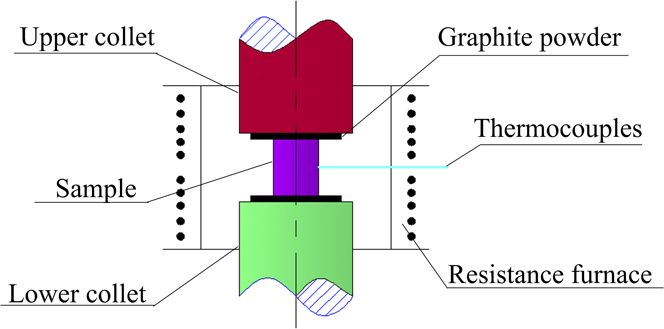
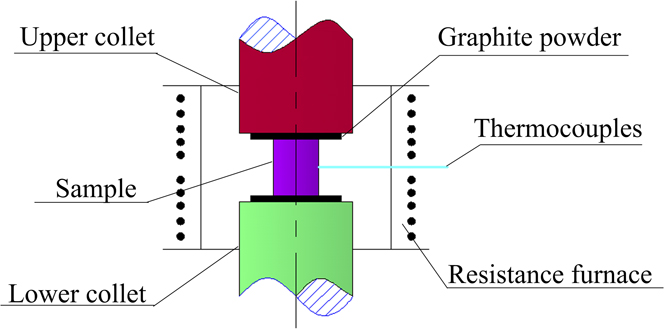
Semisolid isothermal compression experiments were carried out on a simulation testing machine Gleeble 3500D (Dynamic Systems Inc., Poestenkill, New York), as shown in Fig. 1. The graphite powders were smeared on the surfaces of the compression heads to reduce the effect of interfacial friction between the samples and compression heads prior to testing. The solidus–liquidus temperatures of 7075 aluminum alloy were 477 °C and 635 °C, respectively, which were determined by the differential thermal analyzer. To study compression deformation behavior of semisolid AMCs with high solid fraction, the deformation temperatures were taken as 560 °C, 570 °C, 580 °C, and 590 °C, respectively. The corresponding liquid volume fraction was 2.94%, 4.78%, 8.94%, and 15.34%, respectively, which were measured by the differential scanning calorimetry.
Schematic diagram of semisolid compression experimental device.
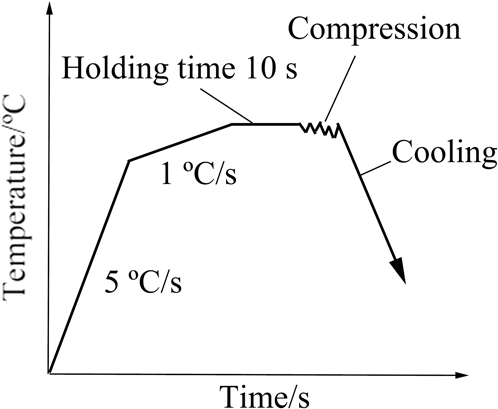
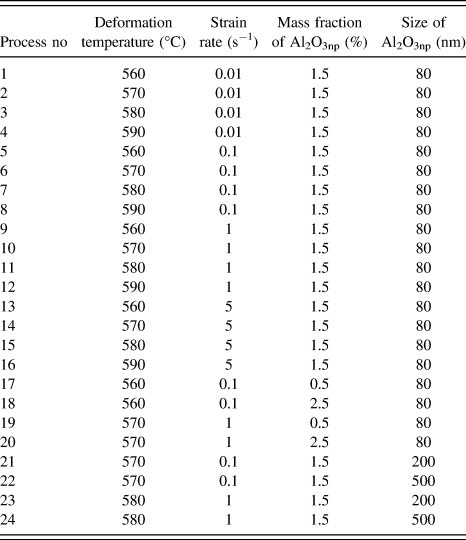
According to the heating procedure shown in Fig. 2, the samples were initially heated to 480 °C at the heating rate of 5 °C/s, then heated to the scheduled temperature at the heating rate of 1 °C/s and held for 10 s before compression. The semisolid isothermal compression experiments were done under the strain rates of 0.01, 0.1, 1, and 5 s−1, in which the total strain was 0.6. The experiment scheme of semisolid isothermal compression is presented in Table II. After compression, the samples were immediately quenched in water at room temperature. The samples were ground, polished, and then etched with Keller's reagent (2 mL HF, 3 mL HCL, 5 mL HNO3 and 190 mL H2O) for up to 5 s before rinsing with distilled water. The microstructures of the composites before and after semisolid compression were observed by an optical microscope (Nican M300, Nican, Tokyo, Japan).
Heating procedure for semisolid isothermal compression experiments.

Experiment scheme of semisolid isothermal compression.

III. RESULTS AND DISCUSSION
A. Effect of deformation temperature on compression deformation behavior in semisolid state
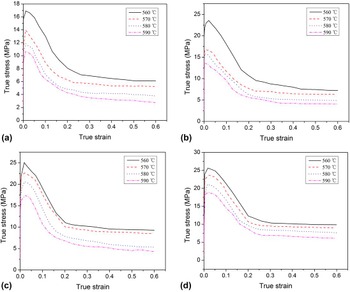
The true stress–strain curves of 1.5% Al2O3np (80 nm) reinforced 7075 AMCs in semisolid state compressed at different deformation temperatures are shown in Fig. 3. It can be seen from Fig. 3 that the peak stress and steady stress decrease with the increase of the deformation temperature at constant strain rate. The influences of the deformation temperature on the stress–strain curves are equivalent to that of the liquid volume fraction, since the liquid volume fraction is a function of the deformation temperature, according to the Scheil equation Reference Yan, Rao and He19 :
 $${f_{\rm{L}}} = {\left( {{{{T_{\rm{M}}} - {T_{\rm{L}}}} \over {{T_{\rm{M}}} - T}}} \right)^{{1 \mathord{\left/ {\vphantom {1 {\left( {1 - {K_0}} \right)}}} \right. \kern-\nulldelimiterspace} {\left( {1 - {K_0}} \right)}}}}\quad ,$$
where f L is the liquid volume fraction, T M is the melting point of pure metal, T L is the liquidus temperature of the alloy, and K 0 is the equilibrium distribution coefficient. In this study, the value of T means the deformation temperature, i.e., 560, 570, 580, 590 °C. The lower the deformation temperature is, the lower the liquid volume fraction, leading to the lubrication action of the liquid phase becoming weak, which makes the sliding and rotation of grains become hard. The liquid volume fraction increases with the increase of the deformation temperature, which enhances the lubrication action of the liquid phase. The solid grains are surrounded by liquid phase, resulting in the grains sliding and rotating easily, which makes the true stress decrease. In addition, the atomic binding force decreases and the free energy of atoms increases with the increase of the deformation temperature, which in turn promotes the sliding and rotating of grains. Moreover, the interface wettability of the composites enhances and the friction generated from the sliding among solid grains decreases with the increase of the deformation temperature, which results in the decrease of the true stress.
True stress–strain curves of 1.5% Al2O3np (80 nm) reinforced 7075 AMCs in semisolid compressed under 4 temperature regimes with different strain rates: (a) 0.01 s−1, (b) 0.1 s−1, (c) 1 s−1, and (d) 5 s−1.

B. Effect of strain rate on compression deformation behavior in semisolid state
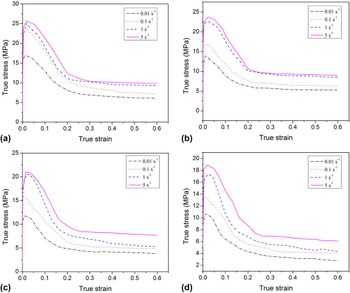
The true stress–strain curves of 1.5% Al2O3np (80 nm) reinforced 7075 AMCs in semisolid state compressed at different strain rates are shown in Fig. 4. It can be observed that the peak stress and steady stress increase with the increase of the strain rate at constant deformation temperature. When the samples are under applied axial compressive load, the liquid phase is squeezed out from the solid network and flows to the free surface during compression deformation process. When the strain rate is relatively low, the liquid phase has enough time to flow out among solid grains, which makes the solid grains easily slide and rotate. With the increase of the strain rate, the liquid phase cannot be squeezed out timely and the solid grains come in contact with each other in a very short time, which results in a significant increase in the true stress.
True stress–strain curves of 1.5% Al2O3np (80 nm) reinforced 7075 AMCs in semisolid state compressed under 4 strain rate regimes with different deformation temperatures: (a) 560 °C, (b) 570 °C, (c) 580 °C, and (d) 590 °C.

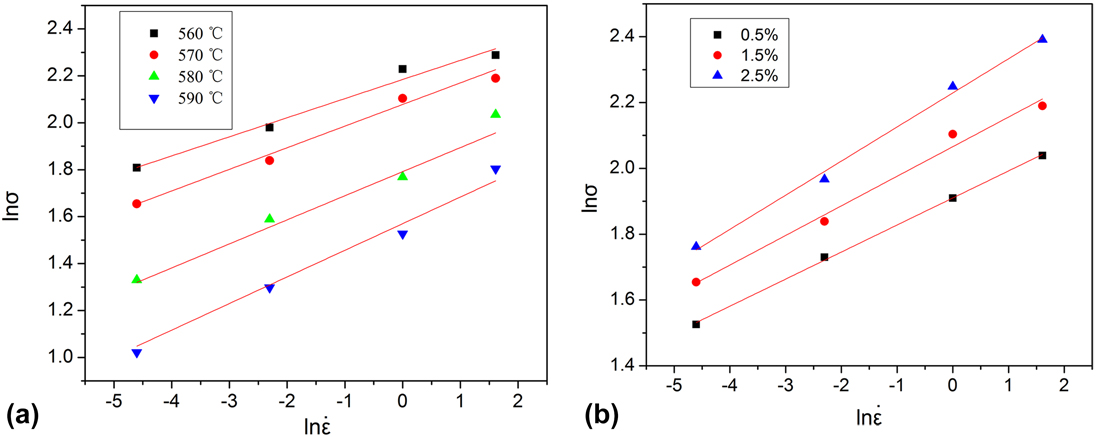
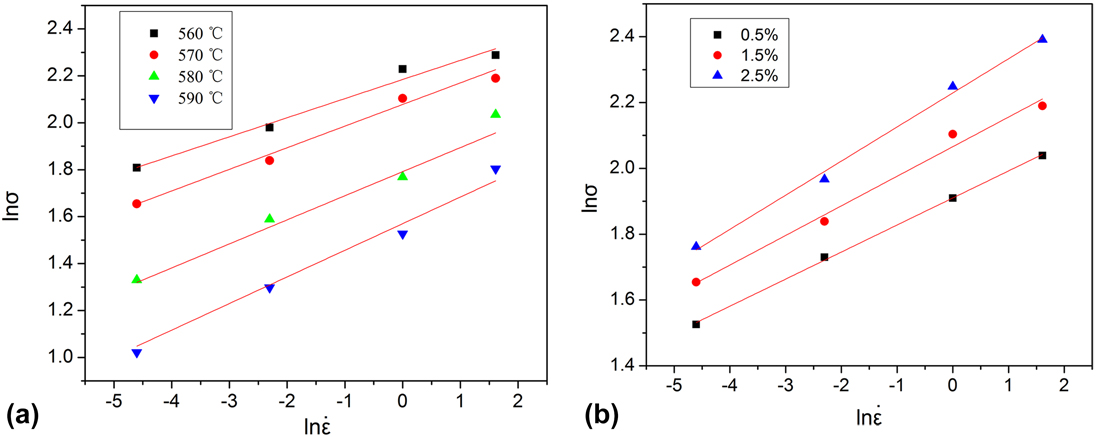
The natural logarithm of steady stress versus strain rate curves of Al2O3np (80 nm) reinforced 7075 AMCs in semisolid state are shown in Fig. 5. It can be noted that the natural logarithm of steady stress versus strain is nearly linear, that is, Al2O3np reinforced 7075 AMCs possess pseudoplasticity in semisolid state. The relationship between the natural logarithm of steady stress and the natural logarithm of strain rate is usually described by the Norton–Hoff law Reference Kang, Choi and Kim20 :
 $$\sigma = K{\dot \varepsilon ^m}\quad ,$$
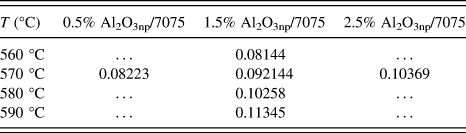
where K denotes the material coefficient, m is the strain rate sensitivity exponent. It can be seen that the slopes of those curves in Fig. 5 represent the strain rate sensitivity exponent m. The strain rate sensitivity exponent m values of Al2O3np (80 nm) reinforced 7075 AMCs in semisolid state obtained by linear regression under different conditions are listed in Table III. It can be seen that m values of Al2O3np reinforced 7075 AMCs in semisolid state tend to increase slightly with the increase of the deformation temperature and the mass fraction of Al2O3np, which is consistent with a study by Nguyen et al. Reference Nguyen, SuéRy and Favier21
The natural logarithm of steady stress versus strain rate curves of Al2O3np (80 nm) reinforced 7075 AMCs in semisolid state: (a) 1.5% Al2O3np and (b) 570 °C.
The strain rate sensitivity exponent m values of Al2O3np (80 nm) reinforced 7075 AMCs in semisolid state obtained by linear regression under different conditions.

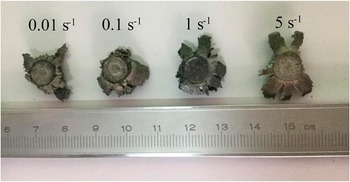
The macrographs of the semisolid composites compressed at different strain rates are shown in Fig. 6. It can be noted that the cracking degree of the sample increases with the increase of the strain rate, which is consistent with the results shown by true stress–strain curves of the samples compressed at different strain rates. The reason is that when the strain rate is relatively high, the liquid phase cannot be squeezed out timely. Accordingly, the liquid phase fails to lubricate the movements of the solid grains. The cracking degree of the sample increases due to the short time for harmonizing deformation. In addition, the destruction forms of the samples are composed of longitudinal cracks and collapsed sections.
Macrographs of 1.5% Al2O3np (80 nm) reinforced 7075 AMCs in semisolid state compressed at 570 °C and under different strain rates.

C. Effect of the mass fraction of Al2O3np on compression deformation behavior in semisolid state
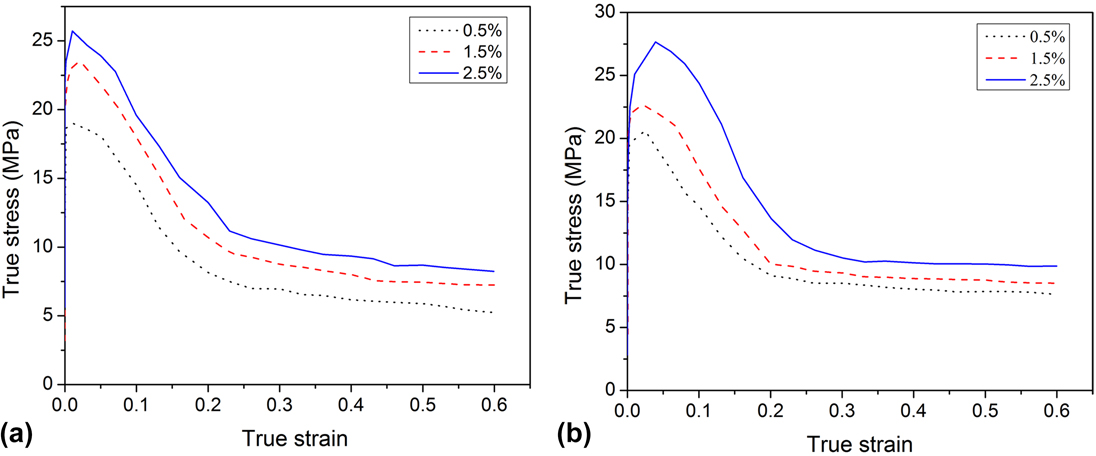
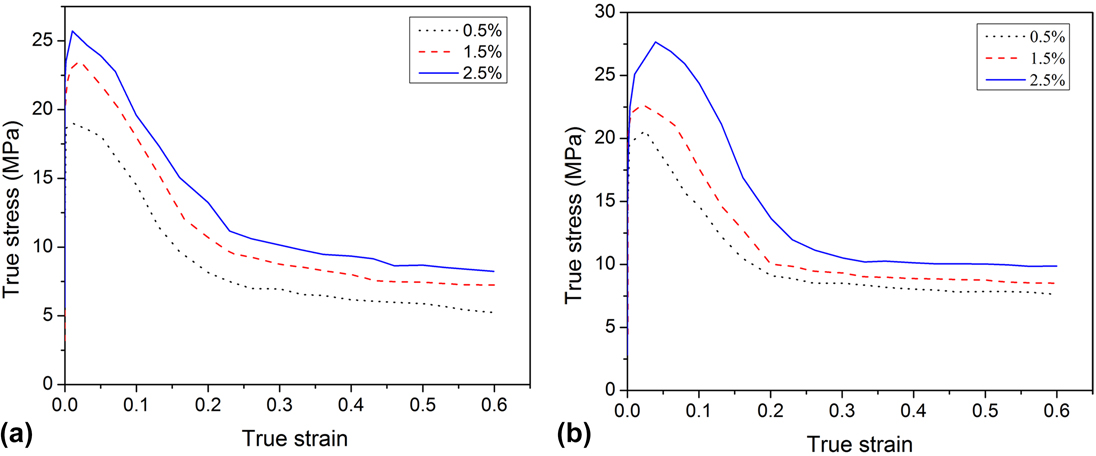
The true stress–strain curves of the semisolid composites with different mass fractions of Al2O3np (80 nm) compressed at 560 °C and 570 °C and constant strain rate of 0.1 s−1 and 1 s−1, respectively, are shown in Fig. 7. The curves show that the peak stress and steady stress increase with the increase of the mass fraction of Al2O3np. Similar trend was observed in the SiCp/AZ61 magnesium matrix composites. Reference Yan and Wang22 This is due to the reason that presence of Al2O3np lowers the effective liquid volume fraction of semisolid microstructures. The higher the mass fraction of Al2O3np is, the lower the effective liquid volume fraction at the same temperature, which makes the resistance to deformation increase during semisolid state. Besides, Al2O3 particles increase the resistance to dislocation motion and grain sliding during semisolid compression process, especially in the steady stage.
True stress–strain curves of the semisolid composites with different mass fractions of Al2O3np (80 nm) compressed at 560 °C and 570 °C and constant strain rate of 0.1 s−1 and 1 s−1, respectively: (a) 560 °C, 0.1 s−1; (b) 570 °C, 1 s−1.
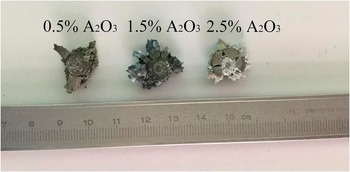
The macrographs of the semisolid composites with different mass fraction of Al2O3np are shown in Fig. 8. It can be observed that the cracking degree of the sample increases with the increase of the mass fraction of Al2O3np. This is due to the reason that the resistance to grain boundaries sliding and dislocation motion increase with the increase of the mass fraction of Al2O3np, leading to an inhomogeneous deformation. The destruction forms of the samples also consist of longitudinal cracks and collapsed sections.
Macrographs of the semisolid composites with different mass fraction of Al2O3np (80 nm) compressed at 570 °C and constant strain rate of 0.1 s−1.

D. Effect of the size of Al2O3np on compression deformation behavior in semisolid state
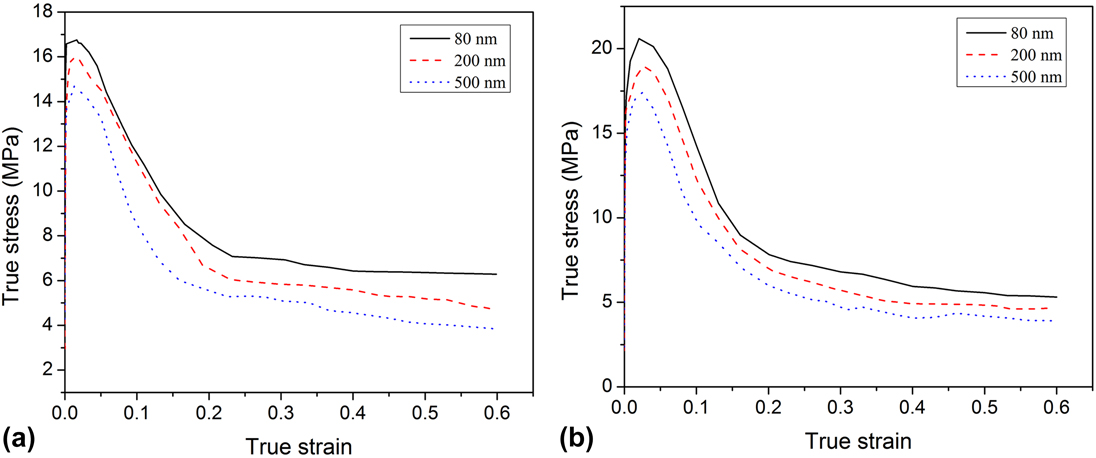
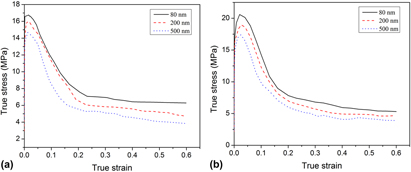
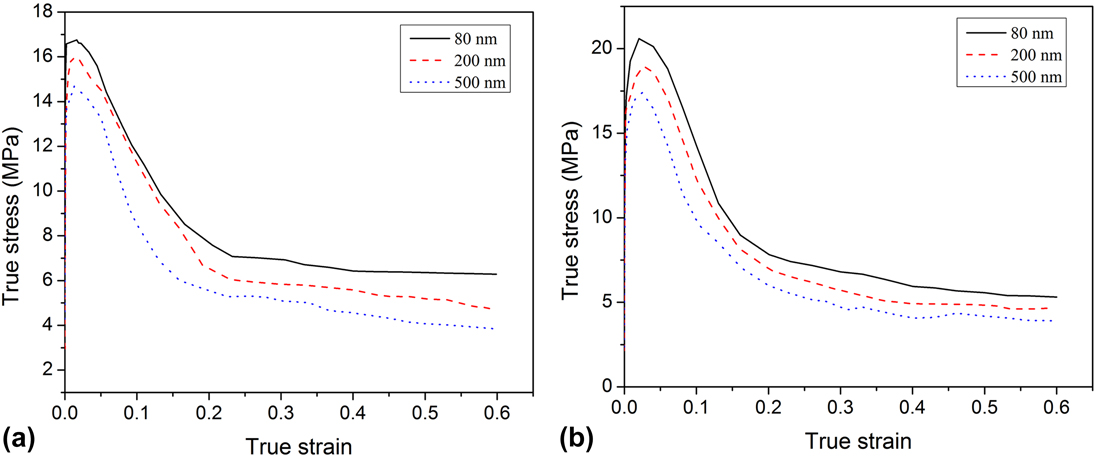
The true stress–strain curves of the semisolid composites with different sizes of Al2O3np (1.5%) compressed at 570 °C and 580 °C and constant strain rate of 0.1 s−1 and 1 s−1, respectively, are shown in Fig. 9. The curves show that the peak stress and steady stress decrease with the increase of the size of Al2O3np. This is because the internal defects of the composites such as porosity and shrinkage cavity increase with the increase of the size of Al2O3np, resulting in the decrease of the true stress. Additionally, when the mass fraction of Al2O3np is the same, the lower the reinforced particles size is, the more the numbers of the reinforced particles, which leads to a decrease in the grain spacing. The deformation binding force and the dislocation density increase with the increase of the grain spacing, imposing barriers to dislocation motion, which results in an increase in the true stress. Furthermore, the size of Al2O3np is relatively large, leading to poor bonding between the reinforced particles and matrix, which also makes the true stress decrease.
True stress–strain curves of the semisolid composites with different sizes of Al2O3np (1.5%) compressed at 570 °C and 580 °C and constant strain rate of 0.1 s−1 and 1 s−1, respectively: (a) 570 °C, 0.1 s−1; (b) 580 °C, 1 s−1.
E. Microstructures before and after semisolid compression
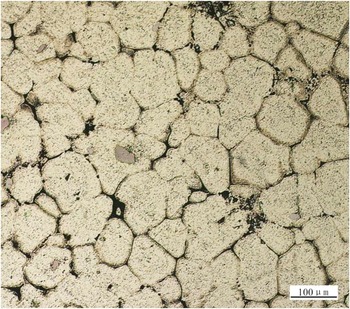
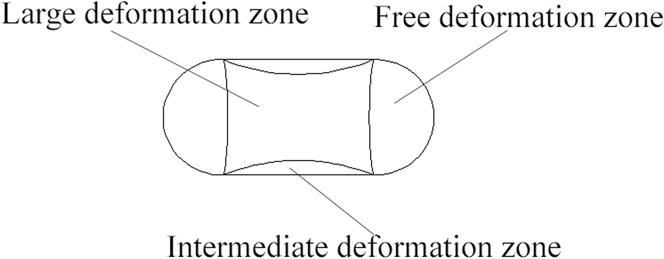
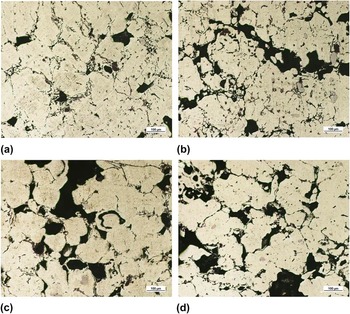
The microstructure of Al2O3np reinforced 7075 AMCs is composed of fine and spherical grains before semisolid compression, as indicated in Fig. 10. The whole deformation zones of the samples during compression process can be divided into three zones shown in Fig. 11: large deformation zone, intermediate deformation zone, and free deformation zone. The microstructures of large deformation zone and free deformation zone are shown in Figs. 12(a) and 12(b), respectively. It can be observed that the deformation degree of the solid grains in large deformation zone is larger than that of free deformation zone. When the samples are under applied axial compressive load, spherical grains contact with each other and plastic deformation occurs among the solid grains in large deformation zone, which makes grain boundaries become unapparent. In addition, the liquid phase is squeezed out and flows to the surface of the material during compression process. Therefore, a great amount of porosity is observed and solid grains and little liquid phase are left in the microstructure of large deformation zone shown in Fig. 12(a), while liquid phase segregates in the microstructure of free deformation zone shown in Fig. 12(b). The microstructures in large deformation zone of Al2O3np reinforced 7075 AMCs under different deformation conditions after semisolid compression are shown in Fig. 13. Under the relatively low strain rate of 0.1 s−1, the liquid phase has enough time to be squeezed out, which leads to the decrease of the liquid phase in the microstructure of large deformation zone. Under the relatively high strain rate of 5 s−1, the liquid phase cannot be squeezed out timely and is enclosed in solid grains, as shown in Fig. 13(a). The liquid phase fails to lubricate to the sliding and rotation of solid grains. Accordingly, the solid grains show evidence of having undergone a higher amount plastic deformation. Figure 13(b) shows the microstructure of the sample compressed at high deformation temperature (590 °C). It can be observed that the liquid volume fraction of the microstructure of the sample compressed at high deformation temperature is more than that of the sample compressed at low deformation temperature. In addition, the lower the deformation temperature is, the more serious the deformation degree of the solid grains is. Figure 13(c) shows the microstructure of the sample with higher mass fraction of Al2O3np (2.5%). The liquid phase of the microstructure is much less and the deformation degree of the solid grains is larger. The microstructure of the sample with larger size of Al2O3np (500 nm) is shown in Fig. 13(d). For the liquid phase of the microstructure, there is no obvious difference among the samples with different sizes of Al2O3 particles. But the solid grains show that the deformation degree is smaller. These results are consistent with the compression deformation behaviors of the composites in semisolid state shown by the strain–stress curves.
Microstructure of Al2O3np reinforced 7075 AMCs before semisolid compression.

Distribution of deformation zone of Al2O3np reinforced 7075 AMCs after semisolid compression.

Microstructures of 1.5% Al2O3np (80 nm) reinforced 7075 AMCs in semisolid state compressed at 570 °C and constant strain rate of 0.1 s−1: (a) large deformation zone and (b) free deformation zone.

Microstructures in large deformation zone of Al2O3np reinforced 7075 AMCs under different deformation conditions after semisolid compression: (a) 1.5% Al2O3np (80 nm), 570 °C, and 5 s−1; (b) 1.5% Al2O3np (80 nm), 590 °C, and 0.1 s−1; (c) 2.5% Al2O3np (80 nm), 570 °C, and 0.1 s−1; (d) 1.5% Al2O3np (500 nm), 570 °C, and 0.1 s−1.

F. Compression deformation mechanism
Chen et al. Reference Chen and Tsao23 proposed that there are four major deformation mechanisms during the semisolid compression process: liquid flow (LF), flow of liquid incorporating solid particles (FLS), sliding between solid particles (SS), and plastic deformation of solid particles (PDS) mechanisms. However, which deformation mechanism is dominant depends on the liquid volume fraction. When the samples have high liquid volume fraction, the solid grains are surrounded by the liquid phase. The deformation force required to overcome the liquid resistance is thus very small, in which LF and FLS mechanisms are dominant. When the samples have high solid volume fraction, the solid grains contact with each other due to compression. The deformation force required to overcome the frictional resistance generated from sliding among solid grains and the restriction of the solid particles movement due to the spatial constraint is relatively large, in which SS and PDS mechanisms are dominant. Due to high solid fraction in this experiment, LF mechanism is not obvious during the whole deformation process. Therefore, the deformation mainly depends on SS and PDS mechanisms in large deformation zone, while the deformation mainly depends on FLS mechanism in free deformation zone.
According to the stress–strain curves from Figs. 3, 4, 7, and 9, it can be seen that the whole deformation process can be divided into three stages: rapid increase of true stress, decrease of true stress, and steady stage. This result is in accordance with a report by Shang et al. Reference Shang, Lu, Tang, Zhao and Wu24 During the initial deformation stage, the true stress increases sharply and reaches the peak value in a very short time. When the samples are under axial compressive load, the liquid phase of the microstructure located in grain boundary begins to flow and the solid grains begin to slide. The solid grains contact with each other in a short time and form a skeleton. In addition, Al2O3 particles increase the resistance to dislocation motion and grain sliding during semisolid compression process. The deformation force is required to overcome the frictional resistance generated from sliding among solid grains and the restriction of the solid particles movement due to the spatial constraint. The strain is very low and the compression time is very short in this deformation stage. The liquid phase cannot be squeezed out timely and is enclosed in solid grains during the semisolid compression. Therefore, SS and PDS are the main mechanisms during the first deformation stage. During the second deformation stage, the true stress decreases with the increase of the strain rate. As the deformation proceeds, larger solid grains begin to break and the liquid phase enclosed in solid grains is squeezed out after the solid phase skeleton is destroyed. The liquid phase flows to the edge of the sample due to compression deformation. The lubrication action of the liquid phase results in sliding and rotating of the grains easily, which makes the true stress decrease. Therefore, LF, SS, and PDS are the main mechanisms during the second deformation stage. However, LF mechanism is especially important during this deformation stage, thus smaller force is required to overcome the liquid resistance. During the last deformation stage, the true stress keeps almost a constant value with the increase of the strain. On the one hand, due to the strain further increasing, plastic deformation occurs among the solid grains and the reinforced particles in the center portion and solid grains continue to slide and rotate, which makes the true stress increase slightly. On the other hand, the diameter of the samples increases during compression process, resulting in the contact area between the samples and compression heads increasing, which leads to a slight decrease in true stress. Eventually, the true stress keeps almost a constant value. Therefore, SS and PDS are the main mechanisms during the last deformation stage.
IV. CONCLUSIONS
-
(1) The peak stress and steady stress decrease with the increase of the deformation temperature and decrease of the strain rate. This decrease is related to the change of the liquid volume fraction. The peak stress and steady stress decrease with the increase of the size of Al2O3np and decrease of the mass fraction of Al2O3np. This is because the presence of Al2O3np increases the resistance to dislocation motion and grain sliding during semisolid compression process.
-
(2) The microstructure of 7075 AMCs reinforced with Al2O3np is composed of fine and spherical grains before semisolid compression. After semisolid compression, the deformation degree of the solid grains in large deformation zone is larger than that of free deformation zone. The reason is that the deformation mainly depends on SS and PDS mechanisms in large deformation zone, while the deformation mainly depends on FLS mechanism in free deformation zone. In addition, the solid grains in large deformation zone show evidence of having undergone different degrees of plastic deformation under different deformation conditions.
-
(3) The whole deformation process can be divided into three stages: rapid increase of true stress, decrease of true stress, and steady stage. SS and PDS are the main mechanisms during the first deformation stage; FLS, SS, and PDS are the main mechanisms during the second deformation stage; SS and PDS are the main mechanisms during the last deformation stage.
ACKNOWLEDGMENTS
Authors express their gratitude to the National Natural Science Foundation of China (51364035) and Innovation Special Funds for Graduate Student of Nanchang University (CX2015055) for financial support.