Introduction
Late in 2012, the author was asked to undertake an analysis in reviewing a transcript of an interview between police, a child safety officer and a mother who was very worried about the fact that her children were being abused by her ex-partner. I agreed to do this on the condition that the ethical nature of this study was paramount in my approach. I was then e-mailed a series of transcripts by lawyers and the parent of two children who had been investigated by police and a state government department.
These children were considered to be victims of sexual abuse by the parent contesting the alleged abuser's application for residence of the children.
Legal personnel sought a discourse analysis of the transcript of the interview of the mother by the senior child protection police officer and child safety worker employed by a government department responsible for child safety.Footnote 2 Written permission was provided by the parties who owned the transcript on condition that their identities were kept confidential.
The transcript is a 47-page document of an interview which lasted more than 2 hours. This interview took place in an interstate police station and the transcript of the recording was given to the parent. It is understood that this interview was then used in the report presented to the Family Court. The court accepted the evidence provided by the two professionals, making the decision to place the children with the male parent (the alleged abuser), restricting the mother to supervised access.
This analysis is based on the interview, which clearly indicates that the investigating team did not believe the disclosing parent or her children. Discourse analysis, in this instance, suggests that courts must become more aware of other issues at play within interlocutory situations, which may, in fact, determine a child's wellbeing more than is evident before the bench.
The Unhappy History of Child Sexual Abuse and the Politics of Protecting Children
Throughout Western society, there has been a long history of child sexual abuse being ignored and disbelieved. John Henry Wigmore's legal textbook, Treatise on Evidence (1934) dismissed the credibility of any female witness alleging sexual abuse, and warned lawyers and judges that women and girls were predisposed to make false allegations against men of good character, and unsuspecting juries must be warned not to believe them. He recommended that a psychiatrist should examine any female who made such allegations. This attitude appears to exist currently.
Herman (Reference Herman1981) showed that Wigmore, like Freud's writings, perpetuated the legal beliefs that protected male culture. More recently, while the writings of American psychiatrist Richard Gardner – supported by Darnall (Reference Darnall1997) – were dismissed as having no scientific credibility by American's psychiatric, psychological and medical professional associations, his ‘Parent Alienation Syndrome’ was quickly accepted internationally and used effectively to remove children from mothers whose children made allegations of father–child incest (see, for example, the websites promoting this view).
More recently, Australian research has shown that one-third of a sample of parents said that they would not believe a child who reported sexual abuse (Tucci, Mitchell, & Goddard, Reference Tucci, Mitchell and Goddard2006). In the rare cases when allegations of abuse have found their way into the criminal courts, powerful and successful methods have been used to prevent abusers from being convicted and jailed. For example, Stevens (Reference Stevens2013, p. 44) has shown that, even when abuse has been proven in courts, the notion of the ‘good offender’ is often presented in mitigation of sentencing.
This powerful discourse has been identified by Stevens as preventing the maximum sentence being imposed when abuse has been established, with the three main elements used to support the [male] claim for leniency being that he has been father, family man and income provider. Briggs (Reference Briggs2012, p. 14), in her historical perspectives, has also shown that there has been what she terms ‘a low priority in politics’. She also indicates that politicians, in general, have a low understanding of child abuse and child protection matters and that, because of the cyclical nature of politics, there is little incentive to consider the long-term consequences. Nevertheless, the media has kept the public informed, and has investigated claims that have taken years to emerge and be believed.
The ongoing thematic issue seems to be that the shock and horror involved in child abuse claims is such that there has emerged evidence of ‘cover-up’ by institutions, and government officials and departments, whose job it was to protect children.
Despite myriad publicity of the harmful effects of child abuse in society, there appears to be an ongoing discourse of disbelief to discredit those who disclose child abuse.
In recent years, there have been a number of Royal Commissions and Commissions of Inquiry into the abuse of children, and there are at least two commissions in operation at the time of writing. Clearly, in recent times, the community is more concerned with Child Protection issues and the institutional responses to Child Abuse issues. A number of enquiries have been conducted including: the Layton Review, presented in 2003 to the then Minister of Social Justice, the Hon. Stephanie Key MP (Layton, Reference Layton2003); the Mullighan Report into child abuse of children in State Care (Mullighan, Reference Mullighan2006); the Debelle Royal Commission into child abuse in South Australian Schools (Debelle, Reference Debelle2013); a Victorian Parliamentary Committee of Inquiry into Child Sexual Abuse by Religious and other Organisations Report (2013); the Tim Carmody Child Protection Royal Commission of Inquiry in Queensland (Carmody, Reference Carmody2013); the McClellan Inquiry in New South Wales (McClellan, Reference McClellanin preparation) and, in addition to the Parliamentary Select Committee in SA conducting its inquiry, an Independent Education Inquiry into child abuse in schools in South Australia.
The prevalent theme is that victims were disbelieved and abuse was ignored. Inquiries have confirmed that some people have had to wait decades to have their stories believed. For example, the Mullighan Inquiry into state institutional abuse of children in care in South Australia exposed numerous examples where young people and their carers had disclosed abuse only to be punished and silenced. Former (the late) Justice Ted Mullighan stated in his report that:
Evidence given to the Inquiry demonstrates that from the 1940s to 2004, children in State care have been sexually abused regardless of their age, gender, race or the type of placement, whether large congregate care in institutions, smaller group care, residential care units, foster care, secure care or the family home. The evidence from people who were children in State care (PICs) shows that the State must
• implement strategies to prevent such sexual abuse
• provide an environment to encourage children in State care to disclose
• respond appropriately when disclosures are made. (Mullighan, Reference Mullighan2006, p. 348)
The key focus in the above paragraph appears to be the issue of responding appropriately when disclosures are made and this was shown to be missing in action on a consistent and distressing basis.
Critical Discourse Analysis as a Powerful Research Tool in Determining Accuracy and Author Mindsets
The courts in Australia rely on information that is presented to them in order to make considered and powerful decisions based on children's lives and safety. This information is often presented in the form of reports following investigations or interviews. For example, in sentencing there is a requirement for judges to consider a range of factors that may mitigate a decision or sentencing. For this, judges have often been criticised.
Judges have requirements placed upon them by their habitus or traditions (Bourdieu, Reference Bourdieu2003), such as silence in the face of much overwhelming criticism (Griffith, Reference Griffith1997, p. 42, citing Kilmuir), a modulated approach to such critics and a desire to be seen as accurate in their judgments. To be accurate in their judgments it is evident that they must rely on information presented to them in court, or by experts engaged by the courts to deliver reports and guide the deliberations and eventual decision. Such decisions may well rest on the delivery of determinations made by interviews, such as the one analysed here. Foucault once famously remarked that government was made up of those who endeavoured to guide the ‘conduct of conduct’ (Foucault, cited in Burchell, Gordon, & Miller, Reference Burchell, Gordon and Miller1991, p. 87).
It is those who judge that conduct, on behalf of society and aided by government agencies, who are of interest in this research. To judge what is being said and deliberated on by others and then reported as fact-finding is of interest. In discourse analysis the construction of the language presented often entails a preconceived mindset which appears evident in the interview conducted by the investigators.
Indeed, Fairclough (Reference Fairclough, Wetherell, Taylor and Yates2001) has suggested that author beliefs and decisions can be implied, and indeed amplified, by the construction of language and its presentation.
In more recent times, a significant number of researchers have discovered that critical discourse analysis is a powerful way to determine what is really being said and what is meant from text or transcripts of interviews, and, indeed, court judgments and decisions, and how they are reported, both at the local and media levels. For example, Rachel Spencer (Reference Spencer, Candlin and Crichton2013) has determined, along with the present author, that the media have done a spectacular task in undermining community trust in the legal profession and, thereby, the courts.
According to Spencer, judges ‘make decisions based on deep consideration’ (Spencer, Reference Spencer, Candlin and Crichton2013, p. 220). Spencer also reminds us that judges must base these decisions and judgments on ‘information provided’ in (or ordered by) courts within the framework of the adversarial justice system.
Because it is well documented by researchers that the media have frequently ‘got it wrong’ and misreported and undermined trust in the justice system (Fairclough, Reference Fairclough1989; Moran, Reference Moran2013; Schulz, Reference Schulz2010; Spencer Reference Spencer, Candlin and Crichton2013; Van Dijk, Reference Van Dijk1998), it is now relevant to ask whether judges were simply misinformed by those responsible for investigations. Has there been misreporting to the judiciary within the court at any point, and how can this be remedied, if at all? Are those people who are tasked to present information to be trusted to provide the actual reality of situations, or are their views already set? Are these views part of what Briggs (Reference Briggs2012) has indicated is an unhappy history of denial that abuse is widespread and cuts across all classes and social groups?
Indeed, there is further suggestion that excuses are made for offenders (Briggs, Reference Briggs2012, p. 383), and this has been echoed in the recent work of Stevens (Reference Stevens2013) on her examination of the discourses suggesting that some child sex offenders are presented as ‘good’ citizens. Stevens again noted that despite using their defence as good citizens of the community, the alleged offenders [convicted paedophiles] used these same positions of trust to groom and abuse children. This latest discourse analysis reflects many of these issues. Qualitative research approaches can uncover the thoughts, processes and behaviours experienced by key people within specific social groups. They provide the tools to examine the culture of a given group, and how it connects with – and distinguishes itself from – its broader social contexts.
This approach can be activated in a spirit of pure empiricism. It is simply to capture and describe the cultural formations within a community, or within the more pragmatic parameters of the ‘purposive selection’ strategies outlined here: to give a deeper understanding of how and why certain themes and issues have arisen within a key community of interest (Loschper, Reference Loschper2000). Within the discourse analysis approach to language construction there is a significant revelation of how and what is said becoming evident as a form of power (Fairclough, Reference Fairclough1989).
A content/frequency analysis to begin the discourse analysis as advocated by Altheide (Reference Altheide1996; 2000) shows a clear incidence of statement declaratives made by the police officer followed by the term “OK”, but it should be noted not in a questioning language construction at all. The term “OK” is used exclusively to indicate that the statement made by the police officer is correct. On one occasion he actually says “I am right, aren't I?” This then follows with the ubiquitous “OK”.
Another outstanding feature of the content analysis is how silent the mother is most of the time and the number of times that she is interrupted by the questioners to tell her she has to “stop”, “believe” or “get on”, or realise she is “wrong”.
In Figure 1 a short content analysis of word choices by the police officer shows a negative approach from the beginning. It becomes evident, as Altheide (2000) has identified, that in this interview there is a strong representation of negative statements made to the parent. In addition, it can also be seen that the police officer has made the bulk of these statements, as they are identified by this discourse analysis as his commentary. The consistency of negative views expressed by the police officer first makes a stance we (that is him and the child safety officer) and I (himself) don’t; can’t; or didn't [want to continue the investigation]. He suggests she should [listen] and take note OK as an added declaration that his word is indeed OK but hers is not. These lexical choices noted in my findings in Figure 1 are frequent and act as steely reminders of the stance that is negative from the outset in the interview with the mother.
Negative word choices used by the police officer in transcript.

There is also evidence here of the use of language as a powerful tool to silence dissent from the interlocutor . . . “you can't say”, “you can't possibly be right”, “you should be ashamed of your behaviour”. . . all designed to be judgmental of this person's comment about her children and her fears that they may be being abused. His dismissal and non-belief become evident later in this analysis.
Topoi of Discourse Identified (Recurring Themes of Commonly Held Values)
I conducted an examination of frequency of the most recurrent topoi, within the text presented of the interviewers’ comments, which Van der Valk (Reference Van der Valk2003, p. 323) refers to as establishing commonly shared ‘values and maxims’ within a discourse community when presenting their arguments. These topoi, or commonly shared views, were evident from the first page. Examples of these included:
1. the topoi of disbelief;
2. the topoi of discrediting.
In order to undertake thematic analysis, it was important to become familiar with the subject matter of the discourse, the specialist semantics deployed, and with at least basic levels of the lexical and grammatical relations present, as indicated by Halliday (Reference Halliday1985) and Hasan (Reference Hasan and Flood1984).
Lemke's (Reference Lemke, Tobin and Fraser1998) view is that discourse analysis should always include a number of resources and strategies, such as lexis (word choices) and rhetorical formations, and the construction of thematic format and cohesion chains, the whole building upwards as broader formations are detected with the same ‘patterning’ of the language being studied. Such elements are used in the assembly of any discourse describing and surrounding a reality, to reveal the particular characteristics of a community and its public perceptions. This is echoed in the work of Fairclough (Reference Fairclough1989, p. 179), who indicates that powerful participants within a communication can control and constrain what is said or done within a particular discourse.
The judiciary, by their very situation, are architects of a punctiliously observed set of traditional constraints. Silence in the face of public comment is a central tenet of judicial discourse, but for police officers – particularly in this interlocutory analysis – used to the spotlight in crime and other daily news rounds, and often being spokespeople for their team, this is not their habitus or set of rules designed to maintain professional order and restraint. They are clearly used to power and its implementation within discourse.
When judges are persuaded to comment, either within their professional circles, their topoi are strongly connected to community understanding of courts, independence and current public opinion, media reporting, and those outcomes that relate directly to community concerns and issues of public confidence (Schulz, Reference Schulz2010).
Establishing recurrent themes within a set of texts is recommended by Riffe, Lacy and Fico (Reference Riffe, Lacy and Fico1998), who advise that a basic group of content units should be examined in the first instance. This is to determine major topical themes of interest and the frequency of their appearance.
The frequency of certain themes connected with address to the parent is clearly indicative of non-belief of the transcript of this discourse community highlighted within this interview. Riffe et al. (Reference Riffe, Lacy and Fico1998) reflect that transcripts of interviews are ideal for the purpose of examination of content units and lexical choices, as long as the researcher specifies clearly that what is selected is what is most appropriate for study and most meaningful to the research. Other recurrences may also be present; for instance, grammatical structures based on professional phrasing; favoured maxims; even aberrant verbal ‘tics’ produced in a range of speakers by the idiosyncratic practice of a single powerful mentor. In this study, the selections relate to the research topic as centred by the transcript – so that what is of most interest is the degree to which common patterns of speech can be shown to emerge.
For example, a range of sentences with these themes ended in “OK” as a statement declarative rather than interrogative, as outlined earlier. This aberrant verbal tic is used in this interview as a power descriptor to emphasise to the mother during interview that the interviewers’ point of view is to be believed and to deter dissent to the views expressed. The verbal tic in one speaker within this interview, using the term “OK”, is so powerfully used to emphasis the rightness of his approach that it showed up in this analysis as the first exemplar of a topoi of non-belief.
The major themes in Figure 2 reveal a strong dislike of the parenting style or comments made by the mother in this interview. Fontana and Frey (Reference Fontana, Frey, Denzin and Lincoln2000) have suggested that revelatory interviews designed to elicit truth are a type of constructed conversation, often augmented by a topic outline. It appears here that the topic outline is already determined by the themes identified in Figure 2. For example, there are strong references to parenting as poor, blaming, detriment, scary, children suffered, disgrace and harm – all these linked to statements around the mother's parenting style. Clearly, what is at work here is a beginning of author mindset (of statements) that suggests that the mother is not believable or capable as a parent.
Major themes revealed in discourse.
The Topoi of Disbelief Revealed: “We do not believe you” or the children
Nowhere is the topoi of disbelief so readily revealed than by the opening statement by the social worker, and augmented by the police officer in interjections (the main speaker throughout the interview):
“. . . we need to be very upfront with you and brutally honest with you in regards . . . OK. Now I didn't want you having your support person here”; [Why?] . . . “Because you really need to listen to what we have got to say because this is it . . . We are not investigating the statements the girls are saying any more . . . OK, this is the finale of our investigation OK?”
This then continues for another 47 pages of what appears as apparent brutal verbal attacks on the parent.
We Believe the Children are Making False Reports and have been Trained by You
This is evidenced by the lexical choices of the officer's interpretation of what the children said after extensive questioning, although it is unclear from this transcript if he actually questioned them himself or is relying on what others have said. They include:
“No one is touching her . . . she fully understands . . . she did say someone had touched her, but when she was given full rein to fully explain she has come up with this . . . This comes back to the allegations of you coaching the girls.”
There is no reference as to why this is so. Later on, the police officer says,
“. . . that in to conduct by yourself [sic] that is abhorrent and disgraceful and that examination of the children by you . . . it is a disgraceful way in which to deal with children and if it happens again you will be charged with a criminal offence . . . nothing more certain than that”.
This last exchange was in response to the mother having examined her daughter following a complaint by the child that her private parts were uncomfortable.Footnote 3 In addition, it is also clear that a different order is in process. Here, then, is a structure which reveals the territory of the interviewers’ practice of investigation and judgment of parents with concerns about their children.
Comments such as charges for misconduct, passing judgments on parenting styles and concerns, and insistence on the interviewers being correct in their evaluation are evident in these exchanges. They are swept up by three powerfully conflicting forces: the institution of policing/justice, the institution of parenting and marriage, and supposedly underpinned by the desire to protect children. Each area has a specific value that it seeks to preserve – family peace and the essence of mothers not taking matters into their own hands. They reference a number of occasions in which the interviewers suggest that the children were “dreaming” about sexual contact with their father when aged 2–3 years and refer to them as having “dreams”.
The question to ask here is why would a small child dream of a parent sexually “touching her”? Further study in this area of dreams is beyond the scope of this paper. However, a quick reference to distinguished experts such as Laura Berk (2013) indicates strongly that in this area of children and dream psychology and development that it seems that memory moves from non-verbal to verbal around 3–4 years, so prior to 3 years children would have great difficulty putting into words what had happened, even though, if presented with the same situation, they would be able to recognise it as familiar. Berk says, ‘only after age three do children often represent events verbally’; and later, ‘very likely, both neurobiological change and social experience contribute to the decline of infant amnesia’ (Berk, Reference Berk2013, p. 301).
For the police and the justice system, the priority is their ability to get to the truth, or a form of truth, which is acceptable for presentation in a court of law via investigation processes. What is at stake is the word of the police and investigation or the mother's and children's allegations. For parents, it is their capacity to view such interview proceedings in their own way, from their own perspective, to ‘judge’ on their own terms. What results is a set of interlocked topic-choices, each working to defend a particular and coherent point of view, and yet revealing the very grounds across which conflict arises. Van der Valk (Reference Van der Valk2003) echoes this conflict where there are consistently positioned oppositional forces within their discourse and reporting.
Here, the police officer and social welfare officers appear almost deliberately detached from the community they see themselves as serving. The community of parents and worried mothers, in particular, are in their sights. The police and social work services in this sample, whether they admit to it or not, are aware as a community in themselves of their ‘lieux commons’ – a process of solidarity-formation common in socially pressured discourse formations, as indicated by Billig (1993) and cited in Van der Valk (Reference Van der Valk2003, p. 323). While this study by Billig referred to racism in discourse, it does consider the notion of a divide between groups; in this case, a divide between parent and police and social services. They appear to have a common purpose to deny a perspective.
Conflict is evident and is revealed as a defended position on the part of the powerful in this interview – the power is with the police who insist they know best about parenting actively supported by the social worker who remains silent but in support. That conflict becomes clearer when a detailed analysis of the topoi of discrediting is arranged. It shows that the mother is not believed and not credited with being reasonable or rational as a parent, as a witness in the justice system, or as a mother. As Van Dijk (Reference Van Dijk, Wodak and Meyer2003) would indicate, mothers are cited and seen as ‘other’.
The Topoi of Discrediting Revealed: You are not a Fit Parent and We Know Best because we are the Professionals
This form of discrediting is evident on a number of occasions in the transcript and shows a style of verbal bullying. These statements of discrediting made by the team include the following:
1. Parents can't get it through their thick heads.
2. These children are so messed up it is not funny.
3. I have never been so disgusted in my life.
4. Your conduct is detrimental.
5. You are not an investigator [we are!]
6. . . . your kids are traumatised by what is happening [between you] (referring to investigation) not, for example, of what may actually have occurred elsewhere.
7. The damage has been done.
8. . . . this isn't a time for you . . . we are not entertaining any more of these statements.
9. We are the professionals.
10. [Name of male parent] is responsible for the day to day . . . Over here is the fun police – it's mum – mum doesn't have a care in the world.
11. Dad's boring because he does the dishes . . . that is what they [the children] are seeing. They see their time with you as fun because you always do fun things and it's great and we don't want to leave mum because we a have a lot of fun.Footnote 4
12. You have to come up with a consistent parenting plan for the kids.
The selection of statements taken from the transcript shows a strong verbal attack on the parenting style of this woman who, despite her fears, has disclosed only to find that she is being discredited and not believed by the very officers she trusts to write a report and present to the judge in court.
The power of author mindset and collocation reveals a team that has already decided how their report will be presented. Collocations are a way of analysing discourses, which shows the power of the juxtaposition of words when co-located with a theme or topic choices identified in discourse. This is highlighted by Fairclough (Reference Fairclough1989, Reference Fairclough2003) and also by Schulz (Reference Schulz2010, Reference Schulz2012), who identifies them along the lines of the ‘company words keep’.
Collocations with Key Words and Themes
One clue lies in the strength of another element of discourse identified within this transcript corpus: the use of co-location (collocation) of certain lexical items. Most obvious, but also most important, is the co-location of the word ‘you’ when addressing the parent with certain recurrent lexical choices at two or three words removed, either side of its appearance within the sentence structure. According to Atkins (Reference Atkins2002), frequent recurrences of such selections can also indicate a socially constructed point of view; one powerful enough to pull forward lexical items subconsciously as a speaker or writer composes, operating as a semi-automatic or pre-formed, ‘cued’ selection.
Atkins (Reference Atkins2002) suggests that language conditions people's attitudes and expectations. Those who habitually use and re-use certain preferred words and phrases betray a settled way of thinking – and also the expectation that this will be shared by listeners. To some extent, however, this also applies to those who are the subjects of this language – those spoken of, who are objectified in the terms used, and who may well take up the positions implied. In other words, how language settles around an issue within a given community, controls community perspectives, and so behaviours.
The collocations revealed in this research clearly indicate a mindset by the authors of the verbal exchange that they do not believe the children's statements, the mother or her concerns, and that the father is to be believed in this instance. This is evidenced by the following notable examples found in the discourse analysis of the transcript.
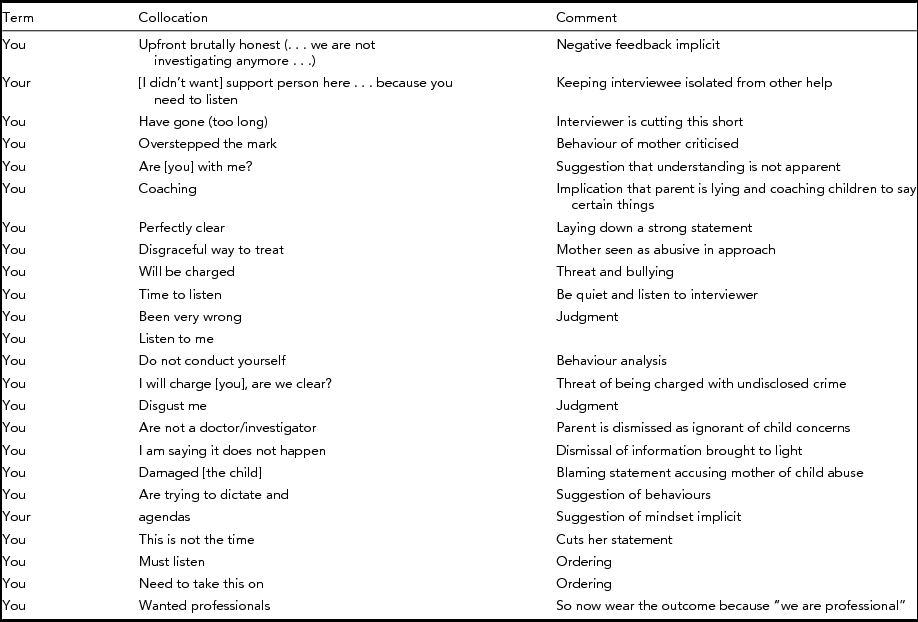
In this instance, the collocations noted in the transcript of interview conversations show that you (the parent at interview) as a central concept is currently considered within the investigating team of police officer and child safety worker as a wildly inaccurate, emotional parent, in need of a certain controlled and predictable outcome for the children in question – while it is actually represented as quite otherwise. Using the ‘edit find’ tool in Microsoft word, the word you when addressing the parent was sought and the immediate words or phrases which are collocated either side of this key word were then noted on to a table.
Norman Fairclough (Reference Fairclough1989) has examined the manner in which a given community can become constrained by the structures and forces of those social institutions in which its members live and function. Taking up Foucault (1984), he introduces the concept of discourses forming the notion of self, through their power as the conceptual ‘frameworks’ surrounding a group (Fairclough, Reference Fairclough1992, p. 39).
For the purposes of this study, I undertook to consider the collocations of the word you or your expressed to the mother at interview and those words juxtaposed either side, to see what the main thrust of the concerns raised by the interviewers was. The selection list in Table 1 is explicatory, according to Fairclough (Reference Fairclough1989), where the notion of collocation is seen as a mindset determined to bring about a certain outcome. Table 1 clearly shows that framework in action, where the self as police investigator and his colleague as welfare officer clearly determine the way this discourse will deliver the outcome determined by them. The parent is not believable, she coaches the children and her parenting style is not acceptable. In this way, the group surrounds itself with power as their conceptual shield. We know best because “you are a parent you are not a police officer” (p. 3 of the transcript).
Selection of collocations with the term “you” directed at the parent.
The list in Table 1 is very typical of 47 pages of a bullying style of conversation in which the investigative team have started out by telling the parent they do not believe her, that she would be denied having her supporter there, and that they and this investigation is coming to a close: “this is the finale of our investigation”. The irony is that the mother was a director of a paediatric health unit.
On several occasions, they are much more specific than in the examples listed in Table 1; this is because the term you was chosen as the term for collocation analysis and not the name of the parent. If this had also been undertaken, this paper would be too long to publish in this journal. The listing in Table 1 shows clearly that badgering the parent was evident and that on no occasion was the team prepared to believe her. Such collocations have the ability to inflict a certain propensity of belief in the orator and the listener over time. For example, the consistent linking of the term outrage in headlines reporting the courts’ sentences in daily tabloids and online sources reflect this view that judges are “out of touch”, as found by Schulz (Reference Schulz2010); and so it is with interlocutory speech that similar outcomes can be seen to emerge.
In fact, De Beaugrande (Reference De Beaugrande and van Dijk1997, p. 35) also calls the ‘collocation’ of words the ‘company they keep’, and suggests that even modest word samples indicate a pattern that identifies issues or concerns that need attention from the perspective of the speaker or writer. Fairclough (Reference Fairclough2003) goes further, encouraging analysts to look for patterns that emerge in all manner of texts to show relationships between powerful and dominant discourses and, in this case, the link between “you” as a descriptor of the mother and what follows shows a dominant discourse of disbelief.
Discourses of disapproval which have been identified by Schulz (Reference Schulz2010, Reference Schulz2012) in other research also suggest that there is a tendency to disapprove by linking pejorative information via collocations. These most often appear in headlines marking the failings of courts in general, but here they mark the failings of a parent who cannot be believed by the investigative officers.
Lacunae in Discourse: Considering what is Missing in Text
Teo (Reference Teo2000, p. 7) has noted that often an analysis selected in text is clearly evident, but that another vehicle is to consider the de-construction of text by considering what is de-selected. Options suppressed or concealed by linguistic choices can reveal much in discourse. For example, Schulz and Cannon (Reference Schulz and Cannon2011) found that the missing words penalty or punishment in opening paragraphs of sentencing were clearly evident and may have led to misreporting by journalists. This led to discourses of disrespect that they identified in media reports of criminal sentences. In particular, descriptions of what was considered as ‘lenient’ sentencing used time as an evaluative language tool to discredit the time given for sentences or lack of time given out in sentences and became the focus of news reports. Such lacunae become crucial in any discursive study.
It is interesting to note that in this transcript analysis of the parent interview with the investigative team the comment “this has gone on far too long” is also a pejorative and evaluative tool to discredit the mother.
What is missing in the transcript, however, are words of comfort . . . that the interviewers are there to ensure the safety and wellbeing of the child and to reassure the parent . . . nowhere in the 47 pages of this analysis does this suggestion appear in any form. However, on page 42 she is told “don't worry the girls are safe you know” following the welfare officer's statement that “I want this to be a 50/50 arrangement in terms of custody and you know that”. From a discourse analysis perspective this speaks louder than the powerful ending of many sentences by the main interlocutor when he says OK in a declarative way to ensure she gets the message from him. Here she is already told what the outcome will be. What is missing is the notion that perhaps the judge may have a hand in determining the outcome! Based on this report of this interview, however, there is little chance of the mother being heard or believed, either in court or beforehand.
What Recommendations can be Suggested in Light of this Analysis?
Judicial officers take their tasks and their role very seriously. This researcher has found through many years of interaction with courts and judges that their task is getting harder and harder (see, for example, Schulz and Cannon, Reference Schulz and Cannon2013 on social media frameworks and their effects on courts). The current spate of inquiries and community anxieties about institutional and individual child abuse appears to be legion, yet in the space of a few hours of interview there is still evidence that parents who are concerned do not receive reassurance and belief of their story. Whether there is evidence to support the abuse, or that children's stories unravel and tangle in the stress of the telling, is not considered in this analysis. However, a report will have been prepared and presented to the courts. Any report from this transcript could be considered to have failed in a number of areas, and the topoi of disbelief and discreditation are evident.
Perhaps the time has come for judicial officers to see for themselves rather than take second-hand information from investigative interviews. Perhaps the time has come for judicial officers to see the direct transcripts of interviews and to see whether the seriousness of decision-making, which marks the honour and work of the judiciary, can be considered in light of this study. Perhaps the time has come for judicial officers to be given education on the grooming methods used by sex offenders to gain the trust of everyone concerned with child safety, the prevalence and terrible consequences of child abuse and its aftermath, the terrible consequences of non-belief and to understand more fully how children communicate at emotional stages in their development. Finally, it is recommended in the light of this study that judicial officers consider the use of language in their considerations of what is brought before them for judgment. It is also strongly recommended that judicial officers consider the power of discourse analysis as a possible way to shed further light on court reports and representations with respect to child protection matters.