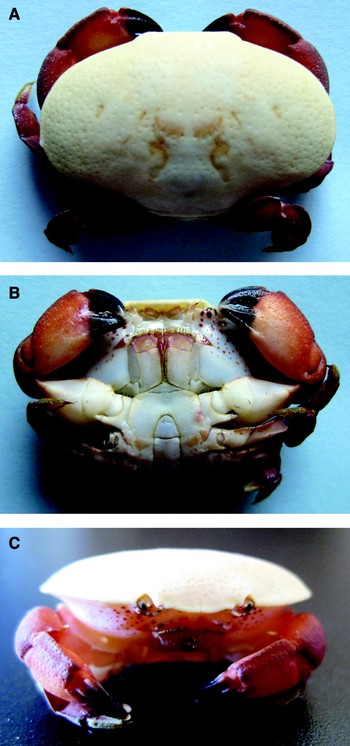
During a survey of the benthic fauna along the eastern coasts of Rhodes Island, a male specimen of the stone crab Atergatis roseus (Rüppell, 1830) (Brachyura: Xanthidae) was caught on 26 July 2009, near Plimmiris Bay (coordinates 35°55′38″N 27°51′37″E), by the fishing boat ‘Captain Stavros’, with trammel nets (26 mm mesh size). The nets were placed at 6–8 m depth the previous evening on sandy bottom with rocks covered by vegetation, and retrieved early in the morning. Surface seawater temperature was 25.5°C, salinity 39.38°/oo.
The specimen was identified and described following Serène (Reference Serène1984), Galil et al. (Reference Galil, Froglia and Noël2002) and BioSearch (2009).
MEASUREMENTS (MM)
Carapace: length 16.5, width: 25.6; frontal border: 6.7; orbit diameter: 1.4; frontorbital width: 9.6; posterior border: 4.8; left chela: length 11.2, height 6.3; right chela: length 10.8, height 6.2. Chelipeds length (maximum opening): left 20.9, right 19.
DESCRIPTION
The carapace is transversely suboval (width:length ratio = 1.55), slightly convex, not embossed but with minute punctures distributed all over its surface; regions are undefined, the antero-lateral margin arched, bluntly carinate, presenting only on the left side a small rounded prominence (Figure 1A). No traces of teeth or ridge marking the junction of the antero-lateral and postero-lateral margins at the epibranchial angle. Punctuations occur also on chelipeds, walking legs, abdomen, sternum; minute setae distributed on abdomen, sternum and coxae (Figure 1B). Front is narrow (front length:carapace width ratio = 0.26, front length:carapace length ratio = 0.41), imperceptibly convex, divided into two lobes by a small notch (Figure 1C). Frontorbital width 0.37 times as wide as carapace. Orbit width 1/5 of front border. Posterior margin of carapace smaller than frontorbital width. Superior face of chela bluntly crested, fingers spoon-tipped with three flutes, coxae and ischium of chelipeds with small tuft of hairs, at the anterior margin of the inner face; carpus with blunt teeth and two tufts of hairs at the inner angle. Walking legs are dilated and crested: the merus is crested at the anterior border, doubly posteriorly, in order to accommodate the propodus in closed position; carpus crested at the anterior border; propodus crested at the anterior and posterior borders (Figure 1A). In the lower side of ischium and merus of ambulatory legs, tufts of yellow hairs are present, two and one respectively (Figure 1B). Dactyls of walking legs are covered by hairs on upper and lower surface. Abdomen segments 3 to 5 are fused, immovable. In the third maxilliped, yellow hairs cover the upper margin of merus and the carpus of palp, which terminates with a tuft of longer hairs. The internal margin of ischium of third maxilliped is ornate by small hairs. The tip of the first pleopod is slightly curved at the end, the left with one hair near the tip, the right with two hairs.
The specimen, when found entangled in the nets, was alive and had lost a walking leg; it had the same coloration at the time it was photographed, just after death (not preserved), and examined (Figure 1A, B, C). Carapace whitish-creamy, lightly red-orange in the middle; chelipeds and walking legs reddish externally, fingers of chelipeds dark brown with whitish teeth; dactyl of walking legs whitish and terminating with a reddish transparent nail; ventral side of the body whitish, with red spots in the orbital and suborbital region (Figure 1A, B). The above coloration was still present in the dried specimen, after three weeks from its finding. The specimen is now preserved in alcohol at the Hydrobiological Station of Rhodes collection (Catalogue number HSR-C46) and the original whitish coloration of the carapace has assumed grey shadings.
Atergatis roseus male from Rhodes, just after death. (A) Dorsal view; (B) ventral view; (C) frontal view.

As underlined by Takeda & Marumura (Reference Takeda and Marumura1997), the species of the genus Atergatis are divided by Serène (Reference Serène1984) ‘into three groups based on the disposition of the epibranchial angle of the carapace’. The specimen under study belongs clearly to the group having neither traces of teeth nor ridge marking at the junction of the antero-lateral and postero-lateral margins, which includes the species Atergatis granulatus, A. roseus, A. laevigatus and A. obtusus. It has been assigned to Atergatis roseus, since its main features agree quite well with the Serène (Reference Serène1984) descriptions and figures. The unique observed discrepancy was related to the number of hairs and a less pointed tip of the first pleopod, which does not correspond exactly to the figure in Serène (Reference Serène1984, figure 86, p. 140). The specimen from Rhodes is however easily distinguishable from the other three species of the same group, as it differs from: (1) Atergatis granulatus De Man, 1889, because the carapace surface is not granulate, but punctuate; (2) Atergatis laevigatus A. Milne-Edwards, Reference Milne-Edwards1865, because carapace length is 1.55 times carapace width, while in A. laevigatus carapace length is 1.60–1.70 times in carapace width; and (3) Atergatis obtusus A. Milne-Edwards, Reference Milne-Edwards1865, both because carapace length is 1.50 times carapace width in A. obtusus and also for different carapace shape (cf. Plate 15, drawing n. 3, in Milne-Edwards, Reference Milne-Edwards1865). To the above mentioned group belongs also the new recently described species Atergatis interruptus (Takeda & Marumura, Reference Takeda and Marumura1997), which is mainly characterized by the presence of a rim on the antero-lateral margin, quite distinctly isolated from the postero-lateral margin. The specimen under study lacks the above rim and differs furthermore from A. interruptus for the different distribution and thickness of hairs in abdomen, chelipeds and ambulatory legs. The first pleopod described above does not present a thick tuft of hairs like A. interruptus.
Carapace colour of the specimen under study differed from that given in the literature and/or published photographic material: brick-red, reddish-brown, bright-brown to rose, dark pink or chocolate in adults, reddish orange rimmed with white in young (Chhapgar, Reference Chhapgar1979; Serène, Reference Serène1984; Galil et al., Reference Galil, Froglia and Noël2002; Jeyabaskaran et al., Reference Jeyabaskaran, Wafar and Wafar2002; Yokes et al., Reference Yokes, Karhan, Okus, Yüksek, Aslan-Yilmaz, Yilmaz, Demirel, Demir and Galil2007). Since the species can reach 60 mm in carapace length (Galil et al., Reference Galil, Froglia and Noël2002), the size of the present specimen suggests that it is a young individual. Serène (Reference Serène1984), with regard to this species (p. 147), observes that ‘the white margin covering the lateral borders’ is present in young individuals of other species, ‘the case of Liomera cinctimana being the better known’ (cf. Liomera cinctimana (White, 1847), in Poupin, Reference Poupin2009). Therefore, the background whitish coloration of the carapace with red-orange traces of the male from Rhodes could be related to its young age, and may undergo colour changes, as observed in other xanthids (Bedini, Reference Bedini2002). The subadult stage of the specimen seems be corroborated by the above mentioned slight difference presented on the first pleopod. Kossmann (Reference Kossmann and Kossmann1877) made a new variety A. roseus var. alba on some Red Sea specimens characterized as follows ‘mit glattem, weissem Thorax’. The taxonomic status of this apparent colour-morph could be cleared only through examination of extensive material from the native and colonized areas.
The natural range of Atergatis roseus is from Hong Kong, India, Sri Lanka to Pakistan, the Red Sea and also South Africa (Serène, Reference Serène1984; Jeyabaskaran et al., Reference Jeyabaskaran, Wafar and Wafar2002; Galil et al., Reference Galil, Froglia and Noël2002; Branch et al., Reference Branch, Griffiths, Branch and Beckley2007). It is one of the alien crustacean decapods introduced into the Mediterranean via the Suez Canal, that gradually dispersed northward and spread westwards (Yokes et al., Reference Yokes, Karhan, Okus, Yüksek, Aslan-Yilmaz, Yilmaz, Demirel, Demir and Galil2007). In the eastern Mediterranean, the species was recorded first from Israel (Lewinsohn & Holthuis, Reference Lewinsohn and Holthuis1964 [1961]), successively from Lebanon, southern coasts of Turkey and Syria (cf. Galil et al., Reference Galil, Froglia and Noël2002; Özcan et al., Reference Özcan, Katağan and Kocataş2005; Yokes & Galil, Reference Yokes and Galil2006; Hasan et al., Reference Hasan, Zeini and Noël2008). The occurrence of the species in the southern Aegean Sea was first reported by Yokes et al. (Reference Yokes, Karhan, Okus, Yüksek, Aslan-Yilmaz, Yilmaz, Demirel, Demir and Galil2007) based on one specimen photographed in 2004 along the coasts of Datça Peninsula.
The alien brachyurans recorded in the waters around Rhodes account today for eleven species, including the present record of the Indo-Pacific Atergatis roseus. Two species are of Atlantic origin: Callinectes sapidus Rathbun, 1896 and Percnon gibbesi (H. Milne-Edwards, 1853) (ELNAIS, 2010), the other eight species are of Indo-Pacific/Red Sea origin: Charybdis longicollis Leene, 1938, Ixa monodi Holthuis & Gottlieb, 1956, Portunus pelagicus (Linnaeus, 1758), Myra subgranulata Kossmann, Reference Kossmann and Kossmann1877, Charybdis hellerii (A. Milne-Edwards, 1867), Carupa tenuipes Dana, 1851 (Pancucci-Papadopoulou et al., Reference Pancucci-Papadopoulou, Corsini-Foka, Tsiamis and Kalogirou2009; ELNAIS, 2010), Coleusia signata (Paulson, 1875) (Corsini-Foka et al., Reference Corsini-Foka, Margies and Santorinios2006, as Leucosia signata) and Thalamita poissonii (Audouin, 1826) (personal observation in 2007). Further findings of C. sapidus, P. gibbesi, I. monodi, C. hellerii, P. pelagicus, M. subgranulata and Th. poissonii in Rhodes confirm the establishment success of these alien species in the area.
ACKNOWLEDGEMENTS
The authors wish to thank the fisherman Alekos Vagianos and his wife Stavroula, who were in command of the ‘Captain Stavros’ fishing boat, for their kind collaboration in the finding of the crab specimen. The authors wish also to acknowledge anonymous referees who provided valuable improvements to the manuscript.