In 1624, a small group of English Benedictine nuns led by Lucy Knatchbull left their motherhouse in Brussels to found a filiation in Ghent. In his biography of Knatchbull, Toby Matthew SJ describes the motivation for this new venture with a charming metaphor:
the Howse begann to fill, and so the Body grew too bigg for the Cloaths; and in multitudes, and especially of Women, all like not easily to be of one dictamen, or humour; in so much; as that (for severall respects) divers persons of great vertue, and worth, in that Company, grew to be of opinion, that it would be of no small service to Almighty God ... if some little Colony, or two, of the Religious, might, be gently drawne out from thence, and placed in some other Citty of the same Country.Footnote 2
Matthew’s evocation of a child outgrowing its clothing gracefully elides the bitter conflicts over governance and spiritual direction that led to the establishment of this ‘little Colony’. Another account by Anne Neville, who professed at Ghent, explains that the mother beginners of her house sought to ensure their access to Jesuit priests. John Norton SJ (alias Knatchbull), the brother of Lucy Knatchbull and an extraordinary confessor at Brussels, arranged for the foundation of a new convent after ‘discerning somme less deppendance then formerly uppon the fathers of the Society’.Footnote 3 The decision to establish this venture in Ghent assured that Knatchbull and her companions would have a ready source of Ignatian direction. In 1620 the English Jesuits had founded a tertianship house in Ghent, where their members spent the third stage of their probation before taking final vows. This early dispute at Brussels might therefore seem to be another example of hostilities between secular priests and Jesuits, which had already led to controversies at Douai College and the English College in Rome.Footnote 4
Yet the early conflicts at Brussels had far more nuanced origins than these accounts suggest, following a course shaped as much by strong personalities as by spiritual preferences. Drawing on letters and visitation records preserved in the archives of the Archdiocese of Mechelen-Brussels, this essay provides the first in-depth overview of the controversies among the Brussels Benedictines between 1620 and 1623.Footnote 5 The disputes began as a simple clash of personalities between Abbess Mary Percy and the house’s ordinary confessor Robert Chambers, which escalated after Percy received an anonymous letter that critiqued her governance of the convent. The situation deteriorated further with the arrival of Francis Ward as Chambers’s co-confessor. When Ward infringed on the Jesuits’ traditional role at the convent, pro-Jesuit nuns and confessors succeeded in removing him from the house by accusing him of attempting to seduce an impressionable young nun.
Although little-known today, these controversies are a significant chapter in the history of English Benedictinism and English Catholicism more broadly. Not only did they result in the foundation of the Ghent convent, which played an important role as a centre of royalism during the civil wars, but these disputes also laid the groundwork for the Brussels convent’s fierce battles over spiritual direction in the late 1620s and 1630s.Footnote 6 Furthermore, the early clashes at Brussels illuminate the cultural and gender politics of the Continental convents established for Englishwomen during the seventeenth century.Footnote 7 By nature a female-oriented institution, the cloister encouraged women to pursue monastic versions of stereotypical feminine virtues such as chastity, obedience, and silence.Footnote 8 Gender consequently provided a convenient means of understanding, evaluating, and politicizing monastic piety. Indeed, Matthew’s account of the Ghent filiation displays this tendency to view convents through the lens of gender: ‘in multitudes, and especially of Women, all like not easily to be of one dictamen’ (my emphasis). The 1631 suppression of Mary Ward’s Institute of English Ladies offers one example of the serious consequences that ensued when women religious did not demonstrate conventional feminine virtues such as obedience to male authority.Footnote 9 As this paper will show, individuals who held little to no official power at Brussels used gender stereotypes to legitimize their interventions in the convent’s affairs between 1620 and 1623. Nuns, confessors, and anonymous outsiders attempted to diminish the spiritual authority of Percy and Ward by raising the spectre of traditionally feminine vices. Within the woman-centred space of the Brussels convent, gender thus became an essential means of claiming moral authority and addressing larger concerns over monastic order and spiritual direction.
Chastising an abbess: Mary Percy and R. H.’s anonymous letter of 1620
From its earliest days, the Brussels convent benefited greatly from its association with Jesuit priests, who offered valuable spiritual and logistical assistance. Mary Percy, the foundress, learned the fundamentals of meditation from John Gerard SJ, and in 1593 she sought his assistance in making her way to the Continent in order to become a nun.Footnote 10 Two more founding members, Dorothy and Gertrude Arundell, were also well-versed in Ignatian spirituality through the teachings of their martyred confessor John Cornelius SJ.Footnote 11 In November 1596, all three women demonstrated their support for English Jesuits by signing a petition that defended William Holt SJ and his order against charges levied by their compatriot Charles Paget: ‘namely, that there is one [i.e., Holt] in that Society in Belgium who tyrannizes his countrymen; that there are others in England, who exercise a certain tyranny there toward Catholic priests’.Footnote 12 Holt, who was the vice-prefect of the English mission in Flanders, knew Percy well and shortly became a driving force behind the establishment of the Brussels Benedictines. While Percy had originally intended to join a local Augustinian house, Holt instead convinced her to found the first Continental convent specifically for Englishwomen. Holt and his allies subsequently made every effort to ensure the success of this venture. In addition to locating a suitable building and holding the house’s first Mass, Holt suggested that Joanna Berkeley, a Benedictine nun in Rheims, become the first abbess.Footnote 13 Meanwhile, Robert Persons SJ obtained papal approval of the house’s establishment and probably recommended Robert Chambers, a secular but pro-Jesuit priest, as the house’s ordinary confessor.Footnote 14 After its establishment in 1598, the convent profited from its ties to a succession of prominent Jesuit priests: William Baldwin, vice-prefect in Flanders, 1598–1610; Anthony Hoskins, vice-prefect in Flanders, 1610–1613; and John Norton, procurator of the Jesuit province, 1620–1623. In 1612, for example, Hoskins and Percy collaborated to publish her translation of a mystical treatise written by Isabella Berinzaga and Achille Gagliardi SJ.Footnote 15 By the time that Percy became abbess in 1616, then, the Brussels house had a well-deserved reputation for Ignatian piety that Percy herself had helped to foster.
The historical circumstances of this foundation led to the creation of an ecclesiastical hierarchy that both permitted and limited Jesuit involvement within the house. As the English Benedictine Congregation had not yet been reconstituted in 1598, the new convent was placed under the spiritual jurisdiction of the archbishop of Mechelen-Brussels, a position then held by Mathias Hovius. The statutes of the Brussels house, which Hovius approved in 1612, granted varying amounts of authority to key office holders who were subordinate to the archbishop: the visitor, the confessor, the abbess, and extraordinary confessors. Typically a local clergyman, the visitor was appointed by the archbishop for the purpose of conducting a yearly visitation in order to evaluate and improve the convent’s spiritual and temporal health.Footnote 16 Although the abbess and convent nominated candidates for this position, the Brussels statutes nonetheless required the community to obey the visitor’s orders.Footnote 17 Of course, the archbishop carried out visitations as well, particularly in times of crisis. The archbishop also appointed an ordinary confessor for the convent, whose duties included providing spiritual guidance, celebrating Mass, and hearing weekly confessions.Footnote 18 The Brussels statutes envision a close working relationship between the abbess and confessor, who were jointly responsible for the spiritual welfare of the convent. The abbess, for example, mandated a specific time for weekly confession and ensured that every nun confessed to the ordinary confessor.Footnote 19 Yet the abbess also bore some responsibility for making sure that the confessor performed his office appropriately. While the Brussels statutes forbade any public critique of the ordinary confessor, nuns could lodge complaints about him with the abbess.Footnote 20 Finally, the convent also had access to extraordinary confessors who provided additional spiritual counsel and heard confessions, a position often held by Jesuits during the convent’s early years. Ideally, extraordinary confessors would collaborate with the abbess and ordinary confessor to advance the spiritual progress of individual nuns. The Brussels statutes offer two possible routes for priests to become extraordinary confessors. First, the archbishop could appoint a priest besides the ordinary confessor to hear confessions two or three times a year.Footnote 21 Second, the abbess ‘shall provide some three or fower Priests ... unto whom, by her leave they [the nuns] may confesse, as often as shee shall deeme fitting for their spirituall good, having notwithstanding still good regard, that shee disturbe not the good order of her Monastery hereby’.Footnote 22 Since most extraordinary confessors were chosen by the abbess and heard confessions only with her permission, their power within the convent was more restricted than that of the ordinary confessor. Such limitations may have arisen from the awareness that extraordinary confessors could ‘disturbe’ the convent’s spiritual order, presumably by offering advice at odds with the ordinary confessor’s guidance. Nonetheless, extraordinary confessors who disagreed with the abbess or ordinary confessor could and did appeal to the archbishop as a final arbiter. Subject to the authority of multiple figures (archbishop, visitor, ordinary confessor, abbess, and extraordinary confessors), the English Benedictine convent in Brussels was fertile ground for power struggles over spiritual direction, particularly given the subordinate role of extraordinary confessors.
Yet it was a growing rift between Percy and Chambers that first threatened the house’s tranquillity and, eventually, its close relationship with Jesuit priests. In 1621 Percy explained to Jacobus Boonen, the new archbishop of Mechelen, that the problem originated years earlier when Chambers rebuked her for trying to limit talking during silent hours, a serious problem that continued to cause issues: ‘when I was prioress [1613–1616], Father Chambers reprimanded me because I reprehended this fault so often, considering it a light thing, and of little importance, otherwise I certainly believe that it would have been amended’.Footnote 23 Percy continued by asserting that Chambers’s dismissiveness had undermined her governance: ‘I think in my conscience that Father Chambers, attributing so much to them [i.e., other nuns] and so little to the superior, has been the cause of all these quarrels’.Footnote 24 Chambers in turn complained to Boonen that Percy had taken advantage of her position as abbess in order to damage his spiritual authority within the house. In May 1623, Chambers objected to Percy’s longstanding refusal to confess to him, which dated from at least 1620: ‘She has withdrawn herself from me in the sacrament of penance, not without grave scandal, and by her bad example has offered occasion for others to do the same: let her render the reason for this most evil deed; and let her give satisfaction to me very worthily’.Footnote 25 Some nuns did avoid him as a confessor, and that same year Teresa Gage reported to Boonen that she and others preferred not to make their confession to Chambers: ‘hee is so sowre in confetion that hee dishartith dev[e]rs from making their contien[c]e knowen to him, for my part I have not confessed to him this t[w]o yeares’.Footnote 26 Just as Chambers may have encouraged the nuns to ignore Percy’s authority, so too Percy’s flouting of Chambers in confession emboldened others to follow suit. While Percy and Chambers should have reinforced each other’s power, their disagreements normalized insubordination and created factions. Ignatian spirituality and Jesuit priests played little to no part in this initial stage of the conflict, as letters from Percy and Chambers both indicate that the source of their discord was mutual disrespect and, in turn, failure to follow monastic protocol.
In 1620, this clash between Percy and Chambers entered a new phase as members of the house and outsiders interceded on Chambers’s behalf. On 8 March, two-thirds of the house requested that Archbishop Hovius conduct a visitation, citing reasons ranging from the irregular reception of a novice to Percy’s preferential treatment of younger nuns. The primary grounds for their request was the tension between Percy and Chambers, which had caused Chambers to contemplate a drastic step: ‘the Reverend Father Robert Chambers, confessor of our convent, has taken some resolution to withdraw himself from here, and to leave us, to our very great regret, and for what cause we do not know except the disgusts and dissatisfactions which have occurred between our Very Reverend Abbess and him’.Footnote 27 The nuns begged Hovius to intervene and ensure that Chambers remained at the house, as he was ‘so good a father who loves us so much, and who since the first erection of this house ... has aided us very faithfully with his labours, instructed with his good doctrine and holy counsels, and put us on the way to the accumulation of all religious perfection’.Footnote 28 In addition to persuading Chambers to stay, Hovius himself conducted the visitation and instructed Percy to modify her behaviour toward her subjects.Footnote 29
Unfortunately for all involved, this visitation did not resolve the core problem within the house: the disagreements between Percy and Chambers. When Hovius died later that month, an Englishman intervened on behalf of Chambers and the disgruntled nuns by sending Percy an anonymous letter. Originally written in English, this missive is now extant only in French and Latin versions produced for Boonen.Footnote 30 It recounted a recent gathering of men in England who had heard about the house’s disagreements. The writer purportedly related in full the highlight of the meeting: an attendee’s impassioned speech castigating Percy’s faults as an abbess, which showed detailed knowledge of the house’s inner politics. Deciding that the convent’s problems could only be resolved by deposing Percy or electing a co-abbess, the group planned to send a petition signed by priests and laymen to both the convent and the archbishop of Mechelen. However, the letter-writer instead offered to inform Percy of their conversation and to write her from time to time with guidance on monastic leadership so that she could become a better abbess. Sometime before December 1622 Percy received a second letter that is no longer extant, and the author wrote again in March 1623, this time identifying himself as ‘R. H.’Footnote 31 Having heard that Percy blamed Toby Matthew and English Jesuits for the letters, R. H. denied their involvement and claimed that the Jesuits continued to support her: ‘concerning Your Honour’s person … in my life, I never heard any Jesuit to speak but with much respect & commendation…. I judge them to be at the present day, your too partial friends & advocates in all occasions’.Footnote 32 The writer’s familiarity with monastic virtues does suggest that he was either a priest or a member of a religious order. Richard Huddleston (1583–1655), a Benedictine monk on the English mission from 1619 onwards, is a possible candidate. However, these initials may have simply been a fabrication meant to point Percy and other readers away from the author’s true identity. No matter who penned these letters, the writer(s) brazenly attempted to circumvent established monastic and ecclesiastical order by seeking to control the convent from the outside.
Percy’s belief that Jesuits were behind this stratagem probably stemmed from the letter’s clear interest in defending Jesuit priests as well as their allies within the house. The central speech uses the rhetorical device of paralipsis—in which a speaker accentuates a topic by supposedly dismissing it—to foreground Percy’s contemptuous treatment of Jesuit priests before critiquing her disdain of Chambers:
I say nothing of the scant affection that she seems to bear toward the fathers of the Society, who have always been since the beginning very great and intimate friends of this house there, and more in particular of herself. But toward the father ordinary confessor of the monastery … she has become irreconcilable forever because of her unmortified passions, which is a thing of very great scandal.Footnote 33
Elsewhere, the speaker claims that Percy used tricks ‘to suppress and hold low the oldest religious, principally those whom she thinks to be the most eminent in judgment and understanding, whom she envies and hates not less than her enemies’.Footnote 34 While defending herself against these accusations in a letter to Boonen, Percy pointed to this issue as the catalyst for the letter:
As for hatinge & en[v]iinge of any ... the persons which may be supposed this partie meaneth is much attributed unto by many seculer persons, but indeed ther cariage is such, that they ar noted in the convent of much particularitie for libertie & secularitie, & for that caus I have not bene so forward in furthering them unto emynent offices (as prioresse, & mistres of the Novices) as some others would have them, & this hath caused in them much discontent, & seems very proble the caus of thes accusations.Footnote 35
In a marginal gloss on this passage, Percy specifically identified these supposed victims: ‘D[ame] Magdaleyn, & D[ame] Lucy, who as it is wel known came to the monasterie with troublesome spirits but yet I hope may doe very well’. Percy is probably referring to the events of 1609, when Digby and Knatchbull temporarily left Brussels with six other would-be nuns in a failed bid to found a new convent in Louvain under Jesuit direction.Footnote 36 It seems very possible that R. H. and his associates intended Knatchbull to be Percy’s replacement or co-abbess, and Percy hints that Knatchbull colluded with outsiders by sending letters in cipher, probably to a Jesuit, while serving as the house’s depositary (supervisor of accounts and goods).Footnote 37 If this correspondence may account for the writer’s inside knowledge about the convent, it also would have flagrantly breached monastic order since the house’s statutes required that the abbess monitor all letters except those sent to the archbishop or visitor.Footnote 38
R. H. and the group he ostensibly represented may have been acting outside of the official power structure of the monastery, but they justified their unorthodox intervention by using gender stereotypes to discredit Percy’s governance. Convents offered early modern women an unusual opportunity to take on leadership roles within a larger religious community, although even abbesses were expected to obey confessors, bishops, and other male superiors. The men who gather to discuss the Brussels house view the convent as a space that encourages unregulated female power, complaining that the house’s statutes give ‘absolute authority … to the superior, as much because they ordain that she will be [abbess] for all her life, as also because they give her too much power and authority, which is easily corrupted by women, and they make her descend into tyranny’.Footnote 39 This representation of female rule as ‘tyranny’ subtly legitimizes the gathering’s intervention by suggesting that the feminine space of the convent requires a strong masculine control. According to the speech that forms the centrepiece of the letter, Percy is such a female despot, wielding ‘her authority rather as an unjust usurper or tyrant than a true and religious superior’.Footnote 40 As the phrase ‘true and religious superior’ suggests, the speaker consistently undermines Percy’s authority by suggesting that her failings prevent her from truly acting as abbess. He consequently refers to Percy as a woman throughout rather than as a nun or abbess: ‘I think that I can rightly say of her in three words that she is a woman very curious, very obstinate and opinionated, and very ambitious’.Footnote 41 In doing so, the speaker scornfully disassociates Percy from her office even as he emphasizes her embodiment of feminine vices at odds with monastic virtue, such as obstinacy. Indeed, the speaker alleges that Percy has refused to relinquish her secular identity as the daughter of Thomas Percy, both a martyr and the earl of Northumberland: ‘she has always been observed to be haughty because of her nobility, seeking after titles of honour, not less than if she was still secular, and from her own subjects there is nothing that contents her except bows and adorations without end, as if she was a goddess in heaven, and not a miserable mortal creature in the world, as she is’.Footnote 42 Rather than truly embracing the humility of monastic life, Percy vainly demands to be treated as if she is a ‘goddess’, revealing that she is ‘still secular’ at heart. Effectively, Percy is a nun in name only, as this unchecked vanity prevents her from attaining monastic virtues such as humility and obedience.
Not surprisingly, the letter suggests that Percy’s shortcomings as a woman and an abbess can be redressed through the counsel of male priests and their allies within the house. In fact, the speaker contends that Percy has descended into tyranny precisely because she has ignored the warnings of her spiritual advisors: ‘all the admonishments both loving and paternal—of which she has received a great number from the most sage and learned persons of our nation over there—have never been sufficient to withdraw her from the insolent desire to follow her own will and design in everything’.Footnote 43 By describing these ‘admonishments’ as ‘loving’ and ‘paternal’, the speaker positions these ‘sagest persons’ as exemplars of the patriarchal authority that all women should obey. Percy’s inability to overcome her self-will, a key aspect of monastic piety, indicates that she is all the more in need of such guidance. Speaking again in his own voice, R. H. concludes by exhorting Percy to recognize the limitations of her sex and demonstrate a humility that befits her gender and monastic office:
who is ignorant, that the authority that is supported by the counsel of many is always more respected and dreaded than the bare authority of a sole person; and in particular of a woman, who by reason of her sex is weak, of her inclination opinionated; by education ignorant, and without experience of the rules of government!Footnote 44
Besides baldly stating that Percy is ‘weak’ simply by virtue of her ‘sex’, the writer also recognizes the cultural subordination of women, who often had poor educations and little experience with ‘the rules of government’ because they were not expected to take on leadership roles. Percy can compensate for these defects by following the advice of the writer and the group he represents, even if they are not part of the ecclesiastical hierarchy that governed the Brussels convent. R. H. thus seeks to control the feminine space of the monastery by invoking the collective authority of the gathering of men depicted in his letter. In R. H.’s epistle, gender stereotypes intersect with monastic virtues in ways that undermine Percy’s authority as abbess and inexorably reinforce the patriarchal authority of men inside and outside the convent.
Ousting a confessor: Francis Ward and allegations of seduction in 1623
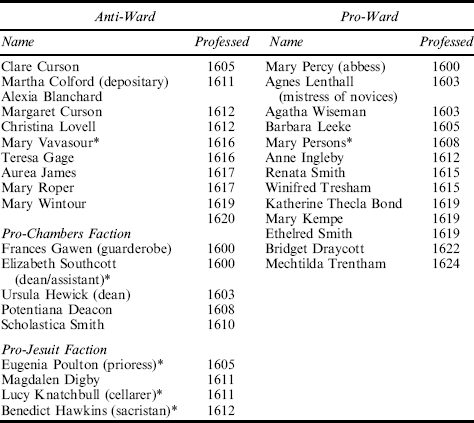
R. H.’s letter produced no change in the house’s government, but it did set the stage for a second, more serious, crisis over spiritual direction two years later. After the 1620 visitation, Hovius had granted the convent’s request to hold communion twice a week as long as they obtained a second ordinary confessor to assist Chambers. In 1622, this position was finally filled by Francis Ward, a 25-year-old secular priest ordained at the English College in Rome a year earlier.Footnote 45 Shortly thereafter, Percy’s apparent partiality for Ward over the house’s other confessors led to an unprecedented breach within the convent. Letters to Archbishop Boonen and documents from a 1623 visitation reveal that at least 32 out of the 45 choir nuns were actively involved in the controversy by offering either glowing commendations or scathing critiques of Ward, see Appendix. The thirteen nuns who defended Percy and Ward were generally newly professed, with the exception of Agnes Lenthall. By contrast, most of the nineteen nuns who objected to Ward had seniority and held monastic offices. In the letter that Percy wrote to Boonen in response to R. H.’s initial missive, she identified two distinct cliques, which were not necessarily in harmony with each other: a pro-Chambers group (Francis Gawen, Ursula Hewick, Elizabeth Southcott, Potentiana Deacon, and Scholastica Smith) and a pro-Jesuit party (Magdalen Digby, Lucy Knatchbull, Eugenia Poulton, and Benedict Hawkins).Footnote 46 These two factions largely coalesced around profession dates, as members of the pro-Chambers clique professed between 1600 and 1610, while the nuns in the pro-Jesuit circle largely professed in 1611 and 1612. Most members of the pro-Jesuit group were related to Jesuit priests, yet the house did not divide strictly according to the nuns’ preference for Ignatian spirituality. Mary Persons would seem to be a natural candidate for membership in the pro-Jesuit group as she was the niece of Robert Persons SJ. Yet Persons seems to have sided with the pro-Ward nuns, and she aided Percy by translating her English letters into French so that they could be sent to the archbishop.Footnote 47 The split between older and younger nuns provides a key to understanding the controversy, which grew out of earlier concerns over Percy’s leadership. As Ward became identified with Percy, he received criticism from more experienced nuns, who were also more likely to have established relationships with Chambers or Jesuit extraordinary confessors.
Soon after Ward’s arrival, Archbishop Boonen was inundated with complaints that Ward’s youth and inexperience made him unfit for his post. These concerns should not have come as a surprise as the nuns who had first nominated Ward for this post had mentioned his age as a potential drawback. Yet the convent had had such difficulty finding a second ordinary confessor that its members were initially willing to overlook Ward’s youth. In a letter nominating Ward as a possible confessor, Eugenia Poulton argued that Ward was unusually mature for his age: ‘though it be true that he is young in years, yet in pietie, judgment, and gravitie he seems not unequall to many much more antient’.Footnote 48 After Ward’s arrival, however, many of the nuns found themselves unable to confess to someone with such little experience. That October, Aurea James informed Boonen, ‘I cannot address myself to him, for he is very young and can scarcely have experience’.Footnote 49 Other allegations suggested that Ward undercut his own spiritual authority through immature behaviour. Christina Lovell accused Ward of leaping and running for exercise outside the convent’s windows, while Potentiana Deacon alleged on 5 April 1623 that Ward bit a silk ribbon off a nun’s bare arm.Footnote 50 The nuns also lodged complaints about Ward’s failure to celebrate Mass, an important part of his duties since Hovius had authorized a second ordinary confessor for the express purpose of assisting Chambers with the work involved in double communion. As Lovell reported, ‘Mr. Ward cannot do this for some weakness, of the sort that it is necessary for Father Chambers to chant nearly all [of them], or rather to have a priest for money’.Footnote 51 Besides unduly burdening Chambers, Ward’s incapacity incurred the additional expense of hiring outside priests. These criticisms do not attack Ward’s sanctity as a priest, but rather suggest that he was not a fit confessor for these particular individuals or the convent at large.
Even more problematically, Ward’s presence threatened to erode the spiritual authority of the convent’s established confessors.Footnote 52 Nominally Chambers’s assistant, Ward allegedly exercised an autonomous power in his interactions with penitents. Mary Roper complained that Ward had ‘the freedom to spend whole days with those of his charge and at every hour, be it silence, dinner, supper, or other observances’.Footnote 53 Elizabeth Southcott, meanwhile, notified the archbishop that some of the nuns were pretending to dislike Chambers because of inequities in access to double confession: ‘there are many now who make semblance of being very alienated from him [Chambers], and principally since Mr. Ward has been confessor among us, basing themselves principally (as they make semblance) in that Father Chambers is difficult in hearing confessions and permitting them to receive the holy sacrament often, which Mr. Ward allows easily’.Footnote 54 Unlike Chambers, Ward freely allowed his penitents to communicate twice a week, causing many nuns to believe that Percy hoped to oust Chambers by allowing Ward special liberties. Some members of the house feared that Percy and Ward would even terminate the convent’s long-established reliance on Jesuit extraordinary confessors. In August 1623, Potentiana Deacon explained to Boonen that Ward’s presence threatened the separate but complementary spiritual domains occupied by Chambers and the Jesuits:
most or all of us, have bene sent hether by the fathers of the Societye, and since the begining of the Monasterie have bene derected by them, for matter of meditation and the spirituall exercise, and difficulties if any have occurred, in our resolutions for Religion, which fa[ther] Cham[bers] did alwayes allow of ... he ever would the fathers should derect for meditation, and the method for young ones to practice it; which it seemes Mr. Ward would drawe to himselfe.Footnote 55
Yet if Percy and Ward were attempting to limit Jesuit influence, Ward did not show distaste for Ignatian spirituality. In fact, Ward took it upon himself to administer the Spiritual Exercises, thereby infringing on the Jesuits’ prerogatives. As early as November 1622, Alexia Blanchard was pleading with Boonen to prevent Ward from using traditionally Ignatian methods: ‘My lord, if it please you, also do not allow Mr. Ward to meddle so any longer, following his beginnings, in giving the Spiritual Exercises, as they are called, ordinary and proper to the Jesuit fathers solely; by which undertaking, he so extremely displeases the greatest part of the Convent’.Footnote 56 Ward may have been trying to supplant Jesuit priests, but his own education at Saint Omer and the English College had probably left him well-versed in Ignatian methods. It is therefore imperative to differentiate between attitudes to Jesuit priests and Ignatian spirituality at Brussels. Ward’s use of the Spiritual Exercises indicates no hostility to Ignatian piety on his part, but it did jeopardize the traditional role of Jesuit priests at the convent.
As with the 1620 clash over monastic governance, Ward’s opponents attempted to exert influence over the convent by exploiting the potential fissure between feminine vices and monastic ideals. In doing so, the nuns and their extraordinary confessors repurposed a staple of anti-Catholic polemics: the stories of lascivious priests, quite often Jesuits, who exploited their penitents’ total obedience.Footnote 57 R. H.’s letter of 7 March 1623 had hinted at this line of attack, noting that in England Ward’s arrival was ‘strangely understood, & sometimes grossly jested at, not only by heretics, but by Catholics also’.Footnote 58 R. H. concluded with an ominous warning: ‘it is said, divisions are daily augmented among the Religious, & that fouler inconveniences also are not unlikely to ensue in time’. Scandal broke out in earnest on 31 March, when John Daniel, a secular extraordinary confessor, wrote Boonen to report that Ward was attempting to seduce one of his penitents: Mary Philips, who had professed in 1616 at the age of 20. Daniel passed along information that Lucy Knatchbull had heard from Philips herself:
he [Ward] has become accustomed to call one particular nun pleasantly and familiarly by a shortened name, with these words, ‘Mall my dear, Mall my sweet, Mall my etc.’; and indeed recently twice while he was addressing her privately in this manner at the windows of the sacristy, having moved his hand toward the girl’s head, and having softly pinched the skin under her chin, he gradually drew her face all the way to the utmost edge of the window itself, and at the same time drew his [face] near, like one about to kiss: at which time likewise he had words with her concerning certain of his dreams, which he said were very foul and obscene.Footnote 59
Adjacent to both the church and the convent, the sacristy was a liminal space that allowed Ward to interact with the nuns who saw to the vestments and other essentials for Mass stored there. As the assistant sacristan, Philips would have had special reason to spend time in this room. In addition to abusing the hierarchical relationship between priest and penitent, Ward irreverently woos Philips through the sacristy window, where Holy Communion was administered during Mass. Philips, meanwhile, foolishly demonstrates complete obedience by passively enduring Ward’s erotic caresses and listening to his obscene conversation. On 16 May Knatchbull sent Boonen a similar account, warning that Ward’s kisses and familiar conversation impaired Philips’s ability to fulfil her monastic vocation:
Which familiarities of his ... worke as she confessed to me daingerus effects in her, and straingly tranceport her … for the generall her prayer is lost and the good impressions of her mind defaced, and the pore creature (who by reason of her imployment is to see him often) is so weake, that when she faleth into the ocasion she hath not the strenght to resist the evill it draws her into.Footnote 60
Easily distracted by romantic daydreams, Philips experiences two supposedly feminine tendencies, weakness and lust, that in turn undermine her spiritual progress by impeding her ‘prayer’ and moral development (‘good impressions of her mind’). Behaving more like a lover than a priest, Ward not only encourages Philips to indulge in stereotypical female vices but also raises the possibility of escaping from their religious vows: ‘taking her by the chine, or ellce wringinge her by the hand, he will say I protest I do love the[e] above all wimen of the world, and if I wear not a Priest and thou Religious, I would make the[e] see how much I love thee and I would marie thee’. Both Daniel and Knatchbull blame Ward for this breach of monastic conduct, presenting Philips as a naive girl victimized by a corrupt priest who exploits feminine weaknesses.
Ward’s opponents may have hoped for a visitation in which they could air their grievances, and Boonen obliged by personally conducting one on 22 and 23 May. During interviews with members of the house, further allegations of Ward’s misconduct with Philips surfaced. Like Daniel and Knatchbull, Mary Vavasour presented Philips as a docile victim of Ward’s romantic overtures:
he himself in the Sacristy with Mary charmingly complained of his offense, declaring his great love for her, seizing her hand and drawing her chin and moving his hands to [her] chest, and at the same time she [did to] his chest, around the beating of the heart. At last with this he pressed her with a long kiss, saying this will be a symbol of love between us that must not be shown to others.Footnote 61
Once again, Ward allegedly engages in physical contact, pressing Philips’s hand, touching her chin, and kissing her in token of their illicit ‘love’. As Philips deferently submits to his advances, Ward subverts monastic obedience into the basis for a profane love affair. In her own testimony, Philips admitted to having physical contact with Ward while also representing herself as having overcome such temptation through Ignatian piety:
She confesses that Mr. Ward has seized the hand and chin of the deponent now and then: yet she admits also that a kiss was sought from her on the part of Mr. Ward, who although he is present at the foresaid window nearly daily, nevertheless he scarcely wishes to converse unless the window is open. Yet she confesses that she once spoke to Mr. Ward of familiar conversation with another person: upon which he warned her seriously how many perils were in this. And however much (as the deponent confesses) he had pressed a kiss on her, he said that he would not do it anymore. Yet she admits that nevertheless he seized her hand a few times thereafter. Asked when he began to use that familiarity of seizing the hand of the deponent, she responded after three months: and after the deponent was in the Exercises, she avoided his familiarity more.... She fears that certain nuns, pressed not so much by necessity of conscience as by sensuality, come to him frequently.Footnote 62
Philips portrays Ward as a crafty predator who warns her against verbal familiarity with others, yet hypocritically seeks to view her through the open sacristy window and forces his kisses on her. She has nonetheless escaped his clutches through the Spiritual Exercises, which have opened her eyes to the dangers faced by other nuns who suffer from the feminine vice of ‘sensuality’. While Philips’s testimony is obviously self-exculpatory, she also represents Ignatian spirituality, and by extension the Jesuits, as a means of instilling proper monastic piety.
Despite this damning testimony the archbishop did not dismiss Ward, perhaps because his supporters aired concerns that undermined the credibility of his opponents. These nuns were particularly concerned about inappropriate behaviour at the grille in the parlour, where members of the convent could speak with outsiders at a remove.Footnote 63 Barbara Leeke, for example, claimed that ‘to[o] manine [many] frequent Conversations have ben had at the grates with secular[s] with ill edification, and inconveinces with in, as not well comming to the quier att tymes off howeres’.Footnote 64 Leeke’s complaint suggests not only that secular persons were having too much influence on the nuns frequenting the grate (‘ill edification’), but also that these conversations disrupted the nuns’ participation in their duty of attending the divine office. Mary Persons provided a similar report, noting that these conversations were often ‘with seculars and particularly with heretic gentlemen when they come from England with some ambassador’.Footnote 65 Alert to the danger that heretical discourse posed to religious orthodoxy within the convent, the archbishop or one of his staff underlined ‘heretic gentlemen’. Mary Kempe, meanwhile, had prepared a written statement praising Ward for his attacks on these frequent conversations at the grate:
I have observed that the grilles are too much frequented, and that there is too much conversation with seculars, although I confess that there has been some amendment since the arrival of Father Ward, who has used all diligence and has done as much as may be in him to reform it, but for this occasion he has lost the good will of some.Footnote 66
Under direct questioning at the visitation itself, Kempe revealed that these women included Eugenia Poulton, Lucy Knatchbull, Mary Roper, Magdalen Digby, Catharine Paston, Teresa Gage, and Christina Lovell. Ward was using his sermons to urge the house’s members to improve their conduct at the grate, and Lovell disgustedly reported that he had accused the nuns of being ‘lovers of grates and to love to be seen, and many other things of this nature’.Footnote 67 This summation of Ward’s sermon indicates that he presented frequenting of the grille as evidence of inappropriate attachment to the world as well as unchecked personal vanity. Ward’s supporters thus portrayed him as exercising his authority justly and effectively to enhance adherence to the Benedictine Rule as well as monastic order.
The rumours about Ward and Philips did not fade away after the visitation, and the scandal eventually led to Ward’s dismissal. In August 1623 Deacon reported that Agnes Lenthall, mistress of novices and part of the pro-Percy faction, was pressuring Margery Cotton, a postulant who ultimately left the house, to confess to Ward rather than Norton.Footnote 68 Deacon’s account may suggest that Percy was attempting to limit Norton’s access to the convent as an extraordinary confessor. Norton nevertheless remained actively involved in the house’s affairs, and on 21 October he informed Boonen that Ward and Philips were planning to consummate their relationship:
That excessive and too little religious familiarity which abides between Mr. Francis Ward and Mary Philips has progressed to the point that now they seem to consider the way and method by which they can meet and fulfil wicked and sacrilegious lust. It does not seem that the matter can be deferred because there will be danger in delay. Therefore may Your Most Illustrious and Reverend Lordship deem it worthy for the love of our Saviour Christ to come as soon as possible, and take care of the soul of this weak, jeopardized girl, who wretchedly faints, melts, and burns with his love, nor can she think anything of God, of religion, of herself, but her whole mind is occupied with him, and he meanwhile with his flatteries and amorous conversations kindles the fire of lust.Footnote 69
Like Daniel, Knatchbull, and Vavasour, Norton depicts Philips as an innocent victim of Ward’s machinations, a ‘weak ... girl’ who ‘burns with love’, unable to think of anything else, including ‘religion’. Norton’s use of Petrarchan language emphasizes Philips’s disassociation from her monastic identity as a bride of Christ. Unable to fulfil the chastity expected of nuns, Philips is on the brink of allowing her feminine weakness to undo her monastic vows. Norton skilfully exhorts Boonen to exercise his paternal duty to care for Philips’s ‘soul’, presenting himself—and implicitly the Jesuit order—as a responsible steward of the convent’s spiritual health. While allegations of seduction might have been enough to remove Ward and reassert Jesuit influence over the house, the pro-Jesuit group underscored the urgency of the situation by emphasizing the interconnection between early modern ideals of monastic and secular femininity.
Gender stereotypes thus provided a key means of asserting moral authority within the cloister, and in this case of effecting real change. Whatever the truth of the accusations about Ward, Boonen subsequently made a concerted effort to end further controversies by removing several key players from the convent. Chambers had already left the house, and Boonen now ordered Ward to depart as well. On 26 October, Norton reported to Boonen that Ward’s dismissal had caused ‘great … wailing and weeping’ among his supporters.Footnote 70 Although Norton’s letter indicated that Percy hoped to persuade Boonen to rescind this mandate, her efforts were clearly futile as the house lodged no further complaints about Ward. Meanwhile, Mary Philips remained at Brussels, but Boonen allowed two members of the pro-Chambers faction—Deacon and Gawen—to assist with the founding of a new Benedictine convent in Cambrai, where they unsuccessfully attempted to establish Ignatian piety.Footnote 71 With Norton’s assistance, members of the pro-Jesuit faction—Knatchbull, Digby, and Poulton—established a new convent in Ghent that quickly rivalled Brussels for its association with Ignatian spirituality. Norton himself became the superior of the Jesuit tertianship house at Ghent in 1624, doubtless continuing to assist his sister and her fledgling convent.
Conclusions
The Ward controversy served as a template for the convent’s later quarrel over the appointment of Anthony Champney as ordinary confessor in 1628. As a student at the English College in Rome, Champney had opposed Jesuit governance, and he was one of the Appellants who appealed to Rome against the Jesuit innovation of an Archpriest, even going so far as to sign the Protestation of Allegiance to Elizabeth in 1603. Champney also represented the pro-secular side of the dispute over Jesuit involvement at Douai College, and he replaced Norton as Vice-President there. At Brussels, Champney’s appointment as confessor created a rift between those who supported and opposed access to Jesuit extraordinary confessors. Once again, Percy’s foes received aid from their kin, in this case, secular priest Henry Vavasour, brother to Mary. The sacristy also played a key role in the discord, as Mary Philips—now sacristan—used her office to provide Henry Vavasour with the materials to hold an unauthorized Mass and later barred Percy and her supporters from entering the sacristy. In an attempt to garner support from the Sacred Congregation for the Propagation of the Faith, Percy accused Jesuit priests of sowing the seeds of the house’s discord:
from the beginning, the fathers of the Society of Jesus have claimed much for themselves in the governance of the whole monastery … But since their rule by no means allowed that they should have care of women, they have been forced to admit others who were ordinary confessors as far as in title, although they themselves nevertheless would not only have been happy indeed to undertake the greatest part of that care, but also they both expected and demanded it. And hence easily jealousy and displeasures were born between those men [Jesuits] and the ordinary confessor of the monastery….Footnote 72
By casting the blame solely on the Jesuits, Percy both eliminates her own culpability and frames the convent’s history in terms of larger conflicts among English Catholics. Such adroit manoeuvring helped Percy maintain her position as abbess until her death in 1642.
Yet the controversies that occurred between 1620 and 1623 reveal that the house’s disputes over spiritual direction were not as straightforward as they might otherwise seem. All of the key figures involved in these early clashes, including Percy and Ward, endorsed Ignatian spirituality, even if they disagreed about who had the right to administer the Spiritual Exercises. As for claims of Jesuit tyranny that are so symptomatic of conflicts over the English mission, Chambers and Percy only complained about Jesuit influence within the convent when it directly opposed their own authority. In the same letter of 19 May 1623 in which he complained about Percy’s refusal to confess to him, Chambers lamented the house’s reliance on Jesuit priests, stating that
in the direction of women, and especially of religious women, … I see how they accomplish little or nothing ... When I took this burden on myself, I hoped that their work would support me not indifferently, but on the contrary nothing except hope occurred, because daily greater difficulties arise for me through them and because of them than I was able to foresee.Footnote 73
Yet Chambers excluded Norton from blame, suggesting that he objected to Jesuit priests whose guidance undermined his position as ordinary confessor. Percy, meanwhile, also revealed a newfound aversion to Jesuit priests in 1623:
there are some others of us who do not wish at all to confess to the Jesuit fathers, and as for my part, I (who have depended on them) have no desire at all, as I have heard tell from the beginning of this cloister that they have taught policy and some fashion of dissimulation which is contrary to the candour of religion and brings many inconveniences.Footnote 74
Percy may seek to discredit the Jesuits by portraying them as instigators of ‘policy’ and ‘dissimulation’, but she nonetheless admits that she herself had once ‘depended on them’. While the Ward controversy eventually became part of the strife between secular and religious priests, its origins had little to do with Ignatian spirituality or Jesuit priests. Percy disliked Chambers, a pro-Jesuit himself, long before she became hostile to Jesuit priests. Meanwhile, anti-Ward sentiment was initially based on his part in the disputes between Percy and Chambers over monastic authority. Unlike other controversies between regular and secular priests, in this case Ward’s overreaching triggered a turf war within the convent as his use of Ignatian spirituality appropriated a Jesuit prerogative.
The female-oriented space of the convent also gave the Brussels conflicts a distinctly gendered inflection in comparison with the controversies over English Jesuits at Douai and Rome.Footnote 75 Since early modern ideals of secular femininity served as a basis for inculcating cloistered piety, gender became a convenient medium for addressing these disputes over governance and spirituality. As a religious institution that allowed female leadership, the convent offered women personal and collective agency that might clash with patriarchal ideals. R. H.’s first letter accordingly presented Percy as a shrewish tyrant whose rejection of male counsel endangered the entire convent. At the same time, women who were subjected to the advances of unscrupulous confessors—as in the case of Philips—might be tempted to indulge in lustful behaviour at odds with the monastic virtue of chastity. Thus nuns, priests, and even outsiders pursued their own spiritual agendas by suggesting that stereotypical feminine vices endangered the house’s progress toward monastic perfection. The Ward controversy in particular provides an intriguing parallel to anti-Catholic polemics of the era that sought to discredit monasteries as dens of lust. Thomas Robinson’s Anatomy of the English Nunnery at Lisbon (1622), for example, alleges that many of the English Brigittines had been deflowered by Jesuit priests, memorably conflating nuns with whores in an epigrammatic marginal note: ‘It is no great miracle for a whore to become a Nunne; nor for a Nunne to become a whore’.Footnote 76 Because the convent was such an innately feminine space, early modern ideas of gender also played an important role in constructing the spiritual authority of those who sought to intervene in the Brussels controversies. R. H., Daniel, and Norton presented themselves as paternal authorities who could recognize and cure the feminine vices that threatened the house’s spiritual health. Such masculine self-fashioning offers further evidence of the way that contemporary gender expectations could impinge upon the female space of the convent. Expressed more in terms of gender than of Ignatian spirituality, these initial controversies among the Brussels Benedictines reveal that early modern views of cloistered piety were not static but rather emerged from the confluence of broader cultural, political, and religious discourses.
Choir Nuns Involved in the Ward Controversy

* denotes Jesuit relative(s)
Profession and kinship information courtesy of Who Were the Nuns? database
Appendix