Introduction
A number of biological, evolutionary and psychological theories have built a link between early life experiences of humans and their reproductive scheduling. Early life and gestational health and nutritional situation are hypothesized as ‘programming’ the human body for a particular reproductive scheduling, most evidently detectable in earlier age at menarche among those having suffered from psycho-social stress or low birth weight and later rapid weight gain (Ibanez et al., Reference Ibanez, Ferrer, Marcos, Hierro and de Zegher2000; Adair, Reference Adair2001; Pesonen et al., Reference Pesonen, Räikkönen, Heinonen, Kajantie, Forsén and Eriksson2008; Karaolis-Danckert et al., Reference Karaolis-Danckert, Buyken, Sonntag and Kroke2009; Ong et al., Reference Ong, Emmett, Northstone, Golding, Rogers and Ness2009; Kuzawa & Bragg, Reference Kuzawa and Bragg2012). Childhood adversity or extrinsic mortality risk have also been found to be related in some contexts to early age at first birth or sexual risk behaviour (Burton, Reference Burton1990; Wilson & Daly, Reference Wilson and Daly1997; Chisholm et al., Reference Chisholm, Quinlivan, Petersen and Coall2005; Low et al., Reference Low, Hazel, Parker and Welch2008; Nettle, Reference Nettle2010; Nettle et al., Reference Nettle, Coall and Dickins2010, Reference Nettle, Coall and Dickins2011; Belsky, Reference Belsky2012). Pesonen et al. (Reference Pesonen, Räikkönen, Heinonen, Kajantie, Forsén and Eriksson2008) found an association between women's childhood adversity and their number of children in late adulthood, but not with their age at first birth.
The Predictive Adaptive Response (PAR) hypothesis was developed in biology and medical sciences to understand better how improving living conditions can affect adversely the health of those born in conditions of nutritional deprivation (Rickard & Lummaa, Reference Rickard and Lummaa2007). Prenatal and early life environment provides the individual with cues of the kind of environment into which the individual will mature, and this is also thought to affect reproductive scheduling (Nettle et al., Reference Nettle, Frankenhuis and Rickard2013). Evolutionary biology suggests that in adverse conditions or high morbidity and mortality, it would appear to be adaptive to reproduce early and in greater numbers, in order to enhance survival of offspring. In more secure conditions of lower mortality and morbidity, it would be more adaptive to postpone reproduction. Resources would thus be freed to invest more on the quality of a smaller number of offspring and on individual survival, growth and longevity (Gagnon et al., Reference Gagnon, Smith, Tremblay, Vézina, Paré and Desjardins2009).
The PAR hypothesis of reproduction (below expressed as the ‘acceleration theory’) complements the population transition theory in which declining child mortality is one of the major explanatory factors (Shenk, Reference Shenk2009). In high-opportunity and low-mortality populations, age at first reproduction is typically delayed as a response to higher costs and future payoffs of investing in offspring (Kuzawa & Bragg, Reference Kuzawa and Bragg2012). Socioeconomic development, and associated reductions in extrinsic child mortality, favour reduced fertility by increasing the relative returns to parental investment (Mace, Reference Mace2008; Lawson et al., Reference Lawson, Alvergne and Gibson2012). The PAR hypothesis seems to provide a missing link between demographic transition and human reproductive decision-making. Some studies have established a link between life expectancy and age at first birth at the neighbourhood level (Nettle, Reference Nettle2011); however, it is not known if this mechanism could help to explain variation in individual reproductive schedules within a population. At least low birth weight for gestational age has been found to relate to higher risk of intended and realized early childbirth in British data (Nettle et al., Reference Nettle, Coall and Dickins2010).
Fertility and reproduction are also undergoing rapid changes in India, which has been a laggard in demographic transition compared with many other Asian societies. The country has wide regional differences in fertility levels so that most of the southern and western states have reached net replacement-level fertility while some of the more populous northern states lag behind (Guilmoto & Rajan, Reference Guilmoto and Rajan2005; IIPS & Macro International, 2007). Urban total fertility rates have declined rapidly throughout the country. The major macro-level determinants of fertility decline have been decline in child mortality (Eini-Zinab, Reference Eini-Zinab2013) and improvement in women's education (Drèze & Murthi, Reference Drèze and Murthi2001; Murthi, Reference Murthi2002; Bhat, Reference Bhat2002; Imai, Reference Imai2008), other important factors being the level of son preference, economic development and female autonomy (Brookins, Reference Brookins2002) and a regional diffusion effect (Guilmoto, Reference Guilmoto, Guilmoto and Rajan2005; Shenk et al., Reference Shenk, Towner, Kress and Alam2013).
If reproductive acceleration theory based on general mortality risks and inter-generational inertia holds, early life adversity presumably is associated with women's fertility intentions and desired birth spacing, when controlled for other important determinants of fertility. In conditions of fast total fertility decline related to macro-level socioeconomic changes and declining child mortality, individuals tend to react to changing conditions by transforming reproductive intentions. If early life conditions have the kind of predictive adaptive role in reproduction as suggested by the acceleration theory, women having had nutritional and health constraints in their gestational period and early childhood would have to be slower than others to react to such environmental changes, irrespective of their current socioeconomic status or education.
This study asks, is there a relationship between individual fertility intentions and a woman's early life health condition? The interaction between childhood health stress and intended reproductive scheduling is analysed among urban Indian women. In the study the adult height of a woman is considered as a proxy for the level of childhood health and nutritional stress, and the willingness to have a child or another child, and/or to have it soon or later are considered as indicators of reproductive scheduling. The hypothesis tested here maintains that those urban women who have experienced nutritional or health hardship in their early developmental period prefer relatively higher number of children and/or relatively shorter birth intervals. This would be interpreted as support for the PAR hypothesis of reproductive acceleration. If such evidence is not available, the hypothesis is rejected.
Methods
Urban areas
The analysis is based on the National Family Health Survey-3 (NFHS-3) 2005–06 data, women's survey (IIPS & Macro International, 2007). The NFHS-3 carried out a targeted data collection in slums and non-slums of eight cities: Chennai, Delhi, Indore, Kolkata, Hyderabad, Meerut, Mumbai and Nagpur. Currently married women living in the eight cities and aged between 15 and 29 (N=4485) are analysed to assess associations between their fertility intentions and a childhood nutritional stress indicator. The data on slum and non-slum areas are analysed separately. A slum is defined in the NFHS-3 data as ‘a compact area of at least 300 population or about 60–70 households of poorly built congested tenements, in unhygienic environment usually with inadequate infrastructure and lacking in proper sanitary and drinking water facilities’ (Gupta et al., Reference Gupta, Arnold and Lhungdim2009, p. 10). In the NFHS-3 survey, slum status was determined according to the assessment of survey supervisors, based on the above-mentioned definition. All other urban areas are defined as ‘non-slums’, following the terminology used in the survey.
In the slums of the eight cities, the total fertility rate is 0.2 to 0.5 children higher than outside slums (Gupta et al., Reference Gupta, Arnold and Lhungdim2009). An individual socioeconomic status is not directly detectable from a person's slum or non-slum residence; non-slums are more heterogeneous in terms of socioeconomic status and education than slums (Gupta et al., Reference Gupta, Arnold and Lhungdim2009; Speizer et al., Reference Speizer, Nanada, Achyut, Pillai and Guilkey2012). Division into slums and non-slums is nevertheless meaningful as the health indicators in slums are clearly inferior to those in non-slums, reflecting poor hygiene and sanitation, lack of pure drinking water, lack of health services and congestion (Gupta et al., Reference Gupta, Arnold and Lhungdim2009). Irrespective of the socioeconomic condition of a family, this ecological environment has an effect on external mortality. Child mortality is higher in slums than in non-slums. The city-wise excess child mortality in slums compared with non-slums ranges between 16.2 and 32.4 points in the under-five mortality rate (Gupta et al., Reference Gupta, Arnold and Lhungdim2009).
Dependent variable
The inter-relationship between early childhood health condition and reproductive scheduling is complicated by the strong patriarchal character of reproductive decision-making in South Asian patrilineal and patrilocal societies. The intervening influence of the husband's and the in-laws' reproductive intentions are predominant, particularly when the timing of the first child is in question (Char et al., Reference Char, Saavala and Kulmala2010). Marriages are mostly arranged when a woman's parents consider it appropriate and conception is expected to take place soon after marriage, particularly in the lower socioeconomic groups (Säävälä, Reference Säävälä2001). Thus, particularly the less-educated young women have limited means of controlling the timing of their first birth. Consequently it is more justified to analyse married women's fertility intentions and wishes than fertility outcomes as the expression of the reproductive acceleration effect.
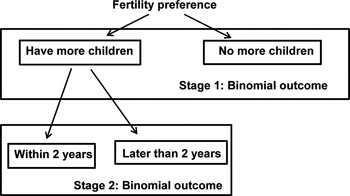
As the dependent/response variable, the respondent's intention to have a child or another child (below, the shorthand ‘a(nother) child’ is used) is analysed. As a second stage dependent variable among those who intended to have a(nother) child, the intention to have another child within the coming two years is used (see Fig. 1).
Two-staged multinomial logistic model of analysis.

The survey respondents were posed the question: ‘Would you like to have another child?’ Those who responded positively were asked, ‘How long would you like to wait from now before the birth of another child?’ Women who had been sterilized were left out of the analysis on the grounds that the choice of wishing for another child is ruled out due to a terminal family planning method. It is more meaningful to examine preference for a(nother) child in a current situation than the more abstract desired family size as a manifestation of fertility preferences (Roy et al., Reference Roy, Sinha, Koenig, Mohanty and Patel2008; Kodzi et al., Reference Kodzi, Johnson and Casterline2012); fertility is better studied as a process than as an outcome (Hobcraft, Reference Hobcraft2006).
The variable relating to the timing of the next birth (re-coded as either ‘soon’, meaning at any time shorter than 2 years from the time of the survey, or ‘later’, at least 2 years after the time of the survey; there were multiple choices in the questionnaire) is here interpreted as describing intentional differences in reproductive scheduling. Those who wish the birth of the next child ‘later’ manifest a slower reproductive regime. In NFHS-3 data, in the whole of India 39% of births occur within 24 months of the previous birth, median months since previous births being 31.1 (IIPS & Macro International, 2007).
Independent variables
The only information available in NFHS data that could indicate childhood nutritional stress is height (in centimetres, measured by trained survey personnel), which is used here as an index of childhood health status. Adult height is known to be to a large extent determined by gestational and early childhood conditions (Case & Paxson, Reference Case and Paxson2010; Wronka, Reference Wronka2013), particularly in developing countries where the influence of genetic factors for completed height is less important than in more affluent environments (Silventoinen, Reference Silventoinen2003). A number of studies have come to the conclusion that nutrition and infections primarily influence adult size by influencing growth attainment during fetal life and early infancy when nutritional resources are derived primarily from the mother's body, thus linking adult size in the present generation with matrilineal nutritional history (Kuzawa, Reference Kuzawa2005, Reference Kuzawa2007; Wells, Reference Wells2007; Kuzawa & Quinn, Reference Kuzawa and Quinn2009). Long-term effects of nutrition on adult size diminish after infancy and early childhood as insulin-dependent growth is gradually replaced by a growth-hormone-regulated growth regime (Karlberg, Reference Karlberg1989, ref. in Kuzawa & Bragg, Reference Kuzawa and Bragg2012). Consequently adult height is used here as an indicator of childhood nutritional and health stress.
Body mass index (BMI) is analysed in order to examine the relationship of current nutritional situation with fertility. Body mass index is sensitive to current changes in nutritional status. Current health status of women may have some influence on birth spacing (Kodzi et al., Reference Kodzi, Johnson and Casterline2012). Moreover, BMI is important to include in the analysis in order to rule out the potential confounding effect of socioeconomic status.
Apart from the health-related variables, socioeconomic and fertility variables are also included in the analysis. Standard of living index (SLI) is defined by combining two categories of the index in NFHS data so that low and middle categories are merged into one group and higher kept separate as the second.
The number of sons is used as an independent fertility variable in the analysis. The existence of sons turned out to have a stronger relationship with fertility intentions than the total number of children (figures not shown), reflecting widespread preference for sons in India. In India, the number of sons is found to be one of the major factors affecting the desire or intention to have more children and adoption of sterilization (Edmeades et al., Reference Edmeades, Pande, Falle and Krishnan2011). A binary variable indicating whether a woman had any sons (total number >0) or not (total number=0) is created.
Other background variables used are age and a woman's educational level (two classes: 1=no education or primary; 2=secondary or higher). Women's education, caste, religion, region and age have been shown to be important determinants of fertility behaviour at individual or household level in India (Drèze & Murthi, Reference Drèze and Murthi2001; Guilmoto, Reference Guilmoto, Guilmoto and Rajan2005). Caste category and religion do not appear to be important determinants in the present analyses and thus are not presented. Region is among the most salient determinants of fertility differentials (Guilmoto, Reference Guilmoto, Guilmoto and Rajan2005); consequently the study examines the eight cities from different parts of the subcontinent separately, and also slums and non-slums in each city separately.
Methods of analysis
The hypothesis is tested using the preference of women to have more children or not and whether to have more children within 2 years (of survey), using multinomial logistic regression models. The response to fertility preference could be naturally factored into a sequence of binary outcomes and these are then modelled using a sequence of ordinary logistic regressions (see Fig. 1). The stage 1 binary response (to have more children or not) is modelled using all subjects, and describes the log-odds of having more children versus no more. The stage 2 model, which is fitted to only those subject who wish to have more children, describes the log-odds of having a child within 2 years of the survey versus later. The logistic regression model can in general be written in terms of the log-odds as follows:
 $${\rm log} \left({p(y=1\,|\,x,b)\over p(y= 0\,|\,x, b)}\right) = b_0 + b_1x_1+ b_2x_2 + \cdots + b_px_p$$
, where y is a response variable, x=(x 1, x 2, …, xp ) is a vector of p independent variables, and b=(b 0, b 1, …, bp ) is a vector of regression coefficients. Here, x has six variables: current age, standard of living index (high is a reference category), woman's education (no or primary is a reference category), having sons (yes is a reference category), height and BMI. For the stage 1 model, y is intention to have a(nother) child (1=yes, 0=no), and for the stage 2 model, y is wishing another child within 2 years or not (yes=1, no=0).
All regression models include current age, standard of living index and education level as background variables, and an indicator variable denoting sons or no sons. In addition height and BMI are included. Statistical analyses are carried out using statistical computing environment R.
The sampling design used in the NFHS is complex and the recommendation is to use sampling weights in analysis. However, here the interest is in studying associations between the dependent and independent variables and not in the city-specific summaries of these variables, and hence the weights are ignored.
Results
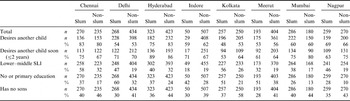
The main categorical variables are described by city in Table 1, separately for slums and non-slums. Unweighted proportions of different categories are given. The proportion of respondents who wish to have another child varies considerably, from 48% to 83%. The same variability is found also in the proportion of those wishing another child soon (53–89%). Differences in proportion by standard of living index and women's education are observed between cities. In Kolkata non-slums 58% of the respondents have no sons, while in Meerut slums only 28% do not have any sons. The variation in categorical variables reflects common regional demographic patterns: in northern cities (Meerut, Delhi, Indore), fertility is higher than in cities in other parts of the county. These differences justify analysing the survey data city-wise.
Unweighted proportions of categorical variables among 15- to 29-year-old currently married women in slums and non-slums of eight Indian cities by slum status

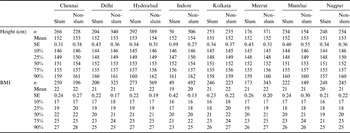
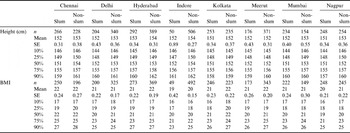
The summarized unweighted anthropometric measures of the respondents are described in Table 2. The distribution of height of the respondents does not differ vastly, although all-India regional-level differences in mean heights have been found to be prominent in the analysis of 2001–02 NFHS-2 data after controlling for socioeconomic differences (Vishwanathan & Sharma, Reference Vishwanathan and Sharma2009). The highest mean BMI (22 kg/m2) is found in the non-slums of Chennai, Hyderabad, Kolkata and Meerut, and the slums of Chennai. The lowest mean BMI (19 kg/m2) is found among respondents in the slums of Indore. The correlation coefficient between BMI and height in women using NFHS data, using national-level weights, was 0.04.
Unweighted mean, standard error and percentiles for height and BMI among 15- to 29-year-old currently married women in eight Indian cities by slum status
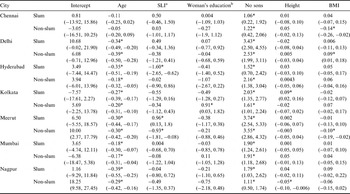
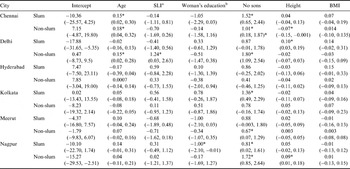
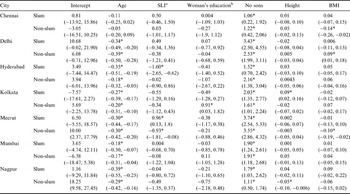
The log-odds of intending to have a(nother) child versus not with respect to age, SLI, woman's education, having no sons, childhood health indicator (height) and current nutritional status indicator (BMI), along with 90% confidence intervals, are given in Table 3. The hypothesis is tested using a 10% level of significance if not otherwise mentioned; higher level is acceptable since the consequences of being wrong in the null hypothesis are minor.
Regression coefficients and 90% confidence intervals of logistic regression stage 1 model, log-odds of intending to have a(nother) child versus not
a SLI, standard of living index, lower or medium.
b Woman's education, secondary or higher.
* Significant effect in 90% confidence level.
The age effect is negative and significant in all cities, except in Chennai, indicating that the log-odds of wishing to have more children versus no more decreases with age (Table 3). The log-odds increases when moving from higher to lower SLI in slums of Meerut, and decreases in the slums of Hyderabad and non-slums of Meerut, and in these cases the effects of SLI are significant. The effect of a woman's education is significant only in the non-slums of Kolkata. The log-odds increases 1- to 4-fold when moving from sons to no sons. The effect of height is not consistent across the cities. Body mass index is significant in three contexts: in the non-slum of Chennai and Meerut (negative effect) and in the non-slum of Delhi (positive effect). Age and number of sons remained significant even at the 5% level of significance, while three other effects became non-significant at the 5% level.
The effect of height is statistically significantly detectable in two contexts: in Kolkata slums (positive effect) and in the non-slums of Nagpur (negative effect; Table 3). This means that in Kolkata slums taller women are more likely to desire another child, while in the non-slums of Nagpur shorter women are more likely to desire another child.
The stage 2 logistic regression model tells in more detail whether anthropometric features (height and BMI) are related to woman's fertility intentions. For the second stage logistic regression analysis, it was only possible to analyse data from six of the eight cities because of the distribution of categorical variables with respect to wishing another child soon. The effects of age and having no sons on the log-odds of wishing another child soon (within 2 years) against later are not consistent or prominent across the cities (Table 4). As in the case of the stage 1 model, again the effects of height and BMI are not consistent between cities. Body mass index is not significant in any of the areas. Height has a positive significant effect in the slums of Delhi and non-slums of Nagpur (both significant at 95% confidence level), and a negative significant effect in Chennai non-slums.
Regression coefficients and 90% confidence intervals of logistic regression stage 2 model, log-odds of wishing a(nother) child soon versus later

a SLI, standard of living index, low or medium.
b Woman's education, secondary or higher.
* Significant effect in 90% confidence level.
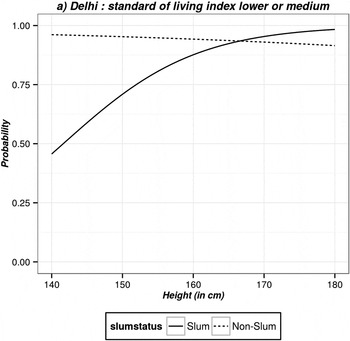
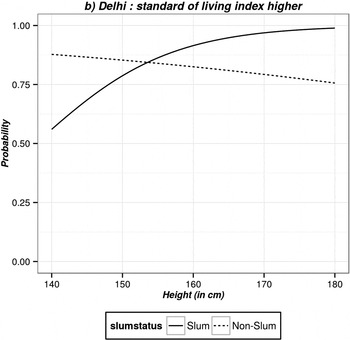
The results of the stage 2 logistic regression model in terms of predictive probabilities of wishing another child soon in Delhi are described graphically in Fig. 2. This figure depicts the probabilities of wishing for a narrow birth spacing for women with varying heights and a fixed age of 22 years, BMI 20 kg/m2, having no or primary education, no sons and of lower or medium SLI and of higher SLI. The probability curves for women in slums and in non-slums differ in Delhi. In slums, the predictive probability for desiring a narrow birth spacing increases along with height. This relationship is the same irrespective of a slum woman's SLI. In non-slum areas, the relationship between height and desired birth spacing is less evident but the trend is opposite to that in slums. Figure 2 shows that non-slum women of higher material well-being tend to prefer longer birth intervals than worse-off women in non-slums, and the opposite is true in slums.
Predictive probabilities for varying heights of currently married women wishing a(nother) child soon in Delhi. Fixed values of other covariates: age=22 years, BMI=20 kg/m2, women's education=no or primary, having no sons; and a) standard of living index fixed to low and medium, b) standard of living index fixed to higher.

Continued

The pattern of women's desired birth spacing in relation to their height in slums and in non-slums is similar also in Chennai (not shown). In other cities examined, the relationship between height and desired birth spacing is less conclusive. Only the case of Chennai non-slums statistically significantly supports the acceleration theory (taller women prefer longer birth spacing) (see Table 4). In two cases (Nagpur non-slums and Delhi slums) the effect of height is significantly positive, supporting the opposite of accelerated reproductive scheduling.
Discussion
The study's analyses have looked for an association between early childhood health and nutrition indicators and intended reproductive scheduling in urban India. Based on logistic regression analysis, the association between short height and predictive probability of wishing another child and/or wishing it soon is detectable in some cities and in some socioecological contexts. A statistically significant reproductive acceleration effect is detected in only one context in desire for a(nother) child and in one context in desired birth spacing. The hypothesis that low height would relate to accelerated reproductive intentions holds only in two of the 26 contextual frames examined in stages 1 and 2 of the multinomial logistic model. In three contexts – in the slums of Delhi and Kolkata and in non-slums of Nagpur – the evidence is the opposite of what the hypothesis maintains: it is the taller women who have higher log-odds for wishing a(nother) child and/or wishing it soon. The results thus give only scant support for the PAR hypothesis and would suggest rejecting the acceleration hypothesis.
The evidence contrary to the acceleration hypothesis in Delhi and Kolkata slums raises the question whether absolute poverty and ill health can lead the shortest women to limit or postpone births. Gurmu & Mace (Reference Gurmu and Mace2008) found a clearly positive relationship between family wealth and fertility in Addis Ababa, Ethiopia, and the hypothesis of poverty-induced fertility decline in Tamil Nadu, India has been debated (Kishor, Reference Kishor, Egerö and Hammarskjöld1994; Krishnamoorty et al., Reference Krishnamoorty, Kulkarni, Audinarayana, Guilmoto and Rajan2005). Nevertheless, in the case of the Indian cities examined here, no link was found between poverty and postponement of births within the populations. In the logistic regression analysis, household standard of living index was significantly associated with desired birth spacing only in one city.
Moreover, low BMI, which is a crude proxy for economic hardship of an Indian woman, did not have a significant relationship with desired birth spacing anywhere. The most relevant factor determining the desire for another child and/or to have it soon was the prior existence of sons in the family. However, here no attempt was made to universally explain the factors responsible for variation in desired fertility in Indian cities; the focus has been only on examining whether a childhood health stress indicator – adult height – has any relationship to fertility intentions.
The conclusion would be to acknowledge the need to condition the acceleration hypothesis better to the socioeconomic and ecological context of reproductive intentions and outcomes. There seems to be an interplay between a woman's personal health history and the surrounding environment. Parental investments required for successful biological and social reproduction are not uniform in slum areas and in more secure socioecological urban environments (Mace, Reference Mace2008; Gurmu & Mace, Reference Gurmu and Mace2008) and this may be reflected in how a woman's early life living conditions influence her reproductive aspirations. The differing results between slums in different cities reflect most probably regional effects and particular contextual features in urban social and economic conditions that the survey might not have captured.
One potential confounding factor behind the inter-relationship between a woman's adult height and her fertility desires could relate to migration patterns and kin support. In India, rural poverty has traditionally been more prevalent than urban poverty (UNDP, 2009) and consequently rural-born women could potentially be shorter. If the slum-dwelling women in Delhi who are migrants from rural areas tend to be relatively shorter, they could possibly lack kin support needed for narrower birth spacing (cf. Gurmu & Mace, Reference Gurmu and Mace2008). Unfortunately the data available do not allow adding this variable in the analysis. Unearthing such effects would require both qualitative and quantitative study.
This article has added empirically to the theoretical critiques of the PAR hypothesis that have been presented from the perspective of evolutionary biology (Rickard & Lummaa, Reference Rickard and Lummaa2007) and by using mathematical models (Nettle et al., Reference Nettle, Frankenhuis and Rickard2013). Although the PAR hypothesis is supported by a wealth of evidence from a number of non-human organisms, its relevance for humans has been questioned due to the long rearing period in humans that precedes reproduction (Wells, Reference Wells2007; Rickard & Lummaa, Reference Rickard and Lummaa2007; Nettle et al., Reference Nettle, Frankenhuis and Rickard2013). The reproductive life span of humans begins approximately at the age of 15 years and can last for decades. Both the long delay between prenatal and early life and the first reproduction and the length of the reproductive life span itself decrease the likelihood that the fetal or early childhood environmental conditions experienced will match those experienced during reproductive life. The probability of mismatches is increased and thus the potential adaptive value of the thrifty ‘survival phenotype’ or fast life history in this life stage is lowered (Rickard & Lummaa, Reference Rickard and Lummaa2007). Kuzawa & Quinn (Reference Kuzawa and Quinn2009) argued that selection would always favour deferring phenotypic specialization until as close to adulthood as possible, since this would lead to ‘dramatically better fit to the adult environment’ (Nettle et al., Reference Nettle, Frankenhuis and Rickard2013, p. 11).
Comparative anthropological studies (Walker et al., Reference Walker, Gurven, Hill, Migliano, Chagnon and De Souza2006; Kuzawa & Bragg, Reference Kuzawa and Bragg2012) have pointed out that the relationship between mortality and human ontogeny and reproductive pattern reflects a number of limiting conditions; mortality risks in the juvenile and adult periods and also the type of mortality risks (infectious and parasitic diseases vs starvation) have differing relationships with ontogeny and reproductive scheduling. In societies where starvation is the major threat to survival, it is biologically more meaningful to adapt to slow growth and reproductive schedule, which has also been the prevalent pattern in human evolutionary history, differentiating humans from other primates (Walker et al., Reference Walker, Gurven, Hill, Migliano, Chagnon and De Souza2006; Kuzawa & Bragg, Reference Kuzawa and Bragg2012). Large juvenile size and accelerated reproduction seem to be more advantageous where major mortality risks are related to infections and parasites (Walker et al., Reference Walker, Gurven, Hill, Migliano, Chagnon and De Souza2006).
In the light of the anthropological analysis provided by Walker et al. (Reference Walker, Gurven, Hill, Migliano, Chagnon and De Souza2006), the Delhi slum situation of taller women being more likely to want to accelerate their reproductive tempo could make sense. If shorter women have been born and raised in an endemic condition of food deprivation of their households, starvation may have been the primary factor jeopardizing survival in early life and gestational period. Taller slum women may have enjoyed better nutritional and health conditions in childhood, with the infections, parasites and sudden deaths prevalent in slum environments overriding starvation as the primary extrinsic health and survival risks. In the light of the data analysis presented above, early life physical adversity does not straightforwardly lead to desire to accelerate reproductive scheduling in urban Indian contexts.
Acknowledgments
The authors wish to thank an anonymous reviewer, Bijoy Joseph, Lassi Lainiala, Anneli Miettinen and Anna Rotkirch for their help and comments on an earlier draft of the paper. This study is part of the project ‘Precarious family formation’ financed by the Kone foundation.